O n L e a r n i n g m o r e A p p r o p r i a t e
S e l e c t i o n a l R e s t r i c t i o n s
F r a n c e s c Ribas*
Departament de Llenguatges i Sistemes Informktics
Universitat Polit~cnica de Catalunya
Pau Gargallo, 5
08028 Barcelona
Spain
r i b a s © i s i , upc. es
Abstract
We present some variations affecting the association measure and thresholding on a technique for learning Selectional Re- strictions f r o m on-line corpora. It uses a wide-coverage noun t a x o n o m y and a statistical measure to generalize the ap- propriate semantic classes. Evaluation measures for the Selectional Restrictions learning task are discussed. Finally, an experimental evaluation of these varia- tions is reported.
S u b j e c t A r e a s : corpus-based language modeling, c o m p u t a t i o n a l lexicography
1 Introduction
In recent years there has been a c o m m o n agree- m e n t in the N L P research c o m m u n i t y on the im- portance of having an extensive coverage of selec- tional restrictions (SRs) tuned to the domain to work with. SRs can be seen as semantic type con- straints t h a t a word sense imposes on the words with which it combines in the process of seman- tic interpretation. SRs m a y have different ap- plications in NLP, specifically, they m a y help a parser with Word Sense Selection (WSS, as in (Hirst, 1987)), with preferring certain structures out of several g r a m m a t i c a l ones ( W h i t t e m o r e et al., 1990) and finally with deciding the semantic role played by a syntactic c o m p l e m e n t (Basili et al., 1992). Lexicography is also interested in the acquisition of SRs (both defining in context ap- proach and lexical semantics work (Levin, 1992)). T h e aim of our work is to explore the feasibil- ity of using an statistical m e t h o d for extracting SRs from on-line corpora. Resnik (1992) devel- oped a m e t h o d for a u t o m a t i c a l l y extracting class- based SRs from on-line corpora. Ribas (1994a)
*This research has been made in the framework of the Acquilex-II Esprit Project (7315), and has been supported by a grant of Departament d'Ensenyament,
performed some e x p e r i m e n t s using this basic tech- nique and drew up some limitations f r o m the cor- responding results.
In this p a p e r we will describe some substantial modifications to the basic technique and will re- p o r t the corresponding e x p e r i m e n t a l evaluation. T h e outline of the p a p e r is as follows: in section 2 we s u m m a r i z e the basic m e t h o d o l o g y used in (Ribas, 1994a), analyzing its limitations; in sec- tion 3 we explore some alternative statistical m e a - sures for ranking the hypothesized SRs; in sec- tion 4 we propose some evaluation measures on the SRs-learning problem, and use t h e m to test the experimental results o b t a i n e d by the different techniques; finally, in section 5 we draw up the final conclusions and establish future lines of re- search.
2
The basic technique for learning
SRs
2.1 D e s c r i p t i o n
T h e technique functionality can be s u m m a r i z e d
a s :
I n p u t T h e training set, i.e. a list of c o m p l e m e n t co-occurrence triples,
(verb-
lemma, syntactic-relationship, noun-lemma)
extracted from the corpus.
P r e v i o u s k n o w l e d g e u s e d A semantic hierar- chy (WordNet 1) where words are clustered in semantic classes, and semantic classes are or- ganized hierarchically. Polysemous words are represented as instances of different classes.
O u t p u t A set of syntac-
tic SRs,
(verb-lemma, syntactic-relationship,
semantic-class, weight).
T h e final SRs m u s t be m u t u a l l y disjoint. SRs are weighted ac- cording to the statistical evidence found in the corpus.L e a r n i n g p r o c e s s 3 stages:
1. Creation of the space of candidate classes.
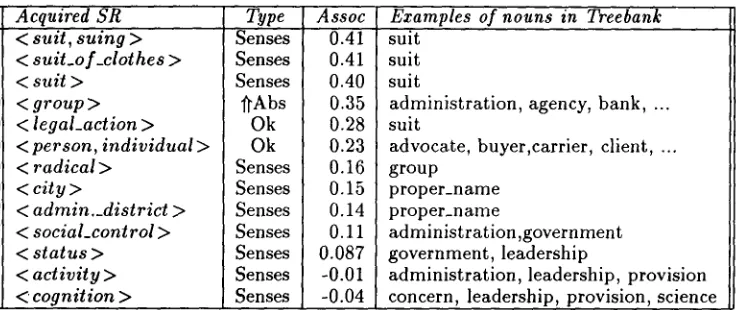
Acquired SR Type Assoc < suit, suing > Senses 0.41 < suit_of_clothes > Senses 0.41
< suit > Senses 0.40
< group > l~Abs 0.35
< legal_action > Ok 0.28
<person, individual> Ok 0.23
< radical> Senses 0.16
< c i t y > Senses 0.15
< admin._district > Senses 0.14 < social_cont rol > Senses 0.11
< status > Senses 0.087
< activity > Senses -0.01
< cognition > Senses -0.04
Examples of nouns in Treebank suit
suit suit
administration, agency, bank, ... suit
advocate, buyer,carrier, client, ... group
proper_name proper_name
administration ,government government, leadership
administration, leadership, provision concern, leadership, provision, science
Table 1: SRs acquired for the subject of seek
2. Evaluation of the appropriateness of the candidates by means of a statistical mea- sure.
3. Selection of the most a p p r o p r i a t e subset in the candidate space to convey the SRs. T h e appropriateness of a class for expressing SRs (stage 2) is quantified from tile strength of co-occurrence of verbs and classes of nouns in the. corpus (Resnik, 1992). Given the verb v, the syntactic-relationship s and the candidate class c, the Association Score, Assoc, between v and c in s is defined:
A s s o c ( v , s , c ) = p(clv, s)I(v;cls )
= p(clv, s)log
p( lv, s._____))
p(cls) T h e two terms of Assoc try to capture different properties:1. Mutual information ratio, l(v; cls), measures the strength of the statistical association be- tween the given verb v and the candidate class c in the given syntactic position s. It compares the prior distribution, p(cls), with the posterior distribution, p(clv, s).
2. p(elv, s) scales up the strength of the associ- ation by the frequency of the relationship.
Probabilities are estimated by M a x i m u m Likeli- hood E s t i m a t i o n (MLE), i.e. counting the relative frequency of the considered events in the corpuQ. However, it is not obvious how to calculate class frequencies when the training corpus is not seman- tically tagged as is the case. Nevertheless, we take a simplistic approach and calculate t h e m in the following manner:
f r e q ( v , s , c ) = ~ f r e q ( v , s , n ) × w (1)
r t E c
2The utility of introducing smoothing techniques on class-based distributions is dubious, see (Resnik,
1993).
Where w is a constant factor used to normalize the probabilities 3
W . ~
~ v E V ~ s q S ~ n q A f f r e q ( v, S,
n)lsenses(n)l
(2)
When creating the space of candidate classes (learning process, stage 1), we use a threshold. ing technique to ignore as much as possible the noise introduced in the training set. Specifically, we consider only those classes t h a t have a higher n u m b e r of occurrences than the threshold. T h e selection of the most a p p r o p r i a t e classes (stage 3) is based on a global search through the candidates, in such a way t h a t the final classes are m u t u a l l y disjoint (not related by h y p e r o n y m y ) .2.2 E v a l u a t i o n
Ribas (1994a) reported e x p e r i m e n t a l results ob- tained from the application of the above technique to learn SRs. He performed an evaluation of the SRs obtained from a training set of 870,000 words of the Wall Street Journal. In this section we sum- marize the results and conclusions reached in t h a t paper.
For instance, table 1 shows the SRs acquired for the subject position of the verb seek. Type indi- cates a manual diagnosis a b o u t the class appropri- ateness (Ok: correct; ~Abs: over-generalization; Senses: due to erroneous senses). Assoc cor- responds to the association score (higher values a p p e a r first). Most of the induced classes are due to incorrect senses. Thus, although suit was used in the W S J articles only in the sense of < legal_action >, the algorithm not only consid- ered the other senses as well ( < suit, suing > , <
[image:2.596.55.423.73.228.2]suit_of_clothes
>, <sugt
> ) , but theAssoc
score ranked t h e m higher t h a n the a p p r o p r i a t e sense. We can also notice t h a t the l~Abs class, <group
>, seems too general for the e x a m p l e nouns, while one of its daughters, <people
> seems to fit the d a t a much better.Analyzing the results obtained from different experimental evaluation methods, Ribas (1994a) drew up some conclusions:
a. T h e technique achieves a good coverage.
b. Most of the classes acquired result from the accumulation of incorrect senses.
c. No clear co-relation between
Assoc
and the m a n u a l diagnosis is found.d. A slight tendency to over-generalization exists due to incorrect senses.
Although the performance of the presented technique seems to be quite good, we think t h a t some of the detected flaws could possibly be ad- dressed. Noise due to polysemy of the nouns in- volved seems to be the main obstacle for the prac- ticality of the technique. It makes the association score prefer incorrect classes and j u m p on over- generalizations. In this paper we are interested in exploring various ways to make the technique more robust to noise, namely, (a) to experiment with variations of the association score, (b) to ex- periment with thresholding.
3 V a r i a t i o n s o n t h e a s s o c i a t i o n s t a t i s t i c a l m e a s u r e
In this section we consider different variations on the association score in order to m a k e it more ro- bust. T h e different techniques are experimentally evaluated in section 4.2.
3.1 V a r i a t i o n s o n t h e p r i o r p r o b a b i l i t y When considering the prior probability, the more independent of the context it is the better to mea- sure actual associations. A sensible modification of the measure would be to consider
p(c) as
the prior distribution:Assoc'(v,s,c) = p(c,v,s) logP(;'(;; s)
Using the chain rule on m u t u a l information (Cover and T h o m a s , 1991, p. 22) we can mathe- matically relate the different versions of
Assoc,
mssoc'(v, s, c) = p(clv, s)log ~ + A s s o c ( v , s, c)
T h e first a d v a n t a g e of
Assoc'
would come from this (information theoretical) relationship. Specif- ically, theAssoF
takes into account the prefer- ence (selection) of syntactic positions for partic- ular classes. In intuitive terms, typical subjects (e.g. <person, individual, ...>) would be preferred(to atypical subjects as <suit_of_clothes>) as SRs on the subject in contrast to
Assoc.
T h e second advantage is t h a t as long as the prior probabili- ties, p(c), involve simpler events t h a n those used inAssoc, p(cls),
the e s t i m a t i o n is easier and m o r e accurate (ameliorating d a t a sparseness).A subsequent modification would be to e s t i m a t e the prior,
p(c),
from the counts of all the nouns ap- pearing in the corpus independently of their syn- tactic positions (not restricted to be heads of ver- bal complements). In this way, the estimation ofp(c)
would be easier and more accurate.3.2 E s t i m a t i n g c l a s s p r o b a b i l i t i e s f r o m n o u n f r e q u e n c i e s
In the global weighting technique presented in equation 2 very polysemous nouns provide the same a m o u n t of evidence to every sense as non- ambiguous nouns do -while less a m b i g u o u s nouns could be more informative a b o u t the correct classes as long as they do not carry ambiguity.
T h e weight introduced in (1) could alternatively be found in a local m a n n e r , in such a way t h a t more polysemous nouns would give less evidence to each one of their senses t h a n less ambiguous ones. Local weight could be obtained using
p(cJn).
Nevertheless, a good estimation of this probabil- ity seems quite problematic because of the lack of tagged training material. In absence of a better e s t i m a t o r we use a rather poor one as the uniform distribution,
c) = (cln) = e el
Is ,,ses(,,)l
Resnik (1993) also uses a local normalization technique but he normalizes by the total n u m b e r of classes in the hierarchy. This scheme seems to present two problematic features (see (Ribas, 1994b) for more details). First, it d o e s n ' t take dependency relationships introduced by hyper- o n y m y into account. Second, nouns categorized in lower levels in the t a x o n o m y provide less weight to each class t h a n higher nouns.
3.3 O t h e r s t a t i s t i c a l m e a s u r e s t o s c o r e S R s
In this section we propose the application of other measures a p a r t from
Assoc
for learning SRs: log- likelihood ratio (Dunning, 1993), relative entropy (Cover and T h o m a s , 1991), m u t u a l information ratio (Church and Hanks, 1990), ¢2 (Gale and Church, 1991). In section (4) their experimental evaluation is presented.e
v_s
p(clv-s)
~v_s
p( cl-.v_s )
p(c)
"~C
p(-~clv~)
p(-,cl-,v-s)
p(-~c)
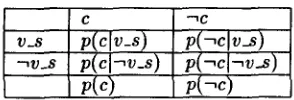
Table 2: Conditional and marginal distributions
of P ( X I Y ) , association measures should be low (near zero), otherwise deviating significantly from
z e r o .
Table 2 shows the cross-table formed by the con- ditional and marginal distributions in the case of X = {e, ~e} and Y = {v_s,-,v_s}. Different asso- ciation measures use the information provided in the cross-table to different extents. Thus, Assoc and mutual information ratio consider only the deviation of the conditional probability p(c[v,s) from the corresponding marginal, p(c).
On the other hand, log-likelihood ratio and ¢2 measure the association between v_s and c con- sidering the deviation of the four conditional cells in table 2 from the corresponding marginals. It is plausible that the deviation of the cells not taken into account by Assoc can help on extracting use- ful Sits.
Finally, it would be interesting to only use the information related to the selectional behavior of v_s, i.e. comparing the conditional probabilities of c and -~c given v_s with the corresponding marginals. Relative entropy, D ( P ( X I v _ s ) I I P ( X ) ) , could do this job.
4
E v a l u a t i o n
4.1 E v a l u a t i o n m e t h o d s o f S R s
Evaluation on NLP has been crucial to fostering research in particular areas. Evaluation of the SR learning task would provide grounds to compare different techniques that try to abstract SRs from corpus using WordNet (e.g, section 4.2). It would also permit measuring the utility of the SRs ob- tained using WordNet in comparison with other frameworks using other kinds of knowledge. Fi- nally it would be a powerful tool for detecting flaws of a particular technique (e.g, (Ribas, 1994a) analysis).
However, a related and crucial issue is which linguistic tasks are used as a reference. SRs are useful for both lexicography and NLP. On the one hand, from the point of view of lexicography, the goal of evaluation would be to measure the quality of the SRs induced, (i.e., how well the resulting classes correspond to the nouns as they were used in the corpus). On the other hand, from the point of view of NLP, StLs should be evaluated on their utility (i.e., how much they help on performing the reference task).
4.1.1 L e x i c o g r a p h y - o r i e n t e d e v a l u a t i o n As far as lexicography (quality) is concerned, w e think the main criteria SRs acquired from c o r - p o r a should meet are: (a) correct categorization -inferred classes should correspond to the correct senses of the words that are being generalized-, (b) appropriate generalization level and (c) good coverage - t h e majority of the noun occurrences in the corpus should be successfully generalized by the induced SRs.
Some of the methods we could use for assessing experimentally the accomplishment of these crite- ria would be:
• I n t r o s p e c t i o n A lexicographer checks if the SRs accomplish the criteria (a) and (b) above (e.g., the manual diagnosis in table 1). Be- sides the intrinsic difficulties of this approach, it does not seem appropriate when comparing across different techniques for learning SRs, because of its qualitative flavor.
• Q u a n t i f i c a t i o n o f g e n e r a l i z a t i o n l e v e l a p p r o p r i a t e n e s s A possible measure would be the percentage of sense occurrences in- cluded in the induced SRs which are effec- tively correct (from now on called Abstraction Ratio). Hopefully, a technique with a higher abstraction ratio learns classes that fit the set of examples better. A manual assessment of the ratio confirmed this behavior, as testing sets With a lower ratio seemed to be inducing less ~Abs cases.
• Q u a n t i f i c a t i o n o f c o v e r a g e It could be measured as the proportion of triples whose correct sense belongs to one of the SRs.
4.1.2 N L P e v a l u a t i o n t a s k s
[image:4.596.87.234.92.142.2]Technique
Assoc & All nouns
Assoc & P(cls) A s s o c & Head-nouns D
log - likelihood A s s o c & Normalizing
¢2
1
Coverage (%) 95.7 95.5 95.3 93.7 92.9 92.7 88.2 74.1
Table 3: Coverage Ratio
4.2 E x p e r i m e n t a l r e s u l t s
In order to evaluate the different variants on the association score and the impact of thresholding we performed several experiments. In this section we analyze the results. As training set we used the 870,000 words of WSJ material provided in the A C L / D C I version of the Penn Treebank. The testing set consisted of 2,658 triples corresponding to four average c o m m o n verbs in the Treebank:
rise, report, seek and present. We only considered those triples that had been correctly extracted from the Treebank and whose noun had the cor- rect sense included in WordNet (2,165 triples out of the 2,658, from now on, called the testing- sample).
As evaluation measures we used coverage, ab- straction ratio, and recall and precision ratios on the WSS task (section 4.1). In addition we per- formed some evaluation by hand comparing the SRs acquired by the different techniques.
4.2.1 C o m p a r i n g d i f f e r e n t t e c h n i q u e s Coverage for the different techniques is shown in table 3. T h e higher the coverage, the better the technique succeeds in correctly generalizing more of the input examples. The labels used for re- ferring to the different techniques are as follows:
"Assoc & p(cls)" corresponds to the basic associ- ation measure (section 2), "Assoc & Head-nouns" and "Assoc & All nouns" to the techniques intro- duced in section 3.1, "Assoe & Normalizing" to the local normalization (section 3.2), and finally,
log-likelihood, D (relative entropy) and I (mutual information ratio) to the techniques discussed in section 3.3.
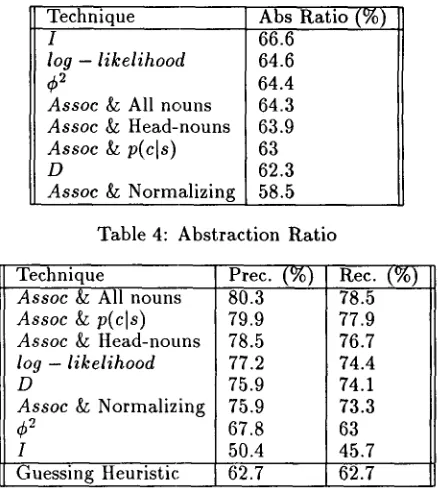
T h e abstraction ratio for the different tech- niques is shown in table 4. In principle, the higher abstraction ratio, the better the technique suc- ceeds in filtering out incorrect senses (less t A b s ) . T h e precision and recall ratios on the noun WSS task for the different techniques are shown in ta- ble 5. In principle, the higher the precision and recall ratios the better the technique succeeds in inducing appropriate SRs for the disambiguation task.
As far as the evaluation measures try to account for different phenomena the goodness of a partic- ular technique should be quantified as a trade-off.
Technique I
log - likelihood
¢2
Assoc & All nouns
Assoc & Head-nouns
Assoc & p(cls) D
Assoc & Normalizing
Abs Ratio (%) 66.6 64.6 64.4 64.3 63.9 63 62.3 58.5
Table 4: Abstraction Ratio
Technique
Assoc & All nouns
Assoc & p(cls) Assoc & Head-nouns
log - likelihood D
Assoc & Normalizing
I
Guessing Heuristic
Prec. (%) 80.3 79.9 78.5 77.2 75.9 75.9 67.8 50.4 62.7
Rec. (%)
78.5 77.9 76.7 74.4 74.1 73.3 63 45.7 62.7
Table 5: Precision and Recall on the WSS task
Most of the results are very similar (differences are not statistically significative). Therefore we should be cautious when extrapolating the results. Some of the conclusions from the tables above are:
1. 4) 2 and I get sensibly worse results than other measures (although abstraction is quite good).
2. The local normalizing technique using the uniform distribution does not help. It seems that by using the local weighting we mis- inform the algorithm. T h e problem is the reduced weight, t h a t polysemous nouns get, while they seem to be the most informative 4. However, a better informed kind of local weight (section 5) should improve the tech- nique significantly.
3. All versions of Assoc (except the local nor- malization) get good results. Specially the two techniques t h a t exploit a simpler prior distribution, which seem to improve the ba- sic technique.
4. log-likelihood and D seem to get slightly worse results than Assoc techniques, although the results are very similar.
4.2.2 T h r e s h o l d l n g
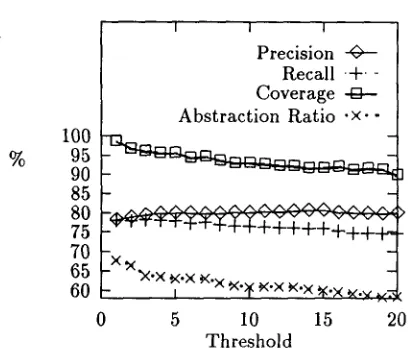
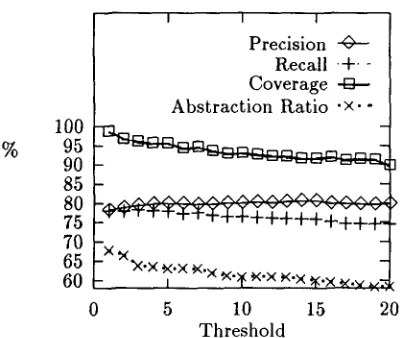
We were also interested in measuring the impact of thresholding on the SRs acquired. In figure 1 we can see the different evaluation measures of the basic technique when varying the threshold. Precision and recall coincide when no candidate
[image:5.596.322.541.93.339.2] [image:5.596.106.288.93.200.2]% 100
95 90 85 80 75 70 65 60
I I I
Precision ~ ' Recall + ' Coverage o Abstraction Ratio -×--
Z
_x ~(54.x ¢<.x
I K ' X *X.)j( ~ ' X k ' X ~ ' X ~ . v ~ 7
0 5 10 15 20
Threshold
Figure 1: Assoc: Evaluation ratios vs. Threshold
classes are refused (threshold = 1). However, as it might be expected, as the threshold increases (i.e. some cases are not classified) the two ratios slightly diverge (precision increases and recall di- minishes).
Figure 1 also shows the impact of thresholding on coverage and abstraction ratios. Both decrease" when threshold increases, probably because when the rejecting threshold is low, small classes that fit the data well can be induced, learning over- general or incomplete SRs otherwise.
Finally, it seems that precision and abstrac- tion ratios are in inverse co-relation (as precision grows, abstraction decreases). In terms of WSS, general classes may be performing better than classes that fit the data better. Nevertheless, this relationship should be further explored in future work.
5 C o n c l u s i o n s a n d f u t u r e w o r k
In this paper we have presented some variations affecting the association measure and thresholding on tile basic technique for learning SRs fi'om on- line corpora. We proposed some evaluation mea- sures for the SRs learning task. Finally, experi- mental results on these variations were reported. We can conclude that some of these variations seem to improve the results obtained using the basic technique. However, although the technique still seems far from practical application to NLP tasks, it may be most useful for providing exper- imental insight to lexicographers. Future lines of research will mainly concentrate on improving the local normalization technique by solving the noun sense ambiguity. We have foreseen the application of the following techniques:
• Simple techniques to decide the best sense c given the target noun n using estimates of the n-grams: P(e), f(eln), P(clv, s) and P(cJv, s,n), obtained from supervised and
un-supervised corpora.
• Combining the different n-grams by means of smoothing techniques.
• Calculating P(elv ,s,n) combining P(nle ) and P(clv ,s), and applying the EM Algo- rithm (Dempster et al., 1977) to improve the model.
• Using the WordNet hierarchy as a source of backing-off knowledge, in such a way that if n-grams composed by c aren't enough to de- cide the best sense (are equal to zero), the tri-grams of ancestor classes could be used instead.
R e f e r e n c e s
R. Basili, M.T. Pazienza, and P. Velardi. 1992. Computational lexicons: the neat examples and the odd exemplars. In Procs 3rd ANLP, Trento, Italy, April.
K.W. Church and P. Hanks. 1990. Word associa- tion norms, mutual information and lexicogra- phy. Computational Linguistics, 16(1).
T.M. Cover and J.A. Thomas, editors. 1991. El- ements of Iuformation Theory. John Wiley. A. P. Dempster, N. M. Laird, and D. B. Ru-
bin. 1977. Maximum likelihood from incom- plete data via the em algorithm. Journal of the Royal Statistical Society, 39(B):1-38.
T. Dunning. 1993. Accurate methods for the statistics of surprise and coincidence. Compu- tational Linguistics, 19(1):61-74.
W. Gale and K. W. Church. 1991. Identify- ing word correspondences in parallel texts. In DARPA Speech and Natural Language Work- shop, Pacific Grove, California, February. R. Grishman and J. Sterling. 1992. Acquisition
of selectional patterns. In COLING, Nantes, France, march.
G. Hirst. 1987. Semantic interpretation and the resolution of ambiguity. Cambridge University Press.
B. Levin. 1992. Towards a lexical organization of English verbs. University of Chicago Press. G. Miller, R. Beckwith, C. Fellbaum, D. Gross,
and K. Miller. 1991. Five papers on wordnet. International Journal of Lexicography.
P. S. Resnik. 1992. Wordnet and distributional analysis: A class-based approach to lexieal dis- covery. In A A A I Symposium on Probabilistic Approaches to NL, San Jose, CA.
[image:6.596.56.262.96.270.2]F. Ribas. 1994a. An experiment on learning ap- propriate selectional restrictions from a parsed corpus. In COLING, Kyoto, Japan, August. F. Ribas. 1994b. Learning more appropriate
selectional restrictions. Technical report, ES- PRIT BRA-7315 ACQUILEX-II WP,
G. Whittemore, K. Ferrara, and H. Brunner. 1990. Empirical study of predictive powers of simple attachment schemes for post-modifier prepositional phrases. In Procs. ACL, Pennsyl- vania.
G. K. Zipf. 1945. The meaning-frequency rela- tionship of words. The Journal of General Psy- chology, 33:251-256.
% 100
95 90 85 80 75 70 65 60
I
I
I
!
Precision Recall + - Coverage [] Abstraction Ratio "×'"
_ . . . .
- ×
~(*X.×
~'× ~('× ~'¥ ~'× ~'× 4"× ~.v ~ . .
0 5 10 15 20
Threshold
Figure 1: Assoc: Evaluation ratios vs. Threshold
classes are refused (threshold = 1). However, as it might be expected, as the threshold increases (i.e. some cases are not classified) the two ratios slightly diverge (precision increases and recall di- minishes).
Figure 1 also shows the impact of thresholding on coverage and abstraction ratios. Both decrease" when threshold increases, probably because when the rejecting threshold is low, small classes that fit the data well can be induced, learning over- general or incomplete SRs otherwise.
Finally, it seems that precision and abstrac- tion ratios are in inverse co-relation (as precision grows, abstraction decreases). In terms of WSS, general classes may be performing better than classes that fit the data better. Nevertheless, this relationship should be further explored in future work.
5 C o n c l u s i o n s a n d f u t u r e w o r k
In this paper we have presented some variations affecting the association measure and thresholding on the basic technique for learning SRs from on- line corpora. We proposed some evaluation mea- sures for the SRs learning task. Finally, experi- mental results on these variations were reported. We can conclude that some of these variations seem to improve the results obtained using the basic technique. However, although the technique still seems far from practical application to NLP tasks, it may be most useful for providing exper- imental insight to lexicographers. Future lines of research will mainly concentrate on improving the local normalization teclmique by solving the noun sense ambiguity. We have foreseen the application of the following techniques:
• Simple techniques to decide the best sense c given the target noun n using estimates of the n-grams: P(e), P(e[n), P(e[v,s) and P(c[v, s,n), obtained from supervised and
un-supervised corpora.
• Combining the different n-grams by means of smoothing techniques.
• Calculating P(clv, s,n ) combining P(nlc) and P(e[v,s), and applying the EM Algo- rithm (Dempster et al., 1977) to improve the model.
• Using the WordNet hierarchy as a source of backing-off knowledge, in such a way that if n-grams composed by c aren't enough to de- cide the best sense (are equal to zero), the tri-grams of ancestor classes could be used instead.
R e f e r e n c e s
R. Basili, M.T. Pazienza, and P. Velardi. 1992. Computational lexicons: the neat examples and the odd exemplars. In Procs 3rd ANLP, Trento, Italy, April.
K.W. Church and P. Hanks. 1990. Word associa- tion norms, mutual information and lexicogra- phy. Computational Linguistics, 16(1).
T.M. Cover and J.A. Thomas, editors. 1991. El- ements of Information Theory. John Wiley. A. P. Dempster, N. M. Laird, and D. B. Ru-
bin. 1977. Maximum likelihood from incom- plete data via the em algorithm. Journal of the Royal Statistical Society, 39(B):1-38.
T. Dunning. 1993. Accurate methods for the statistics of surprise and coincidence. Compu- tational Linguistics, 19(1):61-74.
W. Gale and K. W. Church. 1991. Identify- ing word correspondences in parallel texts. In DARPA Speech and Natural Language Work- shop, Pacific Grove, California, February. R. Grishman and J. Sterling. 1992. Acquisition
of selectional patterns. In COLING, Nantes, France, march.
G. Hirst. 1987. Semantic interpretation and the resolution of ambiguity. Cambridge University Press.
B. Levin. 1992. Towards a lexical organization of English verbs. University of Chicago Press. G. Miller, R. Beckwith, C. Fellbaum, D. Gross,
and K. Miller. 1991. Five papers on wordnet. International Journal of Lexicography.
P. S. Resnik. 1992. Wordnet and distributional analysis: A class-based approach to lexical dis- covery. In A A A I Symposium on Probabilistic Approaches to NL, San Jose, CA.
[image:8.596.60.262.77.246.2]F. Ribas. 1994a. An experiment on learning ap- propriate selectional restrictions from a parsed corpus. In COLING, Kyoto, Japan, August. F. Ribas. 1994b. Learning more appropriate
selectional restrictions. Technical report, ES- PRIT BRA-7315 ACQUILEX-II WP.
G. Whittemore, K. Ferrara, and H. Brunner. 1990. Empirical study of predictive powers of simple attachment schemes for post-modifier prepositional phrases. In Proes. ACL, Pennsyl- vania.
G. K. Zipf. 1945. The meaning-frequency rela- tionship of words. The Journal of General Psy- chology, 33:251-256.