/
/
/
I
/
/
/
Do N o t Forget:
Full M e m o r y in M e m o r y - B a s e d Learning of Word Pronunciation *
Antal van den Bosch and Walter D a e l e m a n s
Tilburg University, ILK
P.O. Box 90153, NL-5000 LE Tilburg
The Netherlands
{ant alb, ealt er}@kub, nl
A b s t r a c t
Memory-based learning, keeping full memory ofleaxning material, appeaxs a viable approach to learning N-~ tasks, and is often superior in genera~sation accuracy to eager learning approaches that abstract from learning mate- riaL Here we investigate three pa~'tial memory- based learning approaches which remove from memory specific task instance types estimated to be exceptional. The three approaches each implement one heuristic function for estimat- ing exceptiona]ity of instance types: (i) typi- catty, (ii) class prediction strength, and (fii) friencfly-neighbourhood size. Experiments are performed with the memory-based learning al- gorithm IBI-IG trained on English word pro- nunciatlon. We find that removing instance types with low prediction strength (il) is the only tested method which does not seriously harm generallsation accuracy. We conclude that keeping full memory of types rather than tokens, and excluding minority ambiguities ap- pear to be the only performance-preserving op- timi~tions of memory-based leaxning.
1
I n t r o d u c t i o n
Memory-based learning of classification tasks is a branch of supervised machine learning in which the learning phase consists simply of storing all en- countered instances from a training set in mem- ory (Aha, 1997). Memory-based learning algorithms do not invest effort during learning in abstract- ing from the tr-lnlng data, such as eager-learning (e.g., decision-tree algorithms, rule-induction, or connectionist-learning algorithms, (Qululan, 1993; Mitchell, 1997)) do. Rather, they defer investing effort until new instances axe presented. On be- ing presented with an instance, a memory-based
*This research was done in the context of the "Induc- tion of Linguistic Knowledge" research programme, par- tially supported by the Foundation for Language Speech and Logic (TSL), which is funded by the Netherlands Organization for Scientific Research (NWO). Part of the first author's work was performed at the Department of Computer Science of the Unlversiteit Maastricht.
learning algorithm searches for a best-matching in- stance, or, more generically, a set of the k best- matching instances in memory. Having found such a set of h best-matching instances, the algorithm takes the (majority) class with which the instances in the set axe labeled to be the class of the new instance. Pure memory-based learning algorithms implement the classic k-nearest neighbour algo- rithm (Cover and Hart, 1967; Devijver and Kittler, 1982; Aha, Kibler, and Albert, 1991); in different contexts, memory-based learning algorithms have also been named lazy, instance-based, exemplar- based, memory-based, case-based learning or reason- ing (Stanfdl and Waltz, 1986; Kolodner, 1993; Aha, Kibler, and Albert, 1991; Aha, 1997))
Memory-based learning has been demonstrated to yield accurate models of various natural lan- guage tasks such as grapheme-phoneme conver- sion, word stress assignment, part-of-speech tagging, and PP-attachment (Daelemans, Van den Bosch, and Weijters, 1997a). For example, the memory- based learning algorithm ml-IG (Daelemans and Van den Bosch, 1992; Daclemans, Van den Bosch, and We~jters, 1997b), which extends the well-known m l algorithm (Aha, Kibler, and Albert, 1991) with an information-gain weighted similaxity met- tic, has been demonstrated to perform adequately and, moreover, consistently and significantly better than eager-lea~'ning algorithms which do invest ef- fort in abstraction during learning (e.g., decision- tree learning (Daelemans, Van den Bosch, and Weijters, 1997b; Quinlan, 1993), and connectionist learning (Rumelhart, Hinton, and Williams, 1986)) when trained and tested on a range of morpho- phonological tasks (e.g., morphological segmenta- tion, grapheme-phoneme conversion, syllabitlcation, and word stress assignment) (Daelemans, Gillis, and Durieux, 1994; Van den Bosch, Daelemans, and We~jters, 1996; Van den Bosch, 1997). Thus, when learning NLP tasks, the abstraction oeeurnng in de- cision trees (i.e., the explicit forgetting of informa- tion considered to be redundant) and in connee- tionist networks (i.e., a non-symbolic encoding and decoding in relatively small numbers of connection
van den Bosch and Daelemans 195 Memory-Based Learning of Word Pronunciation
weights) both hamper accurate generalisation of the learned knowledge to new material.
These findings appear to contrast with the general assumption behind eager learning, that data repre- senting real-world classification tasks tends to con- tains (i) redundancy and (ii) exceptions: redundant data can be compressed, yielding smaller descrip- tions of the original data; some exceptions (e.g., low- frequency exceptions) can (or should) be discarded since they are expected to be bad predictors for clas- shying new (test) material. However, both redun- dancy and exeeptionality cannot be computed triv- ially; heuristic functions are generally used to esti- mate them (e.g., functions from ixLformation theory (Qnlnl~m, 1993)). The lower generalization accura- cies of both decision-tree and eonnectionist learning, compared to memory-based learning, on the above- mentioned NLP tasks, suggest that these heuristic es- timates may not be the best choice for learning NLP tasks. It appears that in order to learn such tasks successfully, a learning algorithm should not forget (i.e., explicitly remove from memory) any informa- tion contained in the learning material: it should not abstract from the individual instances.
An obvious type of abstraction that is not harm- ful for generalisation accuracy (but that is not al- ways acknowledged in implementations of memory- based learning) is the straightforward abstraction from tokens to types with frequency information. In general, data sets representing natural language tasks, when large enough, tend to contain consider- able numbers of duplicate sequences mapping to the same output or class. For example, in data repre- senting word pronunciations, some sequences of let- ters, such as ing at the end of English words, occur hundreds of times, while each of the sequences is pronounced identically, viz. /llJ/. Instead of storing all individual sequence tokens in memory, each set of identical tokens can be safely stored in memory as a single sequence type with frequency informa- tion, without loss of generalisation accuracy (Daele- roans and Van den Bosch, 1992; Daelemans, Van den Bosch, and Weijters, 1997b). Thus, forgetting in- stance tokens and replacing them by instance types may lead to considerable computational optlmi~a- tions of memory-based learning, since the memory that needs to be searched may become considerably
s m a l l e r •
Given the safe, performance-preserving
optlmi-e~-
tion of replacing sets of instance tokens by instance types with frequency information, a next step of in- vestigation into optlmlsing memory-based learning is to measure the effects offorge~ing instance types on grounds of their exceptionality, the underlying idea being that the more exceptional a task instance type is, the more likely it is that it is a bad predic- tor for new instances. Thus, exceptionality should in some way express the unsuitability of a task instance type to be a best match (nearest neighbour) to new
instances: it would be unwise to copy its associated classification to best-matching new instances. In this paper, we investigate three criteria for estimating an instance type's exceptionality, and removing in- stance types estimated to be the most exceptional by each of these criteria. The criteria investigated
a r e
1. typicality of instance types;
2. class prediction strength of instance types;
3. fi-iendly-neighbourhood size of instance types;
4. random (to provide a baseline experiment).
We base our experiments on a large data set of English word pronunciation. We briefly describe this data set, and the way it is converted into an instance base fit for memotT-based learning, in Sec- tion 2. In Section 3 we describe the settings of our experiments and the memory-based learning algo- rithm IBI-Io with which the experiments are per- formed. We then turn to describing the notions of typicality, class-prediction strength, and friendly- neighbourhood size, and the functions to estimate them, in Section 4. Section 5 provides the experi- mental results. In Section 6, we discuss the obtained results and formulate our conclusions.
2 T h e w o r d - p r o n u n c i a t i o n d a t a
Converting written words to stressed phonemic tran- scription, i.e., word pronunciation, is a well-known benchmark task in machine learning (Stanfill and Waltz, 1986; Sejnowski and Rosenberg, 1987; Shav- lik, Mooney, and Towell, 1991; Dietterich, Hild, and Baklri, 1990; Wolpert, 1990). We define the task as the conversion of fixed-sized instances representing parts of words to a class representing the phoneme and the stress marker of the instance's middle let- ter. To genexate the instances, windowing is used (Sejnowski and Rosenberg, 1987). Table I displays example instances and their classifications generated on the basis of the sample word booking. Classifica- tious, i.e., phonemes with stress markers (henceforth PSs), are denoted by composite labels. For exam- pie, the first instance in Table 1, -_book, maps to dass labd / b / l , denoting a / b / which is the first phoneme of a syllable receiving primary stress. In this study, we chose a fixed window width of seven letters, which offers sufficient context information for adequate performance, though extension of the win- dow decreases ambiguity within the data set (Van den Bosch, 1997).
The task, henceforth referred to as Qs (Grapheme- phoneme conversion and stress assignment) is sim- ilar to the NBTTALK task presented by Sejnowski and Rosenberg (1986), but is performed on a laxger corpus, of 77,565 English word-pronunciation pairs, extracted from the cBr.Bx lexical data base (Bur- nage, 1990). Converted into fixed-sized instance, the
Ii
II
Ii
II
II
II
II
II
II
II
II
II
II
II
II
II
II
instance left number context
1
2 b
3 o
4 b o o
5 o o k
6 o k i
7 k i n
f o c u s
letter b
0 0
k i n g
fight context o o k o k i k i n i n g n g _ g
Table 1: Example of instances generated fox the word-pronunciation
classification
/b/1
/u/0
/-/0
/k/0
/olO
/-/o
task from the word booking.
full instance base representing the as task contains 675,745 instances. The task features 159 classes (combined phonemes and stress markers). The cod- ing of the output as 159 atomic ('local') classes com- bining grapheme-phoneme conversion and stress as- signment is one out of many types of output cod- ing (Shavlik, Mooney, and Towel], 1991), e.g., dis- tributed bit coding using articulatory features (Se- jnowski and Rosenberg, 1987), error-correcting out- put coding (Diettefich, Hild, and Bakid, 1990), or split discrete coding of gmpheme-phoneme conver- sion and stress assignment (Van den Bosch, 1997). While these studies point at back-propagation learn- ing (Rumelhart, Hinton, and Williams, 1986), us- ing distributed output code, as the better pet- former as compared to ID3 (Quinlan, 1986), a sym- bolic inductive-learning decision tree algorithm (Di- etterich, Hild, and Bakid, 1990; Shavllk, Mooney, and Towel], 1991), unless IV3 was equipped with error-correcting output codes and additional man- ual tweaks (Dietterich, Hild, and Bakiri, 1990). Sys- tematic experiments with the data also used in this paper have indicated that both back-propagation and decision-tree learning (using either distributed or atomic output coding) ate consistently and sig- nificantly outperformed by memory-based learning of gmpheme-phoneme conversion, stress assignment, and the combination of the two (Van den Bosch, 1997), using atomic output coding. Our choice for atomic output classes in the present study is moti- vated by the latte~ results.
3
Algorithm and experimental setup
3 . 1 M e m o r y - b a s e d l e a r n i n g in I B I - I G
In the experiments reported here, we employ IBI-IG (Daelemaus and Van den Bosch, 1992; Daelemans, Van den Bosch, and Weijters, 1997b), which has been demonstrated to perform adequately, and sig- nitleant]y better than eager-learning algorithms on the os task (Van den Bosch, 1997). ZBI-IG con- structs an instance base daring learning. An in- stance in the instance base consists of a fixed-length vector of n feature-value pairs (here, n = 7), an in- formation field containing the classification of that
particular feature-value vector, and an information field containing the occurrences of the instance with its classification in the full training set. The lat- ter information field thus enables the storage of in- stance types rather than the more extensive storage of identical instance tokens. After the instance base is built, new (test) instances are classified by match- ing them to all instance types in the instance base, and by calculating with each match the distance be- tween the new instance X and the memory instance type Y, A(X, Y), using the function given in Eq. 1:
f t
A(X, Y) = E W([i)6(Xi, Yi), (1)
i = l
where W(fi) is the weight of the ith feature, and 6(zl, yi) is the distance between the values of the ith fcature in the instances X and Y. When the values of the instance features are symbolic, as with the Gs task (i.e., feature values are letters), a simple distance function is used (Eq. 2):
6(Xi, Y/) = 0 i f Xi = Yi else 1. (2) The classification of the memory instance type Y with the smallest A ( X , Y ) is then taken as the clas- sification of X. This procedure is also known as 1-NN, i.e., a search for the single nearest neighbour, the simplest variant of k-NN (Devijver and Kittler, 1982).
The weighting function of IBI-IG, W(fi), repre- sents the information gain of feature fi. Weight- ing features in k-NN ~ e z s such as IB 1-IG is an active field of research (cf. (Wettschereck, 1995; Wettschereck, Aha, and Mohrl, 1997), for compre- hensive overviews and discussion). Information gain is a function from information theory also used in zv3 (Qnlnlan, 1986) and c4.5 (Quinlan, 1993). The information gain of a feature expresses its relative relevance compared to the other features when per- forming the mapping from input to classification.
The idea behind computing the information gain of features is to interpret the training set as an in- formation source capable of generating a number of messages (i.e., classifications) with a certain proba- bility. The information entropy/it of such an infor- mation source can be compared in turn for each of
the features characterising the instances (let n equal the number of features), to the average information entropy of the information source when the value of those features are known.
Data-base information entropy H(D) is equal to the number of bits of information needed to know the classification given an instance. It is computed by equation 3, where p/ (the probability of classifi- cation i) is estimated by its relative frequency in the traini~,g set.
H(D)
= - pjog p(3)
i
To determine the information gain of each of the n features f l - . . f,~, we compute the average informa- tion entropy for each feature and subtract it f~om the information entropy of the data base. To com- pute the average information entropy for a feature fi, given in equation 4, we take the average informa- tion entropy of the data base restricted to each pos- sible value for the feature. The expression D[y~=~] refers to those patterns in the data base that have value vj for feature fi, j is the number of possible values of f~, and V is the set of possible values for feature f~. Finally, IDI is the number of patterns in the (sub) data base.
IDLt'="J]I (4) IDl
~j6V
Information gain of feature f~ is then obtained by equation 5.
G(I,) = H(D)
-H(D ,
1)
(5)
Using the weighting function W(fi) acknowledges the fact that for some tasks, such as the current GS task, some features axe fax more relevant (impor- tant) than other features. Using it, instances that match on a feature with a relatively high informa- tion gain axe regarded as less distant (more alike) than instances that match on a feature with a lower information gain.Finding a nearest neighbour to a test instance may result in two or more candidate ne~aest-neighbour instance types at an identical distance to the test in- stance, yet associated with different classes. The im- plementation oflBl-IG used here handles such eases in the following way. First, IBI-IG selects the class with the highest occurrence within the merged set of classes of the best-mateblng instance types. In case of occurrence ties, the classification is selected that has the highest overall occurrence in the training set. (Daehmans, Van den Bosch, and Weijters, 1997b).
3.2 S e t u p
We performed a series of experiments in which m 1- IG is applied to the Gs data set, systematically edited according to each of the three tested criteria (plus
the baseline random criterion) described in the next section. We performed the following global proce- dure:
1. We partioned the full Gs data set into a training set of 608,228 instances (90% of the full data set) and a test set of 67,517 instances (10%). For use with IB 1-IG, which stores instance types rather than instance tokens, the data set was re- duced to contain 222,601 instance types (i.e., unique combinations of feature-value vectors and their classifications), with frequency infor- mation.
2. For each exceptionality criterion (i.e., typ- icality, class prediction strength, friendly- neighbourhood size, and random selection),
(a) we created four edited instance bases by removing 1%, 2%, 5%, and 10% of the most exceptional instance types (according to the criterion) from the training set, re- spectively.
(b) For each of these increasingly edited train- ing sets, we performed one experiment in which IBI-IG was trained on the edited training set, and tested on the original unedited test set.
4 T h r e e e s t i m a t i o n s o f e x c e p t i o n a l i t y
We investigate three methods for estimating the (degree of) exceptionality of instance types: typ- icality, class prediction strength, and f~iendly- neighbouthood size.
4.1 T y p i c a l i t y
In its common meaning, "typicality" denotes roughly the opposite of exeeptionality; atypicality can be said to be s synonym of exceptionality. We adopt a definition from (Zhang, 1992), who proposes a typicality function. Zhang computes typiealities ofiustance types by taking both their feature values and their classifications into account (Zhang, 1992). He adopts the notions of Jaffa.concept similarity/and inter-concept similarity (Rosch and Mervis, 1975) to do this. First, Zhang introduces a distance func- tion slmilsr to Equation 1, in which W(fi) = 1.0 for all features (i.e., fiat Euclidean distance rather than information-gain weighted distance), in which the distance between two instances X and Y is nor- malised by dividing the summed squared distance by n, the number of features, and in which 6(zi, 9i) is given as Equation 2. The normalised distance func- tion used by Zhang is given in Equation 6.
A ( x , y ) =
_1
n i = 1
I
I
I
I
l
I
I
/
/
Ii
/
I
/
/
/
/
/
I
The intra-concept similarity of instance X with classification C is its similarity (i.e., 1-distance) with all instances in the data set with the same clas- sification C: this subset is referred to as X's
family,
Fara(X).
Equation 7 gives the intra-concept simi- laxity functionIn~ra(X) (]Fam(X)[being
the num- ber of instances in X's family, andFaro(X) ~
the ith instance in that family).1 I~'am(X)l
I n t r a ( X ) _ l F a m ( X ) } ~ 1.0-Z~(X, Fa,~(X)') i = l
(7)
All remaining instances belong to the subset of un- related instances,
Unr(X).
The inter-concept simi- larity of an instanceX, Inter(X), is
given in Equa- tion 8 (with[Unr(X)[
being the number of instances unrelated to X, andUnr(X)"
the ith instance in that subset).1 IV'~,(x)l
I,~e~(X) = i~rnrCX) I ~ 1 . 0 - a ( X , U , r ( X ) ' )
i----1
(s)
The typicality of an instance X,
Typ(X), is
the quo- tient of X's intra-concept similarity and X's inter- concept similarity, as given in Equation 9.~nt~a(X) (9)
Typ( X ) = Inter(X)
An instance type is typical when its intra-concept similarity is laxger than its inter-concept similar- ity, which results in a typicality larger than 1. An instance type is atypical when its intra-concept similarity is smaller than its inter-concept similar- ity, which results in a typicality between 0 and 1. Around typicality value 1, instances cannot be sen- sibly called typical or atypical; (Zhang, 1992) refers to such instances as
boundary
instances.In our experiments, we compute the typicality of all instance types in the training set, order them on their typicality, and remove 1%, 2%, 5%, and 10% of the instance types with the lowest typicality, i.e., the most atypical instance types. In addition to these four experiments, we performed an additional eight experiments using the same percentages, and editing on the basis of (i) instance types' typicality (by ordering them in reverse order) and (il) their in- difference towards typicality or atypicality (i.e., the closeness of their typicality to 1.0, by ordering them in order of the absolute value of their typicality sub- tracted by 1.0). The experiments with removing typ- ical and boundary instance types provide interesting comparisons with the more intuitive editing of atyp- ical instance types.
Table 2 provides examples of four atypical, bound- ary, and typical instance types found in the train- ing set. Globally speaking, (i) the set of atypical instances tend to contain foreign spellings of loan
van den Bosch and Daelemans
199words; (ii) there is no clear characteristic of bound- ary instances; ~and (iii) 'certain' pronunciations, i.e., instance types with high typicality values often in- volve instance types of which the middle letters are at the beginning of words or immediately following a hyphen, or high-frequency instance types, or in- stance types mapping to a low-frequency class that always occurs with a certain spelling (dass frequency is not accounted for in Zhang's metric).
4 . 2 Class-predictlon s t r e n g t h
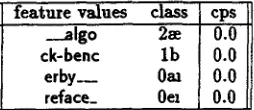
A second estimate of exceptionality is to measure how well an instance type predicts the class of all instance types within the training set (includ- ing itself). Several functions for computing class- prediction strength have been proposed, e.g., as a criterion for removing instances in memory-based (k-nn) learning algorithms, such as m3 (Aha, Ki- bier, and Albert, 1991) (cf. earlier work on edited k-nn (Wilson, 1972; Voisin and Devijver, 1987)); or for weighting instances in the Each[ algorithm (Salzberg, 1990; Cost and Salzberg, 1993). We chose to implement the straightforward class-prediction strength function as proposed in (Salzberg, 1990) in two steps. First, we count (a) the number of times that the instance type is the nearest neigh- bour of another instance type, and (b) the number of occurrences that when the instance type is a near- eat neighbour of another instance type, the classes of the two instances match. Second, the instance's class-prediction strength is computed by taking the ratio of (b) over (a). An instance type with class- prediction strength 1.0 is a perfect predictor of its own class; a class-prediction strength of 0.0 indicates that the instance type is a bad predictor of classes of other instances, presumably indicating that the instance type is exceptional.
We computed the class-prediction strength of all instance types in the training set, ordered the in- stance types according to their strengths, and cre- ated edited training sets with 1%, 2%, 5%, and 10% of the instance types with the lowest class prediction strength removed, respectively. In Ta- ble 3, four sample instance types axe displayed which have elass-prediction strength 0.0, i.e., the lowest possible strength. They are never a correct nearest-ncighbour match, since they all have higher- frequency counterpart types with the same feature values. For example, the letter sequence _ algo oc- curs in two types, one associated with the pronun- ciation / ' ~ / (via., primary-stressed /re/, or lm in our labelling), as in algorithm and algorithms; the other associated with the pronunciation / ' ~ / ( v i z . secondary-stressed / ~ / or 2se), as in algorithmic. The latter instance type occurs less frequently than the former, which is the reason that the class of the former is preferred over the latter. Thus, an am- biguous type with a minority class (a
minority am-
biguity) can
never be a correct predictor, not evenatypical
feature values class I t.ypicality ureaucr OOU 0.428
freudia Oar 0.442 _tissue Of 0.458
_czech O- 0.542
instance types
II feature values class typicality boundary
cheques Oks 1.000
elgium_ O- 1.000
laby__ Ova 1.000
manna__ O- 1.000
I typical
feature values class typicality
__oiff l:)z 7.338
etectio 0kf 8.452 ow-by-b 0b 9.130
ng-iron 2van 12.882 Table 2: Examples of atypical (left), boundary (middle), and typical (left) instance types in the training set. For each instance (seven letters and a class mapping to the middle letter), its typicality value is given.
feature values class cps __algo 2re 0.0 ck-benc lb 0.0 erby__ Om 0.0 reface_ Oez 0.0
Table 3: Examples of instance types with the lowest possible class prediction strength (cps) 0.0.
for itself, when using ml-iG as a classifier, which always prefers high f~equency over low f~equency in case of ties.
4.3 P r l e n d l y - n e l g h b o u r h o o d size
A third estimate for the exceptiona]ity of instance types is counting by how many nearest neighbours of the same class an instance type is surrounded in in- stance space. Given a training set of instance types, for each instance type a ranking can be made oral] of its nearest neighbours, ordered by their distance to the instance type. The number of neaxest-neighbouz instance types in this ranking with the same class, henceforth refe~ed to as the frendly-neighbourhood size, may range between 0 and the total number of instance types of the same class. When the friendly neighbourhood is empty, the instance type only has neaxest neighbouts of different classes. The argu- mentation to regard a small friendly neighbourhood as an indication of an instance type's exceptionality, follows f~om the same argumentation as used with e!~s-prediction strength: when an instance type has nearest neighbours of different classes, it is vice versa a bad predictor for those classes. Thus, the smaller an instance type's friendly neighboaxhood, the more it could be regarded exceptional.
To illustrate t h e computation of frend]y- neighbou~hood size, Table 4 lists fou~ examples of possible neaxest-neighbou~ zankings (truncated at ten nearest neighbours) with their respective num- ber of friendly neighbours. The Table shows that the number of friendly neighboaxs is the number of slmilaxly-labeled instances counted from left to right in the ranking, until a disslmilaxly-labeled instance
o c c u r s .
feature values class fns _-edib 2E: 0 __edib 1E: 0 echnocr In 0 soiree_ Or 0
Table 5: Examples of instance types with the lowest possible f~iendly-neighbourhood size (fns) 0, i.e., no
friendly neighbours.
Friendly-neighbouthood size and class-prediction strength a~e related functions, but differ in thei~ treatment of class ambiguity. As stated above, in- stance types may receive a class-prediction strength of 0.0 when they axe minority ambiguities. Counting a friendly neighbouzhood does not take class ambi- guity into account; each of a set of ambiguous types necessarily has no friendly neighbouzs, since they axe eachothez's nearest neighbouts with different classes. Thus, friendiy-neighbourhood size does not discrim- inate between
minority
and majority ambiguities. In Table 5, four sample instance types axe listed with frendly-neighbouthood size 0. While some of these instance types without friendly neighbours in the training set (perhaps with friendly neighbours in the test set) are minority ambiguities (e.g., __edib 2~), others are majority ambiguities (e.g., __edib 1~), while others are not ambiguous at all but simply have a nearest neighbouz at some distance with a different class (e.g., soiree_ 0z).5
Results
Figure 1 displays the generalisatiou acc~acies in terms of incorrectly classified test instances obtained with all performed experiments. The leftmost point in the Figure, f~om which all lines originate, indi- cates the performance of IBI°IG when trained on the full data set of 222,601 types, viz. 6.42% in- correctly classified test instances (when computed in terms of incorrectly pronounced test words, IBI-IG pronounces 64.61 of all test words flawlessly).
The line graph representing the fou~ expemnents in which instance types are removed randomly can be seen as the baseline graph. It can be expected
II
|
|
m
[image:6.612.85.539.63.142.2] [image:6.612.130.257.199.254.2] [image:6.612.357.482.199.255.2]II
II
II
II
II
II
II
II
II
II
II
II
II
II
nearest neighbour rank #
1 2 3 4 5 6 7 8 9 10 ¢~ o l x 2 0 3 03 0 3 0 4 x 4 × 5 x 5 × 6 1 o l o l o l o l o 1 o l o 2 02 0 3 x 4 9 x 2 02 02 02 o 2 0 2 x 3 × 3 x 3 x 4 0 o l o l o l x 3 x 4 x 4 x 4 x 4 x 5 o 6 3
Table 4: Four examples of nearest-neighbour rankings and their respective numbers of friendly neighbours (fa). Each ranked nearest neighbour is identified by its match (o) or mismatch (×) with the target instance the ranking is computed for, and a number denoting its distance to the target instance.
that removing instances randomly leads to a degra- dation of generalisation performance. The upward curve of the line graph denoting the experiments with random selection indeed shows degrading per- formanee with increasing numbers of left-out in- stance types. The relative decrease in generalisation accuracy is 2.0% when 1% of the training material is removed randomly, 3.8% with 2% random removal, 10.7% with 5% random removal, and 20.7% with 10% random removal.
Surprisingly, the only experiments showing lower performance degradation than removal by random selection are those with class-prediction strength; the other criteria for removing exceptional instances lead to worse degradations. It does not matter whether instance types are removed on grounds of their typicality: apparently, a markedly low, neutral, or high typicality value indicates that the instance type is (on average) important, rather than remov- able. The same applies to friendly-neighbourhood size: instances with small neighbourhood sizes ap- pear to contribute significantly to performance on test material. It is remarkable that the largest er- rors with 1% and 2% removal are obtained with the friendly-neighbourhood size criterion: it appears that on average, the instances with few or no nearest neighbours are important in the classification of test material.
When using class-prediction strength as removal criterion, performance does not degrade until about 5% of the instance types with the lowest strength are removed from memory. The reason is that c|_~ss- prediction strength is the only criterion that detects minority ambiguities, i.e., instance types with pre- diction strength 0.0, that cannot contribute to classi- fication since they are always overshadowed by their counterpart instance types with majority classes, even for their own classification. In the tralni~g set, 9,443 instance types are minority ambiguities, i.e., 4.2% of the instance types (accounting for 3.8% of the instance tokens in the original token set).
Thus, among the tested methods for reducing the memory needed for storing an instance base in memory-based learning, only two relatively trivial methods are performance-preserving while account- ing for a substantial reduction in the amount of
memory needed by IB 1-IG:
1. Replacing instance tokens by instance types ac- counts for a reduction of about 63% of mem- ory needed to store instances, excluding the memory needed to store frequency information. When frequency information is stored in two bytes per instance type, the memory reduction is about 54%.
. Removing instance types that are minority am- bigulties on top of the type/token-reduction ac- counts only for an additional memory reduc- tion of 2%, i.e., for a total memory reduction of 65%; 56% with two-byte frequency informa- tion stored per instance.
6 D i s c u s s i o n a n d f u t u r e r e s e a r c h
As previous research has suggested (Daelemans, 1996; Daelemans, Van den Bosch, and Weijters, 1997a; Van den Bosch, 1997), keeping full mem- ory in memory-based learning of word pronunciation strongly appears to yield optimal generalisation ac- curacy. The experiments in this paper show that op- timi~tion of memory use in memory-based learning while preserving generalisation accuracy can only be performed by (i) replacing instance tokens by in- stance types with frequency information, and (ii) removing minority ambiguities. Both optimi~tions can be performed straightforwardly; minority ambi- guities can be traced with less effort than by using class-prediction strength. Our implementation of IB1-I6 described in (Daelemans and Van den Bosch, 1992; Daelemans, Van den Bosch, and Weijters, 1997b) already makes use of this knowledge, albeit partially (it stores class distributions with letter- window types).
Our results also show that atypicality, non-typic- ality, and typicality (Zhang, 1992), and friendly- neighbourhood size are all estimates of exception- ality that indicate the importance of instance types for classification, rather than their removability. As far as these estimates of exeeptionality are viable, our results suggest that exceptions should be kept in memory and not be thrown away.
[image:7.612.168.452.60.127.2]12.0
11.0
o~
v
10.0
(D t -
O 9.0 ._~
v 8.0,
t - (D
7.0
6.0
atypical o
• typical ...
non-typical --~ .... small neighbourhood . * ...
low prediction strength . . . " / x
[image:8.612.91.518.59.297.2]• random -.. .... . _ . ~ ... :::::::::::::::::::::::::.. ... : ... ~:::::~-. ...
... . . . " I . . . 0 . . . o " . . . . . . . . . . . .
5 00 10000 15000 20000
number of removed instances types
Figure 1: Generallsation errors (percentages of incorrectly classified test instances of TRIBL-IG, with increased numbers of edited instances, according to the tested exeeptionality criteria atypical, typical, boundary, small neighbourhood, low prediction strength, and random selection. Performances, denoted by points, are measured when 1%, 2%, 5%, and 10% of the most exceptional instance types ate edited.
Lazy vs. eager; n o t s t a b l e vs. u n s t a b l e F~om the results in this paper and those reported eatlier (Daelemans, Van den Bosch, and Weijters, 1997a; Van den Bosch, 1997), it appeats that no compromise can be made on memory-base learning in terms of abstraction by forgetting without los- ing generalisation accuracy. Consistently lower per- formances axe obtained with algorithms that forget by constructing decision trees or connectionist net- works, or by editing instance types. Generalisation accuracy appears to be related to the dimension lazy- eager leaxning; for the Gs task (and for many other language tasks, (Daelemans, Van den Bosch, and Weijtezs, 1997a)), it is demonstrated that memory- based lazy leatning leads to the best generalisation accuracies,
Another explanation for the difference in per- formance between decision-tree, connectionist, and editing methods versus pure memory-based leaxn- ing is that the former generally display high ~ar/- ance, which is the portion of the generalisation error caused by the u~tabili~/of the learning algorithm (Breiman, 1996a). An algorithm is unstable when small perturbations in the learning material lead to large differences in induced models, and stable oth- ezwise; pure memory-based learning algorithms axe said to be very stable, and decision-tree algorithms and conneetionist learning to be unstable (Breiman, 1996a). High variance is usually coupled with low bias, i.e., unstable leaxning algorithms with high
vaziance tend to have few limitations in the fxeedom to approximate the task or function to be leaxned) (Bzeiman, 1996b). Breiman points out that often the opposite also holds: a stable classitiez with a low variance can display a high bias when it can- not represent d a t a adequately in its available set of models, but it is not cleat whether or how this ap- plies to pure memory-based leatning as in ml-IG; its success in representing the Gs data and other language tasks quite adequately would rather sug- gest that IB 1-I6 has both low vatiance and low bias. Apatt fzom the possibility that the lazy and eager leatning algorithms investigated here and in eatllez work do not have a strongly contrasting bias, we con- jecture that the editing methods discussed here, and some specific decision-tree leaxning algorithms inves- tigated eaxlier (i.e., IGTItEE (Daclemuns, Van den
Bosch, and Weijters, 1997b), a decision tree learn- ing algorithm that is an approximate optimisation of IBI-IG) have a slmilat vatia~lce to that of IB1- IG; they axe virtually as stable as ~I-IQ. We base this conjecture on the fact that the standard devi- ations of both decision-tree learning and memory- based learning trained and tested on the GS data axe not only very small (in the order of 1/10 percents), but also hatdiy different (cf. (Van den Bosch, 1997) for details and examples). Only counectionist net- works trained with back-propagation and decision- tree leaxning with pruning display latger standard deviations when accuracies ate averaged over exper-
II
II
I
I
I
I
I
I
l
I
I
I
I
I
l
/
/
/
/
/
/
l
/
/
/
/
A
iments (Van den Bosch, 1997); the stable-unstable dimension might play a role there, but not in the difference between pure memory-based learning and edited memory-based learning.
Future research
The results of the present study suggest that the following questions be investigated in future re-
search:
, The tested criteria for editing can be employed as instance weights as in EACH (Salzberg, 1990) and PEI3LS (Cost and Salzberg, 1993), rather than as criteria for instance removal. Instance weighting, preserving pure memory- based learning, may add relevant information to similarity matching, and may improve IB1- IG~s performance.
. Different data sets of different sizes may con- tain different portions of atypical instances or minority ambiguities. Moreover, data sets may contain pure noise. While atypical or excep- tional instances may (and do) return in test material, the chances of noise to return is rel- ativdy minute. Our results generalise to data sets with approximately the characteristics of the Gs dataset. Although there are indica- tions that data sets representing other language tasks indeed share some essential characteristics (e.g., memory-based learning is consistently the best-performlng algorithm), more investigation is needed to make these characteristics explicit.
A c k n o w l e d g e m e n t s
We thank the members of the ILK group, Ton Weij- ters, and Eric Postma for fruitful discussions, and the anonymous reviewers for relevant comments and suggestions.
R e f e r e n c e s
Aha, D. W., editor. 1997. Lazy learning. Dordrecht: Kluwet Academic Publishers. reprinted from: Ar- tificial Intelligence Review, 11:1-5.
Aha, D. W., D. Kibler, and M. Albert. 1991. Instance-based learning algorithms. Machine Learning, 7:37-66.
Breiman, L. 1996a. Bagging predictors. Machine Learning, 24(2).
Breiman, L. 1996b. Bias, variance and arcing elas- sifters. Technical Report 460, University of Cali- fornia, Statistics Department, Berkeley, CA. Burnage, G., 1990. CELEX: A guide for users. Cen-
tre for Lexical Information, Nijmegen.
Cost, S. and S. Salzberg. 1993. A weighted near- est neighbor algorithm for learning with symbolic features. Machine Learning, 10:57-78.
van den Bosch and Daelemans 203
Cover, T. M. and P. E. Hart. 1967. Nearest neigh- bor pattern classification. Institute of Eledrical and Electronics Engineers Transactions on Infor- mation Theory, 13:21-27.
Daelemans, W. 1996. Abstraction considered harm- ful: lazy learning of language processing. In H. J. Van den Herik and A. Weijters, editors, Proceed- ings of the Sizth Belgian-Dutch Conference on Machine Learning, pages 3-12, Maastricht, The Netherlands. MXTRIK$.
Daelemans, W., S. Gillis, and G. Durieux. 1994. The acquisition of stress: a data-oriented ap- proach. Coraputational Linguistics, 20(3):421- 451.
Dadema~, W. and A. Van den Bosch. 1992. Gen- eralisation performance of backpropagation learn- ing on s syllabification task. In M. F. L Drossaers and A. Nijholt, editors, TWLT3: Connectionism and Natural Language Processing, pages 27-37, Enschede. Twente University.
Daelemans, W., A. Van den Bosch, and A. Weij- ters. 1997a. Empirical learning of natural lan- guage processing tasks. Lecture Notes in Artifi- cial Intelligence, , number 1224, pages 337-344. Berlin: Springer-Verlag.
Daelemans, W., A. Van den Bosch, and A. Weij- ters. 1997b. IGTree: using trees for classification in lazy learning algorithms. Artificial Intelligence Review, 11:407--423.
Devijver, P . . A . and J. Kittler. 1982. Pattern recognition. A statistical approach. London, UK: Prentice-HalL
Dietterich, T. G., H. Hild, and G. Bakiri. 1990. A comparison of ID3 and backpropagation for En- glish text-to-speech mapping. Technical Report 90-20-4, Oregon State University.
Kolodner, J. 1993. Case-based reasoning. San Ma- teo, CA: Morgan Kanfmann.
Mitchell, T. 1997. Machine learning. New York, NY: McGraw Hill.
Quinlan, J. R. 1986. Induction of decision trees. Machine LeaNing, 1:81-206.
Quinlsn, J. R. 1993. c4.5: Programs for Machine learning. San Mateo, CA: Morgan Kaufi~mm. Roach, E. and C. B. Mervis. 1975. Fam~y resem-
blances: studies in the internal structure of cate- gories. Cognitive Psychology, 7:??-??
Rumelhart, D. E., G. E. Hinton, and R. J. Williams. 1986. Learning internal representations by error propagation. In D. E. Rumelhart and J. L. Mc- Clelland, editors, Parallel Distributed Processing: gzplorations in the Microstructure of Cognition. Cambridge, MA: The MIT Press, pages 318-362.
Salzberg, S. 1990. Learning with nested generalised ezemplars. Norwell, MA: Klawer Academic Pub- lishers.
Sejnowski, T. J. and C. S. Rosenberg. 1987. Paral- lel networks that learn to pronounce English text.
gomplez Systems, 1:145-168.
Shavlik, J. W., R. J. Mooney, and G. G. Towell. 1991. Symbolic and neural learning algorithms: An experimental comparison. Machine Learning, 6:111-143.
Stanfdl, C. and D. Waltz. 1986. Toward memory- based reasoning. Communications of the ACM,
29(12):1213-1228.
Van den Bosch, A. 1997. Learning to pronounce written words, a study in inductive language learn- ing. Ph.D. thesis, Universiteit Manstricht. Van den Bosch, A., W. Daelemans, and A. Weijters.
1996. Morphological analysis as classification: an inductive-learning approach. In K. Oflazer and H. Somers, editors, Proceedings of the Second In- ternational Conference on New Methods in Nat- ural Language Processing, NeMLaP-~, Ankara, Turkey, pages 79-89.
Voisin, J. and P. A. Devijver. 1987. An applica- tion of the Multiedit-Condensing technique to the reference selection problem in a print recognition system. Pattern Recognition, 5:465-474.
Wettschereck, D. 1995. A study of distance-based machine.learning algorithms. Ph.D. thesis, Ore- gon State University.
Wettschereck, D., D. W. Aha, and T. Mohri. 1997. A review and empirical evaluation of feature weighting methods for a class of lazy learning algo- rithms. Artificial Intelligence Revietv, 11:273-314. Wilson, D. 1972. Asymptotic propexties of near-
eat neighbor rules using edited data. Instit~zte of Electrical and Electronic Engineers Transactions on Systems, Man and Cybernetics, 2:408-421. Wolpert, D. H. 1990. Constructing a generalizer
superior to NETtalk via a mathematical theory of generalization. Neural Networks, 3:445--452. Zhang, J. 1992. Selecting typical instances in
instance-based learning. In Proceedings of the In- ternational Machine Learning Conference 199~, pages 470-479.