Making Dependency Labeling Simple, Fast and Accurate
Tianxiao Shen1 Tao Lei2 Regina Barzilay2
1The Institute for Theoretical Computer Science (ITCS)
Institute for Interdisciplinary Information Sciences Tsinghua University
2MIT CSAIL
1[email protected] 2{taolei, regina}@csail.mit.edu
Abstract
This work addresses the task of dependency labeling—assigning labels to an (unlabeled) dependency tree. We employ and extend a feature representation learning approach, op-timizing it for both high speed and accu-racy. We apply our labeling model on top of state-of-the-art parsers and evaluate its perfor-mance on standard benchmarks including the CoNLL-2009 and the English PTB datasets. Our model processes over 1,700 English sen-tences per second, which is 30 times faster than the sparse-feature method. It improves labeling accuracy over the outputs of top parsers, achieving the best LAS on 5 out of 7 datasets1.
1 Introduction
Traditionally in dependency parsing, the tasks of finding the tree structure and labeling the de-pendency arcs are coupled in a joint achitecture. While it has potential to eliminate errors propogated through a separated procedure, joint decoding intro-duces other sources of issues that can also lead to non-optimal labeling assignments. One of the issues arises from inexact algorithms adopted in order to solve the hard joint search problem. For instance, many parsers (Nivre et al., 2007; Titov and Hender-son, 2007; Zhang et al., 2013; Dyer et al., 2015; Weiss et al., 2015) adopt greedy decoding such as beam search, which may prune away the correct la-beling hypothesis in an early decoding stage. An-other issue is caused by the absence of rich label 1Our code is available at https://github.com/
shentianxiao/RBGParser/tree/labeling.
features. Adding dependency labels to the combina-torial space significantly slows down the search pro-cedure. As a trade-off, many parsers such as MST-Parser, TurboParser and RBGParser (McDonald et al., 2005; Martins et al., 2010; Zhang et al., 2014) incorporate only single-arc label features to reduce the processing time. This restriction greatly limits the labeling accuracy.
In this work, we explore an alternative approach where the dependency labeling is applied as a sep-arate procedure, alleviating the issues described above. The potential of this approach has been ex-plored in early work. For instance, McDonald et al. (2006) applied a separate labeling step on top of the first-order MSTParser. The benefit of such approach is two-fold. First, finding the optimal labeling as-signment (once the tree structure is produced) can be solved via anexactdynamic programming algo-rithm. Second, it becomes relatively cheap to add rich label features given a fixed tree, and the ex-act algorithm still applies when high-order label fea-tures are included. However, due to performance is-sues, such approach has not been adopted by the top performing parsers. In this work, we show that the labeling procedure, when optimized with recent ad-vanced techniques in parsing, can achieve very high speed and accuracy.
Specifically, our approach employs the recent distributional representation learning technique for parsing. We apply and extend the low-rank ten-sor factorization method (Lei et al., 2014) to the second-order case to learn a joint scoring function over grand-head, head, modifier and their labels. Unlike the prior work which additionally requires
traditional sparse features to achieve state-of-the-art performance, our extention alone delivers the same level of accuracy, while being substantially faster. As a consequence, the labeling model can be applied either as a refinement (re-labeling) step on top of ex-isting parsers with negligible cost of computation, or as a part of a decoupled procedure to simplify and speed up the dependency parsing decoding.
We evaluate on all datasets in the CoNLL-2009 shared task as well as the English Penn Treebank dataset, applying our labeling model on top of state-of-the-art dependency parsers. Our labeling model processes over 1,700 English sentences per sec-ond, which is 30 times faster than the sparse-feature method. As a refinement (re-labeling) model, it achieves the best LAS on 5 out of 7 datasets. 2 Method
2.1 Task Formulation
Given an unlabeled dependency parsing tree y of sentence x, where y can be obtained using exist-ing (non-labelexist-ing) parsers, we classify each head-modifier dependency arch →m ∈ywith a partic-ular labellh→m. Letl=Sh→m∈y{lh→m}, our goal
is to find the assignment with the highest score: l∗ = arg max
l S(x,y,l)
For simplicity, we omit x,y in the following dis-cussion, which remain the same during the labeling process. We assume that the scoreS(l)decomposes into a sum of local scores of single arcs or pairs of arcs (in the form of grand-head–head–modifier), i.e.
S(l) = X
h→m∈y
s1(h→q m) +
X
g→h→m∈y
s2(g→p h→q m)
wherep=lg→h,q=lh→m.
Parameterizing the scoring function s1(h →q m)
ands2(g →p h →q m)is a key challenge. We follow
Lei et al. (2014) to learn dense representations of features, which have been shown to better generalize the scoring function.
2.2 Scoring
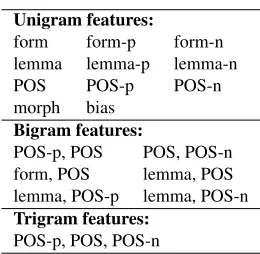
The representation-based approach requires little feature engineering. Concretely, let φg, φh, φm ∈
Rn be the atomic feature vector of the
grand-head, head and modifier word respectively, and
Unigram features:
form form-p form-n lemma lemma-p lemma-n
POS POS-p POS-n
morph bias
Bigram features:
POS-p, POS POS, POS-n form, POS lemma, POS lemma, POS-p lemma, POS-n
Trigram features:
[image:2.612.360.490.56.183.2]POS-p, POS, POS-n
Table 1:Word atomic features used by our model.POS,form, lemma and morph stand for the POS tag, word form, word lemma and morphology features respectively. The suffix -p refers to the previous token, and-nrefers to the next.
φg→h,p, φh→m,q ∈ Rdbe the atomic feature vector
of the two dependency arcs respectively. It is easy to define and compute these vectors. For instance,
φg (as well as φh and φm) can incorperate binary
features which indicate the word and POS tag of the current token (and its local context), whileφg→h,p
(and φh→m,q) can indicate the label, direction and
length of the arc between the two words.
The scores of the arcs are computed by (1) projecting the atomic vectors into low-dimensional spaces; and (2) summing up the element-wise prod-ucts of the resulting dense vectors:
s1(h→q m) = r1
X
i=1
[U1φh]i[V1φm]i[W1φh→m,q]i
wherer1 is a hyper-parameter denoting the
dimen-sion after projection, and U1, V1 ∈ Rr1×n, W1 ∈
Rr1×dare projection matrices to be learned.
The above formulation can be shown equivalent to factorizing a huge score table T1(·,·,·) into the
product of three matricesU1, V1 andW1, whereT1
is a 3-way array (tensor) storing feature weights of all possible features involving three components— the head, modifier and the arc between the two. Ac-cordingly, the formula to calculates1(·)is equivalent
to summing up all feature weights (fromT1) over the
structureh→q m.2
We depart from the prior work in the following aspects. First, we naturally extend the factorization approach to score second-order structures of
head, head and modifier,
s2(g→p h→q m) = r2
X
i=1
[U2φg]i[V2φh]i[W2φm]i
[X2φg→h,p]i[Y2φh→m,q]i
Herer2 is a hyper-parameter denoting the
dimen-sion, andU2, V2, W2 ∈Rr2×n,X2, Y2 ∈ Rr2×dare
additional parameter matrices to be learned. Sec-ond, in order to achieve state-of-the-art parsing ac-curacy, prior work combines the single-arc score s1(h →q m)with an extensive set of sparse features
which go beyond single-arc structures. However, we find this combination is a huge impediment to de-coding speed. Since our extention already captures high-order structures, it readily delivers state-of-the-art accuracy without the combination. This change results in a speed-up of an order of magnitude (see section 2.4 for a further discussion).
2.3 Viterbi Labeling
We use a dynamic programming algorithm to find the labeling assignment with the highest score. Sup-posehis any node apart from the root, andgish’s parent. Letf(h, p) denote the highest score of sub-treehwithlg→hfixed to bep. Then we can compute
f(·,·)using a bottom-up method, from leaves to the root, by transition function
f(h, p) = X
h→m∈y max
q n
f(m, q) + s1(h→q m)
+ s2(g→p h→q m)
o
And the highest score of the whole tree is
f(root) = X
root→m∈y max
q f(m, q) + s1(root q →m)
Once we get f(·,·), we can determine the labels backward, in a top-down manner. The time com-plexity of our algorithm is O(NL2 ·T), where N
is the number of words in a sentence,Lis the num-ber of total labels, andT is the time of computing features and scores.
2.4 Speed-up
In this section, we discuss two simple but effective strategies to speed up the labeling procedure.
Pruning We prune unlikely labels by simply ex-ploiting the part-of-speech (POS) tags of the head and the modifier. Specifically, let 1(posh,posm, l) denote whether there is an arch →l min the train-ing data such thath’s POS tag is posh andm’s POS tag is posm. In the labeling process, we only con-sider the possible labels that occur with the corre-sponding POS tags. LetK be the average number of possible labels per arc, then the time complexity is dropped toO(NK2 ·T)approximately. In
prac-tice,K ≈ L/4. Hence this pruning step makes our labeler 16 times faster.
Using Representation-based Scoring Only The time to compute scores, i.e. T, consists of building the features and fetching the corresponding feature weights. For traditional methods, this requires enu-merating feature templates, constructing feature ID and searching the feature weight in a look-up table. For representation-based scoring, the dense word representations (e.g. U1φh) can be pre-computed,
and the scores are obtained by simple inner products of small vectors. We choose to use representation-based scoring only, therefore reducing the time to O(NK2·(r1+r2) +NT0). In practice, we find the labeling process becomes about 30 times faster. 2.5 Learning
Let D = {(xi,yi,li)}Mi=1 be the collection of M
training samples. Our goal is to learn the values of the set of parametersΘ = {U1, V1, W1, U2, V2, W2, X2, Y2}based onD. Following standard
prac-tice, we optimize the parameter values in an online maximum soft-margin framework, minimizing the structural hinge loss:
loss(Θ) = max
ˆl n
S(ˆl) +kli−ˆlk1 o
−S(li)
wherekli−ˆlk1is the number of different labels
be-tweenli andˆl. We adjust parametersΘby∆Θvia
passive-aggressive update:
∆Θ = max
C,loss(Θ)kδΘk2
·δΘ
whereδΘ = dlossdΘ(Θ) denotes the derivatives andC
is a regularization hyper-parameter controlling the maximum step size of each update.
Model UAS LASCatalan UAS LASChinese UAS LASCzech UAS LASEnglish UAS LASGerman UAS LASJapanese UAS LASSpanish Best Shared Task - 87.86 - 79.17 - 80.38 - 89.88 - 87.48 - 92.57 - 87.64 Bohnet (2010) - 87.45 - 76.99 - 80.96 - 90.33 - 88.06 - 92.47 - 88.13 Zhang and McDonald (2014) 91.41 87.91 82.87 78.57 86.62 80.59 92.69 90.01 89.88 87.38 92.82 91.87 90.82 87.34 Alberti et al. (2015) 92.31 89.17 83.34 79.50 88.35 83.50 92.37 90.21 90.12 87.79 93.99 93.10 91.71 88.68 RBG 91.37 87.31 82.16 77.24 88.88 81.90 92.75 90.04 90.88 87.91 94.18 93.38 91.50 87.69 + our labeling 88.29 77.12 84.04 90.38 88.68 93.59 88.71
Table 2:Pipelined Results on CoNLL-2009.
3 Results
Experimental Setup We test our model on the CoNLL-2009 shared task benchmark with 7 differ-ent languages as well as the English Penn Treebank dataset. Whenever available, we use the predicted POS tags, word lemmas and morphological informa-tion provided in the datasets as atomic features. Fol-lowing standard practice, we use unlabeled attach-ment scores (UAS) and labeled attachattach-ment scores (LAS) as evaluation measure3. In order to compare
with previous reported numbers, we exclude punctu-ations for PTB in the evaluation, and include punc-tuations for CoNLL-2009 for consistency.
We use RBGParser4, a state-of-the-art
graph-based parser for predicting dependency trees, and then apply our labeling model to obtain the depen-dency label assignments. To demonstrate the effec-tiveness of our model on other systems, we also ap-ply it on two additional parsers – Stanford Neural Shift-reduce Parser (Chen and Manning, 2014)5and
TurboParser (Martins et al., 2010)6. In all reported
experiments, we use the default suggested settings to run these parsers. The hyper-parameters of our labeling model are set as follows:r1 = 50,r2= 30, C= 0.01.
Labeling Performance To test the performance of our labeling method, we first train our model us-ing the gold unlabeled dependency trees and eval-uate the labeling accuray on CoNLL-2009. Table 3 presents the results. For comparison, we implement a combined system which adds a rich set of tradi-tional, sparse features into the scoring function and jointly train the feature weights. As shown in the ta-ble, using our representation-based method alone is 3We use the official evaluation script from CoNLL-X:
http://ilk.uvt.nl/conll/software.html
4https://github.com/taolei87/RBGParser
5http://nlp.stanford.edu/software/nndep.shtml 6http://www.cs.cmu.edu/˜ark/TurboParser/
Ours + Sparse Features Ours only
LAS Speed LAS Speed
Catalan 96.33 30 96.42 1070
Chinese 94.16 38 93.16 1304
Czech 95.54 71 95.60 2065
English 97.00 62 96.88 1751
German 96.93 113 96.89 1042
Japanese 98.92 305 98.95 2778
[image:4.612.330.523.309.425.2]Spanish 96.53 43 96.68 1142
Table 3: LAS and parsing speed (sentence per second) based on unlabeled golden trees.
UAS RBG Labeled93.48 Unlabeled93.33
LAS
Before After Stanford NN 89.37 89.55
Turbo 90.22 90.65
RBG 91.00 91.43
Runtime
Joint Two-step Stanford NN 4.4 3.3
Turbo 182.1 119.4
RBG 365.4 305.7
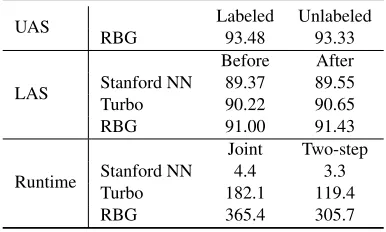
Table 4:Joint vs. Separate analysis on PTB.
super fast, being 30 times faster than the implemen-tation with traditional feature compuimplemen-tation and able to process over 1,700 English sentences per second. It does not affect the LAS accuracy except for Chi-nese.
unlabeled trees, we also obtain speed improvement, even for the highly speed-optimzed Stanford Neural Parser.
CoNLL-2009 Results In Table 2, we compare our model with the best systems7 of the CoNLL-2009
shared task, Bohnet (2010), Zhang and McDonald (2014) as well as the most recent neural network parser (Alberti et al., 2015). Despite the simplic-ity of the decoupled parsing procedure, our labeling model achieves LAS performance on par with the state-of-the-art neural network parser. Specifically, our model obtains the best LAS on 5 out of 7 lan-guages, while the neural parser outperforms ours on Catalan and Chinese.
4 Conclusion
The most common method for dependency parsing couples the structure search and label search. We demonstrate that decoupling these two steps yields both computational gains and improvement in label-ing accuracy. Specifically, we demonstrate that our labeling model can be used as a post-processing step to improve the accuracy of state-of-the-art parsers. Moreover, by employing dense feature representa-tions and a simple pruning strategy, we can signif-icantly speed up the labeling procedure and reduce the total decoding time of dependency parsing.
Acknowledgments
We thank Yuan Zhang for his help on the ex-periments, and Danqi Chen for answering ques-tions about their parser. We also thank the MIT NLP group and the reviewers for their com-ments. This work was supported in part by the National Basic Research Program of China Grant 2011CBA00300, 2011CBA00301, the Na-tional Natural Science Foundation of China Grant 61361136003.
References
Chris Alberti, David Weiss, Greg Coppola, and Slav Petrov. 2015. Improved transition-based parsing and tagging with neural networks. InProceedings of the 7Winners include Bohnet (2009), Che et al. (2009), Ges-mundo et al. (2009) and Ren et al. (2009).
2015 Conference on Empirical Methods in Natural Language Processing.
Bernd Bohnet. 2009. Efficient parsing of syntactic and semantic dependency structures. In Proceedings of the Thirteenth Conference on Computational Natural Language Learning: Shared Task.
Bernd Bohnet. 2010. Very high accuracy and fast depen-dency parsing is not a contradiction. InProceedings of the 23rd International Conference on Computational Linguistics.
Wanxiang Che, Zhenghua Li, Yongqiang Li, Yuhang Guo, Bing Qin, and Ting Liu. 2009. Multilingual dependency-based syntactic and semantic parsing. In
Proceedings of the Thirteenth Conference on Compu-tational Natural Language Learning: Shared Task. Danqi Chen and Christopher D Manning. 2014. A
fast and accurate dependency parser using neural net-works. InProceedings of the Conference on Empirical Methods in Natural Language Processing.
Chris Dyer, Miguel Ballesteros, Wang Ling, Austin Matthews, and Noah A Smith. 2015. Transition-based dependency parsing with stack long short-term mem-ory.arXiv preprint arXiv:1505.08075.
Andrea Gesmundo, James Henderson, Paola Merlo, and Ivan Titov. 2009. A latent variable model of syn-chronous syntactic-semantic parsing for multiple lan-guages. In Proceedings of the Thirteenth Confer-ence on Computational Natural Language Learning: Shared Task.
Tao Lei, Yu Xin, Yuan Zhang, Regina Barzilay, and Tommi Jaakkola. 2014. Low-rank tensors for scor-ing dependency structures. InProceedings of the 52th Annual Meeting of the Association for Computational Linguistics. Association for Computational Linguis-tics.
Andr´e FT Martins, Noah A Smith, Eric P Xing, Pe-dro MQ Aguiar, and M´ario AT Figueiredo. 2010. Turbo parsers: Dependency parsing by approximate variational inference. InProceedings of the 2010 Con-ference on Empirical Methods in Natural Language Processing. Association for Computational Linguis-tics.
Ryan McDonald, Fernando Pereira, Kiril Ribarov, and Jan Hajiˇc. 2005. Non-projective dependency pars-ing uspars-ing spannpars-ing tree algorithms. InProceedings of the conference on Human Language Technology and Empirical Methods in Natural Language Processing. Association for Computational Linguistics.
Joakim Nivre, Johan Hall, Jens Nilsson, Atanas Chanev, G¨ulsen Eryigit, Sandra K¨ubler, Svetoslav Marinov, and Erwin Marsi. 2007. MaltParser: A language-independent system for data-driven dependency pars-ing. Natural Language Engineering.
Han Ren, Donghong Ji, Jing Wan, and Mingyao Zhang. 2009. Parsing syntactic and semantic dependencies for multiple languages with a pipeline approach. In
Proceedings of the Thirteenth Conference on Compu-tational Natural Language Learning: Shared Task. Ivan Titov and James Henderson. 2007. A latent
vari-able model for generative dependency parsing. In Pro-ceedings of 10th International Conference on Parsing Technologies (IWPT).
David Weiss, Chris Alberti, Michael Collins, and Slav Petrov. 2015. Structured training for neural network transition-based parsing. InProceedings of ACL 2015. Hao Zhang and Ryan McDonald. 2014. Enforcing struc-tural diversity in cube-pruned dependency parsing. In
Proceedings of the 52nd Annual Meeting of the Asso-ciation for Computational Linguistics.
Hao Zhang, Liang Zhao, Kai Huang, and Ryan McDon-ald. 2013. Online learning for inexact hypergraph search. InProceedings of EMNLP.