Transition-Based Syntactic Linearization with Lookahead Features
Ratish Puduppully†∗, Yue Zhang‡, Manish Shrivastava†
†Kohli Center on Intelligent Systems (KCIS),
International Institute of Information Technology, Hyderabad (IIIT Hyderabad) ‡Singapore University of Technology and Design
[email protected] yue [email protected] [email protected]
Abstract
It has been shown that transition-based meth-ods can be used for syntactic word order-ing and tree linearization, achievorder-ing signifi-cantly faster speed compared with traditional best-first methods. State-of-the-art transition-based models give competitive results on ab-stract word ordering and unlabeled tree lin-earization, but significantly worse results on labeled tree linearization. We demonstrate that the main cause for the performance bottle-neck is the sparsity of SHIFTtransition actions
rather than heavy pruning. To address this is-sue, we propose a modification to the stan-dard transition-based feature structure, which reduces feature sparsity and allows lookahead features at a small cost to decoding efficiency. Our model gives the best reported accuracies on all benchmarks, yet still being over 30 times faster compared with best-first-search.
1 Introduction
Word ordering is the abstract language modeling task of making a grammatical sentence by ordering a bag of words (White, 2004; Zhang and Clark, 2015; De Gispert et al., 2014; Bohnet et al., 2010; Filip-pova and Strube, 2007; He et al., 2009), which is practically relevant to text-to-text applications such as summarization (Wann et al., 2009) and machine translation (Blackwood et al., 2010). Zhang (2013) built a discriminative word ordering model, which takes a bag of words, together with optional POS and dependency arcs on a subset of input words, and ∗Part of the work was done when the author was a visiting student at Singapore University of Technology and Design.
yields a sentence together with its dependency parse tree that conforms to input syntactic constraints. The system is flexible with respect to input constraints, performing abstract word ordering when no con-straints are given, but gives increasingly confined outputs when more POS and dependency relations are specified. It has been applied to syntactic lin-earization (Song et al., 2014) and machine transla-tion (Zhang et al., 2014).
One limitation of Zhang (2013) is relatively low time efficiency, due to the use of time-constrained best-first-search (White and Rajkumar, 2009) for de-coding. In practice, the system can take seconds to order a bag of words in order to obtain reasonable output quality. Recently, Liu et al. (2015) proposed a transition-based model to address this issue, which uses a sequence of state transitions to build the out-put. The system of Liu et al. (2015) achieves signifi-cant speed improvements without sacrificing accura-cies when working with unlabeled dependency trees. With labeled dependency trees as input constraints, however, the system of Liu et al. (2015) gives much lower accuracies compared with Zhang (2013).
While the low accuracy can be attributed to heavy pruning, we show that it can be mitigated by modi-fying the feature structure of the standard transition-based framework, which scores the output transi-tion sequence by summing the scores of each tran-sition action. Trantran-sition actions are treated as an atomicoutput component in each feature instance. This works effectively for most structured prediction tasks, including parsing (Zhang and Clark, 2011a). For word ordering, however, transition actions are significantly more complex and sparse compared
with parsing, which limits the power of the tradi-tional feature model.
We instead break down complex actions into smaller components, merging some components into configuration features which reduces sparsity in the output action and allows flexible lookahead fea-tures to be defined according to the next action to be applied. On the other hand, this change in the feature structure prevents legitimate actions to be scored simultaneously for each configuration state, thereby reducing decoding efficiency. Experiments show that our method is slightly slower compared with Liu et al. (2015), but achieves significantly bet-ter accuracies. It gives the best results for all stan-dard benchmarks, being over thirty times faster than Zhang (2013). The new feature structures can be ap-plied to other transition-based systems also.
2 Transition-based linearization
Liu et al. (2015) uses a transition-based model for word ordering, building output sentences using a se-quence of state transitions. Instead of scoring out-put syntax trees directly, it scores the transition ac-tion sequence for structural disambiguaac-tion. Liu et al.’s transition system extends from transition-based parsers (Nivre and Scholz, 2004; Chen and Man-ning, 2014), where astateconsists of astackto hold partially built outputs. Transition-based parsers use a queue to maintain input word sequences. How-ever, for word ordering, the input is a set without order. Accordingly, Liu et al. uses asetto maintain the input. The transition actions are:
• SHIFT-Word-POS, which removes Word from theset, assigns POS to it and pushes it onto the stackas the top wordS0;
• LEFTARC-LABEL, which removes the second top of stack S1 and builds a dependency arc
S1←−−−−−LABEL S0;
• RIGHTARC-LABEL, which removes the top of stack S0 and builds a dependency arc
S1−−−−−→LABEL S0.
Using the state transition system, the bag of words {John, loves, Mary} can be ordered by (SHIFT-John-NNP, SHIFT-loves-VBZ, LEFTARC -SBJ, SHIFT-Mary-NNP, RIGHTARC-OBJ).
Liu et al. (2015) use a discriminative perceptron model with beam search (Zhang and Clark, 2011a),
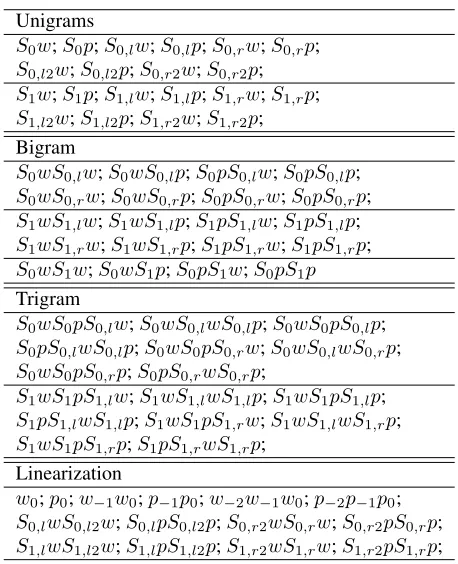
Unigrams
S0w;S0p;S0,lw;S0,lp;S0,rw;S0,rp;
S0,l2w;S0,l2p;S0,r2w;S0,r2p; S1w;S1p;S1,lw;S1,lp;S1,rw;S1,rp;
S1,l2w;S1,l2p;S1,r2w;S1,r2p; Bigram
S0wS0,lw;S0wS0,lp;S0pS0,lw;S0pS0,lp;
S0wS0,rw;S0wS0,rp;S0pS0,rw;S0pS0,rp;
S1wS1,lw;S1wS1,lp;S1pS1,lw;S1pS1,lp;
S1wS1,rw;S1wS1,rp;S1pS1,rw;S1pS1,rp;
S0wS1w;S0wS1p;S0pS1w;S0pS1p
Trigram
S0wS0pS0,lw;S0wS0,lwS0,lp;S0wS0pS0,lp;
S0pS0,lwS0,lp;S0wS0pS0,rw;S0wS0,lwS0,rp;
S0wS0pS0,rp;S0pS0,rwS0,rp;
S1wS1pS1,lw;S1wS1,lwS1,lp;S1wS1pS1,lp;
S1pS1,lwS1,lp;S1wS1pS1,rw;S1wS1,lwS1,rp;
S1wS1pS1,rp;S1pS1,rwS1,rp; Linearization
w0;p0;w−1w0;p−1p0;w−2w−1w0;p−2p−1p0; S0,lwS0,l2w;S0,lpS0,l2p;S0,r2wS0,rw;S0,r2pS0,rp;
[image:2.612.312.541.56.338.2]S1,lwS1,l2w;S1,lpS1,l2p;S1,r2wS1,rw;S1,r2pS1,rp;
Table 1: Base feature templates.
designing decoding algorithms that accommodate flexible constraints. The features include word(w), pos(p) and dependency label(l) information of words on the stack (S0,S1, ... from the top). For example, the word on top of stack isS0wand the POS of the stack top is S0p. The full set of feature templates can be found in Table 2 of Liu et al. (2015), repro-duced here in Table 1. These templates are called configuration features. When instantiated, they are combined with each legal outputactionto score the action. Therefore, actions are atomic in feature in-stances.
Formally, given a configurationC, the score of a possible actionais calculated as:
Score(a) =~θ·Φ(C, a~ ),
where~θis the model parameter vector of the model andΦ(C, a~ )denotes a sparse feature vector that con-sists of features withconfigurationandaction com-ponents i.eΦ(C, a~ )is sparse. ~θhas to be loaded for eacha.
score into
Score(a) = ~θa·Φ(~C), a∈A.
HereAis the full set of actions andΦ(~C) is fixed, and ~θa for all acan be loaded simultaneously. In
a hash-based parameter model, it significantly im-proves the time efficiency.
3 Feature structure modification
3.1 Two limitations of the baseline model There are two major limitations in the feature struc-ture of Liu et al. (2015). First, the SHIFT actions, which consist of the word to shift and its POS, are highly sparse. Since the action is combined with all configuration features, there will be no active feature for disambiguating the shift actions for OOV words. This issue does not exist in transition-based parsers because words are not a part of their transition ac-tions. Second, input constraints are not leveraged by the feature model. Although the dependency rela-tions of the word to shift can be given as inputs, they are used only as constraints to the decoder, but not as features to guide the shift action. Such lookahead information on the to-be-shifted word can be highly useful for disambiguation.
For example, consider the bag of words {John, loves,Mary}. Without constraints, both ‘John loves Mary’ and ‘Mary loves John’ are valid word order-ing results. However, given the constraint (John, SBJ, loves), the correct answer is reduced to the former. The first action to build the two examples are (SHIFT-John-NNP) and (SHIFT-Mary-NNP), re-spectively. According to Liu et al.’s feature model, there is no feature to disambiguate the first SHIFT action if both ‘John’ and ‘Mary’ are OOV words. The system has to maintain both hypotheses and rely on the search algorithm to disambiguate them after the dependency arcs (John, SBJ,loves) and (Mary, OBJ, loves) are built. However, given the syntac-tic constraint that ‘John’ is the subject, the disam-biguation can be done right when performing the first SHIFTaction. This requires the dependency arc label to be extracted for the word to shift e.g.(John, Mary), which is a lookahead feature. In addition, the OOV word ‘John’ must be excluded from the feature instance, which implies that the SHIFT-John-NNP action must be simplified.
set of label and POS of child nodes ofL Lcls;Lclns;Lcps;Lcpns;
S0wLcls;S0pLcls;S1wLcls;S1pLcls;
S0wLclns;S0pLclns;S1wLclns;S1pLclns;
S0wLcps;S0pLcps;S1wLcps;S1pLcps;
S0wLcpns;S0pLcpns;S1wLcpns;S1pLcpns; set of label and POS of siblings ofL Lsls;Lslns;Lsps;Lspns;
S0wLsls;S0pLsls;S1wLsls;S1pLsls;
S0wLslns;S0pLslns;S1wLslns;S1pLslns;
S0wLsps;S0pLsps;S1wLsps;S1pLsps;
S0wLspns;S0pLspns;S1wLspns;S1pLspns; parent label, POS and word ofL
LpsLlp;LpsLpp;LpsLwp;
S0wLpsLlp;S0pLpsLlp;S1wLpsLlp;S1pLpsLlp;
S0wLpsLpp;S0pLpsLpp;S1wLpsLpp;S1pLpsLpp;
S0wLpsLwp;S0pLpsLwp;S1wLpsLwp;S1pLpsLwp; set of label and POS of child nodes ofS0
Scls;Sclns;Scps;Scpns;
S0wScls;S0pScls;S1wScls;S1pScls;
S0wSclns;S0pSclns;S1wSclns;S1pSclns;
S0wScps;S0pScps;S1wScps;S1pScps;
S0wScpns;S0pScpns;S1wScpns;S1pScpns; set of label and POS of siblings ofS0 Ssls;Sslns;Ssps;Sspns;
S0wSsls;S0pSsls;S1wSsls;S1pSsls;
S0wSslns;S0pSslns;S1wSslns;S1pSslns;
S0wSsps;S0pSsps;S1wSsps;S1pSsps;
S0wSspns;S0pSspns;S1wSspns;S1pSspns; parent label and POS ofS0
SpsSlp;SpsSpp;
S0wSpsSlp;S0pSpsSlp;S1wSpsSlp;S1pSpsSlp;
[image:3.612.312.541.52.481.2]S0wSpsSpp;S0pSpsSpp;S1wSpsSpp;S1pSpsSpp;
Table 2: Lookahead feature templates
As a second example, information about depen-dents can also be useful for disambiguating SHIFT actions. In the above case, the fact that thesubject has not been shifted onto the stack can be a useful indicator for not shifting the verb ‘loves’ onto the stack in the beginning. Inspired by the above, we exploit a range of lookahead features from syntactic constraints.
combin-no pos 50% pos all pos no pos 50% pos all pos no pos 50% pos all pos
no dep no dep no dep 50% dep 50% dep 50% dep all dep all dep all dep
BL SP BL SP BL SP BL SP BL SP BL SP BL SP BL SP BL SP
[image:4.612.72.557.60.135.2]Z13 42.9 4872 43.4 4856 44.7 4826 50.5 4790 51.4 4737 52.2 4720 73.3 4600 74.7 4431 76.3 4218 L15 47.5 155 47.9 119 48.8 74 54.8 132 55.2 91 56.2 41 77.8 40 79.1 28 81.1 22 Ours 48.0 175 49.0 156 51.5 148 59.0 144 62.0 160 67.1 171 82.8 62 86.2 68 89.9 70
Table 3: Development partial-tree linearization results.BL– BLEU score;SP– number of milliseconds per sentence. Z13 – best-first system of Zhang (2013) and L15 – transition-based system of Liu et al. (2015).
ingWordandPOSwith other configuration features to form a set of lookahead features.
For example, consider the configuration feature
S0w, which captures the word on the top of the stack. Under the feature structure of Liu et al., it is combined with each possible action to form features for scoring the action. As a result, for scoring the action SHIFT-Lw-Lp,S0wis instantiated intoS0w -SHIFT-Lw-Lp, where Lw is the word to shift and
Lpis its POS. Under our new feature structure, the action component is reduced to SHIFTonly, while
Lw and Lp should be used in lookahead features. Now a effectively equivalent configuration feature to Liu et al.’s S0wis S0w-Lw-Lp, with the looka-headLwandLp. It givesS0w-Lw-Lp-SHIFTwhen combined with the action SHIFT.
This new feature structure reformulates the SHIFT action features only. The LEFTARC/ RIGHTARC ac-tions remain LEFTARC/ RIGHTARC-LABEL since they are not sparse. Note that the change is in the action features rather than the actions themselves. Given the bag of words{John,loves,Mary}, the ac-tion SHIFT-John-NNP is still different from the ac-tion SHIFT-Mary-NNP. However, theaction compo-nent of the features becomes SHIFT only, and the wordsJohn/Mary must be used as lookahead con-figuration featuresfor their disambiguation.
The new feature structure can reduce feature spar-sity by allowing lookahead features without word information. For example, a configuration feature
S0w-Lp, which contains only the stack top word and the POS of the lookahead word, can still fire even if the word to shift is OOV, thereby disambiguating OOV words of different POS. In addition, the looka-headLw andLp do not have to be combined with every other configuration feature, as with Liu et al. (2015), thereby allowing more flexible feature com-bination and a leaner model.
3.3 The new features
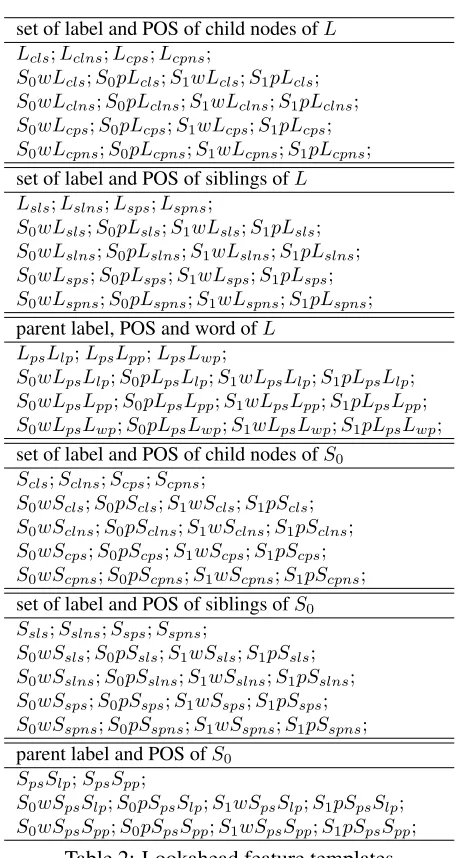
The new feature structure includes two types of fea-tures. The first is the same feature set as Liu et al. (2015), but with the SHIFT action component not havingWordandPOSinformation. We call this type of features as base features. The second is a set oflookahead features, which are shown in Table 2. HereLclsrepresents set of arc labels on child nodes
(of the word L to shift) that have been shifted on to the stack, Lclns represents set of labels on child
nodes that have not been shifted,Lsls the label set
of shifted sibling nodes, Lslns the label set of
un-shifted sibling nodes, Lcps the POS set of shifted
child nodes, Lcpns the POS set of unshifted child
nodes,Lspsthe POS set of shifted sibling nodes and Lspns the POS set of unshifted sibling nodes. Lps
is a binary feature indicating if the parent has been shifted.Llprepresents label on the parent,LppPOS
of parent andLwpthe parent word form. We define
similar lookahead features forS0. These features are instantiated only for SHIFTactions.
The new feature structure prevents all possible ac-tions from being scored simultaneously, because the lookaheadWord andPOSare now in configuration features, rather than output actions, making it neces-sary to score the shifting of different words or POS separately. This leads to reduced search speed. Nev-ertheless, our experiments show that they give a de-sirable tradeoff between efficiency and accuracy.
unlabeled labeled no pos all pos all pos all pos no dep no dep all dep all dep
W09 - 33.7 -
-Z11 - 40.1 -
-Z13 44.7 46.8 76.2 89.3
L15 49.4 50.8 82.3 82.9
[image:5.612.72.305.59.162.2]This paper 50.5 53.0 91.0 91.8
Table 4: Final results. W09 – Wann et al. (2009), Z11 – Zhang and Clark (2011b)
4 Experiments
Following previous work we conduct experiments on the Penn TreeBank (PTB), using Wall Street Journal sections 2-21 for training, 22 for develop-ment and 23 for testing. Gold-standard dependency trees are derived from bracketed sentences using Penn2Malt, and base noun phrases are treated as a single word. The BLEU score is used to evaluate the performance of linearization.
Table 4 shows a difference in scores between transition-based linearization system of Liu et al. (2015) (L15) and best-first system of Zhang (2013) (Z13). L15 performs better for word ordering with unlabeled dependency arcs, but poorly for the task of labeled syntactic linearization.
Table 3 shows a series of development experi-ments comparing our system with Z13 and L15. We vary the amount of input syntactic constraints by randomly sampling from POS and dependency labels of the development set. Our system gives consistently higher accuracies when compared with both Z13 and L15. Compared to L15, the increase in scores for unconstrained word ordering is due to the introduction of reduced feature sparsity. The im-provements on tree linearization tasks involving par-tial to full dependency constraints are also due to lookahead features that leverage tree information to reduce ambiguity early. Though slower than L15, our system is over 30 times faster compared to Z13. We compare final test scores with previous meth-ods in the literature in Table 4. Our system im-proves upon the previous best scores by 8.7 BLEU points for the task of unlabeled syntactic lineariza-tion. For the task of labeled syntactic linearization, we achieve the score of 91.8 BLEU points, the high-est results reported so far.
Table 5 contains examples of fully constrained
Fully constrained output
ref. The spinoff also will compete with Fujitsu L15 The spinoff with Fujitsu compete also will Ours The spinoff also will compete with Fujitsu ref. Dr. Talcott led a team of researchers from
the National Cancer Institute .
L15 a team of researchers from the National Cancer Institute led Dr. Talcott .
[image:5.612.324.530.60.185.2]Ours Dr. Talcott led a team of researchers from the National Cancer Institute .
Table 5: Example outputs.
output . In the first example ‘will’ is the ROOT node with two child nodes ‘also’ and ‘compete’. Looka-head feature for child dependency labelsLcls, Lclns
on the node ‘will’ can help order the segment ‘also will compete’ correctly in our system. Without such features, the system of L15 yields an output that starts with ‘The spinoff with Fujitsu’ which is locally fluent, but leaving the words ‘also’ and ‘will’ diffi-cult to handle. In the second example, ‘Dr. Talcott’ is OOV. Hence system of L15 is not able to score it and thus order it correctly. Our system makes use of both POS and dependency label of ‘Dr. Talcott’ to order it correctly.
5 Conclusion
We identified a feature sparsity issue in state-of-the-art transition-based word ordering, proposing a so-lution by redefining the feature structure and intro-ducing lookahead features. The new method gives the best accuracies on a set of benchmarks, which show that transition-based methods are a fast and accurate choice for syntactic linearization. Future work include the testing of this model in a lineariza-tion shared task (Belz et al., 2011) and investigating the integration of large scale training data (Zhang et al., 2012; Liu and Zhang, 2015).
We release our source code under GPL at
https://github.com/SUTDNLP/ZGen/ releases/tag/v0.2.
Acknowledgments
References
Anja Belz, Michael White, Dominic Espinosa, Eric Kow, Deirdre Hogan, and Amanda Stent. 2011. The first surface realisation shared task: Overview and evalu-ation results. In Proceedings of the 13th European workshop on natural language generation, pages 217– 226. Association for Computational Linguistics. Graeme Blackwood, Adri`a De Gispert, and William
Byrne. 2010. Fluency constraints for minimum bayes-risk decoding of statistical machine translation lattices. In Proceedings of the 23rd International Conference on Computational Linguistics, pages 71–79. Associa-tion for ComputaAssocia-tional Linguistics.
Bernd Bohnet, Leo Wanner, Simon Mille, and Alicia Burga. 2010. Broad coverage multilingual deep sen-tence generation with a stochastic multi-level realizer. In Proceedings of the 23rd International Conference on Computational Linguistics, pages 98–106. Associ-ation for ComputAssoci-ational Linguistics.
Danqi Chen and Christopher D Manning. 2014. A fast and accurate dependency parser using neural net-works. Proceedings of the 2014 Conference on Empirical Methods in Natural Language Processing (EMNLP), 1:740–750.
A De Gispert, M Tomalin, and W Byrne. 2014. Word or-dering with phrase-based grammars. 14th Conference of the European Chapter of the Association for Com-putational Linguistics 2014, EACL 2014, pages 259– 268.
Katja Filippova and Michael Strube. 2007. Gener-ating constituent order in german clauses. In An-nual Meeting-Association for Computational Linguis-tics, volume 45, page 320.
Wei He, Haifeng Wang, Yuqing Guo, and Ting Liu. 2009. Dependency based chinese sentence realization. In
Proceedings of the Joint Conference of the 47th An-nual Meeting of the ACL and the 4th International Joint Conference on Natural Language Processing of the AFNLP: Volume 2, pages 809–816.
Jiangming Liu and Yue Zhang. 2015. An empirical com-parison between n-gram and syntactic language mod-els for word ordering. InProceedings of the 2015 Con-ference on Empirical Methods in Natural Language Processing, pages 369–378, Lisbon, Portugal, Septem-ber. Association for Computational Linguistics. Yijia Liu, Yue Zhang, Wanxiang Che, and Bing Qin.
2015. Transition-based syntactic linearization. In
NAACL HLT 2015, The 2015 Conference of the North American Chapter of the Association for Computa-tional Linguistics: Human Language Technologies, Denver, Colorado, USA, May 31 - June 5, 2015, pages 113–122.
Joakim Nivre and Mario Scholz. 2004. Deterministic dependency parsing of english text. In Proceedings of the 20th international conference on Computational Linguistics, page 64. Association for Computational Linguistics.
Linfeng Song, Yue Zhang, Kai Song, and Qun Liu. 2014. Joint morphological generation and syntactic linearization. Proceedings of the Twenty-Eighth AAAI Conference on Artificial Intelligence, pages 1522– 1528.
Stephen Wann, Mark Dras, Robert Dale, and C´ecile Paris. 2009. Improving grammaticality in statistical sentence generation: Introducing a dependency spanning tree algorithm with an argument satisfaction model. In
Proceedings of the 12th Conference of the European Chapter of the Association for Computational Linguis-tics, pages 852–860.
Michael White and Rajakrishnan Rajkumar. 2009. Per-ceptron reranking for ccg realization. InProceedings of the 2009 Conference on Empirical Methods in Nat-ural Language Processing: Volume 1-Volume 1, pages 410–419. Association for Computational Linguistics. Michael White. 2004. Reining in ccg chart
realiza-tion. In Natural Language Generation, pages 182– 191. Springer Berlin Heidelberg.
Yue Zhang and Stephen Clark. 2011a. Syntactic process-ing usprocess-ing the generalized perceptron and beam search.
Computational linguistics, 37(1):105–151.
Yue Zhang and Stephen Clark. 2011b. Syntax-based grammaticality improvement using ccg and guided search. InProceedings of the Conference on Empir-ical Methods in Natural Language Processing, pages 1147–1157. Association for Computational Linguis-tics.
Yue Zhang and Stephen Clark. 2015. Discriminative syntax-based word ordering for text generation. Com-putational Linguistics, 41(3):503–538.
Yue Zhang, Graeme Blackwood, and Stephen Clark. 2012. Syntax-based word ordering incorporating a large-scale language model. In Proceedings of the 13th Conference of the European Chapter of the Asso-ciation for Computational Linguistics, pages 736–746. Association for Computational Linguistics.
Yue Zhang, Kai Song, Linfeng Song, Jingbo Zhu, and Qun Liu. 2014. Syntactic smt using a discriminative text generation model. In Proceedings of the 2014 Conference on Empirical Methods in Natural Lan-guage Processing (EMNLP), pages 177–182, Doha, Qatar, October. Association for Computational Lin-guistics.