Grounded Semantic Parsing for Complex Knowledge Extraction
Ankur P. Parikh∗ School of Computer Science
Carnegie Mellon University [email protected]
Hoifung Poon Kristina Toutanova Microsoft Research
Redmond, WA, USA
hoifung,[email protected]
Abstract
Recently, there has been increasing interest in learning semantic parsers with indirect super-vision, but existing work focuses almost ex-clusively on question answering. Separately, there have been active pursuits in leveraging databases for distant supervision in informa-tion extracinforma-tion, yet such methods are often limited to binary relations and none can han-dle nested events. In this paper, we gener-alize distant supervision to complex knowl-edge extraction, by proposing the first ap-proach to learn a semantic parser for extract-ing nested event structures without annotated examples, using only a database of such com-plex events and unannotated text. The key idea is to model the annotations as latent variables, and incorporate a prior that favors semantic parses containing known events. Experiments on the GENIA event extraction dataset show that our approach can learn from and extract complex biological pathway events. More-over, when supplied with just five example words per event type, it becomes competitive even among supervised systems, outperform-ing 19 out of 24 teams that participated in the original shared task.
1 Introduction
The goal of semantic parsing is to map text into a complete and detailed meaning representation (Mooney, 2007). Supervised approaches for learn-ing a semantic parser require annotated examples, ∗ This research was conducted during the author’s
intern-ship at Microsoft Research.
Information Extraction
ID TYPE CAUSE THEME TRIGGER
T1 PROTEIN - - BCL
T2 PROTEIN - - RFLAT
T3 PROTEIN - - IL-10
E1 POS-REG T1 E2 stimulates
E2 NEG-REG T3 T2 inhibition
(NEG-REG,BCL,RFLAT) (NEG-REG,IL-10,RFLAT)
Complex Event (POS-REG,BCL,(NEG-REG,IL-10,RFLAT))
[image:1.612.324.526.247.358.2]GENIA Event Annotation
Figure 1: Given sentence “BCL stimulates inhibition of RFLAT by IL-10”, information extraction focuses on classifying simple relations among entities (top), whereas ideally we want to extract the complex event that captures important contextual information (middle), as exempli-fied by the GENIA event annotation (bottom).
which are expensive and time-consuming to acquire (Zelle and Mooney, 1993; Zettlemoyer and Collins, 2005; Zettlemoyer and Collins, 2007). As a re-sult, there has been rising interest in learning se-mantic parsers from indirect supervision. Examples include unsupervised approaches that leverage dis-tributional similarity by recursive clustering (Poon and Domingos, 2009; Poon and Domingos, 2010; Titov and Klementiev, 2011), semi-supervised ap-proaches that learn from dialog context (Artzi and Zettlemoyer, 2011), grounded approaches that learn from annotated question-answer pairs (Clarke et al., 2010; Liang et al., 2011) or virtual worlds (Chen and Mooney, 2011; Artzi and Zettlemoyer, 2013).
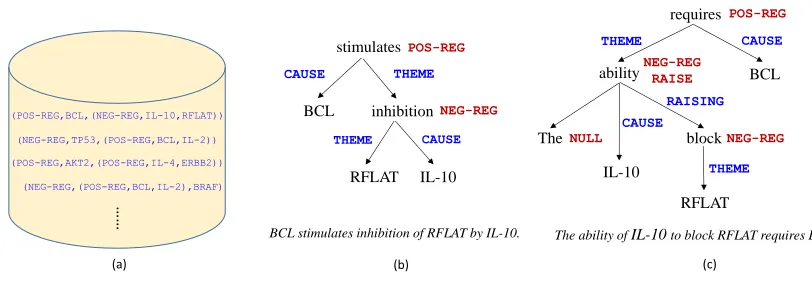
(a) (b) (c)
(POS-REG,BCL,(NEG-REG,IL-10,RFLAT))
(NEG-REG,TP53,(POS-REG,BCL,IL-2))
(POS-REG,AKT2,(POS-REG,IL-4,ERBB2))
(NEG-REG,(POS-REG,BCL,IL-2),BRAF)
……
BCL stimulates inhibition of RFLAT by IL-10. The ability of IL-10 to block RFLAT requires BCL. stimulates
inhibition
IL-10 BCL
RFLAT
THEME CAUSE
POS-REG
CAUSE THEME
NEG-REG
requires
BCL ability
RFLAT
THEME CAUSE
POS-REG
CAUSE
THEME NEG-REG
RAISE
IL-10
block
The NEG-REG
RAISING
[image:2.612.93.499.65.206.2]NULL
Figure 2: Grounded semantic parsing for complex knowledge extraction: (a) input database of complex events, without textual annotation; (b) event extraction as semantic parsing; (c) a complex sentence that requiresRAISING.
plication area for semantic parsing, with great po-tential. Text with valuable information has been undergoing rapid growth across scientific and busi-ness disciplines alike. A prominent example is PubMed (www.ncbi.nlm.nih.gov/pubmed), which contains over 24 million biomedical research arti-cles and grows by over one million each year. Re-search on information extraction abounds, but it tends to focus on classifying simple relations among entities, so is incapable of extracting the preva-lent complex knowledge with nested event struc-tures. Figure 1 illustrates this problem with an example sentence “BCL stimulates inhibition of RFLAT by IL-10”. Traditional information extrac-tion would be content with extracting two binary relation instances (NEG-REG,BCL,RFLAT) and
(NEG-REG,IL-10,RFLAT), where NEG-REG
represents a negative regulation (i.e., inhibition). However, the sentence also discloses important con-textual information, i.e., BCL regulates RFLAT by stimulating the inhibitive effect ofIL-10, and like-wise the inhibition of RFLAT by IL-10 is con-trolled by BCL. Such context-specific knowledge is crucial in translational medicine: imagine a tar-geted therapy that tries to suppress RFLAT by in-ducing either BCL or IL-10, without taking into account their interdependency. As Figure 1 shows, this knowledge can be represented by events with nested structures (e.g., theTHEME argument of E1
is an eventE2), as exemplified by the GENIA event extraction dataset (Kim et al., 2009).
Complex knowledge extraction can be naturally framed as a semantic parsing problem, with the event structure represented by a semantic parse; see
Figure 2. However, annotating example sentences is expensive and time-consuming. GENIA is the only corpus of its kind by far; its annotation took years and its scope is limited to the narrow domain of transcription in human blood cells. In contrast, databases are usually available. For example, due to the central importance of biological pathways in understanding diseases and developing drug targets, there exist many pathway databases (Schaefer et al., 2009; Kanehisa, 2002; Cerami et al., 2011). Lim-ited by manual curation, they are incomplete and not up-to-date, thereby the need for automated extrac-tion. But compared to question answering, knowl-edge extraction can derive more leverage from such databases via distant supervision (Craven and Kum-lien, 1999; Mintz et al., 2009). The key insight is that databases can be used to automatically anno-tate sentences with a relation if the arguments of a known instance co-occur in the sentence. This learn-ing paradigm, however, has never been applied to extracting nested events.
textual annotations (Figure 2). Moreover, after in-corporating prototype-driven learning using just five example words for each event type, GUSPEE be-comes competitive even among supervised systems, outperforming 19 out of 24 teams that participated in the GENIA event extraction shared task. With significant information loss (skipping event triggers and, most importantly, the nested event structures), it is possible to reduce GENIA events to binary re-lations so that existing distant-supervision methods are applicable. Yet even in such an evaluation tai-lored for existing methods, our system still outper-formed them by a wide margin.
2 Related Work
Existing approaches for GENIA event extraction are supervised methods that either used a carefully en-gineered classification pipeline (Bjorne et al., 2009; Quirk et al., 2011) or applied joint inference (Riedel et al., 2009; Poon and Vanderwende, 2010; Riedel and McCallum, 2011). Poon and Vanderwende (2010) used a dependency-based formulation that re-sembled our semantic parsing one, but learned from supervised data. Classification approaches first need to classify words into event triggers, where distant supervision is not directly applicable.
In distant supervision (Craven and Kumlien, 1999; Mintz et al., 2009), if two entities are known to have a binary relation in the database, their co-occurrence in a sentence justifies labeling the in-stance with the relation. This assumption is often incorrect, and Riedel et al. (2010) introduced latent variables to model the uncertainty; the model was later improved by Hoffmann et al. (2011). GUS-PEE generalizes this idea to structured prediction where the latent annotations are not simple classifi-cation decisions, but nested events. Krishnamurthy and Mitchell (2012) and Reddy et al. (2014) took an important step toward this direction, by learning a semantic parser based on combinatorial categorial grammar (CCG) from Freebase and web sentences. However, Krishnamurthy and Mitchell (2012) still learned from binary relations, using only simple sen-tences (of length ten or less). Reddy et al. (2014) learned from n-ary relations as well, yet their for-mulation only allows relations between entities, not relations between relations. Thus their approach
cannot represent nested events, let alone extract-ing them. And like Krishnamurthy and Mitchell (2012), Reddy et al. (2014) focused on simple text and excluded sentences where entities were not de-pendency neighbors (i.e., not directly connected in the ungrounded graph), as well as sentences with un-known entities. While such restrictions do not im-pede parsing simple questions in their evaluation, their approach is not directly applicable to com-plex knowledge extraction. Reschke et al. (2014) also generalized distant supervision to n-ary rela-tions for extracting template-based events, but sim-ilar to Reddy et al. (2014), they did not consider nested events.
Distant supervision can be viewed as a special case of the more general paradigm of grounded learning from a database. Clarke et al. (2010) and Liang et al. (2011) used the database to determine if a candidate semantic parse would yield the anno-tated answer, whereas distant supervision uses the database to determine if a relation instance is con-tained therein. Our GUSPEE system is inspired by grounded unsupervised semantic parsing (GUSP) (Poon, 2013) and shares a similar semantic repre-sentation. GUSP, like most grounded learning ap-proaches, applied to question answering and did not leverage distant supervision. GUSPEE can thus be viewed as an extension of GUSP to leverage distant supervision for complex knowledge extraction.
3 Grounded Semantic Parsing for Event Extraction
We use the GENIA event extraction task (Kim et al., 2009) as a representative example of complex knowledge extraction. The goal is to identify biolog-ical events from text, including the trigger words and arguments (Figure 1, bottom). There are nine event types, including simple ones such as Expression
andTranscriptionthat can only have oneTHEME
argument, Binding that can have more than one
THEMEargument, and regulations that can have both
THEMEandCAUSEarguments. Protein annotations are given as input.
We formulate this task as semantic parsing and present our GUSPEE system (Figure 2). The core of GUSPEE is a tree HMM (Section 3.1), which extracts events from a sentence by annotating its syntactic dependency tree with event and argument states. In training, GUSPEE takes as input unan-notated text and a database of complex events, and learns the tree HMM using EM, guided by grounded learning from the database via virtual evidence.
3.1 Problem Formulation
Lettbe a syntactic dependency tree for a sentence, with nodes ni and dependency edges di,j (nj is a
child of ni). A semantic parse of t is an
assign-ment z that maps each node to an event state and each dependency to an argument state. The semantic state of a protein word is fixed to that protein annota-tion. Basic event states are the nine event types and
NULL(signifying a non-event, e.g., “The” in Figure 2 (c)). Basic argument states areTHEME, CAUSE, andNULL. Additional states will be introduced later in Section 3.2 and 3.4.
GUSPEE modelsz, tby a tree HMM:
Pθ(z, t) = Y
m
PEMIT(tm|zm, θ)·PTRANS(zm|zπ(m), θ)
whereθare the emission and transition parameters,
m ranges over the nodes and dependency edges,
π(nj) =di,jandπ(di,j) =ni. Note that this
formu-lation implicitly assumes a fixed underlying directed tree, while the words and dependencies may vary.
Semantic parsing finds the most probable seman-tic assignment given the dependency tree:
z∗= arg max
z logPθ(z|t) = arg maxz logPθ(z, t)
In training, GUSPEE takes as input a set of complex events (databaseK) and syntactic dependency trees (unannotated textT), and maximizes the likelihood ofTaugmented by virtual evidenceφK(z).
θ∗ = arg max
θ logPθ(T|K) = arg max
θ
X
t∈T
logX
z
Pθ(z, t)·φK(z)
Virtual evidence is analogous to a Bayesian prior, but applies to variable states rather than model pa-rameters (Subramanya and Bilmes, 2007).
3.2 Handling Syntax-Semantics Mismatch
For simple sentences such as the one in Figure 2(b), the complex event can be represented by a seman-tic parse using only basic states. In general, how-ever, syntax and semantics often diverge. For ex-ample, in Figure 2(c), “requires” triggers the top
POS-NEG event that has a THEME argument trig-gered by “block”, but “ability” stands in between the two; likewise for “block” and “IL-10”. Addition-ally, mismatch could stem from errors in the syntac-tic parse. In such cases, the correct semansyntac-tic parse can no longer be represented by basic states alone. Following GUSP (Poon, 2013), we introduced a new argument stateRAISINGwhich, if assigned to a de-pendency, would require that the parent and child be assigned the same basic event state. We also intro-duce a correspondingRAISEversion for each non-null event state, to signify that the word derives its basic state fromRAISINGof a child. RAISINGis related to but not identical with type raising in CCG and other grammars. For simplicity, we did not use other complex states explored in Poon (2013).
3.3 Virtual Evidence for Grounded Learning
Grounded learning in GUSPEE is attained by incor-porating the virtual evidence φK(z), which favors
the z’s containing known events in K and penal-izes those containing unknown events. Intuitively, this can be accomplished by identifying events inz
input and can be mapped to event arguments a pri-ori. Matching sub-events with only one protein argu-ment would be too noisy without direct supervision on triggers. We thus consider matching minimum sub-events with two protein arguments.
Specifically, we preprocessed complex events in K to identify minimum logical forms contain-ing two protein arguments from each complex event, where arguments not directly leading to either protein are skipped. For example, the complex event in Figure 1 would generate three sub-events: (NEG-REG,IL-10,RFLAT),
(POS-REG,BCL,(NEG-REG,-,RFLAT)),
(POS-REG,BCL,(NEG-REG,IL-10,-)), where-signifies underspecification. We denote the set of such sub-events asS(K).
Likewise, given a semantic parsez, for every pro-tein pair in z, we would convert the minimum se-mantic parse subtree spanning the two proteins into the canonical logical form and compare it with el-ements inS(K). If the minimum subtree contains
NULL, either in an event or argument state, it sig-nifies a non-event and would be ignored. Other-wise, the canonical form is derived by collapsing
RAISINGstates. For example, in both Figure 2 (b) and (c), the minimum subtree spanning the proteins
IL-10andRFLATis converted into the same logi-cal form of(NEG-REG,IL-10,RFLAT). We de-note the set of such logical forms asE(z).
Formally, the virtual evidence in GUSPEE are:
φK(z) = exp X
e∈E(z)
σ(e, K)
where
σ(e, K) =
κ :e∈S(K)
−κ :e /∈S(K)
In distant supervision, where z is simply a binary relation, it is trivial to evaluate φK(z). (In fact,
the original distant supervision algorithm is exactly equivalent to this form, withκ =∞.) In GUSPEE, however,zis a semantic parse and evaluatingE(z)
and σ(e, K) involves a global factor that does not decompose into local dependencies as the tree HMM
Pθ(z, t). The naive way to compute the augmented
likelihood (Section 3.1) is thus intractable.
3.4 Efficient Learning with Virtual Evidence
To render learning tractable, the key idea is to aug-ment the local event and arguaug-ment states so that they contain sufficient information for evaluatingφK(z).
Specifically, the semantic statez(ni)needs to
repre-sent not only the semantic assignment toni (e.g., a NEG-REGevent trigger), but also the set of (possi-bly incomplete) sub-events in the subtree underni.
We accomplished this by representing the semantic paths from ni to proteins in the subtree. For
example, in Figure 2 (b), the augmented state of “in-hibition” would be (NEG-REG→THEME→RFLAT,
NEG-REG→CAUSE→IL-10). To facilitate canonicalization and sub-event comparison, a path containing NULL will be skipped, and
RAISING will be collapsed. E.g., in Fig-ure 2(c), the augmented state of “ability” would become (NEG-REG→THEME→RFLAT,
NEG-REG→CAUSE→IL-10).
With these augmented states,φK(z)decomposes
into local factors. The proteins underni are known
a priori, as well as the children containing them. Se-mantic paths fromni to proteins can thus be
com-puted by imposing consistency constraints for each child. Namely, for childnj that contains protein p,
the semantic path from ni to p should result from
combining z(ni), z(di,j), and the semantic path
from nj to p. The minimum sub-events spanning
two proteins underni, if any, can be derived from
the semantic paths in the augmented state. Note that if both proteins come from the same child nj, the
pair needs not be considered atni, as their minimum
spanning sub-event, if any, would be under nj and
already be factored in there.
The number of augmented states isO(sp), and the
number of sub-event evaluations isO(s·p2), wheres
is the number of distinct semantic paths, andpis the number of proteins in the subtree. Below, we show hows, pcan be constrained to reasonable ranges to make computation efficient.
would not match any database events. Likewise, cer-tain sub-paths would not occur in database events. E.g., in GENIA, simple events cannot take events as arguments, so paths containing sub-paths such as Expression → Transcription are also ille-gitimate and can be represented same as the above. We also notice that for regulation events with other regulation events as arguments, the semantics can be compressed into a single regulation event, e.g.,
POS-REG→NEG-REG is semantically equivalent with NEG-REG, as the collective effect of a posi-tive regulation on top of a negaposi-tive one is negaposi-tive. Therefore, when evaulating the semantic path from
ni to a protein during dynamic programming, we
would collapse consecutive regulation events in the child path, if any. This further reduces the length of semantic paths to at most three (regulation - regula-tion - simple event - protein).
Next, we notice that pis bounded to begin with, but it could be quite large. When a sentence con-tains many proteins (i.e., large p), it often stems from conjunction of proteins, as in “TP53 regulates many downstream targets such as ABCB1, AFP, APC, ATF3, BAX”. All proteins in the conjunct play a similar role in their respective events, such as
THEMEin the above example among “ABCB1, AFP, APC, ATF3, BAX”, and so share the same semantic paths. Therefore, prior to learning, we preprocessed the sentences to condense each conjunct into a sin-gleeffectiveprotein node. We identified conjunction by Stanford dependencies (conj ∗). In GENIA, this reduces the maximum number of effective protein nodes to two for the vast majority of sentences (over 90%). Both representation and evaluation are now reasonably efficient. To further speed up learning, in our experiments we only trained on sentences with at most two effective protein nodes, as this already performed quite well. Training on GENIA took 1.5 hours and semantic parsing of a sentence took less than a second (with one i7 core at 2.4 GHz).
Unlike RAISING, the augmented states intro-duced in this section are specific to GENIA events. However, the rules to canonicalize states are general and can potentially be adapted to other domains. An alternative strategy to combat state explosion is by embedding the discrete states in a low-dimensional vector space (Socher et al., 2013), which is a direc-tion for future research.
3.5 Features
The GUSPEE model uses log-linear models for the emission and transition probabilities and trains using feature-rich EM (Berg-Kirkpatrick et al., 2010). The features are:
Word emission I[lemma=l, zm =n];
Dependency emission I[dependency = d, zm =
e]wheree /∈ {NULL,RAISE};
Transition I[zm = a, zπ(m) = b] where a, b /∈
{NULL,RAISE}.
To modulate the model complexity, GUSPEE imposes a standard L2 prior on the weights, and includes the following features with fixed weights:
• WNULL: apply toNULLstates;
• WRAISE−P: apply to proteinRAISING;
• WRAISE−E: apply to eventRAISING.
The advantage of a feature-rich representation is flexibility in feature engineering. Here, we ex-cludedNULL andRAISE in dependency emission and transition features, and regulated them sepa-rately to enable parameter tying for better general-ization.
4 Experiments
4.1 Evaluation on GENIA Event Extraction
In principle, we can learn GUSPEE from any path-way database. However, evaluation is challenging as these databases do not contain textual annotations. Prior work on distant supervision resorted to sam-pling and annotating new extractions. This is effec-tive for comparing among distant-supervision sys-tems, but it cannot be used to compare them with supervised learning. Moreover, as annotation is con-ducted by the authors or crowdsourcing, consistency and quality are hard to control.
Event Type Rec. Prec. F1
Expression 50.8 41.9 45.9
Transcription 18.3 14.0 15.9
Catabolism 0 0 0
Phosphorylation 36.2 43.6 39.5
Localization 0 0 0
Binding 24.0 42.6 30.7
Regulation 2.5 5.0 3.3
Positive regulation 11.4 21.4 14.9
Negative regulation 4.4 16.4 6.9
[image:7.612.82.289.58.196.2]Total Event F1 19.1 29.4 23.2
Table 1: GENIA event extraction results of GUSPEE
evaluation methodology enables us to assess the true accuracy and compare head-to-head with supervised methods.
GENIA contains 800 abstracts for training and 150 for development. It also has a test set, but its annotation is not made public. Therefore, we used the training set for grounded learning and develop-ment, and reserved the development set for testing. The majority events are Regulation (including
Positive regulation,Negative regulation). See Kim et al. (2009) for details. We processed all sentences using SPLAT (Quirk et al., 2012), to conduct tokenization, part-of-speech tagging, and constituency parsing. We then postprocessed the parses to obtain Stanford dependencies (de Marneffe et al., 2006). During development on the training data, we found the following parameters (Section 3) to perform quite well and used them in all subsequent experiments: κ = 20, WNULL = 4, WRAISE−P = 2,WRAISE−E = −6,L2 prior= 0.1.
Interestingly, we found that encouraging protein
RAISINGis beneficial, which probably stems from the fact that proteins are often separated from event triggers by noun modifiers, such as “the BCL gene”, “IL-10 protein”.
Table 1 shows GUSPEE’s results on GENIA event extraction. Note that this event-based eval-uation is rather stringent, as it considers an event incorrect if one of its argument events is not com-pletely correct, thus an incorrect event will render all its upstream events incorrect. See Kim et al. (2009) for details. For comparison, Table 2 shows the results of MSR11, a state-of-the-art supervised system. MSR11 also provides a upper bound for the supervised version of GUSPEE, as the latter is much less engineered.
Event Type Rec. Prec. F1
Expression 76.4 81.5 78.8
Transcription 49.4 73.6 59.1
Catabolism 65.6 80.0 74.4
Phosphorylation 73.9 84.5 78.9
Localization 74.6 75.8 75.2
Binding 48.0 50.9 49.4
Regulation 32.5 47.1 38.6
Positive regulation 38.7 51.7 44.3
Negative regulation 35.9 54.9 43.9
[image:7.612.322.529.58.194.2]Total Event F1 50.2 62.6 55.7
Table 2: GENIA event extraction results of state-of-the-art supervised system MSR11 (Quirk et al., 2011).
Not surprisingly, grounded learning with GUS-PEE still lags behind supervised learning. MSR11 used a rich set of features, including POS tags, linear and dependency n-grams, etc. Also, it is expected that indirect supervision do not provide as effective signals as direct supervision. However, the com-parison reveals a particularly interesting contrast. Event types such as Expression, Catabolism,
Phosphorylation, and Localization are rela-tively easy, yet GUSPEE performed rather poorly on them. Simple events do not admit multiple ar-guments, so they appear less often in the virtual evi-dence, and grounded learning has difficulty learning these event types, especially their triggers. In light of this, it’s actually remarkable that GUSPEE still learned a substantial portion of them.
4.2 Prototype-Driven Learning
While full-blown annotations are undoubtedly ex-pensive and time-consuming to generate, it is rather easy for a domain expert to provide a few trig-ger words per event type, such as “expression”, “expressed” for Expression. This motivates us to explore prototype-driven learning (Haghighi and Klein, 2006) in combination with grounded learn-ing. Specifically, we simulated expert selection by picking the top five most frequent trigger words for each event type from training data. We then augmented grounded learning in GUSPEE by in-corporating word emission features for each proto-type word and the corresponding event state, e.g., I[lemma = express, zm = Expression]. The
Event Type Rec. Prec. F1
Expression 55.3 88.3 68.0
Transcription 50.0 39.1 43.9
Catabolism 52.4 100.0 68.9
Phosphorylation 61.7 82.9 70.7
Localization 52.8 100.0 69.1
Binding 20.2 92.7 33.2
Regulation 24.1 64.0 35.0
Positive regulation 17.4 63.8 27.4
Negative regulation 8.4 52.8 14.5
[image:8.612.81.292.59.193.2]Total Event F1 27.9 72.2 40.2
Table 3: GENIA event extraction results of GUSPEE with five prototype words per event type
0.1 0.2 0.3 0.4 0.5 0.6 0.7 0.8 0.9 1.0 30
35 40
GENIA Event Extraction F1
Incomplete Database Incomplete Text
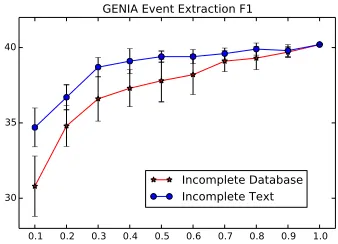
Figure 3: GENIA Event F1 of GUSPEE with prototypes, using incomplete database or text.
events such asCatabolismbenefited the most from prototypes, as they have fewer variations in trig-gers. While the F1 score 40.2 still lags behind the supervised state of the art, it would have been competitive compared to the 24 teams participat-ing in the original shared task, outperformparticipat-ing 19 of them (the top 5th system scored an F1 of 40.5, see
www.nactem.ac.uk/tsujii/GENIA/SharedTask /results/results-master.html, Task 1).
4.3 Database-Text Mismatch
In our simulation of grounded learning, every event in the database is mentioned in some text and vice versa. In practice, however, there is usually a mis-match between database and text: the unannotated text generally contains more facts than are already populated in the database; conversely, a database fact may not be explicitly mentioned in the text.
The GENIA dataset offers an excellent opportu-nity to study the robustness of grounded learning in light of such mismatch. Specifically, we
simu-0.1 0.2 0.3 0.4 0.5 0.6 0.7 0.8 0.9 1.0 15
20 25 30 35
40 GENIA Event Extraction F1
10% Database 50% Database
Figure 4: GENIA Event F1 of GUSPEE with prototypes, using a fraction of database and increasing amount of unannotated text.
[image:8.612.336.529.63.195.2]lated a grounded learning scenario with an incom-plete database by populating events from the anno-tations of a random fraction of training text, and then learning GUSPEE with this database and all training text. Likewise, we simulated a scenario with incom-plete text using the training event database in full, but only a fraction of unannotated text.
Figure 3 shows the results of GUSPEE with proto-types as the fraction varies between 0.1 and 1, by av-eraging five random runs. In both scenarios, the F1 score degrades smoothly as the fraction gets smaller. Precision stays roughly the same while recall grad-ually degrades (curves not shown). This shows that GUSPEE is reasonably robust. Not surprisingly, the degradation is steeper with incomplete database than with incomplete text.
To further investigate the effect of unannotated text, we also randomly sampled a fraction of database events for grounded supervision, and eval-uated GUSPEE with increasing amounts of unanno-tated text. Figure 4 shows the results by averaging nine random runs. The F1 increases steadily with additional unannotated text, mainly due to rising re-call (curves not shown). This suggests that GUSPEE could potentially benefit from more unannotated text and is reasonably robust even when some text is not relevant to the available events. As expected, more grounded supervision (50% vs. 10% database) led to substantially better F1 and lower variation.
4.4 Error Analysis
[image:8.612.88.257.244.366.2]introduced complex states such as Sinking and
Implicitto combat syntax-semantics mismatch, which could also be incorporated into GUSPEE. Improving syntactic parsing, either separately by adapting to the biomedical domain, or jointly along with semantic parsing, is another important future direction. GUSPEE achieved better precision than recall, especially when learning with prototypes, and might benefit from augmenting prototypes by distri-butional similarity (Haghighi and Klein, 2006).
4.5 Comparison with Existing Distant Supervision Approaches
Existing distant supervision approaches are not di-rectly applicable to extracting nested events. How-ever, we can convert the extraction task into clas-sifying minimum sub-events between proteins, for which existing methods can be applied. Specifically, we used binary sub-events inS(K)(Section 3.3) for distant supervision, and evaluated on classifying test sentences. This would enable an interesting compar-ison with GUSPEE, as the latter also derived indirect supervision fromS(K) alone. Textual annotations of triggers and nested event structures in GUSPEE output were ignored, and prototypes were not used to enable a fair comparison. For distant supervision, we used the state-of-the-art MultiR system (Hoff-mann et al., 2011) with standard lexical and syntac-tic features (Mintz et al., 2009). MultiR can be used for supervised learning by fixing relations according to the sentence-level annotations, which provides a supervised upper bound.
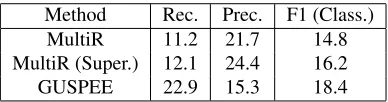
Table 4 shows the results. GUSPEE outperformed MultiR by a wide margin, improving F1 by 24%. Surprisingly, GUSPEE even surpassed the super-vised upper bound of MultiR. This suggests that our semantic parsing formulation not only is supe-rior in representation power, but also facilitates bet-ter learning. We also experimented with sharing parameters among related sub-events in a MultiR-like model, but it did not improve the performance. Upon close inspection, we found that MultiR mainly scored on Binding events and failed almostly en-tirely on the more difficult Regulation events. GUSPEE was able to extract Regulation events, but incurred some precision errors.
Method Rec. Prec. F1 (Class.)
MultiR 11.2 21.7 14.8
MultiR (Super.) 12.1 24.4 16.2
[image:9.612.330.524.59.110.2]GUSPEE 22.9 15.3 18.4
Table 4: Classification results on GENIA when events are simplified to binary relations for distant supervision.
5 Summary
We generalize distant supervision to complex knowledge extraction and propose the first approach to learn a semantic parser from a database of nested events and unannotated text. Experiments on GE-NIA event extraction showed that our GUSPEE sys-tem could learn from and extract such complex events, and was competitive even among supervised systems after incorporating a few easily-obtainable prototype event trigger words.
Future directions include: PubMed-scale path-way extraction; application to other domains; in-corporating additional complex states to address syntax-semantics mismatch; learning vector-space representations for complex states; joint syntactic-semantic parsing; incorporating reasoning and other sources of indirect supervision.
References
Yoav Artzi and Luke Zettlemoyer. 2011. Bootstrapping semantic parsers from conversations. InProceedings of the 2011 Conference on Empirical Methods in Nat-ural Language Processing.
Yoav Artzi and Luke Zettlemoyer. 2013. Weakly su-pervised learning of semantic parsers for mapping in-structions to actions. Transactions of the Association for Computational Linguistics, 1:49–62.
Taylor Berg-Kirkpatrick, John DeNero, and Dan Klein. 2010. Painless unsupervised learning with features. In Proceedings of Human Language Technologies: The 2010 Annual Conference of the North American Chap-ter of the Association for Computational Linguistics. Jari Bjorne, Juho Heimonen, Filip Ginter, Antti Airola,
David Chen and Ray Mooney. 2011. Learning to in-terpret natural language navigation instructions from observations. InProceedings of the Twenty Sixth Na-tional Conference on Artificial Intelligence.
James Clarke, Dan Goldwasser, Ming-Wei Chang, and Dan Roth. 2010. Driving semantic parsing from world’s response. In Proceedings of the 2010 Con-ference on Natural Language Learning.
M. Craven and J. Kumlien. 1999. Constructing biolog-ical knowledge bases by extracting information from text sources. In Proceedings of the 7th International Conference on Intelligent Systems for Molecular Biol-ogy, pages 77–86. AAAI Press.
Marie-Catherine de Marneffe, Bill MacCartney, and Christopher D. Manning. 2006. Generating typed dependency parses from phrase structure parses. In Proceedings of the Fifth International Conference on Language Resources and Evaluation, pages 449–454, Genoa, Italy. ELRA.
Aria Haghighi and Dan Klein. 2006. Prototype-driven learning for sequence models. InProceedings of the Forty Fourth Annual Meeting of the Association for Computational Linguistics.
Raphael Hoffmann, Congle Zhang, Xiao Ling, Luke Zettlemoyer, and Daniel S. Weld. 2011. Knowledge-based weak supervision for information extraction of overlapping relations. In Proceedings of the Forty Ninth Annual Meeting of the Association for Compu-tational Linguistics.
Minoru Kanehisa. 2002. The kegg database. Silico Sim-ulation of Biological Processes, 247:91–103.
Jin-Dong Kim, Tomoko Ohta, Sampo Pyysalo, Yoshi-nobu Kano, and Junichi Tsujii. 2009. Overview of BioNLP-09 Shared Task on event extraction. In Pro-ceedings of the BioNLP Workshop.
Jayant Krishnamurthy and Tom M. Mitchell. 2012. Weakly supervised training of semantic parsers. In EMNLP-12.
Percy Liang, Michael Jordan, and Dan Klein. 2011. Learning dependency-based compositional semantics. In Proceedings of the Forty Ninth Annual Meeting of the Association for Computational Linguistics. Mike Mintz, Steven Bills, Rion Snow, and Dan Jurafsky.
2009. Distant supervision for relation extraction with-out labeled data. InProceedings of the Forty Seventh Annual Meeting of the Association for Computational Linguistics.
Raymond J. Mooney. 2007. Learning for semantic pars-ing. InProceedings of the Eighth International Con-ference on Computational Linguistics and Intelligent Text Processing, pages 311–324, Mexico City, Mex-ico. Springer.
J. Pearl. 1988. Probabilistic Reasoning in Intelligent Systems: Networks of Plausible Inference. Morgan Kaufmann, San Francisco, CA.
Hoifung Poon and Pedro Domingos. 2009. Unsuper-vised semantic parsing. InProceedings of the 2009 Conference on Empirical Methods in Natural Lan-guage Processing, pages 1–10, Singapore. ACL. Hoifung Poon and Pedro Domingos. 2010.
Unsuper-vised ontological induction from text. InProceedings of the Forty Eighth Annual Meeting of the Association for Computational Linguistics, pages 296–305, Upp-sala, Sweden. ACL.
Hoifung Poon and Lucy Vanderwende. 2010. Joint infer-ence for knowledge extraction from biomedical liter-ature. InProceedings of Human Language Technolo-gies: The 2010 Annual Conference of the North Ameri-can Chapter of the Association for Computational Lin-guistics.
Hoifung Poon. 2013. Grounded unsupervised semantic parsing. InProceedings of the Fifty First Annual Meet-ing of the Association for Computational LMeet-inguistics. Chris Quirk, Pallavi Choudhury, Michael Gamon, and
Lucy Vanderwende. 2011. Msr-nlp entry in bionlp shared task 2011. InProc. BioNLP.
Chris Quirk, Pallavi Choudhury, Jianfeng Gao, Hisami Suzuki, Kristina Toutanova, Michael Gamon, Wentau Yih, and Lucy Vanderwende. 2012. MSR SPLAT, a language analysis toolkit. InProceedings of NAACL HLT Demonstration Session.
Siva Reddy, Mirella Lapata, and Mark Steedman. 2014. Large-scale semantic parsing without question-answer pairs. Transactions of the Association for Computa-tional Linguistics.
Kevin Reschke, Martin Jankowiak, Mihai Surdeanu, Christopher D Manning, and Daniel Jurafsky. 2014. Event extraction using distant supervision. In Lan-guage Resources and Evaluation Conference (LREC). Sebastian Riedel and Andrew McCallum. 2011. Fast and robust joint models for biomedical event extraction. In Proceedings of the Conference on Empirical Methods in Natural Language Processing.
Sebastian Riedel, Hong-Woo Chun, Toshihisa Takagi, and Jun’ichi Tsujii. 2009. A markov logic approach to bio-molecular event extraction. InProc. BioNLP. Sebastian Riedel, Limin Yao, and Andrew McCallum.
2010. Modeling relations and their mentions without labeled text. InProceedings of the Sixteen European Conference on Machine Learning.
Richard Socher, John Bauer, Christopher D. Manning, and Andrew Y. Ng. 2013. Parsing with composi-tional vector grammars. In Proceedings of the Fifty First Annual Meeting of the Association for Computa-tional Linguistics.
Mark Steedman. 2000. The syntactic process, vol-ume 35. MIT Press.
Amarnag Subramanya and Jeff Bilmes. 2007. Virtual evidence for training speech recognizers using par-tially labeled data. In Proceedings of Human Lan-guage Technologies: The 2007 Annual Conference of the North American Chapter of the Association for Computational Linguistics.
Ivan Titov and Alexandre Klementiev. 2011. A bayesian model for unsupervised semantic parsing. In Proceed-ings of the Forty Ninth Annual Meeting of the Associ-ation for ComputAssoci-ational Linguistics.
John M. Zelle and Ray Mooney. 1993. Learning seman-tic grammars with constructive inductive logic pro-gramming. In Proceedings of the Eleventh National Conference on Artificial Intelligence.
Luke S. Zettlemoyer and Michael Collins. 2005. Learn-ing to map sentences to logical form: Structured clas-sification with probabilistic categorial grammers. In Proceedings of the Twenty First Conference on Un-certainty in Artificial Intelligence, pages 658–666, Ed-inburgh, Scotland. AUAI Press.