Combining syntactic patterns and Wikipedia's hierarchy of hyperlinks
to extract meronym relations
Debela Tesfaye , Michael Zock and Solomon Teferra
ITPHD PROGRAM, Addis Ababa University, Addis Ababa, Ethiopia LIF-CNRS, 163 Avenue de Luminy, 13288 Marseille, France
Addis Ababa University, Addis Ababa, Ethiopia
[email protected] , [email protected], [email protected]
Abstract
We present here two methods for extraction o, meronymic relation : (a) the first one relies solely on syntactic information. Unlike other approaches based on simple patterns, we determine their optimal combination to extract word pairs linked via a given semantic relation; (b) the second approach consists in combining syntactic patterns with the semantic information extracted from the Wikipedia hyperlink hierarchy (WHH) of the constituent words. By comparing our work with SemEval 2007 (Task 4 test set) and WordNet (WN) we found that our system clearly outperforms its competitors.
1
Introduction
The attempt to discover automatically semantic
relations (SR) between words, or word pairs has
attracted a number of researchers during the last decade which is understandable given the number of applications needing this kind of information. Question Answering, Information Retrieval and Text Summarization being examples in case (Turney and Littman, 2005; Girju et al., 2005).
SRs extraction approaches can be categorized on the basis of the kind of information used. For example, one can rely on syntactic patterns or semantic features of the constituent words. One may as well combine these two approaches.
The method using only syntactic information relies on the extraction of word-level, phrase-level, or sentence-level syntactic information. This approach has been introduced by Hearst (1992) who showed that by using a small set of
lexico-syntactic patterns (LSP) one could extract with
high precision hypernym noun pairs. Similar
methods have been used since then by (Auger and Barriere, 2008; Marshman and L‟Homme, 2006). These authors reported results of high precision for some relations, for example hyponymy, noting poor recall which was low. Furthermore, the performance of this approach varies considerably depending on the type of relation considered (Ravichandran and Hovy, 2002, Girju et al., 2005.
An alternative to the syntactic approach is a
method relying on the semantics features of a pair of words. Most researchers using this approach (Alicia, 2007; Hendrickx et.al, 2007) rely on in-formation extracted from lexical resources like WN (Fellbaum, 1998). Alas, this method works only for languages having a resource equivalent to
WN. Yet, even WN may pose a proble because of
its low coverage across domains (tennis problem). Hybrid approaches consist in the combination of syntactic patterns with the semantic features of the constituent words (Claudio, 2007; Girju et.al 2005). They tend to yield better results. However,
their reliance on WN make them amenable to the
same criticism as the ones just mentioned
concerning WN. More recently Wikipedia based
similarity measures have been proposed (Strube, et.al, 2006; Gabrilovich, and Markovitch, 2007). While this strategy produces excellent results, few
attempts have been made to extract SRs
(Nakayama et. al, 2007; Yulan et, al , 2007). In this paper we propose two approaches to extract meronymic relations. In the first case we
rely on the patterns learned from LSPs. Previous
syntactic approaches aimed at finding stand-alone,
unambiguous LSPs, for instance X such as Y, in
order to extract a semantic relation like hyponymy.
Yet, such unambiguous, stand-alone LSPs are very
rare and yield low performance. Instead of using
LSPs individually, which are often ambiguous, we
try to combine them in such a way that they
plete each other. For instance, the ambiguity of the
pattern “NN1 make of NN2” can be reduced via the
pattern “NN2 to make NN1“in order to extract
me-ronymy. NN1 and NN2 can stand for any pair of
words. The second approach consists in
disambi-guating the word pairs extracted by LSPs via the
information identified from the Wikipedia pages of the respective words.
Our contributions are twofold. First, we propose a novel technique for extracting and combining LSPs in order to extract SRs. Second, we propose an approach for disambiguating the syntactic
patterns (say meronymic patterns like NN1
-has-NN2) by building a hyperlink-hierarchy based on
Wikipedia pages.
2
Our Approach in more detail
Previous work relies on unambiguous, stand alone
LSPs to extract SRs. While this approach allows
for high precision, it has been criticized for its low accuracy and its variability in terms of the SRs to be extracted. Not all SRs are equally well 'identified'. One of the main challenges and
motivations for LSP mining lies in the
disambiguation of LSP to allow for the extraction
of SRs. To achieve this, we propose two methods:
─Determine an optimal combination of LSPs to
represent the relation at hand (section 2.1).
─Combining LSPs with the semantic features
of the constituent words extracted from the Wikipedia hyperlink-hierarchy (section 2.2).
2.1
Combination of syntactic patterns for relationextraction (CoSP-FRe)
The use of individual LSP for the extraction of
word pairs linked via a given SR tends to produce
poor results (Girju et al., 2005; Hearst, 1998). One reason for this lies in the fact that the majority of
word pairs are linked via polysemous LSPs (Girju
et.al , 2005). Hence, these patterns cannot be used alone, as they are ambiguous. At the same time they cannot be ignored as they have the potential to
provide good clues concerning certain SRs. This
being so we suggest to assign weights to the LSPs
according to their relevance for a specific SR, and
to optimally combine such weighted patterns for extracting word pairs linked via the SR at hand.
In order to determine the optimal combination
of LSPs likely to extract SRs, we have harvested all
LSPs encoding the relation at hand. We assigned
weights to the patterns according to their relevance
for the given SRs, and finally filtered the best
combination of LSPs.
In order to extract such patterns linking word
pairs via a certain SR , we selected seed-word
pairs representative of the relation at hand. In order to balance the word pairs we followed standard taxonomies to group the relations and selected samples from each group (see Section 3.1.1). Sentences containing the word pairs were extracted and then identified their dependency structure. We identified dependency structure linking the word
pairs using the shortest path (ex. nsubj(have,
aircraft) and dobj(have, engines) from the sentence aircrafts have engine). Having replaced the words
by NN1 (whole) and NN2 (part) we obtained
pat-terns like NN1 have NN2. We finally counted the
frequency of the LSPs and ordered them according
to their frequency and considering the top 50.
Determination of the optimal combination of
LSPs encoding a given SR. To determine the optimal combination of LSPs, we identyfied the
discrimination value (DV) for each pattern. The DV
is a numerical value signaling the relevancy of a
given LSP with respect to a given SR. We applied
the following steps in order to identify the DV and
to determine the optimal combination of the LSPs:
Step 1: For each extracted LSP, we extracted more connected word pairs from Wikipedia. We defined regular expression matching sentences
linking word pairs via the LSPs and built then
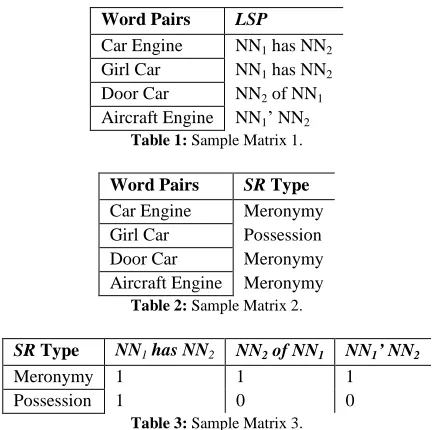
word pairs in a LSPs matrix (Matrix 1). Table 1
be-low shows sample word pairs connected by the patterns NN1 has NN2 andNN2 of NN1. Next, we
labeled the extracted word pairs with the SR type
and built a matrix of word pairs by a specific SR
type (Matrix 2). In Table 2 the word pairs from matrix 1 are labeled with their respective type of
SR. We relied on WN to automatically label the
word pairs. Starting with the first sense of the
words occurring in WN, we traverse the hierarchies
and identify the SRs encoded by the word pairs.
LSPs' encoding. The cells are populated by the
number of word pairs linked by the LSP encoding
the SR. The DV of LSP for a given SR is given by
the following formula:
TRE TNR FP
FPR
DV log (1)
FP represents the total number of word pairs
connected by the LSP (from Matrix 1). FPR stands
for the number of word pairs connected by the
given SR (from Matrix 2), while TNR and TRE
represent respectively the total number of SRs
(from Matrix 3) and the total number of SRs encoded by the pattern (from Matrix 3).
Word Pairs LSP Car Engine NN1 has NN2 Girl Car NN1 has NN2 Door Car NN2 of NN1 Aircraft Engine NN1‟ NN2
Table 1: Sample Matrix 1.
[image:3.612.77.295.241.456.2]Word Pairs SR Type Car Engine Meronymy Girl Car Possession Door Car Meronymy Aircraft Engine Meronymy
Table 2: Sample Matrix 2.
SR Type NN1 hasNN2 NN2 of NN1 NN1’ NN2
Meronymy 1 1 1
Possession 1 0 0
Table 3: Sample Matrix 3.
Step 2: Identify the optimal combination of LSP
to represent a given relation. First, we build a
matrix combining LSPs encoding the respective
SRs (Matrix 4) from matrix 3. The LSPs in Matrix
3 are combined until no other combination is possible. The cells of the Matrix 4 are populated by the number of word pairs linked via the respective
combination of LSPs. Next we calculated the
discrimination value (DV-g) for the combined
LSPs, the DV-g being calculated for each
combination of LSP corresponding to a given SR.
We then selected the combination of LSPs with
maximum DV-g for each SR. The DV-g for the
combined LSPs corresponding to a given SR is given by the following formula:
g TRE
TNR g
FP g FPR g
DV log (2)
FP-g expresses the total number of word pairs
connected by the group of patterns. It is
determined by taking the intersection of word pairs
connected via the combined LSPs (from Matrix 4),
where FPR-g represents the number of word pairs
connected by the combined LSPs for a given SR.
This value is determined by taking the intersection of positive word pairs connected by the combined
LSP for a given SR (from Matrix 4). Finally, TNR
and TRE represent respectively the total number of
SRs (from Matrix 4) and the total number of SRs
encoded by the combination of the LSP.
SR Type NN1 hasNN2+ NN2 of NN1 NN2 of NN1+ NN1’ NN2
Meronymy 2 2
Possession 0 0
Table 4: Sample Matrix 4.
As can be seen from table 3, the pattern “NN1 has
NN2” when used independently encodes both a
me-ronymic and a non-meme-ronymic word pair. From ta-ble 4 above there are two meronymic word pairs
linked by the combination of patterns “NN1 has
NN2 + NN2 of NN1” while there are no
non-meronymic word pairs. Hence the non-non-meronymic
word pair retrieved via the pattern “NN1 has NN2”
is filtered out as a result of having combined it withthe pattern “NN2 of NN1”.
2.2
Wikipedia hyperlink hierarchies for SRextraction (WHH-Fsre): the case of
meronymy extraction
We used here the hyperlink-hierarchies built on the basis of a selected set of sentences of Wikipedia pages containing the respective word pairs in order
to disambiguate LSPs encoding them. The basic
motivations behind this approach are as follows:
1.Words linked to the Wikipedia page title (WPT)
via LSP encoding SR are more reliable than
word pairs linked in arbitrary sentences.
2.Word pairs encoding a given SR are not always
directly connected via LSPs. SRs encoded by a
given word pair can also be encoded by their respective higher/lower order conceptual terms. For instance, the following two sentences "germ is an embryo of seed" and "grain is a seed" yield
relations like hyponymy (germ, embryo, and
grain, seed), meronymy (embryo, seed, and
germ, grain), the latter (germ, grain) being inferred via the relation of their higher order terms (embryo and seed).
The candidate meronymic word pairs extracted
the patterns learned from their conceptual hierarchies built on the basis of semantic links,
namely, 'hypernymic-link' (HL), and the
„meronymic-link’ (ML). We extracted the hyperlinks connected to the Wikipedia pages of the
respective meronymic candidates by using
hypernymic and meronymic LSP. The hyperlink
hierarchies were built by considering only important sentences (1 and 2 below) from the Wikipedia pages of the pair of terms: (1) definition sentences and (2) sentences linking hyperlinks to
the WPT using meronymic LSPs. Since the
meronymic LSP vary according to the nature of the
arguments, the patterns used to extract hyperlinks for building the hierarchies were learned by taking the nature of the meronymic relations into account (section 2.1). The definition sentences are used to
extract hypernymic-hyperlink1, and the sentences
linking hyperlinks to the WPT using meronymic
LSPs are used to extract meronymic-hyperlink2.
Using the hierarchy constructed for the candidate word pairs, this approach determines whether the pairs are meronyms or not based on the following assumptions:
(a)The hyperlink hierarchies of hierarchical
meronymys constructed form their
respective HL have a common ancestor in
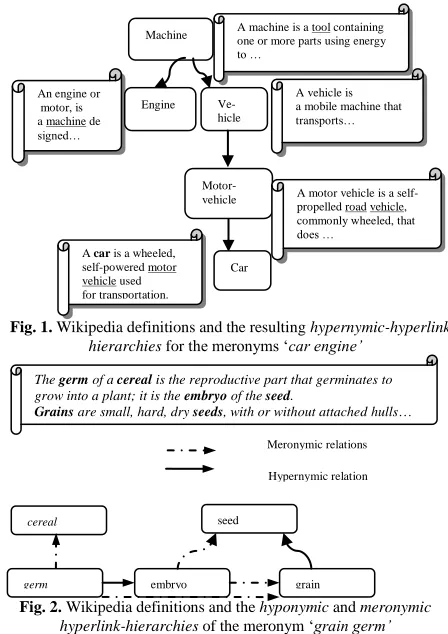
the hierarchy. Figure 1 shows the
compo-nent-Integral meronyms „car engine’ sharing
the parent „machine’ in their
hyperlink-hierarchy constructed from their respective Wikipedia page definitions.
(b)The hyperlink hierarchies of both
hierarchical and non-hierarchical-meronyms
constructed from their respective ML and/or
HL converge along the path in the hierarchy.
Extraction of the hyperlinks. To extract the
hyperlinks, we performed the following operations:
Step 1: For simple meronymic pairs we identified
the respective Wikipedia pages aligning the word
pairs with the WPT based on the overlap of the
1The hypernymic-hyperlink is a word defining a term via its higher-order concept, providing in addition a hyperlink to oth-er Wikipedia pages for furthoth-er reading. The hypernymic-hyperlinks are underlined on figure 1.
2Meronymic-hyperlink is a word describing a term using its whole concept and providing a hyperlink to other Wikipedia pages for further reading.
surface word form. The word pairs were selected based on standard categories used for describing meronymic taxonomy (Winston et al. 1987, see also section 3.1.1). We first cleaned Wikipedia articles and extracted Wikipedia definitions and
sentences linking WPT with hyperlinks using
meronymic LSPs.
Step 2: Annotations. We manually annotated both kinds of sentences using two kinds of information:
WPT and the hyperlinks. The hyperlink either links
the term to its meronyms or hypernyms.
Step 3: Extract LSPs linking the WPT with the
hyperlinks. We assigned DV (section 2.1) for the
patterns and considered the most frequent LSPs.
The hyperlinks broadly fall in either of two
categories: (a) hypernymic-hyperlink. They are
extracted by the patterns linking the tuple
(hyperlink, wpt), for instance, is-a (hyperlink, Wikipedia page title) as in the example (b,c); (b)
meronymic-hyperlinks. They are extracted via
LSPs linking the tuple (hyperlink, wpt), for
instance, made-from (hyperlink, wpt).
[image:4.612.314.538.347.664.2]Fig. 1. Wikipedia definitions and the resulting hypernymic-hyperlink hierarchies for the meronyms „car engine’
Fig. 2. Wikipedia definitions and the hyponymic and meronymic hyperlink-hierarchies of the meronym „grain germ’
Constructing the hierarchy. For a given pair of terms, we identified the respective Wikipedia
cereal
germ embryo grain seed
Meronymic relations
Hypernymic relation
The germ of a cereal is the reproductive part that germinates to grow into a plant; it is the embryo of the seed.
Grains are small, hard, dry seeds, with or without attached hulls…
An engine or motor, is a machine de signed…
Engine Machine
Ve-hicle
Motor-vehicle
Car
A motor vehicle is a self-propelled road vehicle, commonly wheeled, that does …
A vehicle is a mobile machine that transports… A machine is a tool containing one or more parts using energy to …
pages, by aligning the pairs with the wpt and by using word form overlap to extract their associated
initial hypernymic and meronymic hyperlinks (hli)
based on the patterns learned in step 2.2.1. We further identified the respective Wikipedia pages
for the hypernymic and meronymic-hyperlink (hli)
identified before and extracted the associated
hypernymic and meronymic hyperlinks (hli+1).
Next we connected (hli) with (hli+1) to form a
hierarchy (hypernyms are connected to each other and to meronyms and vice versa). The hyperlinks are extracted until the hierarchies converge, or
until the hypernymic-hierarchy reaches seven
layers (most word pairs converge earlier than that).
Decide on the meronymic status of words.
The hypernymic or meronymic-hyperlink of one of the words of the pair is searched in the hierarchy
of the other, and if this link occurs we consider the word pairs as meronyms. Figure 2 shows that the
meronymic word pair „germ grain‟ converges at
„seed’ in the hierarchies built from their respective Wikipedia pages.
3
Experiment
To show the validity of our line of reasoning we carried out three experiments:
I.Extract the optimal combination of LSPs
encod-ing meronymic relation only.
II.Evaluate CoSP-FRe for meronymy extraction.
III.Evaluate WHH-Fre for extracting meronymy.
3.1
Extract the optimal combination of LSPsencoding meronymy
Training data set. Two sets of data are required: (a) the initial meronymic word pairs used to train
our system (b) the corpus from which the LSPs
were selected. To select the representative list of meronymic pairs, we used a standard taxonomy. Indeed, several scholars have proposed taxonomies of meronyms (Winston et al., 1987; Pribbenow, 1995; Keet & Artale, 2008). We followed Winston‟s classical proposal:
component – integral-object (cio) handle– cup member – collection (mc) tree – forest portion – mass (pm) grain – salt stuff – object (so) steel – bike feature–activity (fa) paying–shopping place-area (pa) oasis–desert
For the training we used the part-whole training set of SemEval-2007 task 4 (Girju et al. 2007) .
Experimental setup. To determine the optimal combination of LSPs encoding meronyms we
identified LSPs encoding meronymy according to
the procedures described in section 2.1. Since most of these patterns are rare we considered only those with a frequency of 100 and above. For individual
LSP extraction, we identified the DVs associated
with the meronymic relation by using the formula
1 followed by the DV-gs for every combination of
LSPs by using the second formula. The combined
LSPs are sorted based on their DV. Finally we
selected the LSP with the highest DV as
representatives of the respective meronymic types.
Sno Pattern DV-g
1 NN1 make of NN2+ NN2 to make NN1 +NN2 used NN1 +NN1 NN2
83.6% 2 NN1 make from NN2+ NN2 to make
NN1 +NN2 used NN1 + NN1 NN2
81%
Table 5.Part of the optimal combination of patterns for staff object meronymic relations
As can be seen from Table 5 the DV-g of staff
object meronymic relations patterns is 83.6. The
discrimination values for the LSP in the group
when used individually is below 50%.
Evaluation . The goal is to evaluate the degree of correspondance between the meronyms extracted by CoSP-FRe and WHH-FRe on one hand and the one by human annotators on the other.
Test data set. We used two data sets: (a) the part-whole test set of the SemEval-2007 task 4 (Girju et al. 2007) which contains 72 examples (26 positive and 46 negative) and some meronymic word pairs gleaned from WN.
Comparison with other systems. We have
compared our work against three approaches that achieved the best performance on SemEval-2007 task 4, and two other approaches. We categorized
these approaches as (a) WN-based: CMU-AT
(Alicia, 2007) & ILK (Hendrickx et.al, 2007), (b) syntactic and (c) hybrid approaches: FBK-IRST (Claudio, 2007) & Girjus et.al (2005). We used the
individual LSPs (ILSP) extracted in Sections 2.1 &
the LSPs extracted by Girju, et.al (2005) as
syntactic approach. The LSPs extracted by Girju,
Results. We computed precision, recall and
F-measures as the performance metric. Precision is
defined as the ratio of the number of correct meronyms extracted and by the total number of
extracted word pairs. Recall is defined as the ratio
between the number of correct meronyms extracted and the total number of meronyms in the test set.
Approaches P R F
CoSP-FRe 76% 88% 81.5% WHH-FRe 88% 90% 88.9% ILSP 41.6% 87% 56.2% CMU-AT 57.7% 45.5% 50.8% FBK-IRST 65.5% 73.1% 69.1% ILK 48.4 % 57.7% 52.6%
Table6. Recall (r), Precision (p) and F-Measure (f) of our approach and related works in the SemEval 2007 test set
We have also extracted meronymic word pairs from random Wikipedia pages of 100 articles and
added 85% of the word pairs encoded in WN.
Discussions. The results for both approaches are discussed here below:
CoSP-FRe. The precision of CoSP-FRe is improved over syntactic approach as the ambiguity of the individual LSP‟s is reduced when patterns are combined. Recall is improved as a result of
using ambiguous LSPs for extracting word pairs.
This contrasts with all the other syntactic approaches which relied only on unambiguous
LSPs. In our approach, ambiguous LSPs are also
used in combination with other LSPs. Hence the
coverage is significantly improved.
WHH-FRe. Several kinds of hierarchies were formed. Some of them are made of hypernymic or meronymic links, while others are a combination
of both links. WHH-FRe outperforms significantly
previous approaches both with respect to recall and precision as it combines two important features.
First LSPs are used to extract lists of candidate
pairs. Second semantic features of the constituent words extracted from Wikipedia hyperlink-hierarchy is used to further refine. Precision is improved for several reasons: relations encoding
LSPs which link hyperlinks and WPT are more
reliable than word pairs connected via arbitrary sentences. The features learned from the Wikipedia hyperlink-hierarchy further cleaned the word pairs
extracted by LSPs. Recall is also improved since
word pairs indirectly linked via their respective higher/lower order hierarchy were also extracted.
4
Related Works
4.1
Syntactic approachesThe work of (Turney, 2005, 2006; Turney and Littman, 2005; Chklovski and Pantel, 2004) is closely related to our work (CoSP-Fre) as it also relies on the use of the distribution of syntactic pat-terns. However, their goals, algorithms and tasks are different. The work of (Turney, 2005, 2006; and Turney and Littma, 2005) is aimed at measur-ing relational similarity and is applied to the classi-fication of word pairs (ex. quart: volume vs mile: distance) while we are aimed at extracting SRs.
4.2
Hybrid approachesThe work of Girju et.al (2005) is more related to our WHH-FRe in that they combined LSPs with the semantic analysis of the constituent words to
dis-ambiguate the LSPs. They used WN to get the
semantics of the constituent words. Alicia (2007) converts word pairs of the positive examples into a
semantic graph mapping the pairs to the WN
hypernym hierarchy. Claudio (2007) combines
information from syntactic processing and
semantic information of the constituent words from
WN. Wikipedia-based approaches mainly focused
on the identification of similarity (Nakayama et. al, 2007; Yulan et, al , 2007). Also, there is hardly any recent work concerning the extraction of meronyms. Many researchers are working on the identification of semantic similarity achieving excellent result by using standard datasets (Camacho-Collados, Taher and Navigli, 2015; Ta-her and Navigli , 2015). Yet, most of this work dates back to 2010 and before.
5
Conclusions
We presented here two novel approaches for
ex-tracting SRs: CoSP-FRe and WHH-FRe. The
strength of CoSP-FRe is its capacity to determine
an optimal combination of LSPs in order to extract
SRs. The approach yielded high precision and
re-call compared to other syntactic approaches.
WHH-FRe perform significantly better than pre-vious approaches both with respect to recall and
precision as our approach combines LSP and the
References
Alain A. and Caroline B. (2008). Pattern-based approaches to semantic relation extraction: A state-of-the-art. Terminology Journal, 14(1):1–19
Alicia T. and Scott E. Fahlman (2007). CMU-AT: Semantic Distance and Background Knowledge for Identifying Semantic Relations. Proceedings of the 4th International Workshop on Semantic Evaluations (SemEval-2007), pages 121–124, Prague.
Chklovski, T., and Pantel, P. (2004). VerbOcean: Mining the Web for fine-grained semantic verb relations. In Proceedings of Conference on Empirical Methods in Natural Language Processing (EMNLP-04). pp. 33-40. Barcelona, Spain.
Claudio G., Alberto L., Daniele P. and Lorenza R. (2007). FBK-IRST: Kernel Methods for Semantic Relation Extraction. Proceedings of the 4th International Workshop on Semantic Evaluations (SemEval-2007), pages 121–124, Prague.
Fellbaum, C. editor. (1998). WordNet: An electronic lexical database and some of its applications. MIT Press.
Gabrilovich, E., Markovitch, S. (2007). Computing semantic relatedness using wikipedia-based explicit semantic analysis. In: International Joint Conference on Artificial Intelligence, pp. 12-20.
Girju R., Moldovan D., Tatu, M. & Antohe, D. (2005).
Automatic discovery of Part–Whole relations. ACM 32(1)
Girju, R., Nakov, P., Nastase, V., Szpakowicz, S., Turney, P., & Yuret, D. (2007). Semeval- 2007 task 04: Classification of semantic relations between nominals. In Proceedings of the Fourth International Workshop on Semantic Evaluations (SemEval 2007), pp. 13–18, Prague, Czech Republic.
Hearst, M. (1998). WordNet: An electronic lexical database and some of its applications. In Fellbaum, C., editor, Automated Discovery of WordNet Relations. MIT Press.
Hearst, M. A. (1992). Automatic acquisition of hyponyms from large text corpora. In Proceedings of the 14th International Conference on Computational Linguistics, pages 539–545.
Hendrickx I., Morante R., Sporleder C., Antal v. d. Bosch (2002). ILK: Machine learning of semantic relations with shallow features and almost no data. Proceedings of the 4th International Workshop on Semantic Evaluations (SemEval-2007), pages 121– 124, Prague, June 2007
Jose Camacho-Collados, Mohammad Taher Pilehvar ´ and Roberto Navigli (205). NASARI: a Novel Approach to a Semantically-Aware Representation of Items, Human Language Technologies. The 2015
Annual Conference of the North American Chapter of the ACL, pp 567–577, Denver, Colorado,USA. Keet, C.M. and Artale, A. (2008). Representing and
Reasoning over a Taxonomy of Part-Whole Relations.
Applied Ontology, 2008, 3(1-2): 91-110
Marneffe M., MacCartney B. and Christopher D. Manning. (2006). Generating Typed Dependency Parses from Phrase Structure Parses. In LREC 2006. Marshman, E. and M.-C. L’Homme. (2006).Disambiguation of lexical markers of cause and effect” In Picht, H. (ed.). Modern Approaches to Terminological Theories and Applications. Proceedings of the 15th European Symposium on Language for Special Purposes, LSP 2005. 261-285. Bern: Peter Lang.
Moldovan D., Badulescu A., Tatu M., Antohe D., and Girju R. (2004). Models for the semantic classification of noun phrases. In Proc. of the HLT-NAACL 2004 Workshop on Computational Lexical Semantics, pages 60– 67, Boston, USA.
Nakayama, K., Hara, T., and Nishio S. (2007).
Wikipedia Mining for an Association Web Thesaurus Construction. In: Web Information Systems Engineering – WISE, Lecture Notes in Computer Science, Springer Berlin / Heidelberg, 322-334 Nakayama K., Hara T. and Nishio S. (2008). Wikipedia
Link Structure and Text Mining for Semantic Relation Extraction. SemSearch 2008, CEUR Workshop Proceedings, ISSN 1613-0073, online at CEUR-WS.org/Vol-334/
Peter D. Turney and Michael L. Littman. (2005).
Corpusbased learning of analogies and semantic rela-tions. Machine Learning, in press.
Peter D. Turney and Michael L. Littman. (2005). Corpus based learning of analogies and semantic relations. Machine Learning, 60(1–3):251–278
Peter D. Turney. (2006). Expressing implicit semantic relations without supervision. In Proceedings of ACL-2006.
Pribbenow, S. (1995). Parts and Wholes and their Relations. Habel, C. & Rickheit, G. (eds.): Mental Models in Discourse Processing and Problem Solving. John Benjamins Publishing Company, Amsterdam
Strube, M., and Ponzetto, S.P. (2006). WikiRelate! Computing semantic relatedness using Wikipedia. In: Proceedings of the National Conference on Artificial Intelligence, pp. 1419- 1429
Winston, M., Chaffin, R. & Hermann, D. (1987).
Taxonomy of part-whole relations. Cognitive Science, 11(4), 417–444.