What to talk about and how? Selective Generation using
LSTMs with Coarse-to-Fine Alignment
Hongyuan Mei
UChicago, TTI-Chicago [email protected]
Mohit Bansal
TTI-Chicago [email protected]
Matthew R. Walter
TTI-Chicago [email protected]
Abstract
We propose an end-to-end, domain-independent neural encoder-aligner-decoder model for selective generation, i.e., the joint task of content selection and surface realization. Our model first encodes a full set of over-determined database event records via an LSTM-based recurrent neural network, then utilizes a novel coarse-to-fine aligner to identify the small subset of salient records to talk about, and finally employs a decoder to generate free-form descriptions of the aligned, selected records. Our model achieves the best selection and generation results reported to-date (with 59% relative improvement in generation) on the benchmark WEATHER -GOV dataset, despite using no specialized features or linguistic resources. Using an improved k-nearest neighbor beam filter helps further. We also perform a series of ablations and visualizations to elucidate the contributions of our key model components. Lastly, we evaluate the generalizability of our model on the ROBOCUPdataset, and get results that are competitive with or better than the state-of-the-art, despite being severely data-starved.
1 Introduction
We consider the important task of producing a natu-ral language description of a rich world state rep-resented as an over-determined database of event records. This task, which we refer to as selective generation, is often formulated as two subproblems:
content selection, which involves choosing a sub-set of relevant records to talk about from the ex-haustive database, andsurface realization, which is concerned with generating natural language descrip-tions for this subset. Learning to perform these tasks
jointly is challenging due to the uncertainty in decid-ing which records are relevant, the complex depen-dencies between selected records, and the multiple ways in which these records can be described.
Previous work has made significant progress on this task (Chen and Mooney, 2008; Angeli et al., 2010; Kim and Mooney, 2010; Konstas and Lap-ata, 2012). However, most approaches solve the two content selection and surface realization sub-tasks separately, use manual domain-dependent re-sources (e.g., semantic parsers) and features, or em-ploy template-based generation. This limits do-main adaptability and reduces coherence. We take an alternative, neural encoder-aligner-decoder ap-proach to free-form selective generation that jointly performs content selection and surface realization, without using any specialized features, resources, or generation templates. This enables our approach to generalize to new domains. Further, our memory-based model captures the long-range contextual de-pendencies among records and descriptions, which are integral to this task (Angeli et al., 2010).
We formulate our model as an encoder-aligner-decoder framework that uses recurrent neural net-works with long short-term memory units (LSTM-RNNs) (Hochreiter and Schmidhuber, 1997) to-gether with a coarse-to-fine aligner to select and “translate” the rich world state into a natural lan-guage description. Our model first encodes the full set of over-determined1 event records using a
bidirectional LSTM-RNN. A novel coarse-to-fine aligner then reasons over multiple abstractions of the input to decide which of the records to discuss. The model next employs an LSTM decoder to
gen-1By “over-determined”, we mean that there are extraneous
and redundant records present in the database.
erate natural language descriptions of the selected records.
The use of LSTMs, which have proven effective for similar long-range generation tasks (Sutskever et al., 2014; Vinyals et al., 2015b; Karpathy and Fei-Fei, 2015), allows our model to capture the long-range contextual dependencies that exist in selec-tive generation. Further, the introduction of our pro-posed variation on alignment-based LSTMs (Bah-danau et al., 2014; Xu et al., 2015) enables our model to learn to perform content selection and sur-face realization jointly, by aligning each generated word to an event record during decoding. Our novel coarse-to-fine aligner avoids searching over the full set of over-determined records by employing two stages of increasing complexity: a pre-selector and a refiner acting on multiple abstractions (low- and high-level) of the record input. The end-to-end na-ture of our framework has the advantage that it can be trained directly on corpora of record sets paired with natural language descriptions, without the need for ground-truth content selection.
We evaluate our model on a benchmark weather forecasting dataset (WEATHERGOV) and achieve
the best results reported to-date on content selection (12% relative improvement in F-1) and language generation (59% relative improvement in BLEU), despite using no domain-specific resources. We also perform a series of ablations and visualiza-tions to elucidate the contribuvisualiza-tions of the primary model components, and also show improvements with a simple, k-nearest neighbor beam filter ap-proach. Finally, we demonstrate the generalizability of our model by directly applying it to a benchmark sportscasting dataset (ROBOCUP), where we get
re-sults competitive with or better than state-of-the-art, despite being extremely data-starved.
2 Related Work
Selective generation is a task where a natural lan-guage description is produced for a salient subset of a rich world state represented as an over-determined database of event records. A good deal of atten-tion in this area has been paid to the individual content selection and selective realization subprob-lems. With regards to the former, Barzilay and Lee (2004) model the content structure from
unanno-tated documents and apply it to the application of text summarization. Barzilay and Lapata (2005) treat content selection as a collective classification problem and simultaneously optimize the local label assignment and their pairwise relations. Liang et al. (2009) address the related task of aligning a set of records to given textual description clauses. They propose a generative semi-Markov alignment model that jointly segments text sequences into utterances and associates each to the corresponding record.
Surface realization is often treated as a problem of producing text according to a given representation (Reiter et al., 2000). Walker et al. (2001) and Stent et al. (2004) design trainable sentence planners to generate sentences (and their combinations) for con-text planning and dialog, relying upon various lin-guistics features. Soricut and Marcu (2006) propose a language generation system that uses the WIDL-representation, a formalism used to compactly rep-resent probability distributions over finite sets of strings. Wong and Mooney (2007) and Lu and Ng (2011) use synchronous context-free grammars to generate natural language sentences from formal meaning representations. Similarly, Belz (2008) em-ploys probabilistic context-free grammars to per-form surface realization. Other effective approaches include the use of tree conditional random fields (Lu et al., 2009) and template extraction within a log-linear framework (Angeli et al., 2010).
Recent work seeks to solve the full selective generation problem through a single framework. Chen and Mooney (2008) and Chen et al. (2010) learn alignments between comments and their cor-responding event records using a translation model for parsing and generation. Kim and Mooney (2010) implement a two-stage framework that decides what to discuss using a combination of the methods of Lu et al. (2008) and Liang et al. (2009), and then produces the text based on the generation system of Wong and Mooney (2007).
attributes), and finally a set of templates that they then fill in with words for the selected fields. Their ability to model long-range dependencies relies on their choice of features for the log-linear model, while the template-based generation further employs some domain-specific features for fluent output.
Konstas and Lapata (2012) propose an alternative method that simultaneously optimizes the content selection and surface realization problems. They employ a probabilistic context-free grammar that specifies the structure of the event records, and then treat generation as finding the best derivation tree according to this grammar. However, their method still selects and orders records in a local fashion via a Markovized chaining of records. Konstas and La-pata (2013) improve upon this approach with global document representations. However, this approach also requires alignment during training, which they estimate using the method of Liang et al. (2009).
We treat the problem of selective generation as end-to-end learning via a recurrent neural network encoder-aligner-decoder model, which enables us to jointly learn content selection and surface re-alization directly from database-text pairs, without the need for an external aligner or ground-truth se-lection labels. The use of LSTM-RNNs enables our model to capture the long-range dependencies that exist among the records and natural language output. Additionally, the model does not rely on any manually-selected or domain-dependent fea-tures, templates, or parsers, and is thereby general-izable. The alignment-RNN approach has recently proven successful for generation-style tasks, e.g., machine translation (Bahdanau et al., 2014) and im-age captioning (Xu et al., 2015). Since selective generation requires identifying the small number of salient records among an over-determined database, we avoid performing exhaustive search over the full record set, and instead propose a novel coarse-to-fine aligner that divides the search complexity into pre-selection and refinement stages.
3 Task Definition
We consider the problem of generating a natural language description for a rich world state speci-fied in terms of an over-determined set of records (database). This problem requires deciding which of the records to discuss (content selection) and
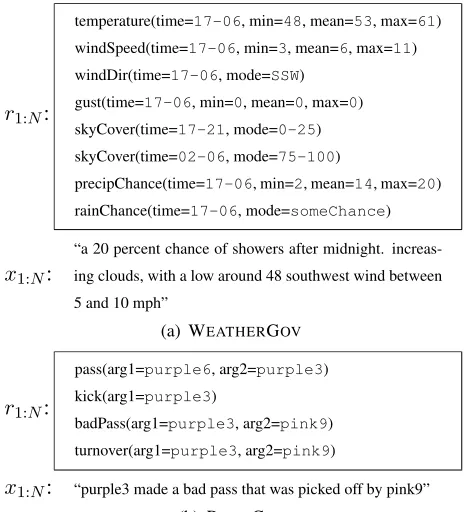
r1:N:
temperature(time=17-06, min=48, mean=53, max=61) windSpeed(time=17-06, min=3, mean=6, max=11) windDir(time=17-06, mode=SSW)
gust(time=17-06, min=0, mean=0, max=0) skyCover(time=17-21, mode=0-25) skyCover(time=02-06, mode=75-100)
precipChance(time=17-06, min=2, mean=14, max=20) rainChance(time=17-06, mode=someChance)
x1:N:
“a 20 percent chance of showers after midnight. increas-ing clouds, with a low around 48 southwest wind between 5 and 10 mph”
(a) WEATHERGOV
r1:N:
pass(arg1=purple6, arg2=purple3) kick(arg1=purple3)
badPass(arg1=purple3, arg2=pink9) turnover(arg1=purple3, arg2=pink9)
[image:3.612.311.544.59.315.2]x1:N: “purple3 made a bad pass that was picked off by pink9” (b) ROBOCUP
Figure 1: Sample database-text pairs chosen from the (a) WEATHERGOVand (b) ROBOCUPdatasets.
how to discuss them (surface realization). Train-ing data consists of scenario pairs (r(i), x(i)) for
i = 1,2, . . . , n, where r(i) is the complete set of
records andx(i) is the natural language description
(Fig. 1). At test time, only the records are given. We evaluate our model in the context of two publicly-available benchmark selective generation datasets.
WEATHERGOV The weather forecasting dataset (see Fig. 1(a)) of Liang et al. (2009) consists of
29528scenarios, each with36weather records (e.g., temperature, sky cover, etc.) paired with a natural language forecast (28.7avg. word length).
ROBOCUP We evaluate our model’s generaliz-ability on the sportscasting dataset of Chen and Mooney (2008), which consists of only1539pairs of temporally ordered robot soccer events (e.g., pass, score) and commentary drawn from the four-game 2001–2004 RoboCup finals (see Fig. 1(b)). Each scenario contains an average of 2.4 event records and a5.7word natural language commentary.
4 The Model
LSTM LSTM LSTM Std. align. Refiner
LSTM LSTM
[image:4.612.73.299.58.263.2]Pre-selec.
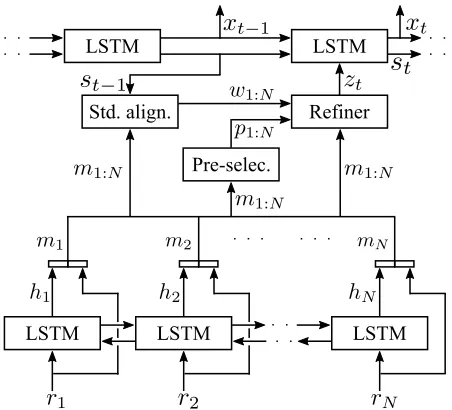
Figure 2: Our model architecture with a bidirectional LSTM encoder, coarse-to-fine aligner, and decoder.
r1:N = (r1, r2, . . . , rN) is the input set of over-determined event records,2x1:T = (x1, x2, . . . , xT)
is the generated description withxt being the word at timetandx0being a special start token:
x∗
1:T =arg max x1:T
P(x1:T|r1:N) (1a)
=arg max x1:T
T
Y
t=1
P(xt|x0:t−1, r1:N) (1b)
The goal of inference is to generate a natural lan-guage description for a given set of records. An effective means of learning to perform this gen-eration is to use an encoder-aligner-decoder archi-tecture with a recurrent neural network, which has proven effective for related problems in machine translation (Bahdanau et al., 2014) and image cap-tioning (Xu et al., 2015). We propose a variation on this general model with novel components that are well-suited to the selective generation problem.
Our model (Fig. 2) first encodes each input record
rj into a hidden state hj with j ∈ {1, . . . , N} us-ing a bidirectional recurrent neural network (RNN). Our novel coarse-to-fine aligner then acts on a con-catenation mj of each record and its hidden state 2These records may take the form of an unordered set
or have a natural ordering (e.g., temporal in the case of ROBOCUP). In order to make our model generalizable, we treat the set as a sequence and use the order specified by the dataset. We note that it is possible that a different ordering will yield improved performance, since ordering has been shown to be important when operating on sets (Vinyals et al., 2015a).
as multi-level representation of the input to compute the selection decisionztat each decoding stept. The model then employs an RNN decoder to arrive at the word likelihoodP(xt|x0:t−1, r1:N)as a function of the multi-level input and the hidden state of the de-coderst−1at time stept−1. In order to model the
long-range dependencies among the records and de-scriptions (which is integral to effectively perform-ing selective generation (Angeli et al., 2010; Kon-stas and Lapata, 2012; KonKon-stas and Lapata, 2013)), our model employs LSTM units as the nonlinear en-coder and deen-coder functions.
Encoder Our LSTM-RNN encoder (Fig. 2) takes as input the set of event records rep-resented as a sequence r1:N = (r1, r2, . . . , rN) and returns a sequence of hidden annotations
h1:N = (h1, h2, . . . , hN), where the annotation hj summarizes the recordrj. This results in a represen-tation that models the dependencies that exist among the records in the database.We adopt an encoder ar-chitecture similar to that of Graves et al. (2013)
ie j
fe j
oe j
ge j
=
σ σ σ
tanh
Te
rj
hj−1
(2a)
ce
j =fjecej−1+iej gej (2b)
hj =oej tanh(cej) (2c)
whereTeis an affine transformation,σis the logis-tic sigmoid that restricts its input to [0,1], ie
j, fje, andoe
j are the input, forget, and output gates of the LSTM, respectively, andce
j is the memory cell acti-vation vector. The memory cell ce
j summarizes the LSTM’s previous memoryce
j−1 and the current
in-put, which are modulated by the forget and input gates, respectively. Our encoder operates bidirec-tionally, encoding the records in both the forward and backward directions, which provides a better summary of the input records. In this way, the hid-den annotationshj = (−→h>j ;←−h>j)>concatenate for-ward−→hjand backward←h−j annotations, each deter-mined using Equation (2c).
Coarse-to-Fine Aligner Having encoded the in-put recordsr1:N to arrive at the hidden annotations
model performs content selection using an extension of the alignment mechanism proposed by Bahdanau et al. (2014), which allows for selection and genera-tion that is independent of the ordering of the input. In selective generation, the given set of event records is over-determined with only a small subset of salient records being relevant to the output natu-ral language description. Standard alignment mech-anisms limit the accuracy of selection and genera-tion by scanning the entire range of over-determined records. In order to better address the selective generation task, we propose a coarse-to-fine aligner that prevents the model from being distracted by non-salient records. 3 Our model aligns based on
multiple abstractions of the input: both the origi-nal input record as well as the hidden annotations
mj = (r>j ;h>j )>, an approach that has previously been shown to yield better results than aligning based only on the hidden state (Mei et al., 2015).
Our coarse-to-fine aligner avoids searching over the full set of over-determined records by using two stages of increasing complexity: a pre-selector and refiner (Fig. 2). The pre-selector first assigns to each record a probabilitypj of being selected, while the standard aligner computes the alignment likelihood
wtj over all the records at each time step tduring decoding. Next, the refiner produces the final se-lection decision by re-weighting the aligner weights
wtjwith the pre-selector probabilitiespj:
pj =sigmoid
q>tanh(P m j)
(3a)
βtj=v>tanh(W st−1+Umj) (3b)
wtj= exp(βtj)/
X
j
exp(βtj) (3c)
αtj=pjwtj/
X
j
pjwtj (3d)
zt=
X
j
αtjmj (3e)
whereP,q,U,W,vare learned parameters. Ideally, the selection decision would be based on the highest-value alignmentzt = mkwherek=arg maxjαtj. However, we use the weighted average (Eqn. 3e) as its soft approximation to maintain differentiability of the entire architecture.
3Our coarse-to-fine nomenclature is based on the alignment
inference at successively finer granularities.
The pre-selector assigns large values (pj > 0.5) to a small subset of salient records and small val-ues (pj <0.5) to the rest. This modulates the stan-dard aligner, which then has to assign a large weight
wtj in order to select the j-th record at time t. In this way, the learned prior pj makes it difficult for the alignment (attention) to be distracted by non-salient records. Further, we can relate the output of the pre-selector to the number of records that are selected. Specifically, the output pj expresses the extent to which thej-th record should be selected. The summation PNj=1pj can then be regarded as a real-valued approximation to the total number of pre-selected records (denoted asγ), which we regu-larize towards, based on validation (see Eqn. 5).
Decoder Our architecture uses an LSTM decoder that takes as input the current context vector zt, the last word xt−1, and the LSTM’s previous
hid-den statest−1. The decoder outputs the conditional
probability distribution Px,t = P(xt|x0:t−1, r1:N) over the next word, represented as a deep output layer (Pascanu et al., 2014),
id t
fd t
od t
gd t
=
σ σ σ
tanh
Td
Exst−t−11
zt
(4a)
cdt =ftdcdt−1+idt gtd (4b)
st=odttanh(cdt) (4c)
lt=L0(Ext−1+Lsst+Lzzt) (4d)
Px,t=softmax(lt) (4e)
whereE(an embedding matrix),L0,Ls, andLzare parameters to be learned.
Training and Inference We train the model us-ing the database-record pairs(r1:N, x1:T) from the training corpora so as to maximize the likelihood of the ground-truth language descriptionx∗
1:T (Eqn. 1). Additionally, we introduce a regularization term
(PNj=1pj −γ)2that enables the model to influence the pre-selector weights based on the aforemen-tioned relationship between the output of the pre-selector and the number of selected records. More-over, we also introduce the term(1.0−max(pj)), which accounts for the fact that at least one record should be pre-selected. Note that whenγ is equal to
(pj = 1.0for allj), and the coarse-to-fine alignment reverts to the standard alignment introduced by Bah-danau et al. (2014). Together with the negative log-likelihood of the ground-truth descriptionx∗
1:T, our loss function becomes
L=−logP(x∗
1:T|r1:N) +G (5a)
=−
T
X
t=1
logP(x∗t|x0:t−1, r1:N) +G (5b)
G=
XN
j=1
pj−γ
2
+1−max(pj)
(5c)
Having trained the model, we generate the natu-ral language description by finding the maximum a posteriori words under the learned model (Eqn. 1).
4 For inference, we perform greedy search starting
with the first wordx1. Beam search offers a way to
perform approximate joint inference — however, we empirically found that beam search does not perform any better than greedy search on the datasets that we consider, an observation that is shared with previous work (Angeli et al., 2010). We later discuss an al-ternative k-nearest neighbor-based beam filter (see Sec 6.2).
5 Experimental Setup
Datasets We analyze our model on the benchmark WEATHERGOV dataset, and use the data-starved
ROBOCUPdataset to demonstrate the model’s
gen-eralizability. Following Angeli et al. (2010), we use WEATHERGOV training, development, and test
splits of size 25000, 1000, and 3528, respectively. For ROBOCUP, we follow the evaluation
method-ology of previous work (Chen and Mooney, 2008), performing three-fold cross-validation whereby we train on three games (approximately1000scenarios) and test on the fourth. Within each split, we hold out10%of the training data as the development set to tune the early-stopping criterion andγ. We then report the standard average performance (weighted by the number of scenarios) over these four splits.
Dataset Processing In this section, we present the implementation details regarding our data prepro-cessing. We use WEATHERGOVas an example here,
4Numerical values are also generated exactly as any other
token in the vocabulary.
since it is our primary dataset, and the same recipe is followed for ROBOCUP.
For tokenization of the textual descriptions, we simply treat as token each string unit delimited by a space, which includes regular words (“sunny”), punctuation (“,”), and numerical values (“20”). A special token is added to represent the beginning and end of the entire textual description. This operation results in a vocabulary of size338, and we did not filter out any rare tokens. Moreover, in this setup, numerical values are also generated as any other to-ken during decoding period.
For event record representation, we represent each event as a fixed-length vector, concatenated by mul-tiple “attribute (field) vectors”. Each attribute vec-tor represents either a 1) record type (e.g., “rain-Chance”) with a one-hot vector, 2) record time slot (e.g., “06:00–21:00”) with a one-hot vector, 3) record mode (e.g., “SSE”) with a one-hot vector, or, 4) record value (e.g., “20”) with a 1 vector. The 0-1 vector for record value is simply the signed binary representation of this number. We choose the usage of 0-1 binary representation vectors for numbers be-cause it allows us to share binning-style information between nearby numbers (whereas a one-hot vector is sparse).
Training Details On WEATHERGOV, we lightly
tune the number of hidden units and γ on the de-velopment set according to the generation metric (BLEU), and choose500units from{250,500,750}
and γ = 8.5 from {6.5,7.5,8.5,10.5,12.5}. For ROBOCUP, we only tuneγ on the development set
and chooseγ = 5.0from the set{1.0,2.0, . . . ,6.0}. However, we do not retune the number of hidden units on ROBOCUP. For each iteration, we
ran-domly sample a mini-batch of100scenarios during back-propagation and use Adam (Kingma and Ba, 2015) for optimization. Training typically converges within30epochs. We select the model according to the BLEU score on the development set.5
Evaluation Metrics We consider two metrics as a means of evaluating the effectiveness of our model on the two selective generation subproblems. For content selection, we use the F-1 score of the set of 5We implement our model in Theano (Bergstra et al., 2010;
Table 1: Primary WEATHERGOVresults Method F-1 sBLEU cBLEU
KL12 – 33.70 –
KL13 – 36.54 –
ALK10 65.40 38.40 51.50 Our model 73.21 61.01 70.39
selected records as defined by the harmonic mean of precision and recall with respect to the ground-truth selection record set. We define the set of selected records as consisting of the record with the largest selection weightαticomputed by our aligner at each decoding stept.
We evaluate the quality of surface realization us-ing the BLEU score6(a4-gram matching-based
pre-cision) (Papineni et al., 2001) of the generated de-scription with respect to the human-created refer-ence. To be comparable to previous results on WEATHERGOV, we also consider a modified BLEU
score (cBLEU) that does not penalize numerical de-viations of at most five (Angeli et al., 2010) (i.e., to not penalize “low around 58” compared to a ref-erence “low around 60”). On ROBOCUP, we also
evaluate the BLEU score in the case that ground-truth content selection is known (sBLEUG), to be
comparable to previous work.
6 Results and Analysis
We analyze the effectiveness of our model on the benchmark WEATHERGOV (as primary) and
ROBOCUP (as generalization) datasets. We also
present several ablations to illustrate the contribu-tions of the primary model components.
6.1 Primary Results (WEATHERGOV)
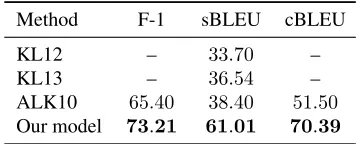
We report the performance of content selection and surface realization using F-1 and two BLEU scores (standard sBLEU and the customized cBLEU of An-geli et al. (2010)), respectively (Sec. 5). Table 1 compares our test results against previous meth-ods that include KL12 (Konstas and Lapata, 2012), KL13 (Konstas and Lapata, 2013), and ALK10 (An-geli et al., 2010). Our method achieves the best results reported to-date on all three metrics, with relative improvements of 11.94% (F-1), 58.88%
6We compute BLEU using the publicly available evaluation
provided by Angeli et al. (2010).
(sBLEU), and 36.68% (cBLEU) over the previous state-of-the-art.
6.2 Beam Filter withk-Nearest Neighbors
[image:7.612.319.534.229.277.2]We perform greedy search as an approximation to full inference over the set of decision variables (Eqn. 1). We considered beam search as an alterna-tive, but as with previous work on this dataset (An-geli et al., 2010), we found that greedy search still yields better BLEU performance (Table 2).
Table 2: Effect of beam width
Beam widthM 1 2 5 10
dev sBLEU 65.58 64.70 57.02 47.07 dev cBLEU 75.78 74.91 65.83 54.19
As an alternative, we consider a beam filter based on ak-nearest neighborhood. First, we generate the
M-best description candidates (i.e., a beam width of M) for a given input record set (database) us-ing standard beam search. Next, we find the K
nearest neighbor database-description pairs from the training data, based on the cosine similarity of each neighbor database with the given input record. We then compute the BLEU score for each of theM de-scription candidates relative to theK nearest neigh-bor descriptions (as references) and select the candi-date with the highest BLEU score. We tuneK and
M on the development set and report the results in Table 3. Table 4 presents the test results with this tuned setting (M = 2, K = 1), where we achieve BLEU scores better than our primary greedy results.
Table 3:k-NN beam filter (dev set) sBLEU M = 2 M = 5 M = 10
K= 1 65.99 65.88 65.65
K= 2 65.89 65.98 65.83
K= 5 65.64 65.45 65.41
K= 10 65.91 65.89 65.12 cBLEU M = 2 M = 5 M = 10
K= 1 76.21 76.13 75.98
K= 2 75.99 76.03 75.82
K= 5 75.90 75.63 75.41
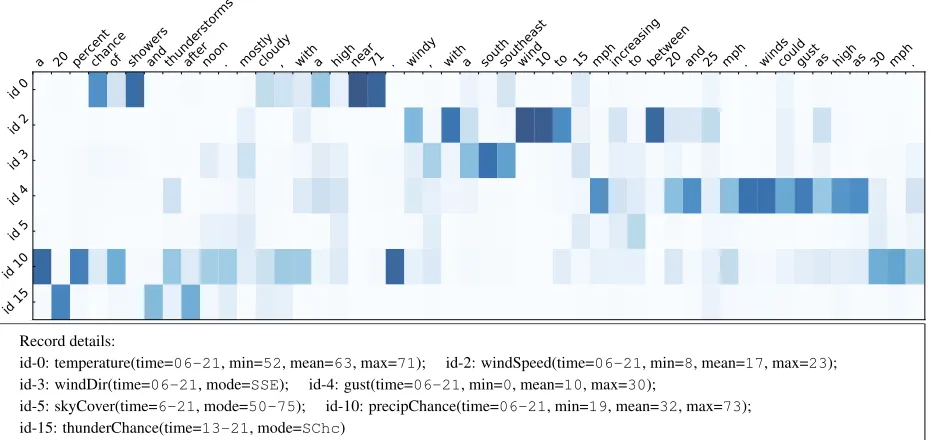
Record details:
id-0: temperature(time=06-21, min=52, mean=63, max=71); id-2: windSpeed(time=06-21, min=8, mean=17, max=23); id-3: windDir(time=06-21, mode=SSE); id-4: gust(time=06-21, min=0, mean=10, max=30);
[image:8.612.75.540.62.282.2]id-5: skyCover(time=6-21, mode=50-75); id-10: precipChance(time=06-21, min=19, mean=32, max=73); id-15: thunderChance(time=13-21, mode=SChc)
[image:8.612.88.281.328.376.2]Figure 3: An example generation for a set of records from WEATHERGOV.
Table 4:k-NN beam filter (test set) Primary k-NN (M = 2,K= 1) sBLEU 61.01 61.76
cBLEU 70.39 71.23
6.3 Ablation Analysis (WEATHERGOV)
Next, we present several ablations to analyze the contribution of our model components.7
[image:8.612.343.507.478.524.2]Aligner Ablation First, we evaluate the contribu-tion of our proposed coarse-to-fine aligner by com-paring our model with the basic encoder-aligner-decoder model introduced by Bahdanau et al. (2014) (which we originally started with). Table 5 reports the results demonstrating that our two-level aligner yields superior F-1 and BLEU scores relative to a standard aligner.8
Table 5: Coarse-to-fine aligner ablation (dev set) Aligner F-1 sBLEU cBLEU Basic 60.35 63.54 74.90 Coarse-to-fine 76.28 65.58 75.78
7These results are based on our primary model of Sec. 6.1
and on the development set.
8The same improvement trends hold on the test set.
More-over, our two-level aligner (and the basic aligner) model is sub-stantially better than having no aligner at all, i.e., a simple encoder-decoder model of Sutskever et al. (2014).
Encoder Ablation Next, we consider the effec-tiveness of the encoder. Table 6 compares the results with and without the encoder on the development set, and demonstrates that there is a significant gain from encoding the event records using the RNN. We attribute this improvement to the LSTM-RNN’s ability to capture the relationships that exist among the records, which is known to be essential to selective generation (Barzilay and Lapata, 2005; Angeli et al., 2010).
Table 6: Encoder ablation (dev set) Encoder F-1 sBLEU cBLEU With 76.28 65.58 75.78 Without 57.45 56.47 68.63
6.4 Qualitative Analysis (WEATHERGOV)
[image:8.612.86.279.585.631.2]mis-aligns to id-0 temp and id-10 precipChance, which we attribute to the high correlation between these types of records (“garbage collection” in Liang et al. (2009)).
Word Embeddings (Trained & Pretrained)
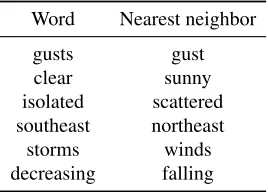
Training our decoder has the effect of learning em-beddings for the words in the training set (via the embedding matrix E in Eqn. 4). Here, we ex-plore the extent to which these learned embeddings capture semantic relationships among the training words. Table 7 presents nearest neighbor words for some of the common words from the WEATHER
-GOV dataset (according to cosine similarity in the
[image:9.612.330.517.99.196.2]embedding space).
Table 7: Nearest neighbor word for example words Word Nearest neighbor
gusts gust
clear sunny isolated scattered southeast northeast storms winds decreasing falling
We also consider different ways of using pre-trained word embeddings (Mikolov et al., 2013) to bootstrap the quality of our learned embeddings. One approach initializes our embedding matrix with the pre-trained vectors and then refines the embed-ding based on our training corpus. The second con-catenates our learned embedding matrix with the pre-trained vectors in an effort to simultaneously ex-ploit general similarities as well as those learned for the domain. As shown previously for other tasks (Vinyals et al., 2014; Vinyals et al., 2015b), we find that the use of pre-trained embeddings results in negligible improvements (on the development set).
6.5 Out-of-Domain Results (ROBOCUP)
We use the ROBOCUP dataset to evaluate the
domain-independence of our model. The dataset is severely data-starved with only 1000 (approx.) training pairs, which is much smaller than is typi-cally necessary to train RNNs. This results in higher variance in the trained model distributions, and we thus adopt the standard denoising method of ensem-bles (Sutskever et al., 2014; Vinyals et al., 2015b;
[image:9.612.118.252.290.386.2]Zaremba et al., 2014).9
Table 8: ROBOCUPresults Method F-1 sBLEU sBLEUG CM08 72.00 – 28.70
LJK09 75.70 – –
CKM10 79.30 – –
ALK10 79.90 – 28.80 KL12 – 24.88 30.90
Our model 81.58 25.28 29.40
Following previous work, we perform two exper-iments on the ROBOCUPdataset (Table 8), the first
considering full selective generation and the second assuming ground-truth content selection at test time. On the former, we obtain a standard BLEU score (sBLEU) of25.28, which exceeds the best score of
24.88 (Konstas and Lapata, 2012). Additionally, we achieve an selection F-1 score of 81.58, which is also the best result reported to-date. In the case of assumed (known) ground-truth content selection, our model attains an sBLEUGscore of29.40, which
is competitive with the state-of-the-art.10
7 Conclusion
We presented an encoder-aligner-decoder model for selective generation that does not use any spe-cialized features, linguistic resources, or genera-tion templates. Our model employs a bidirec-tional LSTM-RNN model with a novel coarse-to-fine aligner that jointly learns content selection and surface realization. We evaluate our model on the benchmark WEATHERGOVdataset and achieve
state-of-the-art selection and generation results. We achieve further improvements via ak-nearest neigh-bor beam filter. We also present several model ab-lations and visualizations to elucidate the effects of the primary components of our model. Moreover, our model generalizes to a different, data-starved do-main (ROBOCUP), where it achieves results
compet-itive with or better than the state-of-the-art. Acknowledgments
We thank Gabor Angeli, David Chen, Ioannis Kon-stas, and the reviewers for their helpful comments.
9We use an ensemble of five randomly initialized models. 10The Chen and Mooney (2008) sBLEU
Gresult is from
References
Gabor Angeli, Percy Liang, and Dan Klein. 2010. A simple domain-independent probabilistic approach to generation. In Proceedings of the Conference on Empirical Methods in Natural Language Processing (EMNLP), pages 502–512.
Dzmitry Bahdanau, Kyunghyun Cho, and Yoshua Ben-gio. 2014. Neural machine translation by jointly learning to align and translate. arXiv preprint arXiv:1409.0473.
Regina Barzilay and Mirella Lapata. 2005. Collective content selection for concept-to-text generation. In
Proceedings of the Human Language Technology Con-ference and the ConCon-ference on Empirical Methods in Natural Language Processing (HLT/EMNLP), pages 331–338.
Regina Barzilay and Lillian Lee. 2004. Catching the drift: Probabilistic content models, with applications to generation and summarization. InProceedings of the Conference of the North American Chapter of the Association for Computational Linguistics Human Language Technologies (NAACL HLT), pages 113– 120.
Fr´ed´eric Bastien, Pascal Lamblin, Razvan Pascanu, James Bergstra, Ian J. Goodfellow, Arnaud Berg-eron, Nicolas Bouchard, and Yoshua Bengio. 2012. Theano: new features and speed improvements. NIPS Workshop on Deep Learning and Unsupervised Fea-ture Learning.
Anja Belz. 2008. Automatic generation of weather forecast texts using comprehensive probabilis-tic generation-space models. Natural Language Engi-neering, 14(04):431–455.
James Bergstra, Olivier Breuleux, Fr´ed´eric Bastien, Pas-cal Lamblin, Razvan Pascanu, Guillaume Desjardins, Joseph Turian, David Warde-Farley, and Yoshua Ben-gio. 2010. Theano: a CPU and GPU math expression compiler. InProceedings of the Scientific Computing with Python Conference (SciPy).
David L. Chen and Raymond J. Mooney. 2008. Learning to sportscast: a test of grounded language acquisition. InProceedings of the International Conference on Ma-chine Learning (ICML), pages 128–135.
David L. Chen, Joohyun Kim, and Raymond J. Mooney. 2010. Training a multilingual sportscaster: Using per-ceptual context to learn language. Journal of Artificial Intelligence Research, 37:397–435.
Alex Graves, Mohamed Abdel-rahman, and Geoffrey Hinton. 2013. Speech recognition with deep recurrent neural networks. In Proceedings of the IEEE Inter-national Conference on Acoustics, Speech and Signal Processing (ICASSP), pages 6645–6649.
Sepp Hochreiter and J¨urgen Schmidhuber. 1997. Long short-term memory. Neural Computation, 9(8):1735– 1780.
Andrej Karpathy and Li Fei-Fei. 2015. Deep visual-semantic alignments for generating image descrip-tions. InProceedings of the IEEE Conference on Com-puter Vision and Pattern Recognition (CVPR), pages 3128–3137.
Joohyun Kim and Raymond J Mooney. 2010. Gen-erative alignment and semantic parsing for learning from ambiguous supervision. In Proceedings of the International Conference on Computational Linguis-tics (COLING), pages 543–551.
Diederik Kingma and Jimmy Ba. 2015. Adam: A method for stochastic optimization. InProceedings of the International Conference on Learning Representa-tions (ICLR).
Ioannis Konstas and Mirella Lapata. 2012. Unsuper-vised concept-to-text generation with hypergraphs. In
Proceedings of the Conference of the North American Chapter of the Association for Computational Linguis-tics Human Language Technologies (NAACL HLT), pages 752–761.
Ioannis Konstas and Mirella Lapata. 2013. Inducing doc-ument plans for concept-to-text generation. In Pro-ceedings of the Conference on Empirical Methods in Natural Language Processing (EMNLP), pages 1503– 1514.
Percy Liang, Michael I. Jordan, and Dan Klein. 2009. Learning semantic correspondences with less supervi-sion. InProceedings of the Joint Conference of the Annual Meeting of the Association for Computational Linguistics and the International Joint Conference on Natural Language Processing (ACL/IJCNLP), pages 91–99.
Wei Lu and Hwee Tou Ng. 2011. A probabilistic forest-to-string model for language generation from typed lambda calculus expressions. In Proceedings of the Conference on Empirical Methods in Natural Lan-guage Processing (EMNLP), pages 1611–1622. Wei Lu, Hwee Tou Ng, Wee Sun Lee, and Luke S
Zettle-moyer. 2008. A generative model for parsing natural language to meaning representations. InProceedings of the Conference on Empirical Methods in Natural Language Processing (EMNLP), pages 783–792. Wei Lu, Hwee Tou Ng, and Wee Sun Lee. 2009.
Natu-ral language generation with tree conditional random fields. InProceedings of the Conference on Empirical Methods in Natural Language Processing (EMNLP), pages 400–409.
Tomas Mikolov, Kai Chen, Greg Corrado, and Jeffrey Dean. 2013. Efficient estimation of word represen-tations in vector space. In Proceedings of the In-ternational Conference on Learning Representations (ICLR).
Kishore Papineni, Salim Roukos, Todd Ward, and Wei-Jing Zhu. 2001. BLEU: a method for automatic eval-uation of machine translation. InProceedings of the Annual Meeting of the Association for Computational Linguistics (ACL), pages 311–318.
Razvan Pascanu, Caglar Gulcehre, Kyunghyun Cho, and Yoshua Bengio. 2014. How to construct deep re-current neural networks. In Proceedings of the In-ternational Conference on Learning Representations (ICLR).
Ehud Reiter, Robert Dale, and Zhiwei Feng. 2000.
Building natural language generation systems, vol-ume 33. MIT Press.
Radu Soricut and Daniel Marcu. 2006. Stochastic lan-guage generation using WIDL-expressions and its ap-plication in machine translation and summarization. In Proceedings of the International Conference on Computational Linguistics and the Annual Meeting of the Association for Computational Linguistics (COL-ING/ACL), pages 1105–1112.
Amanda Stent, Rashmi Prasad, and Marilyn Walker. 2004. Trainable sentence planning for complex infor-mation presentation in spoken dialog systems. In Pro-ceedings of the 42nd annual meeting on association for computational linguistics, page 79. Association for Computational Linguistics.
Ilya Sutskever, Oriol Vinyals, and Quoc V. Lee. 2014. Sequence to sequence learning with neural networks. In Advances in Neural Information Processing Sys-tems (NIPS).
Oriol Vinyals, Lukasz Kaiser, Terry Koo, Slav Petrov, Ilya Sutskever, and Geoffrey Hinton. 2014. Grammar as a foreign language. arXiv preprint arXiv:1412.7449.
Oriol Vinyals, Samy Bengio, and Manjunath Kudlur. 2015a. Order matters: Sequence to sequence for sets.
arXiv preprint arXiv:1511.06391.
Oriol Vinyals, Alexander Toshev, Samy Bengio, and Du-mitru Erhan. 2015b. Show and tell: A neural image caption generator. In Proceedings of the IEEE Con-ference on Computer Vision and Pattern Recognition (CVPR), pages 3156–3164.
Marilyn A Walker, Owen Rambow, and Monica Rogati. 2001. Spot: A trainable sentence planner. In Pro-ceedings of the second meeting of the North American Chapter of the Association for Computational Linguis-tics on Language technologies, pages 1–8. Association for Computational Linguistics.
Yuk Wah Wong and Raymond J Mooney. 2007. Gen-eration by inverting a semantic parser that uses statis-tical machine translation. InProceedings of the Con-ference of the North American Chapter of the Associa-tion for ComputaAssocia-tional Linguistics Human Language Technologies (NAACL HLT), pages 172–179.
Kelvin Xu, Jimmy Ba, Ryan Kiros, Kyunghyun Cho, Aaron Courville, Ruslan Salakhutdinov, Richard Zemel, and Yoshua Bengio. 2015. Show, attend and tell: Neural image caption generation with visual at-tention. In Proceedings of the International Confer-ence on Machine Learning (ICML).