Binary Paragraph Vectors
Karol Grzegorczyk and Marcin Kurdziel
AGH University of Science and Technology Department of Computer Science
Krakow, Poland
{kgr,kurdziel}@agh.edu.pl
Abstract
Recently Le & Mikolov described two log-linear models, called Paragraph Vec-tor, that can be used to learn state-of-the-art distributed representations of doc-uments. Inspired by this work, we present
Binary Paragraph Vector models:
sim-ple neural networks that learn short binary codes for fast information retrieval. We show that binary paragraph vectors outper-form autoencoder-based binary codes, de-spite using fewer bits. We also evaluate their precision in transfer learning settings, where binary codes are inferred for doc-uments unrelated to the training corpus. Results from these experiments indicate that binary paragraph vectors can capture semantics relevant for various domain-specific documents. Finally, we present a model that simultaneously learns short binary codes and longer, real-valued rep-resentations. This model can be used to rapidly retrieve a short list of highly rel-evant documents from a large document collection.
1 Introduction
One of the significant challenges in contempo-rary information processing is the sheer volume
of available data. Gantz and Reinsel (2012), for
example, claim that the amount of digital data in the world doubles every two years. This trend un-derpins efforts to develop algorithms that can ef-ficiently search for relevant information in huge datasets. One class of such algorithms,
repre-sented by, e.g., Locality Sensitive Hashing (
In-dyk and Motwani, 1998), relies on hashing data
into short, locality-preserving binary codes (Wang
et al.,2014). The codes can then be used to group
the data into buckets, thereby enabling sublinear search for relevant information, or for fast com-parison of data items. Most of the algorithms from this family are data-oblivious, i.e. can generate hashes for any type of data. Nevertheless, some methods target specific kind of input data, like text or image.
In this work we focus on learning binary codes for text documents. An important work in this
direction has been presented by Salakhutdinov
and Hinton (2009). Their semantic hashing
leverages autoencoders with sigmoid bottleneck layer to learn binary codes from a word-count bag-of-words (BOW) representation. Salakhutdi-nov & Hinton report that binary codes allow for
up to 20-fold improvement in document ranking
speed, compared to real-valued representation of the same dimensionality. Moreover, they demon-strate that semantic hashing codes used as an ini-tial document filter can improve precision of TF-IDF-based retrieval. Learning binary representa-tion from BOW, however, has its disadvantages. First, word-count representation, and in turn the learned codes, are not in itself stronger than TF-IDF. Second, BOW is an inefficient representa-tion: even for moderate-size vocabularies BOW vectors can have thousands of dimensions. Learn-ing fully-connected autoencoders for such high-dimensional vectors is impractical. Salakhutdi-nov & Hinton restricted the BOW vocabulary in their experiments to 2000 most frequent words.
Binary codes have also been applied to cross-modal retrieval where text is one of the cross-modalities.
Specifically, Wang et al. (2013) incorporated tag
information that often accompany text documents,
whileMasci et al.(2014) employed siamese neural
networks to learn single binary representation for text and image data.
Recently several works explored simple neural models for unsupervised learning of distributed
representations of words, sentences and
docu-ments. Mikolov et al. (2013) proposed
log-linear models that learn distributed representations of words by predicting a central word from its context (CBOW model) or by predicting context words given the central word (Skip-gram model).
The CBOW model was then extended byLe and
Mikolov (2014) to learn distributed
representa-tions of documents. Specifically, they proposed Paragraph Vector Distributed Memory (PV-DM) model, in which the central word is predicted given the context words and the document vec-tor. During training, PV-DM learns the word em-beddings and the parameters of the softmax that models the conditional probability distribution for the central words. During inference, word em-beddings and softmax weights are fixed, but the gradients are backpropagated to the inferred docu-ment vector. In addition to PV-DM, Le & Mikolov studied also a simpler model, namely Paragraph Vector Distributed Bag of Words (PV-DBOW). This model predicts words in the document given only the document vector. It therefore disre-gards context surrounding the predicted word and does not learn word embeddings. Le & Mikolov demonstrated that paragraph vectors outperform BOW and bag-of-bigrams in information retrieval task, while using only few hundreds of dimen-sions. These models are also amendable to learn-ing and inference over large vocabularies. Origi-nal CBOW network used hierarchical softmax to model the probability distribution for the central word. One can also use noise-contrastive
estima-tion (Gutmann and Hyv¨arinen, 2010) or
impor-tance sampling (Cho et al., 2015) to approximate
the gradients with respect to the softmax logits. An alternative approach to learning representa-tion of pieces of text has been recently described byKiros et al.(2015). Networks proposed therein, inspired by the Skip-gram model, learn to predict surrounding sentences given the center sentence. To this end, the center sentence is encoded by an encoder network and the surrounding sentences are predicted by a decoder network conditioned on the center sentence code. Once trained, these models can encode sentences without resorting to backpropagation inference. However, they learn representations at the sentence level but not at the document level.
In this work we present Binary Paragraph Vec-tor models, an extensions to DBOW and
PV-DM that learn short binary codes for text docu-ments. One inspiration for binary paragraph
vec-tors comes from a recent work byLin et al.(2015)
on learning binary codes for images. Specifically, we introduce a sigmoid layer to the paragraph vec-tor models, and train it in a way that encourages binary activations. We demonstrate that the resul-tant binary paragraph vectors significantly outper-form semantic hashing codes. We also evaluate binary paragraph vectors in transfer learning set-tings, where training and inference are carried out on unrelated text corpora. Finally, we study mod-els that simultaneously learn short binary codes for document filtering and longer, real-valued
rep-resentations for ranking. While Lin et al. (2015)
employed a supervised criterion to learn image codes, binary paragraph vectors remain unsuper-vised models: they learn to predict words in docu-ments.
2 Binary paragraph vector models
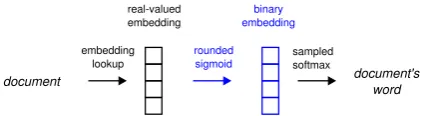
The basic idea in binary paragraph vector models is to introduce a sigmoid nonlinearity before the softmax that models the conditional probability of words given the context. If we then enforce bi-nary or near-bibi-nary activations in this nonlinearity, the probability distribution over words will be con-ditioned on a bit vector context, rather than real-valued representation. The inference in the model proceeds like in Paragraph Vector, except the doc-ument code is constructed from the sigmoid acti-vations. After rounding, this code can be seen as a distributed binary representation of the document. In the simplest Binary PV-DBOW model
(Fig-ure1) the dimensionality of the real-valued
doc-ument embeddings is equal to the length of the binary codes. Despite this low dimensional rep-resentation – a useful binary hash will typically have 128 or fewer bits – this model performed sur-prisingly well in our experiments. Note that we cannot simply increase the embedding
dimension-document's word sampled softmax
rounded sigmoid
embedding lookup
real-valued
embedding embeddingbinary
[image:2.595.309.523.651.709.2]document
ality in Binary PV-DBOW in order to learn better codes: binary vectors learned in this way would be too long to be useful in document hashing. The retrieval performance can, however, be improved by using binary codes for initial filtering of docu-ments, and then using a representation with higher capacity to rank the remaining documents by their
similarity to the query. Salakhutdinov and
Hin-ton (2009), for example, used semantic hashing
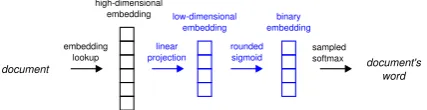
codes for initial filtering and TF-IDF for ranking. A similar document retrieval strategy can be real-ized with binary paragraph vectors. Furthermore, we can extend the Binary PV-DBOW model to si-multaneously learn short binary codes and higher-dimensional real-valued representations. Specifi-cally, in the Real-Binary PV-DBOW model
(Fig-ure2) we introduce a linear projection between the
document embedding matrix and the sigmoid non-linearity. During training, we learn the softmax parameters and the projection matrix. During in-ference, softmax weights and the projection ma-trix are fixed. This way, we simultaneously obtain a high-capacity representation of a document in
the embedding matrix, e.g. 300-dimensional
real-valued vector, and a short binary representation from the sigmoid activations. One advantage of
high-dimensional
embedding low-dimensional
embedding embeddingbinary
linear
projection roundedsigmoid sampledsoftmax
embedding lookup
document document'sword
Figure 2: The Real-Binary PV-DBOW model. Modifications to the original PV-DBOW model are highlighted.
using the Real-Binary PV-DBOW model over two separate networks is that we need to store only one set of softmax parameters (and a small projection matrix) in the memory, instead of two large weight matrices. Additionally, only one model needs to be trained, rather than two distinct networks.
Binary document codes can also be learned by
extending distributed memory models. Le and
Mikolov (2014) suggest that in PV-DM, a
con-text of the central word can be constructed by ei-ther concatenating or averaging the document vec-tor and the embeddings of the surrounding words.
However, in Binary PV-DM (Figure3) we always
construct the context by concatenating the relevant vectors before applying the sigmoid nonlinearity. This way, the length of binary codes is not tied to
sampled softmax
rounded sigmoid
concatenated context
binary concatenated
context
document embedding lookup
word embedding
lookup
document
central word
...
[image:3.595.309.523.66.186.2]context words
Figure 3: The Binary PV-DM model. Modifi-cations to the original PV-DM model are high-lighted.
the dimensionality of word embeddings.
Softmax layers in the models described above should be trained to predict words in documents given binary context vectors. Training should therefore encourage binary activations in the pre-ceding sigmoid layers. This can be done in several
ways. In semantic hashing autoencoders
Salakhut-dinov and Hinton (2009) added noise to the
sig-moid coding layer. Error backpropagation then countered the noise, by forcing the activations to be close to 0 or 1. Another approach was used
byKrizhevsky and Hinton(2011) in autoencoders
that learned binary codes for small images. Dur-ing the forward pass, activations in the codDur-ing layer were rounded to 0 or 1. Original (i.e. not rounded) activations were used when backpropa-gating errors. Alternatively, one could model the document codes with stochastic binary neurons. Learning in this case can still proceed with error backpropagation, provided that a suitable gradi-ent estimator is used alongside stochastic activa-tions. We experimented with the methods used in semantic hashing and Krizhevsky’s autoencoders, as well as with the two biased gradient estimators
for stochastic binary neurons discussed byBengio
et al.(2013). We also investigated the slope
an-nealing trick (Chung et al., 2016) when training
networks with stochastic binary activations. From our experience, binary paragraph vector models with rounded activations are easy to train and learn better codes than models with noise-based bina-rization or stochastic neurons. We therefore use Krizhevsky’s binarization in our models.
3 Experiments
[image:3.595.74.288.429.484.2]datasets: 20 Newsgroups1, a cleansed
ver-sion (also called v2) of Reuters Corpus
Vol-ume 12(RCV1) and English Wikipedia3. As
para-graph vectors can be trained with relatively large vocabularies, we did not perform any stemming of the source text. However, we removed stop words as well as words shorter than two characters and longer than 15 characters. Results reported by (Li et al., 2015) indicate that performance of
PV-DBOW can be improved by includingn-grams
in the model. We therefore evaluated two vari-ants of Binary PV-DBOW: one predicting words in documents and one predicting words and bi-grams. Since 20 Newsgroups is a relatively small dataset, we used all words and bigrams from its documents. This amounts to a vocabulary with slightly over one million elements. For the RCV1 dataset we used words and bigrams with at least 10 occurrences in the text, which gives a vocabulary with approximately 800 thousands elements. In case of English Wikipedia we used words and bi-grams with at least 100 occurrences, which gives a vocabulary with approximately 1.5 million ele-ments.
The 20 Newsgroups dataset comes with refer-ence train/test sets. In case of RCV1 we used half of the documents for training and the other half for evaluation. In case of English Wikipedia we held out for testing randomly selected 10% of the documents. We perform document retrieval by selecting queries from the test set and order-ing other test documents accordorder-ing to the simi-larity of the inferred codes. We use Hamming distance for binary codes and cosine similarity for real-valued representations. Results are av-eraged over queries. We assess the performance of our models with precision-recall curves and two popular information retrieval metrics, namely mean average precision (MAP) and the normal-ized discounted cumulative gain at the 10th result
(NDCG@10) (J¨arvelin and Kek¨al¨ainen, 2002).
The results depend, of course, on the chosen doc-ument relevancy measure. Relevancy measure for the 20 Newsgroups dataset is straightforward: a retrieved document is relevant to the query if they both belong to the same newsgroup. In RCV1 each document belongs to a hierarchy of topics,
1Available at http://qwone.com/˜jason/ 20Newsgroups
2Available at http://trec.nist.gov/data/ reuters/reuters.html
3A snapshot from April 5th, 2016
making the definition of relevancy less obvious. In this case we adopted the relevancy measure
used by Salakhutdinov and Hinton (2009). That
is, the relevancy is calculated as the fraction of overlapping labels in a retrieved document and the query document. Overall, our selection of test datasets and relevancy measures for 20
News-groups and RCV1 followsSalakhutdinov and
Hin-ton (2009), enabling comparison with semantic
hashing codes. To assess the relevancy of ar-ticles in English Wikipedia we can employ cat-egories assigned to them. However, unlike in RCV1, Wikipedia categories can have multiple parent categories and cyclic dependencies. There-fore, for this dataset we adopted a simplified rel-evancy measure: two articles are relevant if they share at least one category. We also removed from the test set categories with less than 20 doc-uments as well as docdoc-uments that were left with no categories. Overall, the relevancy is measured
over more than11,800categories, making English
Wikipedia harder than the other two benchmarks.
We use AdaGrad (Duchi et al., 2011) for
training and inference in all experiments re-ported in this work. During training we employ
dropout (Srivastava et al.,2014) in the embedding
layer. To facilitate models with large vocabularies, we approximate the gradients with respect to the
softmax logits using the method described byCho
et al. (2015). Binary PV-DM networks use the
same number of dimensions for document codes and word embeddings.
Performance of 128- and 32-bit binary
para-graph vector codes is reported in Table 1 and
in Figure 4. For comparison we also report
per-formance of real-valued paragraph vectors. Note that the binary codes perform very well, de-spite their far lower capacity: on 20 Newsgroups
and RCV1 the128-bit Binary PV-DBOW trained
with bigrams approaches the performance of the real-valued paragraph vectors, while on English Wikipedia its performance is slightly lower. Fur-thermore, Binary PV-DBOW with bigrams out-performs semantic hashing codes: comparison of
precision-recall curves from Figures 4a and 4b
with Salakhutdinov and Hinton (2009, Figures 6
& 7) shows that 128-bit codes learned with this
model outperform128-bit semantic hashing codes
on 20 Newsgroups and RCV1. Moreover, the32
-bit codes from this model outperform128-bit
(a) 20 Newsgroups
10-2 10-1 100
Recall 0.0
0.1 0.2 0.3 0.4 0.5 0.6 0.7 0.8 0.9
Pre
cisi
on
PV-DBOW uni- & bi-grams PV-DBOW unigrams only Binary PV-DBOW uni- & bi-grams Binary PV-DBOW unigrams only Binary PV-DM
Semantic hashing
10-2 10-1 100
Recall 0.0
0.1 0.2 0.3 0.4 0.5 0.6 0.7 0.8 0.9
Pre
cisi
on
PV-DBOW uni- & bi-grams PV-DBOW unigrams only Binary PV-DBOW uni- & bi-grams Binary PV-DBOW unigrams only Binary PV-DM
128 dimensional codes 32 dimensional codes
(b) RCV1
10-2 10-1 100
Recall 0.0
0.1 0.2 0.3 0.4 0.5 0.6 0.7
Pre
cisi
on
PV-DBOW uni- & bi-grams PV-DBOW unigrams only Binary PV-DBOW uni- & bi-grams Binary PV-DBOW unigrams only Binary PV-DM
Semantic hashing
10-2 10-1 100
Recall 0.1
0.2 0.3 0.4 0.5 0.6 0.7
Pre
cisi
on
PV-DBOW uni- & bi-grams PV-DBOW unigrams only Binary PV-DBOW uni- & bi-grams Binary PV-DBOW unigrams only Binary PV-DM
128 dimensional codes 32 dimensional codes
(c) English Wikipedia
10−2 10−1 100
Recall 0.0
0.1 0.2 0.3 0.4 0.5 0.6 0.7
Pre
cisi
on
PV-DBOW uni- & bi-grams PV-DBOW unigrams only Binary PV-DBOW uni- & bi-grams Binary PV-DBOW unigrams only Binary PV-DM
10−2 10−1 100
Recall 0.0
0.1 0.2 0.3 0.4 0.5 0.6 0.7
Pre
cisi
on
PV-DBOW uni- & bi-grams PV-DBOW unigrams only Binary PV-DBOW uni- & bi-grams Binary PV-DBOW unigrams only Binary PV-DM
[image:5.595.80.522.32.707.2]128 dimensional codes 32 dimensional codes
Figure 4: Precision-recall curves for the 20 Newsgroups, RCV1 and the English Wikipedia. Cosine similarity was used with real-valued representations and the Hamming distance with binary codes. For
comparison we also included semantic hashing results reported by Salakhutdinov and Hinton (2009,
Code Model With 20 Newsgroups RCV1 English Wikipedia
size bigrams MAP NDCG@10 MAP NDCG@10 MAP NDCG@10
128
PV-DBOW no 0.4 0.75 0.25 0.79 0.25 0.59
yes 0.45 0.75 0.27 0.8 0.26 0.6
Binary no 0.34 0.69 0.22 0.74 0.18 0.48
PV-DBOW yes 0.35 0.69 0.24 0.77 0.18 0.49
PV-DM N/A 0.41 0.73 0.23 0.78 0.24 0.59
Binary PV-DM 0.34 0.65 0.18 0.69 0.16 0.46
32
PV-DBOW yesno 0.430.46 0.710.72 0.260.27 0.750.77 0.230.25 0.550.58
Binary no 0.32 0.53 0.22 0.6 0.16 0.41
PV-DBOW yes 0.32 0.54 0.25 0.66 0.17 0.44
PV-DM N/A 0.43 0.7 0.23 0.77 0.23 0.55
[image:6.595.94.504.61.231.2]Binary PV-DM 0.29 0.49 0.17 0.53 0.15 0.41
Table 1: Information retrieval results. The best results with binary models are highlighted.
on the 20 Newsgroups dataset give similar preci-sion up to approximately 3% recall and better pre-cision for higher recall levels. Note that the differ-ence in this case lies not only in retrieval precision:
the short32-bit Binary PV-DBOW codes are more
efficient for indexing than long 128-bit semantic
hashing codes.
We also compared binary paragraph vectors against codes constructed by first inferring short, real-valued paragraph vectors and then using a separate hashing algorithm for binarization. When the dimensionality of the paragraph vectors is equal to the size of binary codes, the number of network parameters in this approach is sim-ilar to that of Binary PV models. We exper-imented with two standard hashing algorithms,
namely random hyperplane projection (Charikar,
2002) and iterative quantization (Gong and
Lazeb-nik, 2011). Paragraph vectors in these
experi-ments were inferred using PV-DBOW with
bi-grams. Results reported in Table2 show no
ben-efit from using a separate algorithm for binariza-tion. On the 20 Newsgroups and RCV1 datasets Binary PV-DBOW yielded higher MAP than the two baseline approaches. On English Wikipedia iterative quantization achieved MAP equal to Bi-nary PV-DBOW, while random hyperplane
projec-tion yielded lower MAP. Some gain in precision of top hits can be observed for iterative quantization, as indicated by NDCG@10. However, precision of top hits can also be improved by querying with
Real-Binary PV-DBOW model (Section3.2). It is
also worth noting that end-to-end inference in Bi-nary PV models is more convenient than inferring real-valued vectors and then using another algo-rithm for hashing.
Li et al. (2015) argue that PV-DBOW
out-performs PV-DM on a sentiment classification task, and demonstrate that the performance of PV-DBOW can be improved by including bigrams in the vocabulary. We observed similar results with Binary PV models. That is, including bigrams in the vocabulary usually improved retrieval preci-sion. Also, codes learned with Binary PV-DBOW provided higher retrieval precision than Binary PV-DM codes. Furthermore, to choose the context size for the Binary PV-DM models, we evaluated several networks on validation sets taken out of the training data. The best results were obtained with a minimal one-word, one-sided context window. This is the distributed memory architecture most similar to the Binary PV-DBOW model.
Hashing algorithm 20 Newsgroups RCV1 English Wikipedia
MAP NDCG@10 MAP NDCG@10 MAP NDCG@10
Random hyperplane projection 0.27 0.53 0.21 0.66 0.16 0.44 Iterative quantization 0.31 0.58 0.23 0.68 0.17 0.46
Table 2: Information retrieval results for32-bit binary codes constructed by first inferring32d real-valued
[image:6.595.102.492.662.714.2]3.1 Transfer learning
In the experiments presented thus far we had at our disposal training sets with documents simi-lar to the documents for which we inferred binary codes. One could ask a question, if it is possible to use binary paragraph vectors without collecting a domain-specific training set? For example, what if we needed to hash documents that are not asso-ciated with any available domain-specific corpus? One solution could be to train the model with a big generic text corpus, that covers a wide
vari-ety of domains. Lau and Baldwin (2016)
evalu-ated this approach for real-valued paragraph vec-tors, with promising results. It is not obvious, however, whether short binary codes would also perform well in similar settings. To shed light on this question we trained Binary PV-DBOW with
10-2 10-1 100
Recall 0.0
0.1 0.2 0.3 0.4 0.5 0.6 0.7 0.8 0.9
Pr
ec
isi
on
training on the 20 Newsgroups training set training on English Wikipedia
(a) 20 Newsgroups
10-2 10-1 100
Recall 0.1
0.2 0.3 0.4 0.5 0.6 0.7
Pr
ec
isi
on
training on the RCV1 training set training on English Wikipedia
[image:7.595.339.493.221.259.2](b) RCV1
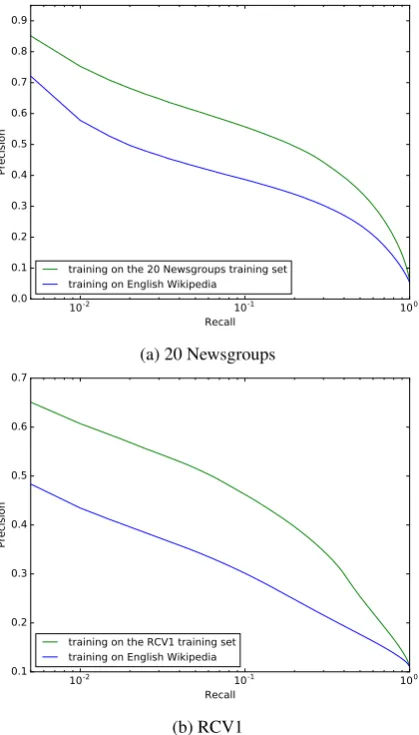
Figure 5: Precision-recall curves for the base-line Binary DBOW models and a Binary PV-DBOW model trained on an unrelated text corpus. Results are reported for 128-bit codes.
bigrams on the English Wikipedia, and then in-ferred binary codes for the test parts of the 20 Newsgroups and RCV1 datasets. The results are
presented in Table3and in Figure5. The model
trained on an unrelated text corpus gives lower re-trieval precision than models with domain-specific training sets, which is not surprising. However, it still performs remarkably well, indicating that the semantics it captured can be useful for different text collections. Importantly, these results were obtained without domain-specific finetuning.
MAP NDCG@10
20 Newsgroups 0.24 0.51
[image:7.595.77.287.329.697.2]RCV1 0.18 0.66
Table 3: Information retrieval results for the Bi-nary PV-DBOW model trained on an unrelated text corpus. Results are reported for 128-bit codes.
3.2 Retrieval with Real-Binary models
As pointed out by Salakhutdinov and Hinton
(2009), when working with large text collections
one can use short binary codes for indexing and a representation with more capacity for ranking. Following this idea, we proposed Real-Binary
PV-DBOW model (Section2) that can simultaneously
learn short binary codes and high-dimensional real-valued representations. We begin evaluation of this model by comparing retrieval precision of real-valued and binary representations learned by it. To this end, we trained a Real-Binary
PV-DBOW model with28-bit binary codes and300
-dimensional real-valued representations on the 20 Newsgroups and RCV1 datasets. Results are
re-ported in Figure 6. The real-valued
representa-tions learned with this model give lower precision than PV-DBOW vectors but, importantly, improve precision over binary codes for top ranked doc-uments. This justifies their use alongside binary codes.
10-2 10-1 100
Recall 0.0
0.1 0.2 0.3 0.4 0.5 0.6 0.7 0.8 0.9
Pr
ec
isi
on
PV-DBOW
Real-Binary PV-DBOW, real-valued codes Real-Binary PV-DBOW, binary codes
(a) 20 Newsgroups
10-2 10-1 100
Recall 0.1
0.2 0.3 0.4 0.5 0.6 0.7
Pr
ec
isi
on
PV-DBOW
Real-Binary PV-DBOW, real-valued codes Real-Binary PV-DBOW, binary codes
[image:8.595.79.523.62.250.2](b) RCV1
Figure 6: Information retrieval results for binary and real-valued codes learned by the Real-Binary
PV-DBOW model with bigrams. Results are reported for28-bit binary codes and300d real-valued codes.
A300d PV-DBOW model is included for reference.
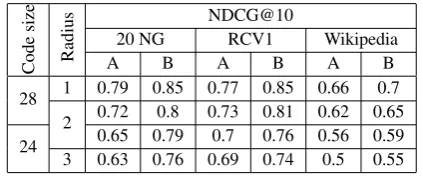
query. They can therefore be used to improve re-call at the cost of retrieval performance, and pos-sibly also precision. For these reasons, we evalu-ated Real-Binary PV-DBOW models with differ-ent code sizes and under differdiffer-ent limits on the Hamming distance to the query. In general, we cannot expect these models to achieve 100% re-call under the test settings. Furthermore, rere-call will vary on query-by-query basis. We therefore decided to focus on the NDCG@10 metric in this evaluation, as it is suited for measuring model per-formance when a short list of relevant documents is sought, and the recall level is not known. MAP and precision-recall curves are not applicable in
Code
size
Radius
NDCG@10
20 NG RCV1 Wikipedia
A B A B A B
28 1 0.79 0.85 0.77 0.85 0.66 0.7 2 0.72 0.8 0.73 0.81 0.62 0.65 24 0.65 0.79 0.7 0.76 0.56 0.59 3 0.63 0.76 0.69 0.74 0.5 0.55
Table 4: Information retrieval results for the Real-Binary PV-DBOW model. Real-valued
represen-tations have300dimensions. (A) Binary codes are
used for selecting documents within a given Ham-ming distance to the query and real-valued rep-resentations are used for ranking. (B) For com-parison, variant A was repeated with binary codes inferred using plain Binary PV-DBOW and real-valued representation inferred using original PV-DBOW model.
these settings.
Information retrieval results for Real-Binary
PV-DBOW are summarized in Table4. The model
gives higher NDCG@10 than 32-bit Binary
PV-DBOW codes (Table 1). The difference is large
when the initial filtering is restrictive, e.g. when
using28-bit codes and1-2bit Hamming distance
limit. Real-Binary PV-DBOW can therefore be useful when one needs to quickly find a short list of relevant documents in a large text collection, and the recall level is not of primary importance. If needed, precision can be further improved by us-ing plain Binary PV-DBOW codes for filterus-ing and standard DBOW representation for raking
(Ta-ble4, column B). Note, however, that PV-DBOW
model would then use approximately 10 times
more parameters than Real-Binary PV-DBOW.
4 Conclusion
[image:8.595.75.287.531.619.2]The best codes in our experiments were in-ferred with Binary PV-DBOW networks. The
Bi-nary PV-DM model did not perform so well. Li
et al. (2015) made similar observations for
Para-graph Vector models, and argue that in distributed memory model the word context takes a lot of the burden of predicting the central word from the document code. An interesting line of future research could, therefore, focus on models that account for word order, while learning good
bi-nary codes. It is also worth noting that Le and
Mikolov(2014) constructed paragraph vectors by
combining DM and DBOW representations. This strategy may proof useful also with binary codes, when employed with hashing algorithms designed for longer codes, e.g. with multi-index
hash-ing (Norouzi et al.,2012).
Acknowledgments
This research is supported by National Science Centre, Poland grant no. 2013/09/B/ST6/01549 “Interactive Visual Text Analytics (IVTA): Devel-opment of novel, user-driven text mining and vi-sualization methods for large text corpora explo-ration.” This research was carried out with the sup-port of the “HPC Infrastructure for Grand Chal-lenges of Science and Engineering” project, co-financed by the European Regional Development Fund under the Innovative Economy Operational Programme. This research was supported in part by PL-Grid Infrastructure.
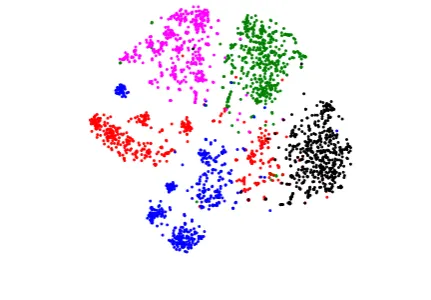
A Visualization of Binary PV codes
For an additional comparison with semantic hash-ing, we used t-distributed Stochastic Neighbor
Embedding (van der Maaten and Hinton,2008) to
construct two-dimensional visualizations of codes learned by Binary PV-DBOW with bigrams. We used the same subsets of newsgroups and RCV1
topics that were used by Salakhutdinov and
Hin-ton (2009, Figure 5). Codes learned by Binary
PV-DBOW (Figure7) appear slightly more
clus-tered.
References
Yoshua Bengio, Nicholas L´eonard, and Aaron Courville. 2013. Estimating or propagating gradi-ents through stochastic neurons for conditional com-putation.arXiv preprint arXiv:1308.3432.
(a) A subset of the 20 Newsgroups dataset: green soc.religion.christian, red talk.politics.guns, blue rec.sport.hockey, brown talk.politics.mideast, magenta -comp.graphics, black - sci.crypt.
[image:9.595.311.527.287.437.2](b) A subset of the RCV1 dataset: green - disasters and acci-dents, red - government borrowing, blue - accounts/earnings, magenta - energy markets, black - EC monetary/economic.
Figure 7: t-SNE visualizations of 128 dimensional binary paragraph vector codes; the Hamming dis-tance was used to calculate code similarity.
Moses S Charikar. 2002. Similarity estimation tech-niques from rounding algorithms. InProceedings of the thiry-fourth annual ACM symposium on Theory of computing. ACM, pages 380–388.
S´ebastien Jean Kyunghyun Cho, Roland Memisevic, and Yoshua Bengio. 2015. On using very large target vocabulary for neural machine translation. In Proceedings of the 53rd Annual Meeting of the Association for Computational Linguistics and the 7th International Joint Conference on Natural Lan-guage Processing. ACL, volume 1, pages 1–10.
Junyoung Chung, Sungjin Ahn, and Yoshua Bengio. 2016. Hierarchical multiscale recurrent neural net-works. arXiv preprint arXiv:1609.01704.
and stochastic optimization. Journal of Machine Learning Research12(Jul):2121–2159.
John Gantz and David Reinsel. 2012. The digital uni-verse in 2020: Big data, bigger digital shadows, and biggest growth in the far east. Technical report, IDC.
Yunchao Gong and Svetlana Lazebnik. 2011. Iterative quantization: A procrustean approach to learning bi-nary codes. InComputer Vision and Pattern Recog-nition (CVPR), 2011 IEEE Conference on. IEEE, pages 817–824.
Michael Gutmann and Aapo Hyv¨arinen. 2010. Noise-contrastive estimation: A new estimation princi-ple for unnormalized statistical models. In Inter-national Conference on Artificial Intelligence and Statistics. pages 297–304.
Piotr Indyk and Rajeev Motwani. 1998. Approximate nearest neighbors: towards removing the curse of di-mensionality. InProceedings of the thirtieth annual ACM symposium on Theory of computing. ACM, pages 604–613.
Kalervo J¨arvelin and Jaana Kek¨al¨ainen. 2002. Cu-mulated gain-based evaluation of ir techniques.
ACM Transactions on Information Systems (TOIS)
20(4):422–446.
Ryan Kiros, Yukun Zhu, Ruslan R Salakhutdinov, Richard Zemel, Raquel Urtasun, Antonio Torralba, and Sanja Fidler. 2015. Skip-thought vectors. In
Advances in neural information processing systems. pages 3294–3302.
Alex Krizhevsky and Geoffrey E Hinton. 2011. Using very deep autoencoders for content-based image re-trieval. InProceedings of the 19th European Sympo-sium on Artificial Neural Networks. pages 489–494.
Jey Han Lau and Timothy Baldwin. 2016. An em-pirical evaluation of doc2vec with practical insights into document embedding generation. In Proceed-ings of the 1st Workshop on Representation Learning for NLP. Association for Computational Linguistics, pages 78–86.
Quoc Le and Tomas Mikolov. 2014. Distributed repre-sentations of sentences and documents. In Proceed-ings of The 31st International Conference on Ma-chine Learning. pages 1188–1196.
Bofang Li, Tao Liu, Xiaoyong Du, Deyuan Zhang, and Zhe Zhao. 2015. Learning document embed-dings by predicting n-grams for sentiment classi-fication of long movie reviews. arXiv preprint arXiv:1512.08183.
Kevin Lin, Huei Fang Yang, Jen Hao Hsiao, and Chu Song Chen. 2015. Deep learning of binary hash codes for fast image retrieval. InProceedings of the IEEE Conference on Computer Vision and Pattern Recognition Workshops. pages 27–35.
Jonathan Masci, Michael M Bronstein, Alexander M Bronstein, and J¨urgen Schmidhuber. 2014. Multi-modal similarity-preserving hashing. IEEE transac-tions on pattern analysis and machine intelligence
36(4):824–830.
Tomas Mikolov, Kai Chen, Greg Corrado, and Jef-frey Dean. 2013. Efficient estimation of word representations in vector space. arXiv preprint arXiv:1301.3781.
Mohammad Norouzi, Ali Punjani, and David J Fleet. 2012. Fast search in hamming space with multi-index hashing. In Computer Vision and Pattern Recognition (CVPR), 2012 IEEE Conference on. IEEE, pages 3108–3115.
Ruslan Salakhutdinov and Geoffrey E Hinton. 2009. Semantic hashing.International Journal of Approx-imate Reasoning50(7):969–978.
Nitish Srivastava, Geoffrey E Hinton, Alex Krizhevsky, Ilya Sutskever, and Ruslan Salakhutdinov. 2014. Dropout: A simple way to prevent neural networks from overfitting. The Journal of Machine Learning Research15(1):1929–1958.
Laurens van der Maaten and Geoffrey Hinton. 2008. Visualizing data using t-SNE. Journal of Machine Learning Research9(Nov):2579–2605.
Jingdong Wang, Heng Tao Shen, Jingkuan Song, and Jianqiu Ji. 2014. Hashing for similarity search: A survey. arXiv preprint arXiv:1408.2927.