17
Proceedings of the Linguistic Resources for Automatic Natural Language Generation Workshop, pages 17– 24, Santiago de Compostela, Spain, September 4, 2017. © 2017 Association for Computational Linguistics
Generating Answering Patterns from Factoid Arabic Questions
Essia Bessaies, Slim Mesfar, Henda Ben Ghezala*
Riadi Laboratory,
*ENSI,
University of Manouba Tunisia
{
essia.bessaies, slim.mesfar}@riadi.rnu.tn;
*
[email protected]
Abstract
This works deals with Arabic factoid Question Answering systems (QA). Commonly, the task of QA is divided into three phases: question analysis, answer pattern generation, and an-swer extraction. Each phase plays a crucial role in overall performance. In this paper, we focus on the two first phases: Question Analysis and Answer Pattern Generation. We used the NooJ platform which represents a valuable linguistic development environment. The first evalua-tions show that the actual results are encourag-ing and could be deployed for more types of questions other than factoid ones.
1
Introduction
In recent years, the medical domain has a high vol-ume of electronic docvol-uments. Managing this large quantity of data makes the search of specific infor-mation complex and time consuming. This com-plexity is especially evident when we seek a short and precise answer to a human natural language question rather than a full list of documents and web pages. In this case, the user requirement could be a Question Answering (QA) system which represents a specialized area in the field of information re-trieval.
The goal of a QA system is to provide inexperi-enced users with a flexible access to information al-lowing them to write a query in natural language and obtain not the documents which contain the an-swer, but its precise answer passage from input texts. There has been a lot of research in English as well as some European language QA systems. How-ever, Arabic QA systems (Brini et al., 2009) could not match the pace due to some inherent difficulties with the language itself as well as due to lack of tools available to assist researchers. Therefore, the
current project attempts to design and develop the modules of an Arabic QA system.
In this paper, we present a linguistic approach for analyzing medical questions and generating answer patterns from factoid Arabic questions.
In the first section, we give a short insight about Arabic NLP specificities followed by an overview of state-of-the-art developments. In section 3, we describe the generic architecture of the proposed QA system. Section 4 introduces our approach to the annotation of medical factoid questions and the generation of answering patterns.
In this section, we describe how we analyze a given question by means of the application of a cas-cade of morpho-syntactic grammars. The linguistic patterns depicted in these grammars allow us to an-notate the question in order to extract its type (time, quantity …), its topic, as well as its focus. After ex-amining the generation of response patterns from these extracted key words (Type, Topic and Focus), the results of our experiments are described in sec-tion 5.
2
Current Research
As explained in the introduction, QA systems psent a good solution for textual information re-trieval, knowledge sharing, and discovery. Current research deals with two challenging topics: the Ar-abic natural language processing in the medical do-main and the second concerns QA systems.
2.1
The Arabic language18 except one diacritic which is used as a double con-sonant marker. The Arabic script does not support capitalization that could help researchers identify named entities, for example. Numbers, however, are written from left to right which presents a real chal-lenge for Arabic text editors to handle words written from right to left and numbers from left to right.
2.2
Arabic QA systemsQA systems for Arabic are very few. Mainly, it is due to the lack of accessibility to linguistic re-sources, such as freely available lexical rere-sources, corpora and basic NLP tools (tokenizers, morpho-logical analyzers, etc.).
To our knowledge, there are only five research works on Arabic QA systems.
QARAB (Hammo et al., 2002) is an Arabic QA system that that takes factoid Arabic questions and attempts to provide short an-swers. QARAB uses both information re-trieval and natural language processing techniques.
ArabiQA (Benajiba et al., 2007), which is fully oriented to the modern Arabic lan-guage, also answers factoid questions using Named Entity Recognition. However, this system is not yet completed.
DefArabicQA (Trigui et al., 2010) provides short answers to Arabic natural language questions. This system provides effective and exact answers to definition questions expressed in Arabic from Web resources. DefArabicQA identifies candidate defini-tions by using a set of lexical patterns, fil-ters these candidate definitions by using heuristic rules and ranks them by using a statistical approach. It only processes defi-nition questions and does not include other types of question (When, How and Why).
AQuASys (Bekhti and Alharbi, 2013) is composed of three modules: A question analysis module, a sentence filtering mod-ule and an answer extraction modmod-ule. Spe-cial consideration has been given to im-proving the accuracy of the question analy-sis and the answer extraction scoring phases. These phases are crucial in terms of
finding the correct answer. The recall rate is 97.5% and the precision rate is 66.25%.
Yes/No Arabic Question Answering Sys-tem (Kurdi, et al, 2014) is a formal model for a semantic based yes/no Arabic question answering system based on paragraph re-trieval. The results are based on 20 docu-ments. It shows a positive result of about 85% when we use entire documents. Be-sides, it gives 88% when we use only para-graphs. The system focuses only on yes/no questions and the corpus size is relatively small (20 documents).
After this investigation into QA systems, we aim to develop a QA system based on a linguistic ap-proach. It uses NooJ’s linguistic engine in order to formalize the automatic recognition rules for ques-tion analysis. The named entity recognizer (NER) is embedded in our QA system in order to annotate the factoid questions and associate them with the ex-tracted named entities. For this purpose, we have adapted a rules based approach to recognize Arabic named entities. Furthermore, we aim to generate the potential answer patterns using the paraphrasing and transformation module in the NooJ platform (Silberztein, 2015).
3
Proposed Architecture for our QA
Sys-tem
From a general viewpoint, the design of a QA sys-tem (Figure 1) must take into account three phases: Question analysis: This module performs a mor-phological analysis to determine the question class. A question class helps the system to classify the question type to provide a suitable answer. This module may also identify additional semantic fea-tures of the question like the topic and the focus.
Answer pattern generation: After analyzing the question and extracting the key words (e.g., focus and topic) from a given factoid question, the system generates response patterns from these extracted key words. Our approach automatically generates patterns using NooJ’s linguistic engine.
19 user as a response to his initial natural language query.
Figure 1: Architecture for our QA System
In this paper, we explore only the first two phases.
4
Preconized processing approach
4.1
Question AnalysisOur approach uses the NooJ development platform. It allows us to build various required resources (dic-tionaries, morpho-syntactic grammars, etc.) and perform a linguistic analysis on a given corpus.
In addition to the linguistic resources in NooJ’s Arabic module (Mesfar, 2010), we added specific properties in lexical entries for the needs of the cur-rent project. For instance, some additional infor-mation must be added to entries:
1. Nominal predicate information
Npred = Nominal predicate information
2. Synonyms
Syn=Synonyms of focus
3. Support verbs (that will be used to generate paraphrases)
Sup=Support verbs Example
ََفَشَتْكِا, V+FLX+NPred=فاَشَتْكِاَ +Syn1=َََدَج ْوَأ +Sup1=ََعَق َوَ+Sup2=َ مَتَ+sup3=ـِبَََماَقَ
These enhanced lexical resources are used next within a cascade of morpho-syntactic grammars. Named Entity Recognition:
We think that an integration of a Named Entity Recognition
(NER)
module will definitely boost system performance. It is also very important to point out that an NERis
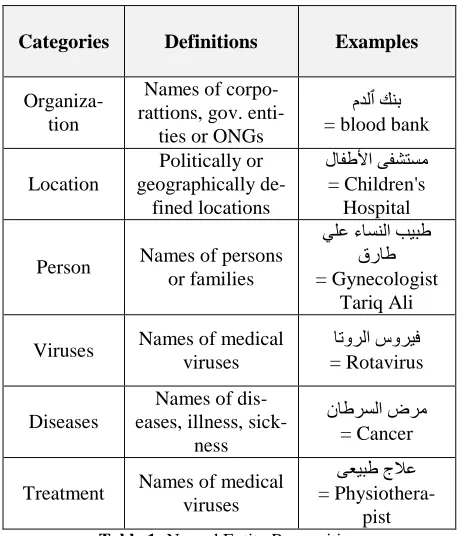
required as a tool for almost all the QA system components. Those NER systems allow extracting proper nouns as well as temporal and numeric expressions from raw text (Mesfar, 2007). In our case, we used our own NER system especially formulated for the Arabic medical do-main. We have considered six proper names catego-ries: organization, location, person, viruses, dis-eases, and treatment (Table 1).Categories Definitions Examples
Organiza-tion
Names of corpo-rattions, gov.
enti-ties or ONGs
كنب َ مدلٱ = blood bank
Location
Politically or geographically
de-fined locations
ىفشتسم َ لافطلأا
= Children's Hospital
Person Names of persons or families
َيلعَءاسنلاَبيبط قراط = Gynecologist
Tariq Ali
Viruses Names of medical viruses
سوريف َ اتورلا = Rotavirus
Diseases
Names of dis-eases, illness,
sick-ness
ضرم َ ناطرسلا
= Cancer
Treatment Names of medical viruses
جلاع َ ىعيبط =
Physiothera-pist
Table 1: Named Entity Recognition
Automatic annotation of question using NooJ’s syntactic grammars
[image:3.612.312.541.373.641.2]20 of fact-seeking questions or factoid questions, for example simple interrogative questions with a named entity (Timex, Numex or Enamex). The choice of factoid questions versus other types of questions is motivated by the following factors:
A considerable percentage of the questions actually submitted to a search engine are factoid questions. Current search engines are only able to return links to full-length documents rather than brief document frag-ments that answer the user’s question.
The frequent occurrence of factoid ques-tions in daily usage is confirmed by the composition of the question test sets in the QA track at TREC1. The percentage of questions that are factoid questions grew in TREC.
Most recent approaches to open-domain QA use NER as a foundation for detecting candidate answers.
As far as current research is concerned, our QA module accepts, as input, only Arabic factoid ques-tions. Then, in order to look for the best answer, it gives the maximum amount of information (syntac-tic, seman(syntac-tic, distributional, etc.) from the given question, such as the expected answer type, and the focus and topic of the question. This information will play an important role in the generation of po-tential answer patterns.
Type: the type corresponds to the type of question (time, person, organization, etc.)
Topic: the topic corresponds to the subject matter of the question.
Focus: the focus corresponds to the specific property of the topic that the user is looking for.
The following example shows the detailed anno-tation of the identified parts of a question.
1 Text Retrieval Conference is an ongoing series of
work-shops focusing on different types of information retrieval (IR), research areas, or tracks.
Example
When was cancer discovered?
4.2
Generating answer patternsArabic sentences are usually complex and very long. This sets up obstacles for the extraction of a short and precise answer for a given question. Thus, we chose to generate answer patterns associated with the output of our question analysis. Our pre-liminary observations on sentence structure showed that a huge number of response structures could be extracted from Arabic texts.
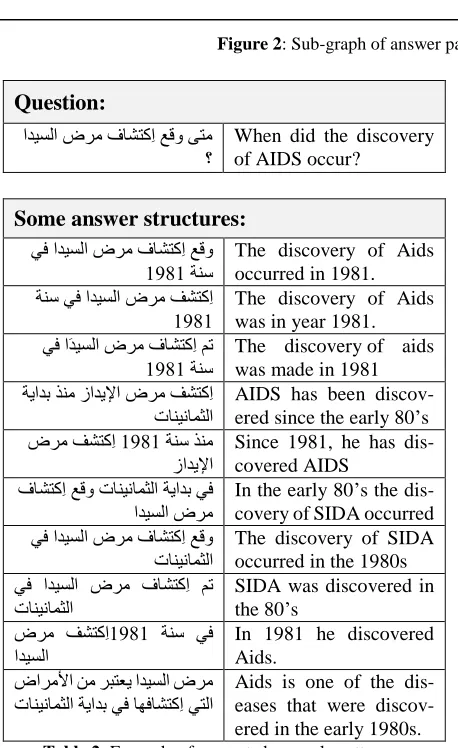
These structures depend on author origins (native language, geographical zone of Arabic studies, etc). Hence, generating answer patterns could be an in-teresting alternative to identify the different struc-tures and answer patterns (see Table 2).
The example provided in Table 2 consolidates the main objective of this project which consists in de-veloping a context-sensitive and linguistically en-hanced paraphrase generator. First, this generator uses the annotated sequences within the question analysis phase (recognized syntactic-semantic se-quences, named entities, multi-words and other phrasal units). Then, it transforms them into seman-tically equivalent phrases, expressions, or sen-tences. This output produces potential answer pat-terns based on the original question’s topic and fo-cus.
21
Figure 2: Sub-graph of answer pattern generation (syntactic grammar)
Question: ىتم َ عقو َ فاشتكِا َ ضرم َ اديسلا َ ؟
When did the discovery of AIDS occur?
Some answer structures:
عقو َ فاشتكِا َ ضرم َ اديسلا َ يف َ ةنس َ 1981
The discovery of Aids occurred in 1981. فشتكِا َ ضرم َ اديسلا َ يف َ ةنس َ 1981
The discovery of Aids was in year 1981. َيفَاَديسلاَضرمَفاشتكِاَمت
َةنس 1981
The discovery of aids was made in 1981 َذنمَزاديلإاَضرمَفشتكِا
ةيادب َ
تانينامثلا
AIDS has been discov-ered since the early 80’s َةنسَذنم
1981 َ َضرمَفشتكِا
زاديلإا
Since 1981, he has dis-covered AIDS
َفاشتكِاَعقوَتانينامثلاَةيادبَيف اديسلاَضرم
In the early 80’s the dis-covery of SIDA occurred َيفَاديسلاَضرمَفاشتكِاَعقو
تانينامثلا
The discovery of SIDA occurred in the 1980s َيفَ اديسلاَ ضرمَ فاشتكِاَ مت
تانينامثلا
SIDA was discovered in the 80’s يف َ ةنس َ 1981 فشتكِا َ ضرم َ اديسلا
In 1981 he discovered Aids. ضرم َ اديسلا َ ربتعي َ نم َ ضارملأا َ يتلا َ اهفاشتكِا َ يف َ ةيادب َ نينامثلا تا
[image:5.612.76.305.225.599.2]Aids is one of the dis-eases that were discov-ered in the early 1980s.
Table 2: Example of generated example patterns
If we consider the previous example (Table 2), we can take advantage of the focus’s annotation in-formation (ََفَشَتْكِا – to discover) to generate:
فاَشَتْكِا (discovery) : the nominal predicate
ََدَج ْوَأ (to find) : a synonym
ََعَق َو (to occur) : a support verb that can be used in conjunction with the predicate noun (discovery)
Based on the information associated with the dif-ferent parts of the question, we generate answer pat-terns with respect to the potential phrase structures (nominal, verbal, prepositional, adverbial, active or passive phrases). In fact, this task takes into consid-eration the type of answer expected by the user, and this means that the answer extraction module will perform differently for each type of question.
The sub-graph illustrated in Figure 2 with NooJ’s graphical editor, shows that the sub-graph called “Question Analysis” that stores the question parts in two variables: $Topic (contains the topic of our question) and $Focus (contains the special focus of the current question). Then, we proceed to the pat-tern generation where we use the related infor-mation (syntactic, semantic, distributional as well as synonymy and/or lexicon-grammar properties). In order to display the needed information, we build a combination of output patterns using the following variables:
$Focus$Syn1
$Focus$NPred
$Focus$Sup
22
Figure 3: Text Annotation Structure
5
Experiments and Results
5.1
Question analysisNamed Entity Recognition (NER)
The ENAMEX+MEDIC grammar is launched auto-matically during the linguistic analysis, in order to annotate the sequences and expressions recognized by the transducers corresponding to the grammar launched (Figure 3).
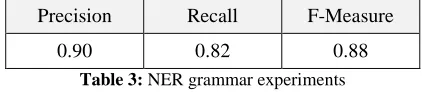
To evaluate our NER local grammars, we ana-lyzed our corpus to extract manually all named en-tities. Then, we compare the results of our system with those obtained by manual extraction. The ap-plication of our cascade of local grammars gives the results as shown in Table 3.
Precision Recall F-Measure
[image:6.612.88.522.73.223.2]0.90 0.82 0.88
Table 3: NER grammar experiments
According to these results (Table 3), we obtain acceptable scores for named entities recognition. Our evaluation shows an F-measure of 0.88. This result is encouraging given the rate achieved by the systems participating in MUC2.
Discussion
Despite the problems described above, the techniques used seem to be adequate and display very encouraging recognition rates. Indeed, a minority of the rules may be suf-ficient to cover a large part of the patterns
2 The Message Understanding Conferences.
and ensure coverage. However, many other rules must be added to improve recall.
Automatic annotation of factoid question in standard Arabic
[image:6.612.313.539.366.513.2]To evaluate our automatic annotation of ques-tions using local grammars, we compare the results of our system with those obtained by manual extrac-tion (Figure 4).
Figure 4: Annotation results of question analysis syntactic grammar (NooJ Grammar).
The application of our local grammar gives the result as shown in Table 4.
Precision Recall F-Measure
0.75 0.72 0.73
Table 4: Annotation of factoid question experiments
[image:6.612.79.290.488.534.2]23
Figure 5: Result of Generating answer patterns
This is due to the fact that this assessment is mainly based on the results of the NER module.
Discussion
Errors are often due to the complexity of user’s questions or the absence of their structure in our sys-tem In fact, Arabic sentences are usually very long, which sets up obstacles for question analysis. De-spite the problems described above, the developed method seems to be adequate and shows very en-couraging extraction rates. However, other rules must be added to improve the result.
5.2
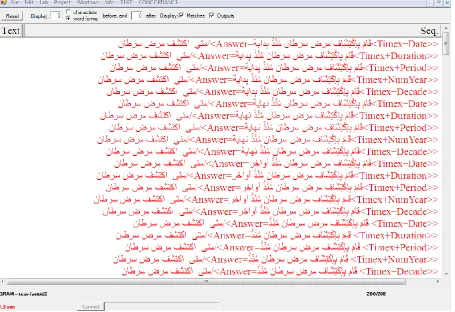
Generating answer patternsFor the already described example, we generate hundreds of answer pattern combinations (Figure 5). At this stage of our research, we can’t deny that some further patterns are not yet covered by our grammar. This is due to the fact that this assessment is mainly based on the results of the question analy-sis module and the NER module.
Despite the problems described above, the devel-oped system seems to be adequate and shows very encouraging extraction rates. However, other rules and other keywords (synonyms, supports verbs, etc.) have to be improved in our next steps.
6
Conclusion
Arabic QA systems could not match the pace due to some inherent difficulties with the language itself, as well as the lack of tools offered to support re-searchers. The task of our QA system can be divided into three phases: question analysis, answer pattern generation, and answer extraction. Each of these phases plays crucial roles in overall performance of the QA system. In this paper, we focused on the first two phases: question analysis and answer pattern generation.
an-24 swer extraction phase. We will consider such meth-ods used in answer extraction including tools, eval-uation, and corpus.
This will show the viability of the current re-search results and give real answers to end users. Fi-nally, as a long term ambition, we intend to consider processing “why” and “how” question types.
References
Sman Bekhti and Maryam Alharbi. 2013. Aquasys: A question answering system for Arabic. In Proceedings of WSeas International Conference. Recent Advances in Computer Engineering Series, no. 12. WSEAS, pp 130-139
Yassine Benajiba, Paolo Rosso and Abdelouahid Lyhyaoui. 2007. Implementation of the ArabiQA Question Answering System’s components. In Pro-ceedings of the Workshop on Arabic Natural Lan-guage Processing, 2nd Information Communication Technologies Int. Symposium, ICTIS-2007, Fez, Mor-roco, pp 3-5.
Wissal Brini, Mariem Ellouze, Slim Mesfar and Lamia Belguith. 2009. An Arabic question-answering system for factoid questions. In Natural Language Processing
and Knowledge Engineering, 2009. NLP-KE 2009. International Conference on. IEEE, 2009, pp 1-7. Bassam Hammou, Hani Abu-Salem and Steven Lytinen.
2002. QARAB: A Question answering system to sup-port the ARABic language. In Proceedings of the workshop on Computational approaches to Semitic languages, ACL, Philadelphia, pp 55-65.
Heba Kurdi, Sara Alkhaider and Nada Alfaifi. 2014. De-velopment and evaluation of a web based question an-swering system for Arabic language. In Computer Sci-ence & Information Technology (CS & IT), vol. 4, no. 2, pp 187-202.
Slim Mesfar. 2007. Named Entity Recognition for Arabic Using Syntactic Grammars. NLDB 2007, pp 305-316. Slim Mesfar. 2010. Towards a Cascade of
Morpho-syn-tactic Tools for Arabic Natural Language Processing. CICLing 2010, pp 150-162
Max Silberztein. 2015. La formalisation des langues : l’approche de NooJ. Londres: ISTE.