Framework for the Analysis of Simplified Texts
Taking Discourse into Account: the Basque Causal Relations as Case Study
Itziar Gonzalez-Dios
and
Arantza Diaz de Ilarraza
and
Mikel Iruskieta
[email protected]; [email protected], [email protected]
University of the Basque Country (UPV/EHU)
IXA Group for NLP
Manuel Lardizabal pasealekua 1. 20018 Donostia, Gipuzkoa
Abstract
Text simplification is crucial for some readers to understand the content of a text. Analyzing simplified texts can help to understand the mech-anism hidden in the process of simplification. In this paper we present a research framework to analyze the impact of simplification operations on discourse. To that end, we used the Corpus of the Simplified Basque texts (CBST) and we studied the strategies followed in the simplification of causal relations and their effects at discourse level. From this analysis of the sample we derive that discourse has not been always taken into account which may lead to a lack of coherence in the simplified text.
1 Introduction and Related Work
Text Simplification is a research line that has been important in the educational community (Simensen, 1987; Young, 1999; Crossley et al., 2007) but it is also becoming important in the Natural Language Process-ing (NLP) community. Therefore, multidisciplinary researchers are working on different ways to make text simplification by automatic or semi-automatic means. This task is known as Automatic or Automated Text Simplification (ATS) and its development has been deeply explained in the literature ((Saggion, 2017)).
In this work, we want to describe a framework to analyze simplified texts taking discourse structure following the Rhetorical Structure Theory (RST)1 (Mann and Thompson, 1988) into account and answer the following research questions:
1RST is an approach to describe text coherence by means of coherence relations or rhetorical relations and has been applied to many NLP tasks.
− How can we describe the impact of simplification operations in discourse?
− How do simplification operations affect the rhetorical structures of the original texts?
This type of studies need annotated corpora which are expensive, but at the same time, necessary. We can find in the literature corpora available for English (Petersen and Ostendorf, 2007; Xu et al., 2015; Pellow and Eskenazi, 2014), Danish (Klerke and Søgaard, 2012), German (Klaper et al., 2013), Brazilian Portuguese (Caseli et al., 2009), Spanish (Bott and Saggion, 2011), Italian (Brunato et al., 2015) and Basque (Gonzalez-Dios, 2016). In the case of the last three corpora, simplification operations have been annotated and general annotation schemes derived. Besides, from the simplification perspective, Gonzalez-Dios et al. (2016) analyzed in the Basque corpus whether conditional, concessive, purpose, temporal and relative clauses2have been simplified or not, and if so, which were the macro-operations that had been performed.
From the discourse perspective, Crossley et al. (2007) analyzed the cohesion of 105 texts taken from seven texts-books aiming beginners of English as a second language with Coh-metrix (Graesser et al., 2004). They focused on the following seven sets:i)causal cohesion, ii)connectives and logical operators,iii)coreference measures,iv)density of major parts of speech measures, v)polysemy and hypernymy measures,vi)syntactic complexity, andvii)word information and frequency measures. They found out among others that original
Original Structural Intuitive
Beraz, hegoaren formak, nahiz eta hegan egitearen lehen arrazoia ez izan, garrantzi handia du, ingu-ruan duen airearen jarioan asko eragiten duelako.
Beraz, hegoaren formak gar-rantzi handia du ; izan ere, hegoaren formak inguruan duen airearen jarioan asko eragiten du . Hegoaren forma, ordea, ez da hegan egitearen lehen arrazoia.
Beraz, hegoaren formak, nahiz eta hegan egitearen lehen arra-zoia ez izan, garrantzi handia du ; izan ere, inguruan duen airearen jarioan asko eragiten du.
So, the form of the wings, though it is not the main motive of the flying, is very important, because it affects a lot the surrounding air flow.
So, the form of the wings is very important; indeed, the form of the wings affects a lot the surrounding air flow. The form of the wings is not, however, the main motive of the flying.’
[image:2.595.77.522.105.279.2]So, the form of the wings, though it is not the main motive of the flying, is very important; indeed, it affects a lot the surrounding air flow.
Table 1: The original sentence Bernoulli 80 and its two simplified versions
texts had a higher ratio of causal verbs to causal particles. Therefore, original texts exhibited less causal relations. In the analysis of intuitively simplified texts, Crossley et al. (2012) found out that advanced level texts exhibited less causal cohesion than beginning level texts.
To our knowledge, there is no joint framework to analyze simplified texts taking simplification operations and discourse into account. That is why the aim of this paper is to propose a framework to measure how simplification operations affect relational discourse structure. In this study, we focus on forms used to express causality because reducing causal discourse relations is crucial for people with language disorders. For example, Kong et al. (2017) stated that the coher-ence of speakers with aphasia tended to miss essential information content. This can be measured because aphasia speakers reduce some RST relations, such as
ELABORATIONand causal relations in their speech.
This paper is structured as follows: in Section 2 we present the resources needed to perform the analysis; in Section 3, we describe the framework for the analysis; in Section 4, we present the results of the quantitative analysis on the causal relations and in Section 5, we conclude and outline the future work.
2 Resources
In order to perform this study, we have used the Corpus of Basque Simplified Text (CBST). This corpus is a col-lection of texts divided in 227 sentences of the science popularisation domain. Each original sentence in the corpus has a structurally simplified and an intuitively simplified sentence. In this corpus, the operations
performed in order to simplify the sentences have been annotated following an annotation scheme3composed by the following eight macro-operations: i) delete, ii)merge,iii)split,iv)transformation,v)insert,vi) re-ordering,vii)no operation andviii)other. These macro-operations involve many macro-operations (Gonzalez-Dios, 2016). In Table 1 we show the original sentence iden-tified asBernoulli 80and its two simplified versions.
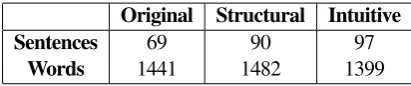
To create the cause subcorpus, we extracted semi-automatically the causal clauses as done by Gonzalez-Dios et al. (2016) and then, following the proposal of Iruskieta et al. (2016), we extracted the sentences containing causal discourse markers and causal lexical signals. The main figures of this sample are presented in Table 2.
Original Structural Intuitive
Sentences 69 90 97
Words 1441 1482 1399
Table 2:Sentence and word number in our sample
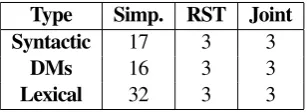
The number of causal structures found in the original sentences of the CBST is shown according to their type in Table 3:i)syntactically marked causal signals (syntactic),ii)causal signals made explicit by discourse markers (DMs), iii) causal relations signaled with
[image:2.595.311.517.523.566.2]nouns and verbs (Lexical).
Type Simp. RST Joint
Syntactic 17 3 3
DMs 16 3 3
[image:3.595.104.258.127.183.2]Lexical 32 3 3
Table 3:Number of analyzed causal structures
The additional resources used in this analysis are1)a study of the frequencies and positions of the adverbial clauses (Gonzalez-Dios et al., 2015) in order to see the frequencies of the syntactic relations;2)the corpus Zernola (Gonzalez-Dios et al., 2014) to see if the syntactic relations are also used in simple texts; and3)a lemma frequency list (Gonzalez-Dios, 2016) to see the frequencies of the discourse markers and lexical signals.
3 Framework
for the Analysis of Simplified Texts
In this section, we present the framework and the annotation required to perform the analysis of simplified texts taking discourse into account.
3.1 Simplification Annotation and Analysis
Following Gonzalez-Dios et al. (2016), we propose to annotate whether the target clauses, in our case the causal relations, have been treated or not (binary tagging). If so, which operations have been performed in each structure. Besides, in this study, we add complementary descriptions such as clause length, syntactic depth (depth of the syntactic tree), surrounding phenomena or frequency information. These are the questions we propose:
a) Simplification treatment and macro-operations: − Have the syntactic, DMs and lexical signals
been treated or not? In the case of the syntactic signals,we also analyze if they have been treated or not according to the causal type defined by Euskaltzaindia (Euskaltzaindia, 2011): i) pure causal -(e)lako‘because’,ii)causal explicative bait-‘since’ andiii)pseudo-causal -(e)nez‘as’). − When the simplification is performed, we
ask: which macro-operations have been performed? For each macro-operation, which exact operations? In the case of lexical signals, which operations according to the PoS (verbs or nouns)?
b) Length and depth
− The sentences that have been split are longer than the average sentence length of original clause?
− The sentences that have been split are inside another subordinate clause?
c) Frequencies
− In the case of the syntactic signals, are they also frequent in other corpora? For this analysis, the frequencies of other corpora are needed.
− When performing transformations, have the syntactic, DMs and lexical signals been sub-stituted with a more frequent equivalent one? d) Ordering
− In the case of the syntactic signals, do the reordering operations suit the word order found in other corpora or the canonical RST relation order?
− Do they suit canonical or stylistic word or sentence orders?
3.2 Discourse Annotation (RST) and Analysis
In the discourse analysis, we want to know if the relations found in the original texts have been kept, modified or deleted in the simplified texts. To that end, we follow this procedure:
− Segmentation: automatic fine-grained discourse segmentation with EusEduSeg (Iruskieta and Zapirain, 2015) and manually corrected following Iruskieta (2014). Output format: RS3.
− Rhetorical structure annotation: manually anno-tated with RSTTool (O’Donnell, 2000) following a modular and incremental annotation method (Pardo, 2005). Output format: RS3.
− Description if there were maintained or changed the nucleus-satellite order of the relations and the relation names with the Rhetorical DataBase (RhetDB) (Pardo, 2005).
In order to describe the simplification operations at rhetorical structure level, we propose the following questions:
a) Rhetorical relations:
− Which relations have been added for text simplification?
b) Ordering:
− Has the nucleus-satellite order been maintained in rhetorical relations?4
3.3 Joint Annotation and Analysis
In order to join both analyses and based on the previous annotation, we propose to analyze the influence of simplification operations in discourse looking at the elementary discourse units (EDU), the central subconstituent (CSC)5 and the rhetorical relations (RR). Exactly, we look the simplification operations performed which impact have on discourse. So, for each relation we make a description like the one that follows for the structurally simplified sentence presented in Table 1:i)an insert (hegoaren formak’the shapes of the wings’) has been performed in the clausal proposition; ii) two split and three insert operations (izan ere, Hegoaren forma’due to the shape of the wings’ and ordea’however’) in the surrounding phenomena.
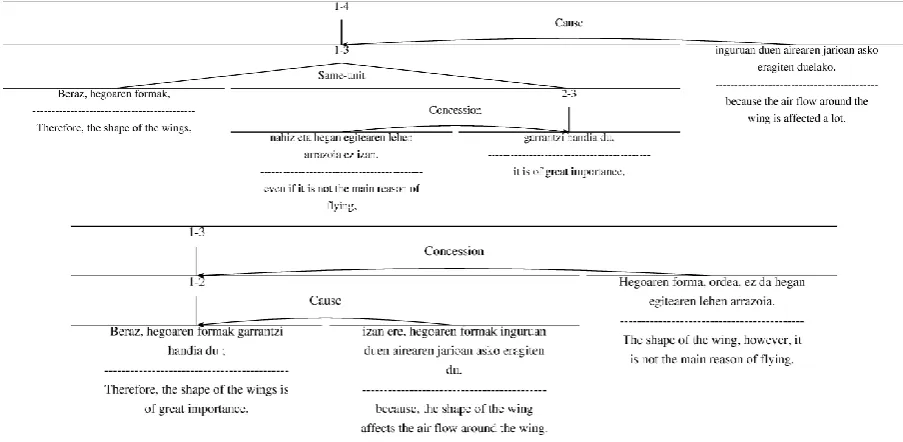
Regarding rhetorical structure, we based on the simplification annotation and in the RST trees like the one presented in Figure 1, where the rhetorical structure (RS-tree) of the original text is shown above and the RS-tree of the structurally simplified text is bellow. There are three main changes in Figure 1:i)there is one span missing (4 above and 3 bellow),ii)the CAUSE relation is attached directly to the most important EDU of the RS-tree (to the central subconstituent), and iii)the CONCESSION relation has a new order (SN above and NS bellow) and is attached to a bigger text span (EDU1−2bellow)6.
In order to quantify and summarize that, these are the questions we propose:
a) Treatment in simplification: − Has it been treated or not? b) Elementary discourse unit (EDU):
4This is important as Mann and Thompson (1987) state: “if a natural text is rewritten to convert the instances of non-canonical span order to canonical order, it seldom reduces text quality and often improves it”.
5The CSC is the salient EDU of a text span.
6Other changes were done in signaling the relations: in the signal CAUSE, the causal subordinator -lako’since’ was changed into the explicative connectorizan ere’since’.
And in the signal CONCESSIONthe subordinatornahiz eta ...-n’in spite of’ was changed into the connectorordea’however’.
− Does the EDU number remain the same? If it changes, which are the changes?
c) Central subconstituent (CSC):
− Are there any changes in the CSC? Which? d) Rhetorical relations (RR):
− Are the RRs kept? Which ones? − Are there new RRs?
− Which RRs have been added, modified or deleted?
This way we see how the simplification operations affect discourse.
4 Results of the Quantitative Analysis
In this section, we present the results and analysis of the causal relations (our sample) according to the framework presented in Section 3.
4.1 Results of Simplification Analysis
Treatment and macro-operations: In Table 4 we present the results in relation to the treatment in both simplification approaches. As we can see:i)more syn-tactic signals have been treated in the intuitive approach; ii) results in the lexical signals are similar; iii)and discourse markers do not seem to be treated in any case.
Treated Structural Intuitive Syntactic 47.06 (8/17) 64.71 (11/17)
DMs 25.00 (4/16) 6.25 (1/16)
[image:4.595.317.512.454.507.2]Lexical 21.21 (7/34) 24.24 (8/34) Table 4:Percentages and raw numbers of causal relations
Focusing on the different types of causal syntactic signals (Table 5), we see that there is a tendency to treat the pure causal -(e)lako‘because’ in the structural approach, while explicativebait- ‘since’ is treated in the intuitive approach.
Structural Intuitive Pure-(e)lako 55.56 (4/9) 33.33 (3/9)
Explicativebait- 40.00 (2/5) 100.00 (5/5)
[image:4.595.309.525.609.663.2]Pseudo-(e)nez 33.33 (1/3) 100.00 (3/3) Table 5:Treated Clauses according to the causal type in both ap-proaches
Figure 1:Bernoulli 80sentence’s original (above) and structural (bellow) RS-trees
undergo transformations (as they are lexical units they cannot undergo splitting operations). The lexical signals undergo split and transformation operations in the struc-tural approach, but only transformations in the intuitive. Comparing the approaches, it is noticeable that more split operations are performed in the structural approach and more transformations in the intuitive. Exactly, the transformations performed in syntactic signals are: i)transforming a subordinate clause into a main clauseii)reformulations (more than one operations and paraphrases) andii)changing the syntactic signal.
Regarding discourse markers, the transformation that has been performed is the substitution of a discourse marker for a more frequent one. The other macro-operations are delete and reordering.
In the case of the lexical signals, the operations performed vary according to the PoS. In Table 7 we present figures about the number of operations performed in nouns and verbs.
To summarize the analysis of the operations, we see that some macro-operations are restricted to the relation type and the PoS of it. That is, we see that no split is applied in all causal DMs or in all noun causal signals. For example, in the causal clause of sentence presented in Table 1, an insert has been performed in the structural approach; in the intuitive approach a split, a transformation (subordinate to main clause) and an insert have been performed.
Length and depth:The average length of the causal clauses in our original sample are 7 words7. In the in-tuitive approach, the split operations have been carried out in all the clauses with 7 or more words, but this only happens in 2 out of the 5 split operations carried out in the structural approach. In relation to the depth, two of the split operations in the structural approach were per-formed in subordinate clauses inside subordinate clauses e.g. a relative clause inside a noun clause.
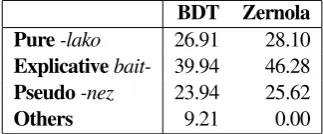
Frequencies:Related to the description of the syntac-tic structures contained in the CBST, we have checked if they are also frequent structures in the BDT corpus8 and in theZernolacorpus. As we can see, they are all frequent structures in both corpora (Table 8).
In Table 9 we present some transformation operations involving substitutions. Our analysis lead us to propose some preliminary conclusions: syntactic signals and DMs are not always substituted with more frequent equivalent ones, but with less ambiguous. As we see here, more frequent forms do not always mean simplicity.
Ordering:In relation to the reordering operations, we have analyzed whether the movements carried out
7As mentioned before, there are 17 clauses with syntactic relations. The longest of them has 17 words and the shortest 3. The mode is 4 words and the median 6.
Macro-oper. Only split Only trans Split+trans Only others
Approach Str. Int. Str. Int. Str. Int. Str. Int.
Syntactic 37.5 (3/8)
9.09 (1/11)
37.5 (3/8)
81.82 (9/11)
25.00 (2/8)
9.09 (1/11)
0.00 (0/8)
0.00 (0/11)
DMs 0.00
(0/4)
0.00 (0/1)
25.00 (1/4)
100.00 (1/1)
0.00 (0/4)
0.00 (0/1)
75.00 (3/4)
0.00 (0/1)
Lexical 42.86
[image:6.595.71.524.105.213.2](3/7) 0.00(0/8) 42.86(3/7) 50.00(4/8) (0/7)0.00 (0/8)0.00 14.29(1/7) 50.00(4/8) Table 6:Percentages and raw numbers of macro-operations performed in causal relations
Oper. Split Trans Reor. Delete
Appr. Str Int Str Int Str Int Str Int
Noun 0 0 1 3 1 1 0 1
[image:6.595.99.261.336.403.2]Verb 3 0 2 1 0 0 0 2
Table 7:Macro-operations performed in the lexical signals accord-ing to their PoS
BDT Zernola
Pure-lako 26.91 28.10
Explicativebait- 39.94 46.28
Pseudo-nez 23.94 25.62
Others 9.21 0.00
Table 8:Distribution of causal structures in the corpora BDT and Zernola
in the simplified sentences at syntactic level suit the canonical word order or the order of clauses found in EPEC. In our sample no reordering was performed at that level. But, we did find an interesting reordering in the intuitive approach: a stylistic reordering took place in the signals in order to avoid the rear-burden9.
4.2 Results of Discourse Analysis
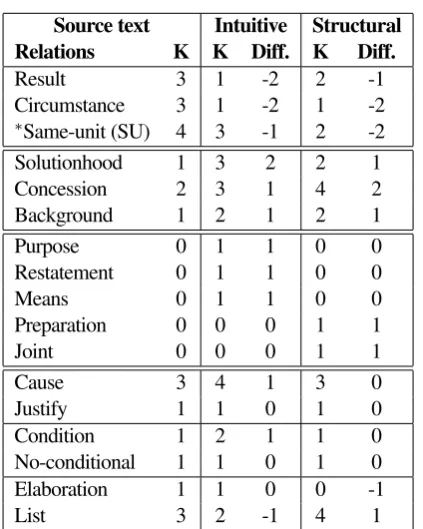
In Table 10, we present the results obtained with Rhetor-ical Database in the different corpus-sets regarding sim-plification approaches and rhetorical relations. The num-ber (K) of all the relations and the differences (diff.) of each corpus-set:i)relations of the original texts (source text) in the first two columns,ii)relations of the intu-itively simplified texts in the following two, andiii) re-lations of the structurally simplified texts in the last two. We can observe different simplification strategies in
9“(...) “rear burden” (...)[is]the effect that occurs when some key elements for correct processing of the message (e.g. the verb) are pushed towards the end of the sentence, thus delaying and making more difficult the comprehension of the message by the receiver.” (Maia-Larretxea, 2015, 68).
Table 10:
− Less frequent RRs in both simplified datasets: the causal relation RESULThas less frequency in both simplified corpus-sets and CIRCUMSTANCEhas also less frequency in both corpus-sets10.
− More frequent RRs in both simplified datasets: SO
-LUTIONHOOD, CONCESSIONand BACKGROUND
are used to simplify texts.
− New RRs in one of the simplified datasets:
PURPOSE, RESTATEMENTand MEANSare new
relations in the intuitive approach and JOINTand
PREPARATIONin the structural.11
Using RhetDB, we extracted and presented in Table 11 the nuclearity type (SN: satellite first and nucleus after; NS: the other way around, nucleus first and satellite after) of all the hypotactic relations12and their frequencies.
Regarding Table 11, we see that the frequency of the causal relations (CAUSE, RESULTand PURPOSE) is bigger in the original subcorpus 0.411 (0.117 for SN and 0.294 for NS),13 than in the intuitive 0.318 (SN: 0.09 and NS: 0.227) and structural approach 0.3 (SN: 0.00 and NS 0.3). This shows that there are less causal relations in the simplified datasets as also found by Graesser et al. (2004) and Crossley et al. (2012) and the NS order is preferred in the causal subgroup, when any causal relation is maintained.
Another interesting observation is that the NS ordering has been increased in the structural approach,
10Although SAME-UNIT (SU) is not a relation, we report it, because it was also simplified in both corpus-sets.
11We think that RRs such as JOINT have appear because discourse was not taken into account when simplifying texts.
12Note that all multinuclear or paratactic relations were excluded from this analysis.
Type Transformation Explanation
Syntactic bait- ->-(e)lako causal explicative substituted with a pure causal (less frequent)
DMs horrez gain’moreover’ ->gainera‘in addition’ substituted with a more frequent
bada‘so’, ‘then’, ‘well’ ->hala ere‘however’ substituted with a less frequent, but less ambiguous
Signals eragile‘originator’,‘promoter’ ->arrazoi‘reason’, ‘cause’, ‘motive’
[image:7.595.66.517.104.483.2]substituted with a more frequent near synonym
Table 9:Transformation operations involving substitutions
Source text Intuitive Structural
Relations K K Diff. K Diff.
Result 3 1 -2 2 -1
Circumstance 3 1 -2 1 -2
∗Same-unit (SU) 4 3 -1 2 -2
Solutionhood 1 3 2 2 1
Concession 2 3 1 4 2
Background 1 2 1 2 1
Purpose 0 1 1 0 0
Restatement 0 1 1 0 0
Means 0 1 1 0 0
Preparation 0 0 0 1 1
Joint 0 0 0 1 1
Cause 3 4 1 3 0
Justify 1 1 0 1 0
Condition 1 2 1 1 0
No-conditional 1 1 0 1 0
Elaboration 1 1 0 0 -1
List 3 2 -1 4 1
Table 10:Simplification strategies and rhetorical relations
whereas in the intuitive approach the SN was increased (and, therefore, the NS decreased). This change brings the important message to the back of the structure and this way, it is more difficult to maintain all the information needed to understand the sentence in the memory, above all in the case of long sentences.
4.3 Joint Analysis
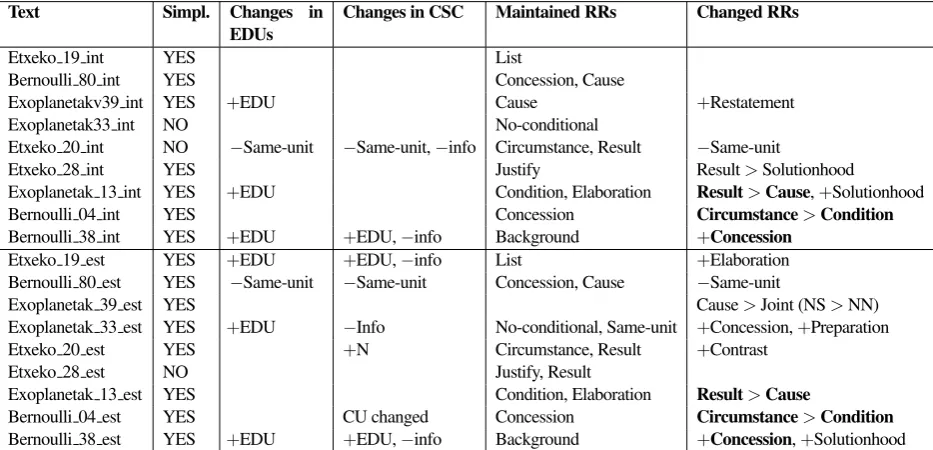
The results of the joint analysis of our sample are presented in Table 12. First column shows the sentence identifier, second column if it has been treated in sim-plification or nor, third column the changes performed in EDU frequency,14fourth column if the changes were
14The sign ’+’ means that there are more EDUs or that some relation was added, whereas the sign ’−’ means that something is
Original Intuitive Structural
Relations SN NS SN NS SN NS
Cause 2 1 1 3 3
Justify 1 1 1
Result 3 1 2
Purpose 1
Condition 1 1 1 1
No-conditional 1 1 1
Circumstance 1 2 1 1
Solutionhood 1 3 1 1
Concession 2 3 2
Background 1 2 2
Restatement 1
Means 1
Preparation 1
Elaboration 1 1 4
[image:7.595.76.288.237.502.2]Total 9 8 14 8 5 15
Table 11:Nucleus/satellite ordering of the rhetorical relations in the original and simplified datasets
performed in the CSCs, the fifth column if RRs were maintained and the sixth column if RRs were changed. To underline these results of Table 12 we summarized the most important differences in Table 13. We observe that the simplification operations performed in the in-tuitive (Int.) and structural (Str.) approaches are similar when simplifying (Simpl.), maintaining or changing the EDUs (Changes in EDUs), performing changes in the CSC and maintaining the RRs. But there is a great differ-ence when they establish a new rhetorical relation (see Table 13), because there are only 3 changed relations (underlined in bold) in common: RESULT>CAUSE,
CIRCUMSTANCE>CONDITIONand+CONCESSION.
4.4 Concluding remarks
[image:7.595.322.508.239.426.2]Text Simpl. Changes in
EDUs Changes in CSC Maintained RRs Changed RRs
Etxeko 19 int YES List
Bernoulli 80 int YES Concession, Cause
Exoplanetakv39 int YES +EDU Cause +Restatement
Exoplanetak33 int NO No-conditional
Etxeko 20 int NO −Same-unit −Same-unit,−info Circumstance, Result −Same-unit
Etxeko 28 int YES Justify Result>Solutionhood
Exoplanetak 13 int YES +EDU Condition, Elaboration Result>Cause,+Solutionhood
Bernoulli 04 int YES Concession Circumstance>Condition
Bernoulli 38 int YES +EDU +EDU,−info Background +Concession
Etxeko 19 est YES +EDU +EDU,−info List +Elaboration
Bernoulli 80 est YES −Same-unit −Same-unit Concession, Cause −Same-unit
Exoplanetak 39 est YES Cause>Joint (NS>NN)
Exoplanetak 33 est YES +EDU −Info No-conditional, Same-unit +Concession,+Preparation
Etxeko 20 est YES +N Circumstance, Result +Contrast
Etxeko 28 est NO Justify, Result
Exoplanetak 13 est YES Condition, Elaboration Result>Cause
Bernoulli 04 est YES CU changed Concession Circumstance>Condition
[image:8.595.73.540.105.330.2]Bernoulli 38 est YES +EDU +EDU,−info Background +Concession,+Solutionhood Table 12:Contingency table of the joint analysis
Simpl. EDU CSC RR
Int. 7 Yes 3+EDU 1−SU−info 12 kept 2 No 1−SU 1+EDU−info 6 changed
3+EDU 2+EDU−info 12 kept
8 Yes 1−SU 1−info 9 changed
Str. 1 No 1−SU 1 NS>NN
1 Change the CSC 1 NN
Table 13:Results of the joint analysis
taken into account when simplifying them (most of them were maintained). So, we want to propose for future simplification guidelines that not only lexis or syntax should be taken into account, but also discourse. That is, if in the original text there is a significant discourse relation, it should be kept in the simplified text when it helps comprehension but deleted when it leads to confusion. But the need of the discourse would not be limited to relations but to the overall relational discourse structure when simplifying text manually, the CSC and the same-unit should also be carefully treated.
For automatic texts simplification systems, the detection of the CSC should also be an important step, above all in the cases that the main piece of information should be highlighted. The difficult task of detecting the same-unit constructions could also be interesting, so that they should be deleted as much as possible.
5 Conclusion and Future Work
In this paper, we present a framework for the analysis of simplified texts taking discourse into account. In the simplification analysis, we propose to analyze the treat-ment and its the macro-operations, the length and depth, the frequencies and the reordering; in the discourse anal-ysis, we propose to segment, annotate and describe the rhetorical relations; and, in the joint analysis, we pro-pose to see the impact of simplification operations on the elementary discourse units, central subconstituents and rhetorical relations. Preliminary results show that this framework is useful to describe the simplified texts and that discourse is not always taken into account when sim-plifying texts in our datasets with the risk of creating not-coherent simplified texts. We have seen e.g. that some macro-operations such as the split cannot be applied to all the relations and that being more frequent does not involve simplicity as took for granted many times.
[image:8.595.71.295.362.456.2]Acknowledgments
This study was carried out within the framework of the following projects: IXA group, Research Group (GIU16/16) and TUNER (TIN2015-65308-C5-1-R).
References
[Bott and Saggion2011] Stefan Bott and Horacio Saggion. 2011. An Unsupervised Alignment Algorithm for Text Simplification Corpus Construction. InProceedings of the Workshop on Monolingual Text-To-Text Generation, MTTG ’11, pages 20–26, Stroudsburg, PA, USA. Association for Computational Linguistics.
[Brunato et al.2015] Dominique Brunato, Felice Dell’Orletta, Giulia Venturi, and Simonetta Montemagni. 2015. Design and Annotation of the First Italian Corpus for Text Sim-plification. InThe 9th Linguistic Annotation Workshop held in conjuncion with NAACL 2015, pages 31–41. [Caseli et al.2009] Helena M. Caseli, Tiago F. Pereira, Lucia
Specia, Thiago. A. S. Pardo, Caroline. Gasperin, and Sandra Alu´ısio. 2009. Building a Brazilian Portuguese Parallel Corpus of Original and Simplified Texts. Inthe Proceedings of CICLing, pages 59–70.
[Crossley et al.2007] Scott. A. Crossley, Max M. Louwerse, Philip M. McCarthy, and Danielle S. McNamara. 2007. A Linguistic Analysis of Simplified and Authentic Texts. The Modern Language Journal, 91(1):15–30.
[Crossley et al.2012] Scott A Crossley, David Allen, and Danielle S McNamara. 2012. Text Simplification and Comprehensible Input: A case for an Intuitive Approach. Language Teaching Research, 16(1):89–108.
[Euskaltzaindia2011] Euskaltzaindia. 2011. VII, (Perpaus jokatugabeak: denborazkoak, kausazkoak eta helbu-ruzkoak, baldintzazkoak, kontzesiozkoak, moduzkoak, erlatiboak eta osagarriak) [VII (Subordinate Clauses-2, temporal, Causal and Purpose, Conditional, Concessive, Modal, Relative and Completive]. In Euskal Gra-matika Lehen Urratsak [Basque Grammar First Steps]. Euskaltzaindia, Bilbo.
[Gonzalez-Dios et al.2014] Itziar Gonzalez-Dios, Mar´ıa Jes´us Aranzabe, Arantza D´ıaz de Ilarraza, and Haritz Salaberri. 2014. Simple or Complex? Assessing the Readability of Basque Texts. InProceedings of COLING 2014, the 25th International Conference on Computational Linguistics: Technical Papers, pages 334–344, Dublin, Ireland, August. Dublin City University and Association for Computational Linguistics.
[Gonzalez-Dios et al.2015] Itziar Gonzalez-Dios, Mar´ıa Jes´us Aranzabe, and Arantza D´ıaz de Ilarraza. 2015. Perpaus adberbialen agerpena, maiztasuna eta kokapena EPEC-DEP corpusean [Presence, frequency and Position of Basque Adberbial Clauses in The BDT corpus]. Technical
report, University of the Basque Country (UPV/EHU) UPV/EHU/LSI/TR 02-2015.
[Gonzalez-Dios et al.2016] Itziar Gonzalez-Dios, Mar´ıa Jes´us Aranzabe, and Arantza D´ıaz de Ilarraza. 2016. A Pre-liminary Study of Statistically Predictive Syntactic Complexity Features and Manual Simplifications in Basque. InProceedings of the Computational Linguistics for Linguistic Complexity (CL4LC) workshop at Coling 2016, pages 89–97.
[Gonzalez-Dios2016] Itziar Gonzalez-Dios. 2016. Eu-skarazko egitura sintaktiko konplexuen analisirako eta testuen sinplifikazio automatikorako proposamena-Readability Assessment and Automatic Text Simplification. The Analysis of Basque Complex Structures. Ph.D. thesis, University of the Basque Country (UPV/EHU).
[Graesser et al.2004] Arthur C. Graesser, Danielle S. Mc-Namara, Max M. Louwerse, and Zhiqiang Cai. 2004. Coh-Metrix: Analysis of text on cohesion and language. Behavior Research Methods, 36(2):193–202.
[Iruskieta and Zapirain2015] Mikel Iruskieta and Benat Zapirain. 2015. Euseduseg: A Dependency-based EDU Segmentation for Basque. Procesamiento del Lenguaje Natural, 55:41–48.
[Iruskieta et al.2016] Mikel Iruskieta, Mar´ıa Jes´us Aranzabe, Arantza D´ıaz de Ilarraza, and Mikel Lersundi. 2016. Kausazko koherentzia-erlazioen azterketa automatikoa euskarazko laburpen zientifikoetan [Toward a computa-tional approach of causal coherence relations in scientific abstract texts]. Gogoa, 14:45–77.
[Iruskieta2014] Mikel Iruskieta. 2014. Pragmatikako erlaziozko diskurtso-egitura: deskribapena eta bere ebalu-azioa hizkuntzalaritza konputazionalean [The Discourse Structure of the Pragmatic Relations: Description and its Evaluation in Computational Lingustics]. Ph.D. thesis, University of the Basque Country (UPV/EHU).
[Klaper et al.2013] David Klaper, Sarah Ebling, and Martin Volk. 2013. Building a German/Simple German Parallel Corpus for Automatic Text Simplification. InProceedings of the Second Workshop on Predicting and Improving Text Readability for Target Reader Populations, pages 11–19, Sofia, Bulgaria, August. Association for Computational Linguistics.
[Klerke and Søgaard2012] Sigrid Klerke and Anders Søgaard. 2012. DSim, a Danish Parallel Corpus for Text Sim-plification. In Nicoletta Calzolari (Conference Chair), Khalid Choukri, Thierry Declerck, Mehmet Ugur Doˇ gan,ˇ Bente Maegaard, Joseph Mariani, Jan Odijk, and Stelios Piperidis, editors,Proceedings of the Eight International Conference on Language Resources and Evaluation (LREC’12), pages 4015–4018, Istanbul, Turkey, May. European Language Resources Association (ELRA). [Kong et al.2017] Anthony Pak-Hin Kong, Anastasia Linnik,
Rhetorical Structure Theory. International Journal of Speech-Language Pathology, pages 1–16.
[Maia-Larretxea2015] Julian Maia-Larretxea. 2015. On Criteria of Professionals of the Language about the Back-burden in Basque. Procedia-Social and Behavioral Sciences, 212:67–73.
[Mann and Thompson1987] William C Mann and Sandra A Thompson. 1987. Rhetorical structure theory: A theory of text organization. University of Southern California, Information Sciences Institute.
[Mann and Thompson1988] William C. Mann and San-dra A. Thompson. 1988. Rhetorical Structure Theory: Toward a functional theory of text organization. Text-Interdisciplinary Journal for the Study of Discourse, 8(3):243–281.
[O’Donnell2000] Michael O’Donnell. 2000. RSTTool 2.4: a Markup Tool for Rhetorical Structure Theory. InProceedings of the first international conference on Natural language generation-Volume 14, pages 253–256. Association for Computational Linguistics.
[Pardo2005] Thiago Alexandre Salgueiro Pardo. 2005. M´etodos para an´alise discursiva autom´atica. Ph.D. thesis, Instituto de Ciˆencias Matem´aticas e de Computac¸˜ao. [Pellow and Eskenazi2014] David Pellow and Maxine
Eske-nazi. 2014. An Open Corpus of Everyday Documents for Simplification Tasks. InProceedings of the 3rd Workshop on Predicting and Improving Text Readability for Tar-get Reader Populations (PITR), pages 84–93, Gothenburg, Sweden, April. Association for Computational Linguistics. [Petersen and Ostendorf2007] Sarah E. Petersen and Mari
Ostendorf. 2007. Text Simplification for Language Learners: A Corpus Analysis. In In Proceedings of Workshop on Speech and Language Technology for Education. SLaTE, pages 69–72. Citeseer.
[Saggion2017] Horacio Saggion. 2017. Automatic Text Simplification. Morgan & Claypool.
[Simensen1987] Aud Marit Simensen. 1987. Adapted Readers: How are they Adapted. Reading in a Foreign Language, 4(1):41–57.
[Xu et al.2015] Wei Xu, Chris Callison-Burch, and Courtney Napoles. 2015. Problems in Current Text Simplification Research: New Data Can Help. Transactions of the Association for Computational Linguistics, 3:283–297. [Young1999] Dolly N. Young. 1999. Linguistic