Universal Morphology for Old Hungarian
Eszter Simon
Research Institute for Linguistics, Hungarian Academy of Sciences
Bencz´ur u. 33. H-1068 Budapest, Hungary [email protected]
Veronika Vincze
MTA-SZTE Research Group for Artificial Intelligence
Tisza Lajos krt. 103. H-6720 Szeged, Hungary [email protected]
Abstract
This paper provides a description of the automatic conversion of the morphologi-cally annotated part of the Old Hungar-ian Corpus. These texts are in the for-mat of the Humor analyzer, which does not follow any international standards. Since standardization always facilitates future research, even for researchers who do not know the Old Hungarian language, we opted for mapping the Humor formalism to a widely used universal tagset, namely the Universal Dependencies framework. The benefits of using a shared tagset across languages enable interlingual comparisons from a theoretical point of view and also multilingual NLP applications can profit from a unified annotation scheme. In this paper, we report the adaptation of the Uni-versal Dependencies morphological anno-tation scheme to Old Hungarian, and we discuss the most important theoretical lin-guistic issues that had to be resolved dur-ing the process. We focus on the ldur-inguistic phenomena typical of Old Hungarian that required special treatment and we offer so-lutions to them.
1 Introduction
There is a growing interest not only in the nat-ural language processing (NLP) community, but even among theoretical and historical linguists for building and using databases of historical texts. High quality historical corpora enriched with some kinds of linguistic information and metadata can provide a fertile ground for theoret-ical investigations. Several databases of histortheoret-ical texts have recently been created for various Indo-European languages, such as the Penn-Helsinki
Parsed Corpus of Middle English (Kroch and Tay-lor, 2000), the Tycho Brahe Parsed Corpus of His-torical Portuguese (Galves and Britto, 2002), or the Welsh Prose corpus (Thomas et al., 2007) and for non-Indo-European languages as well, such as the Old Hungarian Corpus (Simon, 2014).
Historical corpora represent a rich source of data, but only if the relevant information is speci-fied in a computationally interpretable and retriev-able way. Moreover, following the current stan-dardisation efforts allows for cross-lingual com-parative studies, as well as for longitudinal inves-tigations on language change. With the recent increase in the number of annotated corpora, it seems advisable to move towards a harmonized common framework and methodology. Standard-ization always facilitates future research – in this case even for researchers who do not know the Old Hungarian language.
Natural language processing activities in Hun-gary were not synchronized in the past, hence sim-ilar resources were developed in parallel at dif-ferent locations. As a consequence, there are two morphological analyzers for Hungarian: Hun-morph (Tr´on et al., 2005) and Humor (Nov´ak, 2003). The former one has not been maintained recently, while the latter one is not freely available. Moreover, they use different formalisms, which share only one common property: they do not fol-low any international standards. For the morpho-logical annotation of Old Hungarian texts, the Hu-mor analyzer was used, thus all of the Hu- morphologi-cally annotated texts are in a special format, which is hard to be interpreted for a non-Hungarian re-searcher. That is the reason behind the need of mapping the Humor formalism to a widely used universal tagset, for which we chose the Universal Dependencies (UD) framework.
The UD tagset and annotation scheme have just been adapted to Modern Hungarian (Vincze et al.,
2016). In this paper, we report the adaptation of the morphological annotation scheme to Old Hun-garian, and we discuss the most important theoret-ical linguistic issues that had to be resolved during the process. Section 2 briefly presents the inter-national project Universal Dependencies and Mor-phology, then we summarize the part-of-speech (POS) tags and morphological features that are rel-evant for Old Hungarian. Section 3 gives a brief introduction of the Old Hungarian language and describes the morphologically annotated part of the Old Hungarian Corpus which has been con-verted into the UD tagset. Section 4 reports on our experiences in the conversion and discusses the specific linguistic issues concerning parts-of-speech and features. In Section 5, we contrast the annotation schemes developed for Old and Mod-ern Hungarian. Conclusions and the planned fu-ture work end the paper in Section 6.
2 Universal Dependencies and Morphology
Universal Dependencies is an international project that aims at developing a unified annotation scheme for dependency syntax and morphology in a language-independent framework (Nivre, 2015). Currently (as of June 2016), there are anno-tated datasets available for 45 languages, includ-ing modern languages such as English, German, French, Hungarian and Irish, and old languages such as Ancient Greek, Coptic, Latin and Old Church Slavic, among others1. Datasets from all these languages apply the same tagsets at the mor-phological and syntactic levels and are annotated on the basis of the same linguistic principles, to the widest extent possible, however, in some cases, language-specific decisions had to be made. The benefits of using a shared tagset across languages enable interlingual comparisons from a theoretical point of view and also multilingual NLP applica-tions can profit from a unified annotation scheme. Standardized tagsets for both morphological and syntactic annotation have been constantly im-proved in the international NLP community. As for dependency syntax, Stanford dependencies is one of the most widely used tagsets (de Marn-effe and Manning, 2008). For morphology, the MSD coding system was developed for a bunch of Eastern European languages including Hungar-ian (Erjavec, 2012). Interset functions as an
in-1http://universaldependencies.org
POS description ADJ adjective ADP adposition ADV adverb AUX auxiliary
CONJ coordinating conjunction DET determiner
INTJ interjection NOUN noun NUM number PART particle
PRON nominal pronoun PROPN proper noun PUNCT punctuation
SCONJ subordinating conjunction VERB verb
[image:2.595.308.478.67.308.2]X other
Table 1: POS tags for Old Hungarian.
terlingua for different morphological tagsets and it enables the conversion of different tagsets to the same morphological representation (Zeman, 2008). Rambow et al. (2006) defined a multilin-gual tagset for POS tagging and parsing, while McDonald and Nivre (2007) identified eight POS tags based on data from the CoNLL-2007 Shared Task (Nivre et al., 2007). Petrov et al. (2012) offered a tagset of 12 POS tags and applied this tagset to 22 languages.
Now, Universal Dependencies is the latest stan-dardized tagset that we are aware of. In its current form, morphological information is encoded in the form of POS tags and feature–value pairs. There is a fixed set of universal POS tags without the pos-sibility of introducing new members, but features and values can have language-specific additions if needed. Features are divided into the categories lexical features and inflectional features. Lexical features are features that are characteristics of the lemmas rather than the word forms, whereas in-flectional features are those that are characteris-tics of the word forms. Both lexical and inflec-tional features can have layered features: some features are marked more than once on the same word, e.g. a Hungarian noun may denote its pos-sessor’s number as well as its own number. In this case, theNumberfeature has an added layer, Number[psor].
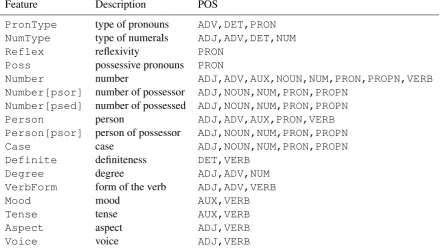
annotates words with POS information and mor-phological features. Tables 1 and 2 summarize the POS tags and morphological features that are rel-evant for Old Hungarian, based on the annotation scheme created for Modern Hungarian, described at the UD website and in Vincze et al. (2016).
3 Old Hungarian
The Old Hungarian era lasted from 896 to 1526, the year of the occupation of the major part of the Hungarian Kingdom by the Ottoman Empire. The first part of this period (between 896–1350), doc-umented by linguistic fragments and short coher-ent texts, is called the Early Old Hungarian period. The Late Old Hungarian period between 1350– 1526 is the period of codices.
The Old Hungarian Corpus (Simon, 2014) con-tains all codices from the Late Old Hungarian pe-riod and several minor texts from the Early Old Hungarian period in their original orthographic form. Because of the heterogeneity of the Old Hungarian orthographic system, the original to-kens had to be transcribed into their modernized form during a normalization step (for more de-tails, see Oravecz et al. (2010)). Twelve of 47 codices have been normalized so far, and five of them have been morphologically analyzed and dis-ambiguated.
The five codices are (in the order of the year of their writing/translation): J´okai Codex (after 1372/around 1448), Munich Codex (1466), Fes-tetics Codex (before 1494), Guary Codex (before 1495) and Booklet on the Dignity of the Apostles (1521). These codices contain legends of saints, prayers, psalms, Bible translations and religious readings.
The Humor morphological analyzer was origi-nally developed for Modern Hungarian and later it was extended to be capable of analyzing words containing morphological constructions, suffixes, paradigms and stems that were used in Old Hun-garian but no longer exist in Modern HunHun-garian (Nov´ak et al., 2013). Since the analyzer gener-ates all potential morphological analyses for each token, a disambiguation step is required to select the most appropriate analysis. For this purpose, an HMM-based trigram tagger, PurePos (Orosz and Nov´ak, 2012) was used, whose output was man-ually validated and corrected. This is the source data of the present conversion process, which con-tains 158,746 tokens altogether.
4 Language-specific extensions
Since the time interval of the Old Hungarian pe-riod is more than 600 years, several linguistic phe-nomena were in permanent change during this pe-riod. That is one of the reasons behind the het-erogeneity of Old Hungarian texts. For instance, the progress in which postpositions became ver-bal particles or adverbs roots back to the Proto-Hungarian period and lasts even in the Modern Hungarian era, thus making a decision on their POS tag is far from trivial (discussed in more de-tail in Section 4.2). Such issues posed several problems during the conversion process, which are detailed in this section.
In examples, throughout the section, the rel-evant parts are emboldened. As a morphologi-cal description, we apply and follow the standard Leipzig Glossing Rules. The source of the exam-ple is provided in brackets after the translation. If the example is part of the Bible, the translation is copied from the King James Bible, and its biblical locus (book, chapter, verse) is also provided.
First, we discuss general issues of the conver-sion, then we illustrate specific cases that are rel-evant to only some or only one POS. Finally, challenges concerning morphological features are summed up.
4.1 General issues
Derivations changing part-of-speech
Hungarian has a great number of derivational suf-fixes, some of which change the POS of the word. These may derive – among others – verbs from nouns, e.g.f¨ul (‘ear’) ∼f¨ulel (‘listen carefully’); nouns from adjectives, e.g.vad(‘wild’)∼vads´ag (‘wildness’); adjectives from nouns, e.g. hold (‘moon’) ∼ holdbeli (‘located on the moon’); or adverbs from adjectives, e.g. v´ıg (‘merry’) ∼
v´ıgan(‘merrily’) (for more details, see T¨orkenczy (2005)). They are formed either with a non-harmonic suffix or with non-harmonic two- or more-form suffixes, which are added to the stem. The choice of the appropriate harmonic variant is de-termined by vowel harmony (see below).
Feature Description POS
PronType type of pronouns ADV,DET,PRON NumType type of numerals ADJ,ADV,DET,NUM Reflex reflexivity PRON
Poss possessive pronouns PRON
Number number ADJ,ADV,AUX,NOUN,NUM,PRON,PROPN,VERB Number[psor] number of possessor ADJ,NOUN,NUM,PRON,PROPN
Number[psed] number of possessed ADJ,NOUN,NUM,PRON,PROPN Person person ADJ,ADV,AUX,PRON,VERB Person[psor] person of possessor ADJ,NOUN,NUM,PRON,PROPN Case case ADJ,NOUN,NUM,PRON,PROPN Definite definiteness DET,VERB
Degree degree ADJ,ADV,NUM VerbForm form of the verb ADJ,ADV,VERB
Mood mood AUX,VERB
Tense tense AUX,VERB
Aspect aspect ADJ,VERB
[image:4.595.73.514.68.319.2]Voice voice ADJ,VERB
Table 2: Morphological features for Old Hungarian.
which do not change the lexical category were left unchanged, while POS-changing suffixes caused several difficulties. In addition to changing the POS, the lemma had also to be changed.
In the case of POSs which cannot be inflected, the full normalized word form can stand for the lemma as well. However, in those cases when the derived form may be inflected (verbs, nouns, adjectives), the lemma and the normalized form are not interchangeable. Thus the new lemma has to be generated from the old lemma and the har-monized form of the derivational suffix. More-over, there are several irregular stems which may be changed before the derivational suffix, thus the converter must be capable to deal with them. The irregular stems occurring in the current version of the corpus are fully covered by the rules of the converter, but new stems may appear when expanding the corpus with new sources. Lem-mas coming from the Humor morphological an-alyzer can be preserved in the 10th column of the CoNLL-U format, which is dedicated to any other annotation.
Allomorphs
In Hungarian, most suffixes harmonize with the stem they are attached to, which means that most suffixes exist in two or three alternative forms differing in the suffix vowel, and the selection of the suffix alternant is determined by the stem
vowel(s). This phenomenon is known as vowel harmony, whose roots probably go back to the Proto-Uralic language, thus it exists in the Old Hungarian language as well.
There are several alternants in the Old Hungar-ian language which do not exist in Modern Hun-garian and which therefore have specific mark-ings in the formalism of Humor. An example of this phenomenon is the allomorph -i. In many cases, it is difficult or even impossible to decide whether it is the 3rd person singular form of the possessive suffix, or whether it marks the plu-rality of the possessed noun. For instance, the form¨ygeret¨ythcan be normalized either as ´ıg´eret-´e-t (‘promise-POSS.3SG-ACC’), or as ´ıg´eret-e-i-t (‘promise-POSS.3SG-PL-ACC’). These forms
4.2 Issues concerning parts-of-speech Pronouns
In UD, only pronouns that substitute nouns are assigned the POS tag PRON, all the other pro-nouns are tagged according to the POS they stand for in the context. However, in the Old Hungar-ian Corpus, all pronouns – even those substituting other parts-of-speech – are tagged as pronouns. While converting the data, we could exploit the fact that pronouns inflected for case can only sub-stitute nouns, compare the examples below:
(1) ilyet´ensuch k¨ony¨org´es-ek-etprayer-PL-ACC
‘such prayers’ (Kazinczy C. 26r)
(2) sohanever such-ilyet´en-tACC nem ten-ninot do-INF
‘such thing never to do’ (J´okai C. 107) Thus, inflected pronouns were automatically tagged as PRON. Words that were originally tagged as pronouns and occurred in the nominative case (i.e. they were not inflected) were assigned their UD POS tags with the help of lexical support: we defined lists for those pronouns and determined their UD POS tag manually. For instance, in Ex-ample 1, ilyet´en was tagged as ADJ. These lists were then used in the automatic conversion pro-cess.
Postpositions
Some of the prepositional meanings found in other languages such as English are expressed in Hun-garian by postpositions (Example 3) and case end-ings (Example 4). Heged˝us (2014) claims that there is historical evidence that the only differ-ence between postpositions and case suffixes is that suffixes are monosyllabic and most of them show vowel harmony with the stem they are at-tached to. Syntactically, the two groups behave largely identically in Modern Hungarian.
(3) h´az-ahouse-POSS.3SG f¨ol¨ottabove
‘above his house’ (Festetics C. 57)
(4) h´az-´a-house-baPOSS.3SG-ILL
‘into his house’ (J´okai C. 88)
Similarly to the forms of pronouns inflected for case (Example 5), some postpositions may form
postpositional pronominal forms (Example 6). The former word forms can be regarded as a com-bination of a case marker and a marker for person and number, while the latter ones consist of a post-position plus the regular person/number endings.
(5) nek-emDAT-1SG
‘to me’ (Festetics C. 54)
(6) ellen-emagainst-1SG
‘against me’ (J´okai C. 103)
In the Old Hungarian Corpus, however, these suffixes are analyzed as possessive endings, which is also a valid approach. Some of the Old Hun-garian postpositions can appear in a structure that is analogous to the possessive construction (for more details on possessive constructions, see Sec-tion 4.3). Similarly to how the possessor can ap-pear in dative case, the complement of some post-positions can also be in dative case, while a pos-sessedness marker may appear on the postposition (Heged˝us, 2014), compare the examples below:
(7) hal´al-adeath-POSS.3SG ut´anafter
‘after his death’ (Vienna C. 4)
(8) hal´al-od-nakdeath-POSS.2SG-DAT ut´an-aafter-POSS
‘after your death’ (Bod C. 14r)
Since inflected pronouns and inflected postpo-sitions behave in a similar way, it can be argued that these endings are only markers of person and number, without referring to possession. In the UD morphology, we analyze both of them as per-sonal pronouns as they can substitute inflected nouns, and assign them the featuresPersonand Number, without any reference to possession.
Complex verb forms
plus two inflectional slots, i.e. positions where in-flectional suffixes can occur. The first of these suf-fix positions is that of tense/mood and the second one is that of person/number. This is the reason be-hind the need for complex verb forms, thus there is insufficient place in one inflected word form for expressing tense and mood at the same time. Therefore, one of the tense and mood markers has to be ‘out-sourced’ to an auxiliary, while agree-ment and definiteness markers stay on the lexical verb.
There are four complex verb forms in Old Hun-garian: past continuous, past perfect, past condi-tional, and past subjunctive. With the only ex-ception of past conditional, all of them are extinct from the Modern Hungarian language.
The past continuous and the past conditional constructions have a version in which the auxiliary also bears an agreement marker, as in Examples 9 and 10:
(9)
tart-om val-´ek
keep-1SG.DEF be-IPFV.1SG
‘I was keeping (them)’ (Munich C. 103vb)
(10) ´ır-t-amwrite-PST-1SG vol-n´ekbe-COND.1SG
‘I would have written’ (Bod C. 15r) In these cases, Person andNumber features of both the lexical verb and the auxiliary have the same value. In the cases where the auxiliary does not carry any grammatical distinctions, but the tense or mood suffixes, Person, Number, Voice and Definite features remain under-specified.
Verbal particles
Hungarian verbs often have particles, which ap-pear pre-verbally in neutral Hungarian sentences. In these cases, they are attached to the beginning of the verb, thus they constitute one token with the verb (Example 11). However, there are sev-eral cases when particles become separated from the verb and actually appear after the verb. For example, if another word or group of words is the focus in the sentence, the particle obligatorily fol-lows the verb (Example 12).
(11)
ki-tisztul-ok nagy v´et´es-b˝ol out-purge-1SG big sin-ELA
‘I am purged from big sin’ (Festetics C. 11)
(12) sok-ak-atmany-PL-ACC hagy-t-amleave-PST-1SG elaway
‘I left many’ (K¨onyvecse 18v)
If the verbal particle immediately precedes the verb, its code is attached to that of the verb in the Humor formalism. Since the verbal particle + verb construction is treated as one unit, only one POS tag can be assigned to it, which isVERB.
In cases when the particle is separated from the verb, the particle itself must have its own POS tag. According to the UD description, however, not all function words that are traditionally called particles automatically qualify for thePART tag, but they may be adpositions or adverbs by origin, therefore should be tagged asADPorADV, respec-tively.
The state and origin of verbal particles are con-stantly disputed even in Modern Hungarian. For example, D. M´atai (1992) claims that they devel-oped from spatial adverbs, while Heged˝us (2014) proposes that they all go back to spatial postposi-tions with a lative (mostly goal) meaning.
The oldest particles are meg‘back’,ki‘out’,le ‘down’, el ‘away’, be ‘into’, fel ‘up’. They are telicizing elements with often little spatial mean-ing left due to semantic bleachmean-ing. However, since they have not been fully grammaticalized, they have preserved some spatial meaning, and as a re-sult we cannot treat them as regular particles.
In addition to the oldest particles, several new ones were born during the Old Hungarian period. According to the theory of Heged˝us (2014), all of them go back to, and are grammaticalized from postpositions, therefore we tagged them asADP.
Adverbial participles
Old Hungarian has three types of adverbial partici-ples, which are formed with one of the harmon-ising two-form suffixes: -v´an/-v´en, -va/-ve, and -atta/-ette. In the UD formalism, they all have theVerbForm=Transfeature–value pair, since they are transgressives, i.e. non-finite verb forms that share properties of verbs and adverbs.
While -v´an/-v´en adverbial participles do not agree, participles with-va/-vecan optionally agree with their subject (Examples 13 and 14), and par-ticiples with -atta/-ette ending obligatorily agree with their subject, see Example 15.
(13) hal-vadead-PART lel-ikfind-3PL.DEF val-abe-PST
(14)
mi alu-v´ank
we sleep-PART.1PL
‘while we slept’
(Munich C. 35vb; Matthew 28,13)
(15)
m´ıg ˝o besz´ell-ette
while he speak-PART.3SG
‘while he yet spake’
(Munich C. 81vb; Luke 22,47)
While some of the Old Hungarian non-finites do agree with their subject, none of them distinguish the definite and indefinite conjugation like finite clauses do. Moreover, they do not bear tempo-ral, mood, and aspect suffixes, thus in this sense their agreement paradigm can be said to be de-fective. Therefore, they can optionally get the PersonandNumberfeatures in UD besides the VerbForm=Transfeature–value pair.
4.3 Issues concerning features Definiteness of the verb
As a special type of agreement, Hungarian verbs also mark the definiteness of their objects. In other words, the form of the verb changes when the def-initeness of the object also changes (T¨orkenczy, 2005). Proper nouns and noun phrases with a def-inite article are prototypical examples of defdef-inite objects while bare nouns and noun phrases with an indefinite article are indefinite objects. Compare:
(16) l´at-´asee-IPFV.3SG.DEF azthe house-h´az-atACC
‘he saw the house’ (Kazinczy C. 13r)
(17) l´at-asee-IPFV.3SG.INDEF dream-´alm-otACC
‘he had a dream’ (Vienna C. 73)
As can be seen in Examples 16 and 17, the two verb forms differ only in one accent, more pre-cisely, in the definite form there is an accenteda, but in the indefinite form, there is no accent on the last vowel. However, due to the lack of standard-ized orthography and spelling conventions in the Old Hungarian period, the very same words can be spelled completely differently on the one hand, and different words can be spelled in the same way on the other hand, especially when no dia-critics are used. Thus, we could encounter cases when it was impossible to decide whether the def-inite or the indefdef-inite form of the verb was meant
to be used, e.g. lata could be l´ata (the indefinite form) as well asl´at´a(the definite form). For these cases, it seemed necessary to add another possi-ble value of the Definite feature: the value Underspecifieddenotes that the definiteness of the verb cannot be figured out and it leaves this feature under-specified.
Possessive constructions
The possessor in Hungarian possessive construc-tions can have two different surface forms both in Old and Modern Hungarian, without any differ-ence in meaning (similar to the English construc-tionsthe boy’s dogandthe dog of the boy). That is, both of the following examples are widely used:
(18)
J´ezus tan´ıtv´any-a Jesus disciple-POSS.3SG
‘Jesus’s disciple’
(Munich C. 35rb; Matthew 27,57)
(19) J´ezus-nakJesus-DAT nev-´e-bename-POSS.3SG-ILL
‘in the name of Jesus’ (Booklet 16r) The first (unmarked) form coincides with the nominative case whereas the second (marked) form coincides with the dative form of the noun, cf.:
(20)
mond-´a J´ezus-nak
say-IPFV.3SG.DEF Jesus-DAT
‘said unto Jesus’
(Munich C. 23rb; Matthew 17,4) According to the UD guidelines for Modern Hungarian, the case of the unmarked possessor is nominative, that is, a nominative possessor is not distinguished from the subject. However, the marked possessor is labeled differently from the dative argument, bearing a genitive label. In the original version of the Old Hungarian Corpus, a distinction was made in all of the cases, and the labels Nom, Dat, Nom Gen and Dat Gen are used for the subject, indirect object, nominative posses-sor and dative possesposses-sor, respectively.
Example Translation UD for MH OH original UD for OH a fi´u kuty´aja the boy’s dog Nom Nom Gen Nom a fi´u j´atszott the boy was playing Nom Nom Nom a fi´unak a kuty´aja the dog of the boy Gen Dat Gen Dat a fi´unak adta a k¨onyvet he gave the book to the boy Dat Dat Dat
Table 3: Morphological features for possessors (MH: Modern Hungarian, OH: Old Hungarian).
5 Differences between Old and Modern Hungarian
In this section, we briefly contrast the annotation schemes for Old and Modern Hungarian, and we highlight the most important differences.
In Old Hungarian, there were more tenses and verb forms in use than in Modern Hungarian (see Section 4.2). Hence, more feature combinations are possible in Old Hungarian. Certain forms of adverbial participles agreed with the subject in Old Hungarian, however, this phenomenon is ex-tinct now (cf. Section 4.2). For this reason, ad-verbial participles can have the featuresNumber andPersonin Old Hungarian but not in Modern Hungarian.
The verbal particlemegoriginates from a post-position meaning ‘behind’. However, in Modern Hungarian,megtotally lost this shade of meaning and now is only used as a particle that perfectivizes the meaning of the verb it is attached to. Due to this historical change, meg is tagged as PART in Modern Hungarian but asADPin Old Hungarian.
In Old Hungarian, ordinal and fractal num-bers are not distinguished from each other, that is, the word form harm-ad (‘three-DERIV.SFX’)
can mean ‘a third part of something’ and ‘the third one’ as well. However, in Modern Hungar-ian, it can only have the first meaning, the lat-ter one is expressed by the word form harm-ad-ik (‘three-DERIV.SFX-DES’). As a consequence,
fractal numbers occur only in Modern Hungarian but not in Old Hungarian.
There are also differences concerning the mark-ing of possessors. As discussed above in Sec-tion 4.3, the Old Hungarian UD annotaSec-tion scheme makes use of only the labels Nom and Dat, re-gardless of whether the noun is used as a possessor or not. However, the morphological annotation of the UD treebank for Modern Hungarian was con-verted from the Szeged Treebank (Csendes et al., 2005), which makes a distinction between dative possessors and indirect objects (both ending in a
dative suffix), thus the distinction was kept in the UD treebank as well. It should be noted, however, that it is not historical changes that led to this dis-tinction: the annotation principles of the two tree-banks are responsible for this divergence.
Due to the orthographic features of codices, the valueUnderspecifiedhad to be added to the Definitefeature for verbs, which is not present in Modern Hungarian (cf. Section 4.3). Neverthe-less, this feature value might be of use in Modern Hungarian too: for instance, social media users tend to write their posts without accents, which might also yield ambiguous word forms. Thus, should social media texts be included in the Mod-ern Hungarian UD treebank in the future, this fea-ture value might be exploited there as well.
As can be seen, in some cases, Old Hungar-ian had a richer set of morphological processes (for instance, verbal conjugation), but in other cases, Modern Hungarian has developed some more morphological distinctions (like that of ordi-nal and fractal numbers). Thus, both additions and losses occurred in Hungarian morphology from a historical perspective. Later on, we intend to in-vestigate whether this is true for syntax as well: we would like to adapt the UD annotation guidelines to Old Hungarian and see the syntactic differences between Old and Modern Hungarian.
6 Conclusions and future work
In this paper, we reported the automatic conver-sion of the morphological annotation of the Old Hungarian Corpus to the international standard framework of Universal Dependencies and Mor-phology. We presented the linguistic phenom-ena typical of Old Hungarian that required spe-cial treatment and we offered solutions to them. The detailed description of the Old Hungarian morphology has been made publicly available, to-gether with the converted corpus2. Later on, we intend to adapt the Modern Hungarian UD
dency tagset and annotation principles to Old Hun-garian as well. After that, we are planning to add syntactic annotation to the corpus and publish it at the UD website3, together with the adapted depen-dency labels and their detailed description.
Currently, additional texts from the Old Hun-garian period are being digitized and normalized, also, morphological annotation is being added to them. These texts will then be standardized ac-cording to the UD morphology on the basis of the conversion rules developed in this paper and thus, the dataset of Old Hungarian texts with UD mor-phology will be expanded too.
Finally, it should be noted that the Hungarian NLP community is currently implementing a new morphological analyzer, which is planned to pro-vide output in different formalisms, one of which will be the UD morphology. We are confident that our corpus and the above-mentioned morpholog-ical analyzer can contribute to the more effective and faster processing of Old Hungarian texts.
Acknowledgments
The research reported in the paper was conducted with the support of the Hungarian Scientific Re-search Fund (OTKA) grant #112057. We thank the anonymous reviewers for their comments.
References
D´ora Csendes, J´anos Csirik, Tibor Gyim´othy, and Andr´as Kocsor. 2005. The Szeged TreeBank. In V´aclav Matousek, Pavel Mautner, and Tom´as
Pavelka, editors, Proceedings of the 8th
Interna-tional Conference on Text, Speech and Dialogue, TSD 2005, Lecture Notes in Computer Science, pages 123–132, Berlin / Heidelberg, September. Springer.
M´aria D. M´atai. 1992. Az igek¨ot˝ok [Particles]. In
Lor´and Benk˝o, editor, A magyar nyelv t¨ort´eneti
nyelvtana II/1. A k´esei ´omagyar kor. Morfematika [Historical grammar of the Hungarian language. The Late Old Hungarian period. Morphology], pages 662–695. Akad´emiai Kiad´o, Budapest. Marie-Catherine de Marneffe and Christopher D.
Man-ning. 2008. Stanford dependencies manual. Tech-nical report, Stanford University.
Tomaˇz Erjavec. 2012. MULTEXT-East: morphosyn-tactic resources for Central and Eastern European
languages. Language Resources and Evaluation,
46(1):131–142.
3As currently there is no dependency annotation available for the Old Hungarian Corpus, it is not officially listed among the UD treebanks on the UD website.
Charlotte Galves and Helena Britto. 2002. The Ty-cho Brahe Corpus of Historical Portuguese. Online publication.
Veronika Heged˝us. 2014. The cyclical development of Ps in Hungarian. In ´E. Kiss, Katalin, editor,The Evolution of Functional Left Peripheries in Hungar-ian Syntax, pages 122–147. Oxford University Press.
Anthony Kroch and Ann Taylor. 2000. The
Penn-Helsinki Parsed Corpus of Middle English (PPCME2). CD-ROM.
Ryan McDonald and Joakim Nivre. 2007. Charac-terizing the errors of data-driven dependency
pars-ing models. InProceedings of the 2007 Joint
Con-ference on Empirical Methods in Natural Language Processing and Computational Natural Language Learning (EMNLP-CoNLL), pages 122–131. Joakim Nivre, Johan Hall, Sandra K¨ubler, Ryan
Mc-Donald, Jens Nilsson, Sebastian Riedel, and Deniz Yuret. 2007. The CoNLL 2007 shared task on
de-pendency parsing. In Proceedings of the CoNLL
Shared Task Session of EMNLP-CoNLL 2007, pages 915–932.
Joakim Nivre. 2015. Towards a Universal Grammar for Natural Language Processing. In Alexander Gel-bukh, editor,Computational Linguistics and Intelli-gent Text Processing, pages 3–16. Springer.
Attila Nov´ak, Gy¨orgy Orosz, and N´ora Wenszky. 2013. Morphological annotation of Old and Middle
Hun-garian corpora. In Proceedings of the 7th
Work-shop on Language Technology for Cultural Her-itage, Social Sciences, and Humanities, pages 43– 48, Sofia, Bulgaria, August. Association for Com-putational Linguistics.
Attila Nov´ak. 2003. Milyen a j´o Humor? [What
is good Humor like?]. In Proceedings of the 1st
Hungarian Computational Linguistics Conference, pages 138–144, Szeged. SZTE.
Csaba Oravecz, B´alint Sass, and Eszter Simon. 2010. Semi-automatic Normalization of Old Hungarian
Codices. In Proceedings of the ECAI 2010
Work-shop on Language Technology for Cultural Her-itage, Social Sciences, and Humanities (LaTeCH 2010), pages 55–60, Lisbon, Portugal. Faculty of Science, University of Lisbon.
Gy¨orgy Orosz and Attila Nov´ak. 2012. PurePos: An
Open Source Morphological Disambiguator. In
Pro-ceedings of the 9th International Workshop on Nat-ural Language Processing and Cognitive Science, pages 53–63.
Slav Petrov, Dipanjan Das, and Ryan McDonald. 2012. A universal part-of-speech tagset. InProceedings of
LREC, May.
Reeder, Florence, and Advaith Siddharthan. 2006. Parallel syntactic annotation of multiple languages. InProceedings of LREC, May.
Eszter Simon. 2014. Corpus building from Old Hun-garian codices. In ´E. Kiss, Katalin, editor,The Evo-lution of Functional Left Peripheries in Hungarian Syntax, pages 224–236. Oxford University Press. Peter Wynn Thomas, D. Mark Smith, and Diana Luft.
2007. Rhyddiaith Gymraeg 1350-1425.
Mikl´os T¨orkenczy. 2005. Practical Hungarian
Gram-mar. Corvina, Budapest.
Viktor Tr´on, Gy¨orgy Gyepesi, P´eter Hal´acsy, Andr´as Kornai, L´aszl´o N´emeth, and D´aniel Varga. 2005.
Hunmorph: Open source word analysis. In
Pro-ceedings of the ACL Workshop on Software, pages 77–85, Ann Arbor, Michigan, June. Association for Computational Linguistics.
Veronika Vincze, Rich´ard Farkas, Katalin Ilona Simk´o, Zsolt Sz´ant´o, and Viktor Varga. 2016. Univerz´alis morfol´ogia ´es dependencia magyar nyelvre [Univer-sal Morphology and Dependencies for Hungarian]. InXII. Magyar Sz´am´ıt´og´epes Nyelv´eszeti Konferen-cia.
Daniel Zeman. 2008. Reusable tagset conversion us-ing tagset drivers. In Nicoletta Calzolari, Khalid Choukri, Bente Maegaard, Joseph Mariani, Jan Odijk, Stelios Piperidis, and Daniel Tapias, editors,