Multilingual Modal Sense Classification using a Convolutional Neural
Network
Ana Marasovi´c and Anette Frank
Research Training Group AIPHES Department of Computational Linguistics
Heidelberg University 69120 Heidelberg, Germany
{marasovic,frank}@cl.uni-heidelberg.de
Abstract
Modal sense classification (MSC) is a special WSD task that depends on the meaning of the proposition in the modal’s scope. We explore a CNN architecture for classifying modal sense in English and German. We show that CNNs are superior to manually designed feature-based clas-sifiers and a standard NN classifier. We analyze the feature maps learned by the CNN and identify known and previously unattested linguistic features. We bench-mark the CNN on a standard WSD task, where it compares favorably to models us-ing sense-disambiguated target vectors.
1 Introduction
Factuality recognition (de Marneffe et al., 2012; Lee et al., 2015) is a subtask in information extrac-tion that differentiates facts from hypotheses and speculation, expressed through signals of modal-ity, most prominently, modal verbs and adverbs. Modal verbs are, however, ambiguous between an
epistemic sense (possibility) as opposed to non-epistemic deontic (permission/obligation) or dy-namic (capability) senses, as in: He could be at home(epistemic),You can enter now(deontic) and
Only John can solve this problem(capability). Modal sense classification (MSC) is a special case of sense disambiguation that is also relevant in areas of dialogue act and plan recognition in AI, as well as novel tasks such as argumentation min-ing. Prior work (Ruppenhofer and Rehbein, 2012; Zhou et al., 2015) addressed the task with feature-based classification. However, even with carefully designed semantic features the models have diffi-culties beating the majority sense baseline in cases of difficult sense distinctions and when applying the models to heterogenous text genres.
We cast modal sense classification as a novel se-mantic sentence classification task using a convo-lutional neural network (CNN) architecture. Our contributions are: (i) our experiments on MSC confirm the adequacy of CNNs for modeling propositions in semantic sentence classification tasks (cf. Kim (2014)); (ii) we show that automati-cally learned features in a CNN outperform manu-ally designed features for difficult modal verbs and novel genres; (iii) we demonstrate that the CNN approach can be generalized across languages, by adapting the model to German. (iv) We offer in-sights into the linguistic properties captured by the learned feature maps. Finally, (v) we benchmark the CNN on a standard WSD task, comparing it to a WSD model using rich sense-disambiguated embeddings and obtain comparable results.
2 Prior and related work
Modal sense classification (MSC). We focus on disambiguation of modal verbs, adopting the sense inventory established in formal seman-tics: epistemic, deontic/bouletic and circumstan-tial/dynamic.1 We compare to prior work in
Rup-penhofer and Rehbein (2012) and follow-up work in Zhou et al. (2015) (henceforth, R&R and Z+). R&R induced modal sense classifiers from man-ual annotations on the MPQA corpus (Wiebe et al., 2005) using word-based and syntactic features. Z+ propose an extended semantically informed model that significantly outperforms R&R’s results. Z+ also create heuristically sense-annotated training data from parallel corpora, to overcome sparsity and bias in the MPQA corpus. However, their models do not beat the majority sense baseline for the difficult modal verbs,may, canandcould.
1These senses correspond to (Baker et al., 2010)’s modal
categories (withdeonticsplit intorequirementand permis-sive), and R&Rs inventory, with regrouping ofconcessive, conditionalandcircumstantial, cf. Zhou et al. (2015).
Modal sense classification interacts with genre and domain differences. Prabhakaran et al. (2012) observe strong cross-genre effects and missing generalization capacities when applying their modality classifier to out-of-domain genres. Word Embeddings and Sense Disambiguation. Taghipour and Ng (2015) investigate the impact of word embeddings on classical WSD, using pre-trained embeddings and tuning them to the task us-ing a NN. Both variants, integrated into the state-of-the-art system IMS (Zhong and Ng, 2012), im-prove WSD performance on benchmark tasks.
Ordinary word embeddings do not differenti-ate word senses. Rothe and Sch¨utze (2015) ex-plore supervised WSD using sense-specific em-beddings, which they induce by exploiting sense encodings and constraints given by a lexical re-source.2Integrating the sense-specific vectors into
IMS yields significant improvements and small gains relative to Taghipour and Ng (2015). Hence, word embeddings – tuned to the task or sense-specific – prove beneficial for supervised WSD.
The CNN approach we investigate in our work does not employ a fixed feature space or a pre-defined window around the target word. It flexi-bly learns feature maps for variable window sizes over the embedding matrix for the full sentence. In contrast to Rothe and Sch¨utze (2015), embeddings used by our CNNs models are knowledge-lean and do not encode senses of the target words.
Sentence classification using CNNs. Recent work investigates NN architectures and their abil-ity to capture the semantics of sentences for vari-ous classification tasks. Kalchbrenner et al. (2014) construct a dynamic CNN that builds on unparsed input and achieves performance beyond strong baselines for sentiment and question type classi-fication. By contrast, recursive neural networks (Socher et al., 2013) take parsed input, recursively generate representations for intermediate phrases, and perform classification on the basis of the full sentence representation.
Kim (2014) evaluates a one-layer CNN on var-ious benchmark tasks for sentence classification. CNNs trained on pre-trained (static) embeddings perform well and can be further improved by tun-ing them to the task (non-static). Ustun-ing two
chan-2Modal verbs are not or not systematically covered in
WordNets or VerbNet; FrameNet relates modal verbs to their predominant sense only. Also, FrameNet’s frame-to-frame relations are known to lack coverage (Burchardt et al., 2009).
nels did not significantly improve results. Overall, the CNNs show consistently strong performance, improving on state-of-the-art results in 4 out of 7 tasks, i.a., sentiment and opinion classification.
3 A CNN for modal sense classification
We aim at a NN approach to MSC that (i) im-proves over existing feature-based classifiers, (ii) alleviates manual crafting of features, (iii) gener-alizes over various text genres, and (iv) is easily portable to novel languages. Besides this, MSC is a special kind of WSD, in that modal verbs have a restricted sense inventory shared across languages, and act as operators that take a full proposition as argument. We thus cast MSC as a semantic sentence classification task in a CNN architecture, adopting the one-layer CNN model of Kim (2014), a variant of Collobert et al. (2011). Unlike Kim (2014) we will use only one channel, but experi-ment with various types of word vectors.
A CNN represents a sentence with a fixed size vector, passed to classifier to classify the sentence into task-specific target categories. In our case, it will classify sentences into three modal sense cate-gories. The input layer is a matrixx∈Rs×d, with
each row corresponding to ad-dimensional word embedding xi ∈ Rd of a word in the sentence
of length s. Word embeddings can be randomly initialized or pre-trained vectors, e.g. word2vec (Mikolov et al., 2013) or dependency-based (Levy and Goldberg, 2014) embeddings. Based on the input layer, a CNN builds up one or more convo-lutional layers. A convolution is an operation be-tween sub-matrices of the input matrixx ∈Rs×d
and afilterparametrised by a weight matrixw ∈ Rn×d, that returns a vector usually referred to as
afeature map. Formally, letxi−n+1:i be the
sub-matrix of the input sub-matrixxfrom the(i−n+1)-th row to thei-th row and leth. , .iF denote the sum
of elements of the component-wise inner product of two matrices, known as Frobenius inner prod-uct. Thei-th component of the feature mapc is obtained by taking the Frobenius inner product of the sub-matrixxi−n+1:iwith the filter matrixw
ci=hxi−n+1:i,wiF, (1)
for i ∈ {n, . . . , s}3. Afterwards, we add a bias
term, b ∈ R to every component of the feature map and apply an activation functionf,
˜
ci =f(ci+b). (2)
Finally, max-over-time pooling (Collobert et al., 2011) is applied over a single feature map that ex-tracts the maximum value cˆ = max{˜c}, which represents the chosen feature for this feature map. Like Kim (2014) we don’t use just one filter as described, but multiple filters with different re-gion sizes n, resulting in multiple feature maps. Features obtained through max-pooling from each feature map are concatenated to a vector represen-tation of the input sentence that is passed to the softmax layer. Parameters to learn are elements of the filter matrices and the input matrix when word vectors are tuned.
Filters are trained to be especially active when they encounter a sequence of words relevant for the given classification task. Kalchbrenner et al. (2014) present n-grams of different feature de-tectors that capture positive or negative sentiment phrases, and also more abstract semantic cate-gories, such as negation or degree particles (’too’) that are relevant in compositional sentiment detec-tion. In the modal sense classification task, we expect the feature maps to capture semantic cat-egories found to be relevant in prior work, such as tense, aspectual classes, negation and seman-tic properties of verbs and phrases. Moreover, prior work has shown that MSC profits from fea-tures that model the wider syntactic context, esp. subject and embedded verb and their semantics (abstractness, semantic class, aspect, tense). Ex-plicit modeling of these features as in Z+ improves performance, but requires feature design for each new language. Also, modeling semantic features through lexical resources is subject to sparsity, and relying on parsed input leads to lack of robustness. Given that MSC profits from semantic features in the wider syntactic context, we expect that a CNN that applies filters of variable sizes to vari-ous regions of the sentence to learn feature maps can capture diverse linguistic features, and of-fers greater flexibility compared to a conventional WSD model with a fixed window size centered around the target word. To investigate these spe-cial properties of the CNN model, we test it on En-glish and German data. While in EnEn-glish, subject, modal and embedded verb are in a close syntactic context, in German, they can be distributed over wider distances, and the feature maps are expected to capture properties over wider distances.
We perform experiments for MSC for English and German, using various data sets. Section 4
presents the data, experimental settings and the model variations we investigate. We perform de-tailed quantitative and qualitative evaluation of our experimental results. In Section 5, we evaluate the CNN approach in a lexical sample WSD task, to benchmark its performance on a well-studied data set, and to investigate the potential advantage of learning feature maps based on flexible window sizes. To our knowledge, this constitutes the first attempt to apply a CNN model in a WSD task.
4 Modal sense classification
4.1 Data
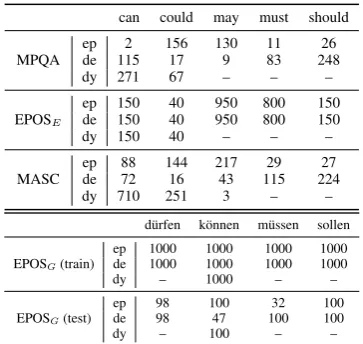
Our experiments are based on three data sets. Their basic composition is given in Table 1.4 1) MPQA + EPOSE The English benchmark
data set MPQA from R&R was further enriched through balanced heuristically tagged training data, EPOSE, by Z+. The EPOSE data set was
obtained using a cross-lingual sense projection approach. Z+ identified paraphrases for modal senses (e.g. brauchen-need; erlauben-permit for deontic, schaffen-able tofor dynamic sense), ex-tracted sentences from a parallel corpus with a modal verb aligned to a sense-identifying para-phrase, and tagged them with the identified modal sense. Z+ measured 0.92 accuracy on 420 in-stances of the heuristically tagged corpora. To alleviate distributional bias stemming from the MPQA dataset, Z+ balanced the blend of MPQA with EPOSE using under- and oversampling. We
experiment with both versions (±balanced).5 2) MASC A subset of the multi-genre corpus MASC (Ide et al., 2008), consisting of 19 genres was manually annotated (Anonymous) with modal senses for the same modal verbs. The annotated data consists of≈100 instances for each genre.6 3) EPOSG Following the method of Z+, we
con-structed a German data set EPOSG from the
Eu-roparl and OpenSubtitles corpora of OPUS (Tiede-mann, 2012) by projecting modal sense categories from English to German, using selected modal sense identifying English paraphrases. The result-ing corpus with sense-tagged German modal verbs
4More detailed information will be provided through
ac-companying material with the final version. The annotated MASC and EPOSGdata sets will be made publicly available. 5Their data is publicly available through their website. We
omitshallfrom MPQA, due to low number of occurrences.
6Exceptions with less than 100 instances are journal,
can could may must should
MPQA epde 1152 15617 1309 1183 24826
dy 271 67 – – –
EPOSE
ep 150 40 950 800 150
de 150 40 950 800 150
dy 150 40 – – –
MASC epde 8872 14416 21743 11529 22427
dy 710 251 3 – –
d¨urfen k¨onnen m¨ussen sollen
EPOSG(train)
ep 1000 1000 1000 1000 de 1000 1000 1000 1000
dy – 1000 – –
EPOSG(test)
ep 98 100 32 100
de 98 47 100 100
[image:4.595.90.272.61.233.2]dy – 100 – –
Table 1: Composition of MPQA, EPOSE, MASC
and EPOSG
k¨onnen (can), m¨ussen (must), sollen (should), d¨urfen (may)consists of a manually validated test section consisting of up to 100 instances for each sense. Annotation was done by two independent judges and one adjudicator. Balanced training data of 1000 instances per sense for each modal verb was constructed from heuristically tagged sen-tences that were judged high-quality by validating 20 instances for each paraphrase. For modal verbs with rare extractions, we added training data from modal verbs of shared senses, changing their verb forms to the verb form of the target verb.7
4.2 Experimental settings
MSC on MPQA using CNN-EB and CNN-EU,
CV For MSC we benchmark the CNN approach against the latest state-of-the-art results in Z+. We reimplemented their maximum entropy clas-sifier (henceforth,MaxEnt) and trained it on their balanced and unbalanced blend of MPQA and EPOS.8 As in Z+ we train independent classifiers
for each modal verb on their respective training data.9 For evaluation, we perform 5-fold cross
val-idation as in Z+. Each fold for training holds a stratified 80% section of the MPQA data together with the full EPOSE data set, and we use the
re-maining 20% of MPQA data for testing. We refer to the CNN models trained on the±balanced ver-sions of this data as CNN-EBand CNN-EU.
MSC on MASC using CNN-EB and CNN-EU
Besides MPQA, we evaluate the CNN on the
7Replacing e.g. k¨onnte with d¨urfte in Es k¨onnte Dir gefallenextracted fromYou might get a taste for it.
8We omitshallwith a small number of instances. 9This holds for all our experiments.
multi-genre MASC (sub)corpus. For compara-bility with Z+, for training we use one training fold from the previous setting,10 and evaluate on
MASC as test. We analyze the performance of the CNN model overall and on different genre subcor-pora (not reported here).
Both English data sets are characterized by modest training set sizes and involve a consider-able distributional biases, with high most frequent sense majority baselines (cf. Tables 3 and 4). MSC on EPOSGusing CNN-G In constrast to
the English data sets, the German EPOSGdata set
provides larger training set sizes of 1000 instances for all modal verbs and senses. This eliminates distributional bias from the data, so that the dis-criminating power of the classifier model is not masqued by distributional information.
4.3 Model variations
Hyperparameters Model-specific hyperparam-eters of the CNN are the number of filters, filter region size, and the depth of the network. We re-strict our model to a one-dimensional CNN archi-tecture.
Following the advices in Zhang and Wallace (2015), we used following setting: ReLU (recti-fied linear unit) as activation function, filter re-gion sizes of 3, 4, and 5 with 100 feature maps each, dropout keep probability of0.5,l2
regulari-sation coefficient of10−3, number of iterations of
100111and mini-batch size of50. Training is done
with the Adam optimisation algorithm (Kingma and Ba, 2014) with learning rate of 10−4. Filter
weights are initialized using Glorot-Bengio strat-egy (Glorot and Bengio, 2010). We experimented with some parameter variations (using nested CV), but found no consistently better results. In all fol-lowing MSC experiments we thus used this hyper-parameter setting for CNN training.
Word embeddings In the first and third ex-perimental setting we investigate the impact of static and tuned versions of different word vectors: word2vec (Mikolov et al., 2013), dependency-based (Levy and Goldberg, 2014) and randomly initialized embeddings.
We used publicly available word2vec vec-tors that were trained on Google News for
En-10Hence, one 80% fold of MPQA plus EPOS
E. Despite
this small difference, we refer to the CNN models as above, as CNN-EBand CNN-EU.
glish12and various datasets for German (Reimers
et al., 2014)13, as well as English
dependency-based vectors trained on Wikipedia14. The
Ger-man dependency-based embeddings were trained on the SdeWaC corpus (Faaß and Eckart, 2013), parsed with Malt parser. We used 300 dimensions for English embeddings and 100 for German.
For words without a pre-trained vector and in the random initialization setting, each dimension of the random vector was sampled from U ∼
[−a, a]with parameterapicked such that the ance of the uniform distribution equals the vari-ance of the available pre-trained vectors.
Baselines For MPQA and MASC, the classifiers are compared against strongmajority sense base-lines, BLmaj, due to skewed sense distributions in
the training data. Further, we compare the CNN results to the reconstructedMaxEntclassifier from Z+, trained on the blend of MPQA and EPOS with R&R’s shallow lexical and syntactic path features and the newly designed semantic features of Z+.
To our knowledge, there is no work on modal sense classification using a neural network. We thus compare our CNN models with a simple, one-layer neural network NN to investigate the impact offered by the more complex CNN architecture.
Input to the NN is the sum of all vectors of the words in the sentence. As for the CNN, we exper-imented with different types of word vectors.
The hyperparameter setting for the NN is: ReLU as activation function,l2 regularisation
co-efficient of10−3, hidden layer size of1024,
num-ber of iterations of 3001, dropout keep probabil-ity of0.5, and mini-batch size of50. Training is again done with the Adam optimisation algorithm (Kingma and Ba, 2014) with learning rate of10−4.
Weights are initialized using Glorot-Bengio strat-egy (Glorot and Bengio, 2010).15
4.4 Results English
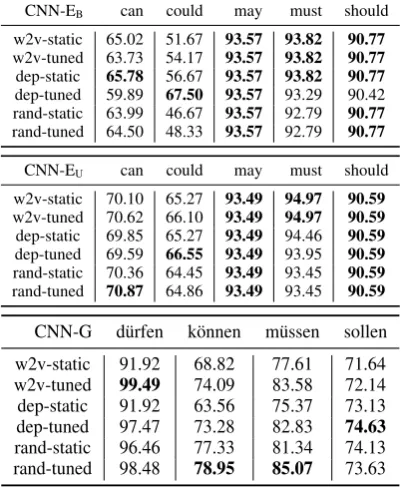
In Table 2 we report results for CNN-EB and
CNN-EU with diverse input representations. For
balanced training, dependency based vectors yield the best (can,could) or equally good results (may,
12https://code.google.com/archive/p/word2vec 13
https://www.ukp.tu-darmstadt.de/research/ukp-in-challenges/germeval-2014
14
https://levyomer.wordpress.com/2014/04/25/dependency-based-word-embeddings
15This is clearly not shown to be the best hyperparameter
setting, as we chose it heuristically without tuning.
CNN-EB can could may must should
w2v-static 65.02 51.67 93.57 93.82 90.77
w2v-tuned 63.73 54.17 93.57 93.82 90.77
dep-static 65.78 56.67 93.57 93.82 90.77
dep-tuned 59.89 67.50 93.57 93.29 90.42 rand-static 63.99 46.67 93.57 92.79 90.77
rand-tuned 64.50 48.33 93.57 92.79 90.77
CNN-EU can could may must should
w2v-static 70.10 65.27 93.49 94.97 90.59
w2v-tuned 70.62 66.10 93.49 94.97 90.59
dep-static 69.85 65.27 93.49 94.46 90.59
dep-tuned 69.59 66.55 93.49 93.95 90.59
rand-static 70.36 64.45 93.49 93.45 90.59
rand-tuned 70.87 64.86 93.49 93.45 90.59
CNN-G d¨urfen k¨onnen m¨ussen sollen w2v-static 91.92 68.82 77.61 71.64 w2v-tuned 99.49 74.09 83.58 72.14 dep-static 91.92 63.56 75.37 73.13 dep-tuned 97.47 73.28 82.83 74.63
[image:5.595.316.518.65.309.2]rand-static 96.46 77.33 81.34 74.13 rand-tuned 98.48 78.95 85.07 73.63
Table 2: CV accuracy for CNN-EB, CNN-EU, test
accuracy for CNN-G, with different input repre-sentations.
must, should). Could is the only case with large performance differences depending on the choice of embeddings. For canand could choosing ei-ther static or tuned versions of vectors is benefi-cial. With unbalanced training, dependency-based vectors are outperformed byword2vecformust
and by randomly initialized vectors forcan. Large differences in the results forcouldw.r.t. the choice of embeddings, are no longer present.
In Table 3 we report overall results for CNN-EBand CNN-EUon MPQA compared to the
base-lines. As representations for the NN and CNN we selected, for each modal verb, the embedding type that yielded the best results (Table 2)16.
For each training data set, scores of the CNN which are significantly better17than the next lower
score among the baselines are underlined. If CNN does not yield the best results, significance be-tween the baseline with the best score and CNN is reported. Overlining is used if CNN with unbal-anced training performs significantly better than CNN with balanced training, and vice versa.
With balanced training, CNN outperforms all baselines for every modal verb and in terms of mi-cro average. However, differences between CNN
16For NN the impact of word vectors was investigated as
well.
17By conducting the mid-p-value McNemar test
can could may must should micro BLrand 33.33 33.33 50.00 50.00 50.00 41.49
MaxEnt 59.64 61.25 92.14 87.60 90.11 74.88 NN 56.01 55.42 90.00 75.24 88.68 69.74 CNN-EB 65.78 67.50 93.57 93.82 90.77 79.29
can could may must should micro BLmaj 69.92 65.00 93.57 94.32 90.81 80.18
[image:6.595.309.523.227.284.2]MaxEnt 64.76 63.33 92.14 92.78 91.48 78.01 NN 67.29 66.08 94.23 86.37 90.96 77.93 CNN-EU 70.87 66.55 93.49 94.97 90.59 80.74
Table 3:Comparison of CV accuracies on MPQA of CNN-EB(upper table) and CNN-EU(lower table) with baselines.
and MaxEnt are significant only for can, could
and micro average. Moving to unbalanced train-ing, CNN has difficulties beating the baselines (cf.
may, should), but yields the best micro average. Unbalanced training for CNN outperforms bal-anced training in terms of micro averages, how-ever the difference is not significant.
Table 4 summarizes the evaluation of CNN-EB
and CNN-EU on the MASC corpus. Note that
CNN with unbalanced training, CNN-EU, does not
have enough generalization capability when ap-plied to different genres. This behavior coincides with changes of the predominant sense between training and test. CNN-EU, as well as MaxEnt,
is highly sensitive to such distributional changes. Even though balanced training for CNN leads to a slightly worse micro average when evaluated on MPQA, on MASC CNN–EByields a +3pp gain in
micro average compared to unbalanced training.18
In sum, our evaluation shows that the CNN model is able to outperform strong baselines in most configurations. Balanced training shows more consistent results beyond the baselines and is competitive with unbalanced training, without significant difference except for can. In view of genre differences in MASC, the CNN–EB model
is more robust against sense changes, and yields overall better results. The strong behaviour on bal-anced training data shows that the CNN model is able to learn meaningful structure from the data. German
In Table 2 we report results for CNN-G with diverse input representations. Reasons for the slightly weaker performance of dependency-based vectors compared to word2vec (1-2 pp.) can be
18In contrast toMaxEnt, which does not profit from
bal-anced training.
can could may must should micro BLrand 33.52 33.82 48.67 46.87 46.01 38.63
MaxEnt 66.74 62.86 87.83 83.33 84.06 72.25 CNN-EB 80.46 64.48 86.69 84.72 88.84 79.33
can could may must should micro BLmaj 81.61 35.04 82.51 79. 86 89.24 72.86
MaxEnt 73.17 55.34 87.45 86.11 89.64 74.41 CNN-EU 81.03 49.15 86.31 86.80 89.24 76.49
Table 4: Accuracies on MASC dataset of classi-fiers trained on MPQA+EPOSE.
d¨urfen k¨onnen m¨ussen sollen micro BLrand 50.00 33.33 50.00 50.00 39.10 NN 77.73 43.32 73.88 50.25 57.69 CNN-G 99.49 78.95 85.07 74.63 84.10
Table 5: Average accuracy on EPOSG.
seen in the smaller size of the training corpus, and possibly greater noise due to parsing errors.
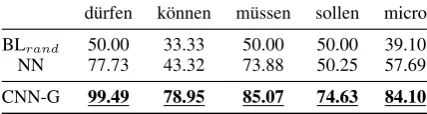
In Table 5 we report overall results for CNN-G compared to the NN baseline.19The CNN
outper-forms both baselines by large margins, per modal verb and in terms of micro average. Given we em-ployed perfectly balanced training data, the classi-fier performances reflect their ability to learn char-acteristic information for the classes. Indeed, the NN has great difficulties distinguishing the senses for k¨onnen (3 senses) and sollen, and is outper-formed by CNN-G by +35.6 and +24.4 pp. gains. The confusion matrices for CNN-G show a clear separation of these classes, in contrast to the NN.
While German is a more difficult language than English due to its syntactic properties (word or-der, degree of inflection), CNN-G reaches overall higher performance levels compared to English, especially for difficult cases.20 One reason can be
the morphological distinction between indicative and subjunctive (Konjunktiv), which – in interac-tion with tense and other factors – can ease the dis-tinction of epistemic vs. deontic/dynamic sense. Forsollenthis morphological division is masqued, and this can explain the weaker results compared to other binary classes. Generally, CNN-G profits from larger and perfectly balanced training data.
19We did not construct a MaxEnt classifier for German.
For NN and CNN-G we chose the best performing embed-ding types per modal verb.
4.5 Semantic feature detectors
Z+ provided a thorough analysis of the impact of semantic features by ablating individual feature groups. Their ablation analysis confirmed that fea-ture groups relating to tense and aspect of the em-bedded verb, negation, abstractness of the subject and semantic features of the embedded verb yield significant effects on classification performance.
Formust, Z+ found clear patterns for the occur-rence of specific features and the ability to prop-erly classify a specific sense. However, they did not identify precise features that differentiate epis-temic and dynamic readings with can. We spefi-cically investigated whether the learned filters for
mustcan be related to the semantic categories Z+ found to be important for distinguishing its senses. In addition, we investigated whether the CNN is able to capture unattested features that differenti-ate epistemic and dynamic readings withcan.
For every modal verb and every filter, we sort sentences in the training data by the maximum value obtained by applying1-max pooling to the feature map acquired by applying the respective filter to a sentence. For each filter and each of the top-ranked 15 sentences, we extract the ngram that corresponds to the maximum value w.r.t. the fil-ter, i.e. the argmax of the feature map. The ngram vector is the sum of all vectors of words in the ngram. The obtained ngram vectors were plotted using the t-SNE algorithm (Van der Maaten and Hinton, 2008) and textually displayed with their surrounding context.
For mustwe found many feature detectors that relate to observations in Z+. Many filters detect past (you must have beenout last night; ep) vs. non-past (we must makefurther efforts; de) and a dynamic event (we must developa policy; de) vs. stative (you must thinkme a perfect fool; ep) read-ing of the embedded verb. Among others the fea-ture detectors capfea-ture passive constructions ( ac-tual steps must be taken; de) and negation (we must not fear; de). Some filters were trained to capture domain vocabulary which intuitively goes along with deontic sense (European parliament; present regulation; fisheries policy). One filter captures telic clauses (to address these problems; to prevent both forum; to exert maximum influ-ence), identifying deontic sense. Novel features not considered in Z+ are discourse markers (but; and (then)) that correlate with deontic sense. All in all, the CNN learns meaningful features that are
known to be important for differentiating senses formust, and in contrast to manual feature design, it detects relevant unattested features by itself.
For can many filters recognise accomplish-ments which go along with dynamic sense, e.g.
You can do it/make it to NY. Others detect words indicatingpossibility(ep), negation (de), discourse markers, animate subject (de and dy), passive con-struction (de and dy). However, without a system-atic classification of these features it remains un-clear how important they are for differentiating the senses ofcan. Also, similar to Z+ we did not find clear-cut features that recognize epistemic sense.
We performed a corresponding analysis of fea-ture maps for German, following the same extrac-tion procedure. We found the typical state (ep) vs. event (de) contrast for the embedded verb, nega-tion and tense, and again previously unattested factors such as discourse relation markers21 (but;
without; thereby; in order to (dy)). For Ger-man we identified various indicators for epistemic sense (for m¨ussen and k¨onnen): attitude predi-cates (believe, not know; tell me; have an idea, be afraid), adverbials (possibly), conditionals (if); counterfactual and negative polarity contexts (not be the case; how; ever). Further detectors for epis-temic sense are abstract subjects: placeholders for propositions (it), abstract concepts (idea; music; grades; application); indefinite subjects (one). We find a tendency for 1st or 2nd person subjects to co-occur with de/dy and 3rd person pronouns with ep. Fork¨onnen(dy) we find achievements (present report; move mountains; find compromise). For deontic readings, next to negation with 1st and 2nd person we find typical verb-object combinations for actions that can be granted: use telephone; communicate with third parties.
We extracted statistics about the distance of the extracted ngrams from the modal verb (distance overall; to the left/right and ngrams starting with the modal). There are no greater overall distances for German compared to English. However, for German we find significantly more ngrams that include the modal verb, especially for epistemic readings of k¨onnen, m¨ussen, d¨urfen that clearly mark subjunctive mood, whereas forsollen, with ambiguous forms for subjunctive and past tense, no such tendency is observed. Thus, the feature maps identify subjunctive marking (in conjunction with other factors) as relevant for classifying
temic sense, whereas forsollenthe lack of this in-dicator goes along with lower performance. Fi-nally, we observe, for English and German, strik-ingly larger distances to the left of the modal verb for epistemic readings compared to non-epistemic readings. This can be traced back to indicators in the wider left-embedding context: embedding predicates, subjects, if clauses, etc.
5 Word sense disambiguation
Next to modal sense classification, we evaluate our CNN model in a classical WSD task. As benchmark corpus we chose the SensEval-3 lexi-cal sampledata set (Mihalcea et al., 2004), which was recently applied in Rothe and Sch¨utze (2015) (henceforth R&S) and Taghipour and Ng (2015), using sense-specific embeddings and a NN archi-tecture, respectively (cf. Section 2).
The training data size for the 57 target word types ranges from 14 to 263 instances. Sense labels of test instances of a given target word are predicted using the CNN model trained on the training instances for the respective word type.22 We set the CNN hyperparameters to
be the same as for MSC, except for mini-batch size and region sizes. Since the training data for some words is below 50 instances, mini-batch size was set to 10. For tuning of the region sizes, we split the training data for each word (80:20 for training and validation) and used static word2vecfor the input representation. Among
{(1,2,3),(2,3,4),(3,4,5),(4,5,6),(5,6,7)}
the best results were obtained for(5,6,7).23
The final hyperparameter setting was used to in-vestigate the impact of representations. Among word2vec, dependency-based and randomly ini-tialised,word2vecperformed the best, the tuned version being slightly better than static vectors. We report results for tunedword2vecvectors.
We compare our results to the results R&S obtained when using only sense-specific embed-dings. These are not the state-of-the-art WSD re-sults they obtain with additional features, namely POS tags of words in a small window around the target word, their discrete representation and local collocations. For sentence representation, R&S used every word in the target word sentence. For
22Training instances in the SensEval-3dataset can have
more than one sense label. For training we randomly picked one of possible labels. Instances which contain more than one marked target word were omitted.
23However, the differences in the results were minor.
Snaive-prod 62.20 S-prod 64.30
[image:8.595.335.497.64.107.2]S-cosine 60.50 S-raw 63.10 CNN 66.50
Table 6: WSD accuracy onSensEval-3dataset.
sense prediction, they used the following feature vectors that are fed into a linear SVM classifier:
S-cosine=hcos(c, s(1)), . . . ,cos(c, s(k))i,
S-product=hc1s(1)1 , . . . , cns(1)n , . . . , c1s(1k), . . . , cns(nk)i,
S-raw=hc1, . . . , cn, . . . , s1(k), . . . , s(nk)i,
where w is a target word with ksenses, c is the centroid defined as the sum of allword2vec vec-tors of words in the sentence and s(j) is the
em-bedding of thej-th synset of w.24 They propose
a variant of theS-prodfeature vector,Snaive-prod,
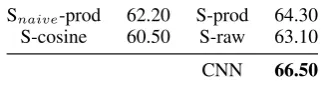
for which the synset embeddings are the sum of theword2vecvectors of all words in that sysnet. The results are summarised in Table 6. The CNN model compares favorably to the competi-tor models of R&S usingAutoExtendembeddings for WSD. It achieves slightly higher results with-out explicitly marking the target word, whereas the AutoExtend embeddings encode much richer information: what is the target word, how many possible sense it has, and knowledge-intense sense embeddings for each of its synsets. The CNN is able to compete with the richAutoExtendmodel, and future work needs to investigate whether – similar to the S-product setting in R&S – the CNN model can achieve competitive state-of-the-art re-sults by incorporating features corresponding to those of the IMS system of Zhong and Ng (2010).
6 Conclusion and future work
We presented an account for multilingual modal sense classification using a CNN architecture. We apply the same architecture in a standard WSD task and achieve competitive results compared to a system using richer embedding information.
Our one-layer CNN architecture outperforms strong baselines and prior art for MSC in English, including a NN and MaxEnt model, and proves particularly robust in cross-genre classification.
We applied the CNN model to German, on a data set of modest size, obtained using cross-lingual projection techniques. The CNN-G clas-sifier outperforms a NN model by large margins.
Our approach can be easily generalized to novel languages without tedious and resource-intensive feature engineering. Through analysis of learned feature maps we gave evidence that the CNN learns both known and novel features for MSC.
The attractiveness of the CNN framework lies in its ability to learn (semantic) features from flexible window regions without syntactic processing, and the ensuing robustness on difficult text genres and its ease in generalizing to novel languages.
Acknowledgments
We thank Mengfei Zhou for her support with the German corpus construction. This work has been supported by the German Research Foundation as part of the Research Training Group ”Adaptive Preparation of Information from Heterogeneous Sources” (AIPHES) under grant No. GRK 1994/1.
References
Kathryn Baker, Michael Bloodgood, Bonnie J Dorr, Nathaniel W Filardo, Lori Levin, and Christine Pi-atko. 2010. A Modality Lexicon and its use in Au-tomatic Tagging. In Proceedings of LREC, pages 1402–1407.
Aljoscha Burchardt, Marco Pennacchiotti, Stefan Thater, and Manfred Pinkal. 2009. Assessing the impact of frame semantics on textual entailment. Natural Langugae Engineering, 15(4):527–550. Ronan Collobert, Jason Weston, L´eon Bottou, Michael
Karlen, Koray Kavukcuoglu, and Pavel Kuksa. 2011. Natural language processing (almost) from scratch. The Journal of Machine Learning Re-search, 12:2493–2537.
Marie-Catherine de Marneffe, Christopher D. Man-ning, and Christopher Potts. 2012. Did It Happen? The Pragmatic Complexity of Veridicality Assess-ment. Computational Linguistics, 38(2):301–333. Special Issue: Modality and Negation.
Gertrud Faaß and Kerstin Eckart. 2013. Language Processing and Knowledge in the Web: 25th In-ternational Conference, GSCL 2013, Darmstadt, Germany, September 25-27, 2013. Proceedings. Springer Berlin Heidelberg, Berlin, Heidelberg. Morten W Fagerland, Stian Lydersen, and Petter Laake.
2013. The mcnemar test for binary matched-pairs data: mid-p and asymptotic are better than exact conditional. BMC medical research methodology, 13(1):1.
Xavier Glorot and Yoshua Bengio. 2010. Understand-ing the difficulty of trainUnderstand-ing deep feedforward neural networks. In International conference on artificial intelligence and statistics, pages 249–256.
Nancy Ide, Collin Baker, Christiane Fellbaum, and Charles Fillmore. 2008. MASC: The manually an-notated sub-corpus of American English. In Pro-ceedings of the Sixth International Conference on Language Resources and Evaluation (LREC-2008).
Nal Kalchbrenner, Edward Grefenstette, and Phil Blun-som. 2014. A convolutional neural network for modelling sentences. In Proceedings of the 52nd Annual Meeting of the Association for Computa-tional Linguistics, pages 655–665, Baltimore, Mary-land.
Yoon Kim. 2014. Convolutional neural networks for sentence classification. InProceedings of the 2014 Conference on Empirical Methods in Natural Lan-guage Processing (EMNLP), page 17461751, Doha, Qatar.
Diederik Kingma and Jimmy Ba. 2014. Adam: A method for stochastic optimization. arXiv preprint arXiv:1412.6980.
Kenton Lee, Yoav Artzi, Yejin Choi, and Luke Zettle-moyer. 2015. Event detection and factuality as-sessment with non-expert supervision. In Proceed-ings of the 2015 Conference on Empirical Methods in Natural Language Processing, pages 1643–1648, Lisbon, Portugal, September.
Omer Levy and Yoav Goldberg. 2014. Dependency-based word embeddings. In ACL (2), pages 302– 308.
R. Mihalcea, T. Chklovski, and A. Kilgarriff. 2004. The Senseval-3 English lexical sample task. In Proceedings of SENSEVAL-3: Third International Workshop on the Evaluation of Systems for the Se-mantic Analysis of Text [CD-ROM], pages 25–28.
Tomas Mikolov, Ilya Sutskever, Kai Chen, Greg S Cor-rado, and Jeff Dean. 2013. Distributed representa-tions of words and phrases and their compositional-ity. InAdvances in neural information processing systems, pages 3111–3119.
Vinodkumar Prabhakaran, Michael Bloodgood, Mona Diab, Bonnie Dorr, Lori Levin, Christine D. Piatko, Owen Rambow, and Benjamin Van Durme. 2012. Statistical modality tagging from rule-based anno-tations and crowdsourcing. In Proceedings of the Workshop on Extra-Propositional Aspects of Mean-ing in Computational LMean-inguistics, pages 57–64, Jeju, Republic of Korea, July.
Sascha Rothe and Hinrich Sch¨utze. 2015. Autoex-tend: Extending word embeddings to embeddings for synsets and lexemes. In Proceedings of the 53rd Annual Meeting of the Association for Compu-tational Linguistics and the 7th International Joint Conference on Natural Language Processing (Vol-ume 1: Long Papers), pages 1793–1803, Beijing, China.
Josef Ruppenhofer and Ines Rehbein. 2012. Yes we can !? Annotating the senses of English modal verbs. In Proceedings of the LREC 2012 Confer-ence, pages 1538–1545.
Richard Socher, Alex Perelygin, Jean Wu, Jason Chuang, Christopher D. Manning, Andrew Ng, and Christopher Potts. 2013. Recursive deep models for semantic compositionality over a sentiment tree-bank. In Proceedings of the 2013 Conference on Empirical Methods in Natural Language Process-ing, pages 1631–1642, Seattle, Washington, USA. Kaveh Taghipour and Hwee Tou Ng. 2015.
Semi-supervised word sense disambiguation using word embeddings in general and specific domains. In The 2015 Annual Conference of the North Ameri-can Chapter of the Association for Computational Linguistics, pages 314–323.
J¨org Tiedemann. 2012. Parallel Data, Tools and In-terfaces in OPUS. In Nicoletta Calzolari, Khalid Choukri, Thierry Declerck, Mehmet U˘gur Do˘gan, Bente Maegaard, Joseph Mariani, Jan Odijk, and Stelios Piperidis, editors, Proceedings of LREC-2012, pages 2214–2218, Istanbul, Turkey, May. Laurens Van der Maaten and Geoffrey Hinton. 2008.
Visualizing data using t-sne. Journal of Machine Learning Research, 9(2579-2605):85.
Janyce Wiebe, Theresa Wilson, and Claire Cardie. 2005. Annotating expressions of opinions and emo-tions in language. Language resources and evalua-tion, 39(2-3):165 – 210.
Ye Zhang and Byron C. Wallace. 2015. A sensi-tivity analysis of (and practitioners’ guide to) con-volutional neural networks for sentence classifica-tion. Technical report, University of Texas at Austin. arXiv:1510.03820v2.
Zhi Zhong and Hwee Tou Ng. 2010. It makes sense: A wide-coverage word sense disambiguation system for free text. InProceedings of the ACL 2010 Sys-tem Demonstrations, pages 78–83. Association for Computational Linguistics.
Zhi Zhong and Hwee Tou Ng. 2012. Word sense dis-ambiguation improves information retrieval. In Pro-ceedings of the 50th Annual Meeting of the Associa-tion for ComputaAssocia-tional Linguistics (Volume 1: Long Papers), pages 273–282, Jeju Island, Korea. Mengfei Zhou, Anette Frank, Annemarie Friedrich,
and Alexis Palmer. 2015. Semantically Enriched