From the
AERA Online Paper Repository
http://www.aera.net/repositoryPaper Title
Piloting a Coteaching Model in Preservice Teacher
Education
Colette Murphy, Trinity College Dublin;; John
McCullagh;; Andrea Doherty
Author(s)
Teacher Professional Development and Practice
Session Title
Paper
Session Type
4/4/2014
Presentation Date
Philadelphia, Pennsylvania
Presentation Location
Teacher Education - Pre-Service
Descriptors
Mixed Method
Methodology
Division K - Teaching and Teacher Education
Unit
Each presenter retains copyright on the full-text paper. Repository users should follow legal and ethical practices in their use of repository material;; permission to reuse material must be sought from the presenter, who owns copyright. Users should be aware of the .
Citation of a paper in the repository should take the following form:
[Authors.] ([Year, Date of Presentation]). [Paper Title.] Paper presented at the [Year] annual meeting of the American Educational Research
Association. Retrieved [Retrieval Date], from the AERA Online Paper Repository.
! "!
Piloting a model for coteaching in preservice teacher education school placements based on Vygotsky’s zone of proximal development
Colette Murphy1, John McCullagh2 and Andrea Doherty2
1Trinity College Dublin
2Stranmillis University College Belfast
Abstract
This paper presents a study which pilots a model for coteaching based on Vygotsky’s zone of proximal development (ZPD) and other sociocultural theoretical constructs. Coteaching, during which coteachers coplan, copractice and coevaluate, has been identified by the National Council for the Accreditation of Teacher Education (NCATE) as an important model for linking theory and practice. Six essential elements of the ZPD were ascribed to different coteaching stages and
analysed subsequently for their relative impacts on successful coteaching. In addition, coteaching is described as progressive, from the early stages in which coteachers are participants in the process through to later stages in which they enact shared contribution, a prerequisite for
transformation. The context for the study was preservice science teacher education, and focused on the development of 10 pre-service primary teachers’ confidence and ability to teach primary science through an innovative program in which preservice teachers shared expertise as they coplanned, copracticed and coevaluted lessons with 10 experienced cooperating teachers for one morning per week over a period of seven weeks as part of their school experience placement. There was an additional focus on the development of reflective practice via coteaching. Findings showed that preservice teachers recorded improvements in various aspects of teacher competence in a post-test audit which was completed a few months following the placement to measure longer term effects of coteaching. The qualitative data provided valuable insights into the ZPD model for coteaching, with the ZPD elements of interaction between real and ideal form, Vygotskian
imitation and structured reflection having the greatest impact in implementing successful
coteaching. The proposed model was adapted in the light of these findings. The study provides a workable model for teacher educators who are implementing coteaching,
Introduction
This paper describes a pilot project which ‘tests’ a model for coteaching, based on firm educational foundations, and combining theoretical contributions from Vygotsky’s zone of
proximal development (ZPD) and other sociocultural models of coteaching. The National Council for the Accreditation of Teacher Education (NCATE)’s Blue Ribbon panel on clinical preparation and partnerships has noted the critical role of coteaching as a model for linking theory and practice in preparing teachers to teach (NCATE, 2010). Coteaching research and practice has suffered from lack of a model which provides a structure of how to coteach. The context for this empirical study is initial teacher education; specifically, the development of pre-service primary teachers’
confidence and ability to teach science through an innovative program in which they share
expertise with experienced cooperating teachers for one afternoon per week over a period of seven
! #!
expertise. Cooperating teachers provide the pedagogical expertise to implement and critique theory in practice, as well as to mentor the preservice coteacher. Coteaching progresses through three key stages: coplanning and copreparation; copractice, which includes coteaching and coevaluation, including coreflection (see Figure 1).
Coteaching therefore provides the mutual support of two (or more) professionals during praxis to develop and reflect on their own and each other’s improving classroom practice to aid the learning of the students. Coteachers are encouraged to progress during the placement from being
participants in the process to enacting shared contribution to improving student learning, which is more likely to lead to classroom transformation (Murphy & Carlisle, 2008).
Coteaching science began as a model for learning how to teach and has evolved to also be a model
for teaching (Martin, 2009). Coteaching also promotes collaboration between teachers and affords the opportunity for on-going, reflective practice. When coteaching is used as a model for
preservice teaching, the established practices involved with learning to teach are challenged and student achievement and attitudes are positively impacted. For over five years, Bacharach, Heck & Dahlberg (2007) explored the development and implementation of an empirical preservice
coteaching model involving formal school-university partnerships in 17 school districts. Children cotaught in mathematics and reading classes showed statistically significant improvement in
achievement. Their study provided strong evidence of the benefits coteaching afforded for student
learning and teacher preparation.
In science education, coteaching evolved as a strategy that addressed a wide range of issues in science teaching, such as elementary (primary) teachers’ anxiety and lack of confidence to teach inquiry-based science; preservice teachers’ fear of group-based science teaching in classrooms with uncooperative students; mainstreaming students with special needs, and declining student attitudes towards science (Murphy and Scantlebury, 2010).
The pilot study of a model reported in this paper provides a structure for coteaching, and sets the foundation for large-scale research and development of coteaching in pre-service teacher
! $!
Theoretical framework
Researchers have applied various explanatory frameworks to coteaching, all of which situate the actions of individuals within a community, mediated by external forces and active engagement in the world (Stetsenko, 2008). The frameworks include: cultural historical activity theory (CHAT), situated learning, solidarity, structure|agency dialectic and the zone of proximal development (ZPD). Each seeks to explain aspects of coteaching at macro, meso and/or micro levels and is summarised below. It is suggested that an in-depth consideration of the ZPD produces a framework for coteaching which subsumes the elements provided in frameworks suggested to date.
Cultural historical activity theory (CHAT)
CHAT can provide a structure for conceptualising the complexities of coteaching and learning to teach as it takes into consideration the social and historical context. CHAT incorporates the interacting systems of all potential actors involved in coteaching (i.e. preservice teachers, cooperating teachers, students, university tutors and other school staff) and can be used to articulate the relationships, tensions and contradictions arising from these interactions. Roth (2002) argued that contradictions should not be viewed negatively, but rather are a driving force for change and development because they lead to the ‘articulation of actions and change’ (Roth, 2002, p. 9). Roth and Tobin (2004) argued that when teachers work together under the same conditions they can experience what others do and emulate such actions that are considered as similar. In coteaching, the collective activity involving two or more teachers expands the available teaching resources (tools) for student learning, and also supports opportunities for learning to teach (Roth & Tobin, 2004). Thus coteachers (new and experienced teachers) have expanded resources to support their learning to teach, both at a level of being aware of and by unconsciously
appropriating new ways of teaching (Roth & Tobin, 2004). There are also situations where preservice teachers and their supervisors may have contradictory perspectives on how to teach science. CHAT provides excellent opportunities for ‘looking in’ on the activity of coteaching from an external perspective, but is more limited in its ability to frame a way for enacting coteaching within the classroom and developing as coteachers.
Situated learning
Coteaching could be considered as an approach to teacher preparation, which locates preservice teachers’ authentic learning in school-based knowledge-building communities involving
preservice teachers, class teachers and university tutors (Lieberman, 1992). Edwards (2005) argued that the focus of the situated learning approach and communities of practice is on how the individual adapts to different social settings. Lave and Wenger (1991) viewed this type of
collective learning as ‘situated learning,’through the process of legitimate peripheral participation in communities of practiceapplied to coteaching, Roth (1998) argued that coteaching, as a
community of practice is a more supportive approach to teacher preparation which moves towards increased participation and sharing in competent practices and practice related discourse.
! %!
more apprenticeship positioning of situated learning, in which preservice teachers assume an ‘under’ role.
Structure|Agency Dialectic
The structure|agency dialectic is a concept which can be used in a variety of contexts to describe the relationship between social structures and human agency (Bourdieu, 1977; Sewell, 1992). Research within coteaching utilises the structure|agency dialectic to examine existing teaching practices and how teachers’ practice can be shaped and changed as a result of coteaching (Roth & Tobin, 2004; Author, 2008; Tobin & Roth, 2006). Structure refers to elements such as social systems and rules, social order and social reproduction which may limit or influence individuals’ opportunities. Agency can be defined as an individuals’ capacity to act (or appropriate resources). Agency implies that individuals do not simply react to situations in ways determined by existing conditions, but allows for and responds to changes to the conditions (Roth & Tobin, 2005). Structure and agency are inextricably linked in a dialectic relationship, in that individuals are intrinsically involved with society and actively enter into its constitution. Scantlebury et al (2008) employed the structure|agency dialectic as a framework to explore preservice teachers’ teaching experience within the context of coteaching. They argued that a teacher’s agency is supported or constrained by the structure/schema of the classroom and their capacity to appropriate both human and material resources. Whether the resources are appropriated depends on the perceived agency of the participants in the class (capacity to appropriate such resources) and whether the structure of the field supports or constrains their agency (Tobin & Roth, 2006). Murphy & Beggs, (2006b) argued that preservice teachers’ agency is expanded when they are coteaching with a class teacher and contributing to planning, teaching and evaluation of the lessons. Roth and Tobin (2004) reported that in the context of coteaching ‘teachers expand one another’s opportunities to act and hence their agency’ (p.170). Author et al (2008) argued that the development of effective
coteaching is dependent not only on the perceived agency of participants and the structure of the social setting but also the working relationship between participants (i.e. social capital).
Scantlebury (2005) also suggested that the working relationship between coteachers was an
important factor promoting effective coteaching. The structure agency dialectic can contribute to a theoretical framework for coteaching in terms of understanding the context of the classroom within which coteaching is enacted and how the structure and resources in the classroom can support coteaching. It contributes less, however, in explaining how individuals enact and develop their coteaching and how such interactions might lead to the perceived benefits of coteaching. For example, in traditional preservice teaching, preservice teachers assume sole responsibility for classes with the expectation that cooperating teachers offer support and input during the initial weeks. But as preservice teaching progresses, cooperating teachers ‘leave’ the classroom.
Coteaching changes the structure of preservice teaching to enhance preservice teachers’ agency by expanding their access to human and materials resources. In various models of coteaching those human resources include their peers, cooperating and inclusion/special education teachers (Scantlebury et al, 2008).
Solidarity
Solidarity can be defined in a general sense as, a feeling of membership or belonging to a group of interlocutors, where ‘our sense of solidarity is strongest when those with whom solidarity is expressed are thought of as ‘one of us’ as opposed to ‘one of them’ (Rorty, 1989, p.191). The concept of solidarity has been used by researchers to emphasise the collective (Roth, 2006) and collaborative nature of coteaching (Ritchie & Rigano, 2007). Solidarity can contribute to a
! &!
coteaching. Roth (2006) argued that coteaching has potential for ‘deconstructing traditional boundaries’ (Roth, 2006, para 37) which define institutionally created relationships, such as that between preservice-inservice teacher or university tutor-preservice teacher. This potential arises because irrespective of their institutional position, coteaching creates opportunities for participants to talk about what they will teach, how they will teach it and how they can enhance the teaching and learning experience for all (Roth, 2006). The shared responsibility arising from effective coteaching can build consensus or solidarity whereby participants agree to support each other as new practices are enacted in the classroom. Roth and Tobin (2005), in this respect, envisioned an ‘expanded agency for all participants so that they each can attain their goals within a context of collective agency’ (p.12). Ritchie and Rigano (2007) and Collins (2004) have highlighted the role of emotions and personal relationships in terms of positive outcomes in collaboration in that successful interaction can lead to the production of positive emotional energy or ‘a feeling of confidence, elation, strength, enthusiasm, and initiative in taking action’ (Collins, 2004, p. 49). Solidarity can contribute to a framework for promoting collective responsibility in the classroom and when considering the impact of coteaching in ways in which it could change existing
classroom. It embraces the importance of the role of emotions. What is limiting is a framework for
how to develop solidarity between coteachers.
The frameworks described above use various ‘lenses’ through which to view coteaching. What is required is a unifying framework which can bring these together and which embraces fully the concept of coteaching as development. For Vygotsky, the concept of development does not include ‘just evolutionary but also revolutionary changes, regression, gaps, zigzags, and conflicts.’
(Vygotsky, 1997c, 221, cited in Silvonen, 2010, p. 38).
Vygotsky’s ZPD as a model for coteaching
Coteaching provides an ideal context for learning by providing a zone of proximal development in which the collective achieves more than any individual alone (Roth, 1998; Roth, Masciotra & Boyd, 1999). Interpretations of the zone of proximal development have suggested that it is a two-way learning process whereby all participants learn through their interactions with each other (Tudge & Scrimsher, 2003). Vygotsky also argued that the zone of proximal development is created in the course of collaboration, in that it “awakens a variety of developmental processes that are open to operate only when the child is interacting with people in his environment and in
collaboration with his peers.” (Vygotsky, 1978, p. 90). Coteaching as a zone of proximal
development also emphasises the collective and socially mediated nature of teaching and learning supported by Vygotsky (1978) (and also Engeström, 1987, Tudge & Scrimsher, 2003).
Coteaching enables (new) collective actions to become part of the ongoing praxis of coteaching and part of the repertoire of the individuals’ action as a result of coteachers planning, teaching and evaluating lessons together (Roth, Tobin and Zimmerman, 2002). Therefore both experienced and
novice teachers expand their opportunities for learning when coteaching. Roth argued that in
coteaching the individual contributes to the development of the community and at the same time indirectly to their own development and learning process (Roth, 2001).
! '!
of proximal development as an interaction between the students and co-participants (Wells, 1999) or a symbolic space for interaction and communication where learning leads to development (Meira & Lerman, 2001). The interaction definition, whilst popular, is contested. Chaiklin (2003) argued that the maturing functions described by Vygotsky (1978) are not created in an interaction, but that interaction helps to identify the existence of such functions and the extent to which they developed.
Development via the ZPD, as described by cultural-historical theory, occurs when specific conditions are satisfied. Veresov (2010) proposed these principles were: interaction between real and ideal forms; buds of development; category/drama/emotion (the unity of affect and intellect); developmental tools and sustainable results. Our conceptual framework for coteaching based on Vygotsky’s ZPD incorporates the essential elements described by Veresov (2010), regression and recursion in the ZPD discussed by other researchers (Zebroski, 1994; Tharp & Gallimore, 1988) and critical reflection using Lampert-Shepel’s (1999) model that was developed from the work of Vygotsky and Dewey. The model also embraces advice from Roth and Radford (2010) who introduced the dimension of power relations between individuals involved in interactions, like those experienced in coteaching. Roth and Radford suggested that insufficient attention is given to co-constitution of subjective and collective consciousness in which interacting participants
“become each other’s teachers and students independent of their institutional positions (p. 300).” Their proposition to consider the ZPD from a symmetrical perspective connects strongly with our position that coteaching is based on sharing expertise. The model also addresses the complexity of interactions that need to occur between successive stages of development via Rogoff et al.’s (1993) consideration of individual development within the ZPD as:
incomplete unless it also considers the societal basis of the shared problem… the nature of the problem the partners seek to solve, the values involved in determining the appropriate goals and means, the intellectual tools available, the institutional structures of the interactions… (Rogoff, Mistry, Goncu & Mosier, 1993, p. 232, cited in Daniels, 2001).
Finally, this model seeks to extend the work of Jones, Rua and Carter (1998) and Ash and Levitt (2003) who earlier advocated the potential of Vygotsky’s ZPD in science teacher professional development contexts because of the transformational potential of activity within the ZPD. Jones et. al. (1998) stress the flexibility of the ZPD to encompass interactions between peers, instructors, students, and with mediating agents, such as readings, physical and technological tools, all of which can stimulate teacher development.
In summary, Vygotsky’s ZPD focuses on learning as development via interaction; sees learning as arising from the interaction between real and ideal forms and as the further development of
‘budding’ capabilities; it addresses the importance of emotion in learning; acknowledges the importance of recursion, affording opportunities for coteachers to learn from struggles as well as affordances, and encourages Vygotskian ‘imitation’, which comprises more than simply modeling practice. As such, it can be used to explicate how best to coplan and coevaluate lessons as well as guiding ways to copractice, which focus on appropriating ideal practice and capitalizing on the role of emotion as affording learning and teaching science.
Vygotsky’s ZPD, with its focus on learning via interaction and learning as arising from the
! (!
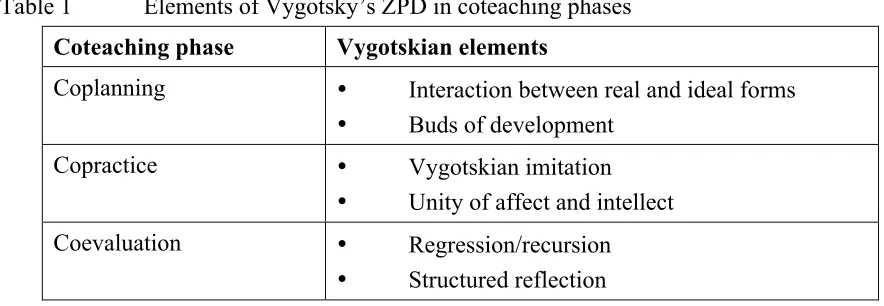
for coteaching that offers the potential to make coteaching scalable, this section presents the conceptual framework. The proposed framework builds on previous work advocating the potential of the ZPD in science teacher education. The following section shows how these ZPD elements can used in a model that can be implemented by educators seeking to use coteaching in their teacher education courses (see Table 1). The specific ZPD elements are: interaction between real and ideal form; buds of development; unity of affect and intellect; Vygotskian imitation;
[image:8.612.71.513.205.358.2]regression and recursion. We link specific elements to coteaching phases as conditions, which underlie the enactment of each phase, to promote the most effective coteaching (see Table 1).
Table 1 Elements of Vygotsky’s ZPD in coteaching phases Coteaching phase Vygotskian elements
Coplanning • Interaction between real and ideal forms
• Buds of development
Copractice • Vygotskian imitation
• Unity of affect and intellect
Coevaluation • Regression/recursion
• Structured reflection
Interaction of Real and Ideal Form
Vygotsky considered the necessity of having from our earliest stages of development an ideal in mind because it incorporates both motive and focus:
The higher, ideal form, which appears at the end of development should already be present and it should interact directly ... along the path of development of this initial or primary form (Vygotsky, 2001, p. 112-113, cited in Veresov, 2010).
Lampert-Shepel (1999) argued that human action has a dual character: ideal and real. She suggested that theoretical thinking shapes the ideal plan, but humanity creates the real plan.
Veresov (2010) argues that there is no development if there is no interaction between the ideal and real forms. In coplanning, coteachers should identify ‘ideal’ practice in order to guide their
preparation of science lessons, using theories about learning and learners. In
preservice/cooperating teacher planning, ideas about new science teaching approaches given to preservice teachers by science educators can be ‘tested’ against the experience of the cooperating teacher (the learning environment and student characteristics) and alterations made which can pre-empt potential failures. For example, the use of inquiry-based science is considered ‘good’
practice in science learning and teaching. But only in the classroom can teachers interrogate such practice in the context of their own students in their specific learning environment. Coplanning between the preservice and inservice teachers can embrace the ‘ideal’ learning intentions of an inquiry-based science activity and rework these in order to maximise learning for the diversity of students in their ‘real’ classroom.
Buds of Development
! )!
1978, p.86). The best learning occurs within the ZPD, that is, when the learner is at a stage, which is proximal (or close to), the next level of development. Such ZPDs can be created using cultural tools to promote learning readiness. Good coteaching is not haphazard or spontaneous, but the result of coplanning; which requires the participation and involvement of all coteachers. Coplanning can be used as a ZPD in which coteachers identify ‘buds’ of development that they can support each other in developing via shared expertise and cultural tools. Coplanning is labour-intensive as coteachers reflect upon lesson and program objectives and goals, relate the learning goals to standards, and provide input on assessments and lesson plans. Coplanning is an excellent professional development activity because during this time, coteachers share ideas, use past experiences, and collectively develop an understanding of students’ learning.
Vygotskian imitation
Vygotsky’s notion of ‘imitation’ is not copying, but emulation of an activity as part of the learning process. For example, someone learning to add, knit or dance emulates the teacher before doing the task by her or himself. Such activity coincides with the ZPD in that it bridges what the learner can do with help from others and individually. Vygotsky cautioned that imitation could only be effective within the ZPD:
… a child does not solve all unresolved problems with the help of imitation. He [or she] advances only up to a certain limit which differs for different children… it is only possible to teach a child when he [or she] is able to learn… the potentials for instruction are determined by the zone of proximal development (Vygotsky, 1987, p. 209 – 210).
Vygotsky considered imitation as a way to push learning and development to a higher level and he implied that successful emulation could indicate the level of development of a maturing function (Chaiklin, 2003). Zaretskii (2010) suggests that Vygotsky expanded the term imitation: “imitation should be understood as collaboration...” (p.75). During copractice, Vygotskian imitation can be enacted as one coteacher emulates practice of the other that is nearer to the ideal, thereby
expanding agency in relation to creating their own new practice. Roth and Tobin (2002) identified this as a feature of coteaching that they described as “being like the other”. This was not proposed as an integral feature of an explanatory model but as a consequential outcome of two teachers working closely together. Vygotsky allows us to see these behaviors as important ones to promote and support within coteaching practice.
Unity of affect and intellect
The unity of affect and intellect in Vygotsky’s ZPD – that emotion and learning are interdependent
! *!
social relations, which become internalized in the individual. The law includes two mentions of the word ‘category’, underlining the importance of the dramatic, emotional element driving
development and learning. The law states that:
…every function in the child’s development appears on stage twice, that is, on two planes. It firstly appears on the social plane and then on a psychological plane. Firstly among people as an inter-psychological category and then within the child as an intra-psychological category. This is equally true with regard to voluntary
attention, logical memory, the formation of concepts and the development of volition (Vygotsky, 1981, p. 163).
Acknowledging the unity of affect and intellect in copractice, realises the key role for emotion in learning. Vygotsky considered that development occurs in learning only when the learner is aware when she is making a mistake and that it is her own behaviour that determines her learning. Awareness of learning occurs via emotional experience (negative as well as positive) and can be harnessed to develop better understanding of each other’s needs as coteachers, so that, in turn, the collaboration can generate conditions that engage the emotions of their students to improve their interest and achievement in science.
Regression/recursion
Linked to the key role for emotion and self-awareness a learner’s behaviour as it affects her learning is the realization that learning can be a difficult process that does not always assume a smooth upward trajectory. Regression can be key to deep learning. Tharp and Gallimore (1988) proposed a four-stage model of the ZPD that addressed the development of any performance capacity. Their model was based on the relationship between self control and social control in an activity, which includes a ‘recursive loop’, in which learners revert to an earlier stage and progress through subsequent stages back to where they were – in effect they ‘re-learn’. Zebroski (1994) used the image of a tidal wave in relation to Vygotsky’s work on development as a process that is progressive and regressive at the same time. The core aspect of the ZPD described by Robbins (2001) is personal transformation, which is not always positive. In fact, she suggests that regression must occur for real growth and development. Indeed Holzman (1997) considers the ZPD as a ‘form of life’, in which:
...people collectively and relationally create developmental learning that goes beyond what any individual in the group could learn on his or her own. Our effort is to create continuously overlapping ZPDs, a particular relational activity that
simultaneously is and makes possible the transforming of rigid behavior (forms of life that have become alienated and fossilized) into new forms of life. (p. 71)
Coteachers consider their own learning along with that of their students during coevaluation, taking into account and addressing regressive and recursive practices.
The proposed ZPD model for coteaching
! "+!
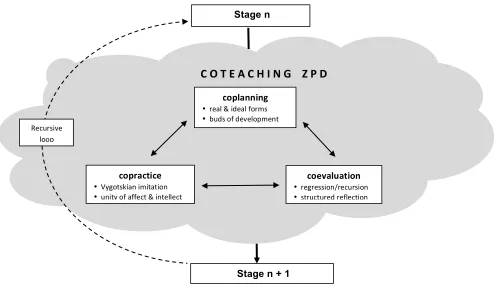
[image:11.612.54.548.102.389.2]sets out conditions comprising elements of Vygotsky’s ZPD leading to effective coplanning, copractice and coevaluation (Figure 2a).
Figure 2a Model for the coteaching ZPD (shaded area represents the ZPD)
Development of coteaching such that it can promote classroom transformation occurs via a series of stages, via the coteaching ZPD illustrated in Figure 2, in which the coteachers initially
participate in the process and eventually act via shared cooperation (see Figure 2b, based on Murphy and Carlisle [2008] and incorporating questions from Kerin [2014], personal
communication]). Progression through each stage proceeds via the coteaching ZPD (Figure 2b).
Stage n + 1
!
Stage n
!"#"$"%"&"!"'"(")"*""""+","-"
./01233435"
• ,-./!0!12-./!34,56! • 7826!43!2-9-/4:5-;<!
!
./67218294/3"
• ,-=,-6614;>,-?8,614;! • 6<,8?<8,-2!,-3/-?<14;!
./0:2.94.6"
•@A=4<6B1.;!151<.<14;! •8;1<A!43!.33-?<!0!1;<-//-?<!
! C-?8,619-!
/44:!
Participation: “Sure, I’ll be involved!”
[Coteaching ZPD]
Active participation: “What should I do...?"
[Coteaching ZPD]
Cooperation: "Do you want me to look after the first group this time...?"
[Coteaching ZPD]
Shared cooperation: "What about if we...?"
[Coteaching ZPD]
Contribution: “Hey, why don't I/you...?"
[Coteaching ZPD]
! ""!
Figure 2b Progression through stages of coteaching practice via the coteaching ZPD
Methodology
The pilot project formed the context for an optional primary science education module within the third and fourth year of a B.Ed programme and involved ten preservice teachers partnered with ten teachers from six local primary schools. There were three distinct phases of activity; planning and preparation; copractice; and solo practice. During the planning and preparation phase, teacher-preservice coteacher pairs attended workshops on a range of innovative approaches including: using stories, puppets, thinking skills, digital resources and role-play. In addition the participants explored coplanning, coteaching and coreflection and designed their own methods for recording and data collection. The researchers adopted a constructivist stance with regard to the design and use of the research instruments and data collection methods. Coteachers designed formats for coplanning and coevaluation templates and chose to use video to record their experiences. During the copractice stage, a total of seven science lessons were coplanned, cotaught and coevaluated during semester one. Each coteaching pair chose topics and content. A dissemination seminar was held early in semester two for coteachers to share coteaching experiences and exchange ideas, extending out students’ and teachers’ repertoires of engaging science lessons in preparation for the final stage of the project, their solo practice. During the course of the pre-service teachers’ school based solo teaching placement, they put into practice the pedagogical approaches which they had developed during the copractice phase. The project concluded with a celebration and
dissemination event during which the teachers and pre-service teachers described how their practice had developed through the course of the project.
Data was collected from several sources. Researchers and participants constructed all data
collection methods collaboratively. Questionnaires were used at the start of the project, to identify a baseline regarding participants’ practice and perceptions of good practice, and then repeated at the end of the pilot, a few months after the coteaching placement had taken place. Semi-structured interviews were also held at the end of the pilot. Documents, for example: coplans, coevaluations, classroom observations, pre-service teachers’ assignment essay on coteaching and reflective practice and video recordings, also provided a rich source of data.
Findings
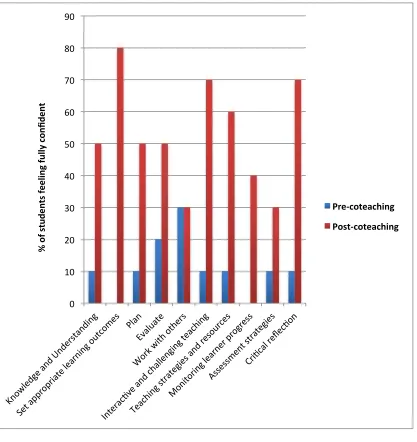
The overall impact of coteaching on developing preservice teacher confidence was indicated by pre- and post audits, in which they recorded confidence levels in an audit instrument based on the development of teacher competence outlined by the General Teaching Council of Northern Ireland (GTCNI, 2007). The ten identified areas were:
• D16:/.A!B;4E/-2=-!.;2!8;2-,6<.;21;=!43!6?1-;?-! • F-<!.::,4:,1.<-!/-.,;1;=!48<?45-6!
• G/.;!/-664;6>!.?<191<1-6!<H.<!-;.7/-!.//!/-.,;-,6!I1;?/821;=!<H46-!E1<H!6:-?1./!.;2!.221<14;./!;--26J! <4!5--<!/-.,;1;=!1;<-;<14;6!
• K9./8.<-!/-664;6>!.?<191<1-6!
• L812-!<H-!E4,B!43!4<H-,!.28/<6!<4!68::4,<!:8:1/!/-.,;1;=!
• M,-.<-!.;2!5.1;<.1;!.!6.3-N!1;<-,.?<19-!.;2!?H.//-;=1;=!/-.,;1;=!-;91,4;5-;<!
• O6-!.!,.;=-!43!<-.?H1;=!6<,.<-=1-6!.;2!,-648,?-6N!1;?/821;=!-P-.,;1;=!EH-,-!.::,4:,1.<-!! • Q4;1<4,1;=!/-.,;-,!:,4=,-66!
! "#! • K9./8.<-!/-664;6!<.8=H<!.;2!86-!?,1<1?./!,-3/-?<14;!<4!=812-!38<8,-!:/.;;1;=R!!
[image:13.612.75.492.159.601.2]The post-test data showed higher levels of confidence in all but one of the identified areas of competence after coteaching. There was no change in the number of students responding that they were fully confident before and after in the area of working with others. The greatest increases were shown in the areas of: setting appropriate learning outcomes; interactice and challenging teaching and critical reflection.
Figure 3 Percentage of students feeling fully confident in their competence in areas defined by the General Teaching Council of Northern Ireland (GTCNI, 2007)
These findings suggested that the experience of coteaching resulted in a significant overall increase in preservice teachers’ confidence in their developing teaching skills. This is consistent with findings of previous coteaching research, much of which is reported in Murphy and
Scantlebury (2010). +! "+! #+! $+! %+! &+! '+! (+! )+! *+!
;"
/<
"=
98
>6
39
="
<6
61
43
5"
<8
11?
".
/3
@>
63
9"
,:6A./962.B435"
! "$!
Testing the ZPD model
Evidence from preservice teacher reflections on coteaching indicated that some essential elements of the ZPD appeared to be more important than others for developing their confidence through coteaching. The data was collected at the end of the project, so preservice teachers reflected on development during coteaching and afterwards, when they enacted only solo teaching in the block placement.
1. Coplanning: interaction between real and ideal form and buds of development
The two Vygotskian essential elements ascribed to coplanning were interaction between real and
ideal form and buds of development. There was much more allusion to the former among the
preservice teachers. ‘Ideal’ practice became a powerful construct in the coplanning. Most commented on ideal practice as thinking more about children’s learning than about lesson resources. Their reflections highlighted this focus on children’s learning instead of the former focus on resources. Indicative quotes from two of the preservice teachers’ reflective essays were:
When I am planning a lesson now I am constantly thinking is this the best way for my pupils, can I improve on their learning?
Before I focused on resources and how they worked, whereas after coteaching I went: “okay this group didn’t get this, and this is why I think they didn’t get it, so this is what I’ll do instead next time”. It was much more detailed in terms of children’s learning instead of the practical setup of the classroom.
Similar findings were observed in the interview data with preservice teachers in relation to the shifting focus from resources to learning as ideal practice, as exemplified by the following short extracts:
I started off when I looked at my reflections, it was more ‘this worked well’, like the white board or website, and then it changed to what they had grasped and learnt. Investigation, not just the teacher telling them what to do, but getting the children to think of their own questions or devise their own experiments.
Key evidence for developing ‘buds’ came from solo practice following the learning gains from the coteaching experience. No preservice teacher mentioned the term ‘buds of development’ so the relation is inferred, for example, a preservice teacher recalls her first solo practice use of outdoor learning:
This aspect of my teaching was noticeable when out on school-based placement independent of the [coteaching] project. Not only did I introduce the use of video recorders for the pupils to use during their lessons, but also [I] used the outdoor space for our lessons.
2. Copractice: Vygotskian imitation and unity of affect and intellect
Pre-service teachers reflected more consistently on Vygotskian imitation than on the unity of affect and intellect. Indeed, there was little conscious reference to emotion in their reflections, apart from relating children’s enjoyment and preservice teachers’ positive feelings in response. Vygotskian imitation was evident both during coteaching and in subsequent solo practice.
Preservice teachers recalled several examples in their interviews; most related to aspects they had noticed during coteaching and had integrated into their solo pracrice, for example:
! "%!
Communicating with children at the end. I had no idea how to do this. The teacher would write the big words on the board and she says it and they copy her. I have used all her techniques.
Let them ramble on for longer bring up their ideas…
More discussion in my lessons; the teacher had the class organized in specific ways so they weren’t just sitting at their desk they engaged more in discussion. I do that now.
Vygotskian imitation was commented on in more depth in preservice teachers’ reflective essays, for example:
…as such I seemed to move from the surface level to the more pedagogical and critical levels of reflection quicker, as I asked the questions the [coteaching partner] teacher would have asked, such as: ‘where is the progression in this lesson?’ ‘is this particular aspect of the lesson beneficial to learning?’ ‘how can you overcome the common misconceptions a child will make in this lesson?’ etc.”
Apart from pre-service teachers’ comments on the importance of engaging children’s emotions to develop their science learning, some also reflected on their own feelings during coteaching, for instance:
Coteaching made me feel good because children were learning and you could see the progression in learning every week and every week they looked forward to you coming in. (reflective essay) I could hear them saying I want to be a scientist. So they are going home and telling their parents. You can see the learning happening before your eyes.
(structured interview) The children’s faces when you brought a puppet or did something interactive. Making a cloud in a bottle a boy’s face lit up and he wouldn’t let anyone else do it; it feels good to see their reaction. (structured interview)
3. Coevaluation: regression and recursion and structured reflection
Most preservice teachers experienced a slow start to becoming effective teachers, more akin to the ‘participant’ phase than to that of shared contribution to the process (see Figure 2b). There was not much evidence of regression in their reflective essays and structured interviews, it was more a case of gradual improvement in relation to their level of comfort while coteaching and a steadily
improving relationship with the teacher. The earlier phase was characterised by little risk-taking and more developing familiarity with each other’s style of practice. One described the experience thus in her reflective essay:
During the first lessons, the roles of the teacher and I in the classroom were arguably stagnant with one party often leading, observing or working with small groups with little flexibility present within these roles…”
Some preservice teachers commented about the slow start in their interviews. In the following extract, one describes his evolving experience as a coteacher:
! "&!
In terms of structured reflection, earlier coteaching studies (Murphy and Scantlebury, 2010) have revealed fairly low level reflection from coteachers in that there is little attention paid to how lessons were enacted in relation to ideal practice and more to surface-level description. Preservice teachers were provided with eight core articles which explored reflective practice and were encouraged to use these in writing a reflective essay on their coteaching experiences. Such structured reflection, which included reference to Larivee’s (2008) tool for reflection which identified levels of preservice teacher reflection, generated a much deeper engagement by
preservice teachers with coteaching practice in their essays than was evidenced in the interviews. Preservice teachers used a template for reflection developed by the research team, and one critiqued this instrument in her reflective essay:
Throughout the coteaching experience, reflection arguably occurred through the provision of a structure, in the coreflection template, maximizing the thinking process. This structure gave reflections a premise, however, care must be taken in the use of templates when reflecting to ensure that the process is not hampered by the completion of sections on paper.
Another comment from a reflective essay indicated how the preservice teacher was considering her coteaching experience in relation to her teaching career.
Through coteaching I have developed my reflective practice through the levels of progression and in a variey of ways through reflection in action and reflection on action… It is evident that whilst coteaching has developed my refective practice, the road to becoming a competent ‘Reflective Practitioner’ (GTCNI, 2010) will be long. Reflection is arguably a process, not a method, but a process which must be developed throughout a teaching career. This journey of effective reflection,
facilitating lessons which site pupils’ learning in the forefront has begun and it will be interesting to chart the progress and effectiveness of my reflections throughout my teaching career.
In terms of level of reflection, the reflective essays on coteaching evidenced reflection at levels we identified by adapting Larivee’s tool, chiefly the following three levels: surface reflection (eg: using evidence and making adjustments based on experience only); level 3, pedagogical reflection (eg: adjusts methods and practices based on students’ relative performance) and level 4, critical pedagogical reflection (eg: commitment to continuous learning and improved practice;
constructive criticism of own practice; sees teaching practices as remaining open to further investigation).
Discussion
The data describing the pre-service teachers’ experiences makes a strong case for including coteaching within initial teacher education programmes. The ZPD which coteaching provides facilitates meaningful thinking coupled with purposeful activity in the areas of planning, teaching and reflecting. Coteaching attends to several of the ‘principles to guide development of responsive
teacher education programmes that make a difference’ as identified by Korthagen et al (2006:
1036), namely; viewing knowledge as a subject to be created; facilitate pre-service teacher research; prioritise peer working; and nurture meaningful relationships between schools,
universities and pre-service teachers. In the words of one of our coteaching pre-service teachers,
! "'!
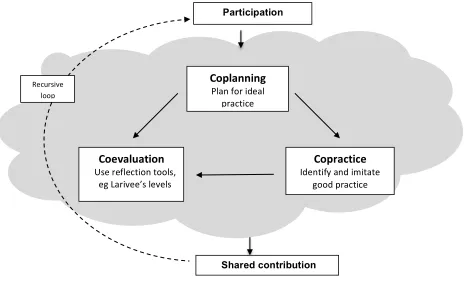
Evidence accrued from this pilot study suggested that the proposed model outlined in Figure 2, structuring coteaching as three phases of cplanning, copractice and coevaluation, further structuring each phase as satisfying elements of Vygtosky’s ZPD, and providing a structure for progressing in coteaching, could be adapted and simplified to make it more workable. For instance, the data indicated that certain Vygotskian constructs were used invariably more than others. The model was therefore adapted to remove those elements which were not embraced by preservice teachers in their reflections. It should be noted here that cooperating teachers were also interviewed and their data exhibited the same trend in the relative attention paid to the six
identified essential elements of Vygotsky’s ZPD. Thus we have reduced the six to three; one for each phase of coplanning (interaction between real and ideal form); copractice (Vygotskian imitation) and structured reflection (coevaluation).
[image:17.612.64.529.271.557.2]The revised and simplified model, which takes the findings from the pilot study into account, is presented in Figure 4.
Figure 4 Revised coteaching model
Our pilot study highlighted the impact of the notion of ‘ideal’ practice, which seemed to galvanise preservice teachers into a higher level of coplanning. They were happy to openly use Vygotskian imitation when they identified good practice in the classroom. Additionally, when given tools for reflection, preservice teachers reflected at very high levels, much improved on any reflection that has been recorded in coteaching studies which have not incorporated the use of reflection tools. The amount of time required for coplanning and coevaluation and a shared understanding of the coteaching concept between the participating teachers (student and cooperating) and university personnel (supervisors and researchers) are universal challenges inherent in implementing
!
Shared contribution Participation
!/01233435"
G/.;!34,!12-./! :,.?<1?-!
!
!/67218294/3"
O6-!,-3/-?<14;!<44/6N! -=!P.,19--S6!/-9-/6!
!/0:2.94.6"
T2-;<13A!.;2!151<.<-! =442!:,.?<1?-! C-?8,619-!
! "(!
coteaching, despite widely different coteaching contexts. Thus the framework in Figure 4 provides a structure in which coplanning, copractice and coevaluation are given equal priority.
Future research could consider contextual factors, in addition to time, that support or impede the design and development of coteaching. The outcomes of this model should realize coteaching as a way to develop more reflective practitioners in the classroom, who have benefited from working with another teacher in developing, delivering and evaluating good science lessons which aim at, and reflect, ideal practice. In addition, coteachers who have practised using this model may develop an increased awareness of, and a focus on, addressing issues in science learning and teaching that arise outside the classroom.
This model provides a context for a deeper consideration of how to enact coteaching effectively and it contributes towards theorising the coteaching process, which has demonstrated significant benefits in the preparation of preservice science teachers, and in most cases, for the cooperating teachers as well. Most importantly, it is hoped that this model provides tools and structures which can be used in the implementation of coteaching as an essential element of preservice teacher education programmes.
References
Ash, D. & Levitt, K. (2003). Working within the zone of proximal development: formative
assessment as professional development. Journal of Science Teacher Education, 14 (1), 1-26.
Bacharach, N., Heck, T., & Dahlberg, K. (2007). Collaboratively researching the impact of a
coteaching model of student teaching. Paper presented at the annual meeting of the
American Educational Research Association, Chicago.
GTCNI (2007). Teaching: The Reflective Profession. (Belfast: GTCNI).
Kluth, P., & Straut, D. (2003). Do as we say and as we do: Co-teaching in the university classroom. The Journal of Teacher Education, 54, 228- 240.
Korthagen, F., Loughran, J., & Russell, T. (2006). Developing fundamental principles for teacher education programs and practice. Teaching and Teacher Education, 22, 1020-1041.
Larivee, B. (2008). Development of a tool to assess teachers’ level of reflective practice. Reflective
Practice, 9, 341–360.
Lave, J., & Wenger, E. (1991). Situated learning: Legitimate peripheral participation. Cambridge: Cambridge University Press.
Leiberman, A. (1992). The meaning of scholarly activity and the building of community.
Educational Researcher, 21(8), 5-12.
National Council for Accreditation of Teacher Education (NCATE) (2010 November 25).
Transforming teacher education through clinical practice: A national strategy to prepare
effective teachers. NCATE: Washington, DC Retrieved from
http://www.ncate.org/LinkClick.aspx?fileticket=zzeiB1OoqPk%3d&tabid=715
Roth, W-M; Lawless, D. V. & Tobin, K. (2000). Coteaching | Cogenerative Dialoguing as Praxis of Dialectic Method. Forum Qualitative Sozialforschung / Forum: Qualitative Social
Research, 1(3), Art. 37, http://nbn-resolving.de/urn:nbn:de:0114-fqs0003372.
! ")!
Scantlebury, K., Gallo-Fox, J., & Wassell, B. (2008). Coteaching as a model for preservice science teacher education. Teaching and Teacher Education, 24 (4), 967-981.
Stetsenko, A. (2008). From relational ontology to transformative activist stance in conceptualizing development and learning: Expanding Vygotsky’s (CHAT) Project. Cultural Studies of
Science Education, 3, 471–491.
Bourdieu, P. (1977). Outline of a theory of practice. Cambridge, MA: Cambridge University Press. Chaiklin, S. (2003). The zone of proximal development in Vygotsky's analysis of learning and
instruction. In A. Kozulin, B. Gindis, V. S. Ageyev, & S. M. Miller (Eds.), Vygotsky's educational theory in cultural context. (pp. 39-64). Cambridge: Cambridge University Press.
Collins, R. (2004). Interaction ritual chains. Princeton: Princeton University Press. Daniels, H., (2001). Vygotsky and pedagogy. London: Routledge.
Edwards, A. (2005). Let’s get beyond community and practice: The many meanings of learning by participating. The Curriculum Journal, 16(1), 53-69.
Engeström, Y. (1987). Learning by expanding: An activity-theoretical approach to developmental research. Helsinki: Orieta-Konsultit.
Holzman, L. (1997). Schools for growth. New Jersey: Lawrence Erlbaum.
Jones, M. G., Rua, M. J., & Carter, G. (1998). Science teachers’ conceptual growth within
Vygotsky’s zone of proximal development. Journal of Research in Science Teaching, 35 (9) 967-985.
Kerin, M. (2014, in preparation). Coteaching in elementary music education.
Lampert -Shepel, E. (1999). Reflective thinking in educational praxis: analysis of multiple perspectives. Educational Foundations 13(3) 69-88.
Lave, J., & Wenger, E. (1991). Situated learning: Legitimate peripheral participation. Cambridge: Cambridge University Press.
Leiberman, A. (1992). The meaning of scholarly activity and the building of community. Educational Researcher, 21(8), 5-12.
Mahn, H. & John-Steiner, V. (2002). The gift of confidence: A Vygotskian view of emotions. In G. Wells and G. Claxton (Eds.), Learning for life in the 21st Century (pp. 46-58). London: Blackwells.
Martin, S. (2009). Learning to teach science. In K. Tobin & W.-M. Roth (Eds.), World of science education: North America (pp. 567-586). The Netherlands: Sense Publishers.
Meira, L. & Lerman, S. (2001 December 30). The zone of proximal development as a symbolic space. Retrieved from www.lsbu.ac.uk/ahs/research/reports/stevelerman1.pdf
Murphy, C and Scantlebury, K (eds) (2010) Coteaching in International Contexts, Springer ISBN: 978-9048137060
National Council for Accreditation of Teacher Education (NCATE) (2010 November 25). Transforming teacher education through clinical practice: A national strategy to prepare effective teachers. NCATE: Washington, DC Retrieved from
http://www.ncate.org/LinkClick.aspx?fileticket=zzeiB1OoqPk%3d&tabid=715
! "*!
Ritchie, S. M., & Rigano, D. L. (2007) Solidarity through collaborative research. International Journal of Qualitative Studies in Education, 20 (2). 129-150.
Robbins, D. (2001). Vygotsky's zone of proximal development, imitation, and mimesis. Published in Works of the Vygotsky Institute of Psychology, Russian State University for the Humanities, Moscow.
Rogoff, B., Mistry, J., Goncu, A. & Mosier, C. (1993). Guided participation in cultural activity by toddlers and caregivers. Monographs of the Society for Research in Child Development, 58(8), Serial #236.
Rorty, R. (1989). Contingency, irony and solidarity. Cambridge: Cambridge University Press. Roth, W-M. (1998). Science teaching as knowledgeability: A case study of knowing and learning
during coteaching. Science Education, 82, 357-377.
Roth, W-M. (2002). Being and becoming in the classroom. London: Ablex Publishing.
Roth, W-M. (2006). Ethical issues when teaching praxis is coextensive with qualitative research praxis: An introduction. Forum: Qualitative Social Research, 7(4), Art. 17. Retrieved from: http://www.qualitative-research.net/fqs-texte/4-06/06-4-17-e.htm
Roth, W.-M., & Tobin, K. (2004). Coteaching: From praxis to theory. Teachers and Teaching: Theory and Practice, 10, 161-179.
Roth, W-M. & Tobin, K. (Eds.) (2005). Teaching together, learning together. New York: Peter Lang.
Roth, W-M., Tobin, K., & Zimmermann, A. (2002). Coteaching/cogenerative dialoguing: learning environments research as classroom praxis. Learning Environments Research, 5, 1-28. Roth, W-M., Masciotra, D., & Boyd, N. (1999). Becoming-in-the-classroom: A case study of
teacher development through coteaching. Teaching and Teacher Education, 15, 771-784. Roth, W-M., Tobin, K., Carambo, C. & Dalland, C. (2004). Coteaching: Creating resources for
learning and learning to teach chemistry in urban high schools. Journal of Research in Science Teaching, 41, 882-904.
Roth, W.-M., & Radford, L. (2010). Re/thinking the zone of proximal development (symmetrically). Mind, Culture, and Activity, 17(4), 299-307.
Sewell, W.H. (1992), A theory of structure: duality, agency, and transformation. American Journal of Sociology, vol.98, no.1, pp.1-29.
Silvonen, J. (2010). Vygotsky's plural discourse on human mind. In P. Aunio, M. Jahnukainen, M. Kalland & J. Silvonen (Eds.) Piaget is dead, Vygotsky is still alive? Helsinki: FERA. Tharp, R. G. & Gallimore, R. (1988). Rousing minds to life: Teaching, learning, and schooling in
social context. New York: Cambridge University Press.
Tobin, K. (2006). Learning to teach through coteaching and cogenerative dialogue. Teaching Education, 17, 133-142.
Tobin, K., & Roth, W-M. (2006). Teaching to Learn: A View from the Field. Rotterdam: Sense Publishers.
! #+!
van Oers. B. (2007). In the zone. Children in Europe: Vygostky Edition, 14-15.
Veresov, N. (2004). Zone of proximal development (ZPD): the hidden dimension? In A. Ostern & R. Heila-Ylikallio (Eds.). Language as culture tensions in time and space. Vol. 1, (pp. 13-30). Vasa, ABO Akademi.
Veresov, N. (2010). Introducing cultural historical theory: main concepts and principles of genetic research methodology. Retrieved from: http://nveresov.narod.ru/KIP.pdf
Veresov, N. (2011). Cultural-historical theory and genetic research methodology. Presentation at the International Society for Cultural and Activity Research (ISCAR), Rome.
Vygotsky, L. S. (1987). The development of scientific concepts in childhood, In R. W. Reiber & A. S. Carton (Eds.), Collected works of L. S. Vygotsky: Vol. 1. (pp. 167-242). New York: Plenum.
Vygotsky, L. S. (1978). Mind in society: The development of higher psychological processes. (M. Cole, V. John-Steiner, S. Scribner, & E. Souberman, Eds.). Cambridge, Massachusetts: Harvard University Press.
Vygotsky, L. S. (1981). The genesis of higher mental functions. In J. V. Wertsch (Ed.), The concept of activity in Soviet psychology (pp. 144-188). Armonk, NY: Sharpe. Vygotsky L. S. (2001). Osnovy pedologii. Stenogrammy lektsii. Izevsk.
Wells, G. (1999). Dialogic inquiry: Towards a sociocultural practice and theory of education. Cambridge: Cambridge University Press.
Zaretskii, V. K. (2010). The zone of proximal development. Journal of Russian and East European Psychology. 47 (6) 70-93.