Learning Kernels for Semantic Clustering: A Deep Approach
Ignacio Arroyo-Fern´andez
Universidad Nacional Aut´onoma de M´exico (UNAM)
Abstract
In this thesis proposal we present a novel semantic embedding method, which aims at consistently performing semantic clustering at sentence level. Taking into account special aspects ofVector Space Models (VSMs), we propose to learnreproducing kernelsin clas-sification tasks. By this way, capturing spec-tral features from data is possible. These fea-tures make it theoretically plausible to model semantic similarity criteriain Hilbert spaces, i.e. the embedding spaces. We could im-prove the semantic assessment over embed-dings, which are criterion-derived representa-tions from traditional semantic vectors. The learned kernel could be easily transferredto clustering methods, where the Multi-Class Im-balance Problem is considered (e.g. semantic clustering of definitions of terms).
1 Introduction
Overall in Machine Learning algorithms (Duda et al., 2012), knowledge is statistically embedded via the Vector Space Model (VSM), which is also named the semantic space (Landauer et al., 1998; Pad´o and Lapata, 2007; Baroni and Lenci, 2010). Contrarily to it is usually conceived in text data analysis (Manning et al., 2009; Aggarwal and Zhai, 2012), not any data set is suitable to embed into`p
metric spaces, including euclidean spaces (p = 2) (Riesz and Nagy, 1955). This implies that, in par-ticular, clustering algorithms are being adapted to some`p-derived metric, but not to semantic vector
sets (clusters) (Qin et al., 2014).
The above implication also means that seman-tic similarity measures are commonly not consis-tent, e.g. the cosine similarity or transformation-based distances (Sidorov et al., 2014). These are mainly based on the concept of triangle. Thus if the triangle inequality does not hold (which in-duces norms for Hilbert spaces exclusively), then the case of the cosine similarity becomes mathe-matically inconsistent1. Despite VSMs are
some-times not mathematically analyzed, traditional algo-rithms work well enough for global semantic anal-ysis (hereinafter global analysis, i.e. at document level where Zipf’s law holds). Nevertheless, for lo-cal analysis (hereinafterlocal analysis, i.e., at sen-tence, phrase or word level) the issue remains still open (Mikolov et al., 2013).
In this thesis proposal, we will address the main difficulties raised from traditional VSMs for local analysis of text data. We consider the latter as an ill-posed problem (which implies unstable algorithms) in the sense of some explicitsemantic similarity cri-terion (hereinafter criterion), e.g. topic, concept, etc. (Vapnik, 1998; Fernandez et al., 2007). The fol-lowing feasible reformulation is proposed. By learn-ing a kernel in classification tasks, we want to induce an embedding space (Lanckriet et al., 2004; Cortes et al., 2009). In this space, we will consider rele-vance (weighting) of spectral features of data, which are in turn related to the shape of semantic vector sets (Xiong et al., 2014). These vectors would be derived from differentStatistical Language Models (SLMs); i.e. countable things, e.g. n-grams, bag-of-words (BoW), etc.; which in turn encodelanguage
1Riesz (1955) gives details about Hilbert spaces.
aspects(e.g. semantics, syntax, morphology, etc.). Learned kernels are susceptible to be transferred to clustering methods (Yosinski et al., 2014; Bengio et al., 2014), where spectral features would be properly
filteredfrom text (Gu et al., 2011).
When both learning and clustering processes are performed, the kernel approach is tolerant enough for data scarcity. Thus, eventually, we could have any criterion-derived amount of semantic clusters regardless of the Multi-Class Imbalance Problem (MCIP) (Sugiyama and Kawanabe, 2012). It is a rarely studied problem in Natural Language Pro-cessing (NLP), however, contributions can be help-ful in a number of tasks such as IE, topic modeling, QA systems, opinion mining, Natural Language Un-derstanding, etc.
This paper is organized as follows: In Section 2 we show our case study. In Section 3 we show the embedding framework. In Section 4 we present our learning problem. Sections 5 and 6 respectively show research directions and related work. In Sec-tion 7, conclusions and future work are presented.
2 A case study and background
A case study. Semantic clustering of definitions of terms is our case study. See the next extracted2
ex-amples for the termswindow andmouse. For each of them, the main acception is showed first, and af-terwards three secondary acceptions:
1. Awindowis aframeincluding asheet of glassor other material capable of admitting light...
(a) The window is thetimeelapsed since apassenger
calls toschedule...
(b) A window is asequenceregion of 20-codon length on an alignment ofhomologous genes...
(c) A window is anyGUI elementand is usually iden-tified by a Windows handle...
2. Amouseis amammalclassified in the orderRodentia, suborderSciurognathi....
(a) A mouse is a small objectyou can roll along a hard, flat surface...
(b) A mouse is a handheld pointing deviceused to position a cursor on acomputer...
(c) The Mouse is afictional characterinAlice’s Ad-venturesin Wonderland byLewis Carroll... In the example 1, it is possible to assign the four acceptions to four different semantic groups (the window (1), transport services (1a), genetics (1b)
2www.describe.com.mx
and computing (1c)) by using lexical features (bold terms). This example also indicates how abstract concepts are always latent in the definitions. The example 2 is a bit more complex. Unlike to example 1, there would be three clusters because there are two semantically similar acceptions (2a and 2b are related to computing). However, they are lexically very distant. See that in both examples the amount of semantic clusters can’t be defined a priory (un-like to Wikipedia). Additionally, it is impossible to know what topic the users of an IE system could be interested in. These issues, point out the need for an-alyzing the way we are currently treating semantic spaces in the sense of stability of algorithms (Vap-nik, 1998), i.e. the existence of semantic similarity consistence, although Zipf’s law scarcely holds (e.g. in local analysis).
Semantic spaces and embeddings. Erk (2012) and Brychc´ın (2014) showed insightful empiricism about well known semantic spaces for different cases in global analysis. In this work we have spe-cial interest in local analysis, where semantic vec-tors are representations (embeddings) derived from learned feature maps for specific semantic assess-ments (Mitchell and Lapata, 2010). These feature maps are commonly encoded in Artificial Neural Networks (ANNs) (Kalchbrenner et al., 2014).
ANNs have recently attracted worldwide atten-tion. Given their surprising adaptability to unknown distributions, they are used in NLP for embedding and feature learning in local analysis, i.e. Deep Learning (DL) (Socher et al., 2011; Socher et al., 2013). However, we require knowledge transfer to-wards clustering tasks. It is still not feasible by using ANNs (Yosinski et al., 2014). Thus, theoretical ac-cess becomes ever more neac-cessary, so it is worth ex-tendingKernel Learning(KL) studies as alternative feature learning method in NLP (Lanckriet et al., 2004). Measuring subtle semantic displacements, according to a criterion, is theoretically attainable in a well defined (learned)reproducing kernel Hilbert space(RKHS), e.g. some subset of L2(Aronszajn, 1950). In these spaces, features are latent abstrac-tion levels3of data spectrum, which improves kernel
scaling (Dai et al., 2014; Anandkumar et al., 2014).
3Mainly inDL, it is known there are different hierarchies of
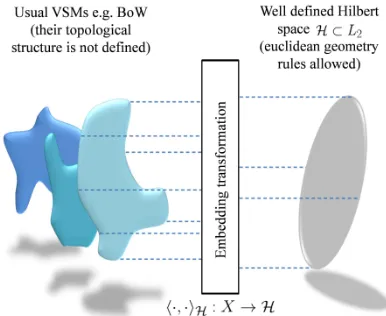
Figure 1: General schema of the transformation frame-work from some traditional VSM (left) to a well defined embedding space (right).
3 RKHS and semantic embeddings
We propose mapping sets of semantic vectors (e.g. BoW) into well defined function spaces (RKHSs), prior to directly endowing such sets (not elliptical or at least convex (Qin et al., 2014)) with the euclidean norm,k.k2(see Figure 1). For the aforesaid purpose, we want to take advantage of the RKHSs.
Any semantic vector xo ∈ X could be
consis-tently embedded (transformed) into a well defined Hilbert space by using thereproducing propertyof a kernelk(·,·)(Shawe-Taylor and Cristianini, 2004):
fxo(x) =hf(·), k(·, x)iH; ∀x∈X (1)
where: H ⊂ L2 is a RKHS,fxo(·) ∈ His the
em-bedding derived fromxo, which can be seen as fixed
parameter ofk(·, xo) =f(·) ∈ H. This embedding
function is defined over the vector domain{x} ⊂X andh·,·iH:X → His the inner product inH.
Always that (1) holds,k(·,·)is a positive definite (PD) kernel function, soX does not need even to be a vector space and even then, convergence of any sequence{fn(x) :fn ∈ H;n∈N}can be ensured.
The above is a highly valuable characteristic of the resulting function space (Smola et al., 2007):
lim
n→∞fn=f ⇐⇒ nlim→∞kn(·, x) =k(·, x). (2) The result (2) implies that convergence of summa-tion of initial guessing kernel funcsumma-tionskn(·,·)∈ H
always occurs, hence talking about the existence of
a suitable kernel functionk(·,·) ∈ H in (1) is ab-solutely possible. It means that L2 operations can be consistently applied, e.g. the usual normk · k2, trigonometric functions (e.g. cosθ) and distance d2 = kfn−fmk2 :m 6=n. Thus, from right side of (2), in order that (1) holds convergence of the Fourier series decomposition ofk(·,·) towards the spectrum of desired features from data is necessary; i.e., by learning parameters and hyperparameters4of
the series (Ong et al., 2005; B˘az˘avan et al., 2012).
3.1 Learnable kernels for language features
Assume (1) and (2) hold. For some SLMaencoded in a traditional semantic space, it is possible to de-fine a learnable kernel matrixKaas follows
(Lanck-riet et al., 2004; Cortes et al., 2009):
Ka:= p X
i=1
βiKi, (3)
where{Ki}pi=1 ⊂ K is the set of p initial
guess-ing kernel matrices (belongguess-ing to the familyK, e.g. Gaussian) with fixed hyperparameters and βi’s are
parameters weighting Ki’s. Please note that, for
simplicity, we are using matrices associated to ker-nel functionski(·,·), ka(·,·)∈ H, respectively.
In the Fourier domain and bandwidth. In fact (3) is a Fourier series, where βi’s are
decomposi-tion coefficients ofKa (B˘az˘avan et al., 2012). This
kernel would be fitting the spectrum of some SLM that encodes some latent language aspect from text (Landauer et al., 1998). On one hand, in Fourier domain operations (e.g. the error vector norm) are closed inL2, i.e., according to (2) convergence is en-sured as a Hilbert space is well defined. Moreover, theL2-regularizer is convex in terms of the Fourier series coefficients (Cortes et al., 2009). The afore-mentioned facts imply benefits in terms of compu-tational complexity (scaling) and precision (Dai et al., 2014). On the other hand, hyperparameters of initial guessing kernels are learnable for detecting the bandwitdh of data (Ong et al., 2005; B˘az˘avan et al., 2012; Xiong et al., 2014). Eventually, the lat-ter fact would lead us to know (learning) bounds for
4So called in order to make distinction between weights
the necessary amount of data to properly train our model (the Nyquist theorem).
Cluster shape.A common shape among clusters is considered even for unseen clusters with differ-ent, independent and imbalanced prior probability densities (Vapnik, 1998; Sugiyama and Kawanabe, 2012). For example, if data is Guassian-distributed in the input space, then shape of different clusters tend to be elliptical (the utopian`2 case), although their densities are not regular or even very imbal-anced. Higher abstraction levels of the data spec-trum possess mentioned traits (Ranzato et al., 2007; Baktashmotlagh et al., 2013). We will suggest below a more general version of (3), thereby considering higher abstraction levels of text data.
4 Learning our kernel in a RKHS
A transducer is a setting for learning parameters and hyperparameters of a multikernel linear combination like the Fourier series (3) (B˘az˘avan et al., 2012).
Overall, the above setting consists on defining a multi-class learning problem over a RKHS: let Yθ = {y`}y`∈N be a sequence of targets
induc-ing a semantic criterion θ, likewise a training set X ={x`}x`∈Rnand a set of initial guessing kernels {Kσi}pi=1 ⊂ Kwith the associated hyperparameter vectorσa = {σi}pi=1. Then for some SLMa ∈ A, we would learn the associated kernel matrixKaby
optimizing the SLM empirical risk functional:
JA(σa, βa) =LA(Ka,X,Yθ) +ψ(σa) +ξ(βa),
(4) where inJA(·,·)we have:
Ka= X
1≤i≤p
βiKσi. (5)
The learning is divided in two interrelated stages: at the first stage, the free parameter vector βa = {βi}pi=1 in (5) (a particular version of (3)), is opti-mized for learning a partial kernelKba, given a fixed
(sufficiently small)σa and by using the regularizer
ξ(βa) over the SLM prediction lossLA(·,·) in (4).
Conversely at the second stageσa is free, thus by
using the regularizerψ(σa)over the prediction loss
LA(·,·), given that the optimalβ∗
awas found at the
first stage, we could have the optimalσ∗
aand
there-foreK∗
a is selected.
At higher abstraction levels, given the association {X,Yθ}, the transducer setting would learn a
ker-nel function that fits a multi-class partition ofX via summation ofKa’s. Thus, we can use learned
ker-nels K∗
a as new initial guesses in order to learn a
compound kernel matrixKθfor a higher abstraction
level:
J(γθ) =L(Kθ,X,Yθ) +ζ(γθ), (6)
where in the general risk functionalJ(·)we have:
Kθ= X
a∈A
γaKa∗. (7)
In (6) the vector γθ = {γa}a∈A weights seman-tic representationsK∗
a associated to each SLM and
ζ(γθ) is a proper regularizer over the general loss
L(·,·). The described learning processes can even be jointly performed (B˘az˘avan et al., 2012). The aforementioned losses and regularizers can be con-veniently defined (Cortes et al., 2009).
4.1 The learned kernel function
In order to make relevant features to emerge from text, we would use our learned kernelK∗
θ. Thus if {γ∗
θ,{β∗a, σ∗a}a∈A} is the solution set of the learn-ing problems (4) and (6), then combinlearn-ing (5) and (7) gives the embedding kernel function, for|A| differ-ent SLMs as required (see Figure 2):
Definition 1. Given a semantic criterionθ, then the learned parameters {γ∗
θ,{βa∗, σ∗a}a∈A} are
eigen-values of kernels {K∗
a}a∈A ≺ Kθ∗, respectively5. Thus according to (1), we have for any semantic vec-torxo∈Xits representationfxo(x)∈ H:
fxo(x) := X
a∈A
p X
i=1
γa∗βi∗ki(x, xo)
=kθ(x, xo)≈Kθ∗xo.
(8)
In (8),ki(·,·), kθ(·,·) ∈ H ⊂L2are reproducing kernel functions associated to matricesKσiandKθ,
respectively. The associated{σ∗
a}a∈Awould be op-timally fitting the bandwidth of data. X ⊃ X is a compounding semantic space from different SLMs 5(i)The symbol ‘≺’ denotes subordination (from right to
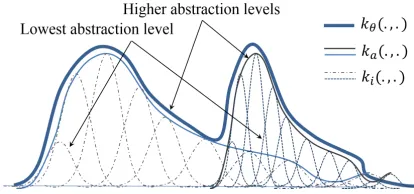
Figure 2: Sketch (bold plot) of the abstraction levels of some learned kernel functionkθ(·.·)∈ H ⊂L2.
a ∈ A(B˘az˘avan et al., 2012). According toθ, se-mantic clustering could be consistently performed in Hby computing anyL2similarity measure between embeddings{fxn, fxm}, which are derived from any
semantic vectors xn, xm ∈ X, e.g. (i) the kernel
correlation coefficientρθ = µkθ(xn, xm) ∈ [0,1];
withµ = 1
kfxnkkfxmk, and(ii)the distance by sim-ply computingd2 =kfxn−fxmk2.
Please note that we could extend Definition 1 to deeper levels (layers) associated to abstraction lev-els of SLMs. These levlev-els could explicitly encode morphology, syntax, semantics or compositional se-mantics, i.e.{Ka}a∈A =KSLMs ≺Kaspects. 5 Research directions
Our main research direction is to address in detail linguistic interpretations associated to second mem-ber of (8), which is still not clear. There are poten-tial ways of interpretingpooling operationsover the expansion of either eigenvalues or eigenfunctions of fxo(·). This fact could lead us to an alternative way
of analyzing written language, i.e. in terms of the spectral decomposition ofX givenθ.
As another direction we consider data scarcity (low annotated resources). It is a well handled issue by spectral approaches like the proposed one, so it is worth investigating hyperparameter learning tech-niques. We consider hyperparameters as the lowest abstraction level of the learned kernel and they are aimed at data bandwidth estimation (i.e. by tuning theσi associated to eachki(·,·) in (8)). This
esti-mation could help us to try to answer the question of how much training data is enough. This ques-tion is also related to the quality bounds of a learned kernel. These bounds could be used to investigate the possible relation among the number of annotated
clusters, the training set size and the generalization ability. The latter would be provided (transferred) by the learned kernel to a common clustering algo-rithm for discovering imbalanced unseen semantic clusters. We are planning to perform the above por-trayed experiments at least for a couple of semantic criteria6, including term acception discovering
(Sec-tion 2). Nevertheless, much remains to be done.
6 Related work
Clustering of definitional contexts.Molina (2009) processed snippets containing definitions of terms (Sierra, 2009). The obtained PD matrix is not more than a homogeneous quadratic kernel that induces a Hilbert space: TheTextual Energyof data (Fernan-dez et al., 2007; Torres-Moreno et al., 2010). Hi-erarchical clustering is performed over the resulting space, but some semantic criterion was not consid-ered. Thus, such as Cigarran (2008), they ranked re-trieved documents by simply relying on lexical fea-tures (global analysis). ML analysis was not per-formed, so their approach suffers from high sensibil-ity to lexical changes (instabilsensibil-ity) in local analysis.
Paraphrase extraction from definitional sen-tences. Hashimoto, et.al. (2011) and Yan, et.al. (2013) engineered vectors from contextual, syntac-tical and lexical features of definitional sentence paraphrases (similarly to Lapata (2007) and Ferrone (2014)). As training data they used a POS anno-tated corpus of sentences that contain noun phrases. It was trained a binary SVM aimed at both para-phrase detection and multi-word term equivalence assertion (Choi and Myaeng, 2012; Abend et al., 2014). More complex constructions were not con-sidered, but their feature mixure performs very well. Socher et al., (2011) used ANNs for paraphrase detection. According to labeling, the network unsu-pervisedly capture as many language features as la-tent in data (Kalchbrenner et al., 2014). The network supervisedly learns to represent desired contents in-side phrases (Mikolov et al., 2013); thus paraphrase detection is highly generalized. Nevertheless, it is notable the necessity of a tree parser. Unlike to (Socher et al., 2013), the network must to learn syn-tactic features separately.
6For example: SemEval-2014; Semantic Evaluation
Definitional answer ranking. Fegueroa (2012) and (2014) proposed to represent definitional an-swers by a Context Language Model (CLM), i.e. a Markovian process as probabilistic language model. A knowledge base (WordNET) is used as an an-notated corpus of specific domains (limited to Wikipedia). Unlike to our approach, queries must be previously disambiguated; for instance:“what is a computer virus?”, where “computer virus” disam-biguates “virus”. Answers are classified according to relevant terms (Mikolov et al., 2013), similarly to the way topic modeling approaches work (Fernan-dez et al., 2007; Lau et al., 2014).
Learning kernels for clustering. Overall for knowledge transfer from classification (source) tasks to clustering (target) tasks, the state of the art is not bast. This setting is generally explored by using toy Gaussian-distributed data and predefined kernels (Jenssen et al., 2006; Jain et al., 2010). Particularly for text data, Gu et.al. (2011) addressed the setting by using multi-task kernels for global analysis. In their work, it was not necessary neither to discover clusters nor to model some semantic criterion. Both them are assumed as a presetting of their analysis, which differs from our proposal.
Feasibility of KL over DL.We want to perform clustering over an embedding space. At the best of our knowledge there exist two dominant approaches for feature learning: KL and DL. However, knowl-edge transfer is equally important for us, so both procedures should be more intuitive by adopting the KL approach instead of DL. We show the main rea-sons:(i) Interpretability. The form (8) has been de-ducted from punctual items (e.g. SLMs encoding language aspects), which leads us to think that a la-tent statistical interpretation of language is worthy of further investigation. (ii) Modularity. Any ker-nel can be transparently transferred into kerker-nelized and non-kernelized clustering methods (Sch¨olkopf et al., 1997; Aguilar-Martin and De M´antaras, 1982; Ben-Hur et al., 2002). (iii) Mathematical sup-port. Theoretical access provided by kernel meth-ods would allow for future work on semantic assess-ments via increasingly abstract representations. (iv) Data scarcity. It is one of our principal challenges, so kernel methods are feasible because of their gen-eralization predictability (Cortes and Vapnik, 1995). Regardless of its advantages, our theoretical
framework exhibit latent drawbacks. The main of them is that feature learning is not fully unsuper-vised, which suggests the underlying possibility of preventing learning from some decisive knowledge related to, mainly, the tractability of the MCIP. Thus, many empirical studies are pending.
7 Conclusions and future work
At the moment, our theoretical framework analyzes semantic embedding in the sense of a criterion for semantic clustering. However, correspondences be-tween linguistic intuitions and the showed theoret-ical framework (interpretability) are actually incip-ient, although we consider these challenging corre-spondences are described in a generalized way in the seminal work of Harris (1968). It is encouraging (not determinant) that our approach can be associ-ated to his operator hypothesis on composition and separability of both linguistic entities and language aspects. That is why we consider it is worth inves-tigating spectral decomposition methods for NLP as possible rapprochement to elucidate improvements in semantic assessments (e.g. semantic clustering). Thus, by performing this research we also expect to advance the state of the art in statistical features of written language.
As immediate future work we are planning to learn compositional distributional operators (ker-nels), which can be seen as stable solutions of op-erator equations (Harris, 1968; Vapnik, 1998). We would like to investigate this approach for morphol-ogy, syntax and semantics (Mitchell and Lapata, 2010; Lazaridou et al., 2013). Another future pro-posal could be derived from the abovementioned ap-proach (operator learning), i.e. multi-sentence com-pression for automatic sumarization.
A further extension could be ontology learning. It would be proposed as a multi-structure KL frame-work (Ferrone and Zanzotto, 2014). In this case, IE and knowledge organization would be our main aims (Anandkumar et al., 2014).
References
Omri Abend, B. Shay Cohen, and Mark Steedman. 2014. Lexical inference over multi-word predicates: A distri-butional approach. InProceedings of the 52nd Annual Meeting of the Association for Computational Linguis-tics (Volume 1: Long Papers), pages 644–654. ACL. Charu C. Aggarwal and Cheng Xiang Zhai. 2012. An
introduction to text mining. In Charu C Aggarwal and ChengXiang Zhai, editors,Mining Text Data, pages 1– 10. Springer US.
J Aguilar-Martin and R De M´antaras. 1982. The process of classification and learning the meaning of linguis-tic descriptors of concepts.Approximate Reasoning in Decision Analysis, 1982:165–175.
Animashree Anandkumar, Rong Ge, Daniel Hsu, Sham M Kakade, and Matus Telgarsky. 2014. Ten-sor decompositions for learning latent variable mod-els. The Journal of Machine Learning Research, 15(1):2773–2832.
Nachman Aronszajn. 1950. Theory of reproducing ker-nels. Transactions of the American mathematical so-ciety, pages 337–404.
Mahsa Baktashmotlagh, Mehrtash T Harandi, Brian C Lovell, and Mathieu Salzmann. 2013. Unsuper-vised domain adaptation by domain invariant projec-tion. InComputer Vision (ICCV), 2013 IEEE Interna-tional Conference on, pages 769–776. IEEE.
Marco Baroni and Alessandro Lenci. 2010. Distribu-tional memory: A general framework for corpus-based semantics. Computational Linguistics, 36(4):673– 721.
Eduard Gabriel B˘az˘avan, Fuxin Li, and Cristian Smin-chisescu. 2012. Fourier kernel learning. InComputer Vision–ECCV 2012, pages 459–473. Springer. Asa Ben-Hur, David Horn, Hava T Siegelmann, and
Vladimir Vapnik. 2002. Support vector clustering. The Journal of Machine Learning Research, 2:125– 137.
Yoshua Bengio, Ian J. Goodfellow, and Aaron Courville. 2014. Deep learning. Book in preparation for MIT Press.
Tom´a˘s Brychc´ın and Miroslav Konop´ık. 2014. Semantic spaces for improving language modelling. Computer Speech and Language, 28:192–209.
Sung-Pil Choi and Sung-Hyon Myaeng. 2012. Termino-logical paraphrase extraction from scientific literature based on predicate argument tuples. Journal of Infor-mation Science, pages 1–19.
Juan Manuel Cigarr´an Recuero. 2008. Organizaci´on de resultados de b´usqueda mediante an´alisis formal de conceptos. Ph.D. thesis, Universidad Nacional de Ed-ucaci´on a Distancia; Escuela T´ecnica Superior de In-genier´ıa Inform´atica.
Corinna Cortes and Vladimir Vapnik. 1995. Support-vector networks.Machine learning, 20(3):273–297. Corinna Cortes, Mehryar Mohri, and Afshin
Ros-tamizadeh. 2009. L 2 regularization for learning ker-nels. InProceedings of the Twenty-Fifth Conference on Uncertainty in Artificial Intelligence, pages 109– 116. AUAI Press.
Bo Dai, Bo Xie, Niao He, Yingyu Liang, Anant Raj, Maria-Florina F Balcan, and Le Song. 2014. Scalable kernel methods via doubly stochastic gradients. In Advances in Neural Information Processing Systems, pages 3041–3049.
Richard O Duda, Peter E Hart, and David G Stork. 2012. Pattern classification. John Wiley & Sons.
Katrin Erk. 2012. Vector space models of word meaning and phrase meaning: A survey. Language and Lin-guistics Compass, 6(10):635–653.
Silvia Fernandez, Eric San Juan, and Juan-Manuel Torres-Moreno. 2007. Textual energy of associa-tive memories: Performant applications of enertex al-gorithm in text summarization and topic segmenta-tion.MICAI 2007: Advances in Artificial Intelligence, pages 861–871.
Lorenzo Ferrone and Fabio Massimo Zanzotto. 2014. Towards syntax-aware compositional distributional se-mantic models. In Proceedings of COLING 2014: Technical Papers, pages 721–730. Dublin City Uni-versity and Association for Computational Linguistics (ACL).
Alejandro Figueroa and John Atkinson. 2012. Contex-tual language models for ranking answers to natural language definition questions. Computational Intelli-gence, pages 528–548.
Alejandro Figueroa and G¨unter Neumann. 2014. Category-specific models for ranking effective para-phrases in community question answering. Expert Systems with Applications, 41(10):4730–4742. Quanquan Gu, Zhenhui Li, and Jiawei Han. 2011.
Learning a kernel for multi-task clustering. In Pro-ceedings of the 25th AAAI conference on artificial in-telligence. Association for the Advancement of Artifi-cial Intelligence (AAAI).
Zellig S. Harris. 1968. Mathematical Structures of Lan-guage. Wiley, New York, NY, USA.
Chikara Hashimoto, Kentaro Torisawa, Stijn De Saeger, Jun’ichi Kazama, and Sadao Kurohashi. 2011. Ex-tracting paraphrases from definition sentences on the web. InProceedings of the 49th Annual Meeting of the Association for Computational Linguistics: Hu-man Language Technologies-Volume 1, pages 1087– 1097.
Advances in Neural Information Processing Systems, pages 946–954.
Robert Jenssen, Torbjørn Eltoft, Mark Girolami, and Deniz Erdogmus. 2006. Kernel maximum entropy data transformation and an enhanced spectral cluster-ing algorithm. In Advances in Neural Information Processing Systems, pages 633–640.
Nal Kalchbrenner, Edward Grefenstette, and Phil Blun-som. 2014. A convolutional neural network for mod-elling sentences.arXiv preprint arXiv:1404.2188. Gert R. G. Lanckriet, Nello Cristianini, Peter Bartlett,
Laurent El Ghaoui, and Michael I. Jordan. 2004. Learning the kernel matrix with semidefinite program-ming.J. Mach. Learn. Res., 5:27–72, December. Thomas K Landauer, Peter W. Foltz, and Darrell Laham.
1998. An introduction to latent semantic analysis. Discourse Processes, 25(2-3):259–284.
Jey Han Lau, Paul Cook, Diana McCarthy, Spandana Gella, and Timothy Baldwin. 2014. Learning word sense distributions, detecting unattested senses and identifying novel senses using topic models. In Pro-ceedings of the 52nd Annual Meeting of the Associ-ation for ComputAssoci-ational Linguistics, ACL 2014, vol-ume 1, pages 259–270.
Angeliki Lazaridou, Marco Marelli, Roberto Zamparelli, and Marco Baroni. 2013. Compositional-ly derived representations of morphologically complex words in distributional semantics. In Proceedings of the 51st Annual Meeting of the Association for Computational Linguistics (Volume 1: Long Papers), pages 1517– 1526.
Christopher D. Manning, Prabhakar Raghavan, and Hin-rich Sch¨utze. 2009. An Introduction to Information Retrieval. Cambridge UP.
Tomas Mikolov, Ilya Sutskever, Kai Chen, Greg S Cor-rado, and Jeff Dean. 2013. Distributed representations of words and phrases and their compositionality. In Advances in Neural Information Processing Systems, pages 3111–3119.
Jeff Mitchell and Mirella Lapata. 2010. Composition in distributional models of semantics.Cognitive Science, 34(34):1388–1429. Cognitive Science Society, ISSN: 1551-6709.
A Molina. 2009. Agrupamiento sem´antico de contex-tos definitorios. M´emoire de Master, Universidad Na-cional Aut´onoma de M´exico–Posgrado en Ciencia e Ingenier´ıa de la Computaci´on, M´exico, 108.
Cheng S Ong, Robert C Williamson, and Alex J Smola. 2005. Learning the kernel with hyperkernels. In Jour-nal of Machine Learning Research, pages 1043–1071. Sebastian Pad´o and Mirella Lapata. 2007. Dependency-based construction of semantic space models. Compu-tational Linguistics, 33(2):161–199.
Danfeng Qin, Xuanli Chen, Matthieu Guillaumin, and Luc V Gool. 2014. Quantized kernel learning for feature matching. InAdvances in Neural Information Processing Systems, pages 172–180.
M Ranzato, Fu Jie Huang, Y-L Boureau, and Yann Le-Cun. 2007. Unsupervised learning of invariant feature hierarchies with applications to object recognition. In Computer Vision and Pattern Recognition, 2007. CVPR’07. IEEE Conference on, pages 1–8. IEEE. F. Riesz and Sz Nagy. 1955. Functional analysis.
Dover Publications, Inc., New York. First published in, 3(6):35.
Bernhard Sch¨olkopf, Alexander Smola, and Klaus-Robert M¨uller. 1997. Kernel principal component analysis. In Artificial Neural Networks–ICANN’97, pages 583–588. Springer.
Jhon Shawe-Taylor and Nello Cristianini. 2004. Kernel Methods for Pattern Analysis. Cambridge UP. ISBN: 978-0-521-81397-6.
Grigori Sidorov, Alexander Gelbukh, Helena G´omez-Adorno, and David Pinto. 2014. Soft similarity and soft cosine measure: Similarity of features in vector space model.Computaci´on y Sistemas, 18(3). Gerardo Sierra. 2009. Extracci´on de
contex-tos definitorios en texcontex-tos de especialidad a partir del reconocimiento de patrones ling¨u´ısticos. Lin-guaM ´ATICA, 2:13–38, Dezembro.
Alex Smola, Arthur Gretton, Le Song, and Bernhard Sch¨olkopf. 2007. A hilbert space embedding for distributions. In Algorithmic Learning Theory: 18th International Conference, pages 13–31. Springer-Verlag.
Richard Socher, Eric H Huang, Jeffrey Pennin, Christo-pher D Manning, and Andrew Y Ng. 2011. Dynamic pooling and unfolding recursive autoencoders for para-phrase detection. InAdvances in Neural Information Processing Systems, pages 801–809.
Richard Socher, Alex Perelygin, Jean Y Wu, Jason Chuang, Christopher D Manning, Andrew Y Ng, and Christopher Potts. 2013. Recursive deep models for semantic compositionality over a sentiment treebank. InProceedings of the Conference on Empirical Meth-ods in Natural Language Processing (EMNLP), pages 1631–1642. Citeseer.
M. Sugiyama and M. Kawanabe. 2012. Machine Learn-ing in Non-stationary Environments: Introduction to Covariate Shift Adaptation. Adaptive computation and machine learning. MIT Press.
Juan-Manuel Torres-Moreno, Alejandro Molina, and Gerardo Sierra. 2010. La energ´ıa textual como me-dida de distancia en agrupamiento de definiciones. In Statistical Analysis of Textual Data, pages 215–226. Vladimir Naumovich Vapnik. 1998. Statistical learning
Yuanjun Xiong, Wei Liu, Deli Zhao, and Xiaoou Tang. 2014. Zeta hull pursuits: Learning nonconvex data hulls. InAdvances in Neural Information Processing Systems, pages 46–54.
Yulan Yan, Chikara Hashimoto, Kentaro Torisawa, Takao Kawai, Jun’ichi Kazama, and Stijn De Saeger. 2013. Minimally supervised method for multilingual para-phrase extraction from definition sentences on the web. InHLT-NAACL, pages 63–73.