Brahmi-Net
: A transliteration and script conversion system for languages of
the Indian subcontinent
Anoop Kunchukuttan∗
IIT Bombay
Ratish Puduppully∗†
IIIT Hyderabad ratish.surendran @research.iiit.ac.in
Pushpak Bhattacharyya
IIT Bombay [email protected]
Abstract
We presentBrahmi-Net- an online system for transliteration and script conversion for all ma-jor Indian language pairs (306 pairs). The sys-tem covers 13 Indo-Aryan languages, 4 Dra-vidian languages and English. For training the transliteration systems, we mined paral-lel transliteration corpora from paralparal-lel trans-lation corpora using an unsupervised method and trained statistical transliteration systems using the mined corpora. Languages which do not have parallel corpora are supported by transliteration through a bridge language. Our script conversion system supports con-version between all Brahmi-derived scripts as well as ITRANS romanization scheme. For this, we leverage co-ordinated Unicode ranges between Indic scripts and use an extended ITRANS encoding for transliterating between English and Indic scripts. The system also pro-vides top-k transliterations and simultaneous transliteration into multiple output languages. We provide a Python as well as REST API to access these services. The API and the mined transliteration corpus are made available for research use under an open source license.
1 Introduction
The Indian subcontinent is home to some of the most widely spoken languages of the world. It is unique in terms of the large number of scripts used for writ-ing these languages. Most of the these areabugida
scripts derived from the Brahmi script. Brahmi is
∗These authors contributed equally to this project †Work done while the author was at IIT Bombay
one of the oldest writing systems of the Indian sub-continent which can be dated to at least the 3rd cen-tury B.C.E. In addition, Arabic-derived and Roman scripts are also used for some languages. Given the diversity of languages and scripts, transliteration and script conversion are extremely important to enable effective communication.
The goal of script conversionis to represent the source script accurately in the target script, without loss of phonetic information. It is useful for exactly reading manuscripts, signboards, etc. It can serve as a useful tool for linguists, NLP researchers, etc. whose research is multilingual in nature. Script con-version enables reading text written in foreign scripts accurately in a user's native script. On the other hand,transliterationaims to conform to the phonol-ogy of the target language, while being close to the source language phonetics. Transliteration is needed for phonetic input systems, cross-lingual informa-tion retrieval, quesinforma-tion-answering, machine transla-tion and other cross-lingual applicatransla-tions.
Brahmi-Net is a general purpose transliteration and script conversion system that aims to provide so-lutions for South Asian scripts and languages. While transliteration and script conversion are challenging given the scale and diversity, we leverage the com-monality in the phonetics and the scriptural systems of these languages. The major features of Brahmi-Netare:
1. It supports 18 languages and 306 language pairs for statistical transliteration. The sup-ported languages cover 13 Indo-Aryan lan-guage (Assamese, Bengali, Gujarati, Hindi, Konkani, Marathi, Nepali, Odia, Punjabi, San-skrit, Sindhi, Sinhala, Urdu) , 4 Dravidian
guages (Kannada, Malayalam, Tamil, Telugu) and English. To the best of our knowledge, no other system covers as many languages and scripts.
2. It supports script conversion among the fol-lowing 10 scripts used by major Indo-Aryan and Dravidian languages: Bengali, Gujarati, Kannada, Malayalam, Odia, Punjabi, Devana-gari, Sinhala, Tamil and Telugu. Some of these scripts are used for writing multiple languages. Devanagari is used for writing Hindi, Sanskrit, Marathi, Nepali, Konkani and Sindhi. The Ben-gali script is also used for writing Assamese. Also, Sanskrit has historically been written in many of the above mentioned scripts.
3. The system also supports an extended ITRANS transliteration scheme for romanization of the Indic scripts.
4. The transliteration and script conversion sys-tems are accessible via an online portal. Some additional features include the ability to simul-taneously view transliterations to all available languages and the top-k best transliterations.
5. An Application Programming Interface (API) is available as a Python package and a REST in-terface for easy integration of the transliteration and script conversion systems into other appli-cations requiring transliteration services.
6. As part of the project, parallel transliteration corpora has been mined for transliteration be-tween 110 languages pairs for the following 11 languages: Bengali, Gujarati, Hindi, Konkani, Marathi, Punjabi, Urdu, Malayalam, Tamil, Telugu and English. The parallel translitera-tion corpora is comprised of 1,694,576 word pairs across all language pairs, which is roughly 15,000 mined pairs per language pair.
2 Script Conversion
Our script conversion engine contains two rule-based systems: one for script conversion amongst scripts of the Brahmi family, and the other for ro-manization of Brahmi scripts.
2.1 Among scripts of the Brahmi family
Each Brahmi-derived Indian language script has been allocated a distinct codepoint range in the Uni-code standard. These scripts have a similar char-acter inventory, but different glyphs. Hence, the first 85 characters in each Unicode block are in the same order and position, on a script by script basis. Our script conversion method simply maps the code-points between the two scripts.
The Tamil script is different from other scripts since it uses the characters for unvoiced, unrated plosives for representing voiced and/or aspi-rated plosives. When converting into the Tamil script, we substitute all voiced and/or aspirated plo-sives by the corresponding unvoiced, unaspirated plosive in the Tamil script. For Sinhala, we do an ex-plicit mapping between the characters since the Uni-code ranges are not coordinated.
This simple script conversion scheme accounts for a vast majority of the characters. However, there are some characters which do not have equivalents in other scripts, an issue we have not addressed so far. For instance, the Dravidian scripts do not have thenuktacharacter.
2.2 Between a Roman transliteration scheme and scripts from the Brahmi family
We chose ITRANS1 as our transliteration scheme since: (i) it can be entered using Roman keyboard characters, (ii) the Roman character mappings map to Indic script characters in a phonetically intuitive fashion. The official ITRANS specification is lim-ited to the Devanagari script. We have added a few extensions to account for some characters not found in non-Devanagari scripts. Our extended encoding is backward compatible with ITRANS. We convert Devanagari to ITRANS using Alan Little's python module2. For romanization of other scripts, we use
Devanagari as a pivot script and use the inter-Brahmi script converter mentioned in Section 2.1.
3 Transliteration
Though Indian language scripts are phonetic and largely unambiguous, script conversion is not a
sub-1http://www.aczoom.com/itrans/ 2http://www.alanlittle.org/projects/
stitute for transliteration which needs to account for the target language phonology and orthographic con-ventions. The main challenges that machine translit-eration systems encounter are: script specifications, missing sounds, transliteration variants, language of origin, etc. (Karimi et al., 2011). A summary of the challenges specific to Indian languages is described by Antony, P. J. and Soman, K.P. (2011).
3.1 Transliteration Mining
Statistical transliteration can address these chal-lenges by learning transliteration divergences from a parallel transliteration corpus. For most Indian lan-guage pairs, parallel transliteration corpora are not publicly available. Hence, we mine transliteration corpora for 110 language pairs from the ILCI corpus, a parallel translation corpora of 11 Indian languages (Jha, 2012). Transliteration pairs are mined using the unsupervised approach proposed by Sajjad et al. (2012) and implemented in theMosesSMT system (Durrani et al., 2014). Their approach models paral-lel translation corpus generation as a generative pro-cess comprising an interpolation of a transliteration and a non-transliteration process. The parameters of the generative process are learnt using the EM proce-dure, followed by extraction of transliteration pairs from the parallel corpora.
Table 1 shows the statistics of mined pairs. We mined a total of 1.69 million word pairs for 110 lan-guage pairs. We observed disparity in the counts of mined transliteration pairs across languages. Lan-guage pairs of the Indo-Aryan family from geo-graphically contiguous regions have more number of mined pairs. For instance, the pan, hin-guj, mar-hin-guj, kok-mar pairs have high number of mined transliterations averaging more than 30,000 entries. The mined pairs are diverse, containing spelling variations, orthographic variations, sound shifts, cognates and loan words.
3.2 Training transliteration systems
We model the transliteration problem as a phrase based translation problem, a common approach which learns mappings from character sequences in the source language to the target language. The sys-tems were trained on the mined transliteration par-allel corpus usingMoses. The mined pairs are first segmented and a phrase-based machine translation
system is trained on them.
We used a hybrid approach for transliteration in-volving languages for which we could not mine a parallel transliteration corpus. Source languages which cannot be statistically transliterated are first transliterated into a phonetically close language (bridge language) using the above-mentioned rule-based system. The bridge language is then transliter-ated into the target language using statistical translit-eration. Similarly, for target languages which cannot be statistically transliterated, the source is first sta-tistically transliterated into a phonetically close lan-guage, followed by rule-based transliteration into the target language.
4 Brahmi-NetInterface
Brahmi-Netis accessible via a web interface as well an API. We describe these interfaces in this section.
4.1 Web Interface
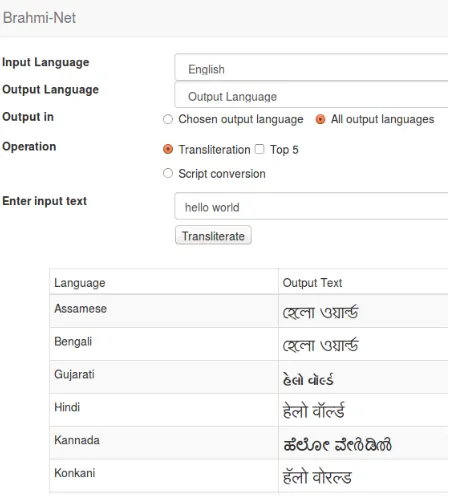
The purpose of the Web interface is to allow users quick access to transliteration and script conversion services. They can also choose to see the translitera-tion/script conversion output in all target languages, making comparison easier. Alternative choices of transliteration can also be studied by requesting the top-5 transliterations for each input. A snapshot of the interface is shown in Figure 1. The web interface is accessible at:
http://www.cfilt.iitb.ac.in/brahminet/
4.2 REST API
We provide a REST interface to access the transliter-ation and script conversion services. Simultaneous transliterations/script conversion into all languages and top-k transliterations are also available. The REST endpoints have an intuitive signature. For in-stance, to fetch the transliteration for a word from English (en) to Hindi (hi), the REST endpoint is:
http://www.cfilt.iitb.ac.in/indicnlpweb/ indicnlpws/transliterate/en/hi/<input>/statistical
hin urd pan ben guj mar kok tam tel mal eng hin - 21185 40456 26880 29554 13694 16608 9410 17607 10519 10518
urd 21184 - 23205 11379 14939 9433 9811 4102 5603 3653 5664
pan 40459 23247 - 25242 29434 21495 21077 7628 15484 8324 8754
ben 26853 11436 25156 - 33125 26947 26694 10418 18303 11293 7543
guj 29550 15019 29434 33166 - 39633 35747 12085 22181 11195 6550
mar 13677 9523 21490 27004 39653 - 31557 10164 18378 9758 4878
kok 16613 9865 21065 26748 35768 31556 - 9849 17599 9287 5560
tam 9421 4132 7668 10471 12107 10148 9838 - 12138 10931 3500
tel 17649 5680 15598 18375 22227 18382 17409 12146 - 12314 4433
mal 10584 3727 8406 11375 11249 9788 9333 10926 12369 - 3070
eng 10513 5609 8751 7567 6537 4857 5521 3549 4371 3039
[image:4.612.115.497.62.185.2]-Table 1: Mined Pairs Statistics (ISO-639-2 language codes are shown)
Figure 1: Brahmi-NetWeb Interface
5 Evaluation
5.1 Transliteration Accuracy
We evaluated the top-1 and top-5 transliteration ac-curacy for a sample set of language pairs. For this evaluation, we used an internally available, manu-ally created corpus of 1000 transliteration pairs for each language pair. These transliterations were man-ually curated from synsets inIndoWordNet3Though this corpus does not reflect the diversity in the mined transliterations, evaluation on this corpus could be a pointer to utility of the transliteration corpus. We compare the accuracy of match for transliteration
3http://www.cfilt.iitb.ac.in/indowordnet
Lang Pair Rule Statistical top-1 top-5
[image:4.612.75.300.223.472.2]ben-mar 64.6 68.3 87.1 mal-tam 27.9 30.9 66.0 mar-ben 68.0 67.3 85.2 tel-mar 68.2 70.9 87.5
Table 2: Transliteration Accuracy (%)
against the rule based script conversion output for some language pairs. Table 2 shows the accu-racy values. top-1 indicates exact match for the first transliteration output returned by our system, whereastop-5indicates match in the top 5 translit-erations returned by the system.
5.2 Case Study: Improving SMT output
[image:4.612.346.509.225.316.2]Lang
PB-SMT PB-SMT
Pair +translit
[image:5.612.109.264.63.210.2]urd-eng 21.0 21.59 tel-eng 12.09 12.34 kok-ben 24.61 27.69 pan-hin 71.26 75.25 mar-pan 34.75 36.92 tel-mal 6.58 7.54 guj-tel 16.57 18.61 tal-urd 15.65 16.22
Table 3: Results of PB-SMT output + transliteration of OOVs (%BLEU)
candidates. The top-k transliterations can thus be disambiguated by SMT or other downstream appli-cations.
6 Conclusion
Brahmi-Net is an effort to provide a comprehen-sive transliteration and script conversion solution for all languages of the Indian subcontinent. Un-supervised transliteration mining and leveraging the phonetic and scriptural similarities between the lan-guages have been the key ingredients in scaling the system to a large number of languages. Even the simple phrase based SMT model of transliteration has proved useful for transliterating the output of MT systems. A natural extension would be to em-ploy richer transliteration models. There is scope for improvement in the hybrid models of transliter-ation used in the system. Some of the finer details regarding script conversions have to be ironed out. Finally, a long term goal is to support other major languages from South Asia, which differ phoneti-cally from the Indo-Aryan and Dravidian languages or use non-Brahmi scripts.
Acknowledgments
We would like to thank Arjun Atreya for making available parallel transliterations fromIndoWordNet
for evaluation of our system.
References
Antony, P. J. and Soman, K.P. 2011. Machine Transliter-ation for Indian Languages: A Literature Survey.
In-ternational Journal of Scientific and Engineering Re-search.
Nadir Durrani, Hieu Hoang, Philipp Koehn, and Hassan Sajjad. 2014. Integrating an Unsupervised Translitera-tion Model into Statistical Machine TranslaTranslitera-tion.EACL 2014.
Girish Nath Jha. 2012. The TDIL program and the Indian Language Corpora Initiative. InLanguage Resources and Evaluation Conference.
Sarvnaz Karimi, Falk Scholer, and Andrew Turpin. 2011. Machine transliteration survey. ACM Computing Sur-veys.
Anoop Kunchukuttan, Abhijit Mishra, Rajen Chatterjee, Ritesh Shah, and Pushpak Bhattacharyya. 2014. Sata-Anuvadak: Tackling Multiway Translation of Indian Languages. In Language Resources and Evaluation Conference.