Parameter Estimation for LDA-Frames
Jiˇr´ı Materna
Centre for Natural Language Processing Faculty of Informatics, Masaryk University Botanick´a 68a, 602 00, Brno, Czech Republic
Abstract
LDA-frames is an unsupervised approach for identifying semantic frames from semanti-cally unlabeled text corpora, and seems to be a useful competitor for manually created databases of selectional preferences. The most limiting property of the algorithm is such that the number of frames and roles must be pre-defined. In this paper we present a modifi-cation of the LDA-frames algorithm allowing the number of frames and roles to be deter-mined automatically, based on the character and size of training data.
1 Introduction
Semantic frames and valency lexicons are useful lexical sources capturing semantic roles valid for a set of lexical units. The structures of linked seman-tic roles are called semanseman-tic frames. Linguists are using them for their ability to describe an interface between syntax and semantics. In practical natural language processing applications, they can be used, for instance, for the word sense disambiguation task or in order to resolve ambiguities in syntactic analy-sis of natural languages.
The lexicons of semantic frames or verb valencies are mainly created manually or semi-automatically by highly trained linguists. Manually created lex-icons involve, for instance, a well-known lexi-con of semantic frames FrameNet (Ruppenhofer et al., 2006) or a lexicon of verb valencies VerbNet (Schuler, 2006). These and other similar lexical re-sources have many promising applications, but suf-fer from several disadvantages:
• Creation of them requires manual work of trained linguists which is very time-consuming and expensive.
• Coverage of the resources is usually small or limited to some specific domain.
• Most of the resources do not provide any information about relative frequency of us-age in corpora. For instance, both patterns [Person] acquire [Physical object] and [Person] acquire [Disease] reflect correct usage of verbacquire, but the former is much more frequent in English.
• Notion of semantic classes and frames is sub-jectively biased when the frames are created manually without corpus evidence.
In order to avoid those problems we proposed a method for creating probabilistic semantic frames called LDA-frames (Materna, 2012). The main idea of LDA-frames is to generate the set of semantic frames and roles automatically by maximizing pos-terior probability of a probabilistic model on a syn-tactically annotated training corpus. A semantic role is represented as probability distribution over all its realizations in the corpus, a semantic frame as a tu-ple of semantic roles, each of them connected with some grammatical relation. For every lexical unit (a verb in case of computing verb valencies), a prob-ability distribution over all semantic frames is gen-erated, where the probability of a frame corresponds to the relative frequency of usage in the corpus for a given lexical unit. An example of LDA-frames
computed on the British National Corpus is avail-able at the LDA-frames website1.
The original LDA-frames algorithm has two pa-rameters that must be predefined – number of frames and number of roles – which is the most limiting property of the algorithm. A simple cross-validation approach can be used in case of very small data. However, real data is much bigger and it is not re-commended to use such techniques. For example, the inference on the British National Corpus using a single core 2.4 GHz CPU takes several days to com-pute one reasonable combination of parameters.
In this paper we present a non-parametric modifi-cation of the LDA-frames algorithm allowing to de-termine the parameters automatically, based on the character and size of training data.
2 LDA-Frames
LDA-frames (Materna, 2012) is an unsupervised ap-proach for identifying semantic frames from seman-tically unlabeled text corpora. In the LDA-frames, a frame is represented as a tuple of semantic roles, each of them connected with a grammatical rela-tion i.e. subject, object, modifier, etc. These frames are related to a lexical unit via probability distribu-tion. Every semantic role is represented as probabil-ity distribution over its realizations.
The method of automatic identification of se-mantic frames is based on probabilistic generative process. Training data for the algorithm consists of tuples of grammatical relation realizations ac-quired using a dependency parser from the train-ing corpus for every lexical unit. For example, sup-pose that the goal is to generate semantic frames of verbs from a corpus for grammatical relations sub-ject and object. The training data for lexical unit
eat may look like {(peter, cake), (man, breakfast), (dog, meat), ...}, where the first component of the tuples corresponds to sub-jectand the second toobject.
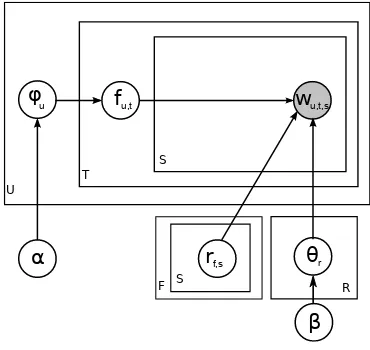
In the generative process, each grammatical rela-tion realizarela-tion is treated as being generated from a given semantic frame according to the realiza-tion distriburealiza-tion of the corresponding semantic role. Supposing the number of frames is given by param-eterF, the number of semantic roles byR, the
num-1http://nlp.fi.muni.cz/projekty/lda-frames/
ber of slots (grammatical relations) bySand the size of vocabulary isV. The realizations are generated as follows.
For each lexical unitu∈ {1,2, . . . , U}:
1. Choose a frame distributionϕufrom Dir(α).
2. For each lexical unit realization t ∈ {1,2, . . . , Tu} choose a frame fu,t from
Multinomial(ϕu), wherefu,t ∈ {1,2, . . . , F}.
3. For each slot s ∈ {1,2, . . . , S} of frame fu,t, generate a grammatical relation
realiza-tion wu,t,s from Multinomial(θrfu,t,s), where
rf,s is a projection (f, s) 7→ r, which assigns
a semantic role for each slotsin framef. The multinomial distribution of realizations, sym-bolized byθr, for semantic roler is generated
from Dir(β).
The graphical model for LDA-Frames is shown in figure 1. It is parametrized by hyperparameters of prior distributions α andβ, usually set by hand to a value between 0.01 – 0.1.
α
φ f
r
w
U
T
S
θ
β
F S u u,t
f,s
u,t,s
[image:2.612.333.518.365.540.2]r R
Figure 1: Graphical model for LDA-frames.
The inference is performed using the Collapsed Gibbs sampling (Neal, 2000), where theθandϕ dis-tributions are marginalized out of the equations. In each iteration, latent variablesfu,tandrf,sare
sam-pled as follows
P(fu,t|f−(u,t),r,w, α, β)∝
(f c−(f u,t)
u,t,u +α)
S
Y
s=1
wc−(wu,t,su,t,s,r)fu,t,s+β
wc−(∗,ru,t,sfu,t,s)+V β
P(rf,s|f,r−(f,s),w, α, β)∝ V
Y
v=1
wc−(v,rf,sf,s)+β
wc−(∗,rf,sf,s)+V β
!wcf,s,v
, (2)
where f c−(f,uu,t) is the number of times frame f is
assigned to lexical unituexcluding(u, t),wc−(v,ru,t,s)
is the number of times word v is assigned to role r excluding (u, t, s), and wcf,s,v is the number of
times wordv is assigned to slot sin framef. The asterisk sign * stands for any value in its position.
After having all latent variablesf andrinferred, one can proceed to compute the lexical unit–frame distribution and the semantic role–word distribution using the following formulas:
ϕu =
f cf,u+α
P
ff cf,u+F α
(3)
θr=
wcv,r+β
P
vwcv,r+V β
. (4)
3 Parameter Estimation
As one can see from the LDA-frames model, the requirement is to define the number of frames and roles in advance. It is not clear, however, how to se-lect the best values that depend on several factors. First of all, the number of frames and roles usually increase with the growing size of training corpus. If the training data is small and covers just a small pro-portion of lexical unit usage patterns, the number of semantic frames should be small as well. The pa-rameters are also affected by the granularity of roles and frames. One way to estimate the parameters au-tomatically is to select those that maximize posterior probability of the model given training data.
LDA-frames algorithm generates frames from the Dirichlet distribution (DD) which requires a fixed number of components. Similarly, the latent vari-ables rf,s are chosen from a fixed set of semantic
roles. In order to be able to update the number of frames and roles during the inference process, we propose to add the Chinese restaurant process (CRP) (Aldous, 1985) prior for therf,svariables, and to
re-place the Dirichlet distribution the semantic frames are generated from with the Dirichlet process (Fer-guson, 1973).
3.1 Number of Semantic Roles
In the original version of the LDA-frames model, the latent variablesrf,s, representing semantic role
assignment for slot s in frame f, are chosen from a fixed set of semantic roles without any prior distri-bution. We propose to generaterf,s from the CRP,
which is a single parameter distribution over parti-tions of integers. The generative process can be de-scribed by using an analogy with a Chinese restau-rant. Consider a restaurant with an infinite number of tables, each of them associated with some dish, and N customers choosing a table. The first cus-tomer sits at the first table. Thenthcustomer sits at tabletdrawn from the following distribution
P(t=occupied tablei) = ni
γ+n−1
P(t=next unoccupied table) = γ
γ+n−1,
(5)
where ni is the number of customers sitting at the
tableiandγ >0is a concentration parameter which controls how often a customer chooses a new table. The seating plan makes a partition of the customers (Aldous, 1985).
In the proposed modification of the LDA-frames model, the dishes are replaced with the semantic role numbers and customers with slots of frames. In the model we use prior distributionω corresponding to the CRP with concentration parameterγ. The latent variablesrf,sare then sampled as follows
P(rf,s|f,r−(f,s),w, α, β, γ)∝
(rc−(r f,s)
f,s +γ)
V
Y
v=1
wc−(v,rf,sf,s)+β
wc−(∗,rf,sf,s)+V β
!wcf,s,v
, (6)
whererc−(r f,s)is the number of times roler is used
in any frame and slot excluding slot s in framef. Notice that the sampling space hasR+1dimensions with the probability of the last unseen component proportional to
γ
V
Y
v=1
1
Vwcf,s,v. (7)
3.2 Number of Semantic Frames
The Dirichlet processDP(α0, G0)is a stochastic process that generates discrete probability distribu-tions. It has two parameters, a base distributionG0 and a concentration parameterα0 > 0. A sample from the Dirichlet process (DP) is then
G=
∞
X
k=1
βkδφk, (8)
where φk are independent random variables
dis-tributed according toG0,δφk is an atom atφk, and
weights βk are also random and dependent on the
parameterα0(Teh et al., 2006). Simply, DP is a dis-tribution over some infinite and discrete distribu-tions. It is the reason why DP is often used instead of DD in order to avoid using a fixed number of com-ponents.
The question, however, is how to make the sam-pled frames shared between different lexical units. We propose to generate base distributions of the DPs from GEM distribution (Pitman, 2002)τ with concentration parameterδ. The idea is inspired by the Hierarchical Dirichlet Process (Teh et al., 2006) used for topic modeling. The graphical model of the non-parametric LDA-frames is shown in figure 2.
α
φ f
r
w
U
T
S
θ
β
S
u u,t
f,s
u,t,s
r
ω
γ
∞ ∞
τ
δ
Figure 2: Graphical model for non-parametric LDA-frames.
Since it is hard to integrate out the DP with base distribution generated from GEM in this model, we proceeded to sampleτ separately (Porteous, 2010). The base distribution proportions can be sampled by simulating how new components are created for f cf,udraws from DP with the concentration
param-eterατf, which is a sequence of Bernoulli trials for
eachuandf (Heinrich, 2011):
P(uf,u,r = 1) =
ατf
ατf +r−1
∀r ∈[1, f cf,u]
τ ∼Dir({uf}f, δ)withuf =
X
u
X
r
uf,u,r.
(9)
Finally, the latent variablesfu,t are sampled as
fol-lows
P(fu,t|f−(u,t),r,w, α, β, τ)∝
(f c−(f u,t)
u,t,u +ατf)
S
Y
s=1
wc−(wu,t,su,t,s,r)fu,t,s+β
wc−(∗,ru,t,sfu,t,s)+V β
. (10)
4 Evaluation
The non-parametric algorithm was evaluated by an experiment on a synthetic data set consisting of 155 subject-object tuples. The training data was generated randomly from a predefined set of 7 frames and 4 roles for 16 verbs using the following algorithm. For every lexical unitu:
1. Choose a number of corpus realizationsNu ∈
{5, . . . ,15}from the uniform distribution.
2. For each realizationnu ∈ {1, . . . , Nu}, among
all permitted frames for lexical unitu, choose a semantic framefnu from the uniform
distri-bution.
3. For each framefnu, generate a realization of all
its roles from the uniform distribution.
Each semantic role had 6 possible realizations on average, some of them assigned to more than one se-mantic role to reflect the character of real languages. Since the data was generated artificially, we knew the number of frames and roles, how the frames were defined, and which frame and which role was re-sponsible for generating each realization in the data. We ran the non-parametric algorithm with hyper-parametersα = 5, β = γ = 0.1, δ = 1.5. It has been shown that the selection of hyperparameters has little impact on the resulting frames when they are in some reasonable range, thus, the hyperparam-eters were chosen empirically by hand. The experi-ment led to correct assignexperi-ments offu,tandrf,safter
[image:4.612.77.296.394.567.2]In order to compare the non-parametric algorithm with the original, we ran the original algorithm with the same data that had the number of frames and roles set to R ∈ {1. . .10}, F ∈ {1. . .20}, and measured the perplexity of the data given to the model after convergence. The perplexities for all settings are shown in figure 3. The lowest perplexity was reached withF = 7, R = 4and had the same value as the case of the non-parametric algorithm. Thefu,tandrf,sassignments were correct as well.
Figure 3: Perplexities for different values of F and R.
We also ran the non-parametric algorithm with the same hyperparameters on real data (1.4 millions of
subject-objecttuples) acquired from the British Na-tional Corpus2using the Stanford Parser (de Marn-effe et al., 2006). The algorithm reached the opti-mal perplexity with 427 frames and 144 roles. This experiment has been performed only for illustrating the algorithm on real data. Because of long running time of the algorithm on such huge data set, we did not perform the same experiments as with the case of the small synthetic data.
5 Conclusion
In this paper we presented a method for estimat-ing the number of frames and roles for the LDA-frames model. The idea is based on using the Chi-nese Restaurant Process and the Dirichlet Process instead of the Dirichlet Distributions and selecting such parameters that maximize the posterior proba-bility of the model for given training data. An ex-periment showed that the non-parametric algorithm
2http://www.natcorp.ox.ac.uk
infers correct values of both the number of frames and roles on a synthetic data set.
Acknowledgments
This work has been partly supported by the Min-istry of Education of the Czech Republic under the project LINDAT-Clarin LM2010013.
References
Aldous, D. J. (1985). Exchangeability and Related Top-ics. Ecole d’ ´´ Et´e de Probabilit´es de Saint-Flour XIII – 1983, 1117:1 – 198.
de Marneffe, M.-C., MacCartney, B., and Manning, C. D. (2006). Generating Typed Dependency Parses from Phrase Structure Parses. InThe International Confer-ence on Language Resources and Evaluation (LREC) 2006.
Ferguson, T. S. (1973). A Bayesian Analysis of Some Nonparametric Problems. The Annals of Statistics, 1:209 – 230.
Heinrich, G. (2011). ”Infinite LDA” – Implementing the HDP with Minimum Code complexity. Technical re-port.
Materna, J. (2012). LDA-Frames: An Unsupervised Ap-proach to Generating Semantic Frames. In Gelbukh, A., editor,Proceedings of the 13th International Con-ference CICLing 2012, Part I, pages 376–387, New Delhi, India. Springer Berlin / Heidelberg.
Neal, R. M. (2000). Markov Chain Sampling Methods for Dirichlet Process Mixture Models.Journal of com-putational and graphical statistics, 9(2):249–265. Pitman, J. (2002). Combinatorial Stochastic Processes.
Lecture Notes for St. Flour Summer School.
Porteous, I. (2010). Networks of mixture blocks for non parametric bayesian models with applications. PhD thesis, University of California.
Ruppenhofer, J., Ellsworth, M., Petruck, M. R. L., Johnson, C. R., and Scheffczyk, J. (2006). FrameNet II: Extended Theory and Practice. http://www.icsi.berkeley.edu/framenet.
Schuler, K. K. (2006). VerbNet: A Broad-Coverage, Comprehensive Verb Lexicon. PhD thesis, University of Pennsylvania.