Global Inference for Bridging Anaphora Resolution
Yufang Hou1, Katja Markert2, Michael Strube1 1
Heidelberg Institute for Theoretical Studies gGmbH, Heidelberg, Germany (yufang.hou|michael.strube)@h-its.org
2
School of Computing, University of Leeds, UK [email protected]
Abstract
We present the first work on antecedent se-lection for bridging resolution without restric-tions on anaphor or relation types. Our model integrates global constraints on top of a rich local feature set in the framework of Markov logic networks. The global model improves over the local one and both strongly outper-form a reimplementation of prior work.
1 Introduction
Identity coreference is a relatively well understood and well-studied instance of entity coherence. How-ever, entity coherence can rely on more complex, lexico-semantic, frame or encyclopedic relations than identity. Anaphora linking distinct entities or events this way are called bridging or associative
anaphora and have been widely discussed in the
lin-guistic literature (Clark, 1975; Prince, 1981; Gundel et al., 1993).1 In Example 1, the phrases the
win-dows, the carpets and walls can be felicitously used
because they are semantically related via a part-of relation to their antecedent the Polish center.2
(1) . . . as much as possible of the Polish center will be made from aluminum, steel and glass recycled from Warsaw’s abundant rubble. . . . The windows will open. The carpets won’t be glued down and walls will be coated with non-toxic finishes.
1
Poesio and Vieira (1998) include cases where antecedent and anaphor are coreferent but do not share the same head noun. We restrict bridging to non-coreferential cases. We also exclude comparative anaphora (Modjeska et al., 2003)
2
Examples are from OntoNotes (Weischedel et al., 2011). Bridging anaphora are typed in boldface; antecedents in italics.
Bridging is frequent amounting to between 5% (Gardent and Manu´elian, 2005) and 20% (Caselli and Prodanof, 2006) of definite descriptions (both studies limited to NPs starting with the or non-English equivalents). Bridging resolution is needed to fill gaps in entity grids based on coreference only (Barzilay and Lapata, 2008). Example 1 does not ex-hibit any coreferential entity coherence. Coherence can only be established when the bridging anaphora are resolved. Bridging resolution may also be im-portant for textual entailment (Mirkin et al., 2010).
Bridging resolution can be divided into two tasks, recognizing that a bridging anaphor is present and finding the correct antecedent among a list of candi-dates. These two tasks have frequently been handled in a pipeline with most research concentrating on an-tecedent selection only. We also handle only the task of antecedent selection.
Previous work on antecedent selection for bridg-ing anaphora is restricted. It makes strong untested assumptions about bridging anaphora types or rela-tions, limiting it to definite NPs (Poesio and Vieira, 1998; Poesio et al., 2004; Lassalle and Denis, 2011) or to part-of relations between anaphor and an-tecedent (Poesio et al., 2004; Markert et al., 2003; Lassalle and Denis, 2011). We break new ground by considering all relations and anaphora/antecedent types and show that the variety of bridging anaphora is much higher than reported previously.
Following work on coreference resolution, we ap-ply a local pairwise model (Soon et al., 2001) for an-tecedent selection. We then develop novel semantic, syntactic and salience features for this task, show-ing strong improvements over one of the best known
prior models (Poesio et al., 2004).
However, this local model classifies each anaphor-antecedent candidate pair in isolation. Thus, it neglects that bridging anaphora referring to a single antecedent often occur in clusters (see Ex-ample 1). It also neglects that once an entity is an antecedent for a bridging anaphor it is more likely to be used again as antecedent. In addition, such local models construct the list of possible antecedent can-didates normally relying on a window size constraint to restrict the set of candidates: is the window too small, we miss too many correct antecedents; is it too large, we include so many incorrect antecedents as to lead to severe data imbalance in learning.
To remedy these flaws we change to a global Markov logic model that allows us to:
• model constraints that certain anaphora are likely to share the same antecedent;
• model the global semantic connectivity of a salient potential antecedent to all anaphora in a text;
• consider the union of potential antecedents for all anaphora instead of a static window-sized constraint.
We show that this global model with the same lo-cal features but enhanced with global constraints im-proves significantly over the local model.
2 Related Work
Prior corpus-linguistic studies on bridging are be-set by three main problems. First, reliability is not measured or low (Fraurud, 1990; Poesio, 2003; Gar-dent and Manu´elian, 2005; Riester et al., 2010).3 Second, annotated corpora are small (Poesio et al., 2004; Korzen and Buch-Kromann, 2011). Third, they are often based on strong untested assumptions about bridging anaphora types, antecedent types or relations, such as limiting it to definite NP anaphora (Poesio and Vieira, 1998; Poesio et al., 2004; Gar-dent and Manu´elian, 2005; Caselli and Prodanof, 2006; Riester et al., 2010; Lassalle and Denis, 2011), to NP antecedents (all prior work) or to
part-3
Although the overall information status scheme in Riester et al. (2010) achieved high agreement, their confusion matrix shows that the anaphoric bridging category (BRI) is frequently confused with other categories so that the two annotators agreed on only less than a third of bridging anaphors.
of relations between anaphor and antecedent (Mark-ert et al., 2003; Poesio et al., 2004). In our own work (Markert et al., 2012) we established a corpus that circumvents these problems, i.e. human bridg-ing recognition was reliable, it contains a medium number of bridging cases that allows generalisable statistics and we did not limit bridging anaphora or antecedents according to their syntactic type or re-lations between them. However, we only discussed human agreement on bridging recognition in Mark-ert et al. (2012), disregarding antecedent annotation. We also did not discuss the different types of bridg-ing in the corpus. We will remedy this in Section 3.
Automatic work on bridging distinguishes be-tween recognition (Vieira and Poesio, 2000; Rah-man and Ng, 2012; Cahill and Riester, 2012; Mark-ert et al., 2012) and antecedent selection. Work on antecedent selection suffers from focusing on sub-problems, e.g. only part-of bridging (Poesio et al., 2004; Markert et al., 2003) or definite NP anaphora (Lassalle and Denis, 2011). Most relevant for us is Lassalle and Denis (2011) who restrict anaphora to definite descriptions but have no other restrictions on relations or antecedent NPs (in a French corpus) with an accuracy of 23%. Also the evaluation set-up is sometimes not clear: The high results in Poe-sio et al. (2004) cannot be used for comparison as they test unrealistically: they distinguish only be-tween the correct antecedent and one or three false candidates (baseline of 50% for the former). They also restrict the phenomenon to part-of relations.
There is a partial overlap between bridging and implicit noun roles (Ruppenhofer et al., 2010). However, work on implicit noun roles is mostly focused on few predicates (e.g. Gerber and Chai (2012)). We consider all bridging anaphors in run-ning text. The closest work to ours interpreting im-plicit role filling as anaphora resolution is Silberer and Frank (2012).
3 Corpus for Bridging: An Overview
are not limited to definite NPs as in previous work. In contrast to Nissim et al. (2004), antecedents are annotated and can be noun phrases, verb phrases or even clauses. Our bridging annotation is also not limited with regards to semantic relations between anaphor and antecedent.
In Markert et al. (2012) we achieved high agree-ment for the overall information status annotation scheme between three annotators (κbetween 75 and 80, dependent on annotator pairs) as well as for all subcategories, including bridging (κover 60 for all annotator pairings, over 70 for two expert annota-tors). Here, we add the following new results:
• Agreement for selecting bridging antecedents was around 80% for all annotator pairings.
• Surprisingly, only 255 of the 663 (38%) bridg-ing anaphors are definite NPs, which calls into question the strategy of prior approaches to limit themselves to these types of bridging.
• NPs are the most frequent antecedents by far with only 42 of 663 (6%) bridging anaphora hav-ing a non-NP antecedent (mostly verb phrases).
• Bridging is a relatively local phenomenon with 71% of NP antecedents occurring in the same or up to 2 sentences prior to the anaphor. However, farther away antecedents are common when the antecedent is the global focus of a document.
• The semantic relations between anaphor and an-tecedent are extremely diverse with only 92 of 663 (14%) anaphors having a part-of/attribute-of antecedent (see Example 1) and only 45 (7%) anaphors standing in a set relationship to the an-tecedent (see Example 2). This contrasts with Gardent and Manu´elian’s (2005) finding that 52% of bridging cases had meronymic relations. We find many different types of relations in our corpus, including encyclopedic relations such as
restaurant — the waiter as well as, frequently,
relational person nouns as bridging anaphors such as friend, husband, president.
• There are only a few cases of bridging where surface cues may indicate the antecedent. First, some bridging anaphors are modified by a small number of adjectives that have more than one role filler, with the bridging relation often being temporal or spatial sequence between two
enti-ties of the same semantic type as in Example 3 (see also Lassalle and Denis (2011) for a dis-cussion of such cases). Second, some anaphors are compounds where the nominal premodifier matches the antecedent head as in Example 4.
(2) Still employees do occasionally try to smuggle out a gem or two. One man wrapped several dia-monds in the knot of his tie. Another poked a hole in the heel of his shoe. None made it past the body searches . . .
(3) His truck is parked across the field . . . The farmer at the next truck shouts . . .
(4) . . . it doesn’t make the equipment needed to
produce those chips. And IBM worries that the Japanese will take over that equipment market.
4 Models for Bridging Resolution
4.1 Pairwise mention-entity model
The pairwise model is widely used in coreference resolution (Soon et al., 2001). We adapt it for bridg-ing resolution4: Given an anaphor mention m and the set of antecedent candidate entities Em which
appear before m, we create a pairwise instance
(m, e)for everye∈Em. A binary decision whether
m is bridged toeis made for each instance (m, e)
separately. A post-processing step to choose one an-tecedent is necessary (closest first or best first are common strategies). This model causes three prob-lems for bridging resolution: First, the ratio between positive and negative instances is 1 to 17 even if only antecedent candidates from the current and the im-mediately preceding two sentences are considered. The ratio will be even worse with a larger win-dow size. Therefore, usually a fixed winwin-dow size is used restricting the set of candidates. This, however, causes a second problem: antecedents which are be-yond the window cannot be found. In our data, only 81% of NP antecedents appear within the previous 5 sentences, and only 71% of NP antecedents appear within the previous 2 sentences. The third problem is a shortcoming of the pairwise model itself: deci-sions are made for each instance separately, ignoring
4
relations between instances. We resolve these prob-lems by employing a global model based on Markov logic networks.
4.2 Markov Logic Networks
Bridging can be considered a document global phe-nomenon, where globally salient entities are pre-ferred as antecedents and two or more anaphors hav-ing the same antecedent should be related or similar. Motivated by this observation, we explore Markov logic networks (Domingos and Lowd, 2009, MLNs) to model bridging resolution on the global discourse level.
MLNs are a powerful representation for joint inference with uncertainty. An MLN consists of a set of pairs (Fi, wi), where Fi is a formula
in first-order logic and wi is its associated real
numbered weight. It can be viewed as a template for constructing Markov networks. Given different sets of constants, an MLN will produce different ground Markov networks which may vary in size but have the same structure and parameters. For a ground Markov network, the probability distribution over possible worldsxis given by
P(X =x) = 1 Zexp
X
i
wini(x)
!
(1)
whereni(x)is the number of true groundings ofFi
in x. The normalization factor Z is the partition function.
MLNs have been applied to many NLP tasks and achieved good performance by leveraging rich re-lations among objects (Poon and Domingos, 2008; Meza-Ruiz and Riedel, 2009; Fahrni and Strube, 2012, inter alia). We use thebeast5 to learn weights for the formulas and to perform inference. thebeast employs cutting plane inference (Riedel, 2008) to improve the accuracy and efficiency of MAP infer-ence for Markov logic.
With MLNs, we model bridging resolution glob-ally on the discourse level: given the set M of all anaphors and sets of local antecedent candidatesEm
for each anaphorm ∈M, we select antecedents for all anaphors fromE=S
m∈M Emat the same time.
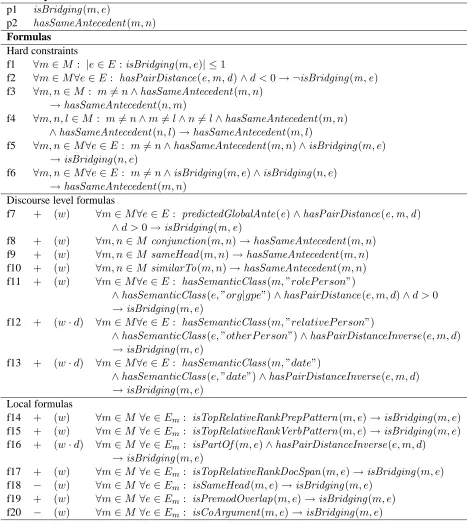
Table 1 shows the hidden predicates and formulas used. Each formula is associated with a weight. The
5http://code.google.com/p/thebeast
polarity of the weights is indicated by the leading
+ or −. The weight value (except for hard con-straints) is learned from training data. For some for-mulas the final weight consists of a learned weight wmultiplied by a scored(e.g. inverse distance be-tween antecedent and anaphor). In these cases the final weight for a formula in a ground Markov net-work does not just depend on the respective formula, but also on the specific constants. We indicate such combined weights by the termw·d.
We tackle the previously mentioned problems of the pairwise model: (1) We construct hard con-straints to specify that each anaphor has at most one antecedent entity (Table 1: f1) and that the an-tecedent must precede the anaphor (f2). This elim-inates the need for the post-processing step in the pairwise model. (2) We select the antecedent en-tity for each anaphor from the antecedent candidate entities pool E which alleviates the missing true antecedent problem in the pairwise model. Based on (1) and (2), MLNs allow us to express relations between anaphor-anaphor and anaphor-antecedent pairs ((m,n)or(m,e)) on the global discourse level improving accuracy by performing joint inference.
5 Features
5.1 Local features
[image:4.612.328.525.586.675.2]5.1.1 Poesio et al.’s feature set
Table 2 shows the feature set proposed by Poesio et al. (2004) for part-of bridging. Google distance is the inverse value of Google hit counts for the
ofPat-tern query (e.g. the windows of the center).
Word-Net distance is the inverse value of the shortest path length between an anaphor and an antecedent candi-date among all synset combinations. These features are supposed to capture the meronymy relation be-tween anaphor and antecedent. The other ones mea-sure the salience of the antecedent candidate.
Group Feature Value
lexical Google distance numeric WordNet distance numeric salience utterance distance numeric local first mention boolean global first mention boolean
Hidden predicates
p1 isBridging(m, e)
p2 hasSameAntecedent(m, n)
Formulas Hard constraints
f1 ∀m∈M : |e∈E :isBridging(m, e)| ≤1
f2 ∀m∈M∀e∈E: hasPairDistance(e,m,d)∧d <0→ ¬isBridging(m,e)
f3 ∀m, n∈M : m6=n∧hasSameAntecedent(m, n)
→hasSameAntecedent(n, m)
f4 ∀m, n, l∈M : m6=n∧m6=l∧n6=l∧hasSameAntecedent(m, n)
∧hasSameAntecedent(n, l)→hasSameAntecedent(m, l)
f5 ∀m, n∈M∀e∈E: m=6 n∧hasSameAntecedent(m, n)∧isBridging(m, e)
→isBridging(n, e)
f6 ∀m, n∈M∀e∈E: m=6 n∧isBridging(m, e)∧isBridging(n, e)
→hasSameAntecedent(m, n)
Discourse level formulas
f7 + (w) ∀m∈M∀e∈E : predictedGlobalAnte(e)∧hasPairDistance(e,m,d)
∧d >0→isBridging(m,e)
f8 + (w) ∀m, n∈M conjunction(m, n)→hasSameAntecedent(m, n)
f9 + (w) ∀m, n∈M sameHead(m, n)→hasSameAntecedent(m, n)
f10 + (w) ∀m, n∈M similarTo(m, n)→hasSameAntecedent(m, n)
f11 + (w) ∀m∈M∀e∈E : hasSemanticClass(m,”roleP erson”)
∧hasSemanticClass(e,”org|gpe”)∧hasPairDistance(e, m, d)∧d >0
→isBridging(m, e)
f12 + (w·d) ∀m∈M∀e∈E : hasSemanticClass(m,”relativeP erson”)
∧hasSemanticClass(e,”otherP erson”)∧hasPairDistanceInverse(e, m, d)
→isBridging(m, e)
f13 + (w·d) ∀m∈M∀e∈E : hasSemanticClass(m,”date”)
∧hasSemanticClass(e,”date”)∧hasPairDistanceInverse(e, m, d)
→isBridging(m, e)
Local formulas
f14 + (w) ∀m∈M ∀e∈Em : isTopRelativeRankPrepPattern(m, e)→isBridging(m, e)
f15 + (w) ∀m∈M ∀e∈Em : isTopRelativeRankVerbPattern(m, e) →isBridging(m, e)
f16 + (w·d) ∀m∈M ∀e∈Em: isPartOf(m, e)∧hasPairDistanceInverse(e, m, d)
→isBridging(m, e)
f17 + (w) ∀m∈M ∀e∈Em: isTopRelativeRankDocSpan(m, e)→isBridging(m, e)
f18 − (w) ∀m∈M ∀e∈Em : isSameHead(m, e)→isBridging(m, e)
f19 + (w) ∀m∈M ∀e∈Em : isPremodOverlap(m, e)→isBridging(m, e)
[image:5.612.72.539.102.626.2]f20 − (w) ∀m∈M ∀e∈Em : isCoArgument(m, e)→isBridging(m, e)
Table 1: Hidden predicates and formulas used for bridging resolution (m, n, lrepresent mentions,Mthe set of bridging anaphora mentions in the whole document,ethe antecedent candidate entity,Emthe set of local antecedent candidate
entities form, andE=S
5.1.2 Other features
Since Poesio et al. (2004) deal exclusively with meronymy bridging, we have to extend the fea-ture set to capfea-ture more diverse relations between anaphor and antecedent. All numeric features in Ta-ble 3 are normalized among all antecedent candi-dates of one anaphor. For anaphor mi and its
an-tecedent candidates Emi (eij ∈ Emi), the numeric
score for pair {mi, eik} is Sik. Then the value
N ormSik for this pair is normalized (set to values
between 0 and 1) as below:
N ormSik=
Sik−minjSij
maxjSij−minjSij
(2)
A second variant of numeric features tells whether the score of an anaphor-antecedent candidate pair is the highest among all pairs for this anaphor.
Group Feature Value
semantic f eat1 preposition pattern numeric
f eat2 verb pattern numeric
f eat3 WordNet partOf boolean
f eat4 semantic class nominal salience f eat5 document span numeric surface f eat6 isSameHead boolean
f eat7 isPremodOverlap boolean syntactic f eat8 isCoArgument boolean
Table 3: Local features we developed
Preposition pattern (f eat1). The ofPattern pro-posed by Poesio et al. (2004) is useful for part-of and attribute-of relations but cannot cover all bridg-ing relations (such as sanctions against a country). We extend the ofPattern to a generalised preposition
pattern by using the Gigaword (Parker et al., 2011)
and the Tipster (Harman and Liberman, 1993) cor-pora (both automatically POS tagged and NP chun-ked for improving query match precision).
First, we extract the three most highly associ-ated prepositions for each anaphor. Then for each anaphor-antecedent candidate pair, we use their head words to create the query ”anaphor preposition
an-tecedent”. To improve recall, we take lowercase,
uppercase, singular and plural forms of the head word into account, and replace proper names by fine-grained named entity types (using a gazetteer). All raw hit counts are converted into the Dunning
Root Loglikelihood association measure,6then nor-malized using Formula 2 within all antecedent can-didates of one anaphor.
Verb pattern (f eat2). A set-membership rela-tion between anaphor and antecedent is often hard to capture by the preposition pattern because the anaphor often has no common noun head (see Ex-ample 2 in Section 3). Hence, we measure the com-patibility of the antecedent candidates with the verb the anaphor depends on.
First, we hypothesise that anaphors whose lexi-cal head is a pronoun or a number are potential set bridging cases and then extract the verb the anaphor depends on. In example 2, for the set anaphor An-other, poked is the verb. Then for each antecedent candidate, subject-verb or verb-object queries are applied to the Web 1T 5-gram corpus (Brants and Franz, 2006). In this case, employees poked and
di-amonds poked are example queries. The hit counts
are transformed into PMI and all pairs for one anaphor are normalized as described in Formula 2.
WordNet partOf relation (f eat3). To capture part-of bridging, we extract whether the anaphor is part of the antecedent candidate in WordNet. To im-prove recall, we use hyponym information of the antecedent. If an antecedent eis a hypernym of x and an anaphor m is a meronym of x, then mis a meronym ofe.
Semantic class (f eat4). The anaphor and the an-tecedent candidate are assigned one of 16 coarse-grained semantic classes, e.g. location, organiza-tion, GPE, roleperson, relativePerson, otherPerson7, product, language, NORP (nationalities, religious or political groups) and several classes for numbers (such as date, money or percent).
Salience feature (f eat5). Salient entities are pre-ferred as antecedents. We capture salience super-ficially by computing the ”antecedent document
span” of an antecedent candidate. We compute the
6http://tdunning.blogspot.de/2008/03/
surprise-and-coincidence.html 7
span of text (measured in sentences) in which the antecedent candidate entity is mentioned. This is di-vided by the number of sentences in the whole doc-ument. This score is normalized using Formula 2 for all antecedent candidates of one anaphor.
Surface features (f eat6-f eat7). isSameHead
(f eat6) checks whether antecedent candidates have the same head as the anaphor: this is rarely the case in bridging anaphora (except in some cases of set bridging and spatial/temporal sequence, see Example 3) and can therefore be used to exclude antecedent candidates. isPremodOverlap (f eat7) determines the antecedent for compound noun anaphors whose head is prenominally modified by the antecedent head (see Example 4).
Syntactic feature (f eat8) The isCoArgument fea-ture is based on the intuition that the subject can-not be the bridging antecedent of the object in the same clause. This feature excludes (some) close antecedent candidates. In Example 4, the an-tecedent candidate the Japanese isCoArgument with the anaphor that equipment market.
5.2 Global features for MLNs
f1-f13 in Table 1 are discourse level constraints. All antecedent candidates come from the antecedent candidates poolEin the whole document.
Global salience (Table 1: f3-f10). The salience feature in the pairwise model only measures the salience for candidates within the local window. However, globally salient antecedents are preferred even if they are far away from the anaphor. We model this from two perspectives:
f7models the preference for globally salient an-tecedents, which we derive for each document. For m ∈ M and e ∈ E, letscore(m, e) be the prepo-sition pattern score for pair (m,e). Calculate pattern semantic salience scoreesal for eache∈Eas
esal=
X
m∈M
score(m, e) (3)
If eappears in the title and also has the highest pattern semantic salience scoreesal among allein
E, theneis the predicted globally salient antecedent for this document. Note that global salience here is based on semantic connectivity to all anaphors in the
document and that not every document has a glob-ally salient antecedent.
f3-f6 and f8-f10 model that similar or related anaphors in one document are likely to have the same antecedent. To make the ground Markov net-work more sparse for more efficient inference, we add the hidden predicate (p2) and hard constraints (f3-f6) specifying relations among similar/related anaphors m, n and l (reflexivity and transitivity). Formulasf8-f10explore three different ways (syn-tactic and semantic) to compute the similarity be-tween two anaphors. Inf10, we use SVMlight (simi-larity scores from WordNet plus sentence distance as features) to predict whether two anaphors not shar-ing the same head are similar or not.
Frequent bridging relations (Table 1: f11-f13). Three common bridging relations are restricted by semantic class of anaphor and antecedent (see also Section 3). It is worth noting that in formula f11
(modeling that a role person mention like
presi-dent or chairman prefers organization or GPE
an-tecedents), we do not penalize the antecedents far away from the anaphor. In formulaf12 (modeling that a relativePerson mention such as mother or
hus-band prefers close person antecedents) andf13, we prefer close antecedents by including the distance between antecedent and anaphor into the weights.
MLN formulation of local features (Table 1:f14 -f20). Corresponding to features of the pairwise model (Table 3) – we exclude only semantic class as this is modelled globally via features f11-f13. These local features are only used for an anaphorm and its local antecedent candidateefromEm.
6 Experiments and Results
6.1 Experimental setup
We perform experiments on our gold standard cor-pus via 10-fold cross-validation on documents. We use gold standard mentions, true coreference infor-mation, and the OntoNotes named entity and syntac-tic annotation layers for feature extraction.
6.2 Improved baseline
whether they used the mention or mention-entity model, we assume they treated antecedents as entities and use a 2 and 5 sentence window for can-didates8. Since the GoogleAPI is not available any more, we use the Web 1T 5-gram corpus (Brants and Franz, 2006) to extract the Google distance feature. We improve it by taking all information about en-tities via coreference into account as well as by re-placing proper names. All other features (Table 2 in Section 5.1.1) are extracted as Poesio et al. did. A Naive Bayes classifier with standard settings in WEKA (Witten and Frank, 2005) is used. In order to evaluate their model in the more realistic setting of our experiment, we apply the best first strategy to select the antecedent for each anaphor.
6.3 Pairwise models
Pairwise model I: We use the preposition pattern feature (f eat1) plus Poesio et al.’s salience features (Table 2). We use a 2 sentence window as it per-formed on a par with the 5 sentence window in the baseline. We replace Naive Bayes with SVMlight because it can deal better with imbalanced data9.
Pairwise model II: Based on Pairwise model I. Local featuresf eat2-f eat8from Table 2 are added.
Pairwise model III: Based on Pairwise model II. We apply a more advanced antecedent candidate se-lection strategy, which allows to include 77% of NP antecedents compared to 71% in Pairwise model II. For each anaphor, we add the top k salient enti-ties measured through the length of the coreference chains (kis set to 10%) as additional antecedent can-didates. For potential set anaphors (as automatically determined by pronoun or number heads), singu-lar antecedent candidates are filtered out. We com-piled a small set of adjectives (using FrameNet and thesauri) that indicate spatial or temporal sequences (see Example 3). For anaphors modified by such ad-jectives we consider only antecedent candidates that have the same semantic class as the anaphor.
8
They use a 5 sentence window, because all antecedents in their corpus are within the previous 5 sentences.
9
The SVMlightparameter is set according to the ratio be-tween positive and negative instances in the training set.
6.4 MLN models
MLN model I: MLN system using local formu-las f1-f2 and f14-f20. The same strategy as in
Pairwise model III is used to select local antecedent
candidatesEmfor each anaphorm.
MLN model II: Based on MLN model I, all for-mulas in Table 1 are used.
[image:8.612.314.542.239.352.2]6.5 Results
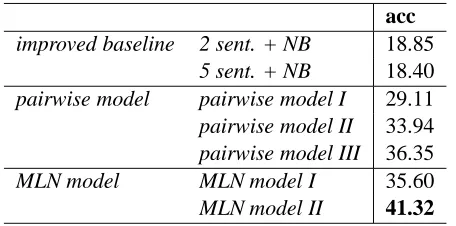
Table 4 shows the comparison of our models to base-lines. Significance tests are conducted using McNe-mar’s test on overall accuracy at the level of 1%.
acc
improved baseline 2 sent. + NB 18.85
5 sent. + NB 18.40
pairwise model pairwise model I 29.11
pairwise model II 33.94
pairwise model III 36.35
MLN model MLN model I 35.60
MLN model II 41.32
Table 4: Results for MLN models compared to pairwise models and baselines.
MLN model II, which is inspired by the
linguis-tic observation that globally salient entities are pre-ferred as antecedents, performs significantly better than all other systems. The gains come from three aspects. First, by selecting the antecedent for each anaphor from the antecedent candidate poolEin the whole document 91% of NP antecedents are acces-sible compared to 77% in pairwise model III. Sec-ond, we leverage semantics and salience by using local formulas and discourse level formulas. Lo-cal formulas are used to capture semantic relations for bridging pairs as well as surface and syntactic constraints. Global formulas resolve several bridg-ing anaphors together, often to a globally salient an-tecedent beyond the local window. Third, the model allows us to express specific relations among bridg-ing anaphors and their antecedents (f11-f13).
However, our pairwise model I already outper-forms improved baselines by about 10%, which sug-gests that our preposition pattern feature can capture more diverse semantic relations. The continuous im-provements shown in pairwise model II and
features and advanced antecedent candidate selec-tion strategy. pairwise model III would become too complex if we tried to integrate discourse level for-mulasf7,f11-f13into antecedent candidate selec-tion. MLN model II solves this task elegantly.
6.6 Discussion and error analysis
We analyse our best model (MLN model II) and compare it to the best local one (pairwise model III). Anaphors with long distance antecedents are harder to resolve. Table 5 shows the compari-son of correctly resolved anaphors with regard to anaphor-antecedent distance. We can see that the global model is equal or better to the local model for all anaphor types but that the difference is espe-cially large for anaphora with antecedents that are 3 or more sentences away due to the use of global salience and accessibility of possible antecedents beyond a fixed window-size.
# pairs MLN II pairwise III
sent. distance
0 175 48.57 45.14
1 260 34.62 35
2 90 47.78 43.33
[image:9.612.73.299.325.408.2]≥3 158 35.44 16.46
Table 5: Comparison of the percentage of correctly re-solved anaphors with regard to anaphor-antecedent dis-tance. Significance tests are conducted using McNemar’s test at the level of 1%.
We now distinguish between ”sibling anaphors” (anaphors that share an antecedent with other bridg-ing anaphors) and ”non-siblbridg-ings” (anaphors that do not share an antecedent with any other anaphor). The performance of our MLN model II is 54% on sibling anaphors but only 24% on non-sibling anaphors. This shows that our use of global salience and links between related anaphors does indeed help to capture the behaviour of sibling anaphors.
However, our global model is good at predicting the right antecedent for sibling anaphors where the antecedent is globally salient but not as good for sib-ling anaphors where the (shared) antecedent is a lo-cally salient subtopic. Thus, in the future we need to model equivalent constraints for local salience of antecedents, taking into account topic segmen-tation/shifts to improve over the 54% for sibling
anaphors.
The semantic knowledge we employ is still in-sufficient. Typical cases where we have problems are: (i) cases with very context-specific bridging re-lations. For example, in one text about the stealing of Sago Palms in California we found the thieves as a bridging anaphor with the antecedent palms, which is not a very usual semantic link. (ii) more frequently, we have cases where several good an-tecedents from a semantic perspective can be found. For example, two laws are discussed and a later anaphor the veto could be the veto of either bills. Integration of the wider context apart from the two NPs is necessary in these cases. This includes the se-mantics of modification, whereas we currently con-sider only head noun knowledge. An example is that the anaphor the local council would preferably be interpreted as the council of a village instead of the
council of a state due to the occurrence of local.
Finally, 6% of the anaphors in our corpus have a non-NP antecedent. These cases are not correctly resolved in our current model as we only extract NP phrases as potential candidate antecedents.
7 Conclusions
We provide the first reasonably sized and reliably annotated English corpus for bridging resolution. It covers a diverse set of relations between anaphor and antecedent as well as all anaphor/antecedent types. We developed novel semantic, syntactic and salience features based on linguistic intuition. Inspired by the observation that salient entities are preferred as antecedents, we implemented a global model for an-tecedent selection within the framework of Markov logic networks. We show that our global model sig-nificantly outperforms other local models and base-lines. This work is – to our knowledge – the first bridging resolution algorithm that tackles the unre-stricted phenomenon in a real setting.
Acknowledgements. Yufang Hou is funded by a PhD scholarship from the Research Training Group
Coher-ence in Language Processing at Heidelberg University.
References
Regina Barzilay and Mirella Lapata. 2008. Modeling local coherence: An entity-based approach.
Computa-tional Linguistics, 34(1):1–34.
Thorsten Brants and Alex Franz. 2006. Web 1t 5-gram version 1. LDC2006T13, Philadelphia, Penn.: Lin-guistic Data Consortium.
Aoife Cahill and Arndt Riester. 2012. Automatically ac-quiring fine-grained information status distinctions in German. In Proceedings of the SIGdial 2012
Confer-ence: The 13th Annual Meeting of the Special Interest Group on Discourse and Dialogue, Seoul, Korea, 5–6
July 2012, pages 232–236.
Tommaso Caselli and Irina Prodanof. 2006. Annotat-ing bridgAnnotat-ing anaphors in Italian: In search of reliabil-ity. In Proceedings of the 5th International Conference
on Language Resources and Evaluation, Genoa, Italy,
22–28 May 2006.
Herbert H. Clark. 1975. Bridging. In Proceedings of the
Conference on Theoretical Issues in Natural Language Processing, Cambridge, Mass., June 1975, pages 169–
174.
Pedro Domingos and Daniel Lowd. 2009. Markov Logic: An Interface Layer for Artificial Intelligence.
Morgan Claypool Publishers.
Angela Fahrni and Michael Strube. 2012. Jointly disambiguating and clustering concepts and entities with Markov logic. In Proceedings of the 24th
In-ternational Conference on Computational Linguistics,
Mumbai, India, 8–15 December 2012, pages 815–832. Kari Fraurud. 1990. Definiteness and the processing of noun phrases in natural discourse. Journal of
Seman-tics, 7:395–433.
Claire Gardent and H´el`ene Manu´elian. 2005. Cr´eation d’un corpus annot´e pour le traitement des descrip-tions d´efinies. Traitement Automatique des Langues, 46(1):115–140.
Matthew Gerber and Joyce Chai. 2012. Semantic role labeling of implicit arguments for nominal predicates.
Computational Linguistics, 38(4):756–798.
Jeanette K. Gundel, Nancy Hedberg, and Ron Zacharski. 1993. Cognitive status and the form of referring ex-pressions in discourse. Language, 69:274–307. Donna Harman and Mark Liberman. 1993. TIPSTER
Complete. LDC93T3A, Philadelphia, Penn.: Linguis-tic Data Consortium.
Iorn Korzen and Matthias Buch-Kromann. 2011. Anaphoric relations in the Copenhagen dependency treebanks. In S. Dipper and H. Zinsmeister, edi-tors, Corpus-based Investigations of Pragmatic and
Discourse Phenomena, volume 3 of Bochumer Lin-guistische Arbeitsberichte, pages 83–98. University of
Bochum, Bochum, Germany.
Emmanuel Lassalle and Pascal Denis. 2011. Leverag-ing different meronym discovery methods for bridgLeverag-ing resolution in French. In Proceedings of the 8th
Dis-course Anaphora and Anaphor Resolution Colloquium (DAARC 2011), Faro, Algarve, Portugal, 6–7 October
2011, pages 35–46.
Katja Markert, Malvina Nissim, and Natalia N. Mod-jeska. 2003. Using the web for nominal anaphora resolution. In Proceedings of the EACL Workshop on
the Computational Treatment of Anaphora. Budapest,
Hungary, 14 April 2003, pages 39–46.
Katja Markert, Yufang Hou, and Michael Strube. 2012. Collective classification for fine-grained information status. In Proceedings of the 50th Annual Meeting of
the Association for Computational Linguistics, Jeju
Is-land, Korea, 8–14 July 2012, pages 795–804.
Ivan Meza-Ruiz and Sebastian Riedel. 2009. Jointly identifying predicates, arguments and senses using Markov logic. In Proceedings of Human Language
Technologies 2009: The Conference of the North American Chapter of the Association for Computa-tional Linguistics, Boulder, Col., 31 May – 5 June
2009, pages 155–163.
Shachar Mirkin, Ido Dagan, and Sebastian Pad ´o. 2010. Assessing the role of discourse references in entail-ment inference. In Proceedings of the 48th Annual
Meeting of the Association for Computational Linguis-tics, Uppsala, Sweden, 11–16 July 2010, pages 1209–
1219.
Natalia M. Modjeska, Katja Markert, and Malvina Nis-sim. 2003. Using the web in machine learning for other-anaphora resolution. In Proceedings of the 2003
Conference on Empirical Methods in Natural Lan-guage Processing, Sapporo, Japan, 11–12 July 2003,
pages 176–183.
Malvina Nissim, Shipara Dingare, Jean Carletta, and Mark Steedman. 2004. An annotation scheme for in-formation status in dialogue. In Proceedings of the 4th
International Conference on Language Resources and Evaluation, Lisbon, Portugal, 26–28 May 2004, pages
1023–1026.
Robert Parker, David Graff, Junbo Kong, Ke Chen, and Kazuaki Maeda. 2011. English Gigaword Fifth Edi-tion. LDC2011T07.
Massimo Poesio and Renata Vieira. 1998. A corpus-based investigation of definite description use.
Com-putational Linguistics, 24(2):183–216.
Massimo Poesio, Rahul Mehta, Axel Maroudas, and Janet Hitzeman. 2004. Learning to resolve bridging references. In Proceedings of the 42nd Annual
Meet-ing of the Association for Computational LMeet-inguistics,
Barcelona, Spain, 21–26 July 2004, pages 143–150. Massimo Poesio. 2003. Associate descriptions and
of the EACL Workshop on the Computational Treat-ment of Anaphora. Budapest, Hungary, 14 April 2003,
pages 31–38.
Hoifung Poon and Pedro Domingos. 2008. Joint un-supervised coreference resolution with Markov Logic. In Proceedings of the 2008 Conference on Empirical
Methods in Natural Language Processing, Waikiki,
Honolulu, Hawaii, 25–27 October 2008, pages 650– 659.
Ellen F. Prince. 1981. Towards a taxonomy of given-new information. In P. Cole, editor, Radical Pragmatics, pages 223–255. Academic Press, New York, N.Y. Altaf Rahman and Vincent Ng. 2012. Learning the
fine-grained information status of discourse entities. In
Proceedings of the 13th Conference of the European Chapter of the Association for Computational Linguis-tics, Avignon, France, 23–27 April 2012, pages 798–
807.
Sebastian Riedel. 2008. Improving the accuracy and ef-ficiency of MAP inference for Markov logic. In
Pro-ceedings of the 24th Conference on Uncertainty in Ar-tificial Intelligence, Helsinki, Finland, 9–12 July 2008,
pages 468–475.
Arndt Riester, David Lorenz, and Nina Seemann. 2010. A recursive annotation scheme for referential informa-tion status. In Proceedings of the 7th Internainforma-tional
Conference on Language Resources and Evaluation,
La Valetta, Malta, 17–23 May 2010, pages 717–722. Josef Ruppenhofer, Caroline Sporleder, Roser Morante,
Collin Baker, and Martha Palmer. 2010. SemEval-2010 Task 10: Linking events and their participants in discourse. In Proceedings of the 5th International
Workshop on Semantic Evaluations (SemEval-2),
Up-psala, Sweden, 15–16 July 2010, pages 45–50. Carina Silberer and Anette Frank. 2012. Casting
implicit role linking as an anaphora resolution task. In Proceedings of STARSEM 2012: The First Joint
Conference on Lexical and Computational Semantics,
Montr´eal, Qu´ebec, Canada, 7–8 June 2012, pages 1– 10.
Wee Meng Soon, Hwee Tou Ng, and Daniel Chung Yong Lim. 2001. A machine learning approach to corefer-ence resolution of noun phrases. Computational
Lin-guistics, 27(4):521–544.
Renata Vieira and Massimo Poesio. 2000. An empirically-based system for processing definite de-scriptions. Computational Linguistics, 26(4):539–
593.
Ralph Weischedel, Martha Palmer, Mitchell Marcus, Ed-uard Hovy, Sameer Pradhan, Lance Ramshaw, Ni-anwen Xue, Ann Taylor, Jeff Kaufman, Michelle Franchini, Mohammed El-Bachouti, Robert Belvin, and Ann Houston. 2011. OntoNotes release 4.0.
LDC2011T03, Philadelphia, Penn.: Linguistic Data Consortium.
Ian H. Witten and Eibe Frank. 2005. Data Mining:
Prac-tical Machine Learning Tools and Techniques.