191
A Context-aware Convolutional Natural Language Generation model for
Dialogue Systems
Sourab Mangrulkar
National Institute of Technology Goa [email protected]
Suhani Shrivastava
National Institute of Technology Goa [email protected]
Veena Thenkanidiyoor National Institute of Technology Goa
Dileep Aroor Dinesh
Indian Institute of Technology Mandi [email protected]
Abstract
Natural language generation (NLG) is an important component in spoken dia-log systems (SDSs). A model for NLG involves sequence to sequence learning. State-of-the-art NLG models are built us-ing recurrent neural network (RNN) based sequence to sequence models (Duˇsek and Jurcicek,2016a). Convolutional sequence to sequence based models have been used in the domain of machine translation but their application as natural language gen-erators in dialogue systems is still unex-plored. In this work, we propose a novel approach to NLG using convolutional neu-ral network (CNN) based sequence to se-quence learning. CNN-based approach al-lows to build a hierarchical model which encapsulates dependencies between words via shorter path unlike RNNs. In con-trast to recurrent models, convolutional approach allows for efficient utilization of computational resources by parallelizing computations over all elements, and eases the learning process by applying constant number of nonlinearities. We also pro-pose to use CNN-based reranker for ob-taining responses having semantic corre-spondence with input dialogue acts. The proposed model is capable of entrainment. Studies using a standard dataset shows the effectiveness of the proposed CNN-based approach to NLG.
1 Introduction
In task-specific spoken dialogue systems (SDS), the function of natural language generation (NLG) components is to generate natural language re-sponse from a dialogue act (DA) (Young et al.,
2009). DA is a meaning representation specify-ing actions along with various attributes and their
values. NLG plays a very important role in real-izing the overall quality of the SDS. Entrainment to users way of speaking is essential for generat-ing more natural and high quality natural language responses. Most of the approaches for incorpo-rating entrainment are rule-based models. Recent advances have been in the direction of develop-ing a fully trainable context aware NLG model (Duˇsek and Jurcicek, 2016a). However, all these approaches are based on recurrent sequence to se-quence architecture.
Convolutional neural networks are largely un-explored in the domain of NLG for SDS inspite of having several advantages (Waibel et al.,1989;
LeCun and Bengio,1995). Recurrent networks de-pend on the computations of previous time step and thus inhibits parallelization within a sequence. Convolutional networks on the other hand, allows parallelization within a sequence resulting in ef-ficient use of GPUs and other computational re-sources (Gehring et al.,2017). Multi-block (multi-layer) convolutional networks enable controlling the upper bound on the effective context size and form a hierarchical structure. In contrast to the sequential structure of RNNs, hierarchical struc-ture provides shorter paths for modeling long-range dependencies. Recurrent networks apply variable number of nonlinearities to the inputs, whereas convolutional networks apply fixed num-ber of nonlinearities which simplifies the learning (Gehring et al.,2017).
In this paper, we present a novel approach of using convolutional sequence to sequence model (ConvSeq2Seq) for the task of NLG. Con-vSeq2Seq generator is an encoder decoder model where convolutional neural networks (CNNs) are used to build both encoder and decoder states. It uses multi-step attention mechanism. In the de-coding phase, beam search is implemented andn -best natural language responses are chosen. The
generator may have some missing and/or irrele-vant information. To address this, we propose to rank then-best outputs from ConvSeq2Seq gener-ator using convolutional reranker (CNN reranker). CNN reranker implements one dimensional con-volution on beam search responses and generates binary vectors. These binary vectors are used to penalize the responses having missing and/or irrelevant information. We evaluate our model on the Alex Context natural language generation (NLG) dataset ofDuˇsek and Jurcicek(2016a) and demonstrate that our model outperforms the RNN-based model ofDuˇsek and Jurcicek(2016a) (TGen model) in automatic metrics. Training time of pro-posed model is observed to be significantly lower than TGen model. The main contributions of this work are (i) ConvSeq2Seq generator for NLG and (ii) CNN-based reranker for rankingn-best beam search responses for obtaining semantically appro-priate responses with respect to input DA.
The rest of this paper is organized as follows. Section 2 gives a brief review of different ap-proaches to NLG. In Section 3, proposed convolu-tional natural language generator (ConvSeq2Seq) is described along with CNN reranker. The ex-perimental studies are presented in Section 4 and conclusions are given in Section 5.
2 Related Work
Natural language generation (NLG) task is divided into two phases: sentence planning and surface re-alization. Sentence planning generates intermedi-ate structure such as dependency trees or templintermedi-ates modeling the input semantic symbols. Surface re-alization phase converts the intermediate structure into the final natural language response.
Conventional approaches to NLG are rule based approaches (Stent et al., 2004; Walker et al.,
2002). Most recent NLG approaches include se-quence to sese-quence RNN models (Wen et al.,
2015a,b;Duˇsek and Jurcicek,2016b,a). Sequence to sequence learning is to map the input sequence to a fixed sized vector using one RNN, and then to map the vector to the target sequence with another RNN. In (Wen et al., 2015a), a sequence to se-quence RNN model is used with some decay factor to avoid vanishing gradient problem. Then-best outputs generated by the model are ranked using a CNN-based reranker. The model also uses a back-ward sequence to sequence RNN reranker to fur-ther improve the performance. Model proposed by
Wen et al.(2015b) is a statistical language gener-ator based on a semantically controlled long-short term memory (LSTM) structure. The LSTM gen-erator can learn from unaligned data by jointly op-timizing sentence planning and surface realization using a simple cross entropy training criterion, and language variation can be easily achieved by sam-pling from output candidates.
Model proposed byDuˇsek and Jurcicek(2016b) serves as a sequence to sequence generation model for SDS which doesn’t take into account the con-text. The model uses single layer sequence to se-quence RNN encoder decoder architecture along with attention mechanism to generate n-best out-put utterances. It then uses RNN reranker to rank then-best outputs of generator to get the utterance which best describes the input DA. The model can also be used to generate deep syntax trees which can be converted to output utterance using a sur-face realization mechanism. This model is context unaware because it takes into account only the in-put DA and no preceding user utterance(s). This leads to generation of very rigid responses and also inhibits flexible interactions. Context awareness adapts/entrains to the user’s way of speaking and thereby generates responses of high quality and naturalness. The semantic meaning which is re-quired to be given in response to a query is very well modelled if context awareness is taken into account. This leads to generation of more infor-mative response.
Model proposed byDuˇsek and Jurcicek(2016a) serves as a baseline sequence to sequence gener-ation model (TGen model) for SDS which takes into account the context. The model takes into account the preceding user utterance while gener-ating natural language output. The model imple-mented three modifications to the model proposed by Duˇsek and Jurcicek (2016b). The first modi-fication was prepending context to the input DAs. The second modification was implementing a sep-arate encoder for user utterances/contexts. The third modification was implementing a N-gram match reranker. This reranker is based on n-gram precision scores and promotes responses having phrase overlaps with user utterances (Duˇsek and Jurcicek,2016a).
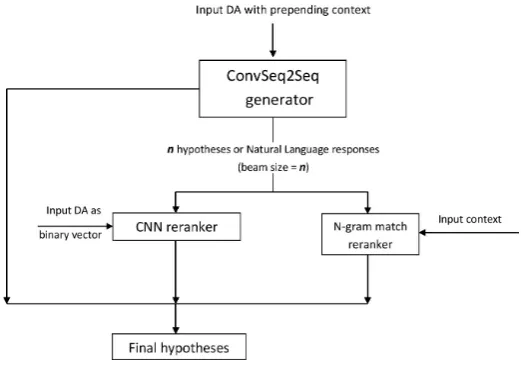
Figure 1: Pipeline of the proposed convolutional NLG model.
3 Proposed Approach
The pipeline of the proposed approach for NLG is shown in Figure 1. Input DA with prepended context is first given to convolutional sequence to sequence generator (ConvSeq2Seq) to get n -best natural language responses or hypotheses (n
is beam size). Thesen-best hypotheses and binary vector representation of input DA are given as in-put to CNN reranker to get the misfit penalties of the hypotheses. Then-best hypotheses and con-text user utterance are given as input to the N-gram match reranker to get bigram precision scores of hypotheses. Final rank of each hypothesisiwhere 1≤i≤nis calculated as follows:
ranki =log probabilityi
+(ω∗bigram precisioni)
−(W ∗misf it penaltyi)
Here, we get log probabilities from ConvSeq2Seq generator, bigram precision scores from N-gram match reranker and misfit penalties from CNN reranker. Here, ω and W are constants. We im-plement the N-gram match reranker as given by
Duˇsek and Jurcicek(2016a). We describe the pro-posed convolutional sequence to sequence gener-ator in Section 3.1 and convolutional reranker in Section 3.2.
3.1 ConvSeq2Seq Generator
The proposed sequence to sequence generator is based on convolutional sequence to sequence ap-proach proposed by Gehring et al. (2017)1. It
1We use the implementation in the pytorch framework
(Gehring et al.,2017)
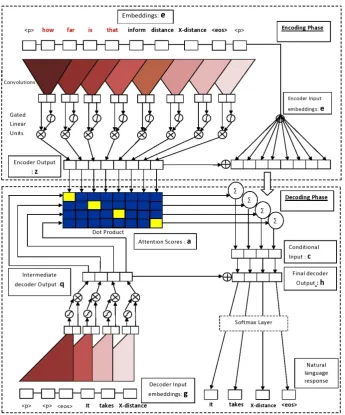
is a CNN-based encoder decoder architecture. Figure 2 shows the working of proposed Con-vSeq2Seq generator on an input instance from training dataset. In this architecture, CNNs are used to compute the encoder states and decoder states. This architecture is based on succession of convolutional blocks/layers. Input sequence is represented as a combination of word and posi-tion embeddings. These embeddings are operated upon by first convolutional block and gated lin-ear units (GLUs) to get the outputs for the first block. This can be seen in Figure 2 where only one convolutional block is shown for representa-tion purpose. The output from first block is input to the second convolutional block and this succes-sion follows till the last convolutional block.
Figure 2: Working of ConvSeq2Seq generator on an input instance from training dataset. Here, for representation purpose, encoder and decoder consists of only one convolutional layer with kernel width
k=3. The encoder input sequencex=(how, far, is, that, inform, distance, X-distance) comprises of user context “how far is that” prepended to input DA “inform distance X-distance”.
whereas a constant number of kernels and nonlin-earities are applied to the inputs of CNN which eases the learning process (Gehring et al.,2017).
The ConvSeq2Seq model uses position embed-dings in addition to word embedembed-dings in order to get a sense of which part of the input sequence it is currently processing (Gehring et al., 2017). Let e = (w1 + p1,. . . ,ws +ps) be the input se-quence representation, wherew= (w1,. . . ,ws) and
p = (p1,. . . ,ps) are the the word embeddings and positional embeddings of the input sequencex = (x1,. . . ,xs) (havingselements) to the encoder net-work respectively. Intermediate states are com-puted based on a fixed number of input elements.
In encoding phase, input is padded with k−21 ele-ments on the left and right side with zero vectors. For each blockl, the outputzl= (z1l,. . . ,zls) is com-puted as follows:
zil=ν(Wlz[zil−−k/21 , . . . , zi+k/2l−1 ] +blz) +zli−1
Figure 3: 19 classes of CNN reranker.
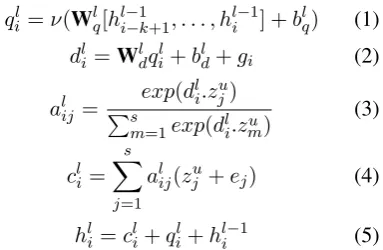
Let g= (g1,. . . ,gt) be the representation of the sequence that is being fed to the decoder network. Computation ofgis similar to that of encoder net-work. Input to decoder is padded with k-1 ele-ments on both left and right side with zero vectors to prevent decoder from having access to future information. As a result, lastk-1 intermediate de-coder outputs are removed. In decoding phase, for each block l, the output hl = (hl1,. . . ,hlt) is com-puted as follows:
qli=ν(Wlq[hil−−1k+1, . . . , hli−1] +blq) (1)
dli=Wldqil+bld+gi (2)
alij = exp(d l i.zju) Ps
m=1exp(dli.zmu)
(3)
cli = s X
j=1
alij(zju+ej) (4)
hli =cli+qli+hli−1 (5)
Here,ql= (ql1, . . . , qtl) is the intermediate decoder output and its computation is similar to that of en-coder network. For computing attention, current intermediate decoder stateqilis combined with the embedding of the previous target element gi as shown in Equation (2). Equation (3) computes at-tention ofi-th decoder state and j-th encoder out-put element for the l-th decoder block. Equa-tion (4) computes the condiEqua-tional input which is weighted sum of combination of encoder outputs and input embeddings. Equation (5) computes the current decoder output which is combination of conditional input, intermediate decoder output and previous layer decoder output. LethLi be the de-coder output ofi-th element and the final decoding block L. Distribution over T possible next target elementsyi+1is computed as follows:
p(yi+1|y1, . . . , yi,x) =ζ(WohLi +bo)∈RT
Here, ζ is softmax function, Wo and bo are the weights and bias of fully connected linear layer.
3.2 CNN Reranker
The n-best beam search responses from Con-vSeq2Seq model may have missing information
and/or irrelevant information. CNN reranker reranks the n-best beam search responses and heavily penalizes those responses which are not semantically in correspondence with the input DA. Responses having missing information and/or ir-relevant information are heavily penalized. Con-volutional networks are excellent feature extrac-tors and have achieved state-of-the-art results in many text classification and sentence-level classi-fication tasks such as sentiment analysis, question classification, etc (Kim,2014;Kalchbrenner et al.,
2014). This classifier takes as input a natural lan-guage response and outputs a binary vector. Each element of binary vector is a binary decision on the presence of DA type or slot-value combina-tions. For the dataset which we have used (Duˇsek and Jurcicek,2016a), there are 19 such classes of DA types and slot-value combinations. These 19 classes are shown in Figure 3.
Input DAs are converted to similar binary vec-tor. Hamming distance between the classifier out-put and binary vector representation of inout-put DA is considered as reranking penalty. The weighted reranking penalties of all then-best responses are subtracted from their log-probabilities similar to
Duˇsek and Jurcicek(2016a).
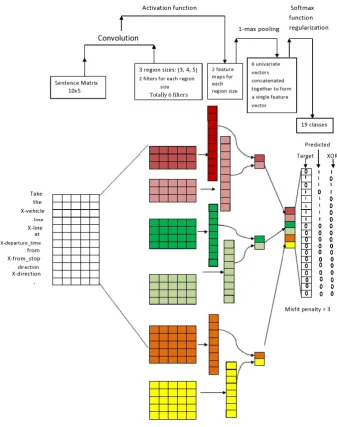
The architecture and working of the CNN reranker on an input instance from training dataset is shown in Figure 4. It is based on the CNN ar-chitecture proposed for sentence classification by
Kim(2014). Input is a natural language response
x= (x1, x2, . . . , xn)where xi’s are word embed-dings each havingmdimensions, resulting in a in-put matrix ofn×mdimensions. Each filter has the width equal to the size of word embeddings, i.e.,
mand its height specifies the number of words it will operate on. This one dimensional convolution is followed by applying activation function and 1-max pooling. The resulting feature vector has the dimension equal to the total number of filters. This penultimate layer is operated upon by a logistic layer to output the binary vector. Given penulti-mate layer feature vectort, the output binary vec-toryis computed as:
Figure 4: Architecture and working of the CNN reranker on an input instance from training dataset.
Here,σ is sigmoid activation function,Wf is the weight matrix andbis the bias vector.
The model proposed by Wen et al. (2015a) implements a CNN reranker that uses one-dimensional filters where convolutional operations are carried out on segments of words. It uses padding vectors. Proposed CNN reranker uses two-dimensional filters which operate on complete words rather than segments of words. This is more intuitive and meaningful. Also, no padding is re-quired. The feature vector from proposed CNN reranker is v-dimensional whereas CNN reranker byWen et al.(2015a) outputs longer feature vec-tors having dimension equal to v ∗m, where v = total number of filters and m = embedding size. Thus, proposed CNN reranker requires lesser number of computations.
4 Experimental Studies
The studies in this work are performed on Alex Context natural language generation (NLG) dataset (Duˇsek and Jurcicek,2016a). This dataset is intended for fully trainable NLG systems in task-oriented spoken dialogue systems (SDS). It is in the domain of public transport information and has four dialogue act (DA) types namely re-quest, inform, iconfirm and inform no match. It contains 1859 data instances each having 3 tar-get responses. Each data instance consists of a preceding context (user utterance), source mean-ing representation and target natural language re-sponses/sentences. Data is delexicalized and split into training, validation and test sets as done by
instances. For evaluation they are used as three target references.
Input to our ConvSeq2Seq generator is a DA prepended with user utterance. This allows en-trainment of the model to the user utterances. A single dictionary is used for context utterances and DA tokens. Our model is trained by min-imizing cross-entropy error using Nesterov Ac-celerated Gradient (NAG) optimizer (Nesterov,
1983). The hyper-parameters are chosen by cross-validation method. Based on our experiments on validation set, we use maximum sentences per batch 20, learning rate 0.07, minimum learning rate0.00001, maximum number of epochs 2000, learning rate shrink factor 0.5, clip-norm 0.5, en-coder embedding dimension 100, deen-coder embed-ding dimension 100, decoder output embedembed-ding dimension 100 and dropout 0.3. Encoder part in-cludes 10 layers/blocks, each having 100 units and kernel width of 7. Decoder part includes 10 lay-ers, each having 100 units and kernel width of 7. For generating outputs on test set, we choose batch size 128 and beam size 20.
For our CNN reranker, all the possible combi-nations of DA tokens and its values are considered as classes. We have 19 such classes. Each input is a natural language sentence and each output is a set of class labels. Training is done by minimizing cross-entropy loss using Adam optimizer (Kingma and Ba,2015). Cross-entropy error is measured on validation set after every 100 steps. Misclassifica-tion penalty for CNN reranker is set to 100. Based on our experiments, we choose embedding dimen-sion 128, filter sizes (3,5,7,9), number of filters 64, dropout keep probability 0.5, batch size 100, num-ber of epochs 100 and L2 regularization,λ=0.05.
The performance of the proposed ConvSeq2Seq model for NLG is compared with that of TGen model (Duˇsek and Jurcicek, 2016a). For com-parison, we have considered NIST (Doddington,
2002), BLEU (Papineni et al., 2002), METEOR (Denkowski and Lavie, 2014), ROUGE L (Lin,
2004) and CIDEr metrics (Vedantam et al.,2015). For this study, we have considered script “mteval-v13a-sig.pl” (version 13a) that implements these metrics. This script was used for E2E NLG chal-lenge (Novikova et al., 2017). We focus on the evaluations using this version. Our model has also been evaluated using the metric script “mteval-v11b.pl” (version 11b) to compare our results with those stated in (Duˇsek and Jurcicek,2016a). The
13a version takes into account the closest refer-ence length with respect to candidate length for calculation of brevity penalty. This is in accor-dance with IBM BLEU. On the contrary, 11b ver-sion takes shortest reference length for measuring brevity penalty. This is the reason behind higher BLEU scores in the 11b version when compared to 13a version. Both the models have been evaluated on five different metrics, with NIST and BLEU scores being of atmost importance.
We have used N-gram match reranker with the weightω set to 1 based on experiments done on validation set. When using 11b version for evalu-ating automatic metrics, weightωis set to 5.
4.1 Studies of the models using 13a version of the metrics
The comparison of the performance of the pro-posed model with that of TGen model using the 13a version of the metric implementation is given in Table 1. It is seen from Table 1 that there is a slight improvement in the scores of our Con-vSeq2Seq generator after using CNN reranker. However, scores improve significantly when N-gram match reranker is used in addition to CNN reranker. An improvement of 3.32 BLEU points is seen. The best scores are obtained whenω is set to 1 for N-gram match reranker.
ConvSeq2Seq model in combination with CNN reranker and N-gram match reranker outperforms TGen model with N-gram match reranker in all the metrics, with a difference of 0.65 in terms of NIST score which is 8% more than the TGen NIST score on this setup. ConvSeq2Seq model with CNN reranker outperforms TGen model with RNN reranker in all the metrics, with a differ-ence of 1.8 in terms of NIST score which is 27% more than the TGen NIST score on this setup. In the domain of NLG, NIST score is found to have highest correlation with human based judgments when compared to other metrics (Belz and Reiter,
2006). In Table 1, the bold numbers indicate the best scores.
4.2 Studies of the models using 11b version of the metrics
Evaluation metric version 13a NIST BLEU METEOR ROUGE L CIDEr Baseline Model: TGen(RNN+RNN)
Prepending context (using RNN reranker) 6.660 62.13 0.4434 0.7269 3.6956 + N-gram match reranker 7.956 65.49 0.4655 0.7547 3.8515
ConvSeq2Seq(CNN + CNN)
Prepending context 8.450 62.08 0.4670 0.7557 3.7281
+ CNN reranker 8.474 62.23 0.4692 0.7561 3.7412
[image:8.595.76.522.219.332.2]+ CNN reranker + N-gram match reranker 8.608 65.55 0.4762 0.7654 3.8725
Table 1: Different automatic metric scores of TGen model (RNN+RNN) and proposed model (CNN+CNN) on test data using evaluation metric version 13a.
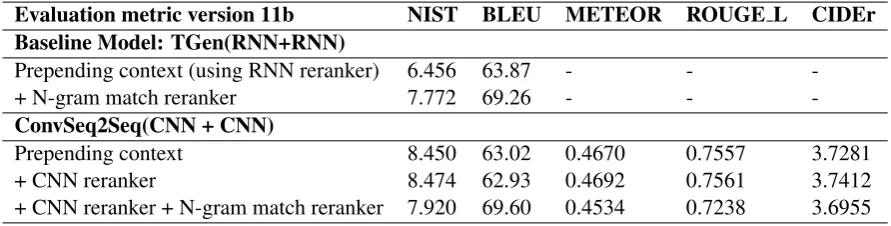
Evaluation metric version 11b NIST BLEU METEOR ROUGE L CIDEr
Baseline Model: TGen(RNN+RNN)
Prepending context (using RNN reranker) 6.456 63.87 - -
-+ N-gram match reranker 7.772 69.26 - -
-ConvSeq2Seq(CNN + CNN)
Prepending context 8.450 63.02 0.4670 0.7557 3.7281
+ CNN reranker 8.474 62.93 0.4692 0.7561 3.7412
+ CNN reranker + N-gram match reranker 7.920 69.60 0.4534 0.7238 3.6955
Table 2: Different automatic metric scores of TGen model (RNN+RNN) and proposed model (CNN+CNN) on test data using evaluation metric version 11b.
We see an improvement of 6.7 BLEU points when using N-gram match reranker with ω set to 5. A decrease in scores of other metrics is seen. These inconsistencies are due to the way brevity penalty is calculated for computing BLEU scores in 11b version of metric implementation.
BLEU and NIST scores of the TGen model given in Table 2 match with that represented in (Duˇsek and Jurcicek, 2016a). The scores of our model shows slight improvement over TGen model.
The studies done to compare the proposed model with the TGen model, show the effective-ness of considering the CNN-based approach to NLG. Studies also show that CNN reranker out-performs the RNN reranker. Further, CNN-based model is expected to take less time to train when compared to RNN-based model. We compare the time taken by the models in the next section.
4.3 Studies on the models based on training time
In this section, we compare the proposed model with that of TGen based on time taken for train-ing. All the experiments were performed on 8GB Nvidia GeForce GTX 1080 GPU. The time taken for training ConvSeq2Seq generator is approxi-mately 4 minutes. The time taken for training
CNN reranker is approximately 2 minutes. The time taken for training TGen model is approxi-mately 128 minutes which is 21 times more than our ConvSeq2Seq generator in combination with CNN reranker. This shows the effectiveness of using convolutional neural network in building a model for NLG than using recurrent neural net-work based approach used in TGen.
5 Conclusion and Future Work
In this paper a novel approach to natural language generation (NLG) using convolutional sequence to sequence learning is proposed. The convolu-tional model for NLG is found to encapsulate de-pendencies between words in a better way than re-current neural network (RNN) based sequence to sequence learning. It is also seen that the convo-lutional approach makes efficient use of compu-tational resources. The proposed model in com-bination with CNN reranker and N-gram match reranker is capable of entraining to users’ way of speaking. Studies conducted on a standard dataset shows the effectiveness of proposed ap-proach which outperforms the conventional RNN-based approach.
References
A. Belz and E. Reiter. 2006. Comparing
Auto-matic and Human Evaluation of NLG Systems.
In 11th Conference of the European Chapter
of the Association for Computational Linguistics.
http://www.aclweb.org/anthology/E06-1040.
M. Denkowski and A. Lavie. 2014. Meteor Universal:
Language Specific Translation Evaluation for Any Target Language. InProceedings of the Ninth
Work-shop on Statistical Machine Translation.
Associa-tion for ComputaAssocia-tional Linguistics, pages 376–380.
https://doi.org/10.3115/v1/W14-3348.
G. Doddington. 2002. Automatic Evaluation of
Machine Translation Quality Using N-gram Co-occurrence Statistics. In Proceedings of the Second International Conference on
Hu-man Language Technology Research.
Mor-gan Kaufmann Publishers Inc., San
Fran-cisco, CA, USA, HLT ’02, pages 138–145.
http://dl.acm.org/citation.cfm?id=1289189.1289273.
O. Duˇsek and F. Jurcicek. 2016a. A Context-aware
Natural Language Generator for Dialogue Systems.
In Proceedings of the 17th Annual Meeting of the
Special Interest Group on Discourse and Dialogue.
Association for Computational Linguistics, pages
185–190. https://doi.org/10.18653/v1/W16-3622.
O. Duˇsek and F. Jurcicek. 2016b.
Sequence-to-Sequence Generation for Spoken Dialogue via Deep Syntax Trees and Strings. In Proceedings of the 54th Annual Meeting of the Association for Compu-tational Linguistics (Volume 2: Short Papers). Asso-ciation for Computational Linguistics, pages 45–51.
https://doi.org/10.18653/v1/P16-2008.
J. Gehring, M. Auli, D. Grangier, D. Yarats, and Y. N.
Dauphin. 2017. Convolutional Sequence to
Se-quence Learning. In ICML. PMLR, volume 70 of
Proceedings of Machine Learning Research, pages
1243–1252.
N. Kalchbrenner, E. Grefenstette, and P. Blunsom.
2014. A Convolutional Neural Network for
Mod-elling Sentences. InProceedings of the 52nd An-nual Meeting of the Association for Computational
Linguistics (Volume 1: Long Papers).
Associa-tion for ComputaAssocia-tional Linguistics, pages 655–665.
https://doi.org/10.3115/v1/P14-1062.
Y. Kim. 2014. Convolutional Neural Networks for
Sentence Classification. In Proceedings of the 2014 Conference on Empirical Methods in
Nat-ural Language Processing (EMNLP). Association
for Computational Linguistics, pages 1746–1751.
https://doi.org/10.3115/v1/D14-1181.
D. P. Kingma and J. L. Ba. 2015. Adam: A Method for
Stochastic Optimization. In Proceedings of
Inter-national Conference on Learning Representations.
pages 1–13.
Y. LeCun and Y. Bengio. 1995. Convolutional
net-works for images, speech, and time series. MIT
Press, Cambridge, MA, USA, 1st edition.
C.-Y. Lin. 2004. ROUGE: A Package
for Automatic Evaluation of Summaries.
In Text Summarization Branches Out.
http://www.aclweb.org/anthology/W04-1013.
Y. Nesterov. 1983. A method for unconstrained
con-vex minimization problem with the rate of conver-genceo(1/k2). Doklady AN USSR 269:543–547.
https://ci.nii.ac.jp/naid/20001173129/en/.
J. Novikova, O. Duˇsek, and V. Rieser. 2017. The E2E
Dataset: New Challenges for End-to-End Genera-tion. InProceedings of the 18th Annual Meeting of the Special Interest Group on Discourse and
Dia-logue. Saarbr¨ucken, Germany. ArXiv:1706.09254.
https://arxiv.org/abs/1706.09254.
K. Papineni, S. Roukos, T. Ward, and W.-J. Zhu.
2002. Bleu: a Method for Automatic
Eval-uation of Machine Translation. In Proceed-ings of the 40th Annual Meeting of the Associa-tion for ComputaAssocia-tional Linguistics. pages 311–318.
http://www.aclweb.org/anthology/P02-1040.
A. Stent, R. Prasad, and M. Walker. 2004. Trainable
Sentence Planning for Complex Information Pre-sentation in Spoken Dialog Systems. In Proceed-ings of the 42nd Annual Meeting on Association for
Computational Linguistics. Association for
Compu-tational Linguistics, Stroudsburg, PA, USA, ACL ’04.https://doi.org/10.3115/1218955.1218966.
R. Vedantam, C. L. Zitnick, and D. Parikh. 2015. CIDEr: Consensus-based image description
evalu-ation. In CVPR. IEEE Computer Society, pages
4566–4575.
A. Waibel, T. Hanazawa, G. Hinton, K. Shikano,
and K. J. Lang. 1989. Phoneme recognition
us-ing time-delay neural networks. IEEE Transac-tions on Acoustics, Speech, and Signal Processing
37(3):328–339.https://doi.org/10.1109/29.21701.
M. A. Walker, O. Rambow, and M. Rogati. 2002.
Training a sentence planner for spoken dialogue using boosting. Computer Speech & Language
16(3-4):409–433.
https://doi.org/10.1016/S0885-2308(02)00027-X.
T.-H. Wen, M. Gasic, D. Kim, N. Mrksic, P.-H. Su,
D. Vandyke, and S. Young. 2015a. Stochastic
Lan-guage Generation in Dialogue using Recurrent Neu-ral Networks with Convolutional Sentence
Rerank-ing. In Proceedings of the 16th Annual Meeting
of the Special Interest Group on Discourse and Di-alogue. Association for Computational Linguistics,
pages 275–284.
T.-H. Wen, M. Gasic, N. Mrkˇsi´c, P.-H. Su, D. Vandyke,
and S. Young. 2015b. Semantically
Condi-tioned LSTM-based Natural Language Genera-tion for Spoken Dialogue Systems. In Proceed-ings of the 2015 Conference on Empirical
Meth-ods in Natural Language Processing. Association
for Computational Linguistics, pages 1711–1721.
https://doi.org/10.18653/v1/D15-1199.
S. Young, M. Gaˇsi´c, S. Keizer, F. Mairesse, J.
Schatz-mann, B. Thomson, and K. Yu. 2009. The
Hid-den Information State Model: a practical frame-work for POMDP-based spoken dialogue
manage-ment. Computer Speech and Language 24(2):150.