warwick.ac.uk/lib-publications
Original citation:
Boehning, C., Bothmer, Hans-Christain Graf von and Sosna, P.. (2016) Some properties of
dynamical degrees with a view towards cubic fourfolds. Research in the Mathematical
Sciences, 3 (23).
Permanent WRAP URL:
http://wrap.warwick.ac.uk/79480
Copyright and reuse:
The Warwick Research Archive Portal (WRAP) makes this work of researchers of the
University of Warwick available open access under the following conditions.
This article is made available under the Creative Commons Attribution 4.0 International
license (CC BY 4.0) and may be reused according to the conditions of the license. For more
details see:
http://creativecommons.org/licenses/by/4.0/
A note on versions:
The version presented in WRAP is the published version, or, version of record, and may be
cited as it appears here.
R E S E A R C H
Open Access
Some properties of dynamical degrees
with a view towards cubic fourfolds
Christian Böhning
1*, Hans-Christian Graf von Bothmer
2and Pawel Sosna
2*Correspondence: [email protected] 1Mathematics Institute, University of Warwick, Coventry CV4 7AL, England, UK This article is dedicated to Fedor Bogomolov on the occasion of his 70th birthday.
Full list of author information is available at the end of the article
Abstract
Dynamical degrees and spectra can serve to distinguish birational automorphism groups of varieties in quantitative, as opposed to only qualitative, ways. We introduce and discuss some properties of those degrees and the Cremona degrees, which facilitate computing or deriving inequalities for them in concrete cases: (generalized) lower semi-continuity, submultiplicativity, and an analog of Picard–Manin/
Zariski–Riemann spaces for higher codimension cycles. We also specialize to cubic fourfolds and show that under certain genericity assumptions the first and second dynamical degrees of a composition of reflections in points on the cubic coincide.
1 Introduction
For a smooth projective varietyXof dimensionnand a birational self-mapf: X X, one can define a tuple of real numbers
λ0(f)=1, λ2(f),. . .,λn−1(f), λn(f)=1,
whereλi(f)≥1 for 2≤i≤n−1, called the dynamical degrees off. See Sect.2for two
equivalent definitions of these numbers. The dynamical degrees turn out to be invariant under birational conjugacy, so that the dynamical spectrum
Λ(X)=λ(f) :=(λ1(f),. . .,λn−1(f))|f ∈Bir(X)
⊂Rn−1
is a birational invariant of the varietyX. One thus might, for example, try to use it to distinguish very general (conjecturally irrational) cubic fourfoldsX from P4. Here are some ideas how the spectra might differ:
(1) As point sets, that is, there might be a tupleλ(f) in the spectrum ofP4which is not in the spectrum ofX. This could, for example, be proven if one could show that on Xthe dynamical degrees have to satisfy other additional inequalities, coming from the geometry ofX, which can be violated onP4. For this, one has, in particular, to develop certain semi-continuity properties and computational tools for dynamical degrees, which we start doing in the subsequent sections.
(2) As metric (or only topological) spaces: for example, one can consider, for everyk, the smallest gap in the spectrum after 1, if there is any, that is,
gk:= inf f∈Bir(X),λk(f)=1
(λk(f)−1).
©2016 The Author(s). This article is distributed under the terms of the Creative Commons Attribution 4.0 International License (http://creativecommons.org/licenses/by/4.0/), which permits unrestricted use, distribution, and reproduction in any medium, provided you give appropriate credit to the original author(s) and the source, provide a link to the Creative Commons license, and indicate if changes were made.
It is possible that these numbers differ forXandP4, but the drawback is that it is
not easy to see how to relate them to accessible geometric features ofX. In other words, it seems very hard to compute or estimate them. On the topological side, it may happen that the Cantor–Bendixson ranks of the dynamical spectra or some linear slices in them differ, but again these are very hard to access.
(3) Arithmetically: it could happen that for bothXandP4, the dynamical degrees are algebraic integers, but forXthey may satisfy some additional arithmetic constraints. For example, the number fields generated by each tuple of dynamical degrees onX might differ from the ones forP4. But also this seems very hard to detect.
We thus concentrate on (1) for the moment.
The paper is organized as follows. In Sect.2, we recall some basic facts about cycles and dynamical degrees. In Sect.3, we prove Theorem3.1which says that the dynami-cal degrees are lower semi-continuous functions for families over smoothbases, if one understands lower semi-continuity in a slightly generalized sense, namely that (down-ward) jumps may occur on countable unions of closed subsets. Moreover, in Proposition
3.4we collect some results that point out the importance of the questions of existence of (finite-dimensional, connected, non-trivial) algebraic subgroups in Bir(X) and of the classification of birational automorphisms with all dynamical degrees equal to 1 for the irrationality problem for cubic fourfoldsX. In Sect.4, we study the relationship between dynamical degrees and Cremona degrees under some assumptions and prove a submulti-plicativity result, Theorem4.3. Section5is devoted to reflections on cubic fourfolds, and in Theorem5.5, we show, under some assumptions, the equality of the first and second dynamical degrees of a composition of reflections on a smooth cubic fourfolds. This is a sample of a type of result which says that special dynamical degrees can only arise in the presence of special dynamics. Such implications are very important for making progress on the irrationality problem for cubics, too. Finally, in “Appendix” we describe general-ized Picard–Manin spaces which might prove useful in the study of dynamical degrees on fourfolds in the future.
ConventionsWe work over the field of complex numbersCthroughout the paper. A variety is a reduced and irreducible scheme of finite type overC. A primek-cycle on a variety is an (irreducible) subvariety of dimensionk. Ak-cycle is a formal linear combination of primek-cycles. Iff: X Y is a rational map between varieties, we denote by dom(f) the largest open subset ofXon whichf is a morphism. The graphΓf ⊂X×Y off is the closure of the locus of points (x, f(x)) withx∈dom(f).
2 Preliminaries 2.1 Cycles
LetX be a smooth projective variety of dimension n. Following [6], we will denote by Ak(X), Bk(X) andHk(X) the groups of algebraic cycles of dimensionkmodulo rational,
algebraic and homological equivalence, respectively. Roughly speaking, a cycle is rationally equivalent to zero if it can be written as the difference of two fibers of a family overP1; algebraically equivalent to zero if it can be written as the difference of two fibers of a family over a smooth curve; and homologically equivalent to zero if it maps to zero under the cycle mapAk(X) //H2n−2k(X,Z).
As usual,Ak(X), Bk(X), Hk(X) will denote the groups of cycles of codimensionk. There
are surjections
Ak(X) //Bk(X) //Hk(X) for all possiblek.
Given a proper mapf: X //Y of some relative dimensionl, one can define pushfor-ward mapsf∗: Ak(X) //Ak(Y) and, iffis also flat, pullback mapsf∗: Ak(Y) //Ak+l(X), see [6, Sect. 1]. For instance, for the pullback under a flat map one simply takes the class of the preimage of a prime cycle and extends this definition linearly. One can also define pullback maps for morphisms between smooth varieties which are not necessarily flat, but this is slightly more complicated and involves some intersection theory, see [6, Ch. 8].
Also recall that the collection of all groupsA∗(X)= ⊕nk=0Ak(X) is a commutative ring
with respect to the intersection pairing (here we needXsmooth). More precisely, there are pairingsAk(X)×Al(X) //Ak+l−n(X) for all possiblek, l. In other words,A∗(X) is a
graded ring.
An important result about cycles which we will use below is the “Principle of Conser-vation of Number”, see [6, Subsect. 10.2].
Theorem 2.1 Let p: Y //T be a proper morphism of varieties,dimT = m, andα be an m-cycle onY. Then the cycle classesαt ∈A0(Yt)for t ∈T a regular closed point, all
have the same degree.
Remark 2.2 Here, if β is an (m+k)-cycle β on Y (where k is not necessarily zero), then fiber cycle classesβtare in general defined viaβt =t!(β), wheret!is a refined Gysin
homomorphism associated with the regular embeddingt: {t} //T, see [6, Subsect. 10.1]; however, in all our applications below, there is a much simpler way to think ofβt: indeed,
we will always have that the embeddingitof the fiberYt=p−1(t) intoYwill be regular of
codimensionm, andYtandYwill be smooth. Thenβt=i∗t(β) (the cycle pullback) by [6,
Ex. 10.1.2]. Even more concretely, suppose thatβis represented by some subvariety ofY that isgenerically transversetoitin the sense of [5, Def. 1.22], i.e.,it−1(β) (scheme-theoretic
preimage) is generically reduced and codimYt(i−
1
t (β))=codimY(β), i.e., the intersections
take place in the expected codimensions. Then the cycle pullbackit∗(β) is represented by the class ofi−t1(β) by [5, Thm. 1.23(a)]. We use this fact in the sequel to understand the geometric meaning of fiber cycle classesβt(e.g., if this is a zero cycle, we will identify its
degree with Cremona degrees in certain setups).
2.2 Dynamical degrees
LetXbe a smooth projective variety of dimensionn, fix an ample divisorHonXand let f: XXbe a birational map. SettingHRk(X) :=Hk(X)⊗R, we define a linear map
f∗: HRk(X) //HRk(X), α //pr1∗Γf ·pr∗2(α)
,
where pri: X×X //Xare the projections andΓf ⊂X×Xis the graph off.
Definition 2.3 LetXandf be as above. Thekth dynamical degreeoff is
λk(f)= lim
m //∞
ρ(fm)∗m1 ,
Equivalently, one can choose any resolutionZof singularities ofΓf, consider the induced diagram
Z
π1
π2
? ? ? ? ? ? ?
X_ _ _ _f _ _ _//X
and define f∗ = π1∗◦π2∗. For the equivalence of these two approaches, see [10, Sub-sect. 3.1].
There is yet another way of defining the dynamical degrees. First, one can define the Cremona degreedegk(f) off with respect toHas the degree (i.e., the intersection number withHn−k) of the birational transform underf−1of a general element in the system of cycles homologically equivalent toHk. In symbols,
degk(f)=Hn−k·f∗Hk. One then puts
λk(f)= lim
m //∞
degk(fm)m1,
the growth rate of the Cremona degrees of the iterates of f. This definition does not depend on the choice ofHand is equivalent to the previous one, see [10, Thm. 1.1] for a statement valid over any algebraically closed field of characteristic zero or [7, Thm. 2.4] for a more analytic statement.
Remark 2.4 Before the existence of the limit was proven, a definition involving a limes inferior of Cremona degrees or spectral radii was sometimes used in the literature.
The dynamical degrees satisfy several numerical properties, such as log-concavity, and are related to the topological entropy off, see [7].
Finally, for the convenience of the reader we recall the statement of [3, Lem. 2.3] since it is used below.
Lemma 2.5 Let p: Z //Ωbe a morphism of varieties over an algebraically closed field k and let W ⊂Z be a constructible subset. Then there is a finite collection of locally closed subsetsΩi ⊂Ω, 1≤i≤N , and closed subsets Yi ⊂p−1(Ωi)such thatΩ =Ni=1Ωiand
for any i, 1≤i≤N , and any pointω∈Ωi, the fiber(Yi)ωis equal to the closure of Wωin Zω.
3 Semi-continuity of dynamical degrees
In this section, we will prove Theorem3.1, providing estimates on dynamical degrees in families.
Theorem 3.1 Let
X
π
//PN×S
prS
{{
xxxxxx xxx
be a smooth projective family of smooth varieties Xs⊂PN over a variety S. Let
X
π????
? ?
? _ _f_ _ _//
_ X
π
S
be a birational map such that no entire fiber ofπ is in the indeterminacy or exceptional locus of f , i.e., fiberwise, fs: Xs Xs is a well-defined birational map (if this is not
satisfied at the beginning, we can always achieve it by replacing S by a non-empty open subset). Consider the function
λj: S //R
associating with s∈S the jth dynamical degreeλj(fs)of fs. Thenλjis lower semi-continuous
in the following generalized sense:the sets
Va:=
s∈S|λj(s)≤a
, a∈R,
are countable unions of Zariski closed subsets in S.
Remark 3.2 We would like to draw attention to a subtlety in the structure of the proof of Theorem3.1at this point already. First of all, notice that to prove Theorem3.1for givenπ: X //Sandf, it is sufficient to prove it for the base change familyπ˜S: X˜S =
X×SS˜ //S˜andfS˜: X˜SXS˜for a desingularizationb: ˜S //S. This is so because all
the hypotheses hold for the family after the base change, and the setsVa=Va(S) onSare
the images under the proper morphismbof the corresponding setsVa(˜S) on ˜S.
This being so, we will prove Theorem3.1by a descending induction on dimS, and for this we will need the statement of the Theorem for arbitrary basesS(non-singular or not) as hypothesis in the induction step. In the course of the proof, we will have to apply the principle of conservation of number Theorem2.1, however, which will require the bases of the families under consideration to be smooth. The remark above shows that this is no serious restriction in our setup: we can always pass to an appropriate non-singular base ˜S if necessary.
We begin with the following result, which generalizes [12, Lem. 4.1].
Lemma 3.3 In the setup of Theorem3.1, let H ⊂PN be the linear system of hyperplanes
inPN. Letdeg
j(fs)be the jth Cremona degree of fs. Then
degj : S //R, s //degj(fs)
is a lower semi-continuous function on S.
Proof Passing to a desingularization ofS and the pullback family as in Remark3.2 if necessary, we may as well assume thatSis smooth. Consider the graphΓf ⊂X×SX ⊂
PN×PN ×Sand the two (flat) projectionsp
1, p2
PN ×PN×S p2
&&
N N N N N N N N N N N
p1
xx
pppppppp ppp
LetHSj ⊂ Pn×S be the pullback toPN ×S of the algebraic equivalence classHj, that is, an intersection ofjrelative hyperplanes inPN ×S. Then, by Theorem2.1applied to
Y =PN×PN×S, T =Sandα=Γ f·p∗1(H
dimXs−j
S )·p∗2(H
j
S) (an easy computation shows
that this is indeed a dim(S)-cycle), the degree ofαt ∈ A0(Yt) is constant. Note that the
cycle pullbacks via the flat morphisms (or, in any case, via morphisms between smooth varieties) and the intersection product in the ambient smooth varietyPN ×PN ×Sare well-defined. Note also that degαsis equal to the Cremona degree degj(s) forsin a
non-empty Zariski open subsetΩ ⊂S, because,firstly, forsin a dense Zariski open subset of Swe have
(Γf)s=Γfs
by an application of Lemma2.5: just apply it toZ=X×SX,Ω =Sand the constructible
setW consisting of the points (x, f(x)) forx∈dom(f) to conclude that there is an open dense subset of points in S with the desired property. Note that for specials ∈ Z := S\Ω,Γfs may be a proper component of (Γf)s. Now,secondly, provided that (Γf)s=Γfs,
we can calculate the restrictionαs ofαtoYs =Ys =PN ×PN × {s}via the geometric
method explained at the end of Remark2.2to find that then
αs=Γfs·pr∗1H
dimXs−j·pr∗
2Hj,
which has degree equal to the Cremona degree degj(s) by the definition of Cremona degree.
Thus we see that onΩ, the function degjis constant by Theorem2.1. Let us check that degjcan only get smaller at a pointz0∈ Z. This will imply the assertion by descending
induction on dimS. Indeed, if degj =agenerically onS, there is a proper closed subset S ⊂ S such that{s ∈ S | degj(s) ≤ a−1} ⊂ S. Now considering the irreducible components ofS, and the restriction of the familyXto each of these implies the assertion. To see that degjcan only drop atz0∈Z, we can assume that dimS >0 and then take a
smooth curveC⊂Swithz0∈CandC∩Ω = ∅, and restrict the familyπ: X //StoC,
i.e., considerπC: XC //Cand the restrictionfC: XC XC off toXC. Then we can
do the above construction withSreplaced byC, that is, we can considerΓfCand a relative cycleαC. Note that sinceΩ∩C= ∅, for a general pointc∈Cthe degree of (αC)cwill be
equal to degj(fc) again by Lemma2.5and Remark2.2.
Now there is a finite set of pointsP ⊂C, where we can assume thatz0∈P, such that
forc∈C\P, the fiber (ΓfC)cofΓfC overcis nothing but the graph of (fC)c.
The graphΓfCis, by definition, the closure of (ΓfC)|C\P //C\PinP
N×PN×C. Now
the advantage of working over a curveCis that, by the valuative criterion of properness and the properness of Chow schemes of cycles inPN×PN, the limits (ΓfC)z, forz∈P, of
the family (ΓfC)|C\P //C\Pwill be cycles of dimension dimXs, that is, all components
of (ΓfC)z0have dimension dimXs. This allows us to interpret the degree of the zero cycle
(αC)z0 geometrically. First of all, deg(αC)z0 = deg(αC)c =degj(fc) forc∈ Cgeneral, by
Theorem 2.1. Note that it is here that we need the assumptionC smooth (hence also had to be able to assumeSsmooth before to ensure the existence of such aC) because otherwise conservation of number does not hold: think of the normalization of a curve with a double point as a relative zero cycle over the singular curve downstairs.
On the other hand, deg(αC)z0is nothing but the sum of the numbersG·pr∗1(HdimXs−j).pr∗2
multiplicities, cf. [6, 10.1, p. 176 bottom]. Here pri are the projections ofPN ×PN onto
its factors. SinceΓfz0 is one of the components, we see that the Cremona degree can only
drop at a special pointz0.
Proof of Theorem3.1 By definition, we have
λj(f)= lim n //∞
degj(fn)1n.
Applying Lemma3.3to each iterate off, we see that for eachn ∈ N, there is a proper closed subsetZn⊂Ssuch that onS\Zn,degj(fsn) is constant. Thus outside the countable
union of proper closed subsets
k0≥1 ⎛
⎝
k≥k0
Zk
⎞ ⎠
the function s //λj(fs) is constant (here we use Remark 2.4). Now arguing again by
induction on the dimensions of the irreducible components of the closed subsets in the previous countable union (these are countably many proper closed subsets) gives the
assertion.
One instance where one can use the above considerations is the following result, which might be useful when trying to prove irrationality of very general cubic fourfolds. It is based on a suggestion by Miles Reid.
LetG be an algebraic group. Recall that given an injective map of (abstract) groups
θ: G //Bir(X), we get an action ofGonXby birational isomorphisms, and we say that Gis analgebraic subgroupof Bir(X) if the domain of definition of the partially defined mapG×XX,(g, x) //θ(g)(x), contains a dense open set ofG×Xand coincides on it with a rational map (in the sense of algebraic geometry). By a theorem of Rosenlicht [8, Thm. 2], one can characterize algebraic subgroupsGequivalently by saying that they are those subgroups for which there is a birational modelY Xsuch thatGacts onY via biregular maps/automorphisms.
Proposition 3.4 Let X be a smooth cubic fourfolds. For a line l⊂X denote byϕl: X //P3
the associated conic fibration, and by
Birϕl(X)⊂Bir(X)
the subgroup consisting of birational self-maps which preserve the fibrationϕl, i.e., map a
general fiber into itself. The following hold.
(1) X is rational if and only if there is an algebraic subgroup(C∗)2inBir(X).
(2) If X is rational, then there is a family of birational maps
X×(C∗)2
πJJJJJ%%
J J J J
f_ _ _ _//
_ _ _
_ X×(C∗)2
π
yy
tttttt ttt
(C∗)2
such that for any s∈ S := (C∗)2all dynamical degrees of fs :=f |Xs are equal to1
(3) If X is rational, then there is some birational self-map f ∈Bir(X)with all dynamical degrees equal to1and such that f is contained in no subgroupBirϕl(X). There is even such a map f with the property that the growth of the Cremona degrees of the iterates of f is bounded.
Proof For (1) note that ifX is rational, Bir(X) certainly contains a subgroup (C∗)2, e.g., coordinate rescalings. Conversely, if there is an algebraic subgroup (C∗)2in Bir(X), then Xis birationally a (C∗)2-principal bundle over a unirational, hence rational, surface (note that (C∗)2, being abelian, will act generically freely once it acts faithfully). Since any such (C∗)2-principal bundle is Zariski locally trivial ((C∗)2 is a special group in the sense of Serre),Xis rational in this case.
To prove (2), note that the existence of the family is clear by (1) (the family is simply induced by the rational action of (C∗)2onX), so we only have to see that for anys ∈
S :=(C∗)2all dynamical degrees offs =f |Xs are equal to 1. Now by Lemma3.3, clearly
all Cremona degrees are bounded in the family. On the other hand, since it arises from a subgroup(C∗)2of Bir(X), for anyfs, fsnis again in the family, i.e., equal to someft. Hence all
dynamical degrees are equal to 1. Moreover, the set{fs}s∈(C∗)2is contained in no subgroup
Birϕl(X), since the images of
(C∗)2s //fs(p)⊂X
(i.e., the (C∗)2-orbits) are rationalsurfacesfor a general pointp∈Xif we construct the family{fs}from a subgroup (C∗)2in Bir(X) as in (1). But if{fs}s∈(C∗)2were contained in a
subgroup Birϕl(X), these images would be conics. To prove (3), suppose that
Φ: P4X
is a birational map, and suppose thatx∈P4is a point in whichΦis defined and is a local isomorphism. Our goal is now to find a one-parameter group
{ft}, t∈C∗, ft◦fs=fts
of birational self-maps ofXsuch thatΓ, the (closure of the) image of
C∗t //ft(p)
is a curve onXthroughpwhich isnota conic. Here we want allftto be birational self-maps
with all dynamical degrees equal to 1. SoΓ is an orbit under the action ofC∗onX. If we can find such a one-parameter group, we are done: namely, if we choosetto be of infinite order, thenf := fthas the required properties; indeed, iff preserved a conic fibration,
then the iteratesfn(p), n∈N, would all have to lie in a conicQ. These iterates also lie on the curveΓ and are distinct by our choice oft; thus,Γ andQwould coincide (they have infinitely many points in common), a contradiction.
One way to construct such a one-parameter subgroup is as follows: consider the family of all conicsCpthroughp=Φ(x). For every conicC∈Cp, consider its birational transform
Φ−1
bir(C) inP4throughx. Now the degrees of the curvesΦbir−1(C) forCranging overCp
are bounded above since degrees are lower semi-continuous in families (compare also Lemma 4.4below, and its proof). Assume without loss of generality thatxis the point (1,1,1,1)∈C4⊂P4. Now consider the one-parameter subgroups
These give families of birational maps of P4 via rescaling the coordinates. The orbit
closures of these subgroups (which are all isomorphic to C∗) are rational curves inP4 whose degree is unbounded. Hence, one of them is certainly not in the set of curves
Φ−1
bir(C). This achieves our goal. The dynamical degrees of the resultingf are equal to 1
since it is contained in an algebraic subgroupC∗by construction.
Remark 3.5 Note the similarity of the argument used in the proof of (1) of Proposition
3.4with [2, Prop. 3.1]. Also note that Proposition3.4continues to hold for any fourfolds with birationally a conic bundle structure overP3.
One might hope that birational self-mapsf with all dynamical degrees equal to 1 are in some sense “classifiable” on a very general cubic fourfolds. Restricting this class even further, the maps whose iterates have bounded growth of the Cremona degrees can be studied. For surfaces, such mapsf are often calledellipticand it is known, see [1], that they are precisely those that arevirtually isotopic to the identity, that is, on some model, an iterate fn0 belongs to the connected component of the identity of the (biregular)
automorphism group. On varieties of higher dimension, the term elliptic does not seem so appropriate, so we call themboundedmaps here for now. Note that not only the dynamical degrees, but also thegrowth rateof the sequence of Cremona degrees is invariant under birational conjugacy. So bounded maps are a birationally invariant class. These maps have topological entropy equal to zero and hence are what is sometimes called topologically deterministic. If on a very general cubic fourfolds it were true that any such map is a birational automorphism of finite order (we believe this could be true, at least none of the examples we know contradicts it), then Proposition3.4. (3) would imply that a very general cubic fourfolds is irrational.
Remark 3.6 In part (3) of Proposition 3.4, one can even assume that the sequence of Cremona degrees is constant. This follows from Lemma3.3: ifftis a family of birational
self-maps ofXparametrized by an algebraic subgroupC∗ ⊂ Bir(X), then the Cremona degrees are constant outside of a finite set of points inC∗. Nowfsn=fsn, and for general
s, the set of its powerssnavoids the previous finite set of points. 4 Upper bounds for dynamical degrees in terms of degrees
For birational mapsf, g: PnPn, thekth Cremona degree degkis submultiplicative in the sense that
degk(fg)≤degk(f) degk(g)
whence also degk(fn)≤degk(f)nandλk(f)≤ degk(f); see [9, Lem. 4.6]. As we will see,
another application of Theorem2.1easily yields a result for certain varieties more general thanPn.
We will use the following result.
Lemma 4.1 (1) Let f: X //Y be a surjective morphism of smooth projective varieties. For any l∈N, let
Yl:=y∈Y |dimf−1(y)≥l,
Then the pullback class f∗[V]in A∗(X)is represented by f−1(V)which is equal to the birational transform of V under f−1.
(2) Now let g: X1X2be a birational map. Pick a resolution of g−1
X2
q
@ @ @ @ @ @ @
p
~~
~~~~ ~~~
X1
g _ _ _//
_ _ _
_ X2
where q is a succession of blowups in subvarieties lying over components of the base locusBs(g−1)⊂X2. Suppose that Z is a subvariety of X2which satisfies the conditions
for V in part (1) with respect to the morphism q and which is also not contained in Exc(g−1), the union of the subvarieties in X
2 contracted by g−1. Then g∗[Z]is
represented by the birational transform of Z under g−1.
Proof Part (1) is [5, Thm. A.6 and Thm. 1.23] or [10, Lem. 3.1] and proof of Lem. 3.2(a) ibid. For part (2), we can apply part (1) to conclude thatq∗[Z] is represented by the birational transform ofZunderq−1onX2. Butg∗[Z] is equal top∗q∗[Z], andp∗is an isomorphism
onto its image onq∗[Z] outside of the strict transforms onX2of the subvarieties contracted
byg, hence the claim.
Definition 4.2 We will call aZas in part (2) of Lemma4.1g-adapted.
Theorem 4.3 Let X be a smooth projective variety such that HRk(X)is one-dimensional generated by Hkwhere H ⊂X is a very ample divisor. For any birational map f: XX, consider the map f∗: HRk(X) //HRk(X)defined in Sect.2. Suppose this map is multiplica-tion byδk(f)∈N. Also suppose that for any birational map g: XX, there is an m∈N and a flat family p: C //S of effective irreducible codimension k cycles homologically equivalent toδk(f)mHk over a smooth irreducible base S such thatC
s0 is the birational
transform under f−1of a general element in mHk, and for general s∈S,Csis g-adapted
in the sense of Definition4.2. Then
δk(f ◦g)≤δk(f)·δk(g).
In particular,λk(f)≤δk(f)for such a birational map f: XX.
To prove Theorem4.3, we use the following Lemma.
Lemma 4.4 Let X be a smooth and projective variety of dimension n with a very ample class H, S be a smooth variety and letC //S be a flat family of irreducible k-cycles of some fixed degree on X×S,ι: C //X×S be the inclusion, and g: XX a birational map such that g−1◦ιsis a well-defined birational map on every fiberCs. Then the function
s // deg(g−1◦ιs)∗(Cs)
which associates with a point s ∈ S the degree of the birational transform of the cycleCs
under g−1◦ι
s(with respect to H)is a lower semi-continuous function on S.
Proof Again we employ Theorem2.1. LetY=X×X×Swith projectionsp1:=p13: X×
X×S //X×Sandp2=p23: X×X×S //X×S. Moreover, for the fiberwise birational
g−1×idS
◦ι: C //X×S,
and (the closure inYof) its graphΓ(g−1×idS)◦ι.
Consider the cycleα=Γ(g−1×id S)◦ι·p
∗
2(HSi) onY, whereiis chosen appropriately such
thatαsis a zero cycle for alls. Then arguing as in the proof of Lemma3.3, we find that for
generalsinS, the degree ofαsis equal to deg((g−1◦is)∗(Cs)), whereas at special points it
only gives an upper bound. Since the degree ofαsis constant by Theorem2.1, we get the
assertion.
Proof of Theorem4.3 Replacing Hk bymHk, we can assumem = 1. Thenδk(f) is the
degree of the birational transform underf−1of a general elementHk, divided byHn, and the same holds forg. In symbols: f∗HHk·Hnn−k =δk(f).
On the other hand, forδk(f ◦g) we first consider the birational transformCs0 under
f−1of a general elementHk, andCs0is now a special element inBk(X). We then have to
compute the degree of the birational transform underg−1ofCs0and divide it byHn, and
this isδk(f ◦g).
By hypothesis, we can deform Cs0 in the homological equivalence class ofδk(f)Hk to
a general elementCsin that class via the familyp: C //Swhose existence is assumed
in Theorem4.3. Then the birational transform, for generals ∈S, underg−1ofC
sis in
δk(g)δk(f)HksinceCsisg-adapted and Lemma4.1(2) holds. But the birational transform
underg−1ofCs0 may lie indHk withd ≤ δk(g)δk(f) by Lemma4.4. Thus Theorem4.3
follows.
Remark 4.5 For example, Theorem4.3is applicable for a birational mapg: X Xof a very general cubic fourfolds, and a reflectionf = σp: X Xin a pointp ∈ X; in
this case,Cs0is the birational transform underf of an element which is general inH2, for
some very ample divisorH. Then we can find an irreducible familyCwith the required properties, taking as elements ofCthe birational transforms of 2-cyclesAunderσq, forq
varying inXandAvarying in the system of complete intersections of two hyperplanesH2.
5 Degrees of iterated birational transforms of surfaces in fourfolds 5.1 An iterative set-up
When computing dynamical degrees, especially λ2 on fourfolds, one frequently has to understand how the degrees of successive birational transforms of some general surface in the initial variety change.
We therefore study the following set-up: letXbe a smooth projective fourfolds with a very ample divisorH. Letf: XXbe a birational map. We want to compute the first and second Cremona degrees of the iterates off successively. Leti∈ Zbe the iteration index.
To begin with, we letS0⊂Xbe a surface which is the intersection of two very general
elements inH. In particular, we assumeS0is smooth. Let
s0: S0 //X
be the inclusion. Moreover, we writeh0⊂S0for the intersection withS0of a very general
element ofH. Thenh0defines a very ample class onS0. Moreover, we also putD0:=h0.
Now suppose inductively thatSi and a morphismsi: Si //X, together with divisors
hi, Di⊂Si, have already been defined. We then defineSi+1andsi+1, withhi+1andDi+1,
Si+1 si !! B B B B B B B B σi
si+1
Γf π2 ? ? ? ? ? ? ? ? π1 }} |||||| ||
Si si //
¯ si 66 n n n n n n n n
X_ _ _ _f _ _ _//X
Hereσiis a sequence of blowups ofSin reduced points such that the rational mapf◦si
becomes a morphismsi+1on the blown-up surfaceSi+1. We will describe more precisely
how to constructσiin a moment. Once this is done, we define
hi+1=σi∗(hi), Di+1=si∗+1(H)
and we would like to compute the quantities
d2(i+1):=Di2+1, d1(i+1):=Di+1·hi+1
in terms of data associated with the resolution mapσiand ofd2(i), d (i)
1 . Note thatd (i+1)
2 is
the second Cremona degree (with respect to the chosenH) offi+1, andd(1i+1)is its first Cremona degree.
Let us now say howσi is defined. The mapf can be given by a certain linear system;
i.e., there is a line bundleLonX, a subspace of sectionsV ⊂H0(X,L) and the associated linear system|V| = P(V) ⊂ P(H0(X,L)) of divisors definingf. Recall that there is an
evaluation morphism for sections evV: V ⊗OX //Lwhich determines a morphism
V ⊗L∨ //OX whose image is called the base ideal
b(|V|)⊂OX
of the linear system|V|. The closed subscheme Bs(|V|)⊂ Xit defines is called the base scheme of the linear system|V|.
SinceS0is chosen very general, the image ofsi: Si //Xis not contained in Bs(|V|) for
anyi, and the composite rational mapf ◦siis defined by the linear system attached to the
pullback space of sectionss∗i(V)⊂H0(Si, si∗L). Its base scheme is defined by the inverse
image ideal sheafs−i 1(b(|V|)) which we callIifor the sake of explaining how to construct
σiwith simpler notation. LetZi⊂Sibe the closed subscheme whichIidefines.
Now we constructσiinductively as a composite of point blowups as follows. PutIi(0):=
Ii, Zi(0):=ZiandSi(0):=Si. We wish to construct a sequence of morphisms
Si+1:=Si(N)
πN−1 //. . . π1 //
Si(1) π0 //S(0)i
where eachπj: S(ij+1) //S(ij)is a blowup in a finite set of reduced points inSi(j).
Step 1Suppose we have already constructed Si(j)together withIi(j), Zi(j). Then ifZi(j)is zero-dimensional, we putZ(ij)(point) :=Zi(j). IfZi(j)is one-dimensional, then we can write
Zi(j)=Di(j)∪E(ij),
whereD(ij)is the union of the one-dimensional isolated components in a primary decom-position of Ii(j). These define a unique divisor Di(j), whereas E(ij), which may contain embedded point components, is not unique: recall for example that locally around the origin inA2, the ideal (xy, y2) can be written in many ways as an intersection of primary ideals:
and the embedded point component defined by any (x2, xy, y2, x+αy) is not unique at all.
LetO(−D(ij)) be the ideal sheaf ofD(ij), and put Zi(j)(point) :=V
I(j)
i :O(−D
(j)
i )
,
which is a well-defined ideal sheaf with support in a finite set of points. Note that whereas the embedded point components are not well-defined, the quotient ideal sheaf
I(j)
i :O(−D
(j)
i )
is and defines a certain zero-dimensional subschemeZ(ij)(point). In the example above, it is just the reduced origin corresponding to (x, y).
Step 2Defineπj: Si(j+1) //Si(j)as the blowup ofS(ij)in the reduced subscheme (a finite
set of points) whose support agrees withZ(ij)(point). Let Zi(j+1):=πj−1(Zi(j)(point))
be the scheme-theoretic preimage with ideal sheafIi(j+1). In other words, ifIi(j)(point) is the ideal sheaf ofZi(j)(point), the subschemeZi(j+1) ⊂ Si(j+1)is defined by the ideal sheaf which is the image ofπj∗(Ii(j)(point)) inOS(j+1)
i
. This is, by definition, the inverse image
ideal sheafπj−1(Ii(j)(point)). It is not necessarily principal of course, since we have blown up in the reduced subscheme underlyingZi(j)(point), and not inZi(j)(point) itself.
At any rate, it is easy to computeZi(j+1)in local coordinates on the blown-up surface simply by substituting these in the original ideal downstairs. WithZi(j+1)now go back to Step 1. The process terminates since the length of the schemeZi(j)(point) drops strictly in each step until it becomes the empty set.
It is now easy to describe whatDi+1is onSi+1 = S(i+N1). In particular, this then allows
us to computed2(i+1) =D2i+1, d1(i+1) =Di+1·hi+1. IfDis a divisor which lives on some
surface in the tower
Si+1:=Si(N)
πN−1 //. . . π1 //
Si(1) π0 //S(0)i ,
then we denote the pullback ofDto the top floorSi+1of the tower simply by putting a hat
on it: ˆD. Then
Di+1=Dˆi−
j
ˆ
D(j)
i .
5.2 Geometry of a reflection on a cubic fourfolds
As an illustration, let us prove a result about equality of dynamical degrees whenXis a very general cubic fourfolds andf is a certain suitably general composition of reflections in points onX. We will say what suitably general means below.
First we recall some facts about the geometry of a reflectionσp: XXon a smooth
cubic fourfolds in a very general pointp. Compare [4, Sect. 3] for these. A general line in
P5throughpintersectsXin two points away fromp, andσ
pis the birational involution
interchanging these points. One main fact we will use is that the birational self-mapσp
lifts to an automorphismσpon a suitable modelX:
X
σp //
X
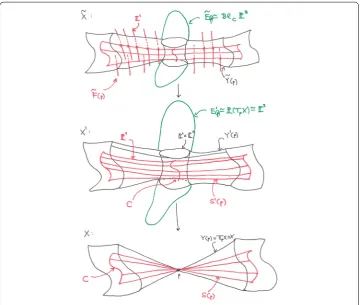
and we can construct Xin two stepsX //X //X, where each map is a blowup in a certain smooth center. See Fig.1for a schematic picture, which we will explain now in some more detail.
The embedded tangent hyperplaneTpXintersectsXin a cubic threefoldY(p) with a
node atp; the lines onXthroughpsweep out a surfaceS(p) which coincides with the surface of lines onY(p). The tangent cone toY(p) inpis a cone over a smooth quadric QP1×P1in the hyperplaneP3∞⊂TpX, andS(p) is a cone over a curveCof bidegree
(3,3) inQ. The indeterminacy locus ofσpisS(p), andσpcontractsY(p) to the pointp.
Definition 5.1 We call a pointp∈X goodifCis a smooth curve.
A general pointpwill be good. To simplify, we will only consider reflections in good points in the sequel. Now X //X is the blowup of X in pwith exceptional divisor E(p) P(TpX) P3. InsideE(p) we retrieveQ P1×P1as the set of all tangent
directions of smooth curve germs inY(p) throughp, and inside this, there is a copy ofC, the set of directions of lines onXthroughp. The strict transformY(p) ofY(p) onXis the blowup ofY(p) in the node, which gets replaced byP1×P1Q. The strict transform S(p) ofS(p) onXis smooth becausepis a good point.
NowX //Xis the blowup ofXinS(p). We call the resulting exceptional divisorF(p). It is aP1-bundle overS(p). The strict transform ofY(p) onXis calledY(p). The strict transform ofE(p) onX, denoted byE(p), is the blowup ofE(p) inC. We also denote by
Hthe pullback of a hyperplane sectionHtoXvia the modificationX //X.
[image:15.595.118.479.403.708.2]Proposition 5.2 (1) The classesH ,E(p),F(p)are a basis ofPic(X). Moreover,
Y(p)≡H−2E(p)−F(p) (5.1)
and
(σp)∗(H)≡2H−3E(p)−F(p), (5.2)
(σp)∗(E(p))≡Y(p)≡H−2E(p)−F(p), (5.3)
(σp)∗(F(p))≡F(p). (5.4)
(2) We have
(σp)∗(H)·Y(p)≡0, (5.5)
H·E(p)≡0. (5.6)
(3) We have
(σp)∗(H)2≡2H2+3E(p)·E(p)−F(p)·H+E(p)·F(p), (5.7)
−Y(p)2≡H2−2−E(p)2−H·F(p)+E(p)·F(p). (5.8)
Proof Part (1) is straightforward and can be found in [4, Sect. 3, Prop. 3.2 ff]. As for (2), note that by the projection formula
(σp)∗(H) ·Y(p)≡H·(σp)∗(Y(p))≡H·E(p)≡0
since a general hyperplane sectionHofXdoes not meetp. For (3) we compute
(σp)∗(H)2≡(σp)∗(H)·(σp)∗(H) −(σp)∗(H)·Y(p)
≡(σp)∗(H)·((σp)∗(H)−Y(p))
≡(2H−3E(p)−F(p))·(H−E(p))
≡2H·H−3H·E(p)−H·F(p)−2H·E(p)+3E(p)·E(p)+F(p)·E(p) ≡2H·H+3E(p)·E(p)−F(p)·H+E(p)·F(p),
where one uses the second formula of (2) (H·E(p) ≡ 0) in the last step and the first formula of (2) in the first step. Now
−Y(p)2≡(σp)∗(H) ·Y(p)−Y(p)2
≡((σp)∗(H) −Y(p))·Y(p)
≡(H−E(p))·(H−2E(p)−F(p))
≡H2−2H·E(p)−H·F(p)−E(p)·H(p)+2E(p)2+E(p)·F(p) ≡H2+2E(p)2−H·F(p)+E(p)·F(p).
Now we pass to an iterative setup again. Namely, consider a sequence of points{pi}i=1,2,...
onXand the corresponding sequence of reflections{σpi}i=1,...Take a surfaceS0⊂Xwhich
is the intersection of two very general elements inH, and leth0⊂S0be the intersection
surface and a smooth cubic curve on X. We want to study the successive birational transforms ofS0andh0when we applyσp1, thenσp2,σp3 and so forth. In particular, we
want to study the degrees of those birational transforms. Let
d1(i), d2(i)
be the degrees, respectively, of the birational transforms ofh0resp.S0underσpi◦· · ·◦σp1.
To study iterates of a single map, let us assume that the sequence of points isperiodic with period N, i.e.,
pi+N =pi ∀i.
Let us also assume that all the pointspiaregood. The growth rates of the degreesd1(i)resp.
d2(i)fori //∞are then the first resp. second dynamical degrees of the composite
σpN ◦ · · · ◦σp1.
To compute the degrees, we first define a sequence of auxiliary surfacesSiwith morphisms
si: Si //X inductively as follows: fori = 0, S0has already been defined, ands0is the
inclusion intoX. Suppose nowsi: Si //Xhas been defined. Look at the commutative
diagram
Si+1
πi+1
si "" E E E E E E E E
si+1
Xi+1 μi+1
σpi+1 //
Xi+1 μi+1
Si
si //
<< y y y y y X σ
pi+1
// _ _ _ _ X. (5.9)
Hereμi+1: Xi+1 //Xis the modification described above: blow up the pointpi+1on
X and then the strict transform of the surface of lines through pi+1. The morphism πi+1: Si+1 //Si is a composite of blowups in reduced points, constructed in the way
described at the beginning of this section, such that the diagonal dotted arrow becomes a morphismsi. Thensi+1is simply the composite
si+1=μi+1◦σpi+1 ◦si.
Now, in the notation of Proposition5.2, we have divisor classesHi+1,E(pi+1),F(pi+1),Y
(pi+1) and (σpi+1)∗(Hi+1) onXi+1and we give names to their pullbacks viasitoSi+1:
Di+1:=(si)∗((σpi+1)∗(Hi+1)),
Ei+1:=(si)∗(E(pi+1)),
Fi+1:=(si)∗(F(pi+1)),
Yi+1:=(si)∗(Y(pi+1)).
Note that by the commutativity of the diagram (5.11), the equality
(si)∗(Hi+1)=(si)∗(μi+1H)=πi∗+1s∗iH
=π∗
i+1(s∗i−1σp∗iμ
∗
holds, so we do not need a new name for (si)∗(Hi+1). Then the morphismsi: Si //X
is defined by the linear system|Di|, i.e.,s∗i(H) = Di. Moreover, we make the following
simplifying notational convention: if some divisor classDlives onSj, then for anyi> j
we denote the pullback ofDtoSivia the composite
Si πi //. . .
πj+1 //
Sj
simply by the same letterD. Thus, for example,h0⊂S0defines a class on each surfaceSi
by pullback, and we denote all of them by the same letter, where, in a given equation, the context makes it clear on whichSithis holds.
Now all Eqs. (5.1)–(5.8) give equations on any surfaceSi+1by pulling the divisors back
viasi. However, we want to impose a certain genericity condition on the pointsp1,. . ., pN
such that these equations take a simpler form.
Assumption 5.3 TheN-periodic sequence of good pointspican be chosen such that for
a very generalS0andh0, the following equations hold on any blown-up surfaceSi+1:
Fi+1· Di =0, Ei+1·Fi+1=0.
In fact, we will assume something a little bit stronger, which implies the previous assumption, but can be expressed more geometrically in terms of the successive bira-tional transforms ofS0:
Assumption 5.4 TheN-periodic sequence of good pointspican be chosen such that for a
very generalS0andh0, the surfacesi(Si)⊂Xisσpi+1-adapted in the sense of Definition4.2
except for the following phenomenon which we allow to cause failure ofσpi+1-adaptedness:
for a pointpkthere can be a pointpτ(k)such that all points
σpl ◦ · · · ◦σpk+1(pk), k≤l≤τ(k)−2
land in the open set whereσpl+1 is a local isomorphism onto the image, and
pτ(k)=σpτ(k)−1◦ · · · ◦σpk+1(pk).
Moreover, the birational transformsτ(k)−1(Sτ(k)−1)⊂X is such that its strict transform
inXτ(k)(obtained fromXby blowing up the pointpτ(k)) meets the exceptional divisor in a
curve,Γτ(k)say, whichdoes not coincide withthe curveCτ(k)of directions of lines through
pτ(k). In fact, this condition ensures thatEτ(k)·Fτ(k)=0 onSτ(k): this is clear ifΓτ(k)and Cτ(k)are even disjoint; but if they meet in only finitely many points, then, looking back at Fig.1, we find thatSτ(k)can be viewed as a blowupπ: Sτ(k) //Sτ(k)of a surfaceSτ(k) such thatEτ(k)is a pullback of a divisor onSτ(k)andFτ(k)is exceptional forπ.
Intuitively, we can express Assumption5.4by saying that we allow a curve in a certain birational transform ofS0to be contracted to a reflection pointpk at some stage of the
iteration, and this point then wanders around, always staying in the domain of definition and away from the exceptional locus of the respective next reflection, until at some later time it gets mapped topτ(k)after applyingσpτ(k)−1. We then also assume that the directions
of smooth curve germs which lie on the birational transformsτ(k)−1(Sτ(k)−1) ⊂ X and
which pass throughpτ(k)are not identical with the directions of lines throughpτ(k).
In this way, we will always have Ei+1· Fi+1 = 0 under Assumption 5.4 as well
attached as indeterminacy loci to subsequent reflections only in points. Thus Assump-tion5.4is stronger than Assumption5.3. Moreover, we then have thesuccessor function
τ: N //N∪ {∞}, which associates withkthe valueτ(k) ifpkgets mapped topτ(k)after
a while as in Assumption5.4, or is equal to∞if there is no successor (if the point never gets mapped unto another reflection point).
For the time being, we will not discuss whether the genericity Assumption5.4can be satisfied by a certain configuration of pointsp1,. . ., pNonX. Also, this is not so important
from our point of view. Rather, we would like to demonstrate that one can prove that some property (P) of dynamical degrees forces special geometric configurations onX, or conversely, that for suitably general configurations, the dynamical degrees fail to have property (P), if the configuration is realizable. The following result is a sample for this.
Theorem 5.5 Suppose that {pi} is an N -periodic sequence of good points on X which
satisfy Assumption5.4. Then the first and second dynamical degrees of the map
σpN ◦ · · · ◦σp1
are equal.
Proof Under the hypotheses, we have the equations onSi+1
Di2+1=2Di2+3Ei2+1, −Yi2+1=Di2−2−E2i+1
from (5.1), (5.2), and from (5.7) and (5.8)
Di+1·h0=2Di·h0−3Ei+1·h0,
Yi+1·h0=Di·h0−2Ei+1·h0
sinceFi+1.h0=0 becauseFi+1lies over points inS0. Note that these equations are valid
universally, butEi+1may very well be zero, and indeed will be unlessi+1 is of the form τ(k). Now note that
d2(i+1)=D2i+1, d1(i+1) =Di+1·h0
and abbreviate
t2(i+1):= −Yi2+1, t1(i+1):=Yi+1·h0.
Moreover, note that under our geometric Assumption5.4, we have
Eτ(k)=Yk.
Thus we get the recursions
d2(i+1)=2d(2i)−3t2(τ−1(i+1)), (5.10) t2(i+1)=d2(i)−2t2(τ−1(i+1)), (5.11) where we agree to put
t2(τ−1(i+1)):=0 if τ−1(i+1)= ∅ by definition. Also,
Note thatτ−1(1)= ∅. Hence, the two sequencesd1(i)andd2(i)are determined by the same set of recursions, starting fromd1(0) = d2(0) = 3, t1(0) = t2(0) = 0, and thus coincide. In particular, the first and second dynamical degrees ofσpN ◦ · · · ◦σp1are equal.
Remark 5.6 In the setup of Theorem5.5, put
C:=l.c.m.i=1,...,N
N,τ(1)−1,τ(2)−2,. . .,τ(N)−N.
Then the recursions (5.11), (5.12) resp. (5.13), (5.14) show that there is a 2C×2Cmatrix M(with constants as entries) such that for the vectors
v1(i)=d1(C+iC),. . ., d1(1+iC), t1(C+iC),. . ., t1(1+iC), v(2i)=
d2(C+iC),. . ., d2(1+iC), t2(C+iC),. . ., t2(1+iC)
,
we have
v(1i+1)=Mv(1i), v(2i+1)=Mv(2i).
This can be used to compute the dynamical degrees for concretely given successor func-tionsτ. Under certain generality assumptions, they will be equal to the spectral radius of M.
Author details
1Mathematics Institute, University of Warwick, Coventry CV4 7AL, England, UK ,2Fachbereich Mathematik der Universität Hamburg, Bundesstraße 55, 20146 Hamburg, Germany.
Acknowledgements
We would like to thank Miles Reid for useful discussions. We are grateful to the referee for many helpful suggestions. Christian Böhning: Supported by Heisenberg-Stipendium BO 3699/1-2 of the DFG (German Research Foundation) during the initial stages of this work. Pawel Sosna: Partially supported by the RTG 1670 of the DFG (German Research
Foundation).
6 Appendix: Inner product structures and generalized Picard–Manin spaces Another strong source of inequalities for dynamical degrees is the phenomenon of hyper-bolicity; Picard–Manin spaces and associated hyperbolic spaces have so far been stud-ied mainly for divisors on surfaces by Cantat, Blanc et al., see also [12, Sect. 2], for a survey. We want to show that something similar can be done under much more gen-eral circumstances, using cycles of higher codimension and the Hodge–Riemann bilinear relations/the Hodge index theorem in higher dimensions. For definiteness, we will deal with fourfoldsXhere only, and considerH2(X), i.e., codimension 2 algebraic cycles mod-ulo homological equivalence, on them. However, the inner product structures we will produce on our infinite-dimensional spaces will be more complicated than Euclidean or hyperbolic.
For a smooth projective fourfoldsXand a surjective birational morphismπ: Y //Xof another smooth projective fourfoldsYontoX, where we also assume thatπis a succession of blowups along smooth centers, we can consider the induced linear maps on cycle classes (which we take with real coefficients for convenience now)
π∗: HR2(Y) //HR2(X), π∗: HR2(X) //HR2(Y).
Definition 6.1 The generalized Picard–Manin spaces are given as follows: as a projective limit with respect to the pushforward maps
H2(X)proj:= lim←−
Y≥X
HR2(Y)
or as an injective limit using the pullback maps
H2(X)inj:= lim
− //
Y≥X
HR2(Y).
The projection formula shows that there is an injectionH2(X)inj⊂H2(X)proj; an
anal-ogous result holds for curves on surfaces, where the space constructed via the injective limit is sometimes called the space of Cartier classes on the Zariski–Riemann space (or Picard–Manin space), and the projective limit is called the space of Weil classes. We will work with the injective limit construction in the sequel.
Each of the spacesHR2(Y) carries an inner product (·,·), the (non-degenerate)intersection form. The pullback mapsπ∗ are isometries for birational proper mapsY //X. Hence H2(X)injcarries the structure of an infinite-dimensional inner product spaceE(X). The
advantage of this is that any birational mapf: XXinduces anisometry fE∗(X)ofE(X): if an elementα ∈ H2(X)injis represented by a classα1 ∈ H2(X1)Rwhereπ: X1 //X
dominatesX, then there is a modelp: X1 //Xsuch thatf := π−1◦f ◦p: X1 //X1
is a morphism. Thenf∗(α1) represents the image underfE∗(X)ofα1inE(X). This gives a well-defined map since for any two models we can find a third dominating both of them. Also
fE∗(X): E(X) //E(X) is clearly an isometry.
Note that for an ample classhonX, the dynamical degrees off are given by the growth behavior of the inner products onE(X):
(fE∗(X))n(hk), h4−k
so the dynamics of these isometries is important to study.
Let us investigate the signature of the inner product/non-degenerate bilinear form on
E(X) more concretely: first, for theH2,2-part of the middle cohomology of a fourfolds, we have the (orthogonal with respect to the intersection form) Lefschetz decomposition
H2,2=L0Hprim2,2 ⊕L1Hprim1,1 ⊕L2Hprim0,0 .
HereLis the Lefschetz operator, and the subscript prim denotes primitive cohomology, for a choice of an ample class. Moreover, the intersection form onLrHprima,b is definite of signature (−1)a, andha,bprim=ha,b−ha−1,b−1. Hence the signature onH2,2(X) of a fourfolds Xis
For a blowupXZofXin a smooth centerZof codimensionr, we have the decomposition
of Hodge structures, see, for example, [11, Thm. 7.31]:
H4(XZ,Z)=H4(X,Z)⊕ r−2
i=0
H4−2i−2(Z,Z),
where we shift the weights in the Hodge structure onH4−2i−2(Z,Z) by (i+1, i+1) to obtain a Hodge structure of weight 4 (and endow the intersection form on it with a sign if we want the decomposition to be compatible with inner products). We also always have the equalityh1,1(X
Z)=h1,1(X)+1. Now suppose
(1) Z is a point: thenh2,2(XZ) = h2,2(X)+1, and by (4.1), the inner product, if we
imagine it to be diagonalized overRto be given by a matrix with+1’s and−1’s on the diagonal, changes by adding one copy of−1.
(2) Zis a curveC: thenh2,2(XZ)=h2,2(X)+h1,1(C)+h0,0(C)= h2,2(X)+2, and by
(4.1) the inner product on the new vector space (which is two dimensions bigger) changes by adding one copy of+1 and one of−1.
(3) Zis a surfaceS: thenh2,2(XZ)=h2,2(X)+h1,1(S), the newH2,2is bigger byh1,1(S)
dimensions, and the inner product changes by addingh1,1(S)−1 entries+1 and one entry−1.
Now, let us specialize to cubic fourfolds. In this case, we can also describe the process on our real algebraic cyclesH2(X)R(Hodge classes, since the Hodge conjecture holds for a cubic fourfolds; in fact, the Hodge conjecture even holds over the integers in this case, but we work overRin order to be able to describe the intersection form as well) now: if
XZ //Xis obtained by blowing up a point, thenH2(XZ)Ris one dimension bigger than H2(X)Rand the intersection form described by adding a−1 along the diagonal; if it is obtained by blowing up a curve, thenH2(XZ)Ris two dimensions bigger, and we add a +1 and a−1 along the diagonal for the new intersection product; ifXZ is obtained by
blowing up a surface, then H2(XZ)Ris bigger by the Picard rankρ of the surface, and we addρ−1 entries+1 and one entry−1 along the diagonal for the new intersection product.
LetEP(NZ/X) be the exceptional divisor andp: E //Zthe induced map. The extra
cycles inH2(XZ)Rcan be described as the pullbacks viapof (1) the pointZifZis a point, (2) the curveZ and a point on it ifZ is a curve, (3) curves onZ ifZ is a surface, each time intersected with an appropriate powerHEi of the relative hyperplane classHEof the
projective bundleEto get an algebraic 2-cycle. Thus, ifZ is a surface, for example, we pull back curves on it toE, which is aP1-bundle, to get surfaces onXZ. IfZis a curve,E
is aP2-bundle over it, and we get two extra surfaces as the class of a fiber andHE(pushed
forward to X). For a point, we get a P3-bundleE over it, and one additional algebraic 2-cycle, namelyHE, pushed forward toX.