Original citation:
Wakenshaw, Susan Y. L., Maple, Carsten, Chen, Daqiang and Micillo, Rosario (2017) An
IoT-enabled supply chain integration framework : empirical case studies. In: 15th International
Conference on Manufacturing Research (ICMR 2017), London, UK, 5-7 Sep 2017. Published
in: Advances in Manufacturing Technology XXXI, 6 pp. 263-268.
Permanent WRAP URL:
http://wrap.warwick.ac.uk/93830
Copyright and reuse:
The Warwick Research Archive Portal (WRAP) makes this work by researchers of the
University of Warwick available open access under the following conditions. Copyright ©
and all moral rights to the version of the paper presented here belong to the individual
author(s) and/or other copyright owners. To the extent reasonable and practicable the
material made available in WRAP has been checked for eligibility before being made
available.
Copies of full items can be used for personal research or study, educational, or not-for-profit
purposes without prior permission or charge. Provided that the authors, title and full
bibliographic details are credited, a hyperlink and/or URL is given for the original metadata
page and the content is not changed in any way.
Publisher’s statement:
Copyright 2017, reproduced with permission from IOS Press
www.iospress.nl
“The final publication is available at IOS Press through
https://doi.org/10.3233/978-1-61499-792-4-263
A note on versions:
The version presented here may differ from the published version or, version of record, if
you wish to cite this item you are advised to consult the publisher’s version. Please see the
‘permanent WRAP URL’ above for details on accessing the published version and note that
access may require a subscription.
An IoT-enabled Supply Chain
Integration Framework: Empirical Case
Studies
Susan Wakenshaw a,1, Carsten Maple a, Daqiang Chen b, Rosario Micillo a
aWMG, University of Warwick, UK bZhengjiang Gongshang University, China
Abstract. Supply chain integration is crucial for supply chain performance, particularly in industry 4.0. With the proliferation of Internet of Things (IoT) and the use of cyber-physical systems, supply chain integration needs to be greatly enhanced. In this paper, we explore supply integration (process and application) in the supply chain network enabled by IoT. Using the case study method, we investigate technical and business applications of IoT in supply chains and how it can interface with the process integration within the CPFR reference model. The project is ongoing and here we report the preliminary findings.
Keywords.Internet of Things; supply chain integration; case study; CPFR.
1.Introduction
The proliferation of Internet of things (IoT) and services, and the use of cyber physical systems (CPS) has introduced the fourth phase of industrialisation, termed “Industry 4.0”. Industry 4.0 will shift centralised production towards decentralised production, shift standard products towards personalised products and increase user participation in creating products [1]. Supply chain integration and coordination among organisations are crucial to enable each piece of manufacturing equipment (cyber-physical-production systems, CPPS) to accomplish the needed activities in creating each tailored product, so as to meet the needs of the ultimate customers of the supply chain[2]. Supply chain integration entails process and application integration [3, 4]. Application integration includes both technical applications and business applications. Pang et al [5] propose a framework for IoT enabled application integration in food supply chains. Sanders (2016) describes the business application corresponding to data analytics in the supply chain. We argue that these application integrations can be combined with process integration to achieve stronger supply chain integration. The Collaborative Planning, Forecasting and Replenishment (CPFR) reference model was developed by
1
the Voluntary Interindustry Commerce Standards (VICS) committee for enhancing supply chain collaboration [6]. The CPFR reference model provides a general framework for the collaborative aspects of planning, forecasting and replenishment processes (p.6). In the era of IoT, the application integration framework (e.g. [5];[7]) could be crucial for the application of the CPFR reference model [6]. This paper aims to investigate the interface between application integration and process integration in supply chains, with the purpose of achieving supply chain integration in IoT-enabled supply chain networks. The paper empirically investigates two cases. One is a benchmark case, in the supply chain of which there is no deployment of IoT. With respect to this case study, we focus our attention on application integration by examining (1) opportunities for IoT deployment and the associated security issues and risks, and (2) business analytics and decision-making enhanced by these analytics. In terms of process integration, we map these analytics and decision-making within the CPFR framework. A second case we focus on is an exemplar, in the supply chain of which IoT solutions have been used. We empirically examine (1) IoT solutions and security issues; and (2) business analytics and decision-making with IoT data within the CPFR framework. Based on these two cases, we develop a framework for supply chain integration in an IoT-enabled supply chain network.
2.RFID and Internet of Things in Supply Chain
3.CPFR processes and CPFR model
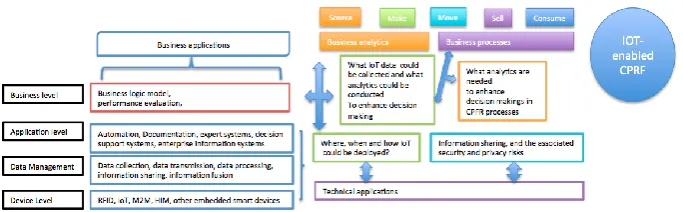
[image:4.595.128.470.470.576.2]CPFR is defined as “a business practice that combines the intelligence of multiple trading partners in the planning and fulfilment of customer demand” [15]. The CPFR process involves (1) An interactive cycle of four main collaborative activities (including Strategy & Planning; Demand & Supply Management; Execution; and Analysis); (2) A set of specific tasks for retailers and manufacturers respectively, as well as collaborative tasks. As early as 2004, it is suggested that many CPFR solutions enabled by specialised technology could facilitate the process, including: Sharing forecasts and historical data; Automating the collaboration arrangement and joint business plan; Evaluating exception conditions; and Enabling revisions and commentary[15]. Indeed, Liu and Sun [6] have illustrated information flow and integration for the CPFR model and for the IoT enabled CPFR model in the automotive supply chain (p.352-353). It is clear that the potential of IoT solutions embedded in a CPFR process and used for supply chain integration is enormous. However, the application of IoT in CPFR processes remains very challenging. In particular, application integration is crucial for the deployment of IoT to enhance process integration and supply chain integration. Business applications enabled by IoT data could affect the short-term demand as well as supply management and execution at the operational level, and could also affect long-term joint planning and collaborative relationships. These issues need to be addressed at intra-organisational, inter-organisational and cross-inter-organisational levels for high level supply chain coordination and integration. We suggest that the CPFR process fits into the ‘Business level” in Pang et al[5]’s framework.
Figure 1.An IoT- enabled supply chain integration framework. .
strategic decisions (such as collaborative relationships) and joint planning; how these analyses could enhance short-term supply and demand management and execution at the operational level.
4.Method
A case study methodology was adopted [16] for our study. It is suggested that case studies allow researchers to investigate micro-level activities[17], dynamic phenomenon unfolding over a period of time [18], and enable a deep understanding of the contextual setting [19]. It is suggested that “a more common application of a case study research is to build theory that can then be tested using further case studies, survey data, or another relevant method” [20]. We use semi-structured interviews to collect data and qualitative analysis to gain insights into the questions we ask. These insights enable us to develop a detailed framework for IoT enabled supply chain integration, which could be validated by further cases and surveys. We select two cases: Company A is a big construction company with a predetermined demand and has not deployed IoT in their supply chain. This case would be used as a benchmark and allow us to identify the gaps and opportunities for improving application integration and the potential of IoT for transforming process integration. Company B is a coffee franchise with a customer demand-driven supply chain and has deployed IoT solutions in their supply chain. This case enables us to investigate how IoT has affected application integration and process integration using the CPFR framework.
5.Preliminary findings
5.1 Information sharing and information integration in supply chains
Company B. The Company B information integration model could represent the Information integration of CPFR for the automotive supply chain proposed by Liu and Sun [6] which includes: (1) sharing information flow: real time inventory levels, POS, sales forecast, promotion plans, and (2) sharing real-time IoT data (things data) across the whole supply chain. We suggest that the model employed by Company B could be useful if we could explicitly adopt CPFR processes and further exploit the potential of IoT for enhancing the CPFR process in supply chain networks.
5.2. Decision-making in the supply chain
One important component of CPFR is business analytics. Indeed, with the deployment of IoT, the supply chain generates huge amounts of data that companies could
transform into intelligence. It is obvious that IoT data would improve the decision-making for “demand and supply management” and “execution” at the operational level. The benefits of IoT applications for supply chains has been well documented [5]. These benefits are primarily derived from traceability and tracking of material/products in the supply chain enabled by IoT. However, at the strategic level, how to make joint planning and make and sustain collaborative relationships in IoT-enabled supply chain needs to be further explored. Moreover, the analytical applications, such as supplier negotiation and sourcing channel options, are identified with decisions based on supplier performance KPIs such as cost, time, quality, flexibility and innovation. How could IoT affect these KPIs? Do we need to develop new KPIs for evaluating supplier performance? The interview with company A has revealed the potential of IoT for enhancing decision making, collaborative activities at project level. In order to enhance supply chain integration at strategic level, there are many challenges such as culture, skill sets and awareness, objectives, top management commitment etc.
5.3. IoT deployment in supply chain network
A paramount concern emerging from the analysis is the security concerns and risks associated with information sharing in the supply chain between secure environments and more primitive and unsecure environments. This would affect information sharing in the supply chain network. It is crucial to ensure that information sharing is secure in the whole supply chain network. In practice, many solutions have been proposed for the secure sharing and secure collaboration services, secure automation services (by adopting some technologies such as hybrid clouds), distributed ledgers, encrypted data brokers, and assured autonomous agents. The key issues are how to balance the cost of the security solutions and its benefits, and the risks for the deployment of IoT systems in the supply chain network. In order to address these issues, we need to consider technical, organisational and environmental factors.
6.Discussions
sector-specific features of supply chains, we need to develop a generic framework by studying different scenarios and using family resemblances to develop a typology of various models and frameworks to fit into industrial contexts. Moreover, it can be seen that with the integration of the CPFR process, in concert with the deployment of IoT, supply chain integration can be enhanced.
References
[1]Zhou, K.L., T.G. Liu, and L.F. Zhou, Industry 4.0: Towards Future Industrial Opportunities and
Challenges. 2015 12th International Conference on Fuzzy Systems and Knowledge Discovery (FSKD), 2015: p. 2147-2152.
[2]Zelbst, P.J., et al., RFID utilization and information sharing: the impact on supply chain performance.
Journal of Business & Industrial Marketing, 2010. 25(8): p. 582-589.
[3]Wolfert, J., et al., Organizing information integration in agri-food-A method based on a service-oriented
architecture and living lab approach. Computers and Electronics in Agriculture, 2010. 70(2): p. 389-405.
[4]Xu, L.D., Information architecture for supply chain quality management. International Journal of
Production Research, 2011. 49(1): p. 183-198.
[5]Pang, Z.B., et al., Value-centric design of the internet-of-things solution for food supply chain: Value creation, sensor portfolio and information fusion. Information Systems Frontiers, 2015. 17(2): p. 289-319.
[6]Liu, X. and Y. Sun, Information integration of CPFR in inbound logistics of automotive manufactures based on internet of things. Journal of Computers, 2012. 7(2): p. 349-355.
[7]Sanders, N.R., How to Use Big Data to Drive Your Supply Chain. California Management Review, 2016.
58(3): p. 26-48.
[8]Li, L. Application of the internet of thing in green agricultural products supply chain management. in
Intelligent Computation Technology and Automation (ICICTA), 2011 International Conference on. 2011. IEEE.
[9]Kulp, S.C., H.L. Lee, and E. Ofek, Manufacturer benefits from information integration with retail
customers. Management Science, 2004. 50(4): p. 431-444.
[10] Cai, S.H., M. Jun, and Z.L. Yang, Implementing supply chain information integration in China: The role of institutional forces and trust. Journal of Operations Management, 2010. 28(3): p. 257-268.
[11] Green, K.W., D. Whitten, and R.A. Inman, The impact of timely information on organisational
performance in a supply chain. Production Planning & Control, 2007. 18(4): p. 274-282.
[12] Gattiker, T.F. and D.L. Goodhue, What happens after ERP implementation: Understanding the impact
of interdependence and differentiation on plant-level outcomes. Mis Quarterly, 2005. 29(3): p. 559-585.
[13] Lambert, D.M., M.C. Cooper, and J.D. Pagh, Supply chain management: implementation issues and
research opportunities. The international journal of logistics management, 1998. 9(2): p. 1-20.
[14] Kocoglu, I., et al., The effect of supply chain integration on information sharing: Enhancing the supply
chain performance. Proceedings of 7th International Strategic Management Conference, 2011. 24. [15] Pfeifer, C., et al., Investigation of opportunities that exist within the Automotive supply chain for
Collaborative Planning Forecasting and Replenishment (VICS CPFR). University of Bolton,
http://www. vics. org/docs/committees/cpfr/cpfr_white_pa pers/CPFR_for_Automotive_Industry. pdf-accessed on, 2008. 28: p. 2012.
[16] Flyvbjerg, B., Five misunderstandings about case-study research. Qualitative Inquiry, 2006. 12(2): p. 219-245.
[17] Perks, H., T. Gruber, and B. Edvardsson, Co-creation in Radical Service Innovation: A Systematic Analysis of Microlevel Processes. Journal of Product Innovation Management, 2012. 29(6): p. 935-951.
[18] Eisenhardt, K.M., BUILDING THEORIES FROM CASE-STUDY RESEARCH. Academy of
Management Review, 1989. 14(4): p. 532-550.
[19] Yin, R.K., Case study research: design and methods, Applied social research methods series. Thousand
Oaks, CA: Sage Publications, Inc. Afacan, Y., & Erbug, C.(2009). An interdisciplinary heuristic evaluation method for universal building design. Journal of Applied Ergonomics, 2003. 40: p. 731-744.
[20] Ellram, L.M., The use of the case study method in logistics research. Journal of business logistics, 1996.