http://wrap.warwick.ac.uk
Original citation:Harrison, Mark, 1949- (2014) Capitalism at war. In: Neal, Larry and Williamson, Jeffrey G., (eds.) The Cambridge History of Capitalism. Cambridge: Cambridge University Press, pp. 348-383. ISBN 9781107036949
Permanent WRAP url:
http://wrap.warwick.ac.uk/63112
Copyright and reuse:
The Warwick Research Archive Portal (WRAP) makes this work by researchers of the University of Warwick available open access under the following conditions. Copyright © and all moral rights to the version of the paper presented here belong to the individual author(s) and/or other copyright owners. To the extent reasonable and practicable the material made available in WRAP has been checked for eligibility before being made available.
Copies of full items can be used for personal research or study, educational, or not-for profit purposes without prior permission or charge. Provided that the authors, title and full bibliographic details are credited, a hyperlink and/or URL is given for the original metadata page and the content is not changed in any way.
Publisher’s statement:
Published inThe Cambridge History of Capitalism. © Cambridge University Press 2014.
Link to publisher’s website for the book:
http://www.cambridge.org/gb/academic/subjects/history/economic-history/cambridge-history-capitalism
A note on versions:
The version presented here may differ from the published version or, version of record, if you wish to cite this item you are advised to consult the publisher’s version. Please see the ‘permanent WRAP url’ above for details on accessing the published version and note that access may require a subscription.
First draft: June 13, 2011. This version: December 20, 2012. Mark Harrison*
Department of Economics and CAGE, University of Warwick Centre for Russian and East European Studies, University of Birmingham
Hoover Institution on War, Revolution, and Peace, Stanford University
Abstract
The nineteenth century witnessed the triumph of capitalism; the twentieth century saw the bloodiest wars in history. Is there a connection? The paper reviews the literature and evidence. It considers first whether capitalism has lowered the cost of war; then, whether capitalism has shown a preference for war. Both questions are considered comparatively. Neither question receives a clear cut answer, but to simplify: Yes; No.
Keywords: Capitalism, Corporate Political Action, Keynesianism, Public Finance, State Capacity, Trade, War.
JEL Codes: N4, P1.
* Mail: Department of Economics, University of Warwick, Coventry CV4 7AL, United Kingdom. Email:[email protected]. This paper is in
preparation forThe Cambridge History of Capitalism, edited by Larry Neal and Jeff Williamson. Earlier versions were presented at the German Historical Institute in Moscow as one of “Ten Lectures about the War,” June 17 and 18, 2011, the XVI World Economic History Congress, Stellenbosch University, South Africa, July 9 to 13, 2012, and a conference on the Economic History of
Capitalism, BBVA, Madrid, November 14 to 16, 2012. I thank Hein Klemann, Sergei Kudriashov, Andrei Markevich, Richard Overy, Leandro Prados de la Escosura, James Robinson, and other participants for discussion; Sascha O. Becker, Michael S. Bernstam, Nick Crafts, Erik Gartzke, and Vasily Zatsepin for comments and advice; Jari Eloranta for access to data; Larry Neal and Jeff
First draft: June 13, 2011. This version: December 20, 2012. “Capitalism means war.” Béla Kun, cited by Daniel Guérin (1938).
The nineteenth century witnessed the triumph of capitalism (see volume 2, chapter 1 by O’Rourke and Williamson); the twentieth century saw the bloodiest wars in history. Both war and society were transformed; what was the link? In what ways did capitalism transform warfare? Was the capitalist system
responsible for spreading or facilitating war, or for the rising toll of war deaths? To some, the connection is so obvious that it has required only illustration. Table 1, from a classic work by the Soviet demographer Boris Urlanis, is an example; the pattern of interest is the rising trend in the final column.
Table 1 near here.
Modern scholarship would qualify this picture in three ways. First, it captures only a narrow band in the overall spectrum of violence in society. This spectrum runs all the way from ordinary homicide through the violence
associated with organized crime to social and political strife, civil war, and inter-state conflict. The data generated for Table 1 omit a large part, and possibly the larger part of this spectrum. Estimates of the incidence of deaths from violence of all types in society over the last ten thousand years are suggestive of a great decline that continues to the present day. If more people died of violence in the age of imperialism it was not because there was more violence at that time but because more people lived in that era than ever before (Gat 2006; Pinker 2011).
Second, if we limit our focus to conflicts among states, the two World Wars of the first half of the twentieth century continue to be recognized as the greatest wars in history. In contrast the second half of the century was more peaceful on a variety of measures (Kristian Gleditsch 2004; Nils Gleditsch 2008; Hewitt 2008; Pinker 2011; Goldstein 2011). The annual number of wars involving fatalities and the number of military fatalities in each year declined. Despite conflicts associated with the breakup of the Soviet and Yugoslav states in the early 1990s, these downward trends continued through the turn of the century.
What does all this have to do with capitalism? The question is more
complicated than would appear at first sight. First, it raises important issues of identification: what is “capitalism” and what can it mean to say, as some once claimed, that “capitalism means war”? In the second part of the chapter I will ask whether capitalism has affected our choices over war and peace by changing opportunity costs. Specifically, have we had more wars, not because we wanted them, but because we could? In the third part I will ask whether the structure of the capitalist economy has motivated the owners of capital to show some systematic preference for war by comparison with the elites of other systems. Having considered the influence of capitalism on war, the fourth part considers the influences of war on capitalism. The fifth part concludes.
1. Capitalism, Anti-Capitalism, and War
Ricardo (1817) used the word “capitalist” to distinguish the owners of capital from landowners and laborers. But the mere existence of capitalists falls short of implying “capitalism,” an entire economic and social system with private capital ownership at its foundation. In fact, the identity of capitalism was created by its critics, Proudhon (1861) and Marx (1867). Marx, before anyone else, argued that capitalism’s defining features allow us logically to infer distinct and general attributes of capitalism (such as alienation) and propensities (such as the declining rate of profit). In this sense to inquire into whether “capitalism” as such has a propensity for anything, let alone something as emotive as war, is to enter a debate on conceptual territory chosen by the enemies of capitalism.
Second, the histories of capitalism and warfare are certainly intertwined, but not uniquely. War is as old as history; capitalism is not. All societies that have given rise to organized government have engaged in warfare (Tilly 1975). The slave and serf societies and city states of the ancient, classical, and medieval eras made war freely. Turning to modern times, the socialist states of the twentieth century were born in wartime, prepared for war, and did not shrink from the use of military power to achieve their goals. Thinking comparatively, it will not be easy to identify any causal connection between capitalism and war. At most, we will look for some adaptation or propensity for war under capitalism, relative to other systems.
Third, if there is a story here, who are the actors? Capitalism is an economic structure; war is a political act. War can hardly be explained by structure alone, for there is no war without agency, calculation, and decision. Given this, our search must be for aspects of capitalism that may have created incentives and propensities for the political actors to choose war with greater frequency, and made them more willing to impose the increasing costs of war on society than under alternative conditions, real or counterfactual.
From the outset I will follow the definition of capitalism set out by Larry Neal (in volume 1, chapter 1): “1) private property rights, 2) enforceable contracts, 3) markets with prices responsive to supply and demand, 4) supportive
conditions are most likely to be met when government is market,” not “business.” What if that condition is not met? It’s a matter of degree. A pro-business government that favors incumbent firms and receives their loyalty weakens competition, contracts, and property rights. At some point we would move into the territory of “crony capitalism.” Thus, capitalism has varieties.
To define capitalism implies both pre-capitalism and anti-capitalism. In nearly all countries before the seventeenth century there was private property and markets existed, but much production was not marketed and many prices were not free. Contracts were insecure. Rulers tended to be more concerned with their own prerogatives than with accepting and upholding the rule of law. Whatever you call it, this was not capitalism.
In the nineteenth century we had anti-capitalist ideologies and, in the twentieth century, anti-capitalist systems (see volume 2, chapter 2 by Engerman and chapter 9 by Frieden and Rogowski). Notably, there was communism: where they could, the communists abolished private business ownership, suppressed markets, and imposed dictatorship over the law. Communism, also, was clearly not capitalism.
The case of fascism is contested. Was fascism somewhere within the spectrum of capitalisms, or outside it and antithetical to it? “Fascism is war,” wrote Georgi Dimitrov (1936/1972, p. 176). If fascism is capitalism, and fascism means war, then capitalism means war. It is important, therefore, to get this right. Under fascist rule there was dictatorship. The courts upheld the interests of the state, not the rights of the citizen or the rule of law. Private property existed, but property rights were maintained if the government allowed, not otherwise (Overy 1994). Often the government did wish it, viewing contracts with capitalist proprietors as creating the right incentives for efficient procurement (Buchheim 2006). Whether this was a deep conviction or an instrumental motivation is debated; Hitler himself declared on one occasion that family property was a productive institution but joint-stock shareholders were parasites whom the state should expropriate (Trevor Roper 2000, pp. 362-363). As we will discuss below, the national socialist government was neither pro-market nor pro-business in any general sense. It favored those businesses that conformed to its policies, while others, such as businesses owned by Jews, and the aircraft interests of the anti-Nazi Hugo Junkers, were confiscated or driven out. There were markets, but many prices were regulated and the government often rationed goods to producers and consumers.
The communists portrayed fascism as pro-capitalism in disguise. I do not find this convincing. The Nazis did not try to disguise anything else; they were not ashamed to advocate racial hatred and war, for example. Compared with these, being in favor of capitalism would seem a small thing; why would they have wished to hide it? Perhaps we should take them at their word: if this was still capitalism, it was captured by an anti-capitalist political agency. Fascism made property, prices, and contracts conditional on the will of the government. This does not mean that fascism and communism were the same. But the superiority of the state over private interests was something they held in common.
As for capitalism and war there is already a large literature, so we do not start from a blank page. I will mention some highlights as we proceed. I will organize the discussion in the following order. Has the existence of capitalism, in some morally neutral and quite general sense, promoted the capacity for war in global society? Then, does the structure of the capitalist economy exhibit some systematic preference for war in comparison to other systems? I will focus on capitalism in the interstate wars of the twentieth century. In the background of this chapter are the experiences of eighteenth century mercantilism and nineteenth century imperialism (see volume 1, chapter 12 by O’Brien and volume 2, chapter 3 by Austin).
2. The Capacity for War
Has capitalism promoted the capacity for war? Before 1914, many observers of the rise of international business would have answered this question decisively in the negative. Writers like Norman Angell (1911) and Ivan Bliokh (de Bloch 1914) believed that modern capitalism had driven up the opportunity cost of war to a point where the industrial and commercial powers would no longer fight major wars. They were both right and wrong. In the twentieth century the costs of war were unprecedented. As it turned out, however, the costs of not being prepared for war and of not fighting had risen even more rapidly.
Moreover, the heavy costs of warfare proved to be unexpectedly sustainable; it turned out that major industrial economies could bear them for years on end without collapsing. How did this come about?
Military innovation
The relative price of destruction has been falling for centuries. The headlines we pay most attention to may be the big ticket items like interceptor aircraft and warships; when we do that, we may forget that their destructive power has risen more rapidly than the price. Today, you can destroy a city in a flash, and the means will fit in a suitcase. Two generations ago you could do it in a night, but it required not less than a thousand bombers. A few generations before that, to ruin a city took an army weeks or months of unceasing effort, with uncertain results.
It is almost too obvious to say that capitalist industry has hugely affected this process, primarily through mechanization. Capitalism mechanized the
armies. This is so obvious that it may seem impossible to overstate. Yet, it can be overstated, for several reasons.
First, the long term decline in the real price of weaponry did not start with industrial capitalism; the industrial revolution prolonged and speeded up a tendency that was already in place. Philip Hoffman (2010, 2012) has shown that the real price of weapons was falling in the late Middle Ages, long before
capitalism. It fell faster in Europe than elsewhere. Its driver was the battlefield rivalry of princes, not the market competition of capitalist firms. Europe’s lasting comparative advantage in what Hoffman calls the “gunpowder technology” was conditioned on its political divisions, its lack of natural frontiers, and princely competition. Capitalism continued this trend, and was well suited to accelerate it. But capitalism did not start it.
Second, the mechanism of improvement was largely the competition of private producers, but government provided the market, and in the few countries that maintained large defence industries competition was (and remains) highly imperfect. Military-technical innovation is subsidized. Pre-contract lobbying and collusion, among firms and between buyer and seller, and post-contract renegotiation are normal (Rogerson 1994). These standard features of capitalist defence markets were largely replicated under both national socialism and communism (Milward 1965; Overy 1994; Buchheim 2006; Markevich and Harrison 2006; Harrison and Markevich 2008a,b).
If we limit ourselves to the qualitative improvement of military technologies in the twentieth century competition between different social systems, it would appear that the capitalist economies had the edge. But it is hard to tell whether this was a systemic bias (capitalism was better than other systems at this specifically), or an income effect (capitalist economies were richer and so better than other economies at everything, including military-technical innovation).
Fiscal capacity
A more original contribution of capitalism was enormously to enhance the fiscal capacity of the state. This innovation arose from the commercial revolution of the seventeenth and eighteenth centuries. Spreading from the Dutch Republic to England, this revolution separated the economy from politics, and public finance from the money of the king; it subjected property rights, contracts, and exchange to the rule of law, even when one of the contracting parties was the king. The result was a dramatic increase in the willingness of the wealthy to pay taxes and in the ability of the government to borrow (see volume 1, chapters 11 by
Gelderblom and Jonker and 12 by O’Brien; Hoffman and Rosenthal 1997; Bonney 1999; Ferguson 2001; O’Brien 2005, 2011).
Fiscal revolution was delayed, in contrast, in the agrarian states of central and southeastern Europe (Karaman and Pamuk 2010). In World War I, a clear gap emerged between the French and German economies, with half of GDP allocated to the war or more, and Austria-Hungary and Turkey, which struggled and failed to reach one third (Broadberry and Harrison 2005). The inability of the Habsburg and Ottoman rulers to tax, borrow, centralize revenues, and spend them on the war was an important factor in their eventual defeat (Schulze 2005; Pamuk 2005).
The fiscal advantage of liberal capitalism, clearly marked at the beginning of the twentieth century, proved temporary. The 1930s saw the rise of states intent on promoting industrial power where property was less private, contracts less enforceable, prices less responsive to supply and demand, and governments more intent on supporting their own geopolitical agendas than the rule of law and free enterprise. In short, these states were less “capitalist”; we know them as varieties of fascism and communism. During World War II, Britain and America could once again drive their fiscal ratios to half of national income or more, but Germany, Japan, and the Soviet Union could go higher, to 60 or even 70 percent for short periods (Harrison 1998). This was a second fiscal revolution.
If the first fiscal revolution was based on transparency and the rule of law, the second revolution was based on modern nationalism and modern
repression. A nationalist police state proved an effective substitute for
transparent legal regulation. Nationalism and repression gave Hitler, Stalin, and the Japanese military a coercive power to mobilize society and centralize
resources not only far beyond the traditional bureaucracies that they succeeded, but even greater than liberal capitalism. Fascism and ultra-nationalism did not survive 1945, but communism did. The capacity to pour resources into a privileged and prioritized defence sector was the basis of the Soviet Union’s postwar superpower status, achieved despite mediocre economic performance (Harrison 2001, p. 81).
There was another way in which capitalism promoted fiscal mobilization. This was by transforming agriculture. Agriculture was an important source of rents for traditional agrarian bureaucracies, but collecting and centralizing direct revenues from small scale subsistence farmers generally involved high transaction costs and payoff to intermediary landlords and tax farmers. Urbanization and the spread of urban-rural exchange created the possibility of taxing farmers indirectly by turning the terms of trade against them. In fact, such a shift in the terms of trade was an inevitable result of war mobilization, which diverted the production capacities of industry to the supply of war and curtailed supplies to the countryside. Faced with this, pre-capitalist or proto-capitalist farmers retained an “inside” option: to retreat into autarky and feed themselves alone, leaving the food needs of the industrial workers and soldiers unmet (Offer 1989; Broadberry and Harrison 2005). In much of central and eastern Europe in two world wars, a large part of the domestic economy proved able to withhold resources from the grabbing hand of the state. There were local famines and spreading general hunger.
other business to wartime incentives and controls. Agricultural production was quickly expanded (in the British case) and restructured to increase the calorie yield per hectare. There was less butter and meat, and more cereals and potatoes; nobody starved.
The dictators, governing countries with large peasant populations, arrived at contrasting solutions. The Axis powers aimed to avoid having to squeeze their own farmers by imposing starvation on the foreign territories they occupied. Starvation followed, but with disappointing results for domestic food availability (Collingham 2010). Stalin found a more durable solution in collective farming, which was designed to rule out the Soviet peasant’s inside option (Harrison 2011). To enforce collectivization required violence of the level of a civil war, leading to millions of famine deaths. The result was an agricultural system that was less productive but more amenable to government control. It did not prevent further famine deaths in wartime, but it did ensure that the Soviet wartime economy did not disintegrate.
In short, capitalism proved to have advantages in mobilizing resources for warfare. These advantages arose, paradoxically, from the ability of the
government to bind itself by the laws of the state, just like a private person. The advantage was temporary, and was lost when modern dictators learned to break traditional constraints on authoritarian rule.
Managing war risks
Angell (1911) and his followers, such as Cordell Hull (1948), expected globalized capitalism to inaugurate lasting peace because of the interdependence it
enforced upon trading states. International trade, they believed, created complementarities in the world economy, powerful enough to turn national rivals into international partners in a global network of stable, durable supply chains. The closing of borders in times of conflict threatened modern economies with breakdown; global war would bring global collapse. This was an aggregate risk that could not be hedged or laid off. Risk-averse governments would therefore back away from war.
The real historical relationship between war and trade is different. Since the eighteenth century, the economies that were most open to multilateral trade proved also to be strategically more secure. Far from being a source of war risk, long distance trade turned out to be an instrument for managing it. In two world wars, the alliances that were better placed to maintain external economic integration also better managed food resources across countries and fighting power across the theatres of combat (Harrison 1998; Broadberry and Harrison 2005). The countries that had resisted globalization in peacetime suffered local famines and generalized hunger in wartime (Collingham 2010). In short, the “commercial” capacity for war deserves to be ranked alongside the technological and fiscal capacities that made modern mass warfare possible (Harrison and Wolf 2012).1
1The strategic advantage that goes along with being able to trade across the
Martin, Mayer, and Thoenig (2008) show how globalization has helped to manage war risks. Using data from 1970 to 2000, they show that trade has a double effect on the propensity for war. Consider any pair of countries. The more a country traded with its pair, they show, the more likely were the two to remain at peace. But as trade increased with third countries, the less likely was peace to persist. Bilateral trade reduced the frequency of bilateral war; multilateral trade increased it.
At the root of the historical process was falling trade costs (Jacks, Meissner, and Novy 2008). Suppose the leaders of a country have some reason to fight their neighbor. Under high trade costs, the adversary is the only trading partner. There is no substitute for the food and fuel previously imported, so war leads to autarky. The peacetime supply chain is broken; the home prices of food and fuel must rise. The duration of autarky is uncertain, since it depends on how quickly the war can be concluded, which is a matter of chance. As a result, the risk of persistent trade disruption and economic losses is high. When trade costs are low, in contrast, the home country can lay off its war risks in the rest of the world; for example, it can easily substitute away from the neighbor for the source of its imports. The broken supply chain can be replaced with others. Thus, low trade costs enable the home country to fight its neighbor while continuing to trade with the rest of the world.
Falling trade costs, the economic aspect of globalization, reduced the market risks that countries faced as they contemplated war. Did capitalism do this? The modern era is not the first in which trade costs have fallen. Long before modern capitalism, Mediterranean trade was repeatedly transformed by innovations in agriculture, shipping, and contractual institutions. The greatest revolution in global trade, the opening up of the Atlantic economy, came on the eve of the capitalist era (Açemoglu, Johnson, and Robinson 2005). The most that may be said is that the rise of capitalism continued a process that was already under way.
War as a free lunch
There is a persistent view that, without wars, capitalism would fall into depression (e.g. Steindl 1952; Baran and Sweezy 1966). The philosophy of “military Keynesianism” maintains that capitalist economies tend to suffer from a deficiency of demand, and will stagnate without frequent injections of demand
discussions that our societies continue to have about “food security” and “energy security.” Despite two centuries of evidence to the contrary, many people
into the circular flow of income. The deficiency can be made up by debt-financed military spending combined with the Keynesian multiplier. If so, it does not follow that “capitalism means war.” Rather, it implies one more way in which capitalism has reduced the costs of war. In this case, supposedly, capitalism can supply war free of charge. If the weapons and armies were not bought up by the government, the resources they represent would be unused; this would make war a free lunch. The lunch will then be eaten, not because we are hungry, but because it is free.
Three historical examples are frequently cited. One is the German recovery from the Great Depression under Hitler’s four-year plans; there, unemployment fell from 29.9 percent of the working population in 1932 to 1.9 percent in 1938. Joan Robinson (1972, p. 8) started the legend of a Keynesian recovery by proposing that “Hitler had already found how to cure unemployment before Keynes had finished explaining why it occurred.” Another was the vast war boom that followed U.S. entry into World War II; U.S. unemployment fell from 9.5 percent in 1940 (or 14.6 percent, if we include those on “emergency
government employment”) to 1.2 percent in 1944. So strong was the connection that afterwards Paul Samuelson (in 1948, cited by Rockoff 1998, p. 196) likened fiscal policy to the atomic bomb: “Too powerful a weapon to let men and
government play with.” And third is the generally higher level of NATO countries’ military spending at the height of the Cold War compared with previous norms, illustrated in Table 2.
Table 2 near here.
More detailed investigations of these episodes have given little support to the Keynesian interpretation. In the German case, recovery had already begun when Hitler took power. Reconstructing fiscal aggregates from the German archives, Ritschl (2002) shows that full-employment budget deficits were modest until 1936, and too small to account for recovery. Multiplier effects cannot be identified with any confidence because (as modern macro would predict) current household income was one of the least important determinants of consumer spending. Rather than exploiting the multiplier to promote
recovery, National Socialist policies repressed consumption to make room for public investment and rearmament.
As for the U.S. experience, Robert Higgs (1992) pointed out that between 1940 and 1944 the Federal government pulled the equivalent of 22 percent of the prewar working population into the armed forces. “No one needs a
macroeconomic model,” he wrote, “to understand this event.” What happened after the war is of greater interest. Between 1944 and 1947 U.S. military outlays fell by 37 percent of GDP, yet in the same period 3.9 million civilian jobs were created (Rockoff 1998, pp. 83, 101). In the same way, the postwar
demilitarization of western Germany did not lead to stagnation but was the prelude to the Wirtschaftswunder.
In other words, defence allocations reflected security spillovers and butter-guns trade-offs, not underconsumption. During the “great moderation” that began in the 1970s, western economic growth became smoother, and unemployment fell, but this owed nothing to military spending, national shares of which continued to decline (Smith 2009, pp. 99-102) along the trend already visible in Table 2. In the recent global recession, conservative voices (e.g. Feldstein 2008) called for military spending to be used countercyclically, but there is no sign that they were heard.
As for theory, modern macroeconomics has tended to the conclusion that, in a competitive capitalist economy, a stable inflation target (for the central bank) and stable tax-and-spending rules (for the fiscal authority) will assure full employment in the medium term. Whatever the implications of the recent recession, it is hard to find anyone who seriously thinks capitalism cannot recover without a boost from military spending. There is nothing military spending can do for capitalism that cannot be done more efficiently by civilian spending, tax cuts or monetary easing.
3. Preferences for War
Up to this point, we have considered whether capitalism lowered the costs of going to war. Preferences for war have been left outside the story so far. Even if preferences were strongly biased towards peace, and were stable, and had not changed, lower opportunity costs could be expected to make war more frequent. Beyond this point lie more radical questions. Motivating them is the possibility that capitalism – or capitalists – might have derived specific benefits from war, such that war became the systematically preferred means of resolving internal or external problems.
Lobbies for war
On the face of it, capitalism and war would seem to be a surprising association. It was of the era before capitalism that Charles Tilly (1975, p. 42) wrote, “War made the state and states made war.” As late as the eighteenth century, Prussia was “not a country with an army, but an army with a country” (Friedrich von Schrötter, cited by Blackbourn 2003, p. 17). The rise of capitalism separated the economy from politics and decentralized economic power. The accumulation of mobile industrial, financial, human, and social capital reduced the importance of immobile natural resources and the territories to which they were confined. And modern commerce gave the state so much more to think about than soldiers and guns. These are all visible reasons why one might expect capitalist societies to have lost the taste for war.
Writing during the Great War, Vladimir Lenin (1916) thought he observed the first transnational companies competing with each other for shares of the world market, while colluding to drive governments to re-divide the world’s colonial spheres to private advantage. Between the wars, radical commentators in both Germany and America accused national business elites of promoting war as a source of war profits (for the charge sheet against the “merchants of death,” see Engelbrecht and Hanighen 1934). In the postwar period U.S. President Dwight D. Eisenhower (1961) warned of the political danger arising from a large peacetime “military-industrial complex.” More recent variants of this tradition include the “oil wars” of Pelletière (2004) and Naomi Klein’s (2007) “disaster capitalism.”
We will go step by step through this complex topic. Does the corporate sector expect to profit from war? Does it actually profit from war? Do corporate owners value connections to power? Do they use these connections to lobby for war contracts? Do such activities have analogues under anti-capitalist and non-capitalist regimes?
To start with profit expectations: If war is a capitalist conspiracy, it turns out that the capitalists were generally not too happy when the conspiracy worked. As Niall Ferguson and others have documented, on the outbreak of World War I, European bond prices fell and unemployment rose in London, Paris, and Berlin (Lawrence, Dean, and Robert 1992; Ferguson 1998, pp. 186-197). The panic on Wall Street was so great that the New York Stock Exchange was closed for the rest of the year.
More generally, think of stock prices as embodying the probability-adjusted profit expectations of the owners of capital. There is no evidence that
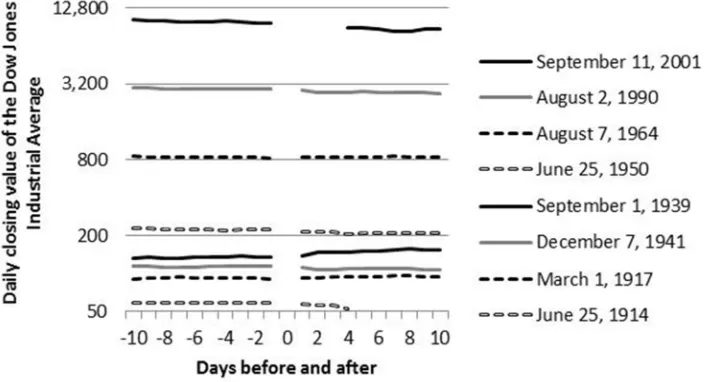
stockholders see the realization of war probabilities in a positive light. Figure 1 shows closing values of the Dow Jones Industrial Average in New York for the ten working days before and after eight twentieth-century onsets of war (the value on the day itself is omitted). Only two events saw stock prices climb; in five they fell, and two cases the stock market was closed (for more than four months after the outbreak of World War I in Europe, and for four days after 9/11). The median change in stock prices over the eight crises was a 5.2 percent decline.
Figure 1 near here.
After realized war come realized war profits. Have wars provided private business with direct benefits? Before we can understand whether or not business is pro-war, we need to know whether war is pro-business. Many have thought so. The Great War saw widespread discontent in both Britain and Germany over industrial war profits and war profiteers (Carsten 1982). In most countries, major wars reduced incomes and weakened the family-based or social safety net, so that poor and vulnerable people suffered harm. It was a short step from this to the idea that the rich had exploited the opportunity of war in order to tilt the distribution of income in their own favor (and another short step to the proposal that the rich had promoted the war with this in mind).
With regard to World War I, it was Gerd Hardach (1977, pp. 106-107) and
“These findings point, not so much to the harnessing of big business to the machine of state, as to the reverse.” Baten and Schulz (2005) and Albrecht Ritschl (2005) have re-examined these claims. Baten and Schulz found that the appearance of rising inequality is explained by two errors, a failure to account for inflation in measuring profits, and a selection bias in the profits reported. A wider sample of big businesses shows the real profits of German large-scale industry declining pari passu with returns to labor, so that the labor share in national income, after initial improvement, was more or less the same in 1917 as it had been in 1913. Ritschl reached similar results independently by comparing real wage and real output data. What this meant for top incomes can be judged directly from the historical cross-country data of Atkinson, Picketty, and Saez (2011). These show sharp wartime declines in the personal income shares of the very rich in every belligerent country for which wartime data are now available.
It was not necessary to go to war to make war profits. In neutral
Netherlands, for example, the outbreak of war in 1914 immediately relieved competitive pressures on Dutch corporations; real wages fell and national income was temporarily redistributed in favor of profits (Klemann 2007). In neutral Argentina, similarly, between 1940 and 1943 the top one percent increased their share of personal incomes from one fifth to more than one quarter (Atkinson, Picketty, and Saez 2011, p. 44). Despite this, no one has tried to blame World War I on Dutch corporations such as Philips or Unilever, or World War II on the Argentinian beef complex.
The claim that corporate owners were able to exploit war conditions to increase their profit incomes acquired its hold on the popular imagination in association with the image of an organized, secretive, military-industrial lobby at work behind the scenes. Therefore, we turn to consider corporate political action, on which there is a large literature. Adam Smith (1776) remarked on the propensity of “people of the same trade” to meet and conspire against the public. In fact, do corporate owners lobby politicians and make self-interested political donations? Yes, all the time (Hillman et al. 2004). Do they value these
connections? Again, yes. In countries that are relatively corrupt, such as
Indonesia and Malaysia, connections to the ruling party add market value to the firm (Fisman 2000, Johnson and Mitton 2003). In the 2000 U.S. presidential election, when Bush beat Gore, oil and tobacco firms gained value and legal firms lost (Knight 2007). And German firms that were linked to the Nazi Party before 1933 by donations or open support gained value when Hitler took power (Ferguson and Voth 2008).
Two world wars left German capitalism with a bad press, much of it
deserved. Even so, the relationship between the industrialists and war aims was more complex than is commonly assumed. The German industrialist Hugo Stinnes, for example, was a militarist and imperialist in the Great War, but an economic liberal and a free-trader before and after. The reason, Feldman (2000) argued, was circumstances:
The war had created a new situation for Stinnes and, like strikes, which he would also just as soon have seen disappear, one had to adjust to them and to their periodic reappearance … this meant placing oneself in the best position for the next occurrence, and that was the goal, exaggerated and uncontrolled as it was, of Stinnes’s war-aims policies.
Studies of German industry and industrialists under the Third Reich point us in the same direction. Until 1930, big business showed little interest in the Nazi party or Hitler, who aimed only to reassure the business interest and neutralize opposition from that quarter (Turner 1985). After that, many business leaders were converted to “willing partners” in the expansionist plans of the Third Reich (Tooze 2006, p. 134). As Hitler unfolded his plans, step by step, the compliant majority adapted easily to new perspectives, such as the idea that foreign forced labor would become a permanent resource (Mommsen 2005, p. 182). In this way they adapted to the growing inevitability and then the fact of war. As for the plan for war and the decision to execute it, this belonged to the political actors, who were reticent on the subject before business audiences until their authority was assured.
Gustav Krupp, whose furnaces forged Hitler’s victories and whose facilities exploited up to 100,000 slaves, was an early adherent to the Hitler regime. But until 1933, Richard Overy (1994, pp. 119-143) has shown, he was a traditional conservative. His chief aim was to keep his firm intact under family control, avoiding the fate of Hugo Junkers whose opposition to Nazi plans led to a state takeover. Like Hugo Stinnes, he accommodated to the realities that he could not alter. Peter Hayes’s history of I.G. Farben tells “not why bad men do evil but why good men do” (Hayes 2001, p. xxi): business leaders who feared and shunned national socialism beforehand were captured morally and became complicit in its most terrible crimes, including the Holocaust.
Not all fell into line. A few, like Junkers, resisted on grounds of the public good. On a more practical plane Hjalmar Schacht, a banker who became Hitler’s economics minister, resigned in 1937 over the cost of rearmament; he became a resister only later.
Still, open opposition to Nazi plans in business circles was rare. This makes Hermann Göring’s confrontation with the steel industrialists in 1937 all the more revealing. In the pursuit of autarky, Göring wished to reorient the steel industry away from imported iron ores. In December 1936 he demanded investments in facilities to exploit inferior domestic deposits. The Ruhr
was a state-owned steel giant, the Reichswerke Hermann Göring (Overy 1994, pp. 93-118). Schacht’s resignation followed Göring’s victory (Schweitzer, 1964, pp. 537-547). RHG later became the major conglomerate vehicle for German investments in occupied Europe (Overy 1994, pp. 144-174).
In prewar Japan, the business class was conservative and patriotic but not reckless. Its leaders were embedded in the political system through both party representation and networks (von Staden 2008). In the 1930s, however, their influence was threatened and increasingly limited by the rise of Japanese “ultra-nationalism,” which was hostile to private property and industrialization. Radical militarists established a political base in the countryside on plans to colonize East Asia, and mounted attacks on those conservative leaders that preferred financial orthodoxy to paying for military adventures (Collingham 2010). Representatives of the armed forces increasingly took over the government.
While the zaibatsu (“money cliques,” the leading Japanese conglomerate corporations) were afterwards reviled for supporting Japanese militarism, the range of their behaviors under this threat is consistent with that of their German counterparts. Japanese business leaders took the opportunities that seemed profitable, shouldered the obligations to support the war that they could not refuse, and accepted the government funding that aligned their incentives with the war effort. As Takao Shiba (1994) has shown, for the Mitsubishi Corporation in the 1930s this meant repeatedly postponing plans to expand civilian
automotive engineering in favor of instructions for war production received from the Army. Kawasaki, in contrast, was ready to build ahead of military demand, but was relieved of the risk after the event by government capital. As all-out war approached the Army and Navy took legal measures to bring private owned industrial facilities under direct supervision. These measures were resisted until it became clear that only firms that accepted military supervision would receive allocations of supplies and labor. While cooperating fully with Japan’s war effort, both Mitsubishi and Kawasaki took steps to preserve the basis of postwar independence.
The common feature of these stories is the “primacy of politics” (Mason 1968). In Japan and Germany, the political leaders held the initiative. Corporate behavior was reactive, defensive, and opportunistic. It is not a pretty picture, but it does not show a capitalist lobby for war. Overy (1994, p. 94) concludes the Krupp story: “Nazi political hegemony in the end prevented German capitalists from acting as capitalists.” From this we learn not about how big business changed government, but how big government diverted business from competitive profit seeking to rent seeking and dependence on government contracts and subsidies.
capitalists or venal politicians. Robert Higgs (1993) has shown that, on the eve of World War II, American business people were distrustful of the Roosevelt
administration, reluctant to undertake war investments, suspicious of the government interference that would follow if they did, and fearful that they would not be allowed to make money on them.
If corporate money has observable influence on politics anywhere, it must surely be in the postwar United States. Robert Higgs has modelled the strategic interaction among American voters, defence producers, and politicians in the Cold War (Higgs and Kilduff 1993; Higgs 1994). Defence firms provided jobs for voters and campaign funding for politicians seeking election. They were
rewarded by a swollen military budget that overprovided both national defence and private profit. The losers were the taxpayers and the armed forces, whose budget was diverted to purchasing lines of equipment that they did not want and could not use. The gains to defence corporations and labor were concentrated and obvious; the efficiency losses were diffuse and opaque, a recipe for status-quo bias, as defined by Fernandez and Rodrik (1991).
Even in this model, the carousel did not go round forever. In the end, voter opinion could still bring it to a halt. Empirically, the balance of public sentiment on whether defence spending should rise or fall was the single most important factor in whether it did so. Successive generations of politicians worked to persuade the public to accept the existence of security threats and shortfalls, but ultimately they could not control voter sentiment. In an open society, two things limited public support for the military and kept the defence budget in check: the tax increases necessary to pay for defence resources, and the war casualties that followed from using them in war. “Deaths and taxes,” Higgs argues, set the ultimate constraints on the power of the military industrial complex.
How do such outcomes compare with those of non-capitalist arrangements? The Soviet defence market differed from the American defence market most obviously in the lack of transparency and public accountability. The postwar Soviet defence sector took a consistently larger share of national resources than the American one (Firth and Noren 1998). If American corporations lobbied for development funding, so too could Soviet weapon designers; they did have to be more careful, knowing Stalin’s capacity for suspicion (Harrison and Markevich 2008; Harrison 2008). The Stalin-era state agencies responsible for the
construction of defence plants were prolific and willing users of forced labor (Harrison 1994; Simonov 2000). These rough comparisons do not point to a moral deficit in capitalism. Rather, the transparency and accountability of democratic political processes placed limits on the power of American military-industrial interests that did not exist under communism.
state.”2More recently Kontorovich and Wein (2009) have asked: “What did the
Soviet rulers maximise?” Based on revealed preferences in resource allocation (“a high share of military spending in GNP, a low share of consumption, and a high share of investment directed primarily into heavy industry”) their answer is not “socialism” or economic growth or even modernization but military power. In other words, no one needed to lobby for it; it was a fundamental preference of the communist regime.3
To summarize: Are capitalist corporations interested in politics? Yes, unquestionably. Do they lobby politicians and make self-interested political donations? Yes, all the time. Do they push for external confrontation or conflict? Examples are hard to find. Are they ready to take the profits offered by war preparations? Yes, although competitive pressures and an open society appear to limit this in various ways. Do they willingly exploit the spoils of conquest or enslavement? Yes, if the opportunity to do so presents itself. Do they do these things systematically? There is no evidence of that. In fact, the character of the state and the agency of politicians appear to be the decisive factors. Communism, not capitalism, has been more conducive to a militarized economy and the accumulation of military power.
Diversionary wars
Bill Pritchard (the prime minister’s press secretary): “Instead of trying to butter up the press, we distract them let's give them a story.”
Jim Hacker (the prime minister): “Such as?”
Bill Pritchard: “Start a war, that sort of thing.”
Jim Hacker: “Start a war?”
2In the same spirit the appointment of former defence minister Raúl Castro
as President of Cuba, where the armed forces control as much as 60 percent of the economy (Gershman and Gutierrez 2009, p. 68), prompted Christopher Hitchens (2006) to comment: “As was once said of Prussia, Cuba is not a country that has an army but an army that has a country.”
3While Stalin undeniably placed high priority on rearmament and military
Bernard Woolley (the prime minister’s private secretary): “Only a small war.”4
In the concept of diversionary wars, political leaders seek and exploit conflict with external adversaries in order to rally domestic support. The idea is well established in the literature, perhaps because the theoretical case is quite intuitive, and narrative support is not hard to find. In fact, it may be too easy. As Jack Levy (1989) pointed out, few wars havenotbeen attributed to political leaders’ desire to improve domestic standing.
The idea of diversionary wars is directly relevant to a discussion of capitalism only if it can be shown that capitalist polities are more likely to exploit foreign adventures. One reason might be advanced from a Marxist perspective: perhaps capitalist societies, being class-divided, are more likely to give rise to wars intended to divert the workers from the cause of socialism. A longstanding interpretation of the origins of World War I in domestic German politics conveys exactly this message (Berghahn 1973).
This view does not sit well with the equally traditional idea that a class-divided society is less able to go to war. The official Soviet histories of World War II used to claim that, under capitalism, divided class interests made the working people reluctant to fight for the nation. Because of this, the workers could be motivated to take part only by “demagogy, deception, bribery, and force” (Grechko et al. 1982, vol. 12, p. 38; on similar lines see also Pospelov et al. 1965, vol. 6, pp. 80-82).
It is also the case that governments of capitalist societies have found many ways to hide the true costs of war from the electorate, as Hugh Rockoff (2012, pp. 24-27) has argued in the case of the United States. These include price controls, the rationing of goods, conscription, and the omission of future liabilities to veterans and their families from the public accounts. These
instruments, however, are not peculiar to a capitalist economy; if anything they reflect methods of managing shortage and mobilization that would be more familiar in a customary economy.
Quantitative empirical work has lent little support to the idea of diversionary war (Levy 1989). Exceptions include studies of the use of force by U.S. and British postwar governments by Morgan and Bickers (1992) and Morgan and Anderson (1999). They conclude that the use of force is more likely when government approval is high but the government’s supporting coalition is suffering erosion. They also suggest that force is unlikely to be used at high intensities under those circumstances (“only a small war”) because the higher expected costs of larger wars will erode political support, and because any degree of foreign conflict will be polarizing rather than consolidate support when domestic conflict is already high.
Another line of research suggests that new or incompletely established democracies are particularly vulnerable to risky adventures in nation-building
4“Official Secrets,” the tenth episode of the BBC TV series “Yes Prime
(Mansfield and Snyder 2005). One inspiration for this view was the record of the new democracies born out of the former Soviet Union and Yugoslavia. More recently, Georgia seems to have provided out-of-sample confirmation.
Suppose diversionary wars exist. Is capitalism somehow more internally conflicted than other societies, and so disproportionately likely to externalize conflict? As a comparator, the case of fascism seems straightforward. Fascism did not produce diversionary wars because, for fascists, war was not a diversion; it was the point.
The more interesting case is that of communism. Communists do not seem to have pursued diversionary wars. At the same time the domestic legitimacy of Soviet rule visibly relied on the image of an external enemy, and thrived on tension short of military conflict. Soviet leaders used external tension to justify internal controls on movement, culture, and expression, and the associated apparatus of secrecy, censorship, and surveillance. When they began to tolerate trends towards détente in the 1970s, they subverted their own controls. An East German Stasi officer told his boss, repeating it later to Timothy Garton Ash (1997, p. 159):
How can you expect me to prevent [defections and revelations], when we’ve signed all these international agreements for improved relations with the West, working conditions for journalists, freedom of movement, respect for human rights?
If Soviet foreign policy was sometimes expansionist, it sought expansion only up to the point where the desired level of tension was assured. Bolsheviks of the 1917 generation knew well that too much conflict abroad encouraged defeatist and counter-revolutionary sentiments at home. As Oleg Khlevniuk (1995, p. 174) noted:
The complex relationship between war and revolution, which had almost seen the tsarist regime toppled in 1905 and which finally brought its demise in 1917, was a relationship of which Stalin was acutely aware. The lessons of history had to be learnt lest history repeat itself.
Stalin did all he could to avoid war with Germany in 1941 (Gorodetsky 1999). Postwar Soviet leaders risked war by proxy, but avoided direct conflict with the “main adversary.” Faced with unfavorable odds, they tended to withdraw (from Cuba) or do nothing (in Poland) or accepted them with great reluctance (in Hungary, Czechoslovakia, and Afghanistan).
We should place this in the wider context of the “democratic peace.” As Levy (1988) wrote: “Liberal or democratic states do not fight each other … This absence of war between democracies comes as close as anything we have to an empirical law in international relations.” Since all liberal democracies have also been capitalist on any definition, it is a finding of deep relevance.
Capitalism’s wars
America is the world’s preeminent capitalist power. According to a poll of more than 21,000 citizens of 21 countries in the second half of 2008, people tended on average to evaluate U.S. foreign policy as inferior to that of their own country in the moral dimension.5While this survey did not disaggregate respondents by
educational status, many apparently knowledgeable people also seem to believe that most wars in the modern world have been caused by America; this
impression is based on my experience of presenting work on the frequency of wars to academic seminars in several European countries.
According to the evidence, however, these beliefs are mistaken. We are all aware of America’s wars, but they make only a small contribution to the total. Counting all bilateral conflicts involving at least the show of force from 1870 to 2001, we find that that the countries that originated them come from all parts of the global income distribution (Harrison and Wolf 2012). It is not the countries that are richer (measured by GDP per head) that tend to start more conflicts. It is the countries that are economically larger (measured by GDP). America is both large and rich, but it turns out that sheer size is what matters. In fact, controlling for size, America has been less warlike than some other countries. We rank countries by the numbers of conflicts they initiated over the period. The United States, with the largest economy, comes only in second place. Third place belongs to China. In first place is Russia (the USSR between 1917 and 1991).
What do capitalist institutions contribute to the empirical patterns in the data? Erik Gartzke (2007) has re-examined the hypothesis of the “democratic peace” based on the possibility that, since capitalism and democracy are highly correlated across countries and time, both democracy and peace might be products of the same underlying cause, the spread of capitalist institutions.
It is a problem that our historical datasets have measured the spread of capitalist property rights and economic freedoms over shorter time spans or on fewer dimensions than political variables. For the period from 1950 to 1992, Gartzke uses a measure of external financial and trade liberalization as most likely to signal robust markets and a laissez faire policy. Countries that share this attribute of capitalism above a certain level, he finds, do not fight each other, so there is capitalist peace as well as democratic peace. Second, economic
liberalization (of the less liberalized of the pair of countries) is a more powerful
5Specifically, 24 percent of respondents rated their own country’s foreign
predictor of bilateral peace than democratization, controlling for the level of economic development and measures of political affinity.
Why, then, with more capitalism and more democracy, do we have more wars? Possibly we have more wars because the quality of war is changing. Münkler (2005) suggests that “new wars” are more like the Thirty Years War (1618-1648) than the great-power territorial conflicts of the twentieth-century world wars. Behind the new wars, he argues, lie deep forces of globalization including world markets awash with cheap Kalashnikov rifles and unemployed young men. The new wars are small scale and protracted; the opposing forces may prefer maintaining a state of conflict over victory, so that new wars smoulder without coming to a definite conclusion, a point also made in relation to civil wars by David Keen (1998). In new wars, as Münkler sees them, conflict is exploited by private causes for private ends. New wars lose the distinction between combatants and civilians; they substitute massacre for battle; they erode rather than build state capacity. By implication, modern states are losing control of violence.
Münkler’s vision can be compared with the perspective of Harrison and Wolf (2012). In both perspectives trends in globalization and the relative cost of means of destruction are underlying forces. For Harrison and Wolf these forces are changing the number of wars, not their quality. “If the frequency of conflict has been increasing,” they conclude, “it may be not because we want it; more likely, it is ‘Because we can’.”
4. Effects of War
In whatever ways capitalism has changed war, war has also changed capitalism. But the nature and persistence of the changes are energetically debated. In the world before 1913, war promoted the transition to modern fiscal systems and this in turn promoted productivity. Based on a nineteenth century sample of 96 countries, Dincecco and Prado (2012, p. 172) find that, as a result, “states in the top decile of past war casualties are 80% more productive today than states with no recorded casualties.” For those that prefer narrative the British story (volume 1, chapter 12 by O’Brien) points in the same direction.)
It does not follow, however, that war has had the same beneficial effect after the transition to a modern state was complete. Münkler (2005) has argued to the contrary that the “new wars” of the late twentieth century, like the Thirty Years’ War of the seventeenth, have tended to undermine state capacity rather than promote it.
Since Adam Smith it has been recognized that capitalism does not work without law, taxes, and public goods (see volume 1, chapter 16 by Cardoso), and most of these are provided by nation states. At the same time, too much taxation and regulation are stifling. There is a right amount. In the twentieth century capitalism worked best under a touch that was light, but not non-existent, when borders were open and the world was more cosmopolitan than nationally minded.
market access, mobilized the people around the identity of the nation in battle, and built the authority and legitimacy of the state. Government took charge of economic life and imposed a command economy, borrowing business personnel and “businesslike” methods of management, monopolizing markets for goods and credit, discriminating in favour of government contracts, overriding private property rights, and replacing the high-powered incentives of market
competition with administrative enforcement and low-powered artificial incentives (Broadberry and Harrison 2005; Harrison 1998; Higgs 1993).
Some countries went to war while others remained neutral, but all countries experienced large reallocations. Belligerents repressed consumption, withdrew from export markets, and prioritized war production and military services. Neutrals experienced large increases in demand from the belligerents for food and raw materials. Some were too close to the fighting for comfort and had to balance uneasily between the two sides (Golson, forthcoming). Others reaped the short-term profits they could, or seized the time to industrialize, aiming to fill the gap in the world market for civilian manufactures (Findlay and O’Rourke 2007). These reallocations also created large rents, appropriated domestically or (in the case of colonial occupation) captured by the occupier (Klemann and Kudriashov 2012).
War redistributed power and reallocated resources; did these changes persist when peace was restored? When the war was over, some countries experienced dramatic reversals. For the aggressors defeat was generally
salutary, although this came at terrible cost. A number of democracies were born from the wreckage of empires in Central and Eastern Europe after 1918, but not in Russia, and within two decades most poor countries (and a rich country, Germany) had reverted to dictatorship (Eloranta and Harrison 2010). The Atlantic Charter of 1941 placed self-determination at the heart of World War II. The defeat of the aggressors in 1945 was more complete and more lasting. In Germany, Italy, and Japan, defeat discredited the politics of aggression, broke the existing ties between wealth and power, and destroyed the slave and serf
empires that had grown up around the war. Freed of burdensome pretensions to great power status, these countries were enabled to experience unprecedented prosperity (Olson 1982).
For some other countries, the two world wars had effects that were highly persistent and often negative. Most obvious was the return of communism to the Baltic and its advance into Eastern Europe, which postponed full realization of the goals of the Atlantic Charter until the Cold War ended half a century later.
More generally, the politicians that found themselves leading their nations into the unfamiliar territory of the postwar world faced every temptation to use the levers at their disposal to shield the economy and protect old and new vested interests. In addition to redistribution and welfarism (see volume 2, chapter 14 by Lindert), the quarter century after 1945 saw fixed exchange rates, capital controls, industrial interventionism, and widespread (though declining) tariff barriers, the main purpose of which was to protect the “strategic”
the level of 1913 until the 1970s (see volume 2, chapter 1 by O’Rourke and Williamson and chapter 9 by James).
Since the 1970s capitalism has changed again (and is continuing to change) but the effects of the world wars, which once seemed so decisive, are no longer clearly identifiable. The gloss that wartime experience put on government controls and industrial plans has faded. Other trends are still present but it is not convincing to continue to ascribe them to the legacies of warfare. The point is made by Figure 2, which compares the Swedish and British shares of
government purchases in GDP over more than a century. Taking the British case in isolation, what strikes us is the seemingly permanent leaps in the share of government outlays occasioned by two world wars. The Swedish case shows how wrong this could be. Over the same period Sweden was consistently neutral yet Sweden’s share starts and finishes with Britain’s. Sweden’s neighbors were frequently at war, but the Swedish series shows no noticeable response even to warfare among neighboring states. Based on study of a wider sample, Eloranta and Andreev (2006) fail to identify war as a significant long-run influence on the scope of government economic activism. What mattered, they find, was
extension of the franchise.
Since the eighteenth century international institutions have provided a growing array of global public goods. International arrangements help to explain why, twice in two centuries, major conflict was followed by an era of
liberalization and international capitalist integration. One was the Congress of Vienna, which ended the Napoleonic Wars in 1815; the other was the ensemble of measures from the Bretton Wood conference in 1944 to Marshall Aid in 1947 that ended World War II. In contrast the treaties that ended World War I and inaugurated the League of Nations failed abjectly to promote economic stability and integration (Findlay and O’Rourke 2007). It seems that a modicum of
international security was needed for national elites to cooperate in the virtuous circles of policy reform and sustained growth (Broadberry 1994; Eichengreen 1996).
5. Conclusion
I have compared capitalism and its historical alternatives. Has capitalism helped to lower the costs of war? Yes, but not uniquely. The technological and trade costs of war began to fall before the capitalist era; capitalism certainly continued this trend. A distinctive contribution of capitalism came from the fiscal
revolution of the eighteenth century that opened the way for mass warfare in the twentieth. By the twentieth century, however, the capitalist fiscal revolution had been all but overtaken by the repressive mobilization capacities of fascism and communism. As for the idea that capitalism reduced the costs of war by making it a Keynesian “free lunch,” I reject it.
Does capitalism prefer war; that is, is war in the private interest of big business? Yes – conditionally. History shows the government can put in place incentives that align the private interests of big business with war, but this is a politically (not economically) determined outcome. The interest of business in war is opportunity, not strategy. There is no evidence that private business has had any greater interest in war, conquest, exploitation, or enslavement than the private or bureaucratic interests that have operated in other forms of society.
Are capitalist polities particularly liable to undertake foreign wars to divert attention from conflicted issues at home? Yes, but only weakly: the
circumstances under which this happens are narrowly defined and the level of conflict is likely to be low. Moreover, there is strong evidence that since 1945 capitalist democracies have formed a “peace club” among themselves.
The determinants of wars involve both structure and agency. Agency must have a role, because wars are conceived, planned, declared, and waged by human actors. On the historical evidence, capitalism has gone to war only when captured and driven by a determined political enterprise. The fact remains that of all social systems liberal capitalism seems to have least in common with war. This is because of the primary emphasis that capitalism gives to private
Figures
Figure 1. Daily closing values of the Dow Jones Industrial Average
Source: http://measuringworth.com/datasets/DJA/ (accessed on June 8, 2011).
Key:
July 25, 1914: Russia mobilizes against Germany. March 1, 1917: The Zimmermann telegram published. September 1, 1939: Germany invades Poland.
December 7, 1941: Japan attacks Pearl Harbor. June 25, 1950: North Korea invades South Korea. August 7, 1964: Gulf of Tonkin Resolution. August 2, 1990: Iraq invades Kuwait.
Figure 2. Government purchases, percent of GDP: Sweden and the United Kingdom, 1880-1990
Tables
Table 1. Capitalism, wars, and deaths in Europe over four centuries, from Urlanis
Period Years
Number killed and died in wars (millions)
Duration of period (years)
Annual average number killed and died (thousands) I. Pre-monopoly
capitalism: Formation of the capitalist mode of
production 1600-1699 3.3 100 33
1700-1788 3.9 89 44
Industrial
capitalism 1789-1897 6.8 109 62
II. Imperialism 1898-1959
More
than 40 62 About 700
Table 2. Military spending, 1870 to 1979, percent of GDP, in four countries
Country 1870 to 1913 1920 to 1938 1960 1970 1979
USA 0.7 1.2 8.9 7.9 5.2
UK 2.6 3.0 6.5 4.8 4.8
France 3.7 4.3 6.3 4.2 3.9
Germany/West Germany 2.6 3.3 4.0 3.5 3.2
References
Açemoglu, Daron, Simon Johnson, and James Robinson. 2005. The Rise of
Europe: Atlantic Trade, Institutional change, and Economic Growth. American Economic Review 95:3, pp. 546-579.
Aghion, Philippe, and Peter Howitt. 2006. Appropriate Growth Theory: a
Unifying Framework. Journal of the European Economic Association 4:2-3, pp. 269-314.
Angell, Norman. 1911. The Great Illusion: A Study of the Relation of Military Power to National Advantage. Third edition. London: Heinemann.
Atkinson, Anthony B., Thomas Piketty, andEmmanuel Saez. 2011. Top Incomes in the Long Run of History. Journal of Economic Literature 49:1, pp. 3-71.
Baran, Paul A., and Paul M. Sweezy. 1996. Monopoly Capital: An Essay on the American Economic and Social Order. New York: Monthly Review Press. Baten, Joerg, and Schulz, Rainer. 2005. Making Profits in Wartime: Corporate
Profits, Inequality, and GDP in Germany during the First World War. Economic History Review, 58:1: 34–56.
Berghahn, Volker R. 1973. Germany and the Approach of War in 1914. London: Macmillan.
Blackbourn, David. 2003. History of Germany, 1780-1918: The Long Nineteenth Century. Oxford: Blackwell.
Bonney, Richard (ed.). 1999. The Rise of the Fiscal State in Europe, 1200-1815. Oxford: Oxford University Press.
Broadberry, S. N. 1994 Why was Unemployment in Postwar Britain so Low?
Bulletin of Econo Research46:3, pp. 241-61.
Broadberry, Stephen, and Mark Harrison (eds.). 2005. The Economics of World War I. Cambridge: Cambridge University Press.
Buchheim, Christoph, and Jonas Scherner. 2006. The Role of Private Property in the Nazi Economy: The Case of Industry. Journal of Economic History 66:2, pp. 390-416.
Carsten, F. L. 1982. War Against War: British and German radical movements in the First World War. Berkeley and Los Angeles: University of California Press. Collingham, Lizzie. 2011. The Taste of War: World War Two and the Battle for
Food. London: Allen Lane.
CPSU. 1941. History of the Communist Party of the Soviet Union: Short Course. Moscow: Foreign Languages Publishing House.
Crafts Nicholas, and Marco Magnani, 2013. The golden age and the second globalization in Italy. In The Oxford Handbook of the Italian Economy, 1861-2011.Edited by Gianni Toniolo. Oxford: Oxford University Press.
de Bloch, Jean (I. S. Bliokh). 1914. The Future of War. Boston: World Peace Foundation.
Dimitrov, Georgi. 1972. Selected Works, vol. 2, Sofia: Sofia Press. Dincecco Mark and Mauricio Prado. 2012. Warfare, Fiscal Capacity, and
Performance. Journal of Economic Growth 17:3, pp. 171-203. Edgerton, David. 2006. Warfare State: Britain, 1920-1970. Cambridge:
Cambridge University Press.
Eichengreen, Barry. 1996. Institutions and Economic Growth: Europe after World War II. InEconomic Growth in Europe Since 1945, pp. 38-70. Edited by Nicholas Crafts and Gianni Toniolo. Cambridge: Cambridge University Press. Eloranta, Jari, and Mark Harrison. 2010. War and Disintegration, 1914-1945. In