University of Warwick institutional repository:
http://go.warwick.ac.uk/wrap
A Thesis Submitted for the Degree of PhD at the University of Warwick
http://go.warwick.ac.uk/wrap/74169
This thesis is made available online and is protected by original copyright.
Please scroll down to view the document itself.
M A E
G
NS I
T A T MOLEM
U N
IV
ER
SITAS WARWICEN
SIS
Robinson-Schensted algorithms and quantum
stochastic double product integrals
by
Yuchen Pei
Thesis
Submitted to the University of Warwick
for the degree of
Doctor of Philosophy
Mathematics and Statistics Doctor Training Centre
Contents
Acknowledgments iii
Declarations iv
Abstract v
Chapter 1 Introduction to Robinson-Schensted algorithms 1
1.1 Overview . . . 1
1.2 The classical Robinson-Schensted algorithms . . . 3
1.3 The growth diagram . . . 5
1.4 The dynamics of the RS algorithm taking a random word . . . 6
Chapter 2 A q-weighted Robinson-Schensted algorithm 8 2.1 Introduction . . . 9
2.2 The Robinson-Schensted algorithm . . . 10
2.3 Theq-weighted version . . . 13
2.4 Main result . . . 20
2.5 Stochastic evolutions . . . 26
2.6 Permutations . . . 30
2.7 Proofs . . . 31
2.7.1 Proof of Proposition 8 . . . 31
2.7.2 Proof of Theorem 6 . . . 35
2.7.3 Proof of Proposition 5 . . . 36
Chapter 3 A symmetry property for theq-weighted an other branch-ing Robinson-Schensted algorithms 38 3.1 Introduction . . . 38
3.2 Classical Robinson-Schensted algorithm . . . 41
3.4 A q-weighted Robinson-Schensted algorithm . . . 47
3.5 Word input for theq-weighted Robinson-Schensted algorithm . . . . 51
3.6 The symmetry property for the q-weighted RS algorithm with per-mutation input . . . 54
3.7 More insertion algorithms . . . 59
Chapter 4 Introduction to quantum stochastic calculus 66 4.1 Quantum probability . . . 66
4.2 The Schr¨odinger representation . . . 67
4.3 The Fock representation . . . 69
4.4 Second quantisation . . . 70
Chapter 5 On a family of causal quantum stochastic double product integrals related to L´evy area 72 5.1 Introduction . . . 72
5.2 The L´evy stochastic area . . . 75
5.3 A discrete double product of unitary matrices . . . 77
5.4 A lattice path model and linear extensions of partial orderings . . . 82
5.5 Dyck paths and Catalan numbers . . . 92
5.5.1 m >0 . . . 96
5.5.2 m= 0 . . . 97
5.6 Proof of Theorem 25 . . . 98
5.6.1 Part 1 . . . 99
5.6.2 Part 2 . . . 100
5.6.3 Part 3 . . . 102
5.7 The unitarity ofW . . . 104
5.7.1 The formulas forf andg . . . 105
Acknowledgments
I would like to thank my supervisors Neil O’Connell and Jon Warren, and
collabo-rator Robin Hudson for their guidance, help and support.
My research was funded by EPSRC grant number EP/H023364/1.
I wish to dedicate this thesis to champions of human rights and dignity
Declarations
Chapter 2 is joint work [OP13] with Prof. Neil O’Connell. Chapter 3 is a
Abstract
This thesis is divided into two parts.
In the first part (Chapters 1, 2, 3) various Robinson-Schensted (RS) al-gorithms are discussed. An introduction to the classical RS algorithm is pre-sented, including the symmetry property, and the result of the algorithm Doob
h-transforming the kernel from the Pieri rule of Schur functions h when taking a random word [O’C03a]. This is followed by the extension to aq-weighted version that has a branching structure, which can be alternatively viewed as a randomisation of the classical algorithm. Theq-weighted RS algorithm is related to the q-Whittaker functions in the same way as the classical algorithm is to the Schur functions. That is, when taking a random word, the algorithm Doobh-transforms the Hamiltonian of the quantum Toda lattice where h are the q-Whittaker functions. Moreover, it can also be applied to model theq-totally asymmetric simple exclusion process intro-duced in [SW98]. Furthermore, theq-RS algorithm also enjoys a symmetry property analogous to that of the symmetry property of the classical algorithm. This is proved by extending Fomin’s growth diagram technique [Fom79, Fom88, Fom94, Fom95], which covers a family of the so-called branching insertion algorithms, including the row insertion proposed in [BP13].
Chapter 1
Introduction to
Robinson-Schensted algorithms
1.1
Overview
The Robinson-Schensted (RS) algorithm was constructed by Robinson [Rob38] and
Schensted [Sch61] for showing explicitly a one-one correspondence between the sym-metric groupSn and the set of pairs of standard Young tableaux of sizen with the
same shape, see e.g. [Ful97] for an exposition of the algorithm and the tableaux, and
the Schur functions mentioned below. Such a simple algorithm has over the decades appeared in various contexts.
First of all, naturally they show up in representation theory, not only ofSn,
but also of gl`, and even Uq(gl`) when q → 0 [DJM90]. This is because the
irre-ducible representations ofgl` and Uq(gl`) are spanned by the vectors parameterised
by the tableaux of the same shape that have entries no greater than`. This
connec-tion, together with the branching behaviour of the representations (decomposition of tensor products of natural representations), of the tableaux (the insertion action
in the RS algorithm) and of the Schur functions (the Pieri formula), result in an
elegant link between the representation theory and the probability theory. In the probabilistic context, a word of independent random letters of categorical
distribu-tion in dicdistribu-tionary{1, . . . , `} can be identified with an`-dimensional simple random walk. When such a word is taken as the input of the RS algorithm, the output
ran-dom tableaux has a Markovian shape whose transition kernel is the discrete Doob
h-transform of that of the random walk, whereh are the Schur functions [O’C03a]. This gives the discrete version of the multidimensional Pitman’s theorem, whose
the process defined byMt:= sups≤tBs, then 2M −X is the 3-d Bessel process.
There are many more applications of the RS algorithm. The algorithm is rep-resented in terms of queues in tandem [O’C03b], as a path transformation named
after Pitman which was generalised to the Coxeter groups [BBO05], and as
percola-tion, corner growth model and interacting particles system model [Joh00]. Starting from the paper [BDJ99], the RS algorithm has been tied to the random matrix
theory and more specifically is related to the Gaussian Unitary Ensemble(GUE)
(and its process version Hermitian Brownian motion) and the Laguerre Ensem-ble [Bar01, GTW01, OY02, Joh00, Dou03].
As a result of the myriad connections there are many ways to extend the
al-gorithm. One of them is to take a geometric lift, replacing the (max,+) by (+,×) in the definition of the Pitman’s transform, raising the temperature in the percolation
model and turning it into a polymer model [COSZ14, OSZ14, O’C12], where the
counterparts of the Schur functions are now thegl`-Whittaker functions (Whittaker functions). Many of the probabilistic models mentioned up to now belong to the so
called Kardar-Parasi-Zhang universality class (see e.g. the survey [Cor14]), where
the GUE Tracy-Widom law is a universal limit distribution.
We wanted to find and study a q-weighted RS (q-RS) algorithm, where
the q-deformed gl`-Whittaker functions (q-Whittaker functions) [GLO10] play the same role as the Schur functions and the Whittaker functions in the classical and
geometric cases respectively. This was motivated by the fact that on the one
hand the q-Whittaker functions, which are Macdonald polynomials [Mac98] when
t= 0 [GLO11], turn into the Schur functions when q = 0, and on the other hand
they scale to the Whittaker functions whenq →1 [GLO12]. Indeed, we were able
to construct such aq-RS algorithm [OP13](Chapter 2) and prove the corresponding Pitman’s theorem. It is very different from the classical and the geometric ones in
that it branches even when taking deterministic input. Moreover, the coefficients
of the branching satisfies positivity when q ∈ [0,1], giving it a probabilistic inter-pretation as a randomised algorithm. When taking a random walk as the input, it
has the first column distributed as the q-totally asymmetric simple exclusion
pro-cess introduced in [SW98], which was later proved to scale to the Tracy-Widom distribution [FV13].
Later I was able to prove theq-RS algorithm has a symmetry property
analo-gous to the one enjoyed by the classical algorithm [Pei14](Chapter 3). The symmetry property states: if we denote by φσ(P, Q) the weight of tableau pair (P, Q) when
performing theq-RS algorithm on a permutationσ, thenφσ−1(Q, P) =φσ(P, Q) for
to the growth diagram by Fomin [Fom94, Fom95]. It also generalises to a class
of branching insertion algorithms which covers a row insertion version introduced in [BP13].
1.2
The classical Robinson-Schensted algorithms
In this and the rest sections of this chapter, a brief introduction to the ideas in Chapters 2 and 3 is presented. Certain contents will be covered in detail in those
chapters.
Fix an arbitrary positive integer `, a partition λ = (λ1, λ2, . . . , λ`) is an
integer vector such that λ1 ≥λ2 ≥ · · · ≥λ` ≥0. It is also called a Young diagram
and visualised as an array of left-aligned boxes withλi boxes in the ith row. The
number of boxes |λ| =λ1+λ2+· · ·+λ` is called the size of λ and we say λ is a
partition of|λ|, which we denote byλ` |λ|.
AYoung tableau (of rank`−1)is a Young diagram filled with integers from [`] := {1,2, . . . , `} such that the entries are increasing along the columns and
non-decreasing along the rows. Denote by T` the set of Young tableaux of rank `−1.
The underlying Young diagram λ of a Young tableau T is called the shape of the latter, denoted byλ= shT. A standard Young tableau of sizen is a Young tableau
of size n whose entries are exactly the members of [n] := {1,2, . . . , n}. Examples
of Young tableaux can be found in Section 2.2. Denote by Sn and Sλ the set of
standard Young tableaux of size n and of shape λ respectively. Letdλ := |Sλ| be
the number of standard tableaux of shapeλ. This is the dimension of the irreducible
representation ofSn corresponding to the conjugacy classλ.
It is well-known (see e.g. [Sag00]) that for a finite groupG,
|G|=X
V
(dimV)2
whereV traverses all irreducible representations of Gand dimV is the dimension of
V. WhenG=S, this becomes
X
λ`n
d2λ=n!.
This identity motivates an explicit bijection between the symmetric group and pairs
of standard Young tableaux of the same shape, and the RS algorithm is one such bijection.
of them. In this section and Section 1.3 I define the column insertion version in two
different ways to suit the Chapters 2 and 3.
We call [`] an alphabet, any k ∈ [`] a letter, and a word w = (w1, w2, . . .)
wherewi ∈[`] aword. For a tableau T we also define λkj to be the number entries
less than or equal tokin thejth row ofT. The triangular array (λjk)1≤j≤k≤` is the
so calledGelfand Tsetlin pattern and satisfies an interlacing relation:
λjk≤λjk−−11 ≤λkj−1.
Clearly given a Gelfand-Tsetlin pattern one can recover the corresponding tableau, thus identifying the two:
T ↔(λkj)1≤j≤k≤`.
The basic operation of the RS algorithm is the insertion of a letterk into a tableau
P = (λkj)1≤j≤k≤` to obtain ˜P = I(k, P), described in an algorithmic language as
follows:
1. Initialise and setkto be j.
2. If λkj−−11=λjk and j > 1 then set j ← j−1; otherwise k displaces the first
number s in jth row of the tableau that is greater than k (s = ∞ and k is appended at the end of the row if no such number exists) and setk←s.
3. Ifk=∞ then we are done; otherwise go to step 2.
The RS algorithm applied to a finite word w= (wi)1≤i≤n is defined as successively
insertingw1, w2, . . . , wn into the empty tableau:
P(0) =∅, P(i) =I(wi, P(i−1)).
The output tableau P = P(n) is called the insertion tableau. We also define
the recording tableau Q by a growth of Young diagrams related to P. For T =
(λkj)1≤j≤k≤`, let λk= (λkj)1≤j≤k be the Young diagram of the subtableau of T
con-sisting of entries no greater than k, then T can be identified with the growth of
Young diagrams
whereλ≺µ meansµi+1≤λi ≤µi∀i. ThenQ is defined as
Q=P(0) =∅ ≺P(1)≺P(2)≺ · · · ≺P(n).
Since the growth of P is one box per time, Q is a standard tableau. The RS
algorithm defines a bijection between the set of words of of lengthn and the set of
pairs (P, Q)∈ T`× Snwhere shP = shQ. By identifying a permutationσ ∈Sn with
a word (σ(1), σ(2), . . . , σ(n)) the algorithm establishes desired bijection betweenSn
and{(P, Q)∈ Sn× Sn: shP = shQ}.
As an example, the Robinson-Schensted algorithm taking the permutation
σ= 1 2 3 4
1 4 2 3
!
as the input gives the following output of tableau pair:
P =
1 4
2
3
, Q=
1 3
2
4
1.3
The growth diagram
An equivalent definition of the RS algorithm applied to permutations is the growth
diagram representation introduced by Fomin [Fom79, Fom88, Fom94, Fom95]. We start with the more general case of an insertion of a wordw. For a series
of tableau (P(m))m≥1 = ((λi(m)j)1≤j≤i≤`)m≥1we call the superscriptitheleveland the parameter in the bracket m thetime of a shape λi(m). When a letter w
m =k
is inserted to a tableau P(m−1) = (λij(m−1))1≤j≤i≤` to obtain a new tableau
P(m) = (λij(m))1≤j≤i≤` in the following way. The shapes at level 0,1, . . . , k−1 are
unchanged:
λi(m) =λi(m−1), 0≤i≤k−1.
The shapes at leveli≥k are altered by growing a new box at rowji, where
ji = max({j≤ji−1:λji−−11(m−1)> λij(m−1)} ∪ {1})
and the boundary conditionjk−1:=k. This way for 1≤i≤`,λi(m) only depends onλi(m−1), λi−1(m−1) and λi−1(m).
When the input is restricted to a permutation of length n, this becomes
[0, n] square lattice, such that the vertex (m, i) is labelled with the shapeλi(m). The
boxes surrounded by (m−1, σ(m)−1),(m−1, σ(m)),(m, σ(m)−1) and (m, σ(m)) for 1≤m≤nare marked with anXto represent the insertion of the letterwm =σ(m).
The shapes λ0(0), λ0(1), . . . , λ0(n) at level 0 and λ0(0), λ1(0), . . . , λn(0) at time 0
are all empty, which are the boundary condition. The growth is a rule of obtaining
λi(m) =f(λi−1(m−1), λi−1(m), λi(m−1),hasX) where hasX is a boolean variable
σ(m) ==iindicating the existence of an X in the box. The rule f is symmetric:
f(λ, µ1, µ2, b) =f(λ, µ2, µ1, b)
which proves the symmetry property of the algorithm:
(P(σ), Q(σ)) = (Q(σ−1), P(σ−1)).
The growth diagram, and its generalisation to the so-called branching
in-sertion algorithms which includes the q-weighted insertion in Chapter 2, will be
discussed in detail in Chapter 3.
1.4
The dynamics of the RS algorithm taking a random
word
The Schur function associated with shapeλis defined as a generating function over
the tableaux of shapeλ:
sλ(x) = X
T∈Tλ
aT = det(a
λj+`−j
i )1≤i,j≤`
det(a`i−j)1≤i,j≤`
, (1.1)
where the weightaT :=a#1’s in1 Ta2#2’s inT . . . a#` `’s inT.
When the input wordw is random, in the way that there exists probabilities
a1, a2, . . . , a` ∈ [0,1] such that a1 +· · ·+a` = 1 such that (wi)i are i.i.d. random
variables with the categorical distribution
P(wi =j) =aj,
the shape of the output tableaux evolves as a Markov process with the kernel [O’C03a]:
p(λ, µ) = sµ(a)
sλ(a)Iλ
where λ % µ means λ ≺ µ and |λ|+ 1 = |µ|, i.e. the Young diagram µ can be
obtained by adding a box toλ.
This result is obtained applying the Markov function theorem:
Theorem 1([RP81]). Let X be a Markov process with transition kernelP on state
space S, and Y a process on T where Yt = f(Xt) for some f. If there is a kernel
K:T×S→ [0,1]such that K(y, x) = 0∀x /∈f−1(y) andP
x∈SK(y, x) = 1∀y∈T
and a kernelQ on T satisfying the intertwining relation
KP =QK (1.3)
then if X0 ∼K(Y0,·) then Y evolves as a Markov chain with kernel Q.
The Pieri rule, which states the Schur function is harmonic with respect to the kernelIλ%µ:
X
µ:λ%µ
sµ=sλ (1.4)
and the structure of sλ as a generating function contribute to the intertwining
relation (1.3) where P is the kernel of the output tableaux, K(λ, T) = asT
λIshT=λ
andQ is the kernel pin (1.2).
Chapter 2
A
q
-weighted
Robinson-Schensted algorithm
We introduce a q-weighted version of the Robinson-Schensted (column insertion)
algorithm which is closely connected toq-Whittaker functions (or Macdonald
poly-nomials with t = 0) and reduces to the usual Robinson-Schensted algorithm when
q = 0. The q-insertion algorithm is ‘randomised’, or ‘quantum’, in the sense that
when inserting a positive integer into a tableau, the output is a distribution of weights on a particular set of tableaux which includes the output which would have
been obtained via the usual column insertion algorithm. There is also a notion of
recording tableau in this setting. We show that the distribution of weights of the pair of tableaux obtained when one applies theq-insertion algorithm to a random word
or permutation takes a particularly simple form and is closely related toq-Whittaker
functions. In the case 0≤q <1, theq-insertion algorithm applied to a random word also provides a new framework for solving theq-TASEP interacting particle system
introduced (in the language ofq-bosons) by Sasamoto and Wadati [SW98] and yields
formulas which are equivalent to some of those recently obtained by Borodin and Corwin [BC13] via a stochastic evolution on discrete Gelfand-Tsetlin patterns (or
semistandard tableaux) which is coupled to the q-TASEP process. We show that
the sequence of P-tableaux obtained when one applies the q-insertion algorithm to a random word defines another, quite different, evolution on semistandard tableaux
2.1
Introduction
We introduce a q-weighted version of the Robinson-Schensted (column insertion)
algorithm which is closely connected toq-Whittaker functions (or Macdonald poly-nomials with t = 0) and reduces to the usual Robinson-Schensted algorithm when
q = 0. The insertion algorithm is ‘randomised’, or ‘quantum’, in the sense that
when inserting a positive integer into a tableau, the output is a distribution of weights on a particular set of tableau which includes the output which would have
been obtained via the usual column insertion algorithm. As such, it is similar to
the quantum insertion algorithm introduced by Date, Jimbo and Miwa [DJM90] (see also [Ber12]) but with different weights. There is also a notion of recording
tableau in this setting. We show that the distribution of weights of the pair of tableaux obtained when one applies the insertion algorithm to a random word or
permutation takes a particularly simple form and is closely related toq-Whittaker
functions. These are functions defined on integer partitions which are eigenfunctions the relativistic Toda chain [Rui90, Rui99, Eti99, GLO10] and simply related to
Mac-donald polynomials (as a function of the index) with the parametert= 0 [GLO11].
When q = 0, they are given by Schur polynomials. Our main result provides a starting point for developing a new combinatorial framework forq-Whittaker
func-tions and related objects, such as Demazure and Kirillov-Reshetikhin crystals. It
will be interesting to understand the relation to recent developments in this area, see [HHL05, Len09, RY11, BBL, LL15, ST12, BF14, LS13] and references therein.
In the case 0≤q < 1, the q-insertion algorithm applied to a random word
also provides a new framework for solving the q-TASEP interacting particle sys-tem introduced (in the language ofq-bosons) by Sasamoto and Wadati [SW98] and
yields formulas which are equivalent to some of those recently obtained by Borodin
and Corwin [BC13] via a stochastic evolution on discrete Gelfand-Tsetlin patterns— or, equivalently, semistandard tableaux—which is coupled to theq-TASEP process.
We show that the sequence ofP-tableaux obtained when one applies theq-insertion
algorithm to a random word defines another, quite different, evolution on semistan-dard tableaux which is also coupled to theq-TASEP process (after Poissonisation).
Theq-TASEP process is a particular case of the totally asymmetric zero-range
pro-cess [BKS12]. See also [BCS14] for related recent work.
When q → 1, the q-Whittaker functions converge with appropriate
rescal-ing to gll-Whittaker functions [GLO12]. The main result of the present chapter can be regarded as a natural (yet non-obvious) discretisation, in time and space,
of the geometric Robinson-Schensted-Knuth (RSK) correspondence introduced by
A.N. Kirillov [Kir01], with Brownian motion as input, to the open quantum Toda chain with l particles. A discrete time version of that result has been developed
in the papers [COSZ14, OSZ14], which is formulated directly in the context of
Kirillov’s geometric RSK correspondence. The present work differs significantly from [O’C12, COSZ14, OSZ14] in that the analogue of the RSK mapping we
con-sider here is (necessarily) randomised. In the above scaling limit, the q-insertion
algorithm we introduce in this chapter should converge in an appropriate sense to the continuous-time version of the geometric RSK mapping considered in [O’C12],
which is deterministic, and the main result of this chapter should rescale to the main
result of [O’C12]. This can be seen by comparing with the corresponding scaling limits considered in [BC13, GLO12].
The outline of the chapter is as follows. In the next section we give some
background on the Robinson-Schensted algorithm. In Section 2.3, we describe the
q-weighted version of this algorithm. The main result is presented in Section 2.4.
In Section 2.5, we consider the q-insertion algorithm with 0 ≤ q < 1 applied to
a random word and explain the connection to the q-TASEP interacting particle system. In Section 2.6 we consider the algorithm applied to a random permutation.
The proofs are given in Section 2.7.
2.2
The Robinson-Schensted algorithm
The Robinson-Schensted algorithm is a combinatorial algorithm which plays a
fun-damental role in the theory of Young tableaux [Rob38, Sch61, Ful97, Sag00, Sta01]. There are two versions, which are in some sense dual to each other, defined via
insertion (or ‘bumping’) algorithms known as row insertion and column insertion.
The column insertion algorithm is also sometimes referred to as the dual RSK algo-rithm, because it has a natural extension to zero-one matrices which was introduced
by Knuth [Knu70]. It is the column insertion version which we consider and
gener-alise in this chapter.
A tableauPis a Young diagram with positive integer entries which are weakly
increasing in each row and strictly increasing in each column. The corresponding
tableauP and denoted by shP. For example,
1 1 2 3
2 3 3
3
is a tableau with shape (4,3,1). To insert a positive integer k into a tableau P,
we begin by trying to place that integer at the bottom of the first column ofP. If
the result is a tableau, we are done. Otherwise, it bumps the smallest entry in that column which is larger than or equal tok. Now proceed by inserting the bumped
entry into the second column according to the same rule, and so on, until we have
placed a bumped entry at the bottom of column (or on its own in a new column). For example, if we insert the number 2 into the tableau shown above, the outcome
is
1 1 2 3 3
2 2 3
3
In this example, the 2 in the first column is bumped into the second, the 2 in the
second is bumped into the third, the 3 in the third column is bumped into the fourth, and the 3 in the fourth is bumped into a new fifth column on its own. Actually, it will
be helpful for later reference to summarise this sequence of events in the following
way: in this example, a 2 is inserted into the second row, and a 3 is bumped from the second row and inserted into the first row.
Now, applying this insertion algorithm recursively to a wordw=w1. . . wn∈
[l]n, starting with an empty tableau and successively inserting the numbersw1, w2, . . . , wn,
gives rise to a sequence of tableau P(1), P(2), . . . , P(n) = P. Note that it is not
possible in general to recover the word w from the tableau P. This motivates the
notion of a recording tableau, which we denote by Q. The tableau Q has size n
and is standard, that is, it contains each of the numbers 1,2, . . . , n exactly once.
If we denote byQi the sub-tableau of Q consisting only of those entries which are
not greated than i, then Q is defined by the requirement that shQi = shP(i) for 1≤i≤n. For example, if w= 1143232 then
P =
1 1 3 4
2 2
3
Q=
1 2 5 7
3 4
6
pairs (P, Q) ∈ Tl× Sn such that shP = shQ, whereTl denotes the set of tableaux
with entries from [l] andSn denotes the set of standard tableaux of sizen. It is the
column insertion version of theRobinson-Schensted correspondence.
As a warm up for next section, we note that the above column insertion
algorithm can also be described in terms of lattice paths, as follows. Suppose we are inserting a number k with 1≤k ≤l into a tableauP ∈ Tl, with resulting tableau
˜
P. For 1 ≤ i ≤ l, set λi = shPi, and ˜λi = sh ˜Pi. Let (ei, 1 ≤ i ≤ l) denote the
standard basis inZl. Then ˜λi = λi +eji where k =jk−1 ≥ jk ≥ · · · ≥jl ≥1 is a
weakly decreasing sequence defined by
ji= max{{2≤m≤ji−1 :λim−−11−λ i
m>0} ∪ {1}}, i=k, k+ 1, . . . , l.
The sequence k ≥ jk ≥ jk+1 ≥ · · ·jl ≥ 1 determines a down/right lattice path
in Z2 from (k, k) to (l+ 1, jl) by specifying the y-coordinates at which the path
moves to the right. From the definition, this path takes a horizontal step to the right (i, j) → (i+ 1, j) whenever λij−−11 > λi
j or j = 1, otherwise it takes a step
down (i, j) → (i, j−1). We will refer to this lattice path as the insertion path.
The interpretation is as follows. A horizontal portion of the path starting at (i, j) represents inserting ani into the jth row. A vertical portion starting at (i, j) and
ending at (i, j−r) indicates that aniis bumped from thejth row to the (j−r)th
row. For example, the insertion path corresponding to the previous example of inserting a 2 into the tableau
1 1 2 3
2 3 3
3
withl= 3 is illustrated in Figure 2.1.
0 1 2 3 4
0 1 2
2.3
The
q
-weighted version
In this chapter, we consider the following generalisation of the column insertion
algorithm. It is defined by a collection of kernelsIk(P,P˜) which depend on a complex
parameterq. We assume throughout thatq is not a root of unity. If 0≤q < 1, we
interpret the quantity Ik(P,P˜) as the probability that, when we insert k into the
tableauP, the output is ˜P. Recall that thetype of a tableaux P, which we denote tyP, is the composition µ = (µ1, µ2, . . .) where µi is the number of i’s in P. The
set of ˜P for whichIk(P,P˜)6= 0 has the following properties. The type of ˜P is given
by ty ˜P = tyP +ek. The shape of ˜P satisfies sh ˜P = shP+ej for some 1 ≤j ≤k.
Moreover, if we set λi = shPi and ˜λi = sh ˜Pi, then there is a weakly decreasing
sequence k = jk−1 ≥ jk ≥ jk+1 ≥ · · ·jl ≥ 1 such that ˜λi = λi for 1 ≤ i < k and
˜
λi =λi+e
ji fork ≤i≤l. The kernel Ik(P,P˜) is defined to be zero if there is no
such sequence; if there is such a sequence, it is given as follows. Define
f0(i, j) = 1−qλ
i−1
j−1−λij, f
1(i, j) =
1−qλ i−1
j−1−λij
1−qλ i−1
j−1−λ
i−1
j
, forj >1;
f0(i,1) =f1(i,1) = 1.
and set
f(i, j) =
f1(i, j), ifj =ji−1 and i6=k;
f0(i, j), otherwise.
Then
Ik(P,P˜) = l Y
i=k
f(i, ji) ji−1
Y
j=ji+1
(1−f(i, j))
. (2.1)
It follows easily from the definition that
X
˜ P
Ik(P,P˜) = 1.
If 0 ≤ q < 1, then Ik(P,P˜) ≥ 0. In this case, for each k and P, Ik(P,·) defines
a probability distribution on Tl and we interpret Ik(P,P˜) as the probability that,
when we insertkinto the tableau P, the output is ˜P.
The formula (2.1) can be interpreted in terms of insertion paths, as follows.
The sequence k ≥ jk ≥jk+1 ≥ · · ·jl ≥1 determines a down/right lattice path in
-coordinates at which the path moves to the right. The edge weights aref(i, j) on the
horizontal edge (i, j)→(i+1, j) and 1−f(i, j) on the vertical edge (i, j)→(i, j−1), and taking a product of these weights along the path gives the weightIk(P,P˜) for the
corresponding output ˜P. We interpret this path as the insertion path associated with
q-inserting the number k into P with resulting tableau ˜P. As before, a horizontal portion of the path starting at (i, j) represents inserting an i into the jth row. A
vertical portion starting at (i, j) and ending at (i, j−r) indicates that aniis bumped
from thejth row to the (j−r)th row. Whenq= 0, there is only one output tableau ˜
P with non-zero weight, namely the output of the usual column insertion algorithm.
Moreover, if we denote by ω0 the insertion path corresponding to this tableau and
by S(k, P) the set of insertion paths corresponding to the support of Ik(P,·) for
nonzeroq, thenω0 ∈S(k, P) and it is the ‘highest’ path inS(k, P) in the sense that
the sequence k≥jk ≥jk+1 ≥ · · ·jl ≥1 is maximal (in the second example below,
it is the path shown on the top left of Figure 2).
Let us compute the kernelIk(P,P˜) for some concrete examples.
Example 2. Suppose l = 2. If we are inserting a 1 into P ∈ T2 there is only one
possible outcome ˜P withI1(P,P˜)6= 0, namely the one obtained by the usual column
insertion algorithm: the 1 is inserted into the first row, pushing the existing first row over by one. The weighted insertion path in this case is very simple:
0 1 2 3
0 1 2
1 1
For example, if
P = 1 1 2 2 2
then, setting
˜
P1=
1 1 1 2 2
2
we have
I1(P,P˜) =
1 if ˜P = ˜P1
0 otherwise.
1. The 2 is inserted into the second row, pushing the existing second row over by
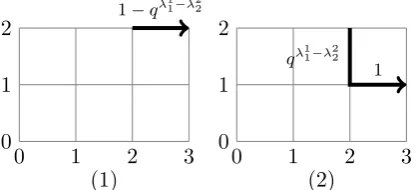
one: this outcome has weight 1−qλ11−λ22.
2. The 2 is inserted into the first row, pushing the existing 2’s over by one: this outcome has weightqλ11−λ22.
Note that these weights sum to one, as is always the case. The corresponding insertion paths, with edge weights indicated, are:
0 1 2 3
0 1
2 1−q
λ11−λ22
(1)
0 1 2 3
0 1 2
qλ11−λ2 2
1
(2)
The quantity λ11 −λ22 is the difference between the number of 1’s in the first row
and the number of 2’s in the second row, see Figure 2.2.
1 . . . 1 2 . . . 2
2 . . . 2 λ1
[image:22.595.217.426.241.336.2]1−λ22
Figure 2.2: The quantityλ11−λ22 in the exponent in Example 2
For example, inserting a 2 into
P = 1 1 2 2 2
gives
I2(P,P˜) =
1−q if ˜P = ˜P2
q if ˜P = ˜P3
0 otherwise.
where
˜
P2 =
1 1 2 2
and
˜
P3 =
1 1 2 2 2
2 .
Example 3. Suppose l = 3. If we are inserting a 1 into P ∈ T3 there is only one
possible outcome ˜P withI1(P,P˜)6= 0, namely the one obtained by the usual column insertion algorithm: the 1 is inserted into the first row, pushing the existing first
row over by one. The corresponding weighted insertion path is:
0 1 2 3 4
0 1 2 3
1 1 1
If we are inserting a 2, there are three possible outcomes:
1. The 2 is inserted into the second row, pushing the existing second row over by
one: this outcome has weight
(1−qλ11−λ22)1−q λ2
1−λ32
1−qλ2 1−λ22
;
2. The 2 is inserted into the second row, bumping a 3 into the first row: this
outcome has weight
(1−qλ11−λ22) 1−1−q λ2
1−λ32
1−qλ21−λ22 !
;
3. The 2 is inserted into the first row, pushing existing 2’s and 3’s in first row
The corresponding insertion paths, with edge weights indicated, are:
0 1 2 3 4
0 1 2 3
1−qλ11−λ2 2
1−qλ21−λ32 1−qλ21−λ22
(1)
0 1 2 3 4
0 1 2 3
1−qλ11−λ2 2
1−1−qλ21−λ32
1−qλ21−λ22
1
(2)
0 1 2 3 4
0 1 2 3
qλ11−λ2 2
1 1
(3)
If we are inserting a 3, there are also three possible outcomes: the 3 is placed in the third, second or first row with respective weights 1−qλ22−λ33,qλ22−λ33(1−qλ21−λ32)
andqλ22−λ33qλ21−λ32. The corresponding insertion paths, with edge weights indicated,
are:
0 1 2 3 4
0 1 2 3
1−qλ22−λ3 3
0 1 2 3 4
0 1 2 3
qλ22−λ33
1−qλ21−λ3 2
0 1 2 3 4
0 1 2 3
qλ22−λ3 3
qλ21−λ32
The quantitiesλ11−λ22,λ21−λ32, etc. which appear in the above weights are
illustrated in Figure 2.3.
1 . . . 1 2 . . . 2 3 . . . 3
2 . . . 2 3 . . . 3
3 . . . 3 λ1
1−λ22 λ21−λ32 λ2
[image:25.595.146.491.149.242.2]2−λ33 λ21−λ22
Figure 2.3: The exponent quantities in Example 3.
Example 4. Suppose we are inserting a 3 into
P =
1 2 2 2 3 5
2 3 4 5
3 4
5
(2.2)
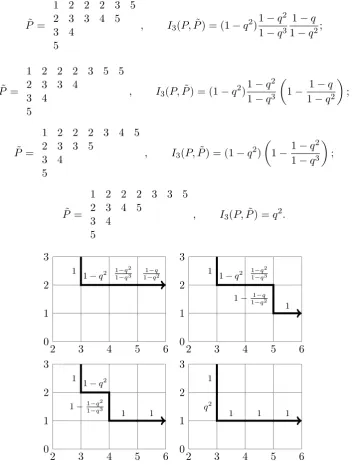
The (four) possible output tableaux ˜P and their weights I3(P,P˜) are shown in
Figure 2.4, along with the corresponding weighted insertion paths.
The q-insertion algorithm can be applied to a word w = w1. . . wn ∈ [l]n,
starting with an empty tableau and successively inserting the numbersw1, w2, . . . , wn,
multiplying the weights along each possible sequence of output tableauxP(1), . . . , P(n) =
P to obtain a distribution of weights φw(P, Q) onTl× Sn. More precisely, we define
φw(P, Q) recursively as follows. Set
φk(P, Q) =
1 ifP =kand Q= 1
0 otherwise.
Forw∈[l]n and ( ˜P ,Q˜)∈ Tl× Sn+1 with sh ˜P = sh ˜Q, define
φwk( ˜P ,Q˜) = X
φw(P, Q)Ik(P,P˜),
where the sum is over (P, Q)∈ Tl× Sn with shP = shQ.
We conclude this section by giving a more algorithmic description of theq -insertion algorithm. For this it is convenient to assume 0 ≤ q < 1 and describe
˜
P =
1 2 2 2 3 5
2 3 3 4 5
3 4
5
, I3(P,P˜) = (1−q2) 1−q2
1−q3 1−q
1−q2;
˜
P =
1 2 2 2 3 5 5
2 3 3 4
3 4
5
, I3(P,P˜) = (1−q2) 1−q2 1−q3
1− 1−q 1−q2
;
˜
P =
1 2 2 2 3 4 5
2 3 3 5
3 4
5
, I3(P,P˜) = (1−q2)
1−1−q 2
1−q3
;
˜
P =
1 2 2 2 3 3 5
2 3 4 5
3 4
5
, I3(P,P˜) =q2.
2 3 4 5 6
0 1 2 3
1
1−q2 1−q
2 1−q3
1−q
1−q2
2 3 4 5 6
0 1 2 3
1
1−q2 1−q
2 1−q3
1− 1−q
1−q2
1
2 3 4 5 6
0 1 2 3
1
1−q2
1−11−q−q23
1 1
2 3 4 5 6
0 1 2 3 1 q2
[image:26.595.146.499.121.587.2]1 1 1
Figure 2.4: The four possible output tableaux ˜P, their weights I3(P,P˜), and the corresponding insertion paths, with edge weights indicated, for k= 3 and P given by (2.2).
the language of ‘weights’ in the general case. For reference, we begin with an
1. Seti←1 and (P, Q) = (∅,∅).
2. Setk←wi and j←k.
3. If λkj−−11=λjk and j > 1 then set j ← j−1; otherwise k displaces the first number s in jth row of the tableau that is larger than k (s = ∞ and k is
appended at the end of the row if no such number exists) and setk←s.
4. If k = ∞ then append i to Q such that P and Q have the same shape, set
i←i+ 1 and go to step (2); otherwise go to step (3).
The q-insertion algorithim is defined as follows. We adopt here the following
con-vention: fori >0, let
qλi−0 1−λi1 =qλi0−λi1 =qλi0−λ
i−1 0 =qλ
i i−λ
i
i+1 =qλii−λ i−1
i =qλ i−1
i −λ i i+1 = 0.
This convention is used for covering boundary conditions in general arguments. It
is only used in the following description of the q-insertion algorithm as well as in Section 2.7.1. Otherwise the undefinedλij forj > i orj= 0 are taken to be zero.
1. Seti←1 and (P, Q) = (∅,∅).
2. Setk←wi,j←k,d←0 and ae(m, n)←fe(m, n) ∀e∈ {0,1},1≤n≤m.
3. With probability 1−ad(k, j) set j ←j−1 and d← 0; otherwise k displaces
the first number s injth row of the tableau that is larger thank(s=∞ and
append kat the end of jth row if no such number exists) and setk← sand
d←1.
4. If k = ∞ then append i to Q such that P and Q have the same shape, set
i←i+ 1 and go to step (2); otherwise go to step (3).
As is obvious, whenq= 0 it reduces to the usual column insertion algorithm.
2.4
Main result
The weightsφw(P, Q) are quite complicated. The main result of this chapter is that
a remarkable simplification occurs when we average over the set of words. Before
stating the result, we first introduce two more functions on tableaux and explain their connection toq-Whittaker functions and Macdonald polynomials. Denote the
q-Pochhammer symbol by
with the conventions (n)0 = (0)q= 1, and the q-binomial coefficients by " n m # q
= (n)q
(m)q(n−m)q
.
ForP ∈ Tl with shPi =λi, 1≤i≤l, writingλ=λl, define
κ(P) =
Ql−1 j=2
Qj−1 i=1(λ
j i −λ
j i+1)q Ql−1
j=1 Qj
i=1(λ j i −λ
j+1
i+1)q(λji+1−λ j i)q
= ∆l(λ)−1 Y
1≤j<i≤l "
λij −λij+1 λi
j−λi −1 j # q , where
∆l(λ) = l−1 Y
i=1
(λi−λi+1)q.
ForQ∈ Sn with shQi =µi, 1≤i≤n, define
ρ(Q) = Y
1≤i≤j:µi j−µ
i−1
j =1
(1−qµij−µij+1).
The functionsκand ρ are simply related as follows. Suppose that l≥nand P has
distinct entriesi1< i2 <· · ·< in. Denote by ˆP ∈ Snthe standard tableau obtained
by replacing the entryik by k, for each k= 1, . . . , n. Then
κ(P) = ρ( ˆP) (1−q)n∆
l(λ)
. (2.3)
Indeed, using the simple identities,
"
a
0 #
q
= 1,
"
a
1 #
q
= 1−q
a
we have
κ(P) = ∆l(λ)−1 Y
1≤i<j≤l λij−λi−j 1=1
"
λij −λij+1 λi
j−λi −1 j
#
q Y
1≤i<j≤l λij−λi−j 1=0
"
λij−λij+1 λi
j−λi −1 j
#
q
= ∆l(λ)−1 Y
1≤i<j≤l λi
j−λ i−1
j =1
1−qλij−λij+1 1−q
Y
1≤i=j≤l λi
j−λ i−1
j =1
1−q
1−q
= ρ( ˆP) (1−q)n∆
l(λ)
.
The functions κ and ρ are closely related to q-Whittaker functions [Rui90, Eti99, GLO10, GLO12]. Denote by Ωl the set of partitions with at most l parts.
Theq-Whittaker function with parameter a∈Cl is a function on Ωl defined by
Ψa(λ) =
X
P∈Tl: shP=λ
aPκ(P). (2.5)
In [GLO11] it is shown that these functions are given in terms of the Macdonald
polynomialsPλ(x;q, t) as
Ψa(λ) = ∆l(λ)−1Pλ(a;q,0). (2.6)
From this it follows that
Ψa(λ) = ∆l(λ)−1 X
µ
kλµ(q)mµ(a) (2.7)
wheremµ denote the monomial symmetric functions and
kλµ(q) = ∆l(λ)
X
shP=λ,tyP=µ
κ(P) =X
ν
Kλν(q,0)Kνµ, (2.8)
where Kλµ(q, t) are the two-variable Kostka polynomials [Mac98]. We recall that
Kλν(q,0) =Kλ0ν0(0, q) =Kλ0ν0(q), where Kλµ(t) =Kλµ(0, t) are the single-variable
Kostka polynomials. For an extensive survey of the various properties and inter-pretations of these polynomials, see [Ana01]. When q = 0, κ(P) ≡ 1 and kλµ(0)
and typeµ. In this case, Ψa(λ) is given by the Schur polynomial
Ψa(λ) =sλ(a) = X
µ
Kλµmµ(a).
We will also consider the following functions:
fλ(q) = X
Q∈Sn: shQ=λ ρ(Q).
Note thatfλ(0) =fλ, the number of standard tableaux with shapeλ. The relation betweenfλ(q) and the Whittaker functions Ψais given by the following proposition,
which is a straightforward consequence of (2.3). Define
∆(λ) =
l(λ) Y
i=1
(λi−λi+1)q,
wherel(λ) denotes the number of parts inλ.
Proposition 5. For each λ`n,
lim
l→∞Ψ(1/l)l(λ) =
fλ(q)
n!(1−q)n∆(λ).
It follows, using
lim
l→∞sλ((1/l)
l) =fλ/n!,
thatfλ(q) is also given, for λ`n, by
fλ(q) = (1−q)nX
µ
Kλµ(q,0)fµ.
To understand this in terms of specializations, recall that the exponential
special-ization ex1 is the homomorphism defined on the ring of symmetric functions by ex1(pn) =δn1, where pn are the elementary power sums (see, for example, [Sta01,
§7.8]). It follows from the above proposition (or can be seen directly) that
fλ(q) =n!(1−q)nex1(Pλ(q,0)).
Toda difference operators [Rui90, Rui99, Eti99, GLO10]. In particular,
LΨa= X
i
ai !
Ψa, (2.9)
whereL is the kernel operator defined by
L(λ, µ) =
ci(λ) ifµ=λ+ei for some 1≤i≤l,
0 otherwise,
and
ci(λ) =
1−qλi−λi+1+1 for 1≤i < l,
1 fori=l.
Our main result is the following.
Theorem 6. Let (P, Q)∈ Tl× Sn with shP =shQ=λ. Then
X
w∈[l]n
φw(P, Q) = (λl)q−1κ(P)ρ(Q). (2.10)
We note the following immediate extension of this identity which is useful for applications. The type of a word w is the composition µ = (µ1, µ2, . . .) where
µi is the number of i’s in w. For a = (a1, . . . , al) and µ a composition, write
aµ =aµ1 1 . . . a
µl
l ; for w ∈ [l]n and P ∈ Tl, write aw = aty(w) and aP = atyP. Now,
sinceφw(P, Q) = 0 unless tyP = ty(w), we can write
X
w∈[l]n
awφw(P, Q) = (λl)q−1aPκ(P)ρ(Q). (2.11)
Summing (2.11) overP and Qgives
X
(P,Q)∈Tl×Sn:shP=shQ=λ
X
w∈[l]n
awφw(P, Q) = (λl)q−1Ψa(λ)fλ(q).
Note that this implies the Cauchy-Littlewood type identity
X
λ`n
(λl)−q1Ψa(λ)fλ(q) = X
i
ai !n
.
Theorem 6 also yields some combinatorial formulas.
shape λ. Then
Pλ(a;q,0) = X
w∈[l]n
HQ(w)aw
and
kλµ(q) =
X
w∈[l]n:ty(w)=µ
HQ(w),
where
HQ(w) =
∆(λ)
ρ(Q) X
P
φw(P, Q).
Similarly, for any fixed P ∈ Tl with shape λ`n,
fλ(q) = X
w∈[l]n
GP(w),
where
GP(w) =
(λl)q
κ(P) X
Q
φw(P, Q).
Taking P to be standard with shape λ`n, this last formula becomes
ex1(Pλ(q,0)) =
1
n! X
σ∈Sn
HP(σ),
where the sum is over permutations andHP(σ) indicates the functionHP evaluated
at the word σ−1(1). . . σ−1(n).
When q = 0, HS(w) equals 1 if the Q-tableau obtained by applying the
Robinson-Schensted algorithm with column insertion to w is S, and 0 otherwise;
similarly, GT(w) equals 1 if the P-tableau obtained by applying the
Robinson-Schensted algorithm with column insertion towisT, and 0 otherwise. The functions
GT andHSthus generalise the notions ofP-equivalence andQ-equivalence, or Knuth
and dual Knuth equivalence, for the Robinson-Schensted algorithm with column
insertion (see, for example, [Ful97, Chapter 2 and§A.3]).
The key ingredient in the proof of Theorem 6 in Section 2.7.1 is the following
intertwining relation. Define kernel operatorsK and M by
K(λ, P) =aPκ(P)IshP=λ, M(P,P˜) = l X
k=1
Proposition 8. The following intertwining relation holds:
KM =LK (2.12)
We remark that (2.12) immediately yields the eigenvalue equation (2.9).
2.5
Stochastic evolutions
If 0≤q <1 anda∈Rl + with
P
iai= 1, then
X
w∈[l]n
awφw(P, Q) = (λl)q−1aPκ(P)ρ(Q) (2.13)
defines a probability measure onTl×Sn, which can be interpreted as the distribution
of the pair of tableaux obtained when one applies the randomised insertion algotihm to a random word w1. . . wn with each wi chosen independently at random from
[l] according to the probabilities a1, . . . , al. If we denote by L(m) the shape of
the tableau obtained after inserting the first m entries w1. . . wm then, given the
interpretation ofQ as a recording tableau, we conclude by summing (2.13) over P
that the sequence of shapesL(1), . . . ,L(n) is distributed according to
P(L(1) =µ1, . . . ,L(n) =µn) = (µn`) −1
q Ψa(µn)ρ(Q),
whereQ∈ Sn is defined by shQi=µi,i= 1, . . . , n. But this can be written as
P(L(1) =µ1, . . . ,L(n) =µn) =
n Y
i=1
Ψa(µi)
Ψa(µi−1)
L(µi−1, µi).
Since n is arbitrary, we immediately conclude the following. Write µ % λ if λ is
obtained from µby adding a single box.
Theorem 9. When applying the randomised insertion algorithm to a random word
w1w2. . . with each wi chosen independently at random from [l] according to the
probabilities a1, . . . , al the sequence of tableaux P(n), n ≥ 0 obtained evolves as a
Markov chain inTl with transition probabilities
M(P,P˜) =
n X
k=1
akIk(P,P˜).
tran-sition probabilities
p(µ, λ) = Ψa(λ) Ψa(µ)
L(µ, λ)Iµ%λ.
The conditional law of P(n), given{L(1), . . . ,L(n); L(n) =λ}, is
P(P(n) =P| L(1), . . . ,L(n); L(n) =λ) = K(λ, P)
Ψa(λ)
.
The conditional law of tyP(n), given {L(1), . . . ,L(n); L(n) =λ}, is
P(tyP(n) =µ| L(1), . . . ,L(n); L(n) =λ) = a
µk λµ(q)
Ψa(λ)
.
The distribution of L(n) is given by
ν(λ) :=P(L(n) =λ) = (λl)q−1Ψa(λ)fλ(q).
The probability distribution ν is a particular specialisation (and restriction
toλ `n) of the Macdonald measures introduced by Forrester and Rains [PJF02],
see also [BC13]. When q = 0, the above theorem reduces to the fact [O’C03a] that, when applying the usual column insertion algorithm to a random word with
probabilities a1, . . . , al, the shape of the tableau evolves as a Markov chain with
transition probabilities
p(µ, λ) = sλ(a)
sµ(a)Iµ%λ
.
Ifa1 > a2 >· · ·> al this Markov chain can be interpreted as a random walk inNl
with transition probabilities
r(µ, λ) =aλ−µIµ%λ
conditioned never to exit the Weyl chamber{λ∈Nl: λ
1 ≥ · · · ≥λl}, which can be
identified with Ωl. This result, which relates to the representation theory ofgll, has been generalised to arbitrary complex semisimple Lie algebras in [BBO05, LLP12].
For earlier related work on the asymptotics of longest monotone subsequences in random words, see [TW01]. When q → 1 the q-Whittaker functions converge
with appropriate rescaling to gll-Whittaker functions [GLO12], and the above the-orem should re-scale to the main result of the paper [O’C12], which relates a continuous-time version of the geometric RSK correspondence introduced by A.N.
Kirillov [Kir01], with Brownian motion as input, to the open quantum Toda chain
an appropriate sense to the continuous-time version of the geometric RSK mapping
considered in [O’C12], which is deterministic. The results of [O’C12] have been generalised in [Chh13] (see also [BBO09]) to arbitrary complex semisimple Lie
al-gebras. It is natural to expect the results of the present chapter to admit a similar
generalisation.
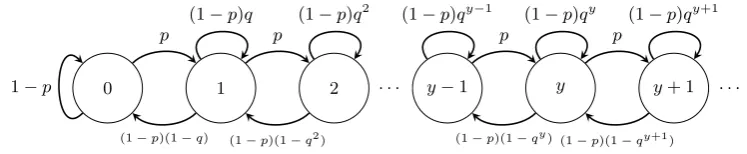
Example 10. The rank-1 case (l= 2) of Theorem 9 is discussed in [O’C14]. Setting Li(n) = shPi(n), the evolution on tableaux in this case is driven by the process
Y(n) = L1
1(n)− L21(n), n≥0, which (setting p=a1) is a birth and death process as illustrated in Figure 2.5.
0 1 2 y−1 y y+ 1
1−p
p p
. . .
p p
. . .
(1−p)(1−q) (1−p)(1−q2) (1−p)(1−qy) (1−p)(1−qy+1)
[image:35.595.131.505.275.352.2](1−p)q (1−p)q2 (1−p)qy−1 (1−p)qy (1−p)qy+1
Figure 2.5: The birth-and-death process Y
Example 11. Whenl= 3 the algorithm is more complicated than in thel= 2 case
because the push-or-bump probability f1(3,2) appears. In this case the algorithm with random input is described as follows (cf. Example 2). In the following, w.p.
means “with probability”.
• w.p. a1, insert 1 to row 1, pushing 2’s and 3’s in row 1
• w.p. a2, insert 2
– w.p. 1−qλ11−λ22, the 2 is inserted to row 2 and the displaced 3 is either
pushed or bumped
∗ w.p. (1−qλ21−λ32)/(1−qλ21−λ22) the displaced 3 is pushed in row 2
∗ w.p. 1−(1−qλ21−λ32)/(1−qλ21−λ22) the displaced 3 is bumped to row
1
– w.p. qλ11−λ22, the 2 is inserted to row 1 and it pushes 3’s in row 1
• w.p. a3, insert 3
– w.p. 1−qλ22−λ33, the 3 is inserted to row 3
– w.p. qλ22−λ33qλ21−λ32 the 3 is inserted to row 1
Theq-insertion algorithm applied to a random word is closely related to the
q-TASEP interacting particle system. This is a variation of the totally asymmetric simple exclusion process (TASEP) which was introduced (in the language of q
-bosons) and shown to be integrable by Sasamoto and Wadati [SW98], and recently
related to q-Whittaker functions by Borodin and Corwin [BC13]. The process is defined as follows. There are l particles on the integer lattice, and we denote their
positions byx1> x2 >· · ·> xl. Let a1, a2, . . . , al ∈R+. Without loss of generality
we can assumeP
iai= 1. The particles jump independently to the right by 1 with
respective rates
ri=
a1, ifi= 1;
ai(1−qxi−1−xi−1), otherwise.
Note that when xi + 1 = xi−1 the rate ri vanishes, thus enforcing the exclusion
rule. Now consider the tableau-valued Markov chain P(n), n ≥ 0, defined as above by applying the randomised insertion algorithm applied to a random word
with probabilities a1, . . . , al. Setting Li(n) = shPi(n), we see that the process
X1(n), . . . , Xl(n), n≥0 defined byXi(n) =Lii(n)−i+ 1 evolves as a Markov chain
with state space{x∈Zl: x
1 > x2>· · ·> xl} and transition probabilities
π(x, x+ei) =ri, i= 1, . . . , l π(x, x) = 1− X
i
ri,
where ri are defined as above. In other words, it is a de-Poissonisation of the q
-TASEP process. Denote the q-TASEP process by ˜X(t), t ≥ 0, started with step initial condition ˜Xi(0) = 1−i,i= 1, . . . , l; by Theorem 9, the law of the position
of the last particle at timetis given by
P( ˜Xl(t) =m−l+ 1) = X
k≥0
e−tt
k
k! X
λ`k,λl=m
(λl)−q1Ψa(λ)fλ(q)
=e−t X
λ∈Ωl,λ l=m
t|λ|
|λ|!(λl)
−1
q Ψa(λ)fλ(q). (2.14)
In [BC13], a continuous-time Markov chain on the set of tableaux Tl (actually
dis-crete Gelfand-Tsetlin patterns, but this is equivalent) was introduced. It has the same fixed time marginals as the Poissonisation of the processP(n), although the
q-TASEP process and in the paper [BC13] an equivalent expression to (2.14) is
ob-tained via this coupling for the law of ˜Xl(t). See also [BCS14] for related recent
work.
2.6
Permutations
Ifl=nand P ∈ Sn with shP =λ, then (2.3) becomes
κ(P) = ρ(P) (1−q)n∆
n(λ)
.
Using this, and the fact that φw(P, Q) = 0 unless tyP = tyw, we immediately
deduce from Theorem 6 the following corollary.
Corollary 12. For P, Q∈ Sn with shP =shQ=λ, we have
ζP,Q(q) := X
σ∈Sn
φσ(P, Q) =
ρ(P)ρ(Q)
(1−q)n∆(λ). (2.15)
Summing overP andQ gives
θλ(q) :=
X
P,Q∈Sn:shP=shQ=λ
ζP,Q(q) =
fλ(q)2 (1−q)n∆(λ).
We note that P
λ`nθλ(q) = n!. When 0 ≤ q < 1, the probability measure on
integer partitions defined by µq(λ) = θλ(q)/n! gives the law of the shape of the
tableaux obtained when one applied the randomised insertion algorithm to a random
permutation. It would be interesting to understand the analogue in this setting of the longest increasing subsequence problem [AD99, BDJ99, Oko01].
For any standard tableauP with entries in [n] and shape λ, its weight ρ(P)
is a product ofnpolynomials of the form of (1−qk) and hence ρ(P) is divisible by (1−q)n. On the other hand, considering the ith and i+ 1th row in P, each time
j a box is added in ith row, a factor (1−qd) - where d is the difference between length of the corresponding two rows at timej- appears inρ(P). For this difference
dto reach the value of λi−λi+1 eventually (which it evidently does) all the factors
(1−q),(1−q2), . . . ,(1−qλi−λi+1) must appear at least once. It follows that ρ(P) is also divisible by ∆(λ). Thus,ζP,Q(q)∈Z[q] for each pair (P, Q) andθλ(q)∈Z[q]
for eachλ.
For any permutationσ∈Sn, denote by (P(σ), Q(σ)) the pair of tableaux
Fσ(q) andθλ(q) are given by
F12(q) = 1−q; F21(q) = 1 +q.
θ2(q) = 1 +q; θ12(q) = 1−q.
Whenn= 3, we have
F123(q) = (1−q)2; F132(q) = 1−q; F213(q) = (1 +q)(1−q2);
F231(q) = 1−q2; F312(q) = 1−q2; F321(q) = (1 +q)(1 +q+q2).
θ3(q) = (1 +q)(1 +q+q2); θ21(q) = (1−q)(2 +q)2; θ13(q) = (1−q)2.
The polynomials Fσ(q) give an alternative interpretation of the probability
measure µq as the distribution of the shape of the tableaux obtained when one
applies the Robinson-Schensted column insertion algorithm to a permutation chosen
at random according to the distributionFσ(q)/n!.
2.7
Proofs
2.7.1 Proof of Proposition 8
To prove (2.12), we take advantage of the recursive structure of the q-Whittaker functions. Define ˆκ on Ωl×Ωl−1 by
ˆ
κ(λl, λl−1) =
Ql−2 i=1(λ
l−1 i −λ
l−1 i+1)q Ql−1
i=1(λl −1
i −λli+1)q(λli−λl −1 i )q
and set
T ={(λl, λl−1)∈Ωl×Ωl−1 :λl−1 ≺λl},
where we writeλ≺µ ifµi+1≤λi ≤µi for each i.
We begin by verifying the simpler intertwining relation:
ˆ
where ˆM :T ×T →R≥0 and ˆK :T →R≥0 are defined as follows.
ˆ
M((λl, λl−1),(λl+ek, λl−1)) =al(1−qλ
l−1
k−1−λ
l k)
l−1 Y
i=k
qλl−i 1−λ l
i+1, 1≤k≤l;
ˆ
M((λl, λl−1),(λl+ek, λl−1+ek)) =
(1−qλl−k 1−λ l−1
k+1+1)(1−qλ
l−1
k−1−λlk)
1−qλl−k−11−λ
l−1
k
,
1≤k≤l−1;
ˆ
M((λl,λl−1),(λl+ek, λl−1+em))
= (1−q
λml−1−λml−+11 +1)(1−qλlm−λ l−1
m )
1−qλl−m−11−λ
l−1
m
(1−qλl−k−11−λlk)
m Y
i=k+1
qλl−i−11−λli,
1≤k < m≤l−1.
ˆ
K(λl,(˜λl, λl−1)) =aPli=1λli− Pl−1
i=1λ
l−1
i ˆκ(λl, λl−1)I
λl=˜λl.
With a slight abuse of notation we will write ˆK(λl, λl−1) as shorthand for ˆK(λl,(˜λl, λl−1))
since the support of latter is in{λl= ˜λl}. We’ll do the same for kernel K.
We will verify the recursive intertwining relation (2.16) directly. The left
hand side is given by
ˆ
KMˆ(λl,(λl+ek, λl−1)) = ˆK(λl, λl−1) ˆM((λl, λl−1),(λl+ek, λl−1))
+ ˆK(λl, λl−1−ek) ˆM((λl, λl−1−ek),(λl+ek, λl−1))Ik≤l−1
+
l−1 X
m=k+1 ˆ
K(λl, λl−1−em) ˆM((λl, λl−1−em),(λl+ek, λl−1))Ik≤l−2.
We calculate each term separately. SetK0 =alKˆ(λl, λl−1).
ˆ
K(λl, λl−1) ˆM((λl, λl−1),(λl+ek, λl−1)) =K0(1−qλ
l−1
k−1−λlk)
l−1 Y
i=k
ˆ
K(λl,λl−1−ek) ˆM((λl, λl−1−ek),(λl+ek, λl−1))
=K0(1−q
λl−k−11−λl−k 1+1)(1−qλl−k 1−λl k+1)
(1−qλl−k 1−λ l−1
k+1)(1−qλlk−λ l−1
k +1)
(1−qλl−k 1−λ l−1
k+1)(1−qλ
l−1
k−1−λlk)
1−qλl−k−11−λ
l−1
k +1
=K0(1−qλk−l−11−λlk)1−q
λl−k 1−λl k+1
1−qλlk−λ l−1
k +1 .
l−1 X
m=k+1 ˆ
K(λl,λl−1−em) ˆM((λl, λl−1−em),(λl+ek, λl−1))
=K0
l−1 X
m=k+1
(1−qλl−m−11−λ
l−1
m +1)(1−qλl−m1−λlm+1)
(1−qλl−m1−λl−m+11 )(1−qλlm−λ l−1
m +1)
×(1−q
λml−1−λml−+11 )(1−qλlm−λ l−1
m +1)
1−qλl−m−11−λ
l−1
m +1
(1−qλl−k−11−λ
l k)
m Y
i=k+1
qλl−i−11−λ
l i
=K0(1−qλl−k−11−λ
l k)
l−1 X
m=k+1
(1−qλl−m1−λlm+1) m Y
i=k+1
qλl−i−11−λli.
The left hand side of (2.16) is thus given by
LHS=K0(1−qλl−k−11−λ
l k)
l−1 Y
i=k
qλl−i 1−λ l i+1
+
l−1 X
m=k+1
(1−qλl−m1−λlm+1) m Y
i=k+1
qλl−i−11−λ
l iI
k≤l−2+
1−qλl−k 1−λ l k+1
1−qλlk−λ l−1
k +1 Ik≤l−1
!
=K0(1−qλk−l−11−λlk)1−q
λl
k−λlk+1+1
1−qλlk−λ l−1
k +1 .
The right hand side is much easier to calculate:
LKˆ(λl,(λl+ek, λl−1)) =L(λl, λl+ek) ˆK(λl+ek, λl−1)
=K0(1−qλlk−λ l
k+1+1) 1−q
λl−k−11−λl k
1−qλlk−λl−k 1+1,
as required.
We will now prove (2.12) by induction on l. When l = 2, since ˆM2 is the
kernel for the whole tableau, the recursive intertwining relation (2.16) is equivalent to the full intertwining relation (2.12). Suppose the statement of the proposition
we have
Kl(λl, λ1:l−1) =Kl−1(λl−1, λ1:l−2) ˆKl(λl, λl−1). (2.17)
By the recursive nature of definition of φw, Ml can be expressed in terms of ˆMl,
Ml−1 andLl−1:
Ml(λ1:l,λ˜1:l) =Iλl−1=˜λl−1Mˆl((λl, λl
−1),(˜λl,˜λl−1))
+Iλl−1%λ˜l−1
Ml−1(λ1:l−1,λ˜1:l−1)
Ll−1(λl−1,λ˜l−1) ˆ
Ml((λl, λl−1),(˜λl,λ˜l−1)).
For partitionsλ, µwrite λ µto mean that eitherλ=µorλ%µ. Then
KlMl(λl,(˜λl, λ1:l−1)) = X ˜
λ1:l−1:˜λl−1 λl−1
Kl(λl,λ˜1:l−1)Ml((λl,λ˜1:l−1),(˜λl, λ1:l−1))
= X
˜ λ1:l−1
ˆ
Kl(λl,λ˜l−1)Kl−1(˜λl−1,˜λ1:l−2)I˜λl−1=λl−1Mˆl((λl,˜λl
−1),(˜λl, λl−1))
+I˜λl−1%λl−1
Ml−1(˜λ1:l−1, λ1:l−1)
Ll−1(˜λl−1, λl−1) ˆ
Ml((λl,λ˜l−1),(˜λl, λl−1))
=:I˜λl−1=λl−1I +Iλ˜l−1%λl−1II.
II = X
˜
λl−1%λl−1 ˆ
Kl(λl,˜λl−1) ˆMl((λl,λ˜l−1),(˜λl, λl−1))
× X
˜
λ1:l−2:˜λl−2 λl−2
Kl−1(˜λl−1,λ˜1:l−2)M
l−1(˜λ1:l−1, λ1:l−1)
Ll−1(˜λl−1, λl−1) !
= X
˜
λl−1%λl−1 ˆ
Kl(λl,˜λl−1) ˆMl((λl,λ˜l−1),(˜λl, λl−1))
×K
l−1Ml−1(˜λl−1,(λl−1, λ1:l−2))
Ll−1(˜λl−1, λl−1)
!
induction ========
assumption
X
˜
λl−1%λl−1 ˆ
Kl(λl,λ˜l−1) ˆMl((λl,λ˜l−1),(˜λl, λl−1))
×L
l−1Kl−1(˜λl−1,(λl−1, λ1:l−2))
Ll−1(˜λl−1, λl−1)
!
= X
˜
λl−1%λl−1 ˆ
Due to the indicator, when ˜λl−1 =λl−1,
I = ˆKl(λl,λ˜l−1)Kl−1(λl−1, λ1:l−2) ˆMl((λl,˜λl−1),(˜λl, λl−1)).
Therefore
KlMl(λl,(˜λl, λ1:l−1))
= X
˜
λl−1:˜λl−1 λl−1 ˆ
Kl(λl,˜λl−1)Kl−1(λl−1, λ1:l−2) ˆMl((λl,˜λl−1),(˜λl, λl−1))
=Kl−1(λl−1, λ1:l−2) ˆKlMˆl(λl,(˜λl, λl−1))
(2.16)
= Kl−1(λl−1, λ1:l−2)Ll(λl,λ˜l) ˆKl(˜λl, λl−1)
(2.17)
= Ll(λl,˜λl)Kl(˜λl, λ1:l−1) =LK(λl,(˜λl, λ1:l−1)),
as required.
2.7.2 Proof of Theorem 6
We will prove the identity (2.11), from which the statement of the theorem follows.
From the definition of φw, for (P, Q) ∈ Tl × Sn such that shP = shQ = λ and
µi = shQi fori= 1, . . . , n, the left hand side of (2.11) can be written as
X
w∈[l]n
awφw(P, Q)
= X
w∈[l]n
X
(P(i))in−=11,shP(i)=µi
awIw1(∅, P(1)). . . Iwn(P(n−1), P)
= X
w∈[l]n
X
(P(i))in−=11,shP(i)=µi
(aw1Iw1(∅, P(1))). . .(awnIwn(P(n−1), P))
= X
(P(i))in−=11,shP(i)=µi
X
w1∈[l]
aw1Iw1(∅, P(1))
. . .
X
wn∈[l]
awnIwn(P(n−1), P)
= X
(P(i))in−=11,shP(i)=µi
M(∅, P(1)). . . M(P(n−1), P).
relation (2.12),
aPκ(P)ρ(Q) (λl)q
=L(∅, µ1). . . L(µn−1, λ)K(λ, P)
=L(∅, µ1). . . L(µn−2, µn−1)LK(µn−1, P)
=L(∅, µ1). . . L(µn−2, µn−1)KM(µn−1, P)
= X
P(n−1): shP(n−1)=µn−1
L(∅, µ1). . . L(µn−2, µn−1)
×K(µn−1, P(n−1))M(P(n−1), P) !
= X
P(n−1),P(n−2): shP(n−1)=µn−1,shP(n−2)=µn−2
L(∅, µ1). . . K(µn−2, P(n−2))
×M(P(n−2), P(n−1))M(P(n−1), P) !
=· · ·= X
(P(i))n−i=11: shP(i)=µi
L(∅, µ1)K(µ1, P(1))M(P(1), P(2))×
· · · ×M(P(n−1), P) !
.
Now, from the definition of L, K and M, for P(1) ∈ Tl that has only one entry k
and whose shape isµ1 = (1),
L(∅, µ1) = 1; K(µ1, P(1)) =M(∅, P(1)) =ak.
This completes the proof.
2.7.3 Proof of Proposition 5
Letλ`nand note that, forl > n, ∆l(λ) = ∆(λ). We want to show that
lim
l→∞Ψ(1/l)l(λ) =
fλ(q)
From the definition of Ψa, this is equivalent to
lim
l→∞l
−n X
P∈Tl: shP=λ
κ(P) = f
λ(q)
n!(1−q)n∆(λ).
Write
X
P∈Tl: shP=λ
κ(P) =A+B
where A denotes the sum over tableaux with distinct entries and B denotes the
remaining sum. Assumel > n. By (2.3), if P has distinct entries, then
κ(P) = ρ( ˆP) (1−q)n∆(λ).
Hence
l−nA=l−n l n
! X
Q∈Sn
ρ(Q)
(1−q)n∆(λ) →
fλ(q)
n!(1−q)n∆(λ)
as l → ∞. Thus it remains to show that l−nB → 0. We first show that κ(P) is bounded for P ∈ Tl with shP = λ. To see this, observe that if P has entries from
the set{i1, . . . , im} wherei1 <· · ·< im and ˜P denotes the tableau obtained from
P by replacing ik by k, for each k= 1, . . . , m, thenκ( ˜P) =κ(P). It follows that
κ(P)≤max
T∈Tn
κ(T)<∞.
Now, by the usual Robinson-Schensted correspondence, the number of P ∈ Tl with
shP =λwhich don’t have distinct entries is at most the number of words w∈[l]n which don’t have distinct entries, and this is given by
N(l, n) =ln− l
n
!
n!.