Access Control Process
for a
SaaS Provider
UNIVERSITY OF TURKU Department of Future Technologies Master of Science in Technology Thesis June 2019 Syeda Nazish Kazmi Supervisors: Seppo Virtanen Petri Sainio
UNIVERSITY OF TURKU
Department of Future Technologies
Syeda Nazish Kazmi: Access Control Process for a SaaS Provider Master of Science in Technology Thesis, 90 p.
Security of Networked Systems June 2019
Access control is a process of limiting access to systems and services. It is a way by which the users are granted access and privileges to information and resources of an organization. The process involves controlling, managing, logging and reviewing access. It ensures that individuals in an organization are able to access and use the systems they need to do their job but do not have more than the needed access.
An organization's major asset is the information regarding customers, processes, products, and suppliers which are critical for its operations. The internet-based technologies provide integration of corporate applications, internal and third-party systems, decision support systems, knowledge management, and repositories. The most common threat to these critical resources is unauthorized access that can pave ways for malicious activities that are harmful and can lead to loss of confidentiality, integrity, and availability. In order to minimize the risks and ensure business continuity, access control process following the best practices should be in place.
In this thesis an access control process for a SaaS organization is designed, implemented and tested. Protection of the proprietary information and resources is of prime importance for such an organization. The existing access control process is not following industry standards and best practices. As the organization is growing fast, the business and organizational requirements are also changing. In order to comply with standards for access control, the new access control process is carried out as per the guidelines provided by security standards while keeping in view the growing organization needs. All controls have been designed as per the requirements of SOC 2 and ISO 27001. The process is implemented mainly on the basis of role-based access (RBAC) model and the principle of “need to know”.
Client satisfaction, legal harmonization, and financial returns are among the benefits that the organization gets by having an access control process in line with security standards. Moreover, the organization is not only able to prevent data breaches but also meet the regional and worldwide regulations.
Acknowledgement
Table of Contents
1 Introduction ... 1
Chapter 2 ... 2
2 Literature Review ... 2
2.1 Access Control ... 2
2.2 Access Control Models ... 3
2.2.1 Discretionary Access Control Model ... 4
2.2.2 Mandatory Access Control Model ... 5
2.2.3 Non-discretionary/ Role-based access control ... 5
2.3 Access Control Techniques ... 6
2.3.1 Rule-Based Access Control ... 6
2.3.2 Constrained User Interface ... 6
2.3.3 Access Control Matrix ... 6
2.3.4 Content Dependent Access Control ... 7
2.3.5 Context-Dependent Access Control ... 7
2.4 Access Control Planning ... 7
2.5 Role-Based Access Control (RBAC) ... 8
2.5.1 Role Based Access Control Models ... 8
2.5.2 Role Based Access Control for Distributed Systems ... 11
2.5.3 Role Engineering ... 16
2.5.4 Constraints in RBAC ... 17
2.5.5 Temporal constraints in RBAC ... 20
2.5.6 Least Privilege ... 20
2.5.7 Separation of Duty ... 21
2.5.8 Limitation of Role Based Access Control ... 21
2.6 Related Terms in Access Process ... 22
2.7 Security Standards ... 23
2.7.1 ISO 27001 ... 23
2.7.2 SOC 2 ... 23
2.7.3 Purpose of Access Compliance ... 24
Chapter 3 ... 26
3 Systems and Requirements ... 26
3.1 System Context ... 26
3.1.1 Customer Environments ... 26
3.1.2 Internal Systems ... 26
3.1.3 Identity and Access Management System (IAMS) ... 27
3.1.4 Human Resource Management System ... 29
3.1.5 Jira-Ticketing and Logging System ... 29
3.2 Security Standards Requirements for Access Control ... 30
3.2.1 ISO 27001 Access control ... 31
3.2.2 SOC 2 Access Control Requirements ... 35
Chapter 4 ... 38
4 Access Management Process Designing ... 38
4.1 Purpose and objectives ... 38
4.1.1 Purpose ... 38
4.2 Scope ... 38
4.3 Value to business ... 39
4.4 Policies, principles and basic concepts ... 39
4.4.1 Policies ... 39
4.4.2 Principles and Basic Concepts ... 40
4.5 Roles in Access Management process ... 41
4.6 Process Activities and Methods ... 41
4.6.1 Customer Environments ... 42
4.6.2 Internal System Access ... 49
4.6.3 Change of Status ... 52
4.7 System Interfacing ... 53
4.8 Mapping Requirements and Controls ... 55
Chapter 5 ... 64
5 Implementation and Testing ... 64
5.1 Creation of Roles ... 64
5.1.1 Groups, Role, and Permissions ... 66
5.2 Including Existing Users in System ... 68
5.2.1 Aggregating Data ... 69
5.2.2 Reviewing ... 69
5.2.3 User ID Mapping ... 70
5.2.4 User Profile Mapping ... 70
5.3 Users Assignment ... 71
5.3.1 Assigning Users to Team-based Groups ... 71
5.3.2 Assigning Users to Other Groups ... 72
5.3.3 Setting Rules ... 72
5.4 Implementation In Jira ... 72
5.4.1 Jira Workflow Implementation ... 73
5.4.2 Jira Request Portal ... 78
5.4.3 Logging and Tracking ... 80
5.5 Testing ... 81
5.5.1 Phase 1 ... 81
5.5.2 Phase 2 ... 84
5.5.3 Phase 3 ... 85
5.6 Access Request Analysis ... 86
6 Conclusion ... 87
7 References ... 90
Abbreviations and Acronyms
ACL Access Control List
COSO Committee of Sponsoring Organization
DAC Discretionary Access Control
ESMS Enterprise Security Management System IAMS Identity and Access Management System
IITS Internal IT Support
ISO International Organization for Standardization
MAC Mandatory Access Control MFA Multifactor Authentication
NIST National Institute of Standards and Technology RBAC Role Based Access Control
SaaS Software as a service
SAML Security Assertion Markup Language
SOC Service Organization Control
1
Introduction
In today’s era, as technology becomes incorporated in our lives, businesses are continuously working on improving efficiency and productivity to stay ahead of the competition. Information storage, processing, transmission and integration provided by various technological devices is one of the most critical resources for conducting businesses. These capabilities offer many benefits to organizations including increased functionalities for users, rapid access to information, efficient service to customers, increased visibility to the outside world. However, such technologies also come with the cost of security threats and risks such as unauthorized access.
In this thesis, the case organization is a SaaS provider that deals with a lot of customer data and have several internal as well as third-party tools for product development and service provision. One of the prime concerns for such an organization is the logical access to data and resources. The existing access control process is not up to industry standards for an organization that is growing too fast. The new access control process is implemented to protect customer and organizational data, meet customer and growing organizational requirements and ensure business continuity. This is achieved by designing and implementing an access process that follows the standardized security framework best practices of ISO 27001 and SOC 2.
Chapter 2
2
Literature Review
This chapter provides an overview of the relevant work in the field of access control and some discussion about security standards. In section 2.1, we discuss some background of the access control process. Traditional access control models and the access control techniques that provide the enforcement mechanisms have been discussed in section 2.2 and 2.3 respectively. Moreover, in section 2.4 we discuss the basic components of access control planning. The Role-Based Access Control (RBAC), its models and security principles have been analyzed in section 2.5. Further, we examine the existing work related to the constraints in RBAC and its limitations. Section 2.6 discusses some related terms in the access control process and later the security standards and purpose of complying with the standards have been analyzed in section 2.7.
2.1 Access Control
Access control is defined as the process to grant or deny a request to use or obtain information and related services that involve information processing and obtain access to physical facilities (Kissel, 2013). Long before the modern computer era, the concept of access control existed. In the early 20th century, it was used in transportation for controlled access to highways and roads. Later, in 1964, one of the MIT projects described the concept of access control in the computer system and emphasized addressing the data protection issues in shared systems. The National Institute of Standards and Technology (NIST, 2014) states that information security access control should include following aspects: access control policy and procedures, account management, access enforcement, information flow enforcement, separation of duties, least privilege, data mining protection, access control decisions, and reference monitor.
control. Moreover, most of the commercially available applications independent of their OS and database management system on which they are installed, implement access control. Access control is implemented in most commercially available systems and mostly independent of the DBMS or underlying operating systems (Hu, Ferraiolo, & Kuhn, 2006).
The main objective of the access control process is expressed as only allowing legitimate access to system sources and protecting against any inappropriate or unauthorized access. This could be described as the optimal sharing of information from a business perspective. The important objective of IT is to make sharing and availability of information between users as easy as possible. Resource protection can become difficult with a greater degree of sharing but an access control mechanism that is effective and well managed eases sharing. Selective sharing of information is possible when the access control mechanism is sufficiently fine-grained else it is considered risky.
2.2 Access Control Models
2.2.1 Discretionary Access Control Model
In the early 1970s, the discretionary access control model was proposed by Lampson (Lampson, 1974). In this model, the control of access in the discretionary access control model is based on the discretion of the owner who performs the policy defining and the specification of resources accessible by subjects is done by the owner. The distinction of subject and object is the basis to control access. DAC allows owners of the objects to propagate permissions to other subjects. Access request is initiated by the subjects. The access is granted or denied based on the identity of the user or group. When a system receives a request to access an object, the authorization mechanism checks the subject's identity and then grant access.
Access control lists are the most common implementation of DAC which are enforced on the operating system level and set by the owners. One of the drawbacks of this model is that it lacks centralized control. It provides a framework for resource protection in operating systems. Access control in systems like Linux, Unix, and Windows are based on discretionary access model. The rights possessed by each subject to access a certain object are depicted in the access matrix. For an access control matrix, A, rows represent the subject's ‘s' and column represents the object ‘o'. The access rights of a subject for the object are A [s, o].
The implementation of the access matrix can be done in multiple ways. It can be read by columns, rows or tables. The capability list of the user is determined by reading the matrix by rows. It determines the access rights for each user and mostly implemented in distributed systems. When it is read by columns the access matrix is interpreted as ACL which determines the permissions granted to a particular object. Centralized systems mostly use this type of method. The access matrix, when read by tables, is interpreted as access control triples. Such implementation is widely used in database systems. The table has subjects, access modes and objects specifying access rights of subjects over objects.
susceptible to Trojan Horse where maliciously files can be copied. The absence of restrictions on rights propagation and copying information increases the risk of malicious activities. Moreover, with a large number of subjects and objects, DAC model becomes more complicated.
2.2.2 Mandatory Access Control Model
The mandatory access control is a structured model based on the security labels that consist of classification and categories. The security clearance is given by classifying the subjects on different security levels as top secret, secret or confidential. Similarly, objects are also classified. The classification and clearance data are assigned to the objects and subjects. The need to know rules are enforced based on the categories. Access is granted on the basis of clearance of the subject, classification of the object and security policy of the system. Mandatory access control model is mostly used in systems where confidentiality and classification are most important such as the military. The implementation of MAC on Linux OS is Security Enhanced Linux.
2.2.3 Non-discretionary/ Role-based access control
Non-discretionary or role-based access control (RBAC) is based on user roles or groups with defined business objectives rather than individual identities. The interaction between objects and subjects is determined by the set of controls that are centrally administered. RBAC relies on the structure of role assignment, authorization, and permissions developed through role engineering to regulate access. Access control administration is simplified by the RBAC model, so it is best suited for companies that have high employee turnover and used widely in businesses (O’Connor & Loomis, 2010). This model can also be used in combination of MAC and DAC models by configuring roles.
users which as a result acquire the permission associated with a role. The access can be controlled by administrators by limiting the rights assigned to the role. This method is quite effective for enforcing security policies and well-organized access control process. Due to its advantages, it was soon adopted in the field and was the most preferred model.
2.3 Access Control Techniques
The access control models define the policies from a high-level perspective whereas, access techniques are the enforcement mechanism that describes implementation architecture (Sandhu, Ferraiolo, & Kuhn, 2000). Different access control techniques are available to support access control models.
2.3.1 Rule-Based Access Control
This technique uses specific rules which specify the interaction between the subject and object. Access to object is not identity-based rather it is granted if the predefined rules are met by the subject irrespective of identity.
2.3.2 Constrained User Interface
The constrained user interfaces are used to restrict access of the user by limiting their access to specific resources or their ability to request particular information or functions. Database view, menus, and shells, and physically constrained interfaces are three main types of restricted interfaces.
2.3.3 Access Control Matrix
the access control matrix to the object is done by ACL. The ACL is bound to an object, but the capability model is bound to a subject.
2.3.4 Content Dependent Access Control
The access is based on the content of the object such as email filtering, database views.
2.3.5 Context-Dependent Access Control
The context of a collection of information is the basis for access decision rather than sensitivity of information such as context-based access decisions are used in the firewall where state information is collected before allowing the packet into the network.
2.4 Access Control Planning
According to Hu et al. (2006) during the planning of an access control system, the three main abstractions that must be considered are policies, model and mechanism of access control. Access control policies define the high-level requirements which specify access management and which resources and information can be accessed by whom (Lampson, 1974). These can be application specific and thus taken into account by the application vendors but are relevant to user actions within the context of an organizational unit. For example, policies may concern the usage of organizational resources or based on various factors like need-to-know, authority, conflict of interest or competence.
The access control policies are enforced through some defined mechanism on a higher level that translates the access requests of users in terms of a system provided structure. There are various structures such as simple table lookup that can be used to translate the processes of granting or denying access. Due to the lack of a well-accepted standard, few access control mechanisms are actually direct implementations of the relevant access control policies.
a precise and clear expression of requirements. Whereas, for the system developers it represents the design and implementation requirements. Access control model could be either flexible enough to allow enforcement and expression of various policies or rigid in the implementation of a single policy. Moreover, access control policies can be changed over time due to ever-evolving regulations, business requirements or other factors. Several well-known access control policies are classified as non-discretionary and discretionary. Where former is associated with rule-based and latter with identity-based access control.
2.5 Role-Based Access Control (RBAC)
In RBAC the access of users to information is regulated on the basis of functions performed by users. Identification of the roles in the system with role-based policies is important. A role is a set of permissions used to access appropriate resources as per job function. Instead of defining all authorized accesses for a user, authorized access to objects is specified for roles and users adopt those roles.
2.5.1 Role Based Access Control Models
Alan O'Connor and Ross Loomis (2010), have discussed different models of role-based access control. The RBAC model taxonomy consists of four models i.e. core, hierarchical, static constrained, and dynamically constrained RBAC. The basic RBAC system features are covered by Core RBAC. The concept of role hierarchy is defined by hierarchical RBAC that uses inheritance relation to define the partial ordering of roles. Constrained RBAC includes properties of dynamic and static separation of duties that are applicable on a session or all-time basis. Constraint relations that are imposed on role assignment relations are added by statically constrained RBAC. The dynamic constrained RBAC imposes the constraints on the activation of sets of roles that may be included as an attribute of a user's subjects. These models have been further discussed below.
2.5.1.1 Core
permissions. A user can be associated with one or more roles. Similarly, a role can have one or several assigned users. This arrangement makes it flexible and allows granular assignment of permissions to roles and users to roles.
2.5.1.2 Hierarchical
Roles in the RBAC model can have overlapping privileges and responsibilities that means users associated with various roles required to perform common operations. Under RBAC, roles can have overlapping responsibilities and privileges; that is, users belonging to different roles may need to perform common operations. Similarly, some operations are general that are required to be performed by all employees. Specifying such general operations for every role would be cumbersome and inefficient thus establishing the role hierarchies to comply with the organizational structure.
Role hierarchy defines roles with unique attributes that may have other roles which imply that roles might contain operations that are also associated with another role. For instance, in a healthcare department, a single role of specialist could have the roles of Intern and Doctor. In this way, the members of Specialist role are inherently connected with associated operations of Intern and Doctor's role's without having to assign the Doctor and Intern operations.
Moreover, each of the roles of Rheumatologist and Cardiologist could contain the specialist role. This is a way to reflect responsibilities, authorities, and competencies. The role to which user is being assigned is not mutually exclusive with another role for which the user already possesses membership. These roles and operations are dependent on the constraints and policies of an organization if overlapping operations exist than such role hierarchies can be established.
2.5.1.3 Statically Constrained
of the clinician can be restricted to only post the patient's test results but not allowed to distribute them to avoid any breach to patient's privacy due to human error and routing. The associated operations with a role can be specified in a way that they demonstrate the enforcement of certain laws and regulations such as the role of pharmacist can have associated operations to dispense but not authorized to prescribe or provide medication.
Complex security constraints or requirements can be captured in an operation that is difficult to be determined by a simple mode of access. Hence operations act as a unit of controls referenced by the particular role that is affected by the constraints in the RBAC framework. For instance, in a bank, the access needs of the role of a teller are different than those of an accounting supervisor. The teller role is defined to perform a savings deposit operation which requires the access to read and write specific fields to a savings file.
Similarly, the role of accounting supervisor can be defined to perform correction operations which require access to the same fields of saving files as the role of teller has. Nonetheless, here the constraints apply on the role of accounting supervisor that is only authorized to perform corrections but not initiating withdraws or deposits. In the same way, after the completion of the transaction, the teller cannot perform any corrections. The difference lies in the associated operations of two roles as a result of which they write different values to the transaction log file.
2.5.1.4 Dynamically Constrained
The role-based access control framework provides a framework for administrators to manage operations that a member of a role is authorized to perform. There could be a limit on assigning the users to a certain role at any given period of time. Such as only one employee can be assigned to the role of a manager at a time. In spite of some employee may act in the role, other than the manager but only one person is allowed to own the role at a given time. Memberships for roles can be assigned to users as long as it does not exceed the maximum number of users allowed for that role.
according to the business requirements of an organization. This is accomplished by managing user actions dynamically and statically through formulation and definition of roles, relationships, role hierarchies, and associated constraints.
Therefore, once the RBAC framework is in place, the major administrative task is removing or assigning a user to a role. This process is unlike the traditional and less intuitive processes of managing access on an object by object basis e.g. access control matrices and access control lists (ACL). RBAC also allows the association between the RBAC operations and "method" in object-oriented technology. This leads to the implementation of RBAC operation in operating systems and applications by using object-oriented technology.
RBAC is adaptable for a wide variety of organizations such as industrial or government organizations have varying security requirements. Despite that, only limited systems are commercially available that implemented RBAC. Oracle Enterprise Server, Informix Online Dynamic Server, and Sybase Adaptive Server are few popular commercial database management systems that support the implementation of basic RBAC features.
2.5.2 Role Based Access Control for Distributed Systems
A variety of enterprise management and resource providers offer additional administrative capabilities to manage the fundamental access control mechanisms of database management, hosts, network operating systems, applications, and file management. This leads to layers of access control management systems on the top of each other. However, few principles are based on the simple access control mechanisms that are supported by a single sign-on system and appropriate for environments with distributed systems. Hu et al. (2006) describes these principles as below.
• Grouping of users by roles • Access rules
• Centralized control
2.5.2.1 User Grouping by Roles
An organization that has RBAC in place can centrally control its resources. This model is different than DAC, where the resource creator determines who is authorized to access it. In most of the organizations, although an employee could be the one creating the resource, the actual owner of the resource is an organization that wants some control over resource sharing.
The scalability and flexibility are greatly enhanced by RBAC which provides the delegation of administration and gives a certain level of control to a user. However, it may also reduce organizational control over resources. The responsibilities of administrator in RBAC distributed systems can be divided at central and local domains. In this way, the central security policies can be defined at the enterprise level and the local security issues can be left for the organizational unit level.
For instance, in a distributed healthcare system, those operations which are associated with healthcare providers and applicable to all clinics and hospitals may be specified centrally. However, the assigning and removing of users to specific roles may be specified by administrators at local sites. Apart from self-contained resource management products like operating systems and DBMSs, RBAC has been implemented also in Enterprise Security Management Systems ESMS. ESMS products are used for the centralized management of authorization of resource in the target systems that are distributed across the organization.
The mapping of an organizational view onto a system level group is done by assigning users to groups that are inherited by or assigned to its corresponding role. In such a technique instead of assigning permissions to roles, they are assigned to groups which are then mapped with roles organized into a role hierarchy. Due to this hierarchy, groups that are assigned to a role are mapped to all the higher roles in the hierarchy.
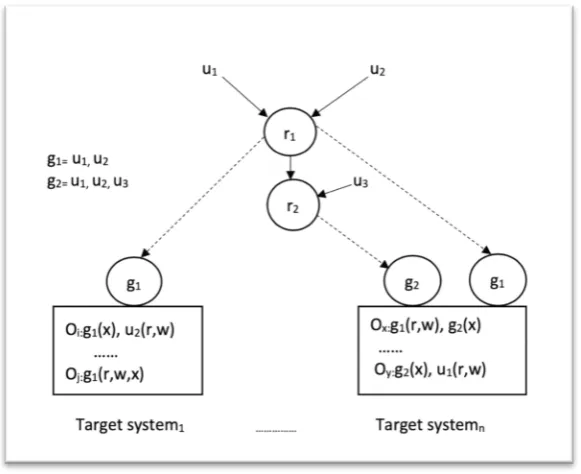
Figure 1.1. Mapping RBAC for Distributed Systems (Hu et al., 2006)
Figure 1.1 shows the links between the circled nodes representing the roles, groups, and assigned users shown as regular arrows, inherited non-circled users with heavy arrows and assigned user with regular arrows. The group-to-role relations are represented with dotted arrows so that if r1 inherits r2, a user that is assigned to role r1also becomes a member of all groups mapped to role r2 and also becomes part of role r2.
On the basis of the subgraph concept, enterprise roles, user and mappings to groups and accounts can be initially created by ESMS. One of the more roles in the role hierarchy can define a subgraph. The defining roles and user or role that inherits the defining roles are included in the subgraph corresponding to the roles. As shown in the Figure 1.1 that the subgraph initiated by role r1 is mapped onto Target system-1, whereas the subgraph defined by role r2 is mapped onto Target system-2.
This mapping of role to group and user to the account can be performed over any number of target systems by ESMS. The enterprise-level deletion of the user's role assignment can result in the deletion of a user's membership in multiple groups in various systems. However, deleting a user on enterprise level results in deletion of all user group memberships and accounts in all target systems where the user existed. Similarly, enterprise-level assigning of user role results in the creation of group memberships and accounts within all system for which the user assigned role was initiated. Such a scheme can be used in an RBAC system to manage user groups and IDs across the control domain by managing the user-role assigning and inheritance at the enterprise level. Once user IDs, group and memberships are created by ESMS at the system level, local resources can be protected by local users by expressing local permissions with the help of user IDs and groups.
In certain implementation, the user might belong to a single group and thus inherits only the attributes and operations associated with the group. However, in the case of conflicting settings, the group level settings are overridden by user level settings by default. Users who authenticate but are not mapped to an existing group, are assigned to the default group. As an alternative, the user might not be mapped to a particular group instead an external authenticator maps the group. The system can collect the group information from the external user database where the defined group memberships for the user can be associated with specific groups.
2.5.2.2 Access Rules
instance, the user wants to access some object in another network on another side of the router. The user is granted or denied access based on the role-based access control and the rule based on network attributes. The existing authentication credentials are still valid if the change in role occurs within the organization and do not require to be reconfigured. When rules are used in combination with roles, flexibility is added as rules are applicable to both devices and people.
Applying the role-based access control in a distributed system requires to define the attributes used for rule constraints to avoid conflicts in rule set that can lead to leaking of privileges. Therefore, constructing rule-based algorithms is vital. For example, consider a quality engineer and product engineer which are two basic types of software users. Both groups have different roles in relation to data and functionality of application but can access the same data. Moreover, people in these groups have varying job responsibilities that can be identified by several attributes. The confusion is avoided by maintaining access to profile rules and application-specific position codes for a particular user. The data owner identifies attributes when storing data objects that express the purpose and content of the document. When the application is executed, access rights for the user are determined by matching the user profile and position codes with the attributes in the document.
Another way to make access decision based on the information in the directory could be using a person's role or set of rules based on user attributes. Such a system allows access to resources and information to be managed for individuals based on their roles or other associated factors such as department, office location, and language. For example, there could be a need to view a completely different set of web resources by two employees with different roles at different locations.
2.5.2.3 Centralized Control
organization. The commonly used techniques are Centralized Object Access and Delegation of Administration Privilege, a model that was designed originally to fit into distributed network and systems (Hu et al., 2006).
2.5.3 Role Engineering
Role-based access control has been implemented in a variety of commercially available system like banks and insurance companies (Ma & Li, 2010). Before the benefits of RBAC can be achieved, the challenging task is to create a comprehensive framework where the architectural structure of RBAC can be defined. Role engineering is the process to migrate a system not based on RBAC to an RBAC system.
E.J. Coyne (1995) introduced the concept of role engineering in 1995, to define a complete, efficient and correct structure to specify the security policies as per the business functions. The two basic approaches for role engineering are top down and the bottom up. In the top-down approach, the business functions are analyzed, and roles are derived from them and then the needed permissions are assigned to roles. Although this approach is costly and time-consuming but reflects the actual organizational functional requirements. For medium to large size organizations, the top-down approach is impractical as they have thousands of users and a lot of business processes (Coyne, 1995).
Under the bottom-up approach, the existing user permission assignments can be used to aggregate roles automatically before the implementation of RBAC. Hence, the business functional requirements of an organization are most likely to ignore but it leads to the generation of the architectural structure of RBAC automatically. Researchers have focused on the application of data mining techniques in role extraction and defining (Frank, Buhman, & David, 2010).
In systems that are not precisely controlled, it is difficult to adjust access based on several constraints and attributes making it costly and difficult to implement. In this case, the concept of role hierarchies can be utilized that sustains the natural structure of an enterprise. Roles are defined with unique attributes and one role may contain another role which means it includes the associated operations of another role.
2.5.4 Constraints in RBAC
The key challenge in the migration of a non-RBAC system to RBAC is the way constraints should be generated. Most of the existing approaches for role engineering use the business rules of organization and then reflect these in the defining, naming, constructing and structuring some valid set of roles. Constraints are an important part of RBAC, but no approach exists that use existing user permission assignments to mine constraints. For instance, in a bank purchasing manager and account payable manager are two mutually exclusive roles so the same individual will not be permitted to have both these roles as it can create a conflict of interest leading to fraud. Similarly, only one person can take the role of chairman of the department. In the same way, there could be a limit on the number of roles to which user can belong to. This is called cardinality constraint (Sandhu, Coyne, Feinstein & Youman, 1996).
The traditional approaches of role engineering only identify roles and place them into a role hierarchy, whereas the constraints are also important and most distinctive feature in RBAC. The set of imposed rules on RBAC are called constraints. The RBAC architectural structure is incomplete without constraints.
Constraints provide a mechanism to lay out organizational policies on a higher level. The chief security officer can lay out what is acceptable in a broad scope and this is imposed a mandatory requirement for others participating in RBAC management i.e. users and security officers. In the absence of such a mechanism, the administrator cannot do this.
The components of RBAC model are users, roles and permissions represented as U,R,P respectively (Ma, Li, Lu, & Wang, 2011).
• PA ⊆ P × R, a many-to-many mapping of permission-to-role assignments; • UA ⊆ U × R, a many-to-many user to role assignment relationships; • auth_perms(R) = {p ∈ P |(p, R) ∈ PA}, the mapping of role R onto a set of
permissions.
Before the RBAC implementation, an m x n binary Matrix can be used to describe users and permissions relationship, where m and n represent the number of user and permissions respectively. The element M{i,j} = 1 represents the ith user has the jth permission or vice versa. ui (i = 1, . . ., m) indicates the ith user and its associated permissions. (ui)(i=1,...,m) indicates the set of permissions assigned to the ith user. pj (j=1,...,n) indicates the jth permission and users with those permissions. (pj ) (j = 1, . . . , n) indicates the users that have permissions Pj.
When role engineering is used in RBAC, the m x k binary matrix to describe user and role relationship, where m represents the number of users and K(k ≤ n) indicates the number of roles. The element N{i,j} = 1 denotes that the ith user has the jth role or vice versa. ui (i = 1,...,m) indicate the users and their roles, (ui)(i=1,...,m) indicate roles assigned to ith user, rj (j=1,...,k) indicate the jth role and role_users (rj ) (j = 1, . . . , k) to indicate the set of users that possess role rj. Therefore, various constraints have been discussed by Ma et al. (2011) as follows.
can have one of the account managers and purchasing manager roles at a time but not both. If we represent ri ∧ rj as ri and rj as mutually exclusive roles than if we have two roles set {r1 , r2 } and {r3 , r4 } then the user cannot be part of both.
Mutually exclusive permissions: Given a set of permissions ps ⊆ P, we say pi ∈ ps and pj ∈ ps are mutually exclusive permissions if pi ∈ auth_perms(ri ), and pj ̸∈ auth_perms(ri ) for all ri ∈ R. If we represent the mutually exclusive permissions by pi and pj then both permissions cannot be assigned to the same role. For instance, the permissions to audit operations and issue checks should not be assigned to the same role. Hence if we have permission sets that are mutually exclusive p1p2 ∧ p3p4 , the role cannot be part of {p1, p2} and {p3, p4} or { p1, p2} and {p3, p4}.
Cardinality constraint of the role: It is defined as a maximum number of roles to which a single user can be associated. As the principle of least privilege is one of the most important principles in RBAC which states that user should be able to access resources needed to complete the regular tasks. If the requested permission set is represented as RQ = {p1,p2,p3,p4,p5,p6}, and authorized permissions by auth_perms (r1) = { p1,p2,p3}, auth_perms(r2) = {p3 , p4 } and auth_perms(r3 ) = { p5,p6}. Then the principle of least privilege can be enforced by role set {r1 , r2 , r3 } for the permission set RQ if the constraint on the maximum number of roles a user can belong to doesn’t exist. However, if each user cannot have more than two roles, then no role set can satisfy the principle of least privilege for the requested permission set.
Cardinality Constraint of User: This defines the maximum number of users that a role can have such a department can have only one chairman. So, no two users can be assigned to this role at a time.
2.5.5 Temporal constraints in RBAC
Several applications require temporal constraints. These are the formal statements of access policies that involve access restrictions to a resource based on time. In some applications, resource use can be limited by temporal constraints. Whereas, others may require it to control activities that are time sensitive.
In addition to other constraints, such time-based constraints must be evaluated for dynamic authorizations generation while the execution of the workflow. Such a constraint may be required for non-workflow environments for instance, in a banking enterprise, the role of a teller should be assumed by an employee who performs transactions on customer accounts during specific timings. To execute this, temporal constraints are required that can limit the availability and activation of role only to designated banking hours.
History-based access control policies are among the few known access control policies related to temporal constraints that have practical application in various business activities like separation of conflicts-of-interests and task transactions.
2.5.6 Least Privilege
Nwafor and Zavarsky (2012) have discussed the principle of least privilege. In the role-based access control model, set of permissions are assigned to roles which are associated with users. The complexity of access control is reduced when access permissions are assigned in this way as the number of users is much larger than roles in an organization. Moreover, one of the three well-known security principles that are supported by RBAC is the least privilege.
2.5.7 Separation of Duty
Separation of duties also known as segregation of duties minimizes the potential to abuse the authorized privilege rights and reduces the risks of malicious activities (NIST, 2014). It ensures that no individual should have the authority to complete multiple conflicting tasks. It is one of the basic internal controls and the idea is to assign the privilege to complete a critical task among several individuals. The concept of separation of duties is well-known in the financial systems since long ago. However, this has also become relevant in the IT industry and greater emphasis has been given to it lately.
The primary objective of SoD is firstly to prevent conflict of interest, fraud, abuse, and malicious actions. Secondly, the detection of failure of controls such as information theft, security breaches and circumvention of security controls. The designing of separation of duties should be done in such a way that no individual should have conflicting responsibilities. There are two main types of separation of duties.
2.5.7.1 Static Separation of Duty (SSOD)
In the static separation of duties, conflicting roles are specified by the predefined set of rules. It prevents from assigning conflicting roles to system users which minimize the risk of conducting fraudulent activities. With the increase of individuals involved in the execution of a critical task, the chance for any malicious activity to take place is
reduced.
2.5.7.2 Dynamic Separation of Duty (DSOD)
In the dynamic separation of duty, the separation of duty is enforced at the time of access. The user can be assigned multiple conflicting roles but only a single role is activated at a time to perform the relevant job functions.
2.5.8 Limitation of Role Based Access Control
In the easier administration, roles with similar permissions can be merged into one role. Thus, reducing the number of roles and also making the management easier. However, if stronger security is the preference here then each and every role should be more granular and well defined. This can also lead to assigning multiple roles to a single user (Kuhn, Coyne, & Weli, 2010). An organization should be able to find some balance between two approaches.
With the technology becoming more and more incorporated in businesses leading to an increase in the number of applications and systems. Moreover, the development of cloud technology is making the technological structure of organizations more complex. In such a scenario, RBAC alone cannot fulfill the access control needs of a company with a complex structure. Therefore, it should be combined with other access methods such as Rule-based access control to achieve more practical value (Hu et al., 2006).
The implementation of segregation of duty is another limitation of RBAC as it requires careful role designing and assigning them privileges. In the process of assigning privileges, it should be ensured that the existing segregation of duty control is not affected by assigning new privileges.
2.6 Related Terms in Access Process
Some terms that are used in the access control process are worth mentioning here as they will be used in explaining the process workflows (Kissel, 2013).
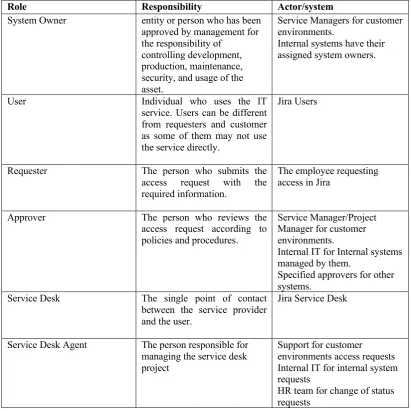
Owner entity or person who has been approved by management for the responsibility of controlling the development, production, maintenance, security, and usage of the asset.
Requester Person who submits the access request with the required information.
Approver Person who reviews the access request according to policies and procedures.
User Individual who uses the IT service. Users can be different from requesters and customer as some of them may not use the service directly.
Service Owner Entity responsible for managing the service throughout its lifecycle.
Escalation additional resources obtained by activity when needed to meet customer expectations and service level targets.
Change The modification, addition or removal of anything that affects the IT services.
Event occurrence of a change of state that effects the management or configuration of IT services.
Incident An unplanned interruption to an IT services or reduction in the quality of the service.
Closed The final status in the lifecycle of a change or incident. No further action can be taken once the status is closed.
Service Desk The single point of contact between the service provider and the user.
2.7 Security Standards
The information security standards SOC 2 and ISO 27001 provide the best practices to implement security controls for businesses. By complying with these standards an assurance of trustworthiness of business is provided by an organization to the customers.
2.7.1 ISO 27001
An access control system to be compliant with ISO 27001, there is a need to have a processor solution that is in line with the defined criteria. If concerns regarding data leakage, malicious attacks and hacks are raised by clients, an organization that is compliant with ISO 27001 is able to show the process and controls in place. Companies can implement the ISO 27001 compliance in parts by choosing the division that needs to be certified and establishing the processes and controls for that area. Client satisfaction, legal harmonization, and financial returns are the major benefits provided by ISO 27001 (ISO/IEC-27001, 2013).
2.7.2 SOC 2
availability, and processing integrity. Among these, the SOC 2 access control is compliance is directly governed by security principles.
Both logical and physical access should be restricted to complete access protection. The access procedures for the data, assets, and resources should be designed properly according to the rules and regulations. The access should be authorized, based on the ID and easily traceable. The personal information should be both logically and physically protected. Moreover, the collection, usage, storage and disposal of data should be as per privacy policy.
Further, the confidentiality should be maintained as agreed with the customers, users, and stakeholders of the company. Similarly, processing integrity and availability should be compliant with the agreements and standard policies. The compliance with some of the rules specified above qualifies an organization as SOC 2 access compliant (AICPA, 2018).
2.7.3 Purpose of Access Compliance
Complying with the standards means following the laws and standards. In the context of access control and security, it means having a standard of the way of granting access, managing and storing permissions. A compliance certificate is a document issued by the authorities which provides the surety that a product or service meets the necessary specification to be used. When it comes to the security of access control systems, compliance certification accounts for quality regarding safety, usability, and efficiency. Complying with a reliable certification authority ensures the overall functionality of a physical access control system.
sure that the files are secure and accessible. Compliance certification ensures the quality and accessibility of the access control system.
Chapter 3
3
Systems and Requirements
This chapter discusses the systems that are involved in the access management process directly or indirectly. There could be other available systems that are better, but these systems were preferred by the organization due to their availability in the organization. All these systems are being used already either in the access or user management or some other processes.
3.1 System Context
3.1.1 Customer Environments
The organization provides SaaS solutions to retail businesses. The single tenant SaaS architecture allows for a single instance of software to run for each customer on SaaS servers. Some customers use the standard solution whereas most of the customers have their own specific requirements as per their business needs. To cater to this, the solution is customized according to customer requirements. These software instances running on cloud-based servers are called customer environments. The customer environments contain customer specific data that is used in the SaaS solution. This is confidential data that must be protected through processes and policies in place. Before the new access control process, it was a small organization where persons across the company were involved in working on multiple customer projects which required accessing several customer environments at one time. Therefore, there was no requirement to have access restriction to customer environments on a granular level. Moreover, the process to request, approve, log and track access was not following standardized security framework best practices. The organization is growing a lot and the new access control process has been implemented to align with the needs of growing organization.
3.1.2 Internal Systems
from project management to logging and tracking systems. Some of the systems are very essential for all employees to work and communicate effectively, others are just needed for certain teams and essential for their tasks. Similarly, varying access levels and permissions exist in the systems. Access to internal systems and privilege rights were not fully restricted. There was no process to log the provision and removal of access.
3.1.3 Identity and Access Management System (IAMS)
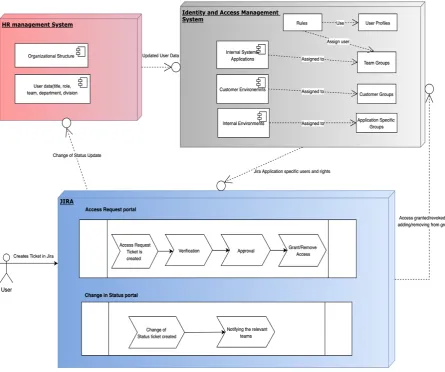
The identity management system which is used to manage the access of employees to organizational applications and devices. It is a cloud-based system which is compatible and integrates well with on-premises applications, identity management systems, and directories. The authentication for systems with customer data and other internal tools is done using the identity management system. This system will be mostly denoted as IAMS in the document.
Single Sign-on
Single sign-on is a way to manage multiple user accounts securely without affecting the integrity of individual applications. In order to get access to multiple applications, users can use one name and password. In this way, there is no need to log in separately to each application rather user login to the identity management system and gain access to all their applications. This capability saves users from remembering the credentials and the credentials are also safe. Single sign-on gives control over the applications by allowing tighter security and monitoring capabilities to ensure compliance with organizational policies and users are not making it more vulnerable.
Multi-factor Authentication
time-based tokens. Moreover, MFA provides a way to application developers to increase the security of application access.
The system provides an identity management approach that facilitates business to take control of user identity and multifactor authentication to reduce data breaches. The customer data can be accessed via the identity management system which provides a centralized identity for users and reduces account management complexity. Access to applications can be restricted by intelligent SAML connections. As the user accesses all application via this service, audit trail for user actions and access in systems containing customer data are available. Logs can help in identifying any suspicious or unusual behavior.
User Access Management
Users and their associated attributes from applications can be stored in the universal directory. It supports multiple types of attributes including predefined lists, sensitive attributes, and linked objects. Users and groups can be created and managed, also permissions can be assigned based on attributes. Using the attribute-based policies, the access of the user to applications can be controlled using SAML and OAuth protocols. Once the user is authenticated, the system needs to understand if the user is authorized to access or interact with some application.
Role-based access control to applications
The identity management system allows to establish and maintain authorization policies that are based on the user context such as user profile and group membership. The access restrictions can be implemented by user types and permissions for which role-based access control can be employed. For instance, an IT person who will handle the IT admin tasks has the rights to create, delete and assign users to their relevant departments and teams. Similarly, product managers, developers, and architects have a different kind of privileges in a system. The varying responsibilities and policies are needed to be set in every group of the organization.
be defined, and the user can be associated with some combination of roles. This approach also provides a logical model for auditing access which reflects an access structure and responsibilities.
3.1.4 Human Resource Management System
The HR Management System is used to manage personnel and their associated information. It maintains an organizational structure which contains all divisions, departments, teams, and sub-teams. The user data is kept up-to-date as it is the source system that provides the user attributes information such as title, role, and team. The user information is pushed from the HR Management System to other systems which need to maintain user profiles for process management. The change management process exists that enables updating the system as soon as user notifies about the change. Further, the changes are communicated to other teams managing their systems or pushed to those systems that are integrated with the HR Management System.
3.1.5 Jira-Ticketing and Logging System
Jira is a platform on which applications and products can be built to plan, manage and track project. It allows for creating different projects based on organizational requirements. There is three standalone product of Jira which can be used based on the requirements i.e. Jira core, Jira Software, and Jira Service Desk. The Jira Core is the basic project and task management solution whereas the Jira software and Service Desk are Jira applications that run on the top of it. There are multiple components of Jira which are described below ( Atlassian, 2019).
Issues
Jira issues are work items of any size and type which are tracked from creation to completion. For instance, an issue could be a request to access certain customer data, development of a feature by the software team or a customer incident to be managed by the support team. The term mostly used for issues are tickets, requests or tasks.
Projects
quite flexible as issues can be grouped by team, product, business unit or stream work. All issues grouped together in a project are represented by an issue key which is specific to a project along with issue number such as ACM-15.
Workflows
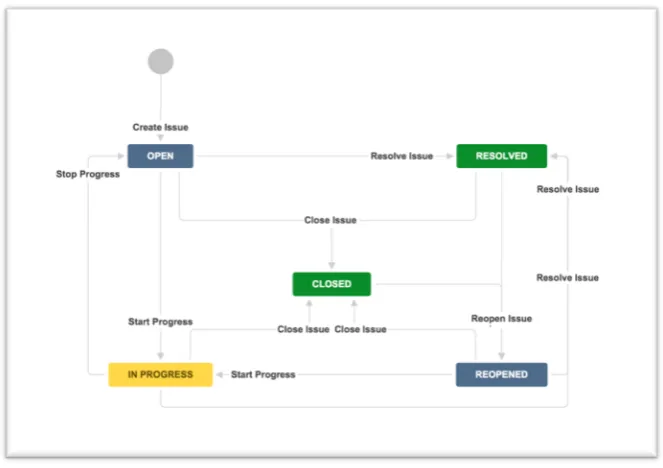
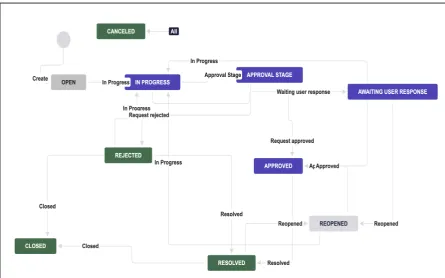
[image:36.595.161.493.246.480.2]Workflows in Jira represent all the sequential steps that an issue takes from the point of creation to completion. A possible basic workflow is represented in Figure 3.1.
Figure 3.1. Basic Jira workflow
Workflows have a status such as open, done and transitions are represented by arrows from one status to another. Workflows can be of varying complexity with triggers, conditions, validators and post functions. The complexity of workflow depends on the business and project requirements.
3.2 Security Standards Requirements for Access Control
aiming at certification. Further, the requirements provided by these standards for access control have been discussed.
3.2.1 ISO 27001 Access control
The objective of the access control is that the access to information, systems processing, and business processes should be controlled according to the organizational and security requirements. Access rights allocation procedures to services and information systems should be in place. These procedures should cover various stages of user access lifecycle. Moreover, special attention should be given to privilege access rights which give user higher level access to the system. Below we discuss the controls (ISO/IEC-27001, 2013) that are required and some guidance regarding their implementation (ISO-27002, 2013).
3.2.1.1 Access control policy Control
An organization should have an access control policy in place. It should be documented and reviewed according to the organizational business and security requirements for access (ISO A.9.1.1).
Implementation guidance
The access control rules and rights should be stated in the access control policy for each user or user group. Both logical and physical access controls should be taken into account. In addition to that service providers and users should be given a clear statement regarding the business requirements that have to be met by access control. The access control policy as per the ISO 27002 implementation guideline should take following into account.
• The security requirements of business applications
• Information that business applications contain and their associated risks.
• The information authorization and dissemination policies such as the need to know principles, information classification, and different security levels.
• Contractual obligations and legislation of an organization regarding access to data and services.
• Standard access profiles for users based on different roles in the organization. • Access rights management in a networked and distributed environment.
• Access control roles segregation such as access request, access administration and access authorization.
• Access request formal authorization requirements • Access control periodic review requirements • Procedure for removal of access rights
• Differentiating between the rules to be enforced always and others which are conditional or optional.
• Rules should be established more in a stronger way that everything is forbidden generally unless allowed than the rule everything is permitted unless forbidden which is a weaker rule.
• Changes in information labels and user permissions that are automatically initiated by processing facilities and others initiated at the discretion of an administrator or user.
• Specification of rules that require approval and those which don’t.
• The access control rules should have clearly defined responsibilities and supported by formal procedures.
3.2.1.2 User access management User Registration and De-registration
Control
The formal user registration and de-registration procedure for granting and revoking of access to all services and information systems should be in place ( ISO A.9.2.1).
Implementation guidance
The access control procedure for user registration and de-registration should include: • User IDs should be used for individual identification of each user and to track
business or operational requirements, but they should be approved and documented.
• System owner should authorize the user for the use of service and approval process for access rights management should be in place.
• The level of access rights granted to each user should be appropriate to business requirements and consistent with the security policy of organization such as segregation of duties should be maintained.
• A written statement of access rights for users, requiring them to sign and understand the access conditions by including a clause in personal and service contracts.
• Service providers should not provide access until the authorization process is complete.
• Maintaining a record of authorized people to use services.
• Managing the access rights based on the change of roles or change of employment.
• Periodic review and removal of redundant accounts and user IDS
• User access roles should be based on organizational requirements that compile access rights into user access profiles. The access requests and review of access rights are easier to be managed on the level of roles.
3.2.1.3 User Access Provisioning Control
For all user and system, the assigning and revoking of access rights should be done through a user access provisioning process (ISO A.9.2.2).
Implementation guidance
The process or assigning or revoking access should include
• System owner should authorize users for the use of service or information systems. Process for access rights approval from the management can be also be in place.
• Access rights are only provided after the completion of authorization process. • Central record is maintained regarding the access rights granted to users for
accessing services and systems.
• Procedures for managing the access rights as a result of change of role or job and removal or blocking of access rights due to termination of employment. • Periodic review of user access rights with system owners.
3.2.1.4 Privilege management Control
The allocation and use of privilege rights should be restricted (ISO A.9.2.3).
Implementation guidance
System and services used by multiple users that require protection against unauthorized access should have the formal authorization procedures for allocation of privilege rights. The following steps should be considered:
• The access privileges regarding each system such as database management system, operating system, applications, and authorized users to have these rights should be identified.
• The privileged access should be allocated on the need to know and event basis as per the access policy.
• An authorization and logging process for privileged access should be in place. • In order to avoid the need of granting privilege access rights, it should be
encouraged to develop and use system routines.
3.2.1.5 Review of User Access Rights Control
The formal process to review the access rights of users at regular intervals should be in place. To maintain effective control over information services and data access, regular review of access rights is necessary (ISO A.9.2.5).
Implementation guidance
• There should be a review of user access rights at regular intervals and after any change for instance demotion, promotion, and termination of employment. • Review and allocation of access rights should be done when a change of
employment occurs within the organization such as change of team.
• The privilege access rights authorization should be reviewed more frequently to ensure no unauthorized privileges have been granted.
• Changes should be logged for periodic review.
3.2.1.6 Removal and Adjustment of Access Rights Control
The access rights of employees and external users to systems and services are adjusted upon change or removed upon termination of contract, employment or agreement (ISO A.9.2.6).
Implementation guidance
The access rights to information systems and services should be removed or reduced depending upon the evaluation of following risk factors.
• The change or termination is initiated by the management, employee or external party.
• Reason for termination
• The current responsibilities of the user. • The value of assets that user can access.
3.2.2 SOC 2 Access Control Requirements
The SOC 2 compliance report meets the needs of a broad range of customer and users who need assurance about the organizational controls that affect the availability, security or processing integrity of services and system used by the organization to process data. SOC 2 reports can include one to five of the principles of Trust Services these are (AICPA, 2017)
• Privacy
• Processing Integrity
3.2.2.1 Logical and Physical Access Control
Only the relevant clause from the logical and physical access control Trust Services criteria are mentioned below (AICPA, 2018).
• Restricts Logical Access— Logical access to information assets including software, hardware, authorities, output, administrative, data (at rest, transmission and processing), offline system components are restricted by access control rules and software.
• Identifies and Authenticates Users—the identification and authentication of persons, software and infrastructure is done locally or remotely prior to accessing information assets
• Manages Points of Access— Identifying, managing and tracking the points of access by outside entities and the data types that flow through them. The different types of systems and individuals that are using access points are identified, managed and documented.
• Restricts Access to Information Assets— Information assets access control rules are established by data classification combinations, port restrictions, separate data structures, access protocol restrictions and digital certificates and user identification.
• Manages Identification and Authentication— For systems and individuals that access entity information, requirements are documented and managed for identification and authentication.