http://wrap.warwick.ac.uk/
Original citation:Eryigit-Madzwamuse, Suna and Wolke, Dieter. (2015) Attention problems in relation to gestational age at birth and smallness for gestational age. Early Human Development, Volume 91 (Number 2). pp. 131-138.
Permanent WRAP url:
http://wrap.warwick.ac.uk/66101 Copyright and reuse:
The Warwick Research Archive Portal (WRAP) makes this work of researchers of the University of Warwick available open access under the following conditions. Copyright © and all moral rights to the version of the paper presented here belong to the individual author(s) and/or other copyright owners. To the extent reasonable and practicable the material made available in WRAP has been checked for eligibility before being made available.
Copies of full items can be used for personal research or study, educational, or not-for-profit purposes without prior permission or charge. Provided that the authors, title and full bibliographic details are credited, a hyperlink and/or URL is given for the original metadata page and the content is not changed in any way.
Publisher statement:
NOTICE: this is the author’s version of a work that was accepted for publication in Early Human Development. Changes resulting from the publishing process, such as peer review, editing, corrections, structural formatting, and other quality control mechanisms may not be reflected in this document. Changes may have been made to this work since it was submitted for publication. A definitive version was subsequently published in
http://dx.doi.org/10.1016/j.earlhumdev.2015.01.004 A note on versions:
The version presented here may differ from the published version or, version of record, if you wish to cite this item you are advised to consult the publisher’s version. Please see the ‘permanent WRAP url’ above for details on accessing the published version and note that access may require a subscription.
Attention problems and gestational age 1
Attention problems in relation to gestational age at birth and smallness for gestational
age
Authors: Suna Eryigit-Madzwamuse, PhD; Brighton, UK; Centre for Health Research,
University of Brighton.
Dieter Wolke, PhD; Coventry, UK; Department of Psychology, University of Warwick; Warwick Medical School, University of Warwick
Paper presentation information: An earlier version of this paper was presented at the 54th
annual meeting of the European Society for Paediatric Research, Porto, Portugal, October 10-13, 2013.
Corresponding author: Dieter Wolke, Department of Psychology, University of Warwick,
Coventry CV4 7AL, United Kingdom, work phone: +44 2476573217,
home/cell phone: +44 7824358737 fax: +44 2476524225, [email protected] Short title: Attention problems and gestational age
Abstract- word count: 243
Main text- word count: 2902
Eryigit-Madzwamuse, S., & Wolke, D. (2015). Attention problems in relation to gestational age at birth and smallness for gestational age. Early Human Development, 91(2), 131-138. doi:
Attention problems and gestational age 2
Abstract
Background: While it is well established that very preterm birth (gestational age at birth<32
weeks) is related to increased attention problems, there is still considerable uncertainty of the effects of moderate or late preterm birth or smallness for gestational age (SGA) on attention regulation.
Aims: To investigate the impact of gestational age at birth and SGA, birth on child attention
problems.
Study design: Prospective longitudinal cohort study.
Subjects: A total of 1435 children sampled from the Bavarian Longitudinal Study (BLS).
Outcome measures: Main outcome variables were parent-reported attention problems and
examiner-reported attention skills at 6 and 8 years. Predictors were linked to attention outcomes using hierarchical regression analyses.
Results: Gestational age at birth ranged from 25 weeks to 41 weeks. We found a quadratic
effect of gestational age on attention problems (β6years=0.161, 95% CI= 0.085; 0.236; β8years= 0.211, 95% CI= 0.135; 0.287), and attention skills at 6 and 8 years (β6years= 0.178, 95% CI= -0.252; -0.104; β8years= -0.169, 95% CI= -0.243; -0.094). Elective caesarean birth did not predict child attention. In adjusted models, SGA was an additional risk factor for attention problems ((β=0.080, 95% CI= 0.026; 0.134), and attention skills (β= -0.091, 95% CI=-0.143; -0.039) at 6 years but not at 8 years after adjusting for child sex and family SES.
Conclusion: Adverse effects on attention are disproportionately higher at early gestations. In
contrast, the impact of SGA status was found to be similar at all gestational ages but disappeared by 8 years.
Keywords: child attention, preterm, gestational age at birth, elective caesarean birth, small for
Attention problems and gestational age 3
1. Introduction
Attention skills are a fundamental prerequisite of learning and attention problems predict lower academic success (1, 2). Attention skills have been regularly reported to be impaired in children and adolescents who were born very preterm (gestational age at birth <32 weeks) (3-6). In contrast, findings are inconsistent for children born moderately or late preterm (gestational age at birth between 32 and 36 weeks) (3, 7-10).
Up to a third of preterm births are iatrogenic because of concerns about maternal or fetal health (11). Elective caesarean birth is common in iatrogenic births, and this mode of delivery has been associated with adverse outcomes in the neonatal period (12-15)and beyond (8, 16). Talge and her colleagues (8) reported a significant association between elective caesarean birth and attention problems in children born late preterm (34- 36 weeks).
Fetal growth restriction (FGR), commonly associated with a variety of pregnancy complications (i.e., preeclampsia), is a common reason for elective caesarean birth (8).
Smallness for gestational age (SGA: i.e. a birth weight below 10th percentile) has been used as a proxy for FGR (17). SGA has been reported to significantly predict attention related problems in some studies (6, 10, 18) but not in others (8, 19, 20). Thus, while the link between very preterm birth and childhood attention problems is well established, the impacts of moderate/late preterm birth, SGA and elective caesarean birth are still uncertain.
Attention problems and gestational age 4
prenatal complications, elective caesarean birth, head circumference in infancy and family socio-economic status (hereafter family SES).
2. Materials and Methods
2.1. Study Sample
Details of the design of the Bavarian Longitudinal Study have been described previously (21). Ethical approval of this study was granted by the Ethical Review Board of the Rheinische Friedrich Wilhelms University, Medical Faculty on 18 August 2009 (reference # 159/09). Informed consent was provided by the parents within 48 hours of their child’s birth. Subjects
were children born alive in a geographically defined area of Southern Bavaria (Germany) between February 1985 and March 1986 and who required admission to children’s hospitals
within the first 10 days after birth (N=7505; 10.6% of all live births). Healthy infants who were born in the same obstetric hospitals, cared for on normal postnatal wards were recruited as controls (N=916), resulting in a total study sample of 8421 newborns. Of the 8421 participants, 1513 children were selected for follow-up at 6 and 8 years of age according to the following criteria: 1. either very preterm (<32 weeks gestation) or very low birth weight (<1500g birth weight); 2. a subsample of children born at ≥32 weeks gestation randomly selected within the
stratification factors gender, family SES (low, medium and high) and degree of neonatal risk (none, low, moderate, high and very high) (22).
Of the eligible children, 1475 participated in the follow-up at both 6 and 8 years. Children who did not attend the assessments either at 6 years or at 8 years (N=38) did not differ from children who attended assessments at both time points (N=1475) in terms of gestational age, prenatal complications, mode of delivery, SGA status and head circumference but were more often of low family SES (χ2 (1) = 21.315, p <0.001). Furthermore, we excluded an additional 40
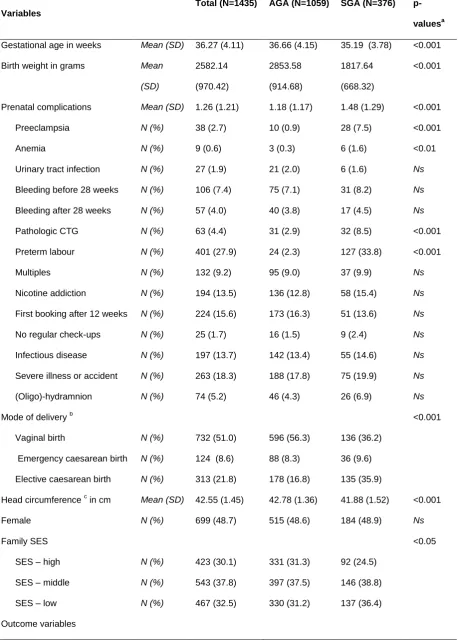
children who were born post-term (42 or more completed weeks of gestation) because post term birth has different causes and is associated with an increased risk of developmental abnormalities (23). Table 1 shows the characteristics of the final sample with gestational age at birth ranging from 25 weeks to 41 weeks (N=1435).
Attention problems and gestational age 5
Gestational age was determined from a combination of maternal reports of the last menstrual period and serial ultrasound fetal biometry during pregnancy. Prenatal data were coded from the standard Bavarian perinatal survey (24) assessed prospectively and included 14 items (e.g. preeclampsia) (Table 1). Higher scores on this scale indicate more complications with a range from 0 (best condition) to 14 (most risky condition) (25).
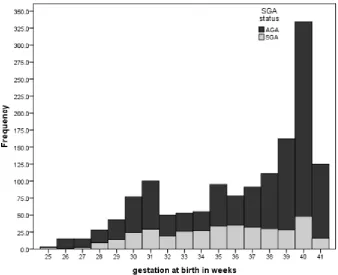
Mode of delivery was coded in the Bavarian perinatal survey (24) as elective caesarean birth, emergency caesarean birth or vaginal birth. For the purposes of the current study we reclassified mode of delivery as elective caesarean birth versus delivery following labour (vaginal birth or emergency caesarean birth). Children with birth weight less than the gender specific 10th percentile for gestational age according to a perinatal survey of all Bavarian newborns (24) were classified as small for gestational age (SGA); 376 children were SGA and 1059 children were born with a birth weight appropriate for their gestational age (AGA). Figure 1 shows the frequency of children who were born small across the whole gestation spectrum. SGA was most frequent between 32 weeks and 37 weeks with a range from 35% to 50% of total births at each week.
The primary outcome of this study was the level of attention of the children reported by parents and examiners separately at the ages of 6 and 8 years. Mothers rated their children’s
attention problems using the attention problems scale of the Child Behaviour Check List (CBCL(26)).Higher scores on this 11 item scale indicate more attention problems.
Examiners reported on children’s attention skills in two ways. First, the assistant psychologist rated children’s behaviour during a cognitive assessment that lasted on average
80 minutes using the Tester Ratings of Child Behaviour (TRCB (1, 27)). Six of 13 items were combined to create a Task Orientation subscale including attention, robustness/endurance, demandingness (reversed score), cooperativeness, compliance and difficulty (reversed score). Inter-class correlations in inter-rater reliabilities ranged from 0.63 to 0.97. Second, adapting a consensus model, the whole research team (psychologist, assistant psychologist and
paediatrician) evaluated children’s behaviour based on their observations during the whole assessment day. They rated children’s behaviours using three items of the TRCB: attention,
Attention problems and gestational age 6
was computed using the Team ratings. Strong correlations were found between the TRCB and Team ratings (r= 0.79, and 0.78 at 6 and 8 years, respectively; p<0.001). Thus, we computed a mean score in order to reflect examiner-reported attention skills. Higher scores on this scale from 1 (very low) to 9 (very high) indicate better attention skills.
Potential confounders. Both head circumference (6, 28) and family SES (20, 29) have
been previously reported to predict attention levels in children. Head circumference is a proxy measure of brain growth and was assessed at 5 months (corrected for gestation at birth) by research nurses who measured head circumference twice and the mean of both measures was recorded. Family SES was a weighted composite score of parents’ education and occupation
and grouped as high, middle and low according to predefined cut-off points . 2.3. Statistical Analysis
We used SPSS 21.0 to analyse the data. First, we examined all the variables for outliers and normality. Next, we compared all included variables between AGA and SGA groups using One-Way ANOVA for continuous variables and χ2 test for categorical variables. Prior to testing
the first research question about the effect of gestational age, we fitted curve estimations and found the quadratic model to be the best fitting model. Next, we fitted regression analyses with gestational age and its quadratic term as predictors for each outcome variable separately. Prior to regression, we centred gestational age at 37 weeks as an attempt to decrease co-linearity between the gestational age linear term and the gestational age quadratic term. To illustrate the quadratic relation, we fitted regression lines from week 25 to week 41 with their 95% confidence intervals.
In order to address the second research question regarding the effects of elective caesarean birth and SGA, we fitted hierarchical regression models where we entered prenatal complications and elective caesarean birth into a third model after gestational age and its quadratic term; SGA in the fourth model; and head circumference in the fifth model. In the final model, we adjusted the analyses according to family SES.
3. Results
Attention problems and gestational age 7
was a significant increase in examiner-reported attention skills (t1310=23.759, p<0.001) from 6
years to 8 years.
Table 1 also shows the comparisons across the two birth weight groups, AGA and SGA. AGA children had, on average, higher gestational age at birth, fewer prenatal complications, were born more frequently following labour and had higher head circumferences at 5 months compared to the SGA group. Furthermore, SGA children were more often of low SES families.
3.1. Is the relation between gestation and child attention linear or non-linear?
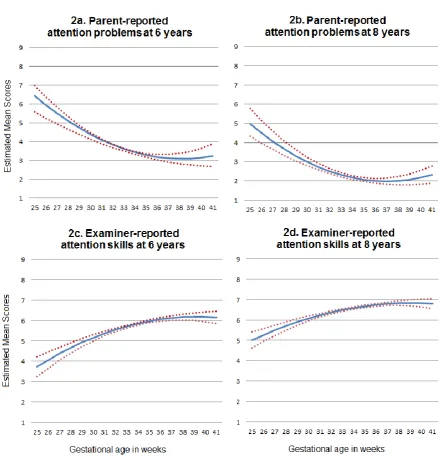
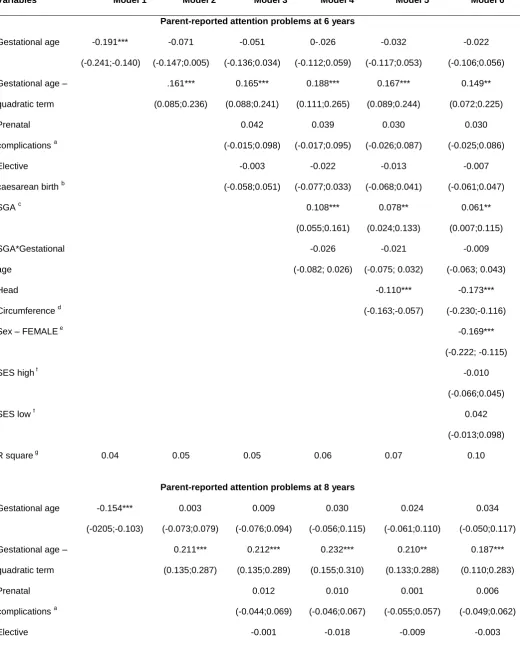
We examined the relationship between gestational age and attention outcomes at 6 and 8 years. Model 1 and Model 2 in Table 2 show the standardized beta coefficients and their 95% confidence intervals for parent-reported attention problems. The gestational age quadratic term was a significant predictor at both 6 and 8 years. As shown in Figure 2a and 2b, the relation between gestational age and parent-reported attention problems is concave, indicating higher attention problems with every week of gestation either before or after 37 weeks. However, at gestational ages later than 37 weeks, differences in attention problems per week of gestation were very small.
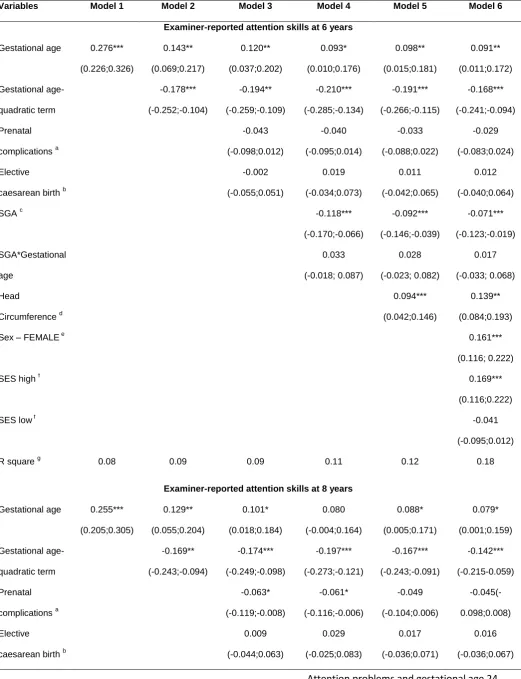
The effect of gestational age at birth on attention was similar on the examiner-reported attention skills (see Model 1 and Model 2 in Table 3). Both the linear and quadratic terms were significant predictors at both 6 years and 8 years. As can be seen in Figure 2c and 2d, the relation between gestational age at birth and examiner-reported attention skills is also concave but downwards, indicating lower attention skills both before and after 37 weeks but very small differences per week of gestation after 37 weeks indicating no significant difference between 37 and 41 weeks.
3.2. What is the effect of SGA on attention in childhood?
Attention problems and gestational age 8
adjusted for head circumference at 5 months.. However, its impact at 8 years disappeared when adjusted for child sex and family SES.
4. Discussion
We found a significant non-linear relationship between gestational age at birth and attention outcomes in childhood regardless of the source of data (parents, examiners who were blind to preterm status) or age at assessment (6 and 8 years). The non-linear relationship remained significant after adjusting for prenatal complications, whether born after labour or by elective caesarean, SGA status, head circumference and family SES. Furthermore, being SGA was an additional risk factor for poorer attention in childhood across the full spectrum of
gestation; however its impact disappeared by 8 years.
The strengths of this study are its prospective design and large sample; inclusion of the full spectrum of gestational age, with a focus on gestational age in weeks rather than
aggregated periods and using multiple sources for child outcomes at different ages. There are also limitations. Induction of labour is a factor that has been associated with improved maternal and/or fetal condition at birth (30, 31). We were unable to examine the impact of induction as induction and acceleration after labour onset were coded as one variable. Second, SGA was used as a proxy of FGR. However, some newborns are constitutionally small rather than growth restricted and their prognosis is less likely to be influenced by SGA status (32). We were unable to differentiate constitutionally small newborns from FGR newborns due to lack of data on pre-pregnancy maternal weight which is a crucial factor when defining constitutional smallness (33). Third, head circumference was employed as a proxy measure of brain volume. Previous
research has indicated that head circumference accurately predicts brain volume (34) with a correlation with brain volume in 1 to 6 year old children in MRI of r = 0.93 (35). Lastly, Lastly, due to improvements in neonatal care and increased survival of extremely preterm children the rates of attention problems or reduced attention skills may be similar or may even have
Attention problems and gestational age 9
children only (36). Very few analysed the effect on attention deficit/hyperactivity disorder (ADHD) across the whole gestation spectrum and reported inconsistent findings (10, 20). Moreover, these studies did not distinguish between inattention (ADD) problems and
hyperactivity/impulsivity problems (ADHD); there is substantial empirical evidence for the risk of inattention, rather than hyperactivity symptoms of ADHD in relation to prematurity (1). We analysed the whole gestation spectrum and found a significant non-linear association between gestational age at birth and child attention. To illustrate the quadratic effect at age 6 years, the decrease in attention problems with one week increase in gestation at 31 weeks (i.e., the difference between 31 weeks and 32 weeks) was 8.6 times higher than the decrease in attention problems with one week increase in gestation at 37 weeks (i.e., the difference between 37 and 38 weeks). Similarly, the increase in attention skills for one week increase in gestation at 31 weeks was 3.5 times higher than the increase in attention skills for one week increase in gestation at 37 weeks. Our study provides strong support for an increased risk of inattention with decreasing gestation at birth. This relationship was found to be non-linear with increasing adverse impact on attention with each week of gestation the lower the gestation.
Consistent with previous studies (1, 3-6), we found that very preterm children still have the lowest attention skills at 8 years of age, showing the importance of reducing the rate of preterm birth. Unfortunately, to date, no interventions designed to prolong pregnancy have been shown to result in an improved long term outcome. This may be because prolonging pregnancy without ameliorating the adverse intrauterine environment associated with impending preterm birth simply keeps the baby longer in a damaging environment, thus negating any improvement consequent upon being born at a later gestational age. This emphases the importance of addressing the factors leading to preterm birth (e.g. infection, malnutrition, social disadvantage, stress, drugs, induced multiple pregnancy from IVF, hypertension and diabetes) rather than trying to prolong the duration of an abnormal pregnancy (37).
Attention problems and gestational age 10
gestational age at birth in the elective caesarean group was 4 weeks earlier than the gestational age at birth in the labouring group. Therefore, the significant effect of elective caesarean birth found in previous studies might be partly explained by differences in gestational ages at birth.
The current SGA results are consistent with previous findings suggesting that SGA is an additional risk factor for attention problems or reduced attention skills (6, 10, 38). Our results shed light on the inconsistent findings regarding the impact of SGA across the full gestation spectrum (10, 39); SGA as defined in our study has similar adverse impact across the whole gestation range. The impact of SGA status is also only partially linked to brain size. After adjusting for head circumference as an indicator of brain size, the impact of SGA on child attention was attenuated but was still significant, suggesting that SGA might be linked to both reduction in brain volume and alteration in brain structure (39). Once child sex and family SES were controlled the impact of SGA on 8 years attention problems and reduced attention skills disappeared; however, no interaction between SGA and child sex or between SGA and family SES were found (data not shown).
Attention problems and gestational age 11
Acknowledgement: We are grateful to funders who supported this study, all research
assistants, psychologists and paediatricians who collected the data and to the parents and their children for their participation. We are grateful to Professor P J Steer for helpful suggestions while the manuscript was being written, and for assistance with editing the text.
Conflict of interest: The authors report no conflict of interest
Role of the Funding Source: This study was funded by grants PKE24, JUG14, 01EP9504 and
01ER0801 from the German Federal Ministry of Education and Science (BMBF). The contents are solely the responsibility of the authors and do not necessarily represent the official view o BMBF. Information on BMBF is available on http://www.bmbf.de/en/.
Highlights
We model attention problems and skills across the whole gestation spectrum.
We compare both parent and examiner reports of attention and at 6 and 8 years.
We find a non-linear relation between gestational age and attention.
Attention problems and gestational age 12
References
1.
Jaekel J, Wolke D, Bartmann P. Poor attention rather than hyperactivity/impulsivity
predicts academic achievement in very preterm and full-term adolescents. Psychol Med.
2013;43(1):183-96.
2.
Duncan GJ, Claessens A, Huston AC, Pagani LS, Engel M, Sexton H, et al. School
readiness and later achievement. Dev Psychol. 2007;43(6):1428-46.
3.
Johnson S, Wolke D. Behavioural outcomes and psychopathology during adolescence.
Early Human Development. 2013;89(4):199-207.
4.
Aarnoudse-Moens CSH, Weisglas-Kuperus N, van Goudoever JB, Oosterlaan J.
Meta-Analysis of Neurobehavioral Outcomes in Very Preterm and/or Very Low Birth Weight
Children. Pediatrics. 2009;124(2):717-28.
5.
Bhutta AT, Cleves MA, Casey PH, Cradock MM, Anand KJS. Cognitive and behavioral
outcomes of school-aged children who were born preterm - A meta-analysis. Jama-Journal of the
American Medical Association. 2002;288(6):728-37.
6.
Hall J, Jaekel J, Wolke D. Gender distinctive impacts of prematurity and small for
gestational age (SGA) on age-6 attention problems. Child Adolesc Ment Health.
2012;17(4):238-45.
7.
de Jong M, Verhoeven M, van Baar AL. School outcome, cognitive functioning, and
behaviour problems in moderate and late preterm children and adults: A review. Seminars in
Fetal & Neonatal Medicine. 2012;17(3):163-9.
8.
Talge NM, Holzman C, Van Egeren LA, Symonds LL, Scheid JM, Senagore PK, et al.
Late-Preterm Birth by Delivery Circumstance and Its Association With Parent-Reported
Attention Problems in Childhood. J Dev Behav Pediatr. 2012;33(5):405-15.
9.
van Baar AL, Vermaas J, Knots E, de Kleine MJK, Soons P. Functioning at School Age
of Moderately Preterm Children Born at 32 to 36 Weeks' Gestational Age. Pediatrics.
Attention problems and gestational age 13
10.
Heinonen K, Raikkonen K, Pesonen AK, Andersson S, Kajantie E, Eriksson JG, et al.
Behavioural symptoms of attention deficit/hyperactivity disorder in preterm and term children
born small and appropriate for gestational age: A longitudinal study. BMC Pediatr. 2010;10.
11.
Saigal S, Doyle LW. Preterm birth 3 - An overview of mortality and sequelae of preterm
birth from infancy to adulthood. Lancet. 2008;371(9608):261-9.
12.
Chiossi G, Lai Y, Landon MB, Spong CY, Rouse DJ, Varner MW, et al. Timing of
Delivery and Adverse Outcomes in Term Singleton Repeat Cesarean Deliveries. Obstetrics &
Gynecology. 2013;121(3):561-9 10.1097/AOG.0b013e3182822193.
13.
Laughon SK, Reddy UM, Sun L, Zhang J. Precursors for Late Preterm Birth in Singleton
Gestations. Obstetrics and Gynecology. 2010;116(5):1047-55.
14.
Kamath BD, Todd JK, Glazner JE, Lezotte D, Lynch AM. Neonatal Outcomes After
Elective Cesarean Delivery. Obstetrics and Gynecology. 2009;113(6):1231-8.
15.
Werner EF, Savitz DA, Janevic TM, Ehsanipoor RM, Thung SF, Funai EF, et al. Mode
of Delivery and Neonatal Outcomes in Preterm, Small-for-Gestational-Age Newborns (vol 68,
pg 9, 2013). Obstetrical & Gynecological Survey. 2013;68(2):151-3.
16.
Walker D-M, Marlow N, Upstone L, Gross H, Hornbuckle J, Vail A, et al. The Growth
Restriction Intervention Trial: long-term outcomes in a randomized trial of timing of delivery in
fetal growth restriction. American journal of obstetrics and gynecology. 2011;204(1):34.e1-9.
17.
Wollmann HA. Children Born Small for Gestational Age: Definitions and Etiology. In:
Kiess W, Chernausek SD, editors. Pediatric and Adolescent Medicine. Pediatric and Adolescent
Medicine. 132009. p. 1-10.
18.
Gutbrod T, Wolke D, Soehne B, Ohrt B, Riegel K. Effects of gestation and birth weight
on the growth and development of very low birthweight small for gestational age infants: a
matched group comparison. Archives of Disease in Childhood. 2000;82(3):F208-F14.
19.
Gustafsson P, KÄLlÉN K. Perinatal, maternal, and fetal characteristics of children
Attention problems and gestational age 14
utilizing the Swedish Medical Birth Register. Developmental Medicine & Child Neurology.
2011;53(3):263-8.
20.
Lindstrom K, Lindblad F, Hjern A. Preterm Birth and Attention-Deficit/Hyperactivity
Disorder in Schoolchildren. Pediatrics. 2011;127(5):858-65.
21.
Wolke D, Schmid G, Schreier A, Meyer R. Crying and Feeding Problems in Infancy and
Cognitive Outcome in Preschool Children Born at Risk: A Prospective Population Study. J Dev
Behav Pediatr. 2009;30(3):226-38.
22.
Jaekel J, Baumann N, Wolke D. Effects of Gestational Age at Birth on Cognitive
Performance: A Function of Cognitive Workload Demands. Plos One. 2013;8(5).
23.
Boyle EM, Poulsen G, Field DJ, Kurinczuk JJ, Wolke D, Alfirevic Z, et al. Effects of
gestational age at birth on health outcomes at 3 and 5 years of age: population based cohort
study. Br Med J. 2012;344.
24.
Zander J, Holzmann K, Selbmann HK. [Data from the Bavarian perinatal survey on the
problem of the incidence of cesarean section]. Geburtshilfe und Frauenheilkunde.
1989;49(4):328-36.
25.
Molfese VJ, Thomson B. OPTIMALITY VERSUS COMPLICATIONS - ASSESSING
PREDICTIVE VALUES OF PERINATAL SCALES. Child Development. 1985;56(4):810-23.
26.
TM A. The Manual for the Child Behavior Checklist 4- 18, 1991 Profile. Burlington VT:
University of Vermont, Department of Psychiatry; 1991.
27.
Wolke D, Skuse D, Mathisen B. BEHAVIORAL STYLE IN FAILURE-TO-THRIVE
INFANTS - A PRELIMINARY COMMUNICATION. Journal of Pediatric Psychology.
1990;15(2):237-54.
28.
Cheong JLY, Hunt RW, Anderson PJ, Howard K, Thompson DK, Wang HX, et al. Head
growth in preterm infants: Correlation with magnetic resonance imaging and
Attention problems and gestational age 15
29.
Ekeus C, Lindstrom K, Lindblad F, Rasmussen F, Hjern A. Preterm Birth, Social
Disadvantage, and Cognitive Competence in Swedish 18- to 19-Year-Old Men. Pediatrics.
2010;125(1):E67-E73.
30.
Koopmans CM, Bijlenga D, Groen H, Vijgen SMC, Aarnoudse JG, Bekedam DJ, et al.
Induction of labour versus expectant monitoring for gestational hypertension or mild
pre-eclampsia after 36 weeks' gestation (HYPITAT): a multicentre, open-label randomised
controlled trial. Lancet. 2009;374(9694):979-88.
31.
Stock SJ, Ferguson E, Duffy A, Ford I, Chalmers J, Norman JE. Outcomes of elective
induction of labour compared with expectant management: population based study. Br Med J.
2012;344.
32.
Resnik R. Intrauterine growth restriction. Obstetrics and Gynecology. 2002;99(3):490-6.
33.
Gardosi J, Clausson B, Francis A. The value of customised centiles in assessing perinatal
mortality risk associated with parity and maternal size. Bjog-an International Journal of
Obstetrics and Gynaecology. 2009;116(10):1356-63.
34.
Winick M, Rosso P. HEAD CIRCUMFERENCE AND CELLULAR GROWTH OF
THE BRAIN IN NORMAL AND MARASMIC CHILDREN. Journal of Pediatrics.
1969;74(5):774-8.
35.
Bartholomeusz HH, Courchesne E, Karns CM. Relationship between head circumference
and brain volume in healthy normal toddlers, children, and adults. Neuropediatrics.
2002;33(5):239-41.
36.
Yang S, Platt RW, Kramer MS. Variation in Child Cognitive Ability by Week of
Gestation Among Healthy Term Births. American Journal of Epidemiology.
2010;171(4):399-406.
37.
Steer PJ. The epidemiology of preterm labour--why have advances not equated to
reduced incidence? BJOG : an international journal of obstetrics and gynaecology. 2006;113
Attention problems and gestational age 16
38.
Yang S, Fombonne E, Kramer MS. Duration of gestation, size at birth and later
childhood behaviour. Paediatric and Perinatal Epidemiology. 2011;25(4):377-87.
39.
Cornforth CM, Thompson JMD, Robinson E, Waldie KE, Pryor JE, Clark P, et al.
Children born small for gestational age are not at special risk for preschool emotion and
Attention problems and gestational age 17
Figure 1. Frequency of infants born with a birth weight small for their gestational age (SGA) and appropriate for gestational age (AGA) for each gestational ages in weeks.
Legend: SGA status
Appropriate for gestational age (AGA) Small for gestational age (SGA)
Figure 2. Predicted change in attention outcomes in relation to gestational age at birth (solid line with 95% confidence intervals in dotted line)
2a. Parent-reported attention problems at 6 years 2b. Parent-reported attention problems at 8 years 2c. Examiner-reported attention skills at 6 years 2d. Examiner-reported attention skills at 8 years
Legend:
Regression line
Attention problems and gestational age 18
Attention problems and gestational age 19
Attention problems and gestational age 20
Table 1. Description of the total sample and for appropriate for gestational age (AGA) and small for gestational age (SGA) children separately.
Variables
Total (N=1435) AGA (N=1059) SGA (N=376)
p-valuesa
Gestational age in weeks Mean (SD) 36.27 (4.11) 36.66 (4.15) 35.19 (3.78) <0.001
Birth weight in grams Mean
(SD)
2582.14
(970.42)
2853.58
(914.68)
1817.64
(668.32)
<0.001
Prenatal complications Mean (SD) 1.26 (1.21) 1.18 (1.17) 1.48 (1.29) <0.001
Preeclampsia N (%) 38 (2.7) 10 (0.9) 28 (7.5) <0.001
Anemia N (%) 9 (0.6) 3 (0.3) 6 (1.6) <0.01
Urinary tract infection N (%) 27 (1.9) 21 (2.0) 6 (1.6) Ns
Bleeding before 28 weeks N (%) 106 (7.4) 75 (7.1) 31 (8.2) Ns
Bleeding after 28 weeks N (%) 57 (4.0) 40 (3.8) 17 (4.5) Ns
Pathologic CTG N (%) 63 (4.4) 31 (2.9) 32 (8.5) <0.001
Preterm labour N (%) 401 (27.9) 24 (2.3) 127 (33.8) <0.001
Multiples N (%) 132 (9.2) 95 (9.0) 37 (9.9) Ns
Nicotine addiction N (%) 194 (13.5) 136 (12.8) 58 (15.4) Ns
First booking after 12 weeks N (%) 224 (15.6) 173 (16.3) 51 (13.6) Ns
No regular check-ups N (%) 25 (1.7) 16 (1.5) 9 (2.4) Ns
Infectious disease N (%) 197 (13.7) 142 (13.4) 55 (14.6) Ns
Severe illness or accident N (%) 263 (18.3) 188 (17.8) 75 (19.9) Ns
(Oligo)-hydramnion N (%) 74 (5.2) 46 (4.3) 26 (6.9) Ns
Mode of delivery b <0.001
Vaginal birth N (%) 732 (51.0) 596 (56.3) 136 (36.2)
Emergency caesarean birth N (%) 124 (8.6) 88 (8.3) 36 (9.6)
Elective caesarean birth N (%) 313 (21.8) 178 (16.8) 135 (35.9)
Head circumference c in cm Mean (SD) 42.55 (1.45) 42.78 (1.36) 41.88 (1.52) <0.001
Female N (%) 699 (48.7) 515 (48.6) 184 (48.9) Ns
Family SES <0.05
SES – high N (%) 423 (30.1) 331 (31.3) 92 (24.5)
SES – middle N (%) 543 (37.8) 397 (37.5) 146 (38.8)
SES – low N (%) 467 (32.5) 330 (31.2) 137 (36.4)
Attention problems and gestational age 21 a Variables were compared between AGA and SGA groups using One-Way ANOVA for
continuous variables and χ2 test for categorical variables. b Missing data: n=142 (9.9%) did not
have elective caesarean birth but not clear whether delivery vas via vaginal birth or emergency caesarean, n=124 (8.6%) did not have mode of delivery information. c Head circumference was measured at 5 months (corrected for prematurity).
Parent-reported attention
problems at 6 years
Mean (SD) 3.49 (2.79) 3.30 (2.75) 4.02 (2.84) <0.001
Parent-reported attention
problems at 8 years
Mean (SD) 2.34 (2.41) 2.21 (2.35) 2.70 (2.56) <0.001
Examiner-reported attention
skills at 6 years
Mean (SD) 5.90 (1.58) 6.03 (1.56) 5.54 (1.57) <0.001
Examiner-reported attention
skills at 8 years
Attention problems and gestational age 22
Table 2. Standardized regression coefficients (95% confidence intervals) for parent-reported attention problems at 6 and 8 years.
Variables Model 1 Model 2 Model 3 Model 4 Model 5 Model 6
Parent-reported attention problems at 6 years
Gestational age -0.191***
(-0.241;-0.140) -0.071 (-0.147;0.005) -0.051 (-0.136;0.034) 0-.026 (-0.112;0.059) -0.032 (-0.117;0.053) -0.022 (-0.106;0.056)
Gestational age –
quadratic term .161*** (0.085;0.236) 0.165*** (0.088;0.241) 0.188*** (0.111;0.265) 0.167*** (0.089;0.244) 0.149** (0.072;0.225) Prenatal
complications a
0.042 (-0.015;0.098) 0.039 (-0.017;0.095) 0.030 (-0.026;0.087) 0.030 (-0.025;0.086) Elective
caesarean birth b
-0.003 (-0.058;0.051) -0.022 (-0.077;0.033) -0.013 (-0.068;0.041) -0.007 (-0.061;0.047)
SGA c 0.108***
(0.055;0.161) 0.078** (0.024;0.133) 0.061** (0.007;0.115) SGA*Gestational age -0.026 (-0.082; 0.026) -0.021 (-0.075; 0.032) -0.009 (-0.063; 0.043) Head
Circumference d
-0.110***
(-0.163;-0.057)
-0.173***
(-0.230;-0.116)
Sex – FEMALE e
-0.169***
(-0.222; -0.115)
SES high f -0.010
(-0.066;0.045)
SES low f 0.042
(-0.013;0.098)
R square g 0.04 0.05 0.05 0.06 0.07 0.10
Parent-reported attention problems at 8 years
Gestational age -0.154***
(-0205;-0.103) 0.003 (-0.073;0.079) 0.009 (-0.076;0.094) 0.030 (-0.056;0.115) 0.024 (-0.061;0.110) 0.034 (-0.050;0.117)
Gestational age –
quadratic term 0.211*** (0.135;0.287) 0.212*** (0.135;0.289) 0.232*** (0.155;0.310) 0.210** (0.133;0.288) 0.187*** (0.110;0.283) Prenatal
complications a
0.012 (-0.044;0.069) 0.010 (-0.046;0.067) 0.001 (-0.055;0.057) 0.006 (-0.049;0.062)
Attention problems and gestational age 23
caesarean birth b (-0.054;0.054) (-0.073;0.037) (-0.064;0.046) (-0.057;0.052)
SGA c 0.093***
(0.039;0.146)
0.063*
(0.008;0.118)
0.042
(-0.012;0.097)
SGA*Gestational
age
-0.024
(-0.080; 0.029)
-0.019
(-0.74; 0.034)
-0.008
(-0.061; 0.045)
Head
Circumference d
-0.110***
(-0.164;-0.057)
-0.184***
(-0.241;-0.127)
Sex- FEMALE e -0.196***
(-0.250; -0.143)
SES high f -0.051
(-0.107;0.004)
SES low f -0.015
(-0.070;0.041)
R square g 0.02 0.04 0.04 0.05 0.06 0.10
*p<0.05 **p<0.01 ***p<0.001 a Higher scores on prenatal complications indicate more complications during pregnancy; b elective caesarean birth is a binary variable indicating elective caesarean birth versus delivery following labour; c SGA (small for gestational age) is a binary variable d Head circumference was measured at 5 months (corrected for prematurity)and higher scores in head
circumference indicate bigger head circumference; e sex is a categorical variable (male = 0, female = 1); f family SES was included as two binary variables, SES-high and SES – low; g
Attention problems and gestational age 24
Table 3. Standardized regression coefficients (95% confidence intervals) for examiner-reported attention skills at 6 and 8 years.
Variables Model 1 Model 2 Model 3 Model 4 Model 5 Model 6
Examiner-reported attention skills at 6 years
Gestational age 0.276***
(0.226;0.326) 0.143** (0.069;0.217) 0.120** (0.037;0.202) 0.093* (0.010;0.176) 0.098** (0.015;0.181) 0.091** (0.011;0.172) Gestational age- quadratic term -0.178*** (-0.252;-0.104) -0.194** (-0.259;-0.109) -0.210*** (-0.285;-0.134) -0.191*** (-0.266;-0.115) -0.168*** (-0.241;-0.094) Prenatal
complications a
-0.043 (-0.098;0.012) -0.040 (-0.095;0.014) -0.033 (-0.088;0.022) -0.029 (-0.083;0.024) Elective
caesarean birth b
-0.002 (-0.055;0.051) 0.019 (-0.034;0.073) 0.011 (-0.042;0.065) 0.012 (-0.040;0.064)
SGA c -0.118***
(-0.170;-0.066) -0.092*** (-0.146;-0.039) -0.071*** (-0.123;-0.019) SGA*Gestational age 0.033 (-0.018; 0.087) 0.028 (-0.023; 0.082) 0.017 (-0.033; 0.068) Head
Circumference d
0.094***
(0.042;0.146)
0.139**
(0.084;0.193)
Sex – FEMALE e
0.161***
(0.116; 0.222)
SES high f 0.169***
(0.116;0.222)
SES low f -0.041
(-0.095;0.012)
R square g 0.08 0.09 0.09 0.11 0.12 0.18
Examiner-reported attention skills at 8 years
Gestational age 0.255***
(0.205;0.305) 0.129** (0.055;0.204) 0.101* (0.018;0.184) 0.080 (-0.004;0.164) 0.088* (0.005;0.171) 0.079* (0.001;0.159) Gestational age- quadratic term -0.169** (-0.243;-0.094) -0.174*** (-0.249;-0.098) -0.197*** (-0.273;-0.121) -0.167*** (-0.243;-0.091) -0.142*** (-0.215-0.059) Prenatal
complications a
-0.063* (-0.119;-0.008) -0.061* (-0.116;-0.006) -0.049 (-0.104;0.006) -0.045(-0.098;0.008) Elective
caesarean birth b
Attention problems and gestational age 25
SGA c -0.100***
(-0.152;-0.048)
-0.060*
(-0.113;-0.007)
-0.037*
(-0.088;-0.015)
SGA*Gestational
age
0.050
(-0.001; 0.106)
0.043
(-0.008; 0.097)
0.031
(-0.020; 0.081)
Head
Circumference d
0.149***
(0.097;0.200)
0.207***
(0.153;0.261)
Sex- FEMALE e 0.192***
(0.141; 0.243)
SES high f 0.141***
(0.088;0.194)
SES low f -0.061*
(-0.114;-0.008)
R square g 0.07 0.08 0.08 0.09 0.11 0.18
*p<0.05 **p<0.01 ***p<0.001 a Higher scores on prenatal complications indicate more complications during pregnancy; b elective caesarean birth is a binary variable indicating elective caesarean birth versus delivery following labour; c SGA (small for gestational age) is a binary variable d Head circumference was measured at 5 months (corrected for prematurity)and higher scores in head
circumference indicate bigger head circumference; e sex is a categorical variable (male = 0, female = 1); f family SES was included as two binary variables, SES-high and SES – low; g R square changes were
significant (p <.001) except for Model 3 (not significantly different from Model 2) and Model 6 (not significantly different from Model 5).