http://wrap.warwick.ac.uk
Original citation:Daamen, Marcel, Bäuml, Josef G., Scheef, Lukas, Sorg, Christian, Busch, Barbara, Baumann, Nicole, Bartmann, Peter, Wolke, Dieter, Wohlschläger, Afra and Boecker, Henning. (2015) Working memory in preterm-born adults : load-dependent
compensatory activity of the posterior default mode network. Human Brain Mapping, 36 (3). pp. 1121-1137.
Permanent WRAP url:
http://wrap.warwick.ac.uk/65995 Copyright and reuse:
The Warwick Research Archive Portal (WRAP) makes this work by researchers of the University of Warwick available open access under the following conditions. Copyright © and all moral rights to the version of the paper presented here belong to the individual author(s) and/or other copyright owners. To the extent reasonable and practicable the material made available in WRAP has been checked for eligibility before being made available.
Copies of full items can be used for personal research or study, educational, or not-for profit purposes without prior permission or charge. Provided that the authors, title and full bibliographic details are credited, a hyperlink and/or URL is given for the original metadata page and the content is not changed in any way.
Publisher’s statement:
"This is the peer reviewed version of the following article: Daamen, M., Bäuml, J. G., Scheef, L., Sorg, C., Busch, B., Baumann, N., Bartmann, P., Wolke, D., Wohlschläger, A. and Boecker, H. (2015), Working memory in preterm-born adults: Load-dependent compensatory activity of the posterior default mode network. Hum. Brain Mapp., 36: 1121–1137. doi: 10.1002/hbm.22691, which has been published in final form at http://dx.doi.org/10.1002/hbm.22691 . This article may be used for non-commercial purposes in accordance with Wiley Terms and Conditions for Self-Archiving." A note on versions:
The version presented here may differ from the published version or, version of record, if you wish to cite this item you are advised to consult the publisher’s version. Please see the ‘permanent WRAP url’ above for details on accessing the published version and note that access may require a subscription.
Daamen et al.: Working memory in preterm-born adults Page: 1 Working memory in preterm-born adults: Load-dependent compensatory
activity of the posterior default mode network
Marcel Daamen1, 2 *, Josef G. Bäuml3, 4 *, Lukas Scheef1, Christian Sorg3, 4, 5, Barbara
Busch2, Nicole Baumann6, Peter Bartmann2,Dieter Wolke6, 7, Afra Wohlschläger3, 4,
Henning Boecker1
Affiliations:
1 Functional Neuroimaging Group, Department of Radiology, University Hospital
Bonn, Germany
2 Department of Neonatology, University Hospital Bonn, Germany
3 Department of Neuroradiology, Klinikum rechts der Isar, Technische Universität
München, Germany
4 TUM-NIC Neuroimaging Center, Technische Universität München, Germany
5 Department of Psychiatry, Klinikum rechts der Isar, Technische Universität
München, Germany
6 Department of Psychology, University of Warwick, Coventry, United Kingdom
7 Warwick Medical School, University of Warwick, Coventry, United Kingdom
Daamen et al.: Working memory in preterm-born adults Page: 2 Corresponding author:
Marcel Daamen
Functional Neuroimaging Group
Department of Radiology
University Hospital Bonn
Sigmund Freud Str. 25
D-53115 Bonn
Phone: +49 228 287 –16409
Email: [email protected]
Running Title: Working memory in preterm-born adults
Keywords:
premature birth; memory, short-term; executive function; intelligence; functional MRI;
Daamen et al.: Working memory in preterm-born adults Page: 3
Abbreviations
ACC – Anterior cingulate cortex BA – Brodmann area
BW – Birth weight
DLPFC – Dorsolateral prefrontal cortex DMN – default mode network
DNTI – Duration of Neonatal Treatment Index DSST – Digit Symbol Substitition Test
EPI – echo-planar imaging EP – extremely preterm
ELBW – extremely low birth weight
(f)MRI – (functional) magnetic resonance imaging FWE – family-wise error
FWHM – Full Width Half Maximum GA – Gestational age
INTI – Intensity of Neonatal Treatment Index
K-ABC – Kaufman Assessment Battery for Children LNS – Letter Number Sequencing
MNI – Montreal Neurological Institute
MPRAGE – Magnetization Prepared Rapid Gradient Echo OPTI – Optimality Index (neonatal)
PCC – Posterior cingulate cortex rs-fMRI – resting-state fMRI RT – Reaction time
Daamen et al.: Working memory in preterm-born adults Page: 4 SENSE – Sensitivity-Encoded
STM – Short-term memory
VP - very preterm
VLBW - very low birth weight
Daamen et al.: Working memory in preterm-born adults Page: 5
Abstract
Premature birth is associated with an increased risk of cognitive performance deficits
that are dependent on working memory (WM) load in childhood. Less clear is whether
preterm-born adults show similar WM impairments, or develop compensatory brain
mechanisms that help to overcome prematurity-related functional deficits, e.g. by a
workload-dependent over-recruitment of WM-typical areas, and/or engagement of
alternative brain networks. In this functional magnetic resonance imaging study, 73
adults born very preterm and/or with very low birth weight (VP/VLBW) and 73
term-born controls (CON, mean age: 26.5 years) performed a verbal N-Back paradigm with
varying workload (0-back, 1-back, 2-back). Generally, both groups showed similar
performance accuracy and task-typical patterns of brain activations (especially in
fronto-cingulo-parietal, thalamic and cerebellar areas) and deactivations (especially in
mesial frontal and parietal aspects of the default mode network (DMN)). However,
VP/VLBW adults showed significantly stronger deactivations (p<.05, cluster-level
corrected) than CON in posterior DMN regions, including right ventral precuneus, and
right parahippocampal areas (with adjacent cerebellar areas), which were specific for
the most demanding 2-back condition. Consistent with a workload-dependent effect,
VP/VLBW adults with stronger deactivations (1-back>2-back) in the
parahippocampal/cerebellar cluster also presented a greater slowing of response
latencies with increasing WM load (2-back>1-back), indicative of higher effort. In
conclusion, VP/VLBW adults recruited similar anatomical networks as controls during
N-back performance, but showed an enhanced suppression of posterior DMN regions
during higher workload, which may reflect a temporary suppression of
stimulus-independent thoughts that helps to maintain adequate task performance with
Daamen et al.: Working memory in preterm-born adults Page: 6
Introduction
Being born very or extremely preterm (VP, < 32 gestational weeks, EP < 28
weeks gestation) or with a very or extremely low birth weight (VLBW, < 1500 g, ELBW
< 1000g) is associated with an elevated risk of perinatal brain injury and abnormal brain
development, which can cause long-term alterations of brain structure and function,
and promote cognitive impairments (Baron and Rey-Casserly, 2010; Hack, 2009;
Johnson et al., 2009; Ment et al., 2009; Volpe, 2009; Wolke and Meyer, 1999).
VP/VLBW children (Bhutta et al., 2002), adolescents (Nosarti et al., 2007) and adults
(Hack et al., 2002) are more likely to show lower global intelligence, and also present
specific deficits in executive functions (e.g., Burnett et al., 2013; Mulder et al., 2009;
Nosarti et al., 2007).
Working memory (WM) is a key aspect of executive function (e.g., Miyake et al.,
2000), and prerequisite for a broad range of complex cognitive functions that we use
to master everyday challenges (e.g., scholar attainments: Griffiths et al., 2013; St
Clair-Thompson and Gathercole, 2006). There is evidence that prematurity is associated
with impaired WM in children (Baron et al., 2012; Mulder et al., 2010), adolescents
(Bjuland et al., 2013), and young adults (Hallin et al., 2010). These WM deficits,
combined with slower processing speed, may mediate behavioral problems and lower
academic achievement in VP children (Burnett et al., 2013; Mulder et al., 2011a; Rose
et al., 2011). Meanwhile, behavioral findings are less consistent than for other
executive functions (Burnett et al., 2013), which could either indicate that WM
processes are less vulnerable to prematurity-related brain alterations, or reflect
compensatory mechanisms that help preterm-born individuals to overcome existing
Daamen et al.: Working memory in preterm-born adults Page: 7 The engagement of compensatory mechanisms will vary with the cognitive
workload of a given task (Hillary, 2008; Just and Varma, 2007). For example, the
4CAPS model (Just and Varma, 2007) predicts that easy tasks will primarily activate
those brain regions which are most specialized and efficient for task demands, while
increasing task difficulty will initially be compensated by stronger activation of these
task-typical regions. Only tasks that exceed the limited processing resources of the
specialized areas will cause a “spillover” to additional brain regions with
complementary, but less specialized capacities (e.g., contralateral homologous
structures). While load-dependent dynamic allocation of limited processing resources
is also observed in the normal brain, brain dysfunctions further constrain available
processing resources, suggesting that affected individuals will already need to recruit
compensatory mechanisms at lower workload levels than healthy individuals. This may
also cause an earlier breakdown of behavioral performance with increasing workload,
in case that these compensatory mechanisms eventually become overstrained. Recent
fMRI studies in non-WM domains support the idea that prematurity-related brain
alterations promote the compensatory recruitment of alternative brain networks (e.g.,
Gimenez et al., 2005; Nosarti et al., 2006; Peterson et al., 2002). Yet, only few studies
tested the dynamics of these compensatory responses by explicitly varying the
cognitive workload of task conditions: For example, Nosarti et al. (2009) found
differential patterns of both enhanced and impaired activations during “easy” and
“hard” verbal fluency tasks in young adults born-preterm (see also: Barde et al., 2012).
Hence, it is highly plausible that similar workload-dependent variations of
compensatory activity exist for WM functions.
Daamen et al.: Working memory in preterm-born adults Page: 8 A frequent neuroimaging approach to assess WM function that typically
incorporates workload manipulations is the N-back paradigm (Gevins and Cutillo,
1993). The task instructs participants to attend to a continuous stream of stimuli
(letters, pictures, etc.) and indicate whether the current stimulus is identical to that
presented n (1, 2, 3…) trials before. With increasing n, WM becomes increasingly taxed
by the larger number of stimuli that need to be maintained and updated concurrently.
N-Back paradigms elicit robust brain activation increases in brain regions that are
implicated in superordinate cognitive control networks (Niendam et al., 2012), including
dorso- (DLPFC) and ventrolateral prefrontal regions, the dorsal anterior cingulate
(ACC), frontal pole, or medial and lateral posterior parietal areas (Owen et al., 2005;
Tomasi et al., 2006). Concurrently, they induce load-dependent activation decreases
(e.g., Prakash et al., 2012; Tomasi et al., 2006), especially in mesial regions of the
“Default Mode Network” (DMN), which includes ventromedial and dorsomedial
prefrontal, posterior cingulate (PCC) and ventral precuneus, inferior parietal, and
(para)hippocampal and lateral temporal areas (Andrews-Hanna et al., 2014; Buckner
et al., 2008). Whereas DMN structures frequently show enhanced activation in
situations where cognitive processing is focused on self-generated, internal mental
representations (e.g. during mind-wandering, or episodic memory retrieval:
Andrews-Hanna et al., 2014), DMN deactivations are thought to reflect an adaptive suppression
of these stimulus-independent thoughts when interfering with the cognitively
demanding processing of external, task-related stimuli (Anticevic et al., 2012; Leech
and Sharp, 2014).
To date, N-back imaging data are only available from preterm-born children:
Daamen et al.: Working memory in preterm-born adults Page: 9 task did not show the DLPFC and ACC activation increases observed in term-born
controls, although direct group contrasts only revealed significant reductions of right
parahippocampal and left precuneus activation in the VP group. Griffiths et al. (2013)
also observed reduced activation in 11-year-old EP/ELBW children during 1-back and
2-back tasks with Stroop color-word interference stimuli, which were mainly located in
occipital, supplementary motor, ACC and insular regions, and most prominent for
1-back and 2-1-back conditions where word color had to be attended (i.e. children had to
suppress interference by automatically reading the word content). In both studies,
lower brain activations were not (Taylor et al., 2012), or only partially (Griffiths et al.,
2013) associated with performance deficits, suggesting that recruited brain resources
were largely sufficient to cope with task demands.
While these data suggest that preterm-born children performing N-back
paradigms activate WM-related brain networks (especially frontal regions) less
effectively, possibly reflecting developmental lag, it remains unknown whether this
translates into adulthood, or whether preterm-born adults develop compensatory
mechanisms during later brain maturation. To address this issue, we examined a large
cohort of VP/VLBW and term-born young adults performing a verbal N-Back fMRI
paradigm. The paradigm manipulated cognitive workload by presenting a 0-back
control task, and 1-back and 2-back WM tasks. It was hypothesized that if VP/VLBW
showed weaker behavioral performance, it would be prominent in, or restricted to, the
most demanding 2-back task: This would converge with childhood data from this cohort
(Jaekel et al., 2013) which suggest that the negative impact of low gestational age is
most evident for tasks with higher cognitive workload. Moreover, we expected
Daamen et al.: Working memory in preterm-born adults Page: 10 stronger for 2-back than 1-back). While N-back studies in clinical populations
frequently suggest pronounced activity changes in prototypical task-relevant regions,
consistent with higher “neural effort” (e.g., stronger activation of frontal areas: Callicott
et al., 2000; enhanced deactivations in DMN areas: Philip et al., 2013), available fMRI
data from other cognitive domains indicate that the altered brain development in
individuals born premature may impair activation of canonical networks, and trigger
compensatory recruitment of additional brain areas (e.g., Nosarti et al., 2006; Peterson
et al., 2002). Since premature populations frequently show lower IQ scores (Bhutta et
al., 2002), which may influence N-back activation patterns (Gray et al., 2003), our
group comparisons were controlled for this factor. Finally, to explore whether aberrant
VP/VLBW activations were influenced by the degree of immaturity at birth or perinatal
risk factors (e.g., Kalpakidou et al., 2012; Narberhaus et al., 2009), we examined
whether the alterations in the VP/VLBW group were predicted by gestational age (GA),
birth weight (BW), and the extent of neonatal medical complications.
Material and Methods
This fMRI study is part of the prospective Bavarian Longitudinal Study (BLS), a
geographically defined whole-population study of VP/VLBW children and term-born
controls in South Bavaria, Germany (e.g., Riegel et al., 1995; Wolke and Meyer, 1999).
Their developmental status was repeatedly assessed with neurological and
psychological test batteries, and parental interviews, at 5 and 20 months (corrected for
prematurity), 4;8 years, 6;3 years, 8;5 years, 13 years, and most recently at 25-27
years of age, by specially trained psychologists. After completing the adult
assessments, eligible participants were invited to an MRI examination (including the
Daamen et al.: Working memory in preterm-born adults Page: 11 carefully screened for MR-related contraindications (e.g., severe claustrophobia,
pregnancy, ferromagnetic implants).
MRI examinations were conducted at two sites: The Department of
Neuroradiology of the Klinikum Rechts der Isar, Technische Universität München, and
the Department of Radiology of the University Hospital Bonn. The study was approved
by local ethics committees. All participants gave written informed consent.
Participants
VP/VLBW group
VP/VLBW infants were recruited from the whole population of infants born alive
in Southern Bavaria (70,600) during the period February 1, 1985, to March 31, 1986.
Of 682 VP/VLBW children (GA <32 weeks, and/or BW < 1500g), 172 died during initial
hospitalization and 12 died between discharge and 25-27 year assessments. Seven
parents did not give consent to participate, and 43 parents and their children were
non-German speakers and excluded as cognitive assessments could not be administered.
No contact information was available for 37 VP/VLBW adults. Of the eligible 411
VP/VLBW survivors, 260 participated in adult psychological assessments. The current
analysis is based on 84 VP/VLBW who performed the N-back task and completed
25-27 year cognitive assessments. One participant was excluded due to image artifacts,
two were excluded due to insufficient task performance. Finally, eight had to be
excluded because of excessive scan-to-scan movements (>2mm). In total, the
Daamen et al.: Working memory in preterm-born adults Page: 12
Term-born controls
A comparison sample of term-born born infants (GA >36 weeks) was recruited
from normal postnatal wards in the same obstetric hospitals. Of 350 children from the
initial cohort, 229 participated in the adult assessments. The current analysis is based
on 80 term-born controls with complete N-Back and cognitive background data. Two
participants were excluded because of image artifacts, while for two, response data
were missing due to equipment malfunctions. Finally, three had to be excluded
because of excessive scan-to-scan movements. In total, the presented analysis
included 73 controls.
Background characteristics
Background information for neonatal parameters, including GA, BW, standardized
optimality scores for neonatal complications (OPTI: Prechtl, 1967), duration (DNTI) and
intensity (INTI) of neonatal intensive treatment, duration of ventilation and
hospitalization, and socioeconomic status at birth (SES), were drawn from earlier
assessments (further details: Supplementary Material; Gutbrod et al., 2000; Riegel et
al., 1995). Developmental cognitive measurements included Griffiths Scales of Baby
Abilities (Brandt, 1983; Griffiths, 1976) at 5 and 20 months, and Kaufman-Assessment
Battery for Children (Kaufman and Kaufman, 1983; Melchers and Preuss, 1991) at 6;3
and 8;5 years. To examine dropout-related selection biases, neonatal and
developmental background parameters for the presented VP/VLBW and term-born
subsamples were compared with respective data from those participants in the initial
Daamen et al.: Working memory in preterm-born adults Page: 13 At 25-27 years, Vocabulary, Similarities, Digit Symbol Coding (DSST), Block
Design, Matrix Reasoning, and Letter Number Sequencing (LNS) subtests from the
German WAIS-III (von Aster et al., 2006) were administered to derive estimates for Full
Scale (FSIQ), Verbal, and Performance IQ. LNS and DSST, which provide
independent measures for WM and processing speed, respectively (Lezak et al.,
2012), were also examined separately. Additionally, short-term memory (STM)
capacity was measured using the WAIS Digit Span forward.
Experimental task
The task was presented using Presentation® (Neurobehavioral Systems Inc.:
Albany, CA). Visual stimuli were projected onto a display in the scanner room, which
was viewed through a mirror system mounted on the MR head coil. Responses were
recorded with MR-compatible button boxes.
During each task block, subjects were instructed to attend to a stream of
consonants presented one at a time. During 0-back (which provided an active control
condition with minimal WM demand), participants had to respond to each presentation
of the letter “X”. During 1-back, participants had to respond when the current letter was
identical to the previous letter. During 2-back, participants had to react when the
current letter was identical to the penultimate letter. Each task condition was presented
four times, in pseudorandomized order. Each task block included 2-3 target stimuli.
Task blocks (duration: 35s) alternated with low-level baseline blocks (fixation cross,
Daamen et al.: Working memory in preterm-born adults Page: 14 For each condition, percentage of correct responses (hit rate), number of false
alarms, and median response latency for correct responses were coded, as well as the
standard deviation of response times per condition, as an additional indicator for
intra-individual response variability (Dykiert et al., 2012)1.
MRI data acquisition
At both sites, MR data were initially acquired on identical Philips Achieva 3T TX
systems (Philips, Best, Netherlands), using 8-channel SENSE head coils. Due to a
scanner upgrade, Bonn had to switch to a complementary Philips Ingenia 3T system
after n=17 participants. To account for possible confounds introduced by scanner
differences, functional data analyses included scanner identity as covariate.
During the experiment, 240 T2*-weighted EPI volumes (+ five dummy scans)
were acquired (TR=2595 ms, TE=35ms, flip angle=90°, parallel imaging with
SENSE=2; 41 interleaved oblique axial slices, slice thickness= 3.59 mm; field of view=
230 x 230 x 147.2 mm; reconstruction matrix= 64 x 64; reconstructed voxel size= 3.593
mm3). For image registration, high-resolution T1-weighted 3D-MPRAGE were acquired
(TI=1300 ms, TR=7.7 ms, TE=3.9 ms, flip angle=15°; 180 sagittal slices, field of view:
256 x 256 mm, reconstructed voxel size = 13 mm3).
Daamen et al.: Working memory in preterm-born adults Page: 15 Statistical analyses for behavioral data
Behavioral data were analyzed using SPSS 20 (IBM Corp., Armonk, NY, USA).
Frequency distributions for categorical variables were analyzed using χ2 tests (or
Fisher exact tests). Mean differences for continuous variables were analyzed with
Student’s t-Tests for independent samples (with Welch-Satterthwaite correction for
unequal variances). Additionally, N-back median reaction times were analyzed using
mixed repeated measures ANOVA, with group (VP/VLBW vs. control) as between-,
and workload (0-back < 1-back < 2-back) as within-subject factor. Where Mauchly’s
test indicated sphericity violation, Greenhouse-Geisser corrected degrees of freedom
were used.
Additionally, associations between N-Back response parameters and clinical
background variables (GA, BW, OPTI) were explored using Pearson correlations.
fMRI data analyses
Data were analyzed using SPM8 (Wellcome Trust Centre for Neuroimaging,
University College London, UK: http://www.fil.ion.ucl.ac.uk/spm), under Matlab 7.5
(MathWorks, Natick, MA, USA). Spatial preprocessing of functional data included
realignment and unwarping, coregistration of the T1-weighted image with the mean
EPI volume, segmentation of the T1-weighted image using Unified Segmentation
(Ashburner and Friston, 2005), application of segmentation-derived normalization
parameters to the co-registered structural and functional data, and spatial smoothing
Daamen et al.: Working memory in preterm-born adults Page: 16 Functional time series were modeled using General Linear modeling (Friston et
al., 1995). The design matrix included four boxcar regressors (Instruction, 0-back,
1-back and 2-1-back blocks), treating fixation blocks as implicit baseline. For 6 participants
(3 VP/VLBW, 3 controls), there was a single 1-back (and in one case, 2-back) task
block where no responses were recorded, calling into question whether they were
attending to the task: Here, an additional error regressor for these blocks was included
as covariate of no interest. In addition, six regressors for individual realignment
parameters were included to capture residual movement-related artifacts (Friston et
al., 1996). Task-related regressors were convolved with the SPM8 canonical
hemodynamic response function. To remove slow frequency signal drifts, high-pass
filtering with 128 seconds cut-off was applied. Parameter estimates were generated
using Restricted Maximum-Likelihood estimation, modeling temporal autocorrelation
with an AR(1) model.
For each participant, first-level contrasts were computed, and entered into
second-level random effect analyses (e.g., Penny et al., 2003). To examine
WM-specific activations, both the 1-back and 2-back conditions were contrasted with the
0-back condition, to control for basic sensory, motor and attentional influences. In
general, “activation” will be used if the more demanding condition elicited higher activity
levels (e.g., 2-back>0-back: positive contrast estimates), while “deactivation” indicates
that the easier condition showed higher activity levels (e.g., 0-back>2-back: negative
contrast estimates).
To examine load-dependent group differences for WM-related activation
Daamen et al.: Working memory in preterm-born adults Page: 17 groups were entered into a two-factorial repeated measures ANOVA, using a Flexible
factorial design (see: Gläscher and Gitelman, 2008). Since this did not allow us to
control subject-specific nuisance variables (e.g., IQ), observed interactions were
scrutinized by post hoc t-test comparisons for the 2-back versus 1-back contrast (i.e.
activation differences between both WM conditions), which included additional
covariates for scanner identity, FSIQ and response speed (operationalized by
individual median RT for the 0-back control condition), as the latter variables differed
between groups (see: Results), and may influence brain activations (e.g., Gray et al.,
2003; Hillary, 2008).
To explore whether activation changes in VP/VLBW adults in areas showing
group differences were related to the degree of their prematurity, or severity of neonatal
medical complications, follow-up regressions in this group examined their associations
with GA, BW and OPTI.
Contrast maps were thresholded at p<.05, familywise error (FWE) corrected
(based on Gaussian Random field theory: Worsley et al., 1996), with cluster extent
k≥10. Anatomical labels for maxima were identified with TalairachClient 2.4.3
(http://www.talairach.org/daemon.html), after converting MNI (Montreal Neurological
Daamen et al.: Working memory in preterm-born adults Page: 18
Results
Background characteristics
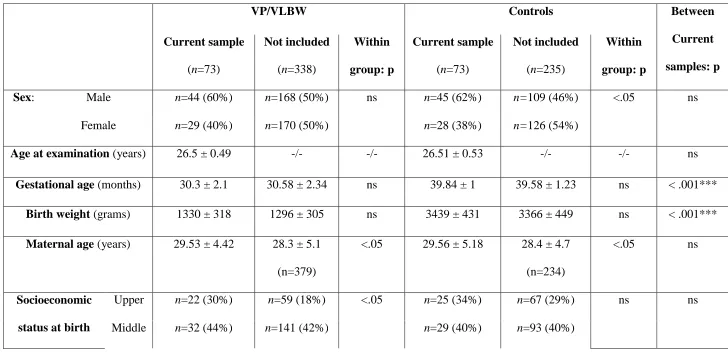
The background characteristics of the final sample are presented in Table 1. It included
58 participants from Bonn (n=33 VP/VLBW, n=25 controls), and 88 from Munich (n=40
VP/VLBW, n=48 controls). VP/VLBW and term-born controls did not differ in sex, age,
maternal age or SES, while VL/VLBW were by definition of lower birth weight, gestation
and had longer hospitalization. VP/VLBW had intensive neonatal treatment (special
care), on average, for M=54.3 days (SD 30.7), and were ventilated for M=11.8 days
(SD 16.4). Seven VP/VLBW (no term-born controls) had cerebral palsy. Dropout
analyses indicated that the GA, BW and duration of hospitalization in both groups were
not significantly different from the remaining cohort, while they showed a similar
overbalance of males, and higher maternal age. Moreover, the current VP/VLBW had
a higher SES, less frequent history of cerebral palsy, received shorter ventilation, and
showed lower optimality scores than the remaining VP/VLBW cohort.
Table 1 about here
--The VP/VLBW group showed weaker global cognitive function in childhood,
although dropout analyses indicated positive selection of VP/VLBW (but not controls)
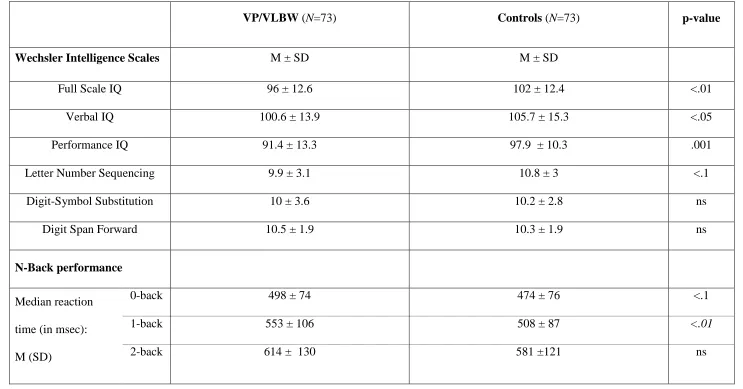
with better cognitive functioning (Table 1). IQ group differences were still present in
adulthood (Table 2). Meanwhile, there were no significant differences for behavioral
WM parameters, although VP/VLBW showed a marginally (p=.089) lower LNS
performance, and there were also no processing speed differences in the DSST (Table
Daamen et al.: Working memory in preterm-born adults Page: 19 -- Insert Table 2 about here –
N-Back behavioral performance
No group differences in task accuracy
Both groups showed similar task accuracy (Table 2). For 0-back and 1-back,
the large majority (≥90%) in both groups showed perfect hit rates. Even collapsing
values into dichotomous variables (i.e., hit rate: below 100%/ 100%) revealed no
significant differences (both ps>.7, Fisher exact test). Meanwhile, both groups showed
a substantial increase of participants with reduced accuracy in the most difficult 2-back
condition, with half (or more) of the participants showing suboptimal 2-back target
detection, consistent with increased task difficulty. While visual inspection (Table 2)
suggests that there was a higher proportion of VP/VLBW participants in the lower hit
rate categories for the 2-back condition, a Cochrane-Armitage trend test (see: Agresti,
2002) failed to reach significance (χ2(1) = 2.6, p=.11). While post hoc dichotomization
of the 2-back accuracy data indicated that a higher proportion of VP/VLBW (63%) than
controls (49%) had sub-optimal 2-back hit rates below 100%, this was not significant
(χ2(1,146)=2.8, p=.095). False alarms were generally rare, which was similar for both
groups (all Fisher exact ps>.2).
VP/VLBW show a general slowing of response latencies, irrespective of workload
Median reaction times showed significant main effects of workload
(F(1.557,224.2)=111.8, p<.001), indicating longer response latencies with increasing task
Daamen et al.: Working memory in preterm-born adults Page: 20 generally responding slower than controls. Importantly, however, there was no group
x workload interaction (F(2,146)=1.15, p=.318), indicating that response latencies for
VP/VLBW did not increase disproportionally with higher task difficulty. Similarly, the
intra-individual standard deviations of response times showed a main effect of
workload (F(1.858, 267.553)=73.3, p<.001), a marginally significant main effect of group
(F(1,144)=3.9, p=.051), but no group x workload interaction (F(1.858, 267.553)=0.01, p=.991).
Results were hardly altered when additionally controlling for group differences in FSIQ.
No correlation with clinical background data
There were no significant correlations of N-Back performance scores with
clinical background variables (i.e., GA, BW, OPTI) for the VP/VLBW group.
Functional imaging data
General overlap of activated and deactivated brain networks
Overall, both groups showed largely similar regional patterns of activations and
deactivations (p<.05 FWE, voxelwise) for the 1-back and 2-back WM tasks, as
compared to 0-back control task (Figure 1). In both groups, WM tasks were associated
with activation increases, especially in bilateral DLPFC, SMA and lateral parietal areas,
and (prominently for 2-back) in the thalamus, dorsal precuneus, anterior insula, and
cerebellum. Concurrently, the WM tasks induced similar, mostly bilateral, deactivations
in mesial parietooccipital regions (including ventral precuneus and PCC), pregenual
ACC and VMPFC, parahippocampal and angular areas, and (prominently for 2-back)
Daamen et al.: Working memory in preterm-born adults Page: 21 and deactivations in both groups were more pronounced for 2-back, as compared to
1-back.
-- Figure 1 about here --
VP/VLBW show a load-dependent enhancement of deactivation in posterior DMN
regions
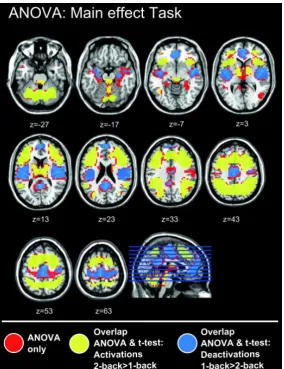
This workload effect was confirmed by a significant ANOVA main effect of task
(Supplementary Fig. 2): Post hoc t-tests (controlling for additional nuisance variables)
confirmed stronger 2-back activations especially in lateral and medial fronto-parietal,
thalamic and cerebellar networks, and stronger 2-back deactivations in posteromedial,
VMPFC, medial temporal, paracentral and midcingulate, as well as posterior insular
areas. While the ANOVA suggested a main effect of group for small clusters in the left
insula, and right posterior ACC (Supplementary Fig. 3), this was not confirmed by post
hoc t-tests.
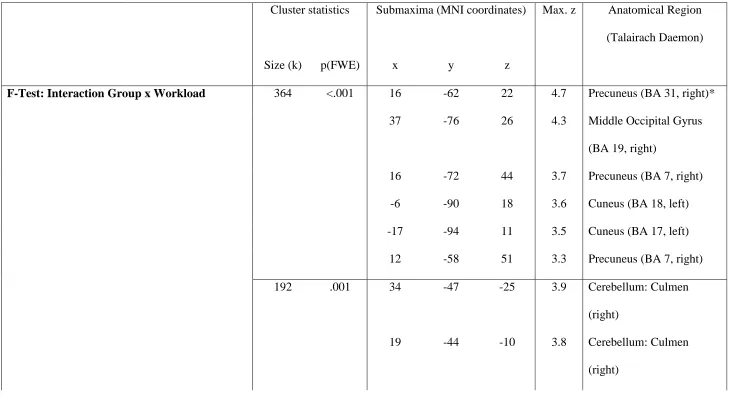
Critically, there was a significant Group x Task interaction (p<.05 FWE,
voxel-level), indicating load-dependent group differences in the right ventral precuneus
(Table 3, Supplementary Fig. 4D). Using a slightly less conservative threshold (p<.05
FWE, cluster-level), this region was located in a larger midline cluster that extended
into the middle occipital gyrus, and the left cuneus (Supplementary Fig. 4C).
Additionally, significant interactions emerged for a cluster that included right cerebellar
vermis, posterior parahippocampal, and fusiform areas (Table 3, Supplementary Fig.
Daamen et al.: Working memory in preterm-born adults Page: 22 contrast generally confirmed these findings (p<.05 FWE, cluster-level), but indicated
that differences concentrated on two more focal regions (Figure 2, Table 3): The right
ventral precuneus, and a cluster at the borderline between the right posterior
parahippocampal region and adjacent cerebellar vermis (mainly lobule V: Diedrichsen
et al., 2009). Differential effects in both regions were driven by a stronger deactivation
for 2-back, as compared to 1-back, in the VP/VLBW group. There were no significant
activation changes indicating weaker load-dependent deactivation for VP/VLBW, and
no significant evidence for either weaker or stronger load-dependent activation
increases than controls (Table 3).
-- Table 3 about here –
- Figure 2 about here –
Associations with response measures
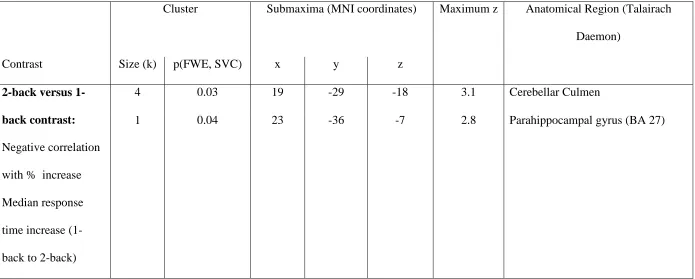
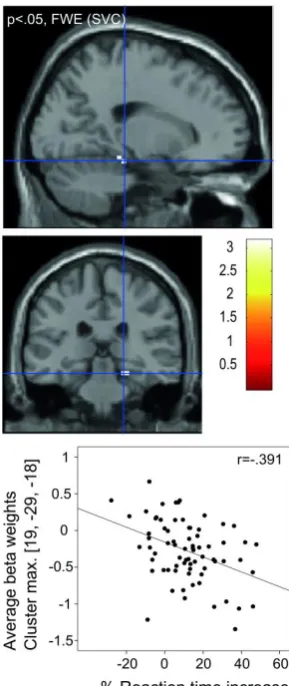
To explore whether pronounced deactivations in the 2-back versus 1-back
contrast were related to VP/VLBW behavioral performance, post hoc regression
analyses examined associations with 2-back accuracy and reaction time measures.
While there was no significant association with 2-back accuracy, and RT variability,
brain activity change for 2-back versus 1-back showed a moderate negative
association with the corresponding percent increase in median RT from 1-back to
2-back within the right cerebellar-parahippocampal cluster (surviving p<.05 FWE after
small volume correction for this region: Figure 3), indicating that those VP/VLBW who
showed stronger RT slowing for 2-back (compared to 1-back) also presented stronger
Daamen et al.: Working memory in preterm-born adults Page: 23 no significant associations (even at a lenient voxelwise threshold of p<.01
uncorrected).
-Figure 3 about here-
-Table 4 about here-
Associations with clinical background parameters
For the regions showing significantly stronger deactivations (i.e.,
1-back>2-back) in VP/VLBW, no robust associations with GA, BW and OPTI of VP/VLBW adults
were observed, even with small volume correction (SVC). Exploratory whole brain
analyses only found positive associations with GA (p<.05 FWE, cluster-level) in regions
where VP/VLBW generally showed activation increases (i.e., 2-back>1-back),
including right inferior frontal and precentral gyrus, left and right inferior parietal lobule,
and the right superior temporal gyrus, which indicated that VL/VLBW with lower GA
showed weaker activation increases in these task-related areas (Supplementary Table
1; Supplementary Fig. 5).
Discussion
In this fMRI study, VP/VLBW and term-born adults from an epidemiological
longitudinal cohort were compared in a verbal N-back task with varying levels of
cognitive workload. Compared to term-born controls, VP/VLBW showed no significant
impairments in behavioral accuracy for the tested workload levels, and similar
Daamen et al.: Working memory in preterm-born adults Page: 24 thalamic and cerebellar regions) and decreases (especially in DMN areas, such as
PCC and ventral precuneus, MPFC, parahippocampal regions), which argue against a
large-scale reorganization of task-relevant networks (i.e., alternative processing
routes) in the N-Back task. However, within these common networks, VP/VLBW
showed enhanced deactivations in posterior DMN areas (including ventral precuneus,
and parahippocampal areas) that were specific for the more difficult 2-back condition,
suggesting load-dependent differences which might reflect an adaptive mechanism
engaged by VP/VLBW to cope with increasing cognitive workload.
Adults born preterm show a load-dependent enhancement of posterior DMN
deactivation
As a central observation, VP/VLBW adults showed stronger deactivations in
posterior DMN regions, primarily the right ventral precuneus and right posterior
parahippocampal areas, which were load-dependent. Within the latter region,
deactivation in the VP/VLBW group was also correlated with relatively slower
responses during 2-back.
While both groups deactivated posteromedial areas during the two WM tasks
(Figure 1), VP/VLBW adults showed pronounced deactivations of the ventral
precuneus in the 2-back, as compared to the 1-back task (Figure 2), consistent with a
workload-dependent enhancement of this mechanism in the premature group. While
the PCC is a DMN core region, the participation of the precuneus is less clear (Buckner
et al., 2008). Yet, the precise boundaries between these regions is a matter of debate
Daamen et al.: Working memory in preterm-born adults Page: 25 2006), and resting-state connectivity data suggest that at least the ventral precuneus
participates in the DMN (Zhang and Li, 2012).
The general finding that DMN deactivation varies with cognitive workload of
processed stimuli concurs with earlier observations (e.g., McKiernan et al., 2003).
Recent data suggest that DMN suppression is functionally relevant for certain types of
goal-directed cognitive tasks that direct attention to external stimuli, whereas
impairments of this suppression mechanism may relate to cognitive dysfunctions in
various brain disorders (Anticevic et al., 2012). For example, previous studies suggest
that stronger suppression of DMN regions (including PCC and precuneus) is
associated with more successful performance in experimental tasks that emphasize
the goal-directed processing of external stimuli (e.g., Weissman et al., 2006), including
WM-related tasks (Anticevic et al., 2010). Possibly, DMN suppression during
externally-guided tasks is necessary to filter out distraction by ongoing,
stimulus-independent thoughts (Anticevic et al., 2012). This converges with recent theories
about attentional functions of the ventral PCC (Leech and Sharp, 2014). Thus, the
observation that VP/VLBW presented enhanced deactivations in the ventral precuneus
during the most demanding 2-back condition might indicate a stronger compensatory
filtering of attentional resources that is necessary to focus on the stimulus-related WM
processes, which was probably not necessary for the easier 1-back condition. This
would also concur with a study in individuals with early life stress experiences (Philip
et al., 2013), who showed stronger suppression of PCC and additional DMN areas
Daamen et al.: Working memory in preterm-born adults Page: 26 Complementary deactivations were found in a borderline region between the
right cerebellar vermis and adjacent parahippocampal cortex (Figure 2), which
complicates reliable anatomical assignments. While there are cerebellar associations
with the DMN, the closest associations exist for more posterior areas (including lobule
IX and Crus I/II border area: Buckner et al., 2011). The present cluster overlap with
lobule V would be more consistent with a concurrent suppression in somatomotor
networks (Krienen and Buckner, 2009; O'Reilly et al., 2010). Meanwhile, the
parahippocampal cortex is implicated in the DMN (Andrews-Hanna et al., 2014). Here,
deactivations may also reflect a compensatory downregulation, complementary to the
ventral precuneus. This would converge with evidence that both regions are
participating in a common medial temporal DMN subsystem (Andrews-Hanna et al.,
2010). Consistent with this notion, deactivations in this region additionally showed a
negative association with the corresponding percent increase of median RT for the
VP/VLBW only (Figure 3). Considering that participants showed a systematic
workload-dependent RT increase towards the most difficult 2-back condition, it seems
plausible that those VP/VLBW with more pronounced RT prolongation also
experienced the highest workload increment during the 2-back task: Thus, the
observation that these participants also showed a stronger downregulation of this
region seems compatible with the idea of a compensatory effort. This assertion would
have been further strengthened by corresponding associations with RT variability2,
which was occasionally reported in recent studies (Esterman et al., 2013). We did not
find support for this prediction, although methodological limitations may play a role
(discussed below). Therefore, this interpretation remains tentative. Notably, the finding
Daamen et al.: Working memory in preterm-born adults Page: 27 was specific for the VP/VLBW group, since controls did not show complementary
associations, even at rather liberal statistical thresholds.
Generally, the observation that the preterm-born adults show a stronger
negative modulation of brain activity in posterior DMN structures argues against the
idea that prematurity causes significant long-term functional impairments in this brain
network, as they were recently found in a variety of clinical populations (Anticevic et
al., 2012). This is broadly consistent with the available resting-state fMRI (rs-fMRI)
literature examining DMN organisation in premature populations. While earlier rs-fMRI
studies suggested that preterm-born infants lack the fragmentary DMN organization
patterns that were observed in term-born infants at term-equivalent age (Fransson et
al., 2007; Smyser et al., 2010), these initial findings were not confirmed by a later study
(Doria et al., 2010). Available rs-fMRI data from older cohorts also provide no, or only
subtle evidence for long-term DMN alterations beyond the neonatal phase: For
example, Damaraju and colleagues examined VLBW infants at 18 or 36 months, and
found no significant spatial or temporal alterations within the DMN, as compared to
term-born controls (Damaraju et al., 2010). Recent graph-theoretical network analyses
in preadolescent children with a GA range from 29-42 weeks indicated that lower GA
was associated with reduced local network efficiency in posterior medial cortex
regions, and a reduced connectivity of “rich club” network structures, including the
precuneus (Kim et al., 2014): Since ventral and dorsal parts of the precuneus were not
separated in the analysis, it remains uncertain whether this relationship specifically
holds for the ventral precuneus region that was relevant in the present study. Another
study found no spatial or spectral alterations of DMN function in young VPT adults,
Daamen et al.: Working memory in preterm-born adults Page: 28 executive and striatal salience networks (White et al., 2014). In addition, rs-fMRI
analyses for a large adult cohort that included most participants of the present sample
(Bäuml et al., 2014) showed both an increased functional connectivity in a dorsal part
of the right precuneus, and decreased connectivity in bilateral perigenual parts of the
PCC, which might indicate some functional reorganization in the posterior DMN during
rest, although the relevant areas were not overlapping with the present task-related
findings, but were located in more dorsal aspects of the network.
While the abovementioned rs-fMRI data suggest that the spatial and functional
organization of the posterior DMN is largely intact in preterm-born individuals, their
recruitment of the network may nevertheless deviate from term-born controls in a
task-dependent manner, possibly depending on the degree of neonatal injury. For example,
a recent task fMRI study (Kalpakidou et al., 2012) examined activity changes in the
PCC during the retrieval of word pairs: While term-born controls showed activation
increases during recall (consistent with the general literature suggesting activity
increases instead of decreases during the retrieval of episodic memory contents:
Huijbers et al., 2012), this activation increase was reduced in VPT adults with no sign
of neonatal brain injury, but reverted to a deactivation in VPT adults with neonatal signs
of periventricular hemorrhage and ventricular dilation, despite similar task performance
in the different groups. This lack of performance differences may result from low task
difficulty, but could also reflect the use of a different cognitive strategy in the VPT group
with neonatal injury which was associated with a down- (instead of up-)regulation of
the posterior DMN. Further research is needed to elucidate posterior DMN functioning
Daamen et al.: Working memory in preterm-born adults Page: 29 Relationship to previous WM studies with children born preterm
Deactivation of posterior DMN areas. Load-dependent deactivations in posterior
DMN regions (especially, ventral precuneus) are not consistent across WM studies
with preterm-born children (Griffiths et al., 2013; Mürner-Lavanchy et al., 2014; Taylor
et al., 2012). Taylor et al. (2012) reported reduced 1-back activation in
parahippocampal and precuneus areas in VP children (although in more rostral and
dorsal locations, respectively). Unfortunately, their descriptions allow no directional
inferences about whether these group differences were actually driven by weaker
activations, or reflect stronger deactivations in the preterm-born group. The fact that
the other studies found no enhanced deactivations in posterior DMN regions might
indicate that these children have not yet developed equivalent compensatory
mechanisms as our preterm-born adults. Moreover, their smaller sample size has
possibly limited their ability to detect subtle group differences.
Deficient activation of other (“task-positive”) WM-related networks. Taylor et al.
(2012) report that VP children did not show similar frontal and ACC activations as
control children. While not statistically significant, this converges with Griffiths et al.
(2013), who observed that EP/ELBW children showed weaker activation increases in
task-related occipital, supplementary motor, ACC and insular regions, which might
reflect deficient recruitment of these networks (although complementary behavioural
deficits were only significant for their most difficult condition). In contrast, activation
increases in classical fronto-cingulo-parietal networks (Owen et al., 2005) for our adult
cohort were not significantly different from controls. Several factors may contribute to
these discrepancies: First, the weaker activations in EP/ELBW children could reflect
Daamen et al.: Working memory in preterm-born adults Page: 30 a complex paradigm that elicited significant behavioral deficits (at least in the most
difficult condition). To some extent, the weaker brain activations may be secondary to
weaker performance (Price and Friston, 1999). Meanwhile, our paradigm was not
demanding enough to provoke significant performance decrements, but examined a
range where compensation was still possible. Third, Griffith et al. selected EP/ELBW
children, while our cohort mainly examined VP/VLBW adults (n=16 (22%) EPT/ELBW):
Due to their stronger prematurity, and its stronger impact on brain development,
EP/ELBW children may be less capable to activate the task-relevant brain networks.
Actually, exploratory analyses in our sample indicated that those VL/VLBW with lower
GA showed weaker activation increases in right inferior frontal, and left and right
inferior parietal regions for the 2-back>1-back comparison, consistent with this
argument (Supplementary Fig. 5). Fourth, our VP/VLBW adults were relatively healthy
and showed higher IQ performance compared to all VP/VLBW children (Bhutta et al.,
2002), which could further mask prematurity-related deficits (see below).
Compensatory activation increases. Recently, Müller-Lanvanchy et al. (2014)
examined 7-12 year old VP children with a visuo-spatial STM retention task. They
observed weaker frontal activations than in controls, but also found evidence for
enhanced activation, especially in superior frontal areas that were activated by both
groups. This might reflect compensatory effort, and would converge with WM studies
in other clinical populations (Callicott et al., 2000; but see: Hillary, 2008). Meanwhile,
our results provide no robust evidence for compensatory activation increases. We
would speculate that adult VP/VLBW have possibly developed alternative strategies,
Daamen et al.: Working memory in preterm-born adults Page: 31 Interestingly, none of these studies found activation increases in alternative
processing pathways, as discussed for other cognitive domains (e.g., Lawrence et al.,
2009; Nosarti et al., 2006; Peterson et al., 2002). WM-relevant brain networks may
either be relatively robust against prematurity-related brain alterations, or the range for
compensatory shifts to functionally equivalent areas (Just and Varma, 2007) is more
restricted.
Methodological considerations
Sample size and selection. A major strength of this study is the large group size
compared to most fMRI studies with premature populations (e.g., Gimenez et al., 2005;
but see: Ment et al., 2006). Larger sample sizes do not only reduce the probability of
missing existing differences due to a lack of power, but may also be less prone to
reporting bias (i.e. tendencies to report more activation clusters than expected due to
sample size) than conventional smaller studies (David et al., 2013). Moreover, it is a
distinctive feature that the VP/VLBW were not drawn from hospital-based cohorts (e.g.,
Gimenez et al., 2005; Narberhaus et al., 2009), but came from an epidemiological
sample (see also: Griffiths et al., 2013), which should promote the generalizability of
findings.
Meanwhile, a methodological drawback is the positive selection of VP/VLBW
with relatively high levels of cognitive function, and lower neonatal risks. While the
average IQ in the VP/VLBW group was significantly lower, confirming previous studies
(Bhutta et al., 2002), drop-out analyses for childhood data confirmed that the VP/VLBW
Daamen et al.: Working memory in preterm-born adults Page: 32 and were also less impaired in some neonatal parameters. Positive IQ attrition is also
observed in other study cohorts that followed premature populations up into adulthood
(e.g., Nosarti et al., 2007), and many fMRI studies with preterm-born participants
concentrate on samples with average cognitive abilities (e.g., Lawrence et al., 2009;
Narberhaus et al., 2009). While not invalidating the results, the group differences in
this cognitively (and medically) “fitter” subsample may only represent the lower
boundary of what could have been observed if more impaired participants were
included: Possibly, individuals with stronger cognitive impairments and neonatal
adversities would have presented worse N-back performance, and also quantitatively
or qualitatively different compensatory activation patterns.
Task design. Behaviorally, performance in both groups proved workload-sensitive, as
indicated by increasing response latencies, and higher proportions of participants with
omissions in the most demanding 2-back condition. Yet, neither general nor
workload-specific performance breakdown was observed in the VP/VLBW group, although they
tended to miss 2-back targets more frequently. This converges with cognitive
background data that showed intact STM (Digit Span forward), and only marginally
weaker WM performance (Letter-Number-Sequencing), and variable WM findings in
other premature populations (Bjuland et al., 2013; Burnett et al., 2013; Soria-Pastor et
al., 2009). Possibly, the positive selection of VP/VLBW with better cognitive (and
presumably: WM) function has masked existing deficits.
Moreover, significant behavioral impairments may only appear at higher
workload levels (Jaekel et al., 2013) that are not sufficiently taxed by our paradigm,
Daamen et al.: Working memory in preterm-born adults Page: 33 of response accuracy for their 2-back (versus 1-back) conditions, but this became
significant only for the most difficult color 2-back condition. Possibly, further workload
increases would have unmasked latent VP/VLBW deficits. Adding a 3-back condition
was initially considered, but eventually discarded with the intention to apply a short
paradigm that was likely to be adequately performed by most participants (see also:
Griffiths et al., 2013), limiting possible performance/ activation confounds that
frequently complicate interpretations in patient studies (Price and Friston, 1999).
Meanwhile, future studies should consider other WM (e.g. Sternberg) paradigms that
provide more flexible approaches for studying parametrical workload manipulations.
VP/VLBW showed a general slowing of response times, in line with earlier
findings (Strang-Karlsson et al., 2010). This might indicate impaired processing speed,
which was argued to mediate executive or WM problems in preterm-born children
(Mulder et al., 2011b; Rose et al., 2011). Yet, the VP/VLBW showed no impaired DSST
performance, which also measures processing speed (Lezak et al., 2012; Wechsler,
1997). Thus, this does most likely not reflect central processing deficits, but relate to
specific motor requirements of the task.
Due to the simple response requirements, and the relatively short duration of
the paradigm, the behavioral parameters had to be derived from a comparably low
number of target stimuli, which means that the reliability of these parameters is
necessarily limited. We cannot exclude that this prevented the detection of latent group
differences in RT measures. Longer experiments, especially in combination with
event-related designs, also provide better opportunities for more fine-grained analyses of
Daamen et al.: Working memory in preterm-born adults Page: 34 deactivations of posterior DMN region during the most difficult 2-back task blocks, it
might be interesting to analyze the relationships between phasic fluctuations of DMN
activity and attentional lapses (Weissman et al., 2006) or RT variability (Esterman et
al., 2013).
Further statistical considerations. As recent ROI-based analyses presented by
Mürner-Lavanchy et al. (2014) suggest, data distributions in preterms may show regional
deviations from normal distribution, which could reduce the sensitivity of conventional
parametric t-tests. This problem may not be specific for preterm-born individuals:
Actually, a methodological investigation in a large-scale (N=81) population of normal
participants (which provided better power than usual small-scale studies to check the
underlying assumptions) found that deviations from normality were detectable in up to
30% of the examined brain voxels (Thirion et al., 2007). Therefore, the authors suggest
that non-parametric tests may generally provide a preferable analytic strategy. To
examine whether this may have influenced our results, we conducted supplementary
non-parametric group analyses, using the Statistical Nonparametric Mapping toolbox
(SnPM Version 13.1.01: http://warwick.ac.uk/snpm; see also: Nichols and Holmes,
2001): The analyses provided virtually identical results, suggesting that the findings of
our large-scale study were generally robust.
Conclusion
This fMRI study provides novel insights into the functional basis of WM function
in VP/VLBW adults. The novel finding of a stronger load-dependent deactivation in
Daamen et al.: Working memory in preterm-born adults Page: 35 networks with increasing WM load. This points towards a stronger downregulation of
interfering, internally-focused thought processes which provides a plausible
compensatory mechanism for preserved WM function in relatively high-functioning
Daamen et al.: Working memory in preterm-born adults Page: 36
Acknowledgements
We thank Prof. Hans H. Schild and Prof. Claus Zimmer for enabling this study, staff at
the MR facilities in Bonn and Munich, and Jason Martin for helpful discussions, for
supporting additional data analyses, and proofreading. Moreover, we thank all current
and former Bavarian Longitudinal Study Group members who contributed to study
organization, recruitment, data collection, management and analyses, including (in
alphabetical order): Stephan Czeschka, Claudia Grünzinger, Julia Jäkel, Christian
Koch, Diana Kurze, Sonja Perk, Andrea Schreier, Antje Strasser, Julia Trummer, and
Eva van Rossum. Most importantly, we thank our study participants for their efforts to
take part in this study.
Funding
Supported by German Federal Ministry of Education and Science (BMBF 01ER0801:
M.D., C.S., B.B., N.B., D.W.; BMBF 01EV0710: A.M.W.; BMBF 01ER0803: C.S.) and
the Kommission für Klinische Forschung, Technische Universität München (KKF
Daamen et al.: Working memory in preterm-born adults Page: 37
References
Agresti A. (2002): Categorical data analysis (2nd edition). New York: Wiley.
Andrews-Hanna JR, Reidler JS, Sepulcre J, Poulin R, Buckner RL. (2010):
Functional-Anatomic Fractionation of the Brain's Default Network. Neuron
65:550-562.
Andrews-Hanna JR, Smallwood J, Spreng RN. (2014): The default network and
self-generated thought: component processes, dynamic control, and clinical
relevance. Ann N Y Acad Sci 1316:29-52.
Anticevic A, Cole MW, Murray JD, Corlett PR, Wang X-J, Krystal JH. (2012): The role
of default network deactivation in cognition and disease. Trends Cogn Sci
16:584-592.
Anticevic A, Repovs G, Shulman GL, Barch DM. (2010): When less is more: TPJ and
default network deactivation during encoding predicts working memory
performance. Neuroimage 49:2638-48.
Ashburner J, Friston KJ. (2005): Unified segmentation. Neuroimage 26:839-851.
Barde LHF, Yeatman JD, Lee ES, Glover G, Feldman HM. (2012): Differences in
neural activation between preterm and full term born adolescents on a
sentence comprehension task: Implications for educational accommodations.
Dev Cogn Neurosci 2:S114-S128.
Baron I, Rey-Casserly C. (2010): Extremely Preterm Birth Outcome: A Review of
Four Decades of Cognitive Research. Neuropsychol Rev 20:430-452.
Baron IS, Kerns KA, Muller U, Ahronovich MD, Litman FR. (2012): Executive
functions in extremely low birth weight and late-preterm preschoolers: Effects
Daamen et al.: Working memory in preterm-born adults Page: 38 Bäuml JG, Daamen M, Meng C, Neitzel J, Scheef L, Jaekel J, Busch B, Baumann N,
Bartmann P, Wolke D, Boecker H, Wohlschläger AM, Sorg C. (2014):
Correspondence Between Aberrant Intrinsic Network Connectivity and
Gray-Matter Volume in the Ventral Brain of Preterm Born Adults. Cereb Cortex:doi:
10.1093/cercor/bhu133.
Bhutta AT, Cleves MA, Casey PH, Cradock MM, Anand KJ. (2002): Cognitive and
behavioral outcomes of school-aged children who were born preterm: a
meta-analysis. JAMA 288:728-37.
Bjuland KJ, Løhaugen GCC, Martinussen M, Skranes J. (2013): Cortical thickness
and cognition in very-low-birth-weight late teenagers. Early Hum Dev
89:371-380.
Brandt I. (1983): Griffiths Entwicklungsskalen (GES) zur Beurteilung der Entwicklung
in den ersten beiden Lebensjahren [Griffiths Developmental Scales for the first
two years of life]. Weinheim: Beltz.
Buckner RL, Andrews-Hanna JR, Schacter DL. (2008): The brain's default network:
anatomy, function, and relevance to disease. Ann N Y Acad Sci 1124:1-38.
Buckner RL, Krienen FM, Castellanos A, Diaz JC, Yeo BT. (2011): The organization
of the human cerebellum estimated by intrinsic functional connectivity. J
Neurophysiol 106:2322-45.
Burnett AC, Scratch SE, Anderson PJ. (2013): Executive function outcome in preterm
adolescents. Early Hum Dev 89:215-220.
Callicott JH, Bertolino A, Mattay VS, Langheim FJ, Duyn J, Coppola R, Goldberg TE,
Weinberger DR. (2000): Physiological dysfunction of the dorsolateral
Daamen et al.: Working memory in preterm-born adults Page: 39 Cavanna AE, Trimble MR. (2006): The precuneus: a review of its functional anatomy
and behavioural correlates. Brain 129:564-83.
Damaraju E, Phillips J, Lowe JR, Ohls R, Calhoun VD, Caprihan A. (2010):
Resting-state functional connectivity differences in premature children. Frontiers in
Systems Neuroscience 4:23.
David SP, Ware JJ, Chu IM, Loftus PD, Fusar-Poli P, Radua J, Munafó MR, Ioannidis
JPA. (2013): Potential Reporting Bias in fMRI Studies of the Brain. PLoS ONE
8:e70104.
Diedrichsen J, Balsters JH, Flavell J, Cussans E, Ramnani N. (2009): A probabilistic
MR atlas of the human cerebellum. Neuroimage 46:39-46.
Doria V, Beckmann CF, Arichi T, Merchant N, Groppo M, Turkheimer FE, Counsell
SJ, Murgasova M, Aljabar P, Nunes RG, Larkman DJ, Rees G, Edwards AD.
(2010): Emergence of resting state networks in the preterm human brain. Proc
Natl Acad Sci U S A 107:20015-20.
Dykiert D, Der G, Starr JM, Deary IJ. (2012): Age differences in intra-individual
variability in simple and choice reaction time: systematic review and
meta-analysis. PLoS ONE 7:e45759.
Esterman M, Noonan SK, Rosenberg M, Degutis J. (2013): In the zone or zoning
out? Tracking behavioral and neural fluctuations during sustained attention.
Cereb Cortex 23:2712-23.
Fransson P, Skiold B, Horsch S, Nordell A, Blennow M, Lagercrantz H, Aden U.
(2007): Resting-state networks in the infant brain. Proc Natl Acad Sci U S A
Daamen et al.: Working memory in preterm-born adults Page: 40 Friston KJ, Holmes AP, Worsley KJ, Poline JP, Frith CD, Frackowiak RSJ. (1995):
Statistical Parametric Maps in Functional Imaging: A General Linear
Approach. Hum Brain Mapp 2:189-210.
Friston KJ, Williams S, Howard R, Frackowiak RS, Turner R. (1996):
Movement-related effects in fMRI time-series. Magn Reson Med 35:346-55.
Gevins A, Cutillo B. (1993): Spatiotemporal dynamics of component processes in
human working memory. Electroencephalogr Clin Neurophysiol 87:128-43.
Gimenez M, Junque C, Vendrell P, Caldu X, Narberhaus A, Bargallo N, Falcon C,
Botet F, Mercader JM. (2005): Hippocampal functional magnetic resonance
imaging during a face-name learning task in adolescents with antecedents of
prematurity. Neuroimage 25:561-9.
Gläscher J, Gitelman D. (2008): Contrast weights in flexible factorial design with
multiple groups of subjects (unpublished
tutorial).https://www.jiscmail.ac.uk/cgi-bin/webadmin?A2=ind0803&L=SPM&P=R16629.
Gray JR, Chabris CF, Braver TS. (2003): Neural mechanisms of general fluid
intelligence. Nat Neurosci 6:316-22.
Griffiths R. (1976): The abilities of babies: a study in mental measurement.
Amersham: Association of Research in Infant and Child Development.
Griffiths ST, Gundersen H, Neto E, Elgen I, Markestad T, Aukland SM, Hugdahl K.
(2013): fMRI: blood oxygen level-dependent activation during a working
memory-selective attention task in children born extremely preterm. Pediatr
Res 74:196–205.
Gutbrod T, Wolke D, Soehne B, Ohrt B, Riegel K. (2000): Effects of gestation and