Manuscript version: Published Version
The version presented in WRAP is the published version (Version of Record).
Persistent WRAP URL:
http://wrap.warwick.ac.uk/112080
How to cite:
The repository item page linked to above, will contain details on accessing citation guidance
from the publisher.
Copyright and reuse:
The Warwick Research Archive Portal (WRAP) makes this work by researchers of the
University of Warwick available open access under the following conditions.
Copyright © and all moral rights to the version of the paper presented here belong to the
individual author(s) and/or other copyright owners. To the extent reasonable and
practicable the material made available in WRAP has been checked for eligibility before
being made available.
Copies of full items can be used for personal research or study, educational, or not-for-profit
purposes without prior permission or charge. Provided that the authors, title and full
bibliographic details are credited, a hyperlink and/or URL is given for the original metadata
page and the content is not changed in any way.
Publisher’s statement:
Please refer to the repository item page, publisher’s statement section, for further
information.
Every Vote Counts: Ensuring Integrity in Large-Scale Electronic
Voting
Feng Hao, Newcastle University, UK
Matthew N. Kreeger, Thales E-Security, UK Brian Randell, Newcastle University, UK Dylan Clarke, Newcastle University, UK
Siamak F. Shahandashti, Newcastle University, UK Peter Hyun-Jeen Lee, Newcastle University, UK
This paper presents a new End-to-End (E2E) verifiable e-voting protocol for large-scale elections, called Direct Recording Electronic with Integrity (DRE-i). In contrast to all other E2E verifiable voting schemes, ours does not involve any Tallying Authorities (TAs). The design of DRE-i is based on the hypothesis that existing E2E voting protocols’ universal dependence on TAs is a key obstacle to their practical deployment. In DRE-i, the need for TAs is removed by applying novel encryption techniques such that after the election multiplying the ciphertexts together will cancel out random factors and permit anyone to verify the tally. We describe how to apply the DRE-i protocol to enforce the tallying integrity of a DRE-based election held at a set of supervised polling stations. Each DRE machine directly records votes just as the existing practice in the real-world DRE deployment. But unlike the ordinary DRE machines, in DRE-i the machine must publish additional audit data to allow public verification of the tally. If the machine attempts to cheat by altering either votes or audit data, then the public verification of the tallying integrity will fail. To improve system reliability, we further present a fail-safe mechanism to allow graceful recovery from the effect of missing or corrupted ballots in a publicly verifiable and privacy-preserving manner. Finally, we compare DRE-i with previous related voting schemes and show several improvements in security, efficiency and usability. This highlights the promising potential of a new category of voting systems that are E2E verifiable and TA-free. We call this new category “self-enforcing electronic voting”.
1. INTRODUCTION
Background. An electronic voting (e-voting) system is a voting system in which the election data
is recorded, stored and processed primarily as digital information [VoteHere 2002]. Depending on the implementation, e-voting can be either local or remote. Local e-voting occurs at a supervised polling station, normally using a touch-screen machine to record votes directly. Such a machine is often called a Direct Recording Electronic (or DRE) machine [Kohno et al. 2004]. In contrast, remote e-voting can be conducted at any location, usually through a web browser [Adida 2008; Adida et al. 2009].
E-voting has already been widely deployed across the world. As shown in USA Today [Wolf 2008], the use of DRE expanded rapidly in the United States following the 2000 national election: from 12% of the votes cast in that election to 29% in 2004, and to 38% in 2006. India moved to full DRE voting in their 2004 national election, and Brazil started its first fully DRE-based election in 2002 [Blanc 2007]. In 2007, Estonia became the first country to allow Internet voting for national elections [Krimmer et al. 2007]. Many other countries have been actively pursuing the implementa-tion of e-voting [Alvarez et al. 2011; Pieters 2011].
Controversy. However, e-voting has become controversial. In 2004, Kohnoet al.critically
anal-ysed a type of e-voting machine that had been widely used in the US, and discovered serious software vulnerabilities and bugs [Kohno et al. 2004]. The alarming level of security flaws was especially worrying because the U.S. government had earlier certified the machine to be “trustwor-thy”. In response to these and other similar findings [Sherman et al. 2006; Jefferson et al. 2004] regarding other manufacturers’ machines, many people have demanded that e-voting be abandoned completely. Several U.S. states consequently abandoned the use of e-voting machines in 2008, caus-ing a rapid decline of DRE usage from 38% in 2006 to 32% in 2008 [Wolf 2008]. Similar problems have also been reported in other countries, e.g., Germany, Netherlands and Ireland have all
Voter
Vote
Tallying result
Unverifiable e-voting system
Untrusted
Interface transmissionUntrusted Untrusted backend
Fig. 1. An unverifiable (black-box) e-voting system
pended e-voting in 2008-2009 [Alvarez et al. 2011; Pieters 2011]. In 2010, researchers also started to seriously question the integrity of e-voting machines used for elections in India [Wolchok et al. 2010].
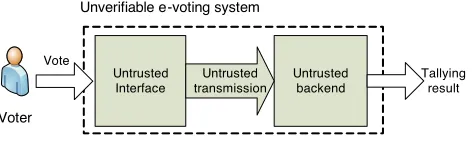
A fundamental problem with many deployed e-voting systems (including the dis-carded/suspended ones) is that they areunverifiable[Pieters 2011]. Essentially each system works like a black-box (Figure 1). After voting, the voter has no means of telling whether her vote was correctly recorded. At the end of the election, the system announces the tallied result for each can-didate, but any independent verification of this result is impossible.
Typically, a black-box e-voting system comprises three components: a voting interface, a trans-mission mechanism and a tallying back-end (see Figure 1). The voting interface may be a touch screen in a local DRE-based election, or it may be a web browser in a remote Internet-based elec-tion. In either case, a compromised voting interface (touch-screen DRE or a web browser) may surreptitiously change the voter’s choice; the transmission of electronic votes (either off-line or on-line) may be intercepted and the votes modified; and the back-end may maliciously change the tally to support some particular candidate regardless of the actual vote count. In summary, there are many opportunities for an attacker to tamper with the electronic data without the public being aware of the change.
This can be contrasted with elections that involve votes being recorded on a visible physical medium such as a printed paper ballot form or a punched card. The processing of such votes can be easily and effectively monitored (e.g., by multiple independent poll-watchers, both professionals and amateurs). And these votes can be retained in case of a challenge, and if necessary be recounted. However, similar direct physical monitoring is not possible in electronic voting.
Government certification of an e-voting system’s hardware and software was perceived by many countries as the solution to the problem of achieving trustworthy e-voting [Alvarez et al. 2011; Pieters 2011], but has proved inadequate for several reasons. First of all, it requires people to trust the probity and competence of the certification authority. Second, it does not solve the fundamen-tal problem, because a certified black-box is still a black-box (i.e., its operation is unverifiable). Third, researchers have repeatedly demonstrated that attackers can successfully compromise “cer-tified” e-voting systems, altering election results without their activities being detected [Sherman et al. 2006; Kohno et al. 2004]. All these greatly reduce public confidence in such government certification.
Therefore, for e-voting to succeed in the future, it is important that the voting system be verifi-able [Adida 2008; Adida et al. 2009]. However, it is worth noting that the idea of verifiverifi-able e-voting is not new; it has existed for over twenty years [Benaloh 1987]. Although progress has been made in trialling verifiable e-voting protocols in practice [Chaum et al. 2008a; Adida et al. 2009], so far the impact on real-world national elections has been limited. In practice, many countries around the world are still using unverifiable (black-box) e-voting systems.
E2E verifiability. To explain the limitations of existing verifiable e-voting technology, we first
[image:3.612.187.423.128.204.2]are generally termed as being End-to-End (E2E) verifiable [Adida 2008]. We refer the reader to papers by Küsterset al.[Küsters and Vogt 2010] and Popoveniucet al.[Popoveniuc et al. 2010] for more formal definitions of E2E verifiability.
Some researchers suggested adding a Voter Verifiable Paper Audit Trail (VVPAT) to a DRE ma-chine. Most notably, the method proposed by Mercuri [Mercuri 2001] works as follows: when the voter makes a selection on the touch-screen, the machine prints the selected choice on a paper receipt in plain text. The voter can visually inspect the receipt under a layer of glass before it is automati-cally transferred to a secure location. The voter is not allowed to take the receipt home as that would reveal (to a coercer) how she had voted. Overall, this method improves the individual verifiability by allowing voters to check if their votes have been recorded correctly. Also, it provides a physical paper trail that permits a manual recount in case of a dispute. However, the VVPAT method provides no means for voters to check whether the recorded votes will be securely transported to the tallying unit and whether the votes will be tallied correctly. Therefore, a DRE system based on VVPAT alone is not E2E verifiable.
Thus, the dual, and potentially conflicting, challenges faced by the designers of any voting system are to ensure the system is publicly verifiable and meanwhile to preserve the voter’s privacy. To satisfy the E2E verifiability, it is necessary to provide the voter a receipt, which can be checked against a public bulletin board [Chaum et al. 2008a]. In order to prevent coercion and vote selling, the receipt must not reveal any information about how the voter had voted. On the other hand, if the receipt does not show how the voter had voted, how can she be sure it is a correct record of her vote? These requirements may seem clearly contradictory, but past research has shown that they can be met by combining various techniques, e.g., cryptography and voter-initiated auditing [Adida et al. 2009; Benaloh 2007].
To date, many E2E verifiable voting protocols have been proposed. Well-known examples in-clude: Adder [Kiayias et al. 2006], Civitas [Clarkson et al. 2008], Helios [Adida 2008; Adida et al. 2009], Scantegrity [Chaum et al. 2008b], Scantegrity II [Chaum et al. 2008a], Prêt à Voter [Ryan et al. 2009], MarkPledge [Adida and Neff 2006] and Chaum’s visual cryptographic scheme [Chaum 2004]. All these protocols rely on there being multiple independent Tallying Authorities (TAs) to perform and control the tallying process in a publicly verifiable manner. Hence, we choose to cate-gorise them as “TA-based E2E verifiable e-voting”.
Protocols in this category generally work as follows (Figure 2): the voter, using a voting interface, casts a vote and obtains a receipt. The receipt is encrypted under a set of tallying authorities’ public keys (or one joint public key). At the end of the election, the system publishes all the receipts on a public bulletin board (e.g., a mirrored public web site), so that voters can check if their votes have been recorded. However, individual voters are unable to decrypt their receipts to confirm their votes have been correctly recorded. Instead they are provided with some other (indirect) way of gaining confidence that this is the case (through voter-initiated auditing, as we will explain in Section 2).
Since all the data on the bulletin board is encrypted, the tallying authorities are needed to perform the decryption and tallying process. This process can be done in a publicly verifiable manner, so that the TAs do not need to be trusted for the integrity of the tallying result. However, they need to be trusted to some extent for the secrecy of individual votes. The common mitigating measure is to put the TAs under ak/nthreshold control, wherenis the total number of TAs andkis the threshold. Only if more than a thresholdknumber of TAs are corrupted will they be able to decrypt each indi-vidual vote. Furthermore, it is normally assumed that the TAs are selected from different parties with conflicting interests, hence they supposedly lack the incentive to collude. (Nonetheless, it is impor-tant to ensure the TAs useindependentsoftware, because “if all trustees (TAs) use tallying software from a single source, then this software might collude without the trustees’ knowledge.” [Karlof et al. 2005])
Implementing E2E verifiability. Although many TA-based E2E verifiable voting protocols have
Voter
Vote
Tallying result
E-voting system
Encrypted receipt
All encrypted receipts
(published data) Decryption System Tallying authorities
Fig. 2. TA-based e-voting with E2E verifiability
Voter
Vote
Tallying result
E-voting System
Encrypted receipt
All encrypted receipts (published data)
Public tallying algorithm
Fig. 3. Self-enforcing e-voting with E2E verifiability
homomorphic tallying [Adida et al. 2009]. In 2009, a customized variant of Helios 2.0 was adopted by the Université catholique de Louvain (UCL) in a campus election to elect the university president. As highlighted in the Helios paper [Adida et al. 2009], the practical implementation of tallying authorities has proved to be “a particularly difficult issue”. To ensure the fairness in the repre-sentations, the tallying authorities were chosen from various groups (students, administrative staff and so on) with different backgrounds (not just computer science). However, it turned out that the chosen authorities did not have the required technical expertise to perform complex cryptographic operations. Hence, a group of “external experts” (whose identities are not mentioned in the Helios paper [Adida et al. 2009]) were invited to first perform the key generation on behalf of the tallying authorities. The whole procedure included purchasing brand new laptops, removing the hard disk drives, disabling wireless network cards, booting up the machines using standard linux live-CDs and loading the key generation code (written in Python) through the USB sticks. Subsequently, the tallying authorities’ private keys were generated and stored on the USB sticks, which were then dis-tributed to the authorities. In the mean time, all of the generated private keys were centrally backed up by one trusted third party (a notary public). After the election, “a similar procedure was followed when those keys were used for decryption” [Adida et al. 2009]. Clearly, the tallying authorities’ fur-ther dependence on “external experts” and a single trusted third party for backup has significantly complicated the trust relationships in the election management.
Removing TAs. A few researchers have investigated how to remove tallying authorities in
elec-tronic voting. Kiayias and Yung first studied this in 2002 with a boardroom voting protocol [Kiayias and Yung 2002], followed by Groth in 2004 [Groth 2004] and Hao-Ryan-Zieli´nski in 2010 [Hao et al. 2010]. Among these boardroom voting protocols, the Hao-Ryan-Zieli´nski’s solution [Hao et al. 2010] is so far the most efficient in every aspect: the number of rounds, the computation load and the message size. In general, a boardroom voting protocol works by requiring voters to coop-eratively interact with all other voters in a network in a number of rounds. In the best case [Hao et al. 2010], only two rounds of interactions are needed. The tallying result is usually computed by voters through exhaustive search. Essentially, the voting is totally decentralized and run by the voters themselves. A decentralized boardroom voting protocol, such as Kiayias-Yung’s [Kiayias and Yung 2002], Groth’s [Groth 2004], or Hao-Ryan-Zieli´nski’s [Hao et al. 2010], can provide the theoretically-best protection of ballot secrecy. In order to learn a voter’s secret choice, the attacker must compromise all other voters to form a full collusion against the voter [Kiayias and Yung 2002; Groth 2004; Hao et al. 2010].
[image:5.612.109.494.128.185.2]requirements are completely different. For example, in a boardroom voting protocol [Kiayias and Yung 2002; Groth 2004; Hao et al. 2010], a voter can trivially prove to a coercer how she had voted by revealing the ephemeral secret generated during the protocol. Furthermore, any arbitrary voter can easily disrupt a multi-round voting procedure by simply dropping out half-way in the protocol. While coercion, vote selling and voter disruption might not be considered serious issues in a small boardroom, they are important considerations in the design of an E2E verifiable voting system.
The scope of this paper is to focus on E2E verifiable voting systems for large-scale elections. Existing boardroom voting protocols are clearly unsuitable for any country-scale elections. How-ever, they are still relevant to our study as they demonstrate that it is possible to remove TAs albeit only in the setting of a small-scale election. To the best of our knowledge, no one has investigated the feasibility of removing tallying authorities for large-scale elections. Indeed, existing E2E ver-ifiable e-voting protocols designed for large-scale elections universally require involving external tallying authorities in the tallying process [Kiayias et al. 2006; Clarkson et al. 2008; Adida 2008; Adida et al. 2009; Chaum et al. 2008b; Chaum et al. 2008a; Ryan et al. 2009; Adida and Neff 2006; Chaum 2004].
Contributions. We initiate a study on whether it is feasible to remove the dependence on external
tallying authorities in an E2E verifiable voting system. Along this direction, we propose to replace the tallying authorities and the decryption system in Figure 2 by a public algorithm. We define the resultant system as a “self-enforcing e-voting” system (see Figure 3). Because the algorithm is public, the tallying process is fully verifiable without any TA involvement. The main contributions of this paper are summarized below:
— We present the first E2E verifiable voting protocol that is TA-free. Our protocol is called Direct Recording Electronic with Integrity (DRE-i). Its “self-enforcing” property is realized by integrat-ing a cancellation formula [Hao and Zieli´nski 2006] into the homomorphic tallyintegrat-ing process: the encryption of votes follows a well-defined structure such that after the election multiplying the ciphertexts together will cancel out random factors and permit anyone to verify the tally. A similar tallying method was used in a previous Hao-Ryan-Zieli´nski boardroom voting protocol [Hao et al. 2010], but ours does not require exhaustive search. Although the two protocols share the same mathematical formula for cancelling random factors, they are designed for completely different election scenarios and have different security requirements.
— We effectively combine the basic DRE-i with several additional engineering designs to make it an overall secure and practical system, suitable for a DRE-based election at polling stations. The first is to seamlessly integrate the voter’s initiated auditing into the natural confirm/cancel voting experience on a touch-screen DRE. As a result, the system is user-friendly to a voter who does not understand cryptography at all. Furthermore, we provide a fail-safe mechanism to allow graceful recovery of partially corrupted audit data in a publicly verifiable and privacy-preserving way. Finally, we support a distributed computation of secret keys to distribute trust and improve system availability. (Advantages of our system over previous ones will be detailed in Section 4.)
2. A SELF-ENFORCING E-VOTING PROTOCOL
In this section, we describe a self-enforcing e-voting protocol called Direct Recording Electronic with Integrity (DRE-i). In particular, we show how to apply the DRE-i protocol to enforce the tallying integrity of DRE-based local voting at the polling station. (It is possible to implement DRE-i for remote voting [Hao et al. 2012; Hao et al. 2013], but to avoid confusion, we will focus on local voting in this paper.) For the simplicity of discussion, we will consider a single-candidate election first, and then extend it to multiple candidates.
2.1. User roles
In an E2E verifiable e-voting protocol, there are generally three user roles as defined below [Adida et al. 2009].
(2) Auditor: Someone who audits the system by performing real-time checks on the system during the voting process.
(3) Universal verifier: Anyone in the world who has the technical expertise to verify the audit data
published by the voting system.
2.2. Integrity requirements
We also adopt the commonly accepted integrity requirements for an E2E verifiable voting proto-col [Adida et al. 2009; Chaum et al. 2008b; Chaum et al. 2008a].
(1) Ballot format integrity: Everyone, including third party observers, should be able to verify that
every encrypted ballot has the correct format to represent exactly one vote.
(2) Ballot casting integrity: All voters should be able to convince themselves that their cast ballots
are recorded to the correct candidates.
(3) Ballot transmission integrity: All voters should be able to verify that their recorded ballots
have been correctly transmitted to the tallying process.
(4) Ballot tallying integrity:Everyone, include third party observers, should be able to verify that
the tallying result is correctly obtained from the recorded ballots.
Obviously, the integrity requirements must be satisfied without compromising the voter’s privacy. In particular, the receipt that permits a voter to verify the integrity of the voting system must not reveal how she had voted. We will explain in Section 3 that this holds true in DRE-i.
2.3. Trust assumptions
There are many other requirements to make a secure e-voting system. Since the satisfaction of those requirements is generally assumed in the literature [Kiayias et al. 2006; Clarkson et al. 2008; Adida 2008; Adida et al. 2009; Chaum et al. 2008b; Chaum et al. 2008a; Adida and Neff 2006; Chaum 2004], we make the same assumptions, namely:
(1) User enrolment: Only eligible users can be enrolled in the voter registration.
(2) User authentication: Only authenticated voters are allowed to vote during the election.
(3) One-man-one-vote: Each authenticated voter is allowed to vote just once.
(4) Voting privacy: Voting happens in a private space that no one else can observe.
(5) Anonymity: The voting machine that is used does not know the real identity of the voter.
(6) Public bulletin board: There is a publicly readable, append-only bulletin board (e.g., a mirrored
public website), on which the legitimate voting system can publish audit data for verification (the authenticity of data can be ensured by the use of digital signatures).
If voting takes place in a supervised environment (say a polling station), it is relatively easy to meet the above assumptions. For example, the polling station staff can authenticate voters based on their ID documents or even biometrics. After successful authentication, the voter is free to take a single random authentication token, say a smart card. The voter then enters a private booth and uses the token to authenticate herself to the machine and starts voting [Kohno et al. 2004]. To ensure one-person-one-vote, the polling station can publish a list of the names of the people who voted, so that anyone can verify that the number of voters matches the number of cast votes [Chaum et al. 2008a]. Observers at a polling station can also independently count how many people have actually voted.
2.4. Three Stages of Voting
The DRE-i protocol consists of three phases: setup, voting and tallying. The following sections explain each phase in detail.
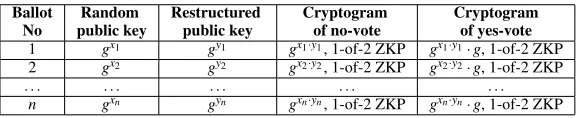
Table I. Setup phase before election
Ballot Random Restructured Cryptogram Cryptogram No public key public key of no-vote of yes-vote
1 gx1 gy1 gx1·y1, 1-of-2 ZKP gx1·y1·g, 1-of-2 ZKP
2 gx2 gy2 gx2·y2, 1-of-2 ZKP gx2·y2·g, 1-of-2 ZKP
. . . . . . . . . . . . . . .
n gxn gyn gxn·yn, 1-of-2 ZKP gxn·yn·g, 1-of-2 ZKP
Note:Data in the first three columns are published on a public bulletin board before the election. They serve as commitment so that the values cannot be later changed. Data in the last two columns are kept secret; they are either computed on-demand during voting or pre-computed before the election.
Gqits subgroup of prime orderq. Letgbe the generator ofGq(any non-identity element inGqcan serve as a generator). We assume the Decision Diffie-Hellman (DDH) problem [Stinson 2006] in Gqis intractable. The parameters (p,q,g) are publicly agreed before the election starts. Unless the contrary is stated explicitly, all the modular operations are performed with respect to the modulus p. Hence, we omit the explicit “ modp” for simplicity.
First of all, the DRE machine generates a private signing key, say using DSA or ECDSA [Stinson 2006], and publishes the public key on the bulletin board. A tamper-resistant module is used to securely manage the private signing key, in line with industry standard practice [Anderson 2008]. The private signing key is generated on-board in the secure memory of the module and never leaves the protected boundary of the module.
Subsequently, the DRE machine computes a table as shown in Table I. The table containsnrows with each row corresponding to a ballot, so there arenballots in total. The numbernis the product of the total number of the eligible voters and a safety factor (>1). The safety factor, say 10, is defined so as to allow the generation of extra ballots for auditing purposes (as we will explain later). Each row in Table I corresponds to a ballot with encrypted data (cryptograms) to represent can-didate choices. In a single-cancan-didate election, the choices are “Yes” and “No”. All rows are con-structed to satisfy four properties. First, given any cryptogram in any row, one can easily verify that it is an encryption of one of the two values: “Yes” or “No” (which translate to 1 and 0 in the imple-mentation). Second, given only a single cryptogram from any selected row, one cannot tell whether it is “Yes” or “No”. Third, given both cryptograms (unordered) from any selected row, anyone will be able to easily tell which is “Yes” and which is “No”. Fourth, given a set of cryptograms, each of which was arbitrarily selected, one from each row, one can easily check how many “Yes” values in total are in the set. In the following, we will explain how these four properties are fulfilled and how they are useful in building a self-enforcing e-voting system.
The system fills the table as follows. For each of then ballots, the system computes a random public keygxi, wherexi∈R[1,q−1]. When this has been done for all the ballots, the system com-putesgyi =∏j<igxj/∏j>igxj for every ballot. Here, we call the obtainedgyi a restructured public key, because it is constructed by multiplying all the random public keys beforeiand dividing the result by all the public keys afteri. Note that anyone is able to computegyi based on the published gxivalues.
The “Yes”/“No” value in each ballot is encoded in the form ofCi=gxiyi·gviwherevi=0 for “No” and 1 for “Yes”. The no-vote,gxiyi, is indistinguishable from random based on the DDH assumption (detailed proofs can be found in Section 3). Clearly, the yes-vote,gxiyi·g, is indistinguishable from random too. However, if both no-vote and yes-vote are published, then it is trivial to distinguish which is “No” and which is “Yes” (because the latter is the former multiplied byg).
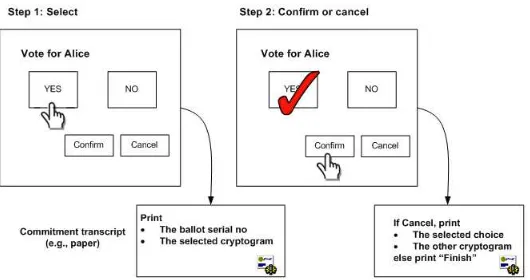
Fig. 4. A simple single-candidate voting interface. The receipt has two parts: the first includes the printout in Step 1 with a digital signature and the second includes the printout in Step 2 with a signature that covers the entire transcript.
that the public key in ElGamal encryption is statically fixed, while in our case, it is dynamically constructed fromgxivalues for each ballot.) Here, we usen=2. The original three-move interactive CDS protocol can be made non-interactive by applying the standard Fiat-Shamir heuristics [Fiat and Shamir 1987]. The same CDS technique has been widely used in previous e-voting protocols to ensure the published ciphertext is well-formed.
As shown in Table I, the cryptogram of the no-vote containsgxiyi and a 1-out-of-2 ZKP; similarly, the cryptogram of the yes-vote comprisesgxiyi·gand a corresponding 1-out-of-2 ZKP.
Similar to the private signing key, allxi secrets are generated on-board in the module and are stored within the module’s secure memory. The corresponding public keys (gxi) are published on the bulletin board before the election; they serve as commitment so the values cannot be changed later. To ensure authenticity, all commitment data published on the bulletin board should be digitally signed. Let us assumen=105and a group setting of 2048-bitpand 256-bitq. The total size ofxi secrets is 3.2 MB. Hence, it is possible to store thexisecrets entirely in the module’s memory. (As an example, a high capacity smart card can have 16 MB non-volatile memory.)
In order to optimize the performance in voting, one may choose to pre-compute all the cryp-tograms (last two columns in Table I) before the election. In that case, the secrecy of pre-computed cryptograms needs to be protected at the same level as thexisecrets. If the size of the cryptograms is more than what the module’s memory can accommodate, one solution, as commonly adopted in industry, is to generate a master key on-board in the module and use the master key to encrypt blobs of data in an authentic manner, so that the encrypted blobs can be stored outside the module and be reloaded back to memory when needed [Anderson 2008]. This is a typical trade-off between memory and speed. Reloading the blob to memory will involve some decryption work, but since it is only a symmetric-key operation, it can be very fast.
2.4.2. Voting phase.As stated before, we assume the eligible voter has been properly authenti-cated. She first obtains a random authentication token, enters a private voting booth, uses the token to authenticate herself to the machine and starts voting. The voter is prompted to select a choice on a touch screen DRE (see Figure 4). To cast her ballot, the voter follows two basic steps below.
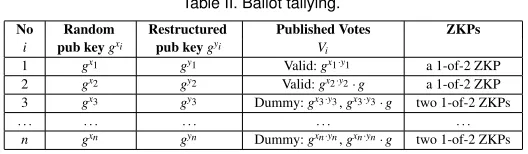
[image:9.612.171.436.124.264.2]Table II. Ballot tallying.
No Random Restructured Published Votes ZKPs
i pub keygxi pub keygyi Vi
1 gx1 gy1 Valid:gx1·y1 a 1-of-2 ZKP
2 gx2 gy2 Valid:gx2·y2·g a 1-of-2 ZKP
3 gx3 gy3 Dummy:gx3·y3,gx3·y3·g two 1-of-2 ZKPs
. . . . . . . . . . . . . . .
n gxn gyn Dummy:gxn·yn,gxn·yn·g two 1-of-2 ZKPs
Note:This entire table is published on the public bulletin board. A vote can be either valid or dummy. Ballot No. 1 shows an example of a valid “No” vote, and No. 2 shows an example of a valid “Yes” vote. Tallying involves multiplying all theVivalues (only including the “No” votes for the dummy case).
In step two, the voter has the option of either confirming or cancelling the previous selection. If she chooses to confirm, the system will print a “finish” message on the paper, and a valid encrypted vote has been cast. On the other hand, if she chooses to cancel, the DRE machine will reveal the selected choice in plain text ("Yes" or "No"), and also print the other cryptogram on the paper. In this case, a dummy vote has been cast. The touch screen will return to the previous step and provide another unused ballot. Voters are entitled to cast as many dummy votes as they wish1, but
are allowed to cast only a single valid vote.
The confirm/cancel option in step two serves to provide ballot casting assurance, namely: the voter needs to gain confidence that her actual vote has been recorded as she intended. For example, a corrupted machine might cheat by swapping the “No”/”Yes” cryptograms. The solution here is to have the machine initially commit to a value, and then give the voter an option to challenge the machine to reveal the commitment so that if the machine has cheated, it will be caught once the voter chooses to audit. Successful cheating on any large scale without being detected is extremely unlikely. Our auditing procedure is consistent, in spirit, with Benaloh’s idea of voter-initiated chal-lenges [Benaloh 2007], but it has been more tightly integrated into the overall cryptographic system starting with the initial setup.
The commitment transcript, signed by the machine, for the entire voting session can be printed on a single piece of paper, which forms the voter’s receipt. The data on the receipt is also available on the public bulletin board. The voter is free to take home the receipt and compare it against the bulletin board, so gaining a degree of trust in the bulletin board’s contents. (This is just as in other verifiable e-voting protocols [Kiayias et al. 2006; Clarkson et al. 2008; Adida 2008; Adida et al. 2009; Chaum et al. 2008b; Chaum et al. 2008a; Adida and Neff 2006; Chaum 2004]). When all the voters have cast their votes, or the election time limit is up, the system will publish both the yes-vote and no-vote cryptograms for the remaining unused ballots and mark them as “dummy” votes.
2.4.3. Tallying phase.Tallying the ballots involves multiplying together all the published cryp-togramsVi(for dummy votes, using only theno-vote; see Table II). Thus, we have:
∏
i Vi =
∏
i g
xiyigvi =
∏
i g
vi =g∑ivi
The key to the tallying process is the fact that∑xiyi=0 (a cancellation formula first introduced in 2006 in the design of an anonymous veto protocol [Hao and Zieli´nski 2006]; we refer the reader to that paper for the proof). Thus, all random factors cancel each other out. Here, we combine this cancelation technique with the conventional homomorphic encryption to build a self-enforcing e-voting protocol. Compared with the existing mix-net or homomorphic aggregation based tallying methods, the new method has the distinctive feature of not requiring any secret keys (hence no TAs). The term∑iviis the total number of the “yes” votes. Note that we do not need to compute the exponent ofg∑ivi (although this is doable by exhaustive search). Because the DRE system records the ballots directly, it announces the count of “yes” votes,β, right after the election, as is current
practice in DRE-based elections. Anyone can verify whethergβandg∑ivi are equal. This takes only one exponentiation. Also, anyone can count the number of dummy votes from the bulletin board, which we denote asλ. Thus, the tally of “no” votes isα=n−β−λ.
There are several ways to extend a single-candidate election to multiple candidates. One straight-forward method is to have a Yes/No selection for each of the candidates [Hao et al. 2010]. Another method involves defining more efficient encoding values for candidates [Cramer et al. 1996]. These are standard techniques to extend a single-candidate election to a multiple-candidate election, while the underlying voting protocol remains unchanged.
3. SYSTEM ANALYSIS
In this Section, we analyze the DRE-i protocol with regard to security, efficiency, usability and dependability.
3.1. Security analysis
First of all, we show the encryption of the “No” vote is semantically secure: in other words, the value gxiyi for the ith ballot is indistinguishable from random. As explained earlier, the system selects random valuesxi∈R[1,q−1]fori=1, . . . ,n. The valueyiis defined from:gyi=∏j<igxj/∏j>igxj, henceyi=∑j<ixj−∑j>ixj. Given thatxiis random,yi=0 holds with an overwhelming probability (i.e., 1−1/q). Furthermore,yiis random over[1,q−1]and it is independent ofxi, the valuegxiyiwill be uniformly distributed over non-identity elements inG[Stinson 2006]. Therefore, the termgxiyi is indistinguishable from random based on the DDH assumption as long as thexi values are kept secret. All thegxiyi values (i∈[1,n]) are related by the constraint that∏igxiyi=1. In the following, we will prove that such a structural relationship does not reveal any information other than the tally. ASSUMPTION1 (DDH VARIANT). For a generator g and a,b∈R[1,q−1], given a tuple (g,ga,gb,C)in which C is either gabor gab+1, it is hard to decide whether C=gabor C=gab+1.
LEMMA 3.1. Assumption 1 is implied by the DDH assumption (i.e., the problem is at least as
hard as the DDH problem).
PROOF. Consider the following tuples:
(g,ga,gb,gab), (g,ga,gb,R), (g,ga,gb,Rg), and (g,ga,gb,gabg),
for randoma,b,R, andR. DDH guarantees that the first and second tuples are indistinguishable.
The second and third tuples have the exact same distribution and hence are indistinguishable. DDH also guarantees that the third and fourth tuples are indistinguishable. Hence, the first and fourth tuples, i.e.(g,ga,gb,gab)and(g,ga,gb,gab+1)are indistinguishable.
Definition3.2 (Bare Bulletin Board). A bare bulletin board is a bulletin board without the ZKPs and digital signatures.
In the following analysis, we will first consider a bare bulletin board for simplicity, assuming the underlying ZKPs and digital signature schemes are secure primitives. The ZKPs serve to prove that the ciphertexts published on the bulletin board are well-formed, and they do not reveal any information about the plaintext votes. The digital signatures serve to prove that all data published on the bulletin board are authentic; they are not related to the secrecy of votes.
LEMMA 3.3. Consider two DRE-i elections in which all the votes are exactly the same except
for two votes viand vjwhich are swapped between the two elections. Under Assumption 1, the bare bulletin boards of these two elections are indistinguishable to an adversary that has the capability to determine an arbitrary number of votes other than viand vj.
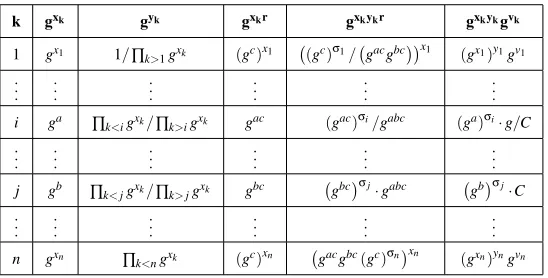
Table III. The simulated bare bulletin boards in the proof of Lemma 3.3.
k gxk gyk gxkyk·gvk k gxk gyk gxkyk·gvk 1 gx1 1/∏k>1gxk gx1y1·gv1 1 gx1 1/∏k>1gxk gx1y1·gv1
..
. ... ... ... ... ... ... ...
i ga ∏
k<igxk/∏k>igxk (ga)σi·g/C i ga ∏k<igxk/∏k>igxk (ga)σi·g/C
..
. ... ... ... ⇔ ... ... ... ...
j gb ∏
k<jgxk/∏k>jgxk (gb)σj·C j gb ∏k<jgxk/∏k>jgxk (gb)σj·C
..
. ... ... ... ... ... ... ...
n gxn ∏
k<ngxk gxnyn·gvn n gxn ∏k<ngxk gxnyn·gvn
Note:The two tables are identical except thatC=gabin one table andC=gab+1 in the other. They are indistinguishable as long as the twoCvalues are indistinguishable.
andvj. Let us assume w.l.o.g. thati<j. Ifvi=vj, the lemma holds trivially. In the following we give a proof forvi=vj.
Let us assume there is an adversary
A
that first chooses an arbitrary number of the votes other thanvi andvj, and eventually distinguishes the two elections. Given a tuple(g,ga,gb,C), where a,b∈R[1,q−1]andCequals eithergaborgab+1, we now construct an algorithmS
that usesA
to break Assumption 1. The algorithmS
sets up the bulletin board with the generatorgas below. Let I={1, . . . ,n} \ {i,j}.First,
S
choosesn−2 random valuesxkfor allk∈I.S
setsgxi←ga,gxj←gb, and calculatesgxk for allk∈I. Note that we implicitly havexi=aandxj=b. Lets1=∑k<ixk,s2=∑i<k<jxk, and s3=∑k>jxk.S
also calculatess1,s2, ands3and then computesσi=s1−s2−s3andσj=s1+s2−s3.Figure 5 illustrates the relations betweenxkvalues anda,b,s1,s2, ands3.
x1, x2, . . . , xi−1, xi , xi+1, . . . , xj−1, xj , xj+1, . . . , xn−1, xn
k<i xi=s1
i<k<j xi=s2
k>j xi=s3
a b
Fig. 5. xivalues used in the simulation
Now given allgxk, allgykcan be computed accordingly. Note that we implicitly have: yi=
∑
k<i xk−
∑
k>i
xk=s1−(s2+b+s3) =σi−b
yj=
∑
k<jxk−
∑
k>jxk= (s1+a+s2)−s3=σj+a
A
chooses a set of votes{vk}k∈IA for the set of indexesIA⊆I. Let us consider some arbitraryset of votes{vk}k∈I\IA.
S
can calculategxkyk for allk∈I, since it knowsxkandgyk. Hence, it cancalculategxkykgvk for allk∈I. Fork=i,j,
S
setsgxiyigvi ←(ga)σi·g/C and gxjyjgvj ←gbσj·C.
[image:12.612.160.445.454.504.2]In the case thatC=gab, we have:
gxiyigvi←(ga)σi·g/C= (ga)σi·g/gab=ga(σi−b)g=gxiyig and
gxjyjgvj ←gbσj·C=gbσj·gab=gb(σj+a)=gxjyj ,
which means that in our bare bulletin boardvi=1 andvj=0. In the case thatC=gab+1, we have:
gxiyigvi←(ga)σi·g/C= (ga)σi·g/gab+1=ga(σi−b)=gxiyi and
gxjyjgvj←gbσj·C=gbσj·gab+1=gb(σj+a)g=gxjyjg,
which means that in our bare bulletin boardvi=0 andvj=1.
S
then givesA
the constructed bare bulletin board as input. IfA
is able to distinguish which of the above two cases the given bare bulletin board corresponds to,S
will be able to successfully distinguish the two cases forCand hence break Assumption 1.THEOREM3.4 (MAINTHEOREM). We term the votes that are determined by the adversary
“the adversarial votes” and the rest “the non-adversarial votes”. Under the DDH assumption and that the ZKP primitive used in the protocol is secure, the DRE-i bulletin board does not reveal anything about the secrecy of the votes other than the tally of non-adversarial votes to an adversary that is able to determine an arbitrary number of votes.
PROOF. We first restrict our attention to the bare bulletin board and consider the additional ZKP and digital signatures later. To prove that the bare bulletin board does not reveal anything other than the tally of non-adversarial votes, we prove that given only a tally of non-adversarial votestHand a
set of adversarial votes{vk}k∈IA, a bare bulletin board can be simulated which is indistinguishable
from any other bare bulletin board with the same non-adversarial vote tally and given adversarial votes. We do this in two steps: first, we show how to simulate a random bare bulletin board with the sametHand given adversarial votes; and second, we show that such a random bare bulletin board
is indeed indistinguishable from any other bare bulletin board with the same non-adversarial vote tally and given adversarial votes.
Step 1.Given the adversarial votes{vk}k∈IA, we randomly choose the rest of the votes{vk}k∈/IA such that their tally istH. Choosing random values forxkfor allk, we can simulate a bare bulletin board with{vk}k∈IA as the adversarial votes and{vk}k∈/IA as the non-adversarial votes.
Step 2.Consider any two possible bare bulletin boardsBBandBBwith the same non-adversarial
vote tally and given adversarial votes as above. First note thatBBandBBhave the same adversarial
votes, they have the same adversarial vote tallytA, and since they have the same non-adversarial vote tallytHas well, they have the same total tallyt=tH+tA. We know that any two bulletin boards with the same total tally (and henceBBandBB) differ on anevennumber of votes. Let this vote
difference betweenBBandBB be 2d. This means that withd swaps, one can get from one bare
bulletin board to the other. Lemma 3.3 guarantees that in all thesed steps, under Assumption 1, the two bare bulletin boards involved are indistinguishable to an adversary choosing{vk}k∈IA. Note
that the adversarial votes remain fixed between the swaps. Furthermore, Assumption 1 is implied by DDH according to Lemma 3.1. Hence, a standard hybrid argument implies that the original bare bulletin boards (BBandBB) are indistinguishable under the DDH assumption.
to prove that all data published on the bulletin board are authentic; they are not related to the secrecy of votes. Hence, we conclude that the theorem holds for the full bulletin board.
The Theorem 3.4 guarantees the highest possible privacy level for DRE-i. To see this, note that the election tally is public in any election, and hence an adversary controlling a number of adver-sarial votes inevitably finds out the non-adveradver-sarial vote tally. The above theorem ensures that this inevitable knowledge is the only knowledge the adversary gains and in this sense proves the highest privacy level for DRE-i.
A corollary of the above theorem can be stated as below for a passive adversary that does not determine any votes, but only observes the bulletin board.
COROLLARY3.5 (PRIVACY AGAINSTPASSIVEADVERSARIES). Under the DDH assumption
and that the ZKP primitive used in the protocol is secure, the DRE-i bulletin board does not reveal anything about the secrecy of the votes other than the tally of the votes to a passive adversary.
Although we have proven that encrypted votes in DRE-i are protected at the highest possible level, it is important to note that breaking encryption is not the only way to compromise ballot secrecy. There are other potentially more effective attacks, and security is determined by the weakest link in the chain. For example, an untrustworthy voting interface is one weak link in the chain; a corrupted interface can trivially disclose the voter’s secret choice [Karlof et al. 2005; Estehghari and Desmedt 2010]. The setup phase is another potentially weak link. Existing E2E verifiable voting Protocols [Kiayias et al. 2006; Clarkson et al. 2008; Adida 2008; Adida et al. 2009; Chaum et al. 2008b; Chaum et al. 2008a; Adida and Neff 2006; Chaum 2004] generally require a secure setup phase, in which TAs securely generate and distribute key shares. If the setup phase is compromised by attackers, then thesecrecyof the vote will be breached. These issues also apply to DRE-i. On the other hand, in DRE-i even if the setup phase is completely corrupted, the tallyingintegritywill remain unaffected. This property is claimed for existing E2E verifiable protocols [Chaum et al. 2008a; Adida et al. 2009]. We now explain how this also holds for DRE-i.
We will show DRE-i satisfies all the four integrity requirements as defined in Section 2.2, even if the setup phase is compromised. The use of the CDS technique (i.e., the 1-out-of-nZero Knowledge Proof) ensures the correct format of the ballot [Cramer et al. 1994], and fulfills the first requirement. The second requirement is satisfied by the voter-initiated auditing (i.e., voter challenge), which is adopted in most verifiable e-voting protocols. The third requirement, that on transmission integrity, is satisfied by the voter being able to check the receipt against the public bulletin board. The fourth requirement, that on tallying integrity, is fulfilled by using homomorphic aggregation combined with the random-factor cancelation, so that anyone is able to verify the tally based on the audit data published on the public bulletin board without relying on any TA. In summary, if an insider attacker attempts to compromise the integrity of the election at any stage, this will most likely be caught by the public because the protocol is E2E verifiable [Adida et al. 2009; Chaum et al. 2008a].
Finally, it is important to ensure that a receipt does not reveal the voter’s choice to a coercer. This is a property formally defined as “receipt-freeness” [Delaune et al. 2006]. Previous E2E verifiable voting protocols [Kiayias et al. 2006; Adida 2008; Adida et al. 2009; Chaum et al. 2008b; Chaum et al. 2008a; Adida and Neff 2006; Chaum 2004] generally satisfy this requirement. We explain our protocol conforms to it too. As explained earlier, if the voter chooses to confirm her vote, the receipt does not leak any information about the choice made. If, on the other hand, the voter opts to cancel her vote, the receipt will reveal the selected choice, but the vote will be declared to be a dummy. A dummy vote is of course useless to a would-be coercer.
3.2. Performance evaluation
same strategy also permits pre-computation of all cryptograms, hence optimizing the performance during voting.
We evaluate the system performance by starting from ballot generation. As shown in Table I, we need to computegyi for each ballot. At first glance, this is very expensive, taking approximatelyn multiplications to computegy1 (recall thatnis the total number of ballots, which may be hundreds
of thousands). However, note thatgy2=gy1·gx2·gx1. More generally,gyi=gyi−1·gxi·gxi−1fori>1.
Thus, computinggyi, fori=2,3, . . . ,n, incurs negligible cost.
For each balloti, exponentiation is the predominant cost factor. It takes one exponentiation to computegxi, one to computegxiyi and four2to compute the 1-out-2 ZKP [Cramer et al. 1996] for each no/yes vote, totalling ten exponentiations.
In the ballot casting stage, the computational cost incurred by the DRE machine is small. If we opt for the option of pre-computing all cryptograms before the election, the delay imposed of voting would be almost negligible, since the machine merely needs to print out the pre-computed cryptogram according to the voter’s choice and sign it with the digital signature key. Obviously, pre-computing the cryptograms would mean we need to do more preparation work for an election, but that seems a worthwhile trade-off.
The data published on the bulletin board is universally verifiable. Anyone is able to check that the published random public keysgxilie within the prime-order group, and that the values ofgyi are correctly computed. To verify the ZKP for the published voteVi, it is necessary to first validate the order ofVi. This requires an exponentiation (for both the valid and dummy cases); it takes a further four exponentiations to verify the 1-out-of-2 ZKP [Cramer et al. 1994; Cramer et al. 1996]. In total, it takes roughly 5 exponentiations to verify a ZKP. In principle, it suffices for at least one person to verify all the ZKPs in a batch (those who lost the election would be motivated to verify the tally).
3.3. Usability
As explained earlier in Section 2.1, there are three types of users in an e-voting system: ordinary voters, auditors and universal verifiers. In the DRE-i protocol, the auditing is voter-initiated, so an ordinary voter is also an auditor. Of course this does not preclude employing dedicated auditors in an election to perform auditing by casting dummy votes. A universal verifier is anyone in the world who has the technical expertise to verify all data on the public bulletin board in a batch operation.
For an e-voting system to be practically useful, it needs to be “usable”. However the notion of “usability” can be abstract and elusive. Here, we define a “usable” cryptographic e-voting system as one that can be used independently by ordinary voters and auditors without requiring any cryp-tographic knowledge or relying on any trusted software. This is because in practice most people have no knowledge of cryptography and cannot distinguish trustworthy software from untrustwor-thy software.
The DRE-i protocol assumes a minimum technical background about the voter who may wish to audit the system. The auditing process has been seamlessly integrated into the natural confirm/cancel selection. Every voter can easily audit the ballot by simply choosing the “cancel” button. If a ballot is canceled, the voter just needs to verify that the printed candidate choice (in plain text) on the receipt is the same as that she chose previously. If not, she should lodge a protest immediately. This can be done without requiring any cryptographic knowledge. Of course, the voter needs to know how to open a web browser and check the bulletin board. This basic computer skill is also assumed in other verifiable e-voting protocols [Kiayias et al. 2006; Clarkson et al. 2008; Adida 2008; Adida et al. 2009; Chaum et al. 2008b; Chaum et al. 2008a; Adida and Neff 2006; Chaum 2004].
One may be concerned about the authenticity of the receipt and how to verify this. The data on the receipt should be authentic; otherwise, a dishonest voter may modify the receipt to support a protest that the data fail to match that on the bulletin board. Obviously, if we wish to assume the official receipt paper is physically unforgeable and any tampering with the printed data on the receipt will be visibly evident, then such an attack will not work. However, the assumption of the physical
unforgeability is difficult to realize. In most cases, a digital signature would be needed, as in other e-voting protocols. With DRE-i, the voter does not have to verify the signature cryptographically; all she needs to do is to ensure the data on the receipt matches that on the bulletin board. A universal verifier will be able to verify all data on the bulletin board in a batch. We assume there is a facility provided at the polling station, say before the exit of the station, to allow voters to check the bulletin board. If the data is found not to match, the voter should raise the matter immediately.
3.4. Dependability and fault tolerance
In DRE-i, the integrity of the election tally depends on the accuracy and completeness of the au-dit data. The DRE machine directly records votes just as the existing practice in real-world DRE deployment. At the end of the election, the machine reports the tally that it counts internally. But unlike the ordinary DRE machines, in DRE-i, the machine must publish additional audit data to al-low public verification of the tally. If the audit data is corrupted (say some ballots are lost), then the integrity of the tally will be lost and the universal verification will fail. In that case, the system es-sentially degenerates to the existing unverifiable DRE-based e-voting. Here, we have considered the assurance of tallying integrity in the most stringent case, ensuring that every vote must be counted. In a practical election, it is desirable to handle system faults gracefully. When the audit data have been found to be partially corrupted, instead of merely degenerating to unverifiable e-voting, we can extend the DRE-i protocol to provide a fail-safe feature.
Fail-safe DRE-i. Consider a case where a small subsetLof ballots are found missing from (or to
be corrupted on) the public bulletin board. (The number of the missing ballots should be insufficient to change the election outcome; otherwise, the act of error recovery may not be meaningful.) We assume the DRE machine still maintains the xi secrets in the protected memory of the tamper-resistant module. To allow the tallying verification to proceed, one trivial solution is to re-publish the cryptograms of the subsetLof ballots as if they were “dummy” votes. The no-votes (gxiyi for i∈L) are then included into the tallying process, hence allowing the tally of the remaining ballots to be verified. However, if a voter holds a receipt of a missing ballot, the secrecy of that ballot will be lost. Hence, instead of publishing individual cryptograms, it is more secure to publish just one aggregate value: namely,A=∑i∈Lgxiyitogether with some cryptographic proofs to show thatAis in the correct format (details can be found in Appendix A). Thus, the information leakage is minimal. An attacker in possession of some (notall) receipts cannot learn anything about the missing ballots. In the worst case when the attacker is able to collectallreceipts of the missing ballots, the only thing he can learn is the tally of the missing ballots, not any individual vote.
Distributed DRE-i. The fail-safe mechanism works on the condition that thexisecrets are
avail-able. If the DRE machine is physically damaged or lost, such an error recovery procedure may no longer be possible. In order to ensure system robustness, it is desirable to implement DRE-i in a distributed way, as we explain below.
DRE client Sever cluster (k/n threshold)
Secure channel with mutual authentication
Fig. 6. A distributed implementation of the DRE-i system
• Kiayias-Yung (2002): Internet • Groth (2004): Internet
• Hao-Ryan-Zielinski (2010): Internet
• Chaum (2004): touch-screen • MarkPledge (2006): touch-screen • Adder (2006): Internet
• Civitas (2008): Internet • Scantegrity (2008): Scanner • ScantegrityII (2008): Scanner • Helios 1.0 (2008): Internet • Helios 2.0 (2009): Internet • Prêt à Voter (2009): Scanner • DRE-i: touch-screen
or Internet E-voting protocols
Centralized e-voting
Decentralized e-voting
TA-based
Self-enforcing
Fig. 7. Categorization of e-voting protocols
A further practical strategy in distributing the implementation of DRE-i is to divide the national-scale tallying into a set of smaller-national-scale tallying processes, each implementing an independent DRE-i system. This is consistent with many real-world elections where tallies are calculated at relatively small (say county or precinct) scales and then added up.
4. RELATED WORK AND COMPARISON
In this section, we compare DRE-i with previous DRE-based voting protocols in a local supervised voting environment.
4.1. Categorization of e-voting
First of all, we take a broad view at the existing e-voting protocols. There are generally two cate-gories of cryptographic voting protocols: decentralized and centralized (see Figure 7). The former includes boardroom voting protocols due to Kiayias-Yung [Kiayias and Yung 2002], Groth [Groth 2004] and Hao-Ryan-Zieli´nski [Hao et al. 2010]. The latter includes a wide range of E2E verifiable protocols: e.g., Adder [Kiayias et al. 2006], Civitas [Clarkson et al. 2008], Helios [Adida 2008; Adida et al. 2009], Scantegrity [Chaum et al. 2008b], Scantegrity II [Chaum et al. 2008a], Prêt à Voter [Ryan et al. 2009], MarkPledge [Adida and Neff 2006] and Chaum’s visual cryptographic scheme [Chaum 2004]. Existing E2E verifiable voting protocols are often designed to use differ-ent voting interfaces: e.g., a web browser [Kiayias et al. 2006; Adida 2008; Adida et al. 2009], an optical scanner [Chaum et al. 2008b; Chaum et al. 2008a; Ryan et al. 2009], and a touch-screen DRE [Adida and Neff 2006; Chaum 2004]. They are also designed to suit two different scenarios: local voting [Chaum et al. 2008b; Chaum et al. 2008a; Ryan et al. 2009; Adida and Neff 2006; Chaum 2004] and remote voting [Kiayias et al. 2006; Clarkson et al. 2008; Adida 2008; Adida et al. 2009]. All these E2E verifiable protocols require external tallying authorities to decrypt and tally the submitted votes. Hence, they belong to the category of “TA-based e-voting” (see Figure 7).
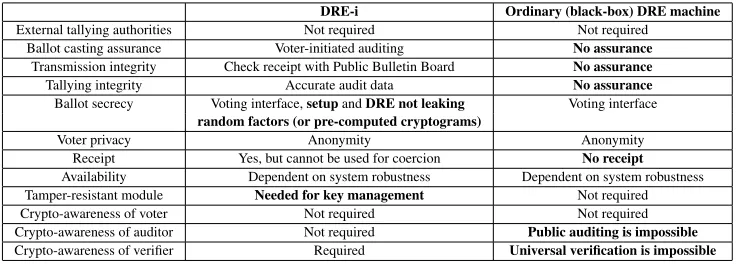
[image:17.612.186.419.128.240.2] [image:17.612.119.486.276.365.2]Table IV. Comparison between DRE-i and ordinary (black-box) e-voting in local DRE-based voting.
DRE-i Ordinary (black-box) DRE machine External tallying authorities Not required Not required
Ballot casting assurance Voter-initiated auditing No assurance Transmission integrity Check receipt with Public Bulletin Board No assurance Tallying integrity Accurate audit data No assurance Ballot secrecy Voting interface,setupandDRE not leaking Voting interface
random factors (or pre-computed cryptograms)
Voter privacy Anonymity Anonymity Receipt Yes, but cannot be used for coercion No receipt Availability Dependent on system robustness Dependent on system robustness Tamper-resistant module Needed for key management Not required Crypto-awareness of voter Not required Not required Crypto-awareness of auditor Not required Public auditing is impossible Crypto-awareness of verifier Required Universal verification is impossible
Notes: Major differences are highlighted in bold face.
4.2. Comparison with unverifiable DRE
We first compare DRE-i with the unverifiable (or black-box) DRE machines that have been widely deployed around the world. The results of the comparison are summarized in Table IV. We explain the main differences below.
Integrity. The primary advantage of DRE-i lies in the additional “-i” in the name: i.e., its integrity.
In DRE-i, a voter can verify that her ballot is recorded to the correct candidate through voter-initiated auditing (i.e., ballot casting integrity). She can further verify that the recorded ballot is correctly transmitted to the tallying unit by checking the receipt against the public bulletin board (i.e.,transmission integrity). Finally, every voter is able to verify the integrity of the tally based on the public audit data published on the bulletin board (i.e.,ballot tallying integrity). These essential verification procedures are missing in the currently deployed DRE machines.
Ballot secrecy and voter privacy. In both systems, the touch-screen interface can violate the
secrecy of the vote. However, it does not know the voter’s real identity. Hence, the voter’s privacy is protected through anonymity. In DRE-i, the system requires an additional setup phase, which pre-fixes random factors used for encryption. The secrecy of the random factors needs to be securely protected, as well as the pre-computed cryptograms (if the pre-computation option is enabled).
Receipt. In DRE-i, the machine prints out a receipt, which the voter can verify against a public
bulletin board. The receipt does not reveal how a voter had voted, but allows the voter to check if her vote has indeed been included into the tallying process. By contrast, the ordinary DRE machine does not provide any receipt. If the ballot is missing or miscounted, the voter would not be able to know.
Tamper-resistant module. In DRE-i, a tamper-resistant module (e.g., smart card or TPM chip)
is needed to securely manage sensitive key material, including the private signing key, thexi se-crets and pre-computed cryptograms (if any). This follows the standard industry practice for key management [Anderson 2008]. However, an ordinary DRE machine normally does not require a tamper-resistant module, as no cryptography is used.
Usability. As compared to the ordinary DRE, the usability in DRE-i degrades slightly due to
the additional opportunity provided to the voter to check the receipt against the bulletin board. On the other hand, the receipts allow public verification of the tallying integrity, which is not possible with ordinary DRE machines. Hence, the trade-off seems worthwhile for the improved assurance on integrity.
4.3. Comparison with previous DRE-based E2E verifiable schemes
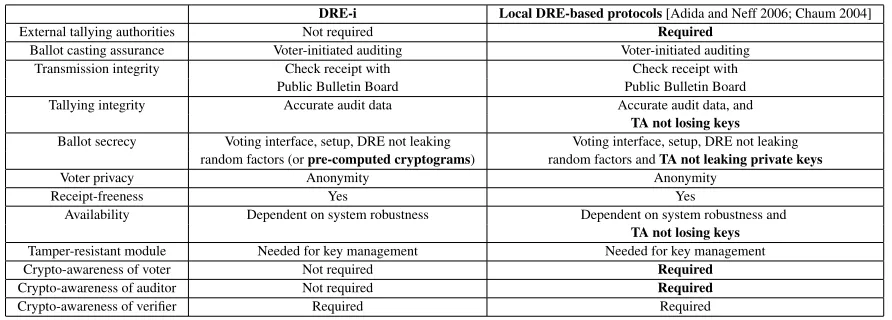
Table V. Comparison between DRE-i and related E2E verifiable voting protocols for local DRE-based voting
DRE-i Local DRE-based protocols[Adida and Neff 2006; Chaum 2004] External tallying authorities Not required Required
Ballot casting assurance Voter-initiated auditing Voter-initiated auditing Transmission integrity Check receipt with Check receipt with
Public Bulletin Board Public Bulletin Board Tallying integrity Accurate audit data Accurate audit data, and
TA not losing keys Ballot secrecy Voting interface, setup, DRE not leaking Voting interface, setup, DRE not leaking
random factors (orpre-computed cryptograms) random factors andTA not leaking private keys
Voter privacy Anonymity Anonymity
Receipt-freeness Yes Yes
Availability Dependent on system robustness Dependent on system robustness and TA not losing keys Tamper-resistant module Needed for key management Needed for key management Crypto-awareness of voter Not required Required Crypto-awareness of auditor Not required Required Crypto-awareness of verifier Required Required
Note:Major differences are highlighted in bold face.
Integrity. DRE-i provides the same E2E verifiability as MarkPledge [Adida and Neff 2006] and
Chaum’s scheme [Chaum 2004], but without involving any external tallying authorities. To guaran-tee the tallying integrity, all three protocols require the audit data as published on the bulletin board be accurate and complete. In MarkPledge [Adida and Neff 2006] and Chaum’s scheme [Chaum 2004], when the election is finished, the audit data published on the bulletin board must be first decrypted by external tallying authorities before any verification is possible. This requires that the tallying authorities’ private keys be available at the decryption and tallying phase; otherwise, the tally cannot be verified.
Ballot secrecy and voter privacy. In all three protocols, if the voting interface is corrupted, the
secrecy of the ballot is lost. In addition, if the setup process (be it the pre-computation procedure in DRE-i or the secret sharing setup in TA-based e-voting) is compromised, the secrecy of the ballot is lost too. In DRE-i, all random factors are pre-determined before the election with commitment pub-lished on the bulletin board. The secrecy of the pre-determined random factors needs to be securely protected, which can be realized by storing them in the secure memory of a tamper-resistant mod-ule [Anderson 2008]. In MarkPledge [Adida and Neff 2006] and Chaum’s scheme [Chaum 2004], the random factors are generated by the DRE machine on the fly during the encryption of ballots. Similarly, the secrecy of those random factors needs to be protected. It is critically important that the random factors are generated honestly from a secure random number generator. If the random number generator is corrupted, all random factors are effectively leaked. Consequently, the secrecy of all encrypted votes is trivially lost (which is orthogonal to the security of the TAs’ private keys). In DRE-i, the choice of pre-computing random factors before the election is based on the assump-tion that the environment in the setup phase is more controllable than that in the field deployment on the election day, hence the random number generator is less likely to be corrupted. Finally, Mark-Pledge [Adida and Neff 2006] and Chaum’s scheme [Chaum 2004] assume the external TAs do not leak their private keys; otherwise, the secrecy of the votes is compromised.
Availability. All three protocols depend on the robustness of hardware and software to ensure