http://wrap.warwick.ac.uk
Original citation:DiazOrdaz, K., Slowther, A.-M., Potter, R. (Rachel) and Eldridge, S.. (2013) Consent processes in cluster-randomised trials in residential facilities for older adults : a
systematic review of reporting practices and proposed guidelines. BMJ Open, Volume 3
(Number 7). Article number e003057. ISSN 2044-6055
Permanent WRAP url:
http://wrap.warwick.ac.uk/59819
Copyright and reuse:
The Warwick Research Archive Portal (WRAP) makes this work of researchers of the University of Warwick available open access under the following conditions.
This article is made available under the Creative Commons Attribution-NonCommercial 3.0 (CC BY-NC 3.0) license and may be reused according to the conditions of the license. For more details see: http://creativecommons.org/licenses/by-nc/3.0/
A note on versions:
The version presented in WRAP is the published version, or, version of record, and may be cited as it appears here.
Consent processes in cluster-randomised
trials in residential facilities for older
adults: a systematic review of reporting
practices and proposed guidelines
Karla DiazOrdaz,1,2Anne-Marie Slowther,3Rachel Potter,3Sandra Eldridge2
To cite:DiazOrdaz K, Slowther A-M, Potter R,et al. Consent processes in cluster-randomised trials in residential facilities for older adults: a systematic review of reporting practices and proposed guidelines.BMJ Open2013;3:e003057. doi:10.1136/bmjopen-2013-003057
▸ Prepublication history and additional material for this paper is available online. To view these files please visit the journal online (http://dx.doi.org/10.1136/ bmjopen-2013-003057).
Received 15 April 2013 Accepted 30 May 2013
This final article is available for use under the terms of the Creative Commons Attribution Non-Commercial 3.0 Licence; see
http://bmjopen.bmj.com
1Department of Health Services Research and Policy, London School of Hygiene and Tropical Medicine, London, UK
2Centre for Primary Care and Public Health, Queen Mary University of London, London, UK
3Warwick Clinical Trials Unit, Warwick Medical School, The University of Warwick, Coventry, UK
Correspondence to
Dr Karla DiazOrdaz; [email protected]
ABSTRACT
Objective:To assess the quality of reported consent processes of cluster-randomised trials conducted in residential facilities for older people and to explore whether the focus on improving the general conduct and reporting of cluster-randomised trials influenced the quality of conduct and reporting of ethical processes in these trials.
Design:Systematic review of cluster-randomised trials reports, published up to the end of 2010.
Data sources:National Library of Medicine (Medline) via PubMed, hand-searches ofBMJ,Journal of the American Medical Association,BMC Health Services Research,Age and Ageing and Journal of the American Geriatrics Society, reference search in Web of
Knowledge and consultation with experts.
Eligibility for selecting studies:Published cluster-randomised trials where the unit of randomisation is a part or the whole of a residential facility for older people, without language or year of publication restrictions.
Results:We included 73 trials. Authors reported ethical approval in 59, obtaining individual consent in 51, and using proxies for this consent in 37, but the process to assess residents’capacity to consent was clearly reported in only eight. We rated only six trials high for the quality of consent processes. We considered that individual informed consent could have been waived legitimately in 14 of 22 trials not reporting obtaining consent. The proportions reporting ethical approval and quality of consent processes were higher in recent trials.
Conclusions:Recently published international recommendations regarding ethical conduct in cluster-randomised trials are much needed. In relation to consent processes when cognitively impaired individuals are included in these trials, we provide a six-point checklist and recommend the minimum information to be reported. Those who lack capacity in trials with complex designs should be afforded the same care in relation to consent as competent adults in trials with simpler designs.
INTRODUCTION
The increasing number of frail older people in our population is a major challenge for healthcare in the 21st century. Good care for
older people should be based on high-quality, ethically sound, relevant research involving this patient population.1 This must include studies in nursing and residential homes, where many of the growing numbers of frail older people live. Research in these settings poses ethical challenges, not least because many residents of nursing and residential homes are cognitively impaired,2 and therefore may have difficulty in
ARTICLE SUMMARY
Article focus
▪ The overall quality of consent processes in cluster-randomised trials (CRTs) conducted in residential facilities for older people.
▪ The standard of reporting of consent processes and research ethics approval in publications describing CRTs in this context.
▪ The potential association between the quality of this reporting and other quality markers such as accounting for clustering.
Key messages
▪ The majority of investigators of CRTs in nursing and residential homes understand when it is necessary to obtain individual consent for resi-dents’participation.
▪ The ethical principles underlying the need to assess capacity and the use of proxies appear to be poorly understood in these trials.
▪ The quality of reporting ethical approval and consent processes is also poor in these trials.
Strengths and limitations of this study
▪ The relatively small number of included trials precludes extensive formal statistical analyses of associations between the quality of consent pro-cesses and possible determinants.
▪ Published reports may not fully reflect the ethical procedures because of space limitations.
understanding information usually provided in consent processes or may lack capacity to consent to participate.
International ethical standards for research include the requirement for valid consent from participants who have capacity,3 the obligation to take all practical mea-sures to maximise understanding and facilitate capaci-tous consent, and the adherence to appropriate guidance when capacity is lacking. Since capacity is deci-sion specific, researchers must assess capacity for each potential participant during the recruitment process; reliance on the opinion of others, standardised tests or previous assessments of capacity for other decisions is not adequate.4–7If an individual lacks capacity, research-ers should follow the relevant regulatory framework depending on the nature of the study and the legal juris-diction in which it takes place. However, guidance on the conduct of research involving people who lack cap-acity is often not clearly understood, even by research ethics committees8or easily put into practice.9
When cluster-randomised trials are conducted in resi-dential homes, there are additional ethical challenges, as well as statistical challenges.10–12In these trials, clusters are randomised rather than individuals themselves. When the interventions being evaluated are aimed primarily at homes, for example, a change in the type of lightfittings,13 an individual’s refusal to participate is meaningless, though there may still be a need to obtain individual consent for assessment of outcome measures and for data collection.14An international research group recently pro-duced draft recommendations to clarify appropriate ethical conduct in cluster randomised trials, including recommendations about when investigators need to obtain individual consent to participate in these trials and when they do not. In line with international ethical guide-lines, the group recommend that consent be obtained from research participants unless a waiver of consent has been approved by the relevant research ethics commit-tee.15However, a recent review of 300 cluster randomised trials by this research group showed that investigators were less likely to report obtaining ethical approval and to report obtaining participant consent than in individually randomised trials.16 The International Committee of Medical Journal Editors requires authors to indicate whether the research reported complied with the stan-dards set by the relevant research ethics committee and were in accordance with the Helsinki Declaration.17 Where there is doubt about compliance with the Declaration, the requirements state that‘the authors must explain the rationale for their approach and demonstrate that the institutional review body explicitly approved the doubtful aspects of the study’. As cluster randomised trials raise concerns about appropriate consent processes, there is an obligation on researchers to report the approach taken and their reasons for it. Given the risk of lack of decision-making capacity in this research population, this obligation could be expected to include reporting pro-cesses for assessing capacity and compliance with the rele-vant regulation when participants lack capacity.
As a result of our own efforts to conduct consent pro-cesses in a large cluster-randomised trial in nursing and residential homes in the UK,18 we wanted to explore, as part of a systematic review of the quality of such trials ( paper submitted), how other researchers had approached this double challenge of ethical conduct in cluster-randomised trials in nursing and residential homes, and provide guidance for future investigators. In this paper, we make specific recommendations for improving the reporting and conduct of consent pro-cesses in these trials based on weaknesses we identify in reporting, conducting consent processes, and under-standing when consent from participants is and is not necessary. We also explore whether the focus on improv-ing the general conduct and reportimprov-ing of cluster-randomised trials and discussions of ethical issues in these trials in the early part of the 21st century was asso-ciated with a change in the quality of conduct and reporting of ethical processes in these trials. In addition, we assess whether the reporting of these processes was of higher quality if the trials appeared to be of higher quality in other respects.
METHODS
Inclusion and identification
We included cluster-randomised trials conducted in resi-dential facilities for older people. We used the Medical Subject Headings definition of residential care facilities: long-term care facilities which provide supervision and assistance in activities of daily living with medical and nursing services when required, and extended this defi n-ition to include other group-living arrangements where some care is provided, for example, retirement villages. Trials were included if the unit of randomisation was the facility or a part of it, for example, a ward, wing or floor, and the majority of the trial participants were 60 years old or over. We included all such trials published up to the end of 2010, without language restrictions. We searched PubMed in January 2011 for reports of relevant trials (full search strategy in table A in web appendix A). In addition, we hand-searched the electronic archives of
five journals (British Medical Journal, Journal of the American Medical Association,BMC Health Services Research, Age and Ageing and the Journal of the American Geriatrics Society) back to 2001, reviewed the references of each eli-gible report identified using Web of Knowledge, and contacted experts to identify any further trials. Secondary reports of the same trial were excluded.
Data extraction
One researcher extracted data from all reports; a second, independent extraction was carried out by other members of the research team. We used written guid-ance on extraction, agreed in advguid-ance, resolving discrep-ancies by discussion. We extracted data from all trial reports on whether approval by an ethics committee and individual consent/assent were reported. If consent/
assent was reported, we extracted all quotes relating to consent processes. We emailed twice a 10% sample of authors for further information. For trials in which indi-vidual consent/assent was not reported, we extracted data on type of intervention and method of data collec-tion in order to judge whether it would have been legit-imate not to obtain consent for individual participation.
Data on year of publication and markers of methodo-logical quality were extracted from the trial reports, as part of a review of the quality of these trials, based on the same sample ( paper submitted). Following a previ-ous review,16 we used accounting for clustering in the sample size calculations and analysis of the trials as two methodological quality markers, and publication in a journal putting a stronger emphasis on following the CONSORT statement as a marker of journal focus on the quality of reporting in general, although this state-ment does not explicitly recommend reporting ethical approval and consent (see web appendix A for details). The review protocol is available from authors.
Analysis
To assess reporting, we present proportions reporting ethical approval and seeking individual consent for par-ticipation and, for trials for which authors reported obtaining such consent, proportions assessing capacity, using proxies for consent (including type of proxy), excluding cognitively impaired individuals and obtaining consent only in the intervention arm.
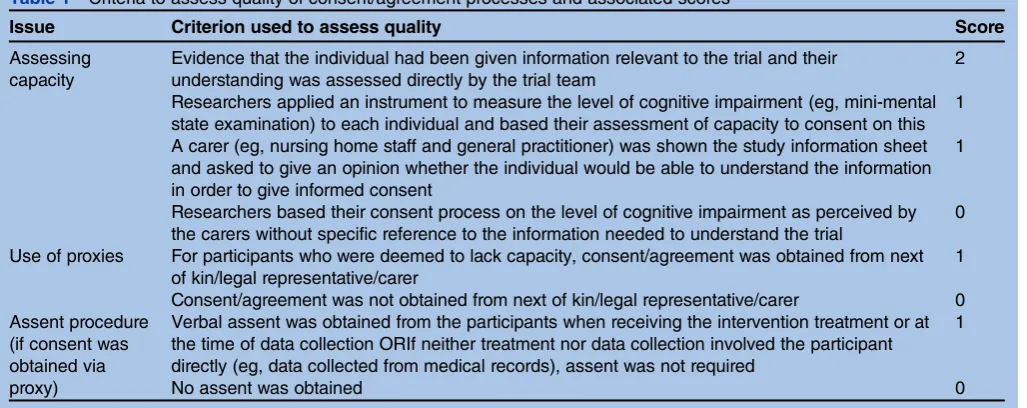
To assess the conduct of consent processes, two researchers independently scored the quality of the cap-acity assessment, use of proxies and processes for obtain-ing assent usobtain-ing the criteria shown in table 1, resolving discrepancies by discussion. The scores from each of these were summed to provide a total score for the quality of consent processes: high (score=3 or higher),
medium (score=2) or low (score=1). Some reports did not provide enough information to provide a score.
Two researchers independently judged whether such consent was necessary in trials for which the authors had not reported obtaining individual consent, using guidance produced by an international research group that has produced ethical guidelines for cluster-randomised trials. This group defined research participants as anyone in at least one of the following categories: (1) a recipient of an experimental (or control) intervention; (2) someone who is the direct target of an experimental (or control) manipulation of his/her environment; (3) someone from whom a researcher collects data about that individual (4) or someone about whom an investigator obtains identifi -able private information for the purpose of collecting data.15 We first judged home residents as research parti-cipants if they fell into either category (1) or (2). When they did not, we additionally examined data collection procedures, assessing residents as research participants if they fell into category (3) or (4). When we found it diffi -cult to judge whether collection from routine data involved identifiable private information, and the inter-vention procedures posed no more than minimal risk, we assumed that a waiver of consent would have been acceptable.
[image:4.595.44.558.541.745.2]To explore any association between the focus on improving reporting in general and discussion of ethical issues in cluster trials in the early part of the 21st century, and the conduct and reporting of ethical pro-cesses in such trials, we present proportions reporting ethical approval, individual consent and the quality of the consent processes for studies reported in or before or after the publication of the extended CONSORT statement for cluster-randomised trials in 2004. Various publications discussing the ethical conduct of trials were published just before or around the same time.11 12 14 19
Table 1 Criteria to assess quality of consent/agreement processes and associated scores
Issue Criterion used to assess quality Score
Assessing capacity
Evidence that the individual had been given information relevant to the trial and their understanding was assessed directly by the trial team
2
Researchers applied an instrument to measure the level of cognitive impairment (eg, mini-mental state examination) to each individual and based their assessment of capacity to consent on this
1
A carer (eg, nursing home staff and general practitioner) was shown the study information sheet and asked to give an opinion whether the individual would be able to understand the information in order to give informed consent
1
Researchers based their consent process on the level of cognitive impairment as perceived by the carers without specific reference to the information needed to understand the trial
0
Use of proxies For participants who were deemed to lack capacity, consent/agreement was obtained from next of kin/legal representative/carer
1
Consent/agreement was not obtained from next of kin/legal representative/carer 0 Assent procedure
(if consent was obtained via proxy)
Verbal assent was obtained from the participants when receiving the intervention treatment or at the time of data collection ORIf neither treatment nor data collection involved the participant directly (eg, data collected from medical records), assent was not required
1
We also examined trends over time in reporting ethical approval, reporting individual consent and quality of the consent processes, using logistic regression or ordinal logistic regression as appropriate, testing for assumptions of the models as appropriate and using a 5% signifi -cance level in all analyses. Analyses were undertaken in Stata, V.11.20
To see whether ethical reporting and conduct are better addressed by those whose trial reports were of higher quality in other respects or published in journals that put a greater emphasis on the quality of reporting, we fitted further logistic and ordinal regression models as appropriate, with accounting for clustering in sample size calculations, accounting for clustering in the analysis and the strength of the journal’s endorsement of the extended CONSORT statement (no endorsement and weak endorsement vs moderate and strong endorse-ment) as predictors.
RESULTS
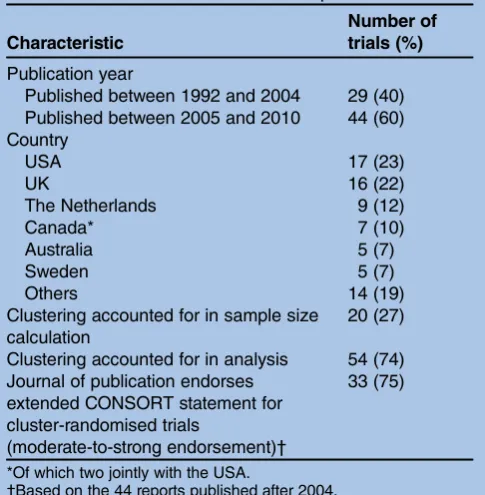
We identified 308 published reports via our electronic search, rejecting 248 on the basis of titles or abstracts. Additionally, 27 reports were found by hand-searching and reference-searching and three from consulting experts, making a total of 90 full-text papers to be exam-ined (figure 1 in web appendix B). From these, 73 primary reports met our eligibility criteria (see table C in web appendix C for a full-reference list). Basic charac-teristics are reported intable 2.
The strength of the CONSORT endorsement of the journals is reported in table B in web appendix A. Authors reported obtaining approval from a research ethics committee in 59 (81%) trials, obtaining individual
consent to participate in 51 (70%) trials and obtaining both in 45 (62%) trials.
Among the 51 trials in which authors reported obtain-ing individual consent, the process used to assess cap-acity was described in detail for only 8 trials: in 4 trials, researchers asked the general practitioner or main staff carer for an assessment of capacity, and in 4 other trials, they interviewed each eligible resident. Nevertheless, proxies, usually next of kin, were used for consent in 37 trials (table 3). Six of these trials, evaluating specific dementia interventions, described their processes in
suf-ficient detail for us to ascertain that they definitely did not assess capacity in any residents. In a further six trials, those deemed cognitively impaired were excluded from the trial, and in three other trials, consent was sought only in the experimental intervention arm. We rated only six publications as high for the quality of consent processes; none scored the maximum possible of six points. Twenty-two trial reports (43%) did not contain sufficient detail for us to score them. We did not receive any replies to our emails to a 10% sample of authors for further information about processes for assessing capacity and obtaining consent.
Of the 22 trials for which authors did not report obtaining individual resident consent, we judged that in 14 consent was either not required, or the description made it difficult to judge if consent was required, but if it had been, a waiver of consent could been appropriate (table 3). Examples of interventions used in these trials were staff training in fall prevention, or influenza vaccin-ation administered to residence staff. In 8 of these 14 trials, authors reported obtaining ethical approval. Of the 8 of the 22 trials that we judged needed consent from individual participants, 1 included an intervention aimed directly at residents, 1 included an intervention that was a manipulation of a resident’s environment; both papers reported obtaining ethical approval. Five trials collected data directly from participants, and one collected identifiable data from other sources; of these, four reported obtaining ethical approval.
As we judged that only eight of the trials in the review that did not report obtaining individual consent needed to do so, we did not perform any formal statistical ana-lyses related to the propensity to obtain consent. There was a 14% higher odds of reporting ethical approval per year (95% CI 1.01 to 1.29). Ethical approval was more likely to be reported for trials in which clustering was accounted for correctly in the sample size calculation (OR 6.17 (95% CI 0.76 to 50.73)) and in the analysis (OR 2.66 (95% CI 0.78 to 9.03)). Among reports pub-lished post-2004 (44 reports), the odds of reporting ethical approval was 8.85 (95% CI 1.34 to 58.34) times higher among those reports published in journals with moderate-to-strong extended CONSORT endorsement, when compared with those published in journals with low CONSORT endorsement.
[image:5.595.45.288.493.741.2]Among those trials for which authors reported obtain-ing individual consent, the quality of consent processes
Table 2 Characteristics of included reports
Characteristic
Number of trials (%)
Publication year
Published between 1992 and 2004 29 (40) Published between 2005 and 2010 44 (60) Country
USA 17 (23)
UK 16 (22)
The Netherlands 9 (12)
Canada* 7 (10)
Australia 5 (7)
Sweden 5 (7)
Others 14 (19)
Clustering accounted for in sample size calculation
20 (27)
Clustering accounted for in analysis 54 (74) Journal of publication endorses
extended CONSORT statement for cluster-randomised trials
(moderate-to-strong endorsement)†
33 (75)
*Of which two jointly with the USA.
†Based on the 44 reports published after 2004.
appeared to improve over time (ordinal logistic OR 1.12 (95% CI 0.98 to 1.28)). Relationships between other quality markers and the quality of consent processes were weaker and not statistically significant at the 5% level, with ordinal logistic ORs of 1.65 (95% CI 0.53 to 5.12) for the association with accounting for clustering in the sample size calculation, 2.49 (95% CI 0.77 to 8.04) for the association with accounting for clustering in the analysis and 0.84 (95% 0.16 to 4.39) for the asso-ciation with CONSORT endorsement.
DISCUSSION
The majority of authors of trials in our review appeared to correctly understand when consent for residents’ par-ticipation was needed. However, the quality of reporting the ethical approval and consent processes was generally poor. Furthermore, 16% of trials reported ethically ques-tionable practices: 8% seeking proxy consent without an assessment of residents’ capacity, and 8% excluding patients with cognitive impairment without this assess-ment. Authors of 22 trials did not provide enough infor-mation for us to comment on the ethical quality of their consent processes. Trials published later are more likely
to report obtaining ethical approval and have higher quality consent processes. The reporting of ethical approval but not the quality of the consent process appears higher in trials in which other methodological quality markers and journal endorsement of reporting quality were also high.
Strengths and weaknesses
Our rigorous review processes ensured that we included the majority of cluster randomised trials in residential and nursing homes. In spite of the limited potential for statistical analysis with only 73 trials in total and only 51 reporting obtaining consent, our data suggest some trends in reporting of ethical approval and processes and some associations with other quality markers, though it is difficult to ascertain whether these trends are sustained, as we have not included papers reported since 2011.
[image:6.595.49.552.89.399.2]Our assessment of the quality of consent processes may not fully reflect conduct because space limitations in journals can preclude detailed descriptions. Owing to a lack of data, we were unable to assess the extent to which investigators had modified information given to potential participants to allow for cognitive impairment.
Table 3 Prevalence of characteristics of consent processes stratified by whether obtaining of individual consent was reported
Trials that report obtaining individual consent
Total N=51
Report obtaining ethical approval N=45
Did not report obtaining ethical approval N=6
Published 1992–2004 N=22
Published 2005–2010 N=29
Reporting using proxy for consent 37 (72%) 34 (76%) 3 (50%) 13 (59%) 24 (83%) Type of proxy
Next of kin or other relative 19 (37%) 19 (42%) 0 (0%) 8 (36%) 11 (38%) Family members or guardians 6 (12%) 4 (9%) 2 (33%) 3 (14%) 3 (10%) Legal or designated guardian 11 (22%) 10 (22%) 1 (17%) 2 (9%) 9 (31%)
Member of staff or relative 1 (3%) 1 (2%) 0 (0%) 0 (0%) 1 (3%)
Reported process to assess capacity
8 (16%) 7 (16%) 1 (16%) 2 (9%) 6 (21%)
Quality of consent process:
Insufficient details reported 22 (43%) 18 (40%) 4 (67%) 12 (59%) 10 (31%)
Poor 15 (29%) 15 (34%) 0 (0%) 5 (23%) 10 (34%)
Fair 8 (16%) 7 (16%) 1 (17%) 3 (14%) 5 (17%)
High 6 (12%) 5 (11%) 1 (17%) 2 (9%) 4 (14%)
Trials that did not report obtaining individual consent Total
N=22 N=14 N=8 N=7 N=15
No consent needed because of nature of intervention and data collection*
14 8 (57%) 6 (75%) 5 (72%) 9 (60%)
Consent needed because of data collection procedures
6 4 (29%) 2 (25%) 1 (14%) 5 (33%)
Consent needed because of type of intervention
2 2 (14%) 0 (0%) 1 (14%) 1 (7%)
Since we were unable to obtain further information from the selected sample of authors, it is not possible to establish the extent to which our findings reflect defi -ciencies in study conduct or reporting or both.
Moreover, the nature of the cluster intervention means that on many occasions a component of the inter-vention is targeted at the residential home staff or at the healthcare professionals dedicated to the home. In these cases, the corresponding staff would be considered as research participants. As the focus of the present study was residents’ consent procedures, we did not extract details on the nature of interventions, except for those 22 studies that did not report obtaining consent from the residents or their representatives. Among those studies, 21 interventions were targeted at the home staff or healthcare professionals, and informed consent should therefore have been obtained from them. However, only one study explicitly reported obtaining such consent.
While this study supports previous research suggesting that reporting of ethics processes in cluster-randomised trials is poor,16 it also provides reassurance that in general investigators are aware of the need to gain consent when necessary. Our study raises some con-cerns, however, about the processes of obtaining a valid consent in cluster-randomised trials including partici-pants with cognitive impairment. In this area, the correct ethical processes may be less well understood. In addition, investigators conducting cluster-randomised trials may have greater opportunity to overlook appropri-ate ethical processes in obtaining individual consent than investigators conducting individually randomised trials because the focus in trial design is on initial recruitment, consent and randomisation of homes rather than of individuals.
In 2004, a review of publications of trials including participants with Alzheimer’s disease showed a similar lack of reporting of research ethics review and consent processes.21 A review of 300 cluster-randomised trials found slightly higher proportions of trials reporting ethics committee reviews and obtaining consent.16 This probably reflects the recent timescale of that review and the fact that it was not restricted to trials in residential and nursing homes. That review suggested, as does our review, greater reporting of ethical approval by authors of more recent trials and by authors of trials in which clustering was accounted for in the sample size calcula-tions. Previous research highlights that assessing capacity can be difficult; that even experienced assessors often disagree in their assessment22; that response rates from next of kin can be disappointing23 24; and that proxy decisionmakers tend to be less likely to consent to research than participants themselves.25 As far as we know, however, no previous work has attempted to review and score the quality of consent processes within empirical trials that include substantial numbers of adults who lack capacity. Similarly, we know of no previ-ous research exploring the extent to which investigators
in cluster-randomised trials follow appropriate ethical processes in relation to obtaining individual consent.
We agree with previous researchers that improvements are needed in the reporting of ethical approval and consent processes in cluster-randomised trials,16 as well as in research with vulnerable adults.21 Without consist-ent accurate reporting, it is difficult to be sure that appropriate processes have been followed, or to improve such processes via further research and development. As full details of consent processes can take up consider-able space, we recommend that a full description is given in an on-line supplement and a brief summary in the main article, at a minimum including whether or not investigators obtained ethics approval and consent for individual participation; if they did obtain such consent, who from; if they did not obtain consent, why
Box 1 Guidelines for individual informed consent pro-cesses in adults involved in cluster-randomised trials in nursing or residential homes
1 The need for individual informed consent should be assessed using the recently drafted Ottawa guidelines recommendations regarding who a research participant is in these trials. An ethics committee should approve any decision not to obtain consent because individuals are not considered as research participants. Consent should be obtained from all research par-ticipants unless the appropriate ethics committee agrees to a waiver. This waiver should be obtained even when the indivi-duals are not research participants but routinely collected data pertaining to the individuals are to be used, and these data are not fully anonymised
2 Where individual consent is required, the potential participant should be approached in the first instance and provided with information in an appropriate form to facilitate understanding and promote capacity3 26
3 If there is concern that the person does not have capacity, either during the consent process or because of a previously diagnosed cognitive impairment, capacity should be explicitly assessed by the researcher and recorded in the study docu-mentation together with the next step in the consent process in accordance with the relevant legal framework (seek consent if person has capacity; identify a legally authorised proxy or consultee if person lacks capacity)3 26
4 Exclusion of potential participants because of cognitive impair-ment should be explicitly justified (someone with cognitive impairment should not be assumed to lack capacity)26
5 Inclusion of participants who lack capacity should be explicitly justified. (The research cannot be carried out with people who have capacity and will directly benefit the participant or others with the same condition)3
6 Tests of cognitive function, such as the Mini Mental State Examination (MMSE), cannot be used as a proxy for capacity, but there is some evidence that they can be useful as a screen-ing tool to identify participants in whom a full assessment of capacity is required27 28
not; and who assessed capacity if this was necessary. While the accurate reporting of consent processes is important for transparency and ethical accountability, a more fundamental requirement is that the consent process does in fact comply with accepted ethical princi-ples and regulatory standards. We have uncovered a need for greater understanding of how to conduct the consent process when researchers face the double chal-lenge of including vulnerable adults in cluster-randomised trials. Based on our findings, we present a guide to best practice for research involving older frail adults in residential care (box 1). All items are based on best practice with regard to the information we extracted from the trials in this review. Item 1 refers to the need to obtain ethical approval and consent and the judge-ment about whom to approach for consent. Items 2–6 refer to the information we extracted on the process for assessing capacity and obtaining consent. The guide draws on relevant ethical and legal requirements includ-ing the Declaration of Helsinki, the Mental Capacity Act (England and Wales), and the Ottawa Statement. That the research is complex and obtaining valid consent is difficult is not a justification for treating this group of research participants with less care in relation to consent than that afforded to participants in a standard individu-ally randomised trial involving competent adults.
AcknowledgementsWe thank Dr Robert Froud for extracting some of the data used in this review.
Contributors SE conceived the study. All authors contributed to the design. A-MS advised on the quality of capacity assessment and consent processes and designed the system for scoring consent processes. KDO wrote the protocol and extraction forms. The four authors undertook independent data extraction. KDO conducted all analyses. All authors had full access to all the data. KDO, SE and A-MS took primary responsibility for writing the manuscript and all authors provided comments on all versions of the paper. RF helped in extracting some data used in this review.
Funding This research received no specific grant from any funding agency in the public, commercial or not-for-profit sectors. KDO was supported by a Research Methods Fellowship awarded by the National Institute for Health Research UK.
Competing interests KDO and SE accept full responsibility for the work and/or the conduct of the study, had access to the data and controlled the decision to publish.
Provenance and peer review Not commissioned; externally peer reviewed.
Data sharing statement Statistical code and extraction dataset available from the corresponding author.
REFERENCES
1. Department of Health.National service framework for older people, 2001:42–4.
2. Netten A, Darton R, Bebbington A,et al. Residential and nursing home care of elderly people with cognitive impairment: prevalence, mortality and costs.Ageing Ment Health 20012001;5:14–22. 3. World Medical Association. Declaration of Helsinki—ethical
principles for medical research involving human subjects, 2008. 4. Marson DC, McInturff B, Hawkins L. Consistency of physician
judgments of capacity to consent in mild Alzheimer’s disease.J Am Geriatr Soc1997;45:453–7.
5. Kim S, Caine ED. Utility and limits of the Mini Mental State Examination in evaluating consent capacity in Alzheimer’s disease.
Psychiatr Serv2002;53:1322–4.
6. Sturman ED. The capacity to consent to treatment and research: a review of standardized assessment tools.Clin Psychol Rev
2005;25:954–74.
7. Dunn LB, Nowrangi MA, Palmer BW,et al. Assessing decisional capacity for clinical research or treatment: a review of instruments.
Am J Psychiatry2006;163:1323–34.
8. Dixon-Woods M, Angell EL. Research involving adults who lack capacity: how have research ethics committees interpreted the requirements?J Med Ethics2009;35:377–81.
9. Underwood M, Atherton N, Bremner S,et al. Exercise for depression in care home residents. A randomised controlled trial with
cost-effectiveness analysis (OPERA).Health Technol Assess
2013;17:1–281.
10. Weijer C, Grimshaw JM, Taljaard M,et al. Ethical issues posed by cluster randomized trials in health research.Trials2011;12:100. 11. Hutton JL. Are distinctive ethical principles required for cluster
randomized controlled trials?Stat Med2001;20:473–88. 12. Eldridge SM, Ashby D, Feder GS. Informed patient consent to
participation in cluster randomized trials: an empirical exploration of trials in primary care.Clin Trials2005;2:91–8.
13. Riemersma-van der Lek RF, Swaab DF, Twisk J,et al. Effect of bright light and melatonin on cognitive and noncognitive function in elderly residents of group care facilities: a randomized controlled trial.JAMA2008;299:2642–55.
14. Edwards SJ, Braunholtz DA, Lilford RJ,et al. Ethical issues in the design and conduct of cluster randomised controlled trials.BMJ
1999;318:1407–9.
15. Weijer C, Grimshaw JM, Eccles MP,et al. The Ottawa Statement on the Ethical Design and Conduct of Cluster Randomized Trials.PLoS Med2012;9:e1001346.
16. Taljaard M, McRae AD, Weijer C,et al. Inadequate reporting of research ethics review and informed consent in cluster randomised trials: review of random sample of published trials.BMJ2011;342: d2496.
17. International Committee of Medical Journal Editors Uniform Requirements for Manuscripts Submitted to Biomedical Journals.
Ethical considerations in the conduct and reporting of research. Protection of human subjects and animals in research, 2013. http:// www.icmje.org/ethical_6protection.html
18. Underwood M, Eldridge S, Lamb S,et al. The OPERA trial: protocol for a randomised trial of an exercise intervention for older people in residential and nursing accommodation.Trials 20112011;12:27. 19. StataCorp. 2009. Stata Statistical Software: Release 11. College
Station, TX: StataCorp LP.Cluster randomised trials: methodological and ethical considerations. London, UK, 2002. Medical Research Council. Cluster Randomized Trials: Methodological and Ethical Considerations. 2002. MRC clinical trials series. Available at: http:// www.mrc.ac.uk/Utilities/Documentrecord/index.htm?d=MRC002406 20. Stata Statistical Software: Release 11 [ program]. 11 version. College
Station, TX: StataCorp LP, 2009.
21. Stocking C, Hougham GW, Baron AR,et al. Ethics reporting in publications about research with Alzheimer’s disease patients.J Am Geriatri Soc2004;52:305–10.
22. Kim SY, Seibel KM, Karlawish JH. Variability of judgements of capacity: experience of capacity evaluators in a study of research consent capacity.Psychosomatics2011;52:346–53.
23. Goodman C, Baron NL, Machen I,et al. Culture, consent, costs and care homes: enabling older people with dementia to participate in research.Ageing Ment Health2011;15:475–81.
24. Zermansky AG, Alldred DP, Petty DR,et al. Striving to recruit: the difficulties of conducting clinical research on elderly care home residents.J R Soc Med2007;100:258–61.
25. Mason S, Barrow H, Phillips A,et al. Brief report on the experience of using proxy consent for incapacitated adults.Med Ethics
2006;32:61–2.
26. Department of Constitutional Affairs. Mental Capacity Act. Code of practice. 2005. http://www.legislation.gov.uk/ukpga/2005/9/section/30 27. Warner J, McCarney R, Griffin M,et al. Participation in dementia
research: rates and correlates of capacity to give informed consent.
J Med Ethics2008;34:167–70.