Original citation:
Mabire, Anne B., Brouard, Quentin, Pitto-Barry, Anaïs, Williams, Rebecca J., Willcock, Helen,
Kirby, Nigel, Chapman, Emma and O'Reilly, Rachel K.. (2016) CO2/pH-responsive particles
with built-in fluorescence read-out. Polymer Chemistry, 7 (38). pp. 5943-5948.
Permanent WRAP URL:
http://wrap.warwick.ac.uk/86181
Copyright and reuse:
The Warwick Research Archive Portal (WRAP) makes this work of researchers of the
University of Warwick available open access under the following conditions.
This article is made available under the Creative Commons Attribution 3.0 (CC BY 3.0) license
and may be reused according to the conditions of the license. For more details see:
http://creativecommons.org/licenses/by/3.0/
A note on versions:
The version presented in WRAP is the published version, or, version of record, and may be
cited as it appears here.
Chemistry
PAPER
Cite this:Polym. Chem., 2016,7, 5943
Received 20th July 2016, Accepted 29th August 2016
DOI: 10.1039/c6py01254j
www.rsc.org/polymers
CO
2
/pH-responsive particles with built-in
fl
uorescence read-out
†
Anne B. Mabire,
aQuentin Brouard,
aAnaïs Pitto-Barry,
aRebecca J. Williams,
aHelen Willcock,
aNigel Kirby,
bEmma Chapman
cand Rachel K. O
’
Reilly*
aA novel fluorescent monomer was synthesized to probe the state of CO2-responsive cross-linked
polymeric particles. The fluorescent emission of this aminobromomaleimide-bearing monomer, being sensitive to protic environments, can provide information on the core hydrophilicity of the particles and therefore indicates the swollen state and size of the particles. The particles’ core, synthesized from DEAEMA (N,N-diethylaminoethyl methacrylate), is responsive to CO2through protonation of the tertiary
amines of DEAEMA. The response is reversible and thefluorescence emission can be recovered by simply bubbling nitrogen into the particle solution. Alternate purges of CO2and N2into the particles’solution
allow several ON/OFFfluorescence emission cycles and simultaneous particle swelling/shrinking cycles.
Introduction
Stimuli-responsive polymers have received great interest in recent years and have been developed for different applications such as nanotechnology, bio-materials and drug delivery.1–4To trigger a response and/or change in properties, external stimuli such as temperature, pH, CO2 or light can be utilized.5–9The recent interest in CO2as a stimulus for respon-sive materials is due to the natural abundance of this gas and its bio-compatibility. The usage of CO2-responsive polymers is widely reported to trigger and control self-assembly mor-phology transitions.10–13 These responsive polymers are usually synthesized with monomers containing tertiary amine, amidine, guanidine or imidazole functional groups.14–16These functional groups can all be protonated upon a decrease in pH which in turn can be induced by CO2. Tertiary amine-contain-ing monomers such as DMAEMA (N,N-dimethylaminoethyl methacrylate), DEAEMA and DPAEMA (N,N -diisopropyl-aminoethyl methacrylate) exhibit a pH-responsive behavior, as they can react with strong and weak acids.17,18 These pH-responsive monomers are also pH-responsive to CO2in water, as CO2 partially dissolves in water to form an equilibrium with carbonic acid, which is a weak acid that can dissociate into HCO3−, CO32− and H+, allowing protonation of the amine
monomers. The CO2 response is a reversible process where reversal is carried out by simply bubbling nitrogen or argon in the solution, which displaces carbonic acid and shifts the equilibrium toward the initial pH.19CO2-responsive polymer assemblies can also be obtainedvia encapsulation of amine-bearing small molecules into non-responsive systems such as micelles.20 Further examples of CO2-responsive materials include the use of CO2/pH-responsive latexes as Pickering emulsifiers, reported by Morse and co-workers.21 The cross-linked latexes were synthesized from DEAEMA, DVB (divinyl-benzene) and PEGMA ( poly(ethylene glycol methacrylate)) and showed a reversible diameter increase from 230 nm to 590 nm using HCl/KOH or CO2/N2 gas purges to change the pH. The protonation of the DEAEMA cross-linked core, using HCl or CO2, increases the core hydrophilicity, which induces a swelling effect. The deprotonation of DEAEMA via N2 purging or with KOH decreases the hydrophilicity of the core and results in a reduction of the particle diameter back to its original size. Recently, Chen and co-workers also reported the preparation of CO2-responsive polymeric microgels which are composed of a DEAEMA core co-valently stabilized with PEGA (poly(ethylene glycol acrylate)), cross-linked with EGDMA (ethylene glycol dimethacrylate) or BIS (methylene bis(acrylamide)).22 The different microgels obtained showed a reversible size increase upon CO2and argon bubbling. Depending on the CO2concentration, these microgels can rever-sibly swell, or swell then collapse.
Fluorescent dyes are of key interest owing to their potential use in drug delivery systems.23–25Liang and co-workers pre-sented the advantages of a responsive and fluorescent combi-nation for bio-medical applications with the preparation of polymeric nanoparticles that are fluorescent, pH-responsive and biocompatible for intracellular imaging and drug †Electronic supplementary information (ESI) available. See DOI: 10.1039/
c6py01254j
aUniversity of Warwick, Department of Chemistry, Gibbet Hill Road, Coventry CV4
7AL, UK. E-mail: [email protected]
bAustralian Synchrotron, 800 Blackburn Road, Clayton, Victoria 3168, Australia
cBP Exploration Operating Company, Ltd., Chertsey Road, Sunbury-on-Thames,
TW16 7BP, UK
Open Access Article. Published on 06 September 2016. Downloaded on 27/02/2017 11:20:49.
This article is licensed under a
Creative Commons Attribution 3.0 Unported Licence.
View Article Online
delivery.26 We previously reported the synthesis of fluores-cently labelled proteins and polymers with a dithiomaleimide moiety; a small functional group that does not affect the polymer or protein scaffold.27 This fluorescent functional group was also incorporated into an amphiphilic block copoly-mer which self-assembled into spherical micelles and can be used in nanomedicine.28We also recently reported the one-pot synthesis of fluorescent nanogels that were covalently dyed using a dithiomaleimide methacrylate monomer.29,30It was also demonstrated that these particles do not exhibit self-quenching at high concentration unlike commonly used fluorophores such as phloxine B. Dithiomaleimides have been previously demonstrated to be highly fluorescent when the maleimide unit is conjugated to an alkyl thiol,27,31although dithiomalei-mides in the presence of an excess of thiol can undergo substi-tution, which may result in loss of fluorescent properties if substituted with an aromatic thiol.32 To counter this substi-tution effect and thus the loss of fluorescence, we have recently developed a new class of highly emissive fluorophores, the aminobromomaleimides (ABM).33 Their fluorescence pro-perties are environment dependent; in protic solvents a loss of fluorescence can be observed. Herein, we report the first syn-thesis of fluorescent CO2-responsive polymeric particles by emulsion polymerization. A novel ABM functional fluorescent monomer, present in the particle core, was utilized as a probe of the core hydrophobicity. By simple CO2bubbling, the par-ticles become swollen and, as a consequence of the increased hydrophilicity of the particles, their fluorescence drastically decreases. This swelling is reversible by purging the solution with nitrogen and ON/OFF cycles of fluorescence are reprodu-cible with successive CO2/N2 purges. PDEAEMA ( poly(N,N -di-ethylaminoethyl methacrylate)) was used as the CO2-responsive core-forming segment, with OEGMA (oligoethylene glycol methacrylate) as the hydrophilic shell-forming block.
Experimental
Materials
Dry solvents were obtained by passing over a column of acti-vated alumina using an Innovative Technologies solvent purifi-cation system. DEAEMA was filtered through a plug of alumina prior to use and stored at 4 °C. All other chemicals were pur-chased from Aldrich, Fluka or Acros and used as received.
Synthetic procedures
Synthesis of the dibromomaleimide methacrylate monomer
(DBMMA). To an oven-dried round-bottom flask under an
inert nitrogen atmosphere was added triphenyl phosphine (1.03 g, 1 equiv.) and dry THF (35 mL). The mixture was cooled to−78 °C before the dropwise addition of diisopropyl azodi-carboxylate (DIAD) (0.769 mL, 1 equiv.). The mixture was stirred for 5 min before adding 2-hydroxyethyl methacrylate (0.475 mL, 1 equiv.), stirred for a further 5 min before adding 2,2-dimethylpropan-1-ol (0.170 g, 0.5 equiv.), and stirred a further 5 min before adding 2,3-dibromomaleimide (1.00 g,
1 equiv.). The reaction was allowed to warm to room tempera-ture while stirring for 18 h. The solvent was removedin vacuo, and the crude mixture purified by column chromatography on silica gel using a 1 : 1 mixture of petroleum ether 40–60 °C and di-chloromethane, to give the product as a white solid (1.037 g, 73%). The monomer was characterized by1H NMR spectroscopy in CDCl3,13C NMR spectroscopy and mass spectrometry, see ESI.†
Synthesis of aminobromomaleimide methacrylate
(ABMMA).DBMMA (1) (1.00 g, 1 equiv.) was dissolved in THF
(50 mL). To the solution, sodium carbonate (0.720 g, 2.5 equiv.) was added and stirred. Isopropylamine (0.250 mL, 1.05 equiv.) was added dropwise to the solution, whereby an immediate color change of the solution to yellow and the for-mation of a white precipitate was observed. Upon complete addition of isopropylamine, the solution was left to stir for 2 h at room temperature. The solvent was removed in vacuo, the residue taken up in CH2Cl2(150 mL), washed with water (2 × 150 mL) and dried with MgSO4. The organic layer was concen-tratedin vacuoand the product purified by column chromato-graphy on silica gel using a 10 : 1 mixture of petroleum ether 40–60 °C and ethyl acetate to yield the product as a yellow-orange crystalline solid (0.88 g, 94%). The product was characterized by 1H NMR spectroscopy in CDCl3,13C NMR spectroscopy, mass
spectrometry and fluorescence spectroscopy, see ESI.†
General procedure for the synthesis of fluorescent particles.
OEGMA (0.11 mmol) was first dissolved in 44 mL of deionised water and then EGDMA (0.126 mmol), and ABMMA (2) (0.145 mmol) were dissolved in DEAEMA (13.5 mmol) and added dropwise to the solution. The mixture, whilst stirred, was degassed with nitrogen for 30 min and further heated at 65 °C for 30 min. The initiator, potassium persulfate (KPS) (0.093 mmol), was dissolved in water (1 mL) and degassed with nitrogen before being added to the reaction mixture. The reaction was stirred at 65 °C for 16 h under a nitrogen atmosphere. The particles were purified by exhaustive dialysis (MWCO 3.5 kDa) against deionised water.
Results and discussion
Synthesis and characterization of the fluorescent monomer
The fluorescent monomer containing the ABM functionality was synthesized in two steps, see Scheme 1. First, 2,3-dibromo-maleimide methacrylate (DBMMA,1) was synthesized by
alkyl-Scheme 1 Synthesis of the ABMMA monomer (2). Conditions: (i) PPh3,
DIAD, 2,2-dimethylpropan-1-ol in THF; (ii) Na2CO3in THF.
Paper Polymer Chemistry
Open Access Article. Published on 06 September 2016. Downloaded on 27/02/2017 11:20:49.
This article is licensed under a
Creative Commons Attribution 3.0 Unported Licence.
ation of 2-hydroxyethyl 2-methylprop-2-enoate with 2,3-dibromo-maleimide using a modified Mitsunobu reaction procedure reported by Walker.34 The DBMMA monomer (1) was then functionalizedviamono-substitution of the bromine with iso-propylamine to obtain an aminobromomaleimide metha-crylate (ABMMA,2), following a procedure similar to that used for the synthesis of a library of aminomaleimides, previously reported by our group.33 The monomer presents excitation maxima at 247 nm and 372 nm corresponding to an emission maximum at 482 nm in 1,4-dioxane.
Synthesis and characterization of fluorescent PDEAEMA particles
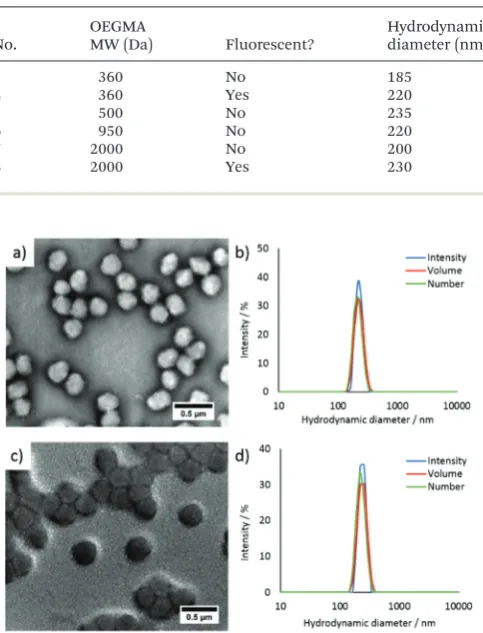
Fluorescent CO2/pH-responsive particles were designed with a tertiary amine-bearing monomer (DEAEMA) and the fluorescent ABMMA monomer (1), the former allows a pH-response while the latter monomer allows a fluorescence read-out of the par-ticles’state. Particles were synthesized viaemulsion polymeri-zation in water and the polymeripolymeri-zation was initiated by using potassium persulfate (KPS) as the initiator, see Scheme 2. The emulsion polymerization procedure consists of emulsifying an insoluble monomer phase in water in the presence of a stabiliz-ing amphiphilic compound. The amphiphilic compound in this case is OEGMA, which copolymerizes with DEAEMA to form a covalently linked hydrophilic shell. The hydrophobic core is composed of PDEAEMA cross-linked with 1 wt% of EGDMA and 2 wt% of the fluorescent ABMMA monomer (2). The tertiary amines of the core-forming block allow a CO2-responsive behav-ior while the presence of the ABM allows a built-in fluorescence read-out. Several batches of particles were synthesized. The influence of the OEGMA molecular weight (from 360 Da to 2000 Da) on the particles’ size and responsive character was studied. As a control experiment, particles were also synthesized without the fluorescent monomer in order to confirm it does not affect the particles’response to CO2. The hydrodynamic dia-meter of the different particles in solution in deionized water was measured by dynamic light scattering (DLS) and it was found that the particles are all in the same size rangeca.200 nm, see Table 1 and Fig. 1b, d for the DLS of particles4and8, see ESI†for par-ticles3,5,6and7. The variation of the OEGMA molecular weight or the incorporation of ABMMA did not affect the particles’
morphology and size range. The different OEGMA utilized changed the shell’s density as the degree of polymerization of OEGMA was kept the same whilst the monomer increased in size. The size of fluorescent particles with different shells (4and 8) was also confirmed by transmission electron microscopy (TEM), see Fig. 1a and c. The particles’spherical morphology was con-firmed and the average diameter was measured to be 257 nm for particles4and 330 nm for particles8. The difference between the
[image:4.595.307.549.62.379.2]Scheme 2 Synthesis of particles (8)viaemulsion polymerization in water at 65 °C and the reversible particle response upon CO2and N2bubbling.
Table 1 Characteristics of the different PDEAEMA particles synthesized
No.
OEGMA
MW (Da) Fluorescent?
Hydrodynamic diameter (nm)
3 360 No 185
4 360 Yes 220
5 500 No 235
6 950 No 220
7 2000 No 200
8 2000 Yes 230
Fig. 1 (a) TEM image of particles4, (b) DLS analysis of particles4, (c)
TEM image of particles8, (d) DLS analysis of particles8. TEM grids were stained with an aqueous solution of uranyl acetate, see ESI†for more details.35
Open Access Article. Published on 06 September 2016. Downloaded on 27/02/2017 11:20:49.
This article is licensed under a
[image:4.595.62.546.569.703.2]DLS hydrodynamic diameter and the TEM average diameter occurs as a consequence of a drying effect. Fluorescence spectroscopy was performed on particles containing the fluo-rescent monomer (4and8) in solution in deionized water. The particles both present an emission maximum at 487 nm for an excitation at 375 nm, see Fig. 2a for the emission spectrum of par-ticles8.
Particle size monitoring
DLS was utilized to monitor changes in the particle diameter in response to bubbling with CO2. When CO2is bubbled in the particle solution, the amines of PDEAEMA present in the core of the particles become protonated and therefore hydrophilic. Owing to their cross-linked structure, the particles swell and increase in diameter instead of disassembling. A size increase upon CO2 bubbling was observed for all the particles, see Fig. 2b for particles8 and ESI†for particles3,4,5,6and7. For example, the hydrodynamic diameter of particles 3
increased from 185 nm to 390 nm and particles 7present a diameter increase from 200 nm to 435 nm. The size increase of the non-fluorescent particles with the small molecular weight OEGMA shell (3) was also monitored by small angle X-ray light scattering (SAXS) with an in situ CO2 purge, see Fig. 2c. The SAXS data shows an increase of the radius of gyra-tion within minutes. Analysis of the SAXS curves over a period of 21 min indicates an increase of particle size as well as an increase of the dispersity. The initial particles could be ana-lyzed as spherical micelles with really low core dispersity with some polymer coils accounting for the outer hydrated shell.36,37After bubbling CO
2the dispersity of the core slightly increased (as evidenced by the loss of oscillations in the raw SAXS profiles) and a more pronounced core–shell spherical morphology was observed with an increase of core radius. An initial diameter of 180 nm is observed, and an increase of the diameter is observed over time: after 2 min of bubbling, 255 nm and after 21 min, 280 nm.
Fluorescence emission monitoring
As previously demonstrated by our group, the ABM functional group is sensitive to polar protic environments.33 Thus, the ABM-bearing monomer should be able to probe the
protona-tion of its environment. Therefore, the increasing hydrophili-city of the core upon CO2 bubbling should quench the fluorescence emission of the particles. Fluorescence emission of the particles8was measured before and after CO2bubbling, a drastic decrease of the intensity was observed at 487 nm from 810 a.u. to 50 a.u. (see Fig. 2a). The decrease in fluo-rescence emission upon CO2bubbling was observed under a UV lamp (λ= 345 nm), see video in ESI.†
Reversibility of the system: CO2/N2purge cycles
To test the reversibility of the system, the particle solution was repeatedly purged with successive cycles of CO2 and N2 bub-bling. Purge cycles were monitored by fluorescence spectro-scopy and DLS. The purging time was kept constant for the entire experiment, CO2 was bubbled for 15 min and N2 was bubbled for 30 min. Cycle experiments were performed on fluorescent particles with the denser OEGMA shell (8). The hydrodynamic diameter and the fluorescence emission at 487 nm of the particles (8) were measured after each CO2or N2 purge. As shown in Fig. 3, the size of the particles alternatively increases and decreases six times. Similarly the emission intensity is reversibly quenched eight times (Fig. 4). Although
Fig. 2 (a) Fluorescence emission spectra of particles8before and after thefirst CO2bubbling, (b) DLS of particles8before and after thefirst CO2
purge, (c)in situsize monitoring of particles3by SAXS over 21 min of CO2bubbling.
Fig. 3 Hydrodynamic diameter of the particles (8) in deionized water
measured after each gas purge.
Paper Polymer Chemistry
Open Access Article. Published on 06 September 2016. Downloaded on 27/02/2017 11:20:49.
This article is licensed under a
Creative Commons Attribution 3.0 Unported Licence.
[image:5.595.55.545.49.165.2] [image:5.595.306.552.513.694.2]particles with a less dense shell (3,4,5,6) can swell with CO2, they are unable to collapse upon N2 bubbling. For example, particles5exhibit a diameter of 235 nm before bubbling, 430 nm after CO2bubbling and 1000 nm after N2purge. This irreversible swelling occurs as a consequence of the density of the shell that cannot counter the effect of core chains that irreversibly penetrate the shell during the first protonation. These hydrophobic chains get trapped in the shell when the particles shrink and their presence promotes inter-particle interactions, which leads to the formation of uncontrolled large aggregates. The formation of aggregates is significantly reduced with a denser shell made of OEGMA with a molecular weight of 2000 Da.
Conclusions
In conclusion, we have presented the synthesis of fluorescent CO2-responsive cross-linked polymeric particles. The fluorescent dye was incorporated in the core in the form of a novel fluo-rescent monomer containing an ABM functional group while the CO2-responsive character was introduced by the presence of tertiary amines. These particles swell as the core is made hydro-philic by bubbling CO2into the solution. This change of local hydrophobic character then induces a decrease in ABM fluo-rescence intensity. Thus, the fluofluo-rescence intensity can be used to probe the particle core hydrophobicity and particle size.
Acknowledgements
The authors thank Dr Dafni Moatsou and Dr Mathew Robin for helpful discussions, BP and the EPSRC for funding.
Notes and references
1 M. R. Hill, E. J. MacKrell, C. P. Forsthoefel, S. P. Jensen, M. Chen, G. A. Moore, Z. L. He and B. S. Sumerlin,
Biomacromolecules, 2015,16, 1276–1282.
2 I. Cobo, M. Li, B. S. Sumerlin and S. Perrier,Nat. Mater., 2015,14, 143–159.
3 P. Theato, B. S. Sumerlin, R. K. O’Reilly and I. I. I. T. H. Epps,Chem. Soc. Rev., 2013,42, 7055–7056. 4 C.-Y. Chen and H.-L. Wang, Macromol. Rapid Commun.,
2014,35, 1534–1540.
5 M. I. Gibson and R. K. O’Reilly,Chem. Soc. Rev., 2013,42, 7204–7213.
6 S. Dai, P. Ravi and K. C. Tam, Soft Matter, 2008, 4, 435–449.
7 X. Xiao, S. He, M. Dan, F. Huo and W. Zhang, Chem. Commun., 2014,50, 3969–3972.
8 B. W. Liu, H. Zhou, S. T. Zhou, H. J. Zhang, A. C. Feng, C. M. Jian, J. Hu, W. P. Gao and J. Y. Yuan,Macromolecules, 2014,47, 2938–2946.
9 B. A. Abel, M. B. Sims and C. L. McCormick,
Macromolecules, 2015,48, 5487–5495.
10 A. Darabi, P. G. Jessop and M. F. Cunningham,Chem. Soc. Rev., 2016,45, 4391–4436.
11 Q. Yan and Y. Zhao, Chem. Commun., 2014, 50, 11631– 11641.
12 S. Lin and P. Theato,Macromol. Rapid Commun., 2013,34, 1118–1133.
13 E. Girard, T. Tassaing, J.-D. Marty and M. Destarac,Chem. Rev., 2016,116, 4125–4169.
14 Q. Yan, R. Zhou, C. Fu, H. Zhang, Y. Yin and J. Yuan,
Angew. Chem., Int. Ed., 2011,50, 4923–4927.
15 P. Schattling, I. Pollmann and P. Theato, React. Funct. Polym., 2014,75, 16–21.
16 J. Y. Quek, P. J. Roth, R. A. Evans, T. P. Davis and A. B. Lowe, J. Polym. Sci., Part A: Polym. Chem., 2013, 51, 394–404.
17 S. Shahalom, T. Tong, S. Emmett and B. R. Saunders,
Langmuir, 2006,22, 8311–8317.
18 J. Pinaud, E. Kowal, M. F. Cunningham and P. Jessop,ACS Macro Lett., 2012,1, 1103–1107.
19 Y. Hoshino, K. Imamura, M. Yue, G. Inoue and Y. Miura,
J. Am. Chem. Soc., 2012,134, 18177–18180.
20 S. Salentinig, P. Jackson and A. Hawley, Macromolecules, 2015,48, 2283–2289.
21 A. J. Morse, S. P. Armes, K. L. Thompson, D. Dupin, L. A. Fielding, P. Mills and R. Swart, Langmuir, 2013, 29, 5466–5475.
22 Y. Chen, T. Zhao, B. Wang, D. Qiu and N. Ma,Langmuir, 2015,31, 8138–8145.
23 M. P. Robin and R. K. O’Reilly, Polym. Int., 2015, 64, 174–182.
24 H. Wang, M. Xu, M. Xiong and J. Cheng,Chem. Commun., 2015,51, 4807–4810.
25 J.-K. Y. Tan, J. L. Choi, H. Wei, J. G. Schellinger and S. H. Pun,Biomater. Sci., 2015,3, 112–120.
26 S. Li, K. Hu, W. Cao, Y. Sun, W. Sheng, F. Li, Y. Wu and X.-J. Liang,Nanoscale, 2014,6, 13701–13709.
27 M. P. Robin, P. Wilson, A. B. Mabire, J. K. Kiviaho, J. E. Raymond, D. M. Haddleton and R. K. O’Reilly,J. Am. Chem. Soc., 2013,135, 2875–2878.
Fig. 4 Fluorescence emission intensity at 487 nm measured of the
par-ticles (8) in deionized water after each gas purge.
Open Access Article. Published on 06 September 2016. Downloaded on 27/02/2017 11:20:49.
This article is licensed under a
[image:6.595.47.284.51.204.2]28 M. P. Robin, A. B. Mabire, J. C. Damborsky, E. S. Thom, U. H. Winzer-Serhan, J. E. Raymond and R. K. O’Reilly,
J. Am. Chem. Soc., 2013,135, 9518–9524.
29 M. P. Robin, J. E. Raymond and R. K. O’Reilly, Mater. Horiz., 2015,2, 54–59.
30 M. P. Robin and R. K. O’Reilly, Chem. Sci., 2014, 5, 2717–2723.
31 Z.-L. Li, L. Sun, J. Ma, Z. Zeng and H. Jiang,Polymer, 2016,
84, 336–342.
32 A. B. Mabire, M. P. Robin, H. Willcock, A. Pitto-Barry, N. Kirby and R. K. O’Reilly, Chem. Commun., 2014, 50, 11492–11495.
33 A. B. Mabire, M. P. Robin, W.-D. Quan, H. Willcock, V. G. Stavros and R. K. O’Reilly,Chem. Commun., 2015,51, 9733–9736.
34 M. A. Walker,J. Org. Chem., 1995,60, 5352–5355.
35 J. P. Patterson, M. P. Robin, C. Chassenieux, O. Colombani and R. K. O’Reilly,Chem. Soc. Rev., 2014,43, 2412–2425. 36 D. B. Wright, J. P. Patterson, A. Pitto-Barry, A. Lu, N. Kirby,
N. C. Gianneschi, C. Chassenieux, O. Colombani and R. K. O’Reilly,Macromolecules, 2015,48, 6516–6522. 37 D. B. Wright, J. P. Patterson, A. Pitto-Barry, P. Cotanda,
C. Chassenieux, O. Colombani and R. K. O’Reilly, Polym. Chem., 2015,6, 2761–2768.
Paper Polymer Chemistry
Open Access Article. Published on 06 September 2016. Downloaded on 27/02/2017 11:20:49.
This article is licensed under a
Creative Commons Attribution 3.0 Unported Licence.