1 Master thesis
Business Administration
Track: Strategic Marketing & Business Information University of Twente
Author J. Dijkkamp
Supervisors Dr. M. Renkema Prof. Dr. T. Bondarouk
Date and place Enschede
Wednesday, November 13 , 2019
2
Acknowledegments
This thesis presents the research done for my graduation project for the master Business Administration with the specialization: Strategic Marketing & Business Information.
My research would not have been possible without the help of several people, which I would like to thank for their contribution.
First of all, I am very grateful for all the support I receive during the project from my supervisors, Prof Dr. Tanya Bondarouk and especially Dr. Maarten Renkama. It was a great pleasure to work together on this project with you. We had really good discussions about the project during the meetings but also a lot of fun. Thank you very much!
I also want to thank the organization for the opportunity they gave me to do conduct this interesting research in one of the largest HRM companies in the world.
Further, I want to thank all respondents for their time and effort.
3
Abstract
4
Table of Contents
1. Introduction and research question ... 5
2. AI-supported recruitment and selection process: a literature review ... 6
2.1 From e-HRM to e-recruitment ... 6
2.2 Implications of artificial intelligence in the recruitment and selection ... 10
2.3 The changing role of the HR professional ... 11
3. Methodology ... 14
3.1 Data collection ... 14
3.2 Data sources and procedure ... 16
3.3 Data analysis ... 16
4. Findings ... 17
4.1 Case description ... 17
4.2 Defining artificial intelligence ... 18
4.3 Recruitment and selection process ... 19
4.3.1 Sourcing ... 19
4.3.2 Screening ... 24
4.3.3 Selecting ... 27
5. The changing role of the HR professional in the recruitment and selection process with the introduction of AI ... 29
6. Discussion ... 31
6.1 Theoretical implications ... 32
6.2 Practical implications ... 34
6.3 Limitations and suggestions for future research ... 35
6.4 Conclusion ... 35
7. References ... 36
5
1. Introduction and research question
The rapid developments of the internet during the last decade have encouraged the introduction and use of electronic Human Resource Management (e-HRM). Ruel, Bondarouk, and Looise (2004) define e-HRM as ‘a way of implementing HRM strategies, policies and practices in organizations through the conscious and direct support of and/or with the full use of channels based on web-technologies. Most large organizations now use technology to a certain level in their management of human resources (Martin, 2005). At some point, companies became aware of the fact that human resource management changed from a cost factor to a success factor (Biesalski, 2003). The growing literature on this subject has determined a number of goals, including cost and efficiency savings, improvement in services for the client, and strategic aim of the organization (Ruel, Bondarouk, and Looise, 2004; Marler, 2009). According to Parry and Tyson (2011), managers and employees must engage in making the use of e-HRM a success.
In the last decade, technological innovations in e-recruitment systems have seen an explosive expansion. Due to this, HR professionals can find talents who are supposed to have the best fit with the organization. More specifically, in modern business, it becomes more relevant for organizations to use Artificial Intelligence (AI) for decision making. Kaplan and Haenlein (2019) define AI as “a systems ability to correctly interpret external data, to learn from such data, and to use those learnings to achieve specific goals and tasks through flexible adaption.” For more than a decade now, digital innovations have been challenging traditional forms of delivering HRM services within organizations, and the introduction of AI has only increased this. In many big companies, like Unilever, the validation of the recruitment and selection process by artificial intelligence now takes place (Marr, 2018). This includes the screening of resumes and automated job interviews. According to Trombin, Musso, Pinna and de Marco (2018), one of the major trends in HRM will be AI. AI will also transform recruitment in three different ways. First of all, AI could make the screening process more efficient and guarantee a fairer screening process. Second, AI will provide a better candidate fit through online job boards. Lastly, AI enhances employee retention and development due to protecting future talent pipelines.
6 How the role of the HR professional will transform over time is unknown and very interesting to investigate, since AI will be more and more part of the recruitment and selection process in the future.
Furthermore, researchers have to emphasize how to employ technology in recruitment functions and get the benefits out of it. This could result in a change in the organizational design of the recruitment teams and would address the question of how technology would affect these subsystems, which could result in a decentralization of the hiring function. A recent study has identified the potential for the use of AI techniques in HR management (Strohmeijer and Piazza, 2015). Yet, these contributions did not describe how AI techniques generally have consequences for the role of an HR professional in organizations. More specifically, in the literature, no research is done on how AI will influence the role of the HR professional in the recruitment and selection process, whereas this new technology can most impact this domain of HRM.
Having a clear picture of the phenomena that is e-HRM, e-recruitment, and AI, allows us to pose a central research question. Our understanding about the role of AI in recruitment & selection and the use in practice is limited. It is important to expand the literature with more qualitative insights on this topic. Therefore, this research aims to fill this gap and investigate what the consequences are for the HR professional in the recruitment and selection process when implementing AI. We pose the following research question. What are the consequences for the HR professional with AI-supported recruitment and selection?
The paper is organized in the following way. First, we elaborate on the concept of e-HRM. We follow this by discussing the topic of e-recruitment and AI. Later we dig deeper into the literature of the HR professional. Based on the literature review, an initial conceptual framework is proposed. This is followed by an outline of the research design, which is based on a case study. The next section presents the findings of the interviews. Then we compared the findings with the literature and drew key conclusions. Finally, we suggest implications for theory, practice and future research.
2. AI-supported recruitment and selection process: a literature review 2.1 From e-HRM to e-recruitment
7 choices upon a pool of candidates. The primary purpose of the recruiting process is to hire candidates that create value for the company (Laumar and Eckhardt, 2009).
The recruitment and selection process consists of three stages: sourcing, screening and selecting (Rajesh, Kandaswamy, Rakesh, 2018). The stages will be defined to get a clear understanding of the variables of the recruitment and selection process. Sourcing is the use of one or more strategies to relate talent to organizational vacancies. Different sorts of advertisements can be used, for example, using appropriate media, the internet, job centers, specific recruitment media, window advertisement, and newspapers. External and internal recruiters could perform sourcing for candidates (Sinha and Tahly, 2013). The screening of resumes is a crucial phase in personnel selection processes. Recruiters use resume information to conclude an applicant’s work-related skills, abilities, motivation, personality, and job fit (Brown and Campion, 1994; Chapman and Webster, 2003). Therefore, the resume is a critical tool for evaluating the appropriateness of any given applicant for a particular job, and it often determines who the HR professional invite for additional screening. (Sackett and Lievens, 2008) Lastly, selecting is the process of choosing the individual best suited for a particular position within the organization (Mondy, 2008). The process does not always run from sourcing to selecting. But in general, the order is sourcing, screening, and selecting. After the selecting stage, the ‘match’ is made, and the recruiter has found the most suitable candidate for the organization.
Since recruitment and selection are areas of e-HRM, it is important to define this concept. In this, we define this concept as ‘’a way of implementing HR strategies, policies and practices in organizations through a conscious and erected support of and/or with the full use of web technology-based channels (Ruel et al. 2004). Based on the research of Strohmeijer (2007,) e-HRM is defined ‘’as the planning, implementation, and application of information technologies for both networking and supporting HR activities’’. A more recent definition described E-HRM as following, the application of computer and telecommunication devices to collect, store, retrieve and disseminate HR data for business purposes (Stone, Deadrick, Lukaszweksi & Johnson, 2015). The definition of Voerman & van Veldhoven (2007) focusses more on the HR function as chose to define it as ‘’the administrative support of the HR function in the organization by using internet technologies’’. Another definition proposed by Bondarouk, Harms, and Lepak (2015) aims to make HRM processes more efficient, higher in quality and which will create long term opportunities through the use of IT. We conclude that there is no clear definition of the concept of e-HRM since a lot of authors have a different view.
8 strategic (Gardner, Lepak, and Bartol, 2003; Ruël et al., 2004; Ruta, 2005) Some authors indicate that e-HRM can contribute to the strategic orientation HR-function. Ruel et al. (2004) state that e-HRM can transform the HR function to a more strategic level.
Looking at the antecedents of e-HRM outcomes, recent research has given significant attention to the interplay between the two concepts, IT and HR, as an antecedent of the E-HRM outcomes. The following example could emphasize this. Parry & Tyson (2011) concluded from a study across 12 countries that organizations that fail to integrate e-HRM will not achieve the promised results, such as reduction of HR headcount. Another study in the public sector in the UK established how the technical elements of e-HRM, allowed managers to exploit the full potential for effective HRM (Tansley, Kirk, Williams, and Barton, 2014). These authors agree that to achieve successful e-HRM outcomes; the organization has to support the implementation of e-e-HRM.
From previous studies, it appeared several times that specifically when it comes to e-HRM, primarily recruiting and selecting personnel is an appropriate application (Ruel, Looisea and Bondarouk, 2002). The use of e-recruitment has increased enormously in the last ten years. The figures show that in the US in 2010, almost ¾ of all large organizations and all state governments used e-recruitment tools to some extent (Stone, Lukaszweky, Romero and Johnson, 2013; Selden and Orenstein 2011). Compared to Europe, only 2/3 of the organizations used e-recruitment tools. Currently, a considerable amount of job descriptions and candidate resumes become available. This enormous amount of information and data is an opportunity for an organization to improve the matching quality of the potential candidates. There is a need for technologies that can effectively convert this information and data into usable output for the recruiter (Färber, Weitzel, and Keim, 2003; Yi, Allan, and Croft, 2007).
However, before we explain some systems used in e-recruitment, first we have to define the concept. According to Wolfswinkel, Furtmueller and Wilderom (2010) “e-recruiting is the online attraction and identification of potential employees using corporate or commercial recruiting websites, electronic advertisements on other websites, or an arbitrary combinations of these channels including optional methods such as remote interviews and assessment, smart online search agents or interactive communications tools between recruiter and applicant’’. Due to the expansion of new technologies, several e-recruitment systems have been devised to accelerate the recruitment process. There are different systems to match the applicants with the systems, these systems are typically combining techniques from classical information retrieval and recommender systems such as collaborative filtering techniques (Rafter, 2000), relevance feedback, (Kessler, 2009), semantic matching (Mochol, 2007), multi-agent systems (Meo, 2007), Analytic Hierarchy Process (Faliagka, Ramantas, Tsakalidis, Viennas, Kafeza and Tzimas, 2011), and NLP technology (Amdouni and Karaa, 2010).
9 employees, time and cost-saving, more opportunities for smaller companies, better quality of response, easier to apply for a job and brand image development (Othman and Musa, 2007; Dhamija, 2012; Nasreem, Hassan, Khan, 2016). However, some disadvantages include lack of personal touch, outdated resumes, user-unfriendly tools, discrimination between applications. If an organization implements e-recruitment systems, these advantages and disadvantages must be taken into consideration.
According to Caggiano (1999) and Borck (2000), e-recruitment will not replace the traditional way of recruiting but will help the recruiters to become more successful in their process. E-recruitment is considered as an essential part of the development of human resources within an organization. According to Tong and Sivanand (2005), e-recruitment uses IT to perform, speed up, or improves the process. E-recruitment emerged as additional tools over the traditional ways. In the future managers will see intelligent machines as their ‘’colleagues’’. A survey showed that 78% of the managers would trust the advice of AI in their decision-making process (Kolbjronsrud, Amico and Thomas, 2016). This is in line with Dhamaij who argues that e-recruitment is revolutionizing the complete recruiting process and the internet is the link between the employer and the potential candidate. The transformation of the recruitment process, besides the improved techniques, has changed the task of the recruiter to a more online recruiter. A study regarding e-recruitment established that e-recruitment does not lead to lower satisfaction of the applicant (Rozelle and Landis, 2002). In line with this, the research of Van Rooy, Alonso, and Fairchild (2003) indicate that the perceptions of applications were positive since a higher number of jobs become visible for job seekers.
E-recruitment platforms are mostly based on search strings and filtering methods that cannot capture the soft skills of a person and the person-job fit as a selection decision (Malinowski, Keim, Wendt and Weitzel, 2008). In their study, they establish that e-recruitment systems must consider attributes as individual skills, mental abilities, and personality that control the fit between the organization and individual; further, the relational attributes should be determined to assess the fit between the individual and the team members. In this context, the literature distinguishes between person-job – person team and person-organization fits (Sekiguchi, 2004). According to Keim (2007), this is a challenging but promising objective. To conclude, as we have shown, in literature, many authors agree on the growing importance of e-recruitment in developing human capital and strategic human resource management.
10
2.2 Implications of artificial intelligence in the recruitment and selection
While the use of AI in e-recruitment is a new phenomenon. The concept of AI has been around for a while. Russel and Norvig (1995) describe AI as anything that perceives its environment through sensors and acting upon that environment through effectors. While Hayes-Roth (1995) tried to broaden the definition by stating that AI provides” reasoning to interpret perceptions, solve problems, draw inferences and determine actions.” More recently, Kaplan and Haenlein (2019) define AI as “ a systems ability to correctly interpret external data, to learn from such data, and to use those learnings to achieve specific goals and tasks through flexible adaption.” All definitions emphasize the purpose of AI is to act autonomously and independently of any external inputs either during or after the activity. Besides, AI is a container concept, which includes as much as machine learning (ML), natural language processing (NLP) expert systems, vision (e.g., image recognition), speech, planning, and robotics.
The use of AI in recruitment and selection is still in its infancy. The emerge of AI in the recruitment process has made storing and retrieving of resumes easier. With the advent of AI, successful innovations are combined with existing methods to form a technique that can deliver a user-friendly experience for organization and candidate (Mathis, 2018). The recruitment landscape has seen extensive changes over the years and has evolved with the creation of new recruitment tools and processes (Bersin, McDowell, Rahnema, van Durme, 2017). According to Schweyer (2017), AI and machine learning can be used in the different stages of the recruitment and selection process. More specifically, these stages are sourcing, screening and selecting.
In many big companies, the validation of the selection process through AI is now taking place; this consists of a wide range of applications, from the screening of the resumes to automated interviews. An example of an application is Pymetrics, this start-up uses neuroscience assessments and data science to offer a better career assessment to job seekers and provides an unbiased hiring process to organizations in which it replaces the resume as first-pass filter. Pymetrics mentioned that clients had seen the following outcomes: reduction of time to hire from 4 months to 4 weeks, 75% reduction in recruiter time, went from 150 resumes to fill one role to only 25 resumes at a financial organization (Trombin, Musso, Pinna, de Marco, 2018). The AI techniques need to fit the specific task requirements, but must also outperform the currently used technique. In this, effective implementation of AI requires in-depth HR knowledge and deep AI knowledge. This can be realized due directly embed AI functionality in the domain-specific HR information systems (Strohmeijer and Piazza, 2013) this allows the organization to implement AI within a familiar context.
11 supportive in HR, for example, with the screening of a resume. However, nowadays, AI could transform the recruitment and selection process. The introduction of AI could ultimately lead to a reallocation of time, in which recruiters can spend their time more meaningfully, this means they can focus their time on smaller groups of selected final candidates and improve the human touch which results in better candidate experience (Lee, Lee, and Tarpey, 2018). Furthermore, AI can provide customized candidate experiences and personalized questions and answers based on algorithms.
While there are some benefits of AI, there are also disadvantages. In the case of implementing AI in the process, the human aspect will partly disappear. Furthermore, the implementation of AI could lead to ethical and legal regulations take into consideration. If the recruitment process deals with personal information, the recruiters must have permission to use it. Fernandez and Fernandez (2019) mentioned that the machine learning algorithm trained with data from white people thus biased data. Another disadvantage claimed by Van Esch et al. (2019) shows that potential candidates do not like to use an application system based on AI. Based on this all, we can conclude to not fully trust the adoption of AI in the recruitment and selection process and that a potential candidate also pays attention to the personal touch of the HR professional.
So, we already explained the concept of e-recruitment. But nowadays, the concept of AI is emerging in the recruitment and selection process. AI could potentially have a significant impact on the recruitment and selection process. So, in this study, we dig deeper into the impact of AI on the recruitment process and study how AI will affect the role of the HR professional.
2.3 The changing role of the HR professional
After we describe the literature about e-HRM, e-recruitment, and AI, we no turn to the actors of the process, the HR professional. In the last decades, the role of the HR professional changed from a highly administrative role towards a more strategic role. Effective HRM is more and more considered as a source of competitive advantages within an organization (Wright, Funford & Snell. 2001). This transformation has created opportunities for people working within an HR position to make a more significant contribution to the success of the organization. The transition also requires a substantial change in the role and skills an HR professional must acquire (Beer 1997; Ulrich, 1997).
12 policies and think along in business problems). This decentralization of the HR function provided HR professionals with more time to contribute to business successes (Legge, 1995). However, studies by Valverde, Ryan & Soler (2006) and Woering & van Dartel (2014) indicate that in practice, HR professionals are mostly working on operational tasks and provide service to the management instead of making strategic decisions. Despite the extra time as mentioned by Legge (1995) and the substantial attention to contribute to business success, it remains unclear how the HR professionals could add value (Paauwe & Boselie, 2003)
There is increasing support for a positive relationship between HRM and firm performance, and we see a heightened interest in the type of roles and competencies that an HR manager must possess to add value to the performance of an organization (Boselie, Paauwe and Janssen, 2001). Therefore, they focus more on the type of capacities an HR manager must possess instead of how they align HR policies. Whereas in the past the debate mainly evolved around the different HR roles and subsequent shifts in it, we recently see a more empirically based trend, which tries to establish the necessary competencies based on the demands of the main stakeholders. HR professionals face considerable ambiguity because of their shared responsibility between themselves, top and line management (Legge, 1995). HR professionals have HRM responsibilities. However, they do not hold hierarchical authority. This suggests that HR professionals are seen as internal consultants for workforce-related topics that add value by advising line and top management. HR professionals still have operational and administrative work; however there is also substantially more attention for strategic decision making, value creation, support for line management, organization development and a high-level HRM task. (Valverde et al., 2006; Woering & Van Dartel, 2014). HR professionals who act from the customer's perspective, both internally and externally, can deliver real value to organizations. This is what Ulrich and Dulebohn (2015) call the outside-in approach and what has been the underlying research principle for investigating what effective HR professionals do (task), what responsibilities they have, how they add value, and what competencies they need to do so. Since these dimensions are the underlying research principles, they will be integrated into the conceptual framework.
13 performed in a role, and the function an employee is accountable for. For example, a recruiter is responsible for customers in the branch of telecom and energy. So, the recruiter is accountable for the vacancies in this branch; (3) how HR professionals add value for the organization in the future with the introduction of AI. In this, value creation is the performance that increases the worth of services or even a business. For example, an organization develops a tool that makes it easier to find a job for job seekers. Then the organization creates value for the job seeker by improving the services; (4) which competencies the HR professional need in the future. In this, competencies are the knowledge, skills, abilities and other requirements that are needed to perform a job. This not only includes what a person knows and does but also how they do it. For example, you need communication skills to lead a job interview. In summation, the dimensions are; task, responsibilities, competences and value creation. Tomassen, Van den Heuvel and De Leede (2016) use these dimensions in their conference article. They used these dimensions to explore the black box of machine learning in human resource management.
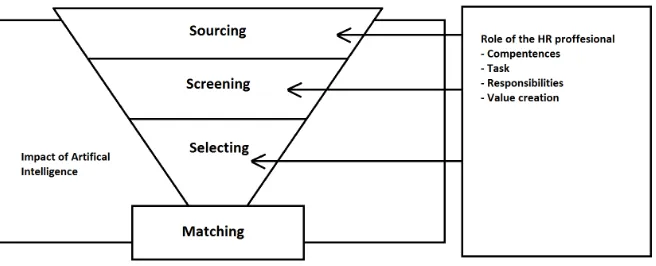
So based on three main subjects we propose a conceptual framework in figure 1. First, the recruitment and selection process in the framework is defined as sourcing, screening and selecting. Second, we visualized the impact of AI on the recruitment process as external factor in the framework. Lastly, we add the role of the HR professional in the framework, with tasks & responsibilities, competences and value creation. In this framework, we show the ‘traditional recruitment & selection funnel’ with the introduction of AI. For our research, we will look at how the role of the HR professional could change in the future in the different stages of the recruitment process with the introduction of AI. For example, how will the role of the HR professional change in the sourcing stages according to tasks & responsibilities, competences and value creation. We will study this for all stages of the recruitment process. So, based on the literature and conceptual framework, we proposed our specified research question: “What are the consequences for the HR professional in the stages of the recruitment & selection with the implementation of artificial intelligence?”
[image:14.595.82.410.589.722.2]14
3. Methodology
For our research, we used a qualitative research design with a single case study to explore the consequences for the HR professional with the implementation of AI (Yin, 2014). We conducted a case study within a large Dutch HRM organization. The organization is a global leader in the HR services industry and is based in 38 different countries with around 38,000 employees worldwide. The organization is selected because it worldwide organization which invests in new technologies. For the reason of anonymity, the organization is called AIrecruiting. The unit of analysis is the role of the HR professional. The research is primarily interested in whether the introduction of AI has consequences for the role of the HR professional in the stages of the recruitment and selection process. In this research, HR professionals are the recruiters of the organization.
3.1 Data collection
15 Interview Reason for interview
Recruiters & ambassadors AI tool
Gain insights into the current situation and how it already is changed with the implementation of AI. To gain insight from people who work in operation. This group contains ambassadors of the AI tools of the organization and used the AI tools from the start. This group informs other employees about the use and usefulness of the tool.
Recruiters Gain insights into the current situation of the recruitment and selection process and how it already is changed with the introduction of AI. To gain insight from the people who work with it.
Team AI tool organization A group of people who implemented the AI systems in the organization. Thus, who is responsible for the technical part of the application but also know what the practical reason for the tool is. Find out the purpose of the AI systems. So why is it implemented and find out how the system works so far.
Managers Gain insights into the plans of the organization in terms of AI and recruitment & selection. So, gather knowledge about how the role of the HR professional will change in the future.
[image:16.595.64.510.92.360.2]Innovation department A group of investors who particulars invest in start-ups in the area of HRM and AI. So up to date data and useful insight into how the future will look. Table 1. List of groups of participants with the reason for interviewing
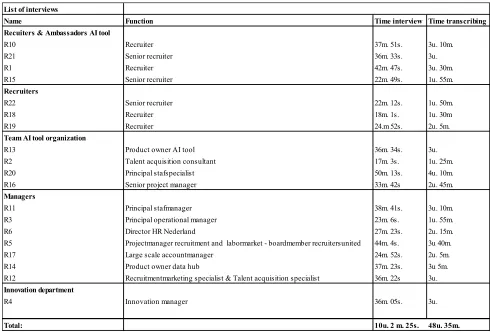
Table 2. Overview of interviews at AIrecruiting List of interviews
Name Function Time interview Time transcribing
Recuiters & Ambassadors AI tool
R10 Recruiter 37m. 51s. 3u. 10m.
R21 Senior recruiter 36m. 33s. 3u.
R1 Recruiter 42m. 47s. 3u. 30m.
R15 Senior recruiter 22m. 49s. 1u. 55m.
Recruiters
R22 Senior recruiter 22m. 12s. 1u. 50m.
R18 Recruiter 18m. 1s. 1u. 30m
R19 Recruiter 24.m 52s. 2u. 5m.
Team AI tool organization
R13 Product owner AI tool 36m. 34s. 3u.
R2 Talent acquisition consultant 17m. 3s. 1u. 25m.
R20 Principal stafspecialist 50m. 13s. 4u. 10m.
R16 Senior project manager 33m. 42s 2u. 45m.
Managers
R11 Principal stafmanager 38m. 41s. 3u. 10m.
R3 Principal operational manager 23m. 6s. 1u. 55m.
R6 Director HR Nederland 27m. 23s. 2u. 15m.
R5 Projectmanager recruitment and labormarket - boardmember recruitersunited 44m. 4s. 3u 40m.
R17 Large scale accountmanager 24m. 52s. 2u. 5m.
R14 Product owner data hub 37m. 23s. 3u 5m.
R12 Recruitmentmarketing specialist & Talent acquisition specialist 36m. 22s 3u.
Innovation department
R4 Innovation manager 36m. 05s. 3u.
[image:16.595.70.560.387.720.2]16
3.2 Data sources and procedure
The first research phase included desk research with document analysis, informal conversations with employees, and observations. In the initial period of the study, we had conversations with several employees to get insights in the research context. Vary from product owner of the AI tools to recruiters, to managers, to the innovation department of the organization. This to get an understanding of the current situation. The documents contain information about the plans the organization has with AI tools. This provides us an understanding of the organizational culture and traditions to establish the common research language and get to know which people in the organization were involved in the process. In close collaboration with my manager, we selected employees and contacted to participate in the research. The network of the manager within the organization was bigger. For this reason, the manager approached the first potential respondents. Afterward, we conducted semi-structured interviews with the selected employees. Each interview was approximately 30 – 60 minutes in a reserved room to ensure that we will not be disturbed. The participants are informed about anonymity and confidentiality before the interview. The interviews are recorded and transcribed, only with the permission of the participant. In all situations, the respondents permitted to record the conversations. This is done to ensure the quality of the output from the interviews. In total 19 interviews were conducted with different employees from different departments.
Along with the data from the interviews, notes from non-participants observations at the organization were used to add additional insight into the recruitment and selection process. To increase the reliability and rigidity of the research, we conducted serval actions. First of all, using the triangulation method of Patton (1990). For instance, we conducted interviews with employees with different functions and background. Since the researcher was part of the organization, several meetings and informal conversations were attended as an observer to acquire an understanding of the recruitment and selection process and to triangulate the interview data. Secondly, internal documents and communications were observed to increase the validity and enhance the credibility of the research (Yin, 2014). Lastly, all semi-structured interviews followed a protocol in which questions were established based on both the literature and previous interviews.
3.3 Data analysis
17 assessed the data for themes that we linked to the recruitment and selection process and the role of the HR professional. We coded all text that was related to the stages of recruitment and selection process, like sourcing, screening and selecting based on existing literature. We did the same for the role of the HR professional with the dimensions: task & responsibilities, competences and value creation. Because our interview protocol was quite strict, it was easy to code the themes in Atlas. Next, we used open coding to identify and describe specific activities (Gioia, Corley and Hamilton, 2013). The codes came directly from the interview transcripts and words used by the respondents. For example, ‘’The candidate and client want to have face to face contact at least once’’. Subsequently, the list of codes is reviewed by the researcher and grouped under higher-order codes. The aim here is to reduce the number of categories. For example, we coded - human aspect within the AI tools is important and - organize the human element in a different way as a new code: connection human to human is important. Next, axial coding is used to see differences and similarities between the group of codes. After axial coding, we added no new codes, and the group of codes and thematic codes were analyzed together. We performed this analysis in the Atlas.it by using a co-occurrence table. It is important to emphasize that the strength of the co-occurrence tool is that it allows for quantitative and qualitative exploration of associations between concepts. With the co-occurrence table, we saw how often two codes occurred together. The codes can overlap completely, depending on the same quotation. However, also partially, by overlap at the beginning or end of a quotation or overlap because one quotation falls entirely in or around the other. In this, we looked at the number of quotations for a specific code combination, for example, the combination of sourcing and current & future competencies. As a result, this allowed us to distinguish between the current and future competencies of an HR professional in the sourcing stages. We did this for all stages of the recruitment and selection process (sourcing, screening, and selecting) and for all the dimensions of the HR professional (task & responsibilities, competencies, and value creation) both in the current and future situation. So, inductive and deductive analyses were used to analyze the data. Based on the analysis, we reported the findings, conclusion, and discussion.
4. Findings
This chapter presents the results of the investigation. We describe the findings and illustrate how the role of the HR professional changes in the recruitment and selection process with the introduction of AI.
4.1 Case description
18 The organization aims to help clients to get the most out of their talent and, therefore out of their business. Inhouse Services is a unique solution for managing an efficient contingent workforce for which there is a fluctuating level of demand. The aim is to improve clients’ labor flexibility, retention, productivity, and efficiency. The organizations work on-site exclusively for one client, providing a large number of candidates, often in the manufacturing and logistics segments. Frequently they work with the client to determine specific performance criteria and provide total HR management, including recruitment & selection, training, planning, retention, and management reporting. Furthermore, the organization invests in and cooperates with companies working on HR technology to accelerate growth. To accelerate the growth of technology within the company, the organization appointed ambassadors for information and convincing people of the use of new technologies. The organization tries to be at the forefront of technology and uses various AI tools. The organization currently uses three tools in the recruitment and selection process that contain AI. The first tool makes automatic suggestions from candidates who meet the request. This means the tool selects candidates/talents from the database who meet the requirements of the vacancy. The system can also do this the other way around. With this, a candidate/talent must be selected from the database and then the tool checks which vacancy fits based on criteria. The last tool in the use of the organization can match comparable profiles of individual talents. Some companies say, ‘’I want another Piet, he does his job well’’. The system can search in the database for a similar profile as Piet and can present it to the customer. The organization currently uses these systems. The organization is now developing a new system that can give a ranking to the candidates, to see which candidate best fits which request. But, in some cases, a person does not meet with all requirements of the vacancy. For example, if Piet applies for position Y. But there is no culture fit, but all other conditions are sufficient. Then the system knows that all other requirements are met and a comparable function/vacancy is added. The candidate can then be presented immediately in this position. These are concrete plans that are currently being developed and for which new systems are built. So, currently, three AI systems are used and one AI system is in development. The job description of the recruiter can be found in Appendix D.
4.2 Defining artificial intelligence
In recent years, artificial intelligence had a significant impact on business. This is also the case within AIrecruiting. Therefore, we asked the respondents whether they could describe their definition of the concept of artificial intelligence. We asked the nineteen respondents for a description, and the answers varied considerably.
19 intelligence as a tool that uses data from the past to make predictions and as a tool to get candidates faster and with less effort out of the labor market. They base their view on the tools within the organization for matching candidates on vacancy. Also, two respondents indicate that AI includes self-learning ability. ‘’ And what I like about AI is that it is not only code but that it also learns naturally and that it gets better the more data you generate, R11’’. Furthermore, some respondents indicate that it is about automating work processes. Lastly, a couple of respondents describe artificial intelligence as a container concept by which they name the terms machine learning, deep learning, and big data. If we look at the literature, a number of respondents come close to the definition of Kaplan and Heinlein, who defined AI as ‘’a system’s ability to correctly interpret external data, to learn from such data, and to use those learnings to achieve specific goals and tasks through flexible adaptation”. Besides, some respondents cannot provide a description or explanation of the AI, even though the organization works with it. Based on the data, we concluded that people who have helped with the development of the AI systems, or the technicians, have a good understanding of the concept of AI, whereas some end-users know more about its daily use.
4.3 Recruitment and selection process 4.3.1 Sourcing
Current task and responsibilities
20
AI Influence on the task and responsibilities
If we look at the current influence of artificial intelligence on the sourcing process, several respondents indicate that artificial intelligence help to work more efficiently and effectively. A respondent mentioned it is no longer necessary to make a Boolean search string. That there are artificial intelligence tools that can assemble these strings. In addition, social media contains implications of AI, and these channels are nowadays important sources for finding candidates. As the work processes become more effective and efficient, there is more time for other parts of the recruitment funnel, a respondent says. ‘’Thanks to the implementation of AI, I have more time for the part that follows, so screening and selecting, R15.’’ Returning to working effectively and efficiently, interestingly, one respondent argues. ‘’You see a clear channeling. What is the most effective way of spending money? Where do you have the most qualified applicants? You almost never see a sourcing method that looks at hires. Just like Google cannot promise that you will buy something in terms of advertising costs. They can say. Here you have traffic or qualified traffic. HR always lagged behind with marketing. But just like with advertisement technology there is a lot of AI here, but then it is about conversion, R4’’. The implementation of AI has also ensured that HR professionals do not first start writing a vacancy text, but use the tools to see if suitable candidates emerge. This insight emerged from several interviews. In addition, the data shows something interesting about the scarcity in the labor market and how the organization can respond to this by raising the salary for a function. ‘’If there is data about the market. Then organization see how many qualified applicants they need in relation to the market. Maybe we should raise the salary a little. I think in the long term salary is seen as a variable in sourcing. That you are automatically source and salary is a variable. We need twenty qualified applicants to come to hire. With this salary we are not going to make it, so given the scarcity in the market we have to increase the salary a bit, R4.’’ So, economic status can, therefore, be important in the sourcing process.
On the other hand, a respondent indicated that the current influence of AI is still limited and is that the recruiter mainly performs his searches and is decisive. Another respondent agrees and admits that they do everything traditionally, so write vacancy text, etc. We concluded that the implementation of tools already saves time for HR professionals to some extent. Also, tools make the work of the HR professional more effective and efficient by using the right resources at the correct times. But in conclusion, we see that the influence of AI in sourcing is currently rather limited because it is still in its infancy.
From administration to binding and coaching
21 This is in line with another respondent who stated: ‘’If I look into the future, I think it will save me a lot of time so that I can focus on the candidate, fill more vacancies and help more companies. R20’’. The data shows that many respondents see the time saving as the most significant change in sourcing, and argue they can use their time more meaningfully and not have to search infinitely in databases for candidates. However, we cannot determine if there is more time left, but the results hint at timesaving by the introduction of AI. As a result of the timesaving, a number of respondents indicate that the emphasis will be more on the binding and coaching of candidates instead of rather searching. For example, conducting evaluations and progressing conversations, see if there are career opportunities within the current position or elsewhere, and improve the positive candidate experience1 of new employees. This involves the coaching skills of an HR professional. In addition, the findings show that in the future organization will emphasize the importance of the potential of a candidate more instead of just assessing a resume. This also contains a person-organization fit. Matching a vacancy with candidates based on a resume will be taken over by AI tools. Lastly, a respondent indicates that the experience of the past allows HR professionals to interpret the results of the tool well. However, it is crucial to take a critical look at the results of the tools and not just take it for granted.
Different scenarios for future tasks and responsibilities
The case study also highlighted that there is a variety of perceptions on the job and responsibilities in the sourcing stages. While some respondents think tasks and responsibilities will change, other respondents believe it will disappear for the HR professional as a result of the introduction of AI. ‘’ In a new world, the sourcing part is being replaced by AI, R16’’ Another respondent indicates that in the future it is not necessary to write vacancy text, create Boolean search strings and search on external job boards anymore. The work of the HR professional starts with screening. ‘’ If you define sourcing as. I create search strings; I am searching online; I am on LinkedIn and Indeed; I search on all databases. I think that will disappear. Then you just get ready-made candidates and you know exactly where they come from, R6’’. In contrast with the above, another respondent thinks that there will be a hyper specialty of professions: sourcing will become a separate department and companies will adopt special sourcing teams that focus solely on finding candidates. So, we can conclude that the opinions of the respondents differ. Where a number of respondents are confident that the tasks completely disappear, another respondent indicates that a form of hyper specialty will take place. With sourcing becoming an essential department. In which the organization formates a team that is only responsible for the attraction of external talent.
1How job seekers perceive and react to employers’ sourcing, recruiting, interviewing, hiring, and onboarding
22
Competences
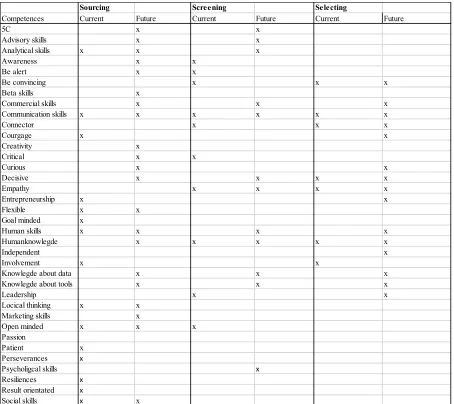
Interestingly, the data clearly shows an enormous amount of competences an HR professional needs in the sourcing stages. To clarify this example, all respondents provide a total of 29 competences an HR professional should need in the sourcing stage. The list with all competences can be found in table 3. Since this enormous amount of competences we classified the competences and differentiated current competences in sourcing from future competences in sourcing. So, in this, we only pointed out the competencies that were stated as important to acquire as HR professionals in the future.
In this, we see that the communications skills remain an essential competence of the HR professional, for the current situation and the future. This because the HR professional still has to communicate with the customer and candidate. As indicated above, a respondent argues that sourcing become will become a separate department within the recruitment process. The same person mentioned that the beta part of the brain is becoming increasingly important. This respondent said that ‘’it is not just the technical skills, but more analytical skills. Really the beta subjects such as math and economics. That the HR professional needs those competencies in the future, R5’’ As we can see in table 1, other respondents agree on this, and the HR professional should develop analytical skills, knowledge of data and understanding of the tool according to the respondents. Furthermore, a respondent indicates that is it is essential to be critical of the results of the tools. Also, one respondent noted that current HR professionals should be trained to use all the possibilities of AI so that they can get the best out of it.
23 Table 3. List of competencies mentioned by respondents
Value creation
The data indicate that knowing the customer is an important way in which the HR professional can add value. According to the majority of the respondents, the HR professional knows precisely which candidates are suitable for the vacancy. The reason for this is that the HR professional has a complete picture of the work the candidate is going to do and can communicate this well to the candidate. With this, it is important to find out the motivations of the candidate to guarantee a good match in the long term. So, the HR professional currently adds value to being a matchmaker. Furthermore, the HR professional adds value in attracting external talent. ‘’ Attracting candidates can be done both online and offline, so they are added to our database and can be matched trough Spotter, R3’’. In addition, an HR professional indicates that they add value in filling the challenging vacancies by using their creativity and network. ‘’ A truck driver can work well in a sales position if his communication skills are good, R18’’. The creativity of the HR professional for filling the problematic and rare profiles remains an essential skill in the future. For example, if there is a shortage of nurses in the labor market
Sourcing Screening Selecting
Competences Current Future Current Future Current Future
5C x x
Advisory skills x x
Analytical skills x x x
Awareness x x
Be alert x x
Be convincing x x x
Beta skills x
Commercial skills x x x
Communication skills x x x x x x
Connector x x x
Courgage x x
Creativity x
Critical x x
Curious x x
Decisive x x x x
Empathy x x x x
Entrepreneurship x x
Flexible x x
Goal minded x
Human skills x x x x
Humanknowlegde x x x x x
Independent x
Involvement x x
Knowlegde about data x x x
Knowlegde about tools x x x
Leadership x x
Locical thinking x x
Marketing skills x
Open minded x x x
Passion
Patient x
Perseverances x
Psycholigcal skills x
Resiliences x
Result orientated x
24 and the system and database cannot find a suitable candidate. Then the HR professional must use own network or search externally for suitable candidates.
Looking at the future of value creation, the data shows how the HR professional create value will change. According to a number of respondents, the HR professional becomes a marketer and employer branding specialist and adds value in attracting new talent to the organization. In addition, the data illustrates that the HR professional becomes a consultant for clients in the field of the labor market and recruitment strategy. Furthermore, mapping the needs and requesting the vacancy in the right way always remains important. In the future, organizations could have very advanced tools for their sourcing strategy. However, if the job description is not right, they will not get the right people via the tools. Moreover, another respondent thinks that the added value of the will be about creating content. ‘’We can leave online sourcing to the algorithm. But, which job boards are you going to use, are you going to use the socials, what exactly are you going to post. In that process, the HR professional can still add value for the organization, R4’’. Finally, personal contact is seen as an outstanding added value by several respondents, because it is about human work, the personal connection remains very important. ‘’Well I think the added value is always in the human aspect. A machine can tell which person fits. But whether it actually fits. We know the demand of a customer. Knowing how a company works. And what type of people are being sought? That is currently not yet included in the AI tools. So if you look now, there is still a big task to make the final move, R13’’
As indicated above, some respondents think that the tasks and responsibilities are being taken over. This also means that there is little to no added value for the HR professional in this phase. ‘’I think sourcing is no longer done by an HR professional. They do not have to worry about it anymore, R13’’ In the long term, there is no added value for the HR professional in bulk profiles, since all these vacancies can be taken over by the AI tools.
Hence, we conclude that HR professionals think they can still have added value, but this value will decrease considerably in the future. The added value consists mainly of establishing personal contact with the candidate and client. In addition, if task & responsibilities are to be replaced by AI tools the added value of the HR professional disappear
4.3.2 Screening
Current task and responsibilities
25 In summary, we conclude that screening currently is done based on hard requirements, competencies, and references.
AI Influence on the task and responsibilities
If we look at the current influences of AI on the screening process, the data indicates that AI helps to make the process more efficient and effective. The first pre-selection can be taken over by the tools, and this is a timesaving solution for the HR professional. ‘’I note that it saves time by using the tools. This ensures the recruiters to handle more vacancies and can place more candidates at companies. That is, in particular, a bit of efficiency, R10’’ This is a development of recent years, an HR professional indicates. When she started one year ago (May 2018), there were no tools with any implementation of AI. In addition, companies nowadays are looking more at whether there is a culture fit. ‘’I notice that we are increasingly looking to see if there is a match between the person and the company, R11’’ They are currently developing a test for this purpose. Also, a respondent indicates that it is essential which data you put in an algorithm. ‘’Garbage is, is garbage out, R4’’ Finally, we see more and more the introduction of job simulations. In this, candidates will perform tests and games during their application process that come close to actual work activities, to predict the capacities of the candidate with high accuracy. Where biases often emerge in screening stages, since that is a human thing, these tools can exclude these biases. ‘’ Perhaps a recruiter's intervention might not be good at all when it comes to biases when it comes to diversity, inclusion. I am convinced that AI has a positive effect on diversity and inclusion and not a negative effect, R4’’. If organizations introduce tools that support them, for example assessing resumes, it is crucial to show openness and transparency in how the algorithms act and learn indicates one respondent: ‘’It is about the ethical discussion of what the algorithm does and how do you know that we play fair as an organization. Openness is then very important. R,14 ’’
Looking at the current influences, we can conclude that the introduction of tools that support the HR professional in the screening process is developing fast. Since a year ago, there were no tools in this organization. In addition, we see a shift in assessments whereby they pay more attention to person-organization fit instead of just assessing a resume. Finally, we see an introduction of gamification in the recruitment and selection process. However, this development is still at an early stage. The organization is currently introducing a gamification tool for hiring management traineeships.
Transformation of screening
26 added value in this process, R4’’. Another respondent pointed out that the screening process can be adopted more quickly because it only looks at the competences of the candidate. In addition, a respondent believes screening is completely taken over by artificial intelligence and that it, therefore, disappears as tasks and responsibilities of the recruiter.
If organizations decide to implement AI, they partly remove the human aspect. One respondent indicates that they have to organize this differently. Another respondent suggests that people also need human contact in a certain way and do not want to be helped by robots. An example of another respondent supports this opinion. ‘’ It's nice that you say it. If you measure the NetPromoterScore (is customer loyalty and satisfaction measurement) that they would prefer that they get the result a day later. So they can tell immediately after the game whether people are suitable or not, but they still want to pretend that the algorithm needs to think and process all the data. Apparently, people still like the human element in it while they know it is an algorithm. We also see that with chatbots. They can send an answer right away, but candidates like it better if a few points come of is typing and then gives the answer. The human element in communication is very important. R4 ’’ Finally, a respondent indicates how they organize it is essential. The user-friendliness and candidate experiences are an important factor in this that it ultimately turns into a unique experience. ‘’ I have such a dream. That at a certain point you have to make a test for a customer. That you do with VR glasses. That you immediately walk through the factory. That you get a picture of the company, R6.’’ Based on the above, we conclude that the human aspect within the tools remains essential. As the example above indicates, the candidates require human traits in the AI tools. So, organizations should organize the human aspect in a different way of the tools that should contain human characteristics.
Competences
The findings present a large number of competencies an HR professional needs in the screening stages. To clarify this example, all respondents provide a total of 19 competencies an HR professional should need in the screening stage. The list with all competencies can be found in table 3. Since this enormous amount of competences, we classified the competences and differentiated current competences in screening from future competences in screening. So, in this, we only pointed out the competencies that were stated as important to acquire as an HR professional in the future.
27 understand the decision the tools take. So, the HR professional should develop more knowledge about the tools and data. If HR professional knows how the tools operate, they can easier trust on it. Finally, the results show that the HR professional should become (more) proficient with decision making based on data. ‘’This is about hard psychology. So really based on data. To draw conclusions from that. numerical psychology, so really the psychological skills .’’ This is essential to make an accurate interpretation of the data and output of the tool. This interpretation also includes analytical skills.
So, the results show that communication skills remain essential. But the HR professional should also become more proficient with other competencies like decision making based on data, psychosocial skills and should know the tools and data.
Value creation
Several respondents see the added value of the HR professional as a matchmaker. The added value comes from screening based on hard requirements, competencies, and references. ‘’Where the HR-professional currently adds value in the screening process. That he is very capable of assessing whether or not a candidate should be introduced. Often he can do this better than the organization for which we recruit. I think that there is still added value there at the moment, R2’’. If these screening methods disappear, the added value of the HR professional will automatically disappear.
Looking at the future of value creation, the results show that the HR professional will add value to the personal touch. The human aspect is missing in the tools so the HR professional should add this to the screening process. In this, it is essential that the HR professional explains the context and tries to make a connection with the candidate. Furthermore, it is crucial to have a certain feeling with the candidate.
Also, some respondents indicate that there is no added value for the HR professional in this phase because it can be fully automated. ‘’I think that at a given moment no recruiter has to worry about it anymore R13’’
4.3.3 Selecting
Current task and responsibilities
28 voicemail. Do not use telephone conversations only. Send confirmation via WhatsApp instead of by e-mail. Use photos to level with the candidate, R22 ’’ This is an example to immediately create a bond with the candidate and make a connection with the organization.
AI Influence on the task and responsibilities
If we look at the current influence of artificial intelligence on the selection process, we mainly see that it is still limited. One respondent pointed out that in five years, there will be no influence of tools coming in here. ‘’This is about such abstract things as character, a certain attitude. These are things that are very difficult to quantify and make measurable in data, R2.’’ Other respondents mentioned that there is no influence of any tool within this phase. ‘’I still have complete control over that, R1’’
Increased importance in selecting
Looking into the future, the results demonstrate that the tasks and responsibilities do not change much at the selecting stage. ‘’I think tooling helps us in this, but we do keep the same task, R6.’’ According to several respondents, the importance of tasks and responsibilities in this phase will increase. In the current situation, the HR professional is busy with the entire spectrum, which means sourcing, screening, and selecting. When tasks in other phases disappear, the recruiter has more time for the selecting stage. In addition, one respondent indicated that creating growth paths will become an important task. ‘’You need much more in a coach-like person. We will zoom in much more on the person, having coach-like conversations. You need a completely different person.’’ Furthermore, in the future, the HR professional will work with a smaller pool of people. This allows HR professionals to have much more personal contact with a number of people, instead of little contact with many candidates. They can address specific prospects more specifically. ‘’Of all three phases, I see the least impact of AI here’’. These findings indicate that the tasks and responsibilities in the selecting stage generally remain the same, but the importance of the task and responsibilities will increase. In which AI tools could support the HR professionals.
Competences
The findings also show a large number of competencies an HR professional needs in the selecting stages. To clarify this example, all respondents provide a total of 16 competencies an HR professional should need in the selecting stage. The list with all competences can be found in table 1. Since this enormous amount of competences we classified the competences and differentiated current competences in selecting from future competences in selecting. So, in this, we only pointed out the competencies that were stated as important to acquire as an HR professional in the future.
29 tasks and responsibilities in the selecting phase increase, as a result of taking over tasks in the other phase, some competencies will be more emphasized. In this, commercial and communication skills should be more emphasis. Whereas, commercial skills should be more useful in attracting external talent in the sourcing stages. The introduction of AI could change the role of the HR professional, in which the HR professional can have more personal contact with the client and candidate, so communication skills remain important. Communication skills also include advising clients and candidates by enabling a positive candidate experience.
Value creation
Looking at value creation, several respondents indicated that the added value of the HR professional is primarily making a match between vacancy and candidate. In this, it is important that the organization with the open vacancy and the candidate are satisfied. Furthermore, a respondent pointed out that they add value in expectation management and preparing the candidate. So really the human aspect. Supporting and advising is very important. ‘’Preparing the candidate is also an important aspect, an example of this. With one application interview, you are expected to wear a suit and with the other, jeans are permitted. This is something I don't see an AI tool doing yet., R14’’
Looking in the future, several respondents mentioned that the HR professional adds the most value in the selecting stages and this could possible only increase in the future. Our study indicates that task will shift from sourcing and screening to selecting. So the importance of selecting will increase. In this, the HR professional has more time in this phase and can work in a more customer-oriented way to add value. This could be done by the guidance of current employees, but also support new candidates by enabling a positive candidate experience. So, our research hint at a more consulting and supporting role. In which the HR professionals could be a labor market specialist and consultant for the client and mentor for the candidate in which the HR professional adds value in personal contact.
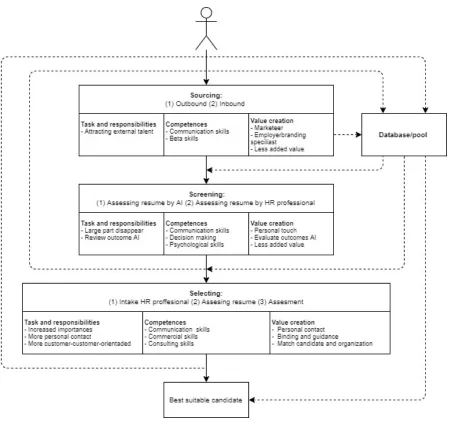
5. The changing role of the HR professional in the recruitment and selection process with the introduction of AI
31 Figure 2: The changing role of the HR professional in the recruitment and selection process with the introduction of AI
6. Discussion
32
6.1 Theoretical implications
This study makes six important contributions to HRM literature. First, as mentioned in earlier work by Beer (1997) and Ulrich (1997), the transformation of the HR role from highly administrative towards a more strategic role, requires a significant change in the role and skills an HR professional must acquire. We support this claim and indicates that the HR professional will perform other tasks and need other competencies in the future. However, other studies also claim that HR professionals still perform operational tasks and prove services to the management instead of making strategic decisions (Valverde et all., 2006)( Woering & van Dartel, 2014). In our study, we see a transformation of the role of HR professionals from rather sourcing to another function, in which the HR professional is a labor market specialist and consultant for clients and candidates. This is still predominantly an operational task, but, one could question whether these activities are of more strategic importance and the HR professional add more value. According to the study by Paauwe & Boselie (2003), it remains unclear how the HR professional could add value despite the extra time. Our findings show that the HR professional of the future adds real value in making a physical and emotional connection with the client and candidate, enabling a positive experience in a world where AI tools take away the human touch in the process. Further, we need to remember that AI cannot completely replace the HR professional and is primarily supportive and developed to make the work of the HR professional easier and more effective and/or efficient. These developments could transform the HR professional into a strategic positioner in the longer term (Ulrich, Younger, Brockbank, and Ulrich, 2012), in which the HR professional acts from the outside-in approach. In this, the HR professional, delivers real value, by acting both internally and externally from the customer’s perspective.