1
Bachelor Thesis
Designing an eHealth approach for students with stress related
problems, based on the goal management oriented intervention
“Right on target”
Nicole Szajda
14.06.2019
Positive Psychology & Technology University of Twente
1st Supervisor: Nienke Peeters
2
Abstract
A Dutch study with 551 student respondents, showed that 62% of them experienced constant stress. This stress can ultimately not only lead to a drop out of college, but also to serious mental and physical health issues. The most influencing self-management behavior to deal with stress, was shown to be time-management, which consists of planning, scheduling and prioritizing daily tasks and goals. To create an eHealth approach that influences the goal-management behavior of students with stress related problems, this study uses the “Right on target” intervention from the “Raise your strengths” stepped care approach. This approach was developed to help chronically ill people to adapt in a flexible way to goals that are threatened by their disease through use of different goal-management strategies.
In this study, six college students participated, two of them in the first two interviews and further four in the usability test. They were chosen based on convenient sampling. A qualitative research design has been chosen to determine, what the actual self-management behavior regarding stress problems of the sample of students is and to ascertain their needs and preferences regarding persuasive and design features of an eHealth application. A low-fidelity prototype was created based on these findings and used in a structured usability test.
The first interview confirmed that ineffective time management is a problem that influences the perceived stress. With the second interview it was shown that there are many persuasive features like personalization, praise and reminders which are regarded as useful by this target group, while their attitude towards social elements for a stress-management prototype was rather negative. The usability test demonstrated that the design of the low-fidelity prototype is logical, and the tasks are perceived as useful, nevertheless, the overview can be better structured and further features added.
3
TABLE OF CONTENTS
1. Introduction………... 4
1.1 Research question……… 11
2. Methods……….. 12
3. Results………. 18
4. Discussion………... 44
5. Conclusion……….. 49
6. References……….. 51
7. Appendix ………... 56
7.1Appendix A – Ethics approval……….. 56
7.2Appendix B – General information………….……….. 58
7.3Appendix C – Informed consent……… 60
7.4 Appendix D – Interview schemes………... 61
7.5 Appendix E – Signed informed consents………... 67
7.6 Appendix F – Persuasive features……….. 74
7.7 Appendix G – Chosen worksheets “Right on target” intervention………. 79
7.8 Appendix H – Extended version Table 2………... 88
4
Introduction
In the past decades, different studies have shown that the number of students
experiencing mental health problems and even committing suicide has risen (de Beurs, Van Dyck, Marquenie, Lange, & Blonk, 2001; Mowbray et al., 2006; Bayram, & Bilgel, 2008). The dominating problem that lead to this rise in mental health issues, is the stress students experience (Misra, & McKean, 2000; de Beurs, Van Dyck, Marquenie, Lange, & Blonk, 2001; Bayram, & Bilgel, 2008). Many studies have been conducted to examine why students seem to experience such an high amount of stress and came to the conclusion that students are exposed to many stressors like financial problems, exam performance (Misra, & McKean, 2000; Andrews, & Wilding, 2004) and health related issues (Misra, & McKean, 2000). Nevertheless, the biggest stressor has been shown to be time management, because study related issues, e.g., deadlines, learning for exams and lectures have to be organized, next to work and finances, and the private life, e.g., friends, sleep and household duties. This leads to a lot of pressure and the need to manage the limited time wisely (Alzahem, Van der Molen, Alaujan, & De Boer, 2014; Heins, Fahey, & Leiden, 1984; Misra, & McKean, 2000).
5
students were officially enrolled, while in 2018/2019 there have already been almost 3 million students (Unterberg, & Spiegel Online, 2018). In the Netherlands, the rise is not as steep as in Germany, but statistical forecasts also predict a slight raise in the following years (Onderwijs, & Wetenschap, 2018). There is a general rise in people who enroll in university and subsequently a rise in students with stress problems (Marx, 2016).
Stress experienced in high amounts goes along with problems that are cognitive, like problems with concentration, memory and organization, emotional, like constant worrying and feelings of anxiety, as well as behavioral, like the loss of appetite (Butler, 1993). For students, these cognitive effects can reduce their academic achievement due to the lack of concentration and memory problems, which influence the learning ability. Moreover, problems with time management and organization often lead to cramming, which lowers the academic performance and in turn self-esteem. An emotional problem students experience is the constant fear of failure due to the pressure experienced through the demands of their studies. This can lead to depression and anxiety problems (Saipanish, 2003). Behaviorally, academic stress can adversely influence personal relationships with others due to lack of time for family and friends (Saipanish, 2003). The loss of appetite and problems with sleeping are also mentioned consequences (Lund, Reider, Whiting, & Prichard, 2010; Misra, & McKean, 2000). In the long run, a high amount of
experienced stress can lead to severe mental consequences and to failing or quitting their studies (Hammen, 2005; Saipanish, 2003; Qin et al., 2015 ).
6
meals and finances, and the use of a financial budget. Another study by Phinney and Haas (2003) found that positive coping with stress by students often includes seeking support from friends or study advisors to talk about the experienced stress. To deal with the biggest stressor, time management, students were found using goals, making to-do lists, and scheduling and planning appointments (Credé, & Kuncel, 2008; Misra, & McKean, 2000). Furthermore, the study of Macan et al. (1990) described that students reported less feelings of tension and a higher feeling of control when they felt their goals are clear and defined.
7
To make the decision, which actions are helpful, and to define clear goals to reach desired outcomes to feel less stressed, goal management strategies can be used which help to adapt to difficult situations and circumstances like situations that are stressful in a flexible way (Arends, Bode, Taal & Van de Laar, 2013). In order to reach desired goals, it is often needed to adjust them to the personal circumstances to be able to maintain them (Gionta, 2009; Voltolina, 2017). It is also possible that some goals do not fit the personal circumstances or are less important than others in a given situation and have therefore to be let go or replaced by new goals. A study from Wrosch, Scheier, Miller, Schulz and Caver (2003) showed that students who let go on unreachable goals reported a higher well-being and less feelings of stress. In order to get a clear overview, which goals are helpful or not, this study will use the Integrated Model of Goal management as used in the study from Arends, Bode, Taal and Van de Laar (2013), which combines two goal management theories, the dual process model of assimilative and
accommodative coping and the Goal adjustment model. This combination leads to four goal management strategies, namely goal maintenance, goal adjustment, goal disengagement and goal reengagement. Goal maintenance and goal reengagement are strategies, which focus on keeping goals to achieve them, while goal adjustment and goal disengagement focus more on how goals can be adjusted or dropped to fit the personal situation (Arends, Bode, Taal & Van de Laar, 2013).
self-8
management behavior by raising their awareness of their own strengths and how these can be used in the first and second step of the approach, and by improving their goal-management behavior in the third step. The third step, which uses the goal management focused “Right on target” intervention (Arends, Bode, Taal & Van de Laar, 2013), will be used in this study. It was created to raise the patient’s flexibility, when coping with goals, which are more difficult to achieve due to the chronic disease by learning to adjust different goal management strategies to their situation. It contains 3 sessions where, with the help of worksheets, the patient learns goal management strategies to be able to adjust the goals and learn, which activities are really priority and, which possibly hinder them in their daily life. This goal management part therefore helps the patients with the setting of their goals and deciding on priorities. The “Right on target” worksheets will be incorporated in the following approach to reduce stress in students by integrating the goal management strategies, so that those can help them to get a feeling of control by providing a good overview of their own goals and tasks and reduce worrying.
Although the “Right on target” intervention was used in cooperation with mental health nurses and general practitioners, the following intervention will not do so. In contrast to the already existing intervention, the focus group in this study are not chronically ill people. For the interview partners, students with stress problems, it can lead to even more stress if they have to also plan and organize meetings into their already stressful daily life and adjust their time management accordingly (Saipanish, 2003). Furthermore, for some people, talking to a general practitioner or mental health nurse, especially when they do not know them, increases stress due to feelings of anxiety (Gould, 2017). In order to not stress the target group even more, a
9
The decision is therefore to develop an eHealth approach and to utilize technology to adjust the goal management behavior of students and to lower this way the level of stress. In this approach the convenience eHealth offers is the strongest reason to use an electronic device or website to enhance stress management behavior. The end users, students, which are facing stress, get the opportunity to have something directly in hand when facing stress (van Gemert-Pijnen, Peters, & Ossebaard, 2013). Another advantage is the possibility of tailoring the product to the user by adjusting the eHealth application to the different needs and stress resilience levels of the users (van Gemert-Pijnen, Peters, & Ossebaard, 2013). Regarding the target group, using a technical device is therefore a sensible choice, because almost everyone has the possibility to connect to the internet and in the Netherlands, 13 of 17 million Dutch people own a smartphone (Newzoo, 2018). Current students have been raised with technology, are familiar with its usage and are also the group, which uses the internet the most (Kezer, Sevi, Cemalcilar, & Baruh, 2016).
In order to gain a behavioral change in the target group, i.e., to change their
10
overly ambitious or stressing goals and activities into smaller ones. The user will be able to formulate (sub) goals and learn with feedback, to stay motivated and to self-monitor behavior. This will, among others, be achieved with the help of the goal management-oriented tasks from the “Right on target” intervention, which will be incorporated in a low fidelity prototype. Furthermore, to make the low-fidelity prototype appealing to the user, persuasive features from the Persuasive System Design from Oinas-Kukkonen and Harjumaa (2008) will be used to improve the goal-management behavior of the students (Appendix F). This Persuasive feature model is split in tables of 4 categories. The first is the primary task support, which focuses on, e.g., the personalization a technology should offer. The second one is the dialogue support with principles like, e.g., reminders and praise. In the third table principles to support system
credibility can be found. The last table deals with principles regarding the social support and the communication from the user and other users. These persuasive features should, when
incorporated into the technology, make the prototype attractive for the target group and persuade them to use it.
11
Research question
Most studies, which use a goal management eHealth approach were conducted for ill people, while almost none used this approach to prevent further illness, and thus mental and physical problems resulting from stress, by improving the actual stress-management behavior and reduce feelings of stress. Therefore, this study will use the “Right on target” intervention to help students with the management of activities and goals, how to decide on their importance, to obtain an overview over those, and raise their well-being. The research question is: What does a goal management-oriented eHealth approach, based on the “Right on target” intervention, need to include to positively influence stress and goal management behavior in the target group students?
This question will be split into four sub-questions, which are based on the first four steps of the CeHRes Roadmap (van Gemert-Pijnen, Peters, & Ossebaard, 2013), which can be used to improve the structure and plan the creation of an eHealth technology. These first four steps are contextual inquiry, value specification, design and operationalization. The formulated sub-questions are:
1. What is the actual problem students face concerning the self-management behavior in stressful situations?
2. Which needs and preferences do the patient partners have regarding the persuasive features and design in the chosen technology, to positively influence the stress management behavior in students of the University of Twente?
12
influence the stress management behavior in students of the University of Twente? 4. In how far is the created eHealth technology understandable and easy to use for students
with stress problems?
Methods
Design
To answer the Research questions, a qualitative research design with semi-structured interviews will be used.
Participants
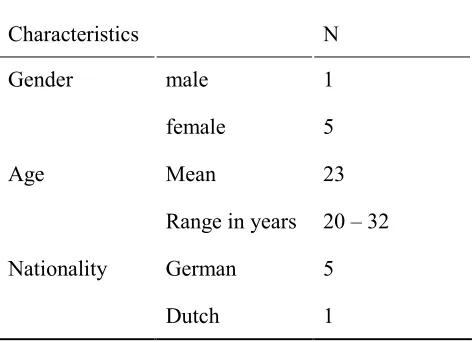
13 Table 1
Demographic information
Characteristics N
Gender male 1
female 5
Age Mean 23
Range in years 20 – 32
Nationality German 5
Dutch 1
Materials
In order to interview the two interview partners and meet the ethical and legal requirements, an informed consent was used, which states that they can withdraw from the interviews at any time, that their personal information will be changed so they are not identifiable and that they agree being recorded (Appendix C).
14
they come up?” and “What problems do you experience with your self-management?”. Furthermore, they were questioned if they ever consulted professional help to cope with their stress problems.
The second interview was about the patient partners usage of technology and how the eHealth approach should be designed in order to help them manage their stress problems. At first, they were asked which technology would be suitable regarding the eHealth approach. Taking into account the problems they mentioned regarding the stress management it was asked “Do you have an idea how a technology could solve those problems?”. Moreover, a table with persuasive features (Oinas-Kukkonen, &Harjumaa, 2008) was given to them and they were asked, which persuasive features they think are useful and which are not. Next, the interview partners were handed the “Right on target” worksheets and asked “You have seen the goal focused worksheets, do you have any idea about how you would like to see them in a eHealth
platform?”. Finally, they were asked if there are other elements, they would think could be useful, e.g., “Are there any other elements you can think of that you want to include?”.
15
interview to test it.
The third interview, the usability test, a structured interview scheme was used, which contained tasks based on the designed low fidelity prototype, ranging from easy, like typing in the name, to difficult, where they had to do a task from the “Right on target” intervention. All interviews, including one and two, have been recorded with a mobile phone
Procedure
The first interview was conducted with each of the two patient partners and took about 30 minutes. The interview procedure was explained to the two patient partners, information about the “Raise your strengths” stepped care approach and the “Right on target” intervention was given (Appendix B), and the informed consent signed when the partner agreed to take part and there were no further questions (Appendix C). Afterwards, with help of interview scheme in Appendix B, the two partners were interviewed to obtain more information about the stressful situations they experience and the problems resulting from it, specifically regarding their self-management behavior. The second interview (Appendix D), taking also about 30 minutes, was about the technologies they use and what they think an eHealth technology should include to be helpful, easy and effective. Here, also the work sheets “right on target” were shown to determine how they could be incorporated in the prototype. The same was accomplished with the table of persuasive features from Oinas-Kukkonen and Harjumaa (2008).
16
interview one and how those could be solved. Subsequently, the third interview took place. Six people, including the two patient partners, performed a usability test with beforehand determined tasks ranging from easy, to modest, to difficult. The participants were informed, that they are going to see a low fidelity application where they can click through but not type something in or swipe. If they agreed to take part, they signed the informed consent. First, each of the six
participants got three minutes to click through the application and get to know it. The participants were asked to think aloud. After these three minutes they were asked if they are ready to start with the tasks. If they were ready, they were first asked to complete 3 easy tasks, to type in the name, to select a password and to skip the tutorial. Next, modest tasks were given, which were to take a look at the long-term goals and to select all to-do list tasks as done. Lastly, they were asked to complete 3 difficult tasks, to watch the tutorial again, to fill in 2 goal
pyramids in the goal pyramid task, and to do the “possible actions” for a threatened main goal task. The participants completed these tasks and any problems were recorded. Afterwards they were asked for feedback and recommendations regarding the design and structure of the prototype.
Data analysis
17
feedback of the first supervisor until the final coding scheme, which answers the Research questions most adequate, was reached. The chosen quotations are those which show most concrete what the category and code is about. For the first interview, the final categories are “Difficulties in stressful situations” and “Self-management behavior”. The categories for the second interview are “Technology”, “Persuasive features to include”, “Persuasive features to exclude”, “Design” and “Other features additional to worksheets”. For the usability tests, two categories have been chosen, the “Procedure” and the “Design” category.
18
Results
In the following chapter the Research questions will be answered. The first and second question will be answered with a table of codes and an explanation. The third question will be answered with help of the first two interviews, the persuasive features mentioned by the patient partners and the chosen behavioral change techniques. The prototype will be shown, and the design will be explained. To answer the fourth Research question, again a table of codes and an explanation will be used.
1. What is the actual problem students face concerning the self-management behavior in stressful situations?
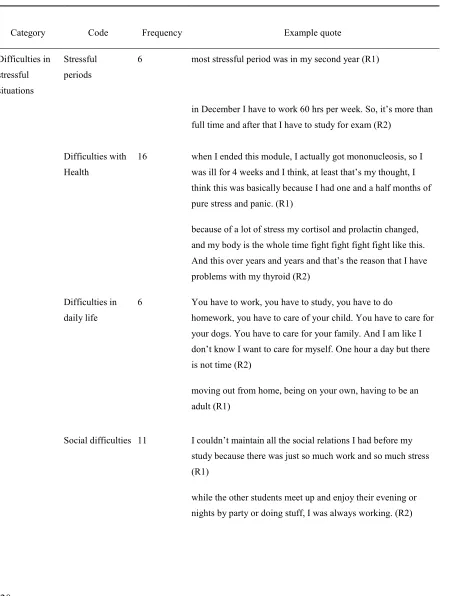
To answer the first Research question, the most important categories and codes from interview one with both patient partners will be discussed (Table 2). The categories are the difficulties in stressful situations and self-management behavior. An extended version of the Table can be found in Appendix H.
Difficulties in stressful situations
The first thing to mention, is that both patient partners describe the experience of high stress as periodically, e.g., for one was the stress higher in the second year, for the other at times, when there was a lot of work in addition to studying. Furthermore, they stated that the bachelor study is more stressful than the master study and that the winter months are especially
19
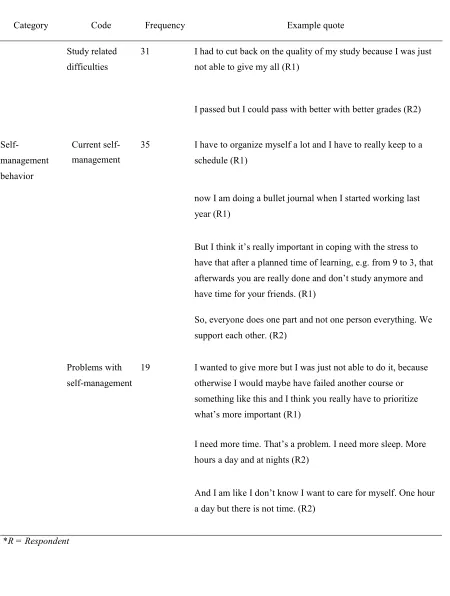
depressive episodes. The difficulties in daily life were mainly the lack of time for daily activities like going out with the dog, sleeping, or cooking. They both stated more impairment in social life, with social contacts that could not be maintained, friends who got upset due to less shared time and also not being able to take part in social activities like parties with other students. Regarding the difficulties in their studies, both mentioned the same problem, that due to the stress and a lack of time they both were busier with passing exams and assignments and could not give all to reach high grades.
Self-management behavior
20 Table 2
Coding scheme - Difficulties in stress situations and Self-management behavior
Category Code Frequency Example quote
Difficulties in stressful situations
Stressful periods
6 most stressful period was in my second year (R1)
in December I have to work 60 hrs per week. So, it’s more than full time and after that I have to study for exam (R2)
Difficulties with Health
16 when I ended this module, I actually got mononucleosis, so I
was ill for 4 weeks and I think, at least that’s my thought, I think this was basically because I had one and a half months of pure stress and panic. (R1)
because of a lot of stress my cortisol and prolactin changed, and my body is the whole time fight fight fight fight like this. And this over years and years and that’s the reason that I have problems with my thyroid (R2)
Difficulties in daily life
6 You have to work, you have to study, you have to do
homework, you have to care of your child. You have to care for your dogs. You have to care for your family. And I am like I don’t know I want to care for myself. One hour a day but there is not time (R2)
moving out from home, being on your own, having to be an adult (R1)
Social difficulties 11 I couldn’t maintain all the social relations I had before my
study because there was just so much work and so much stress (R1)
21
Table 2 continued
Category Code Frequency Example quote
Study related difficulties
31 I had to cut back on the quality of my study because I was just
not able to give my all (R1)
I passed but I could pass with better with better grades (R2)
Self- management behavior
Current self-management
35 I have to organize myself a lot and I have to really keep to a
schedule (R1)
now I am doing a bullet journal when I started working last year (R1)
But I think it’s really important in coping with the stress to have that after a planned time of learning, e.g. from 9 to 3, that afterwards you are really done and don’t study anymore and have time for your friends. (R1)
So, everyone does one part and not one person everything. We support each other. (R2)
Problems with self-management
19 I wanted to give more but I was just not able to do it, because
otherwise I would maybe have failed another course or something like this and I think you really have to prioritize what’s more important (R1)
I need more time. That’s a problem. I need more sleep. More hours a day and at nights (R2)
And I am like I don’t know I want to care for myself. One hour a day but there is not time. (R2)
22
2. Which needs and preferences do the patient partners have regarding the persuasive features and design in the chosen technology, to positively influence the stress
management behavior in students of the University of Twente?
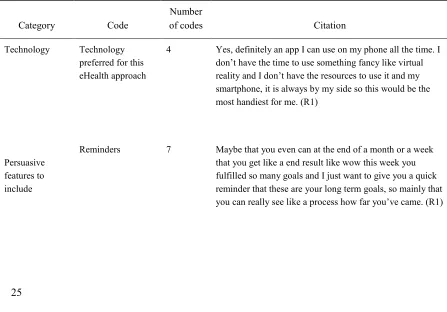
This second Research question will be answered with the categories and codes from the second interview with both patient partners (Table 3). The categories that are going to be discussed are first the chosen “Technology”, then the “Persuasive features to include” and “Persuasive features to exclude”. Moreover, the “Design” and “Other features additional to the worksheets” category, which the patient partners see as useful, will be discussed. An extended version of Table 3 can be found in Appendix I.
Technology
The second interview has shown that both participants clearly prefer an eHealth
application for this approach. Both use their smartphone daily and think that an application is the fastest, cheapest and easiest way to use technology because everyone has a smartphone and they both use other technologies less.
Persuasive features to include
23
periods. Additionally, both participants wanted some expertise in the prototype that the application was designed by knowledgeable people from a university and not just by a
trendsetter. One respondent mentioned this would raise the feeling that the one who designed the application actually cared about the target group instead of just wanting to make money. The other respondent mentioned that this would make the application more credible because it was scientifically researched. Similarity, that the app was designed by a student, with which the target group can identify, was also mentioned. The information, that the application was designed by a student from a university, could be part of the background information in the application, said one patient partner. Furthermore, personalization was mentioned, as the application should be easy adjustable to the users wishes and needs because they can change over time. One patient partner referred to this personalization by stating that especially their own goals should be easy to adjust (Table 3). Further persuasive features named by the patient
24
Persuasive features to exclude
Both patient partners agreed regarding the persuasive features, that the application should not contain any social elements. They both view their organization, management, and goals as something personal, which they do not want to share or to compare with anyone else. Specially the social comparison was disliked because it would cause more stress comparing their own achievements with others. Moreover, the reminder function should be designed with the possibility to turn it on and off and no “use the app” reminder should be used. This was
described by one patient partner as causing more stress because of the feeling that next to all the appointments and things that have to be done, the user has still to use the application. The effect of a “use the app” reminder would therefore be counter-productive.
Design
Regarding the design both patient partners wanted rather muted colors and a minimalistic design, so that the colors and details do not distract from the main goal of the application. One patient partner referred here to another application where mainly green and natural colors were used. The other patient partner showed an application with many colorful symbols on one screen, which the patient partner mentioned as too distracting and confusing. An introductory tutorial on how to use the application, which can be skipped and re-watched when needed was also
25
for a longer time, it should be available all the time and designed in a way that the user can decide when to fill in the tasks and options (Appendix I).
Other elements additional to worksheets
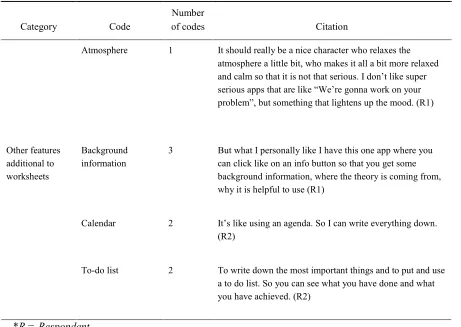
[image:25.612.61.508.422.734.2]Other elements they mentioned as useful in the application were background information, to know the theories behind the tasks and with what goal the application was built for. Due to the fact that both use an agenda they also wanted to see one in the app, to type in appointments and important meetings. Lastly, a to-do list was mentioned as really helpful to watch their own progress and achievements when checking items on the list as done. This was mentioned as motivating due to a positive feeling when the user is able to see how much work is already done.
Table 3
Coding scheme - Needs and preferences for features from the patient partners
Category Code
Number
of codes Citation
Technology Technology
preferred for this eHealth approach
4 Yes, definitely an app I can use on my phone all the time. I
don’t have the time to use something fancy like virtual reality and I don’t have the resources to use it and my smartphone, it is always by my side so this would be the most handiest for me. (R1)
Persuasive features to include
Reminders 7 Maybe that you even can at the end of a month or a week
26
Table 3 continued
Category Code
Number
of codes Citation
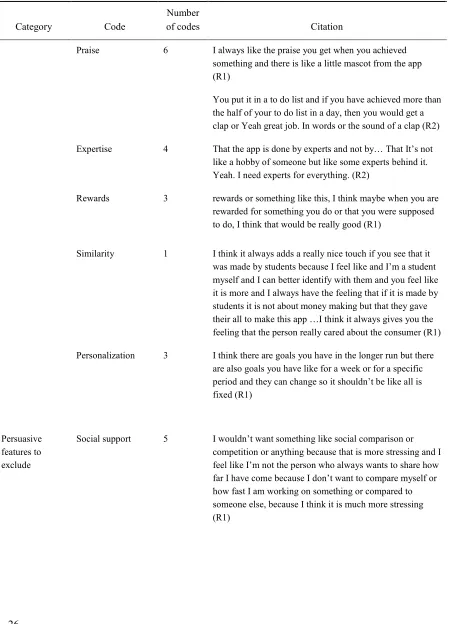
Praise 6 I always like the praise you get when you achieved
something and there is like a little mascot from the app (R1)
You put it in a to do list and if you have achieved more than the half of your to do list in a day, then you would get a clap or Yeah great job. In words or the sound of a clap (R2)
Expertise 4 That the app is done by experts and not by… That It’s not
like a hobby of someone but like some experts behind it. Yeah. I need experts for everything. (R2)
Rewards 3 rewards or something like this, I think maybe when you are
rewarded for something you do or that you were supposed to do, I think that would be really good (R1)
Similarity 1 I think it always adds a really nice touch if you see that it
was made by students because I feel like and I’m a student myself and I can better identify with them and you feel like it is more and I always have the feeling that if it is made by students it is not about money making but that they gave their all to make this app …I think it always gives you the feeling that the person really cared about the consumer (R1)
Personalization 3 I think there are goals you have in the longer run but there
are also goals you have like for a week or for a specific period and they can change so it shouldn’t be like all is fixed (R1)
Persuasive features to exclude
Social support 5 I wouldn’t want something like social comparison or
27
Table 3 continued
Category Code
Number
of codes Citation
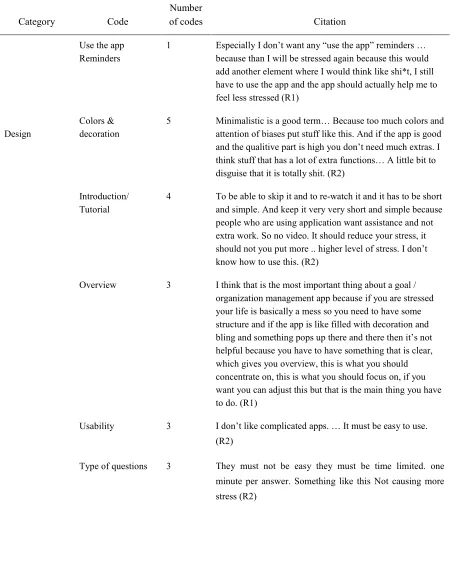
Use the app Reminders
1 Especially I don’t want any “use the app” reminders …
because than I will be stressed again because this would add another element where I would think like shi*t, I still have to use the app and the app should actually help me to feel less stressed (R1)
Design
Colors & decoration
5 Minimalistic is a good term… Because too much colors and
attention of biases put stuff like this. And if the app is good and the qualitive part is high you don’t need much extras. I think stuff that has a lot of extra functions… A little bit to disguise that it is totally shit. (R2)
Introduction/
Tutorial 4 To be able to skip it and to re-watch it and it has to be short and simple. And keep it very very short and simple because
people who are using application want assistance and not extra work. So no video. It should reduce your stress, it should not you put more .. higher level of stress. I don’t know how to use this. (R2)
Overview 3 I think that is the most important thing about a goal /
organization management app because if you are stressed your life is basically a mess so you need to have some structure and if the app is like filled with decoration and bling and something pops up there and there then it’s not helpful because you have to have something that is clear, which gives you overview, this is what you should concentrate on, this is what you should focus on, if you want you can adjust this but that is the main thing you have to do. (R1)
Usability 3 I don’t like complicated apps. … It must be easy to use.
(R2)
Type of questions 3 They must not be easy they must be time limited. one
28
Table 3 continued
Category Code
Number
of codes Citation
Atmosphere 1 It should really be a nice character who relaxes the
atmosphere a little bit, who makes it all a bit more relaxed and calm so that it is not that serious. I don’t like super serious apps that are like “We’re gonna work on your problem”, but something that lightens up the mood. (R1)
Other features additional to worksheets
Background information
3 But what I personally like I have this one app where you
can click like on an info button so that you get some background information, where the theory is coming from, why it is helpful to use (R1)
Calendar 2 It’s like using an agenda. So I can write everything down.
(R2)
To-do list 2 To write down the most important things and to put and use
a to do list. So you can see what you have done and what you have achieved. (R2)
*R = Respondent
3. How should the chosen technology be designed, taking into account the patient partners opinions, regarding persuasive features and behavioral change techniques to positively
influence the stress management behavior in students of the University of Twente?
29
Starting to design, at first an introduction screen was created. To make the application look friendly and still use not to bright and rather muted colors, the whole application was created mainly in the colors green and blue. The colors were chosen due to the natural feeling that one interview partner especially liked in another used application. Holding account with the wish of the patient partners to have a friendly atmosphere by the usage of a character, Mr. Pebbles, a green friendly looking smiley was created which introduces itself at this first screen (Figure 1).
Figure 1
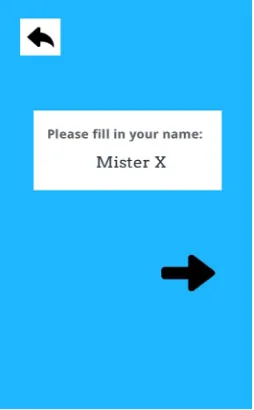
Following the first opening screen, the option to personalize the application was implemented in form of the option to type in the own name. Furthermore, on this and on every following screen an arrow to get to the next page was inserted to guarantee an easy usability as known in other applications. This function was not explicitly mentioned by the interview
30 Figure 2
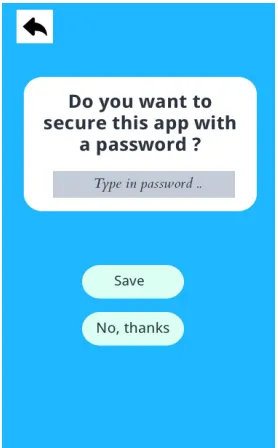
Next to the possibility to type in a name, the application offers the option to secure it with a password. This was implemented due to the statements of the interview partners, that they regard their to-do lists and goals as something personal they do not want to share. To give them the option to make the application fully private, a password can be chosen, but it is not
31
Figure 3
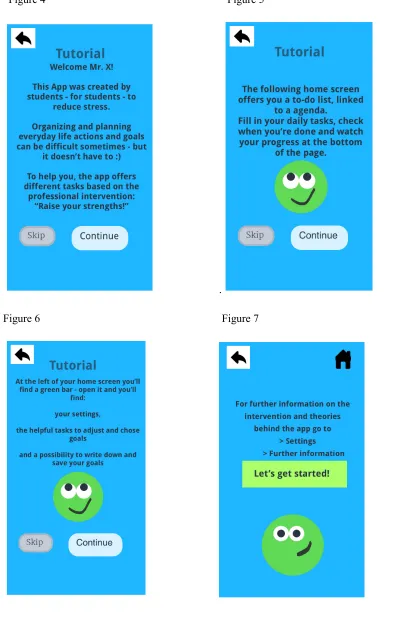
Furthermore, the patient partners wanted a tutorial, which introduces and explains how to use the application, and which can be skipped and watched again at any time. This was ensured by inserting a skip button and the option to watch the tutorial again later under settings. The tutorial follows the password screen and is four screens long (Figure 4-7). On these screens the purpose of the application and the main functions are explained. Moreover, it is mentioned that the application offers more background information about the used intervention and the theories behind it in the settings option (Figure 7). This background information is given due to the wish of the interview partners regarding the persuasive feature “Expertise”, to show that the
32
Figure 4 Figure 5
[image:32.612.69.475.79.706.2].
33
[image:33.612.323.476.367.636.2]The tutorial is leading to the main, the home screen (Figure 8). This screen contains the wanted features adding to the worksheets, the to-do list which is placed in an agenda. Next to every to-do list task, which the user can type in, is a box that can be checked and to see the progress a circle at the bottom of the page will show how much percent have already been completed. To motivate the user and implement the praise and reminders, Mr. Pebbles, the friendly green smiley will pop up with a praising sentence when 100% of the to-do list tasks are accomplished (Figure 9). At the left of the screen will be a green side bar with an arrow, which can be clicked to open further options (Figure 8). In this way, the clear overview, which was important to both interview partners, should be maintained and only the most important things for the day shown at the main screen.
[image:33.612.72.217.390.635.2]34
[image:34.612.71.207.228.434.2]The green side bar will lead to a screen with a list of options. Here, a button for settings will be implemented, as well as a button for their own goals, which the patient partners wanted to be able to adjust and type in, and a button for the chosen tasks from the intervention “Right on target”, described as “Helpful tasks” (Figure 10).
Figure 10
35
[image:35.612.72.202.165.388.2]decides later on that the application should be secured by a password, this option will be also presented here.
Figure 11
The button “Helpful tasks” in Figure 10 will lead to the tasks chosen from the
intervention worksheets from “Right on target”. The chosen tasks will be included, with exercise 1D “Taking stock” under the “activity satisfaction balance” button, 2A “goal pyramid”, 2B “Importance of the main goals” and 2C “Threatened main goals” under “goal pyramids” and 2D “select an important activity” and 3A “Actions for a threatened activity” under “Threatened main goals” (Figure 12). Moreover, each of the three tasks in the application will have a result
36 Figure 12
37
Figure 13 Figure 14
[image:37.612.69.461.99.369.2]38 Figure 15
39 Figure 16
40
Figure 17 Figure 18
[image:40.612.72.215.106.349.2]41
4. In how far is the created eHealth low fidelity prototype understandable and easy to use for students with stress problems?
In order to answer the last research question the usability tests with the six students have been coded and categorized. The chosen categories are “Process”, which describes in how far the tasks were easy to do and the low fidelity prototype logically build, and the “Design” to explain whether the participants found the design of the low fidelity type appealing and why (Table 4).
Process
Overall, all 6 participants described the low-fidelity prototype as easy to use and well designed. Of these six participants, four did not experience any difficulties and mentioned that they knew what they had to do. A problem came up at the difficult task, to fill in two goal pyramids,
because two of the participants clicked at first on the “goal” button instead of the “Helpful tasks” button. The word “goal” was experienced as confusing, because they expected to find the “goal pyramid” task under “goals” instead of “helpful tasks”. Except of the goal pyramid task, the prototype worked as expected and the screens were logically ordered.
Design
42
Participant 3 experienced it as annoying that 2 of 3 completed tasks in the to-do list were described as 60% achievement because it should be 66%. Participant 5 missed some examples under the pictures of the “possible actions” for a threatened main goal task. This participant also wanted some relaxing or meditation tasks, because this could be helpful in getting more distance to the stress and to be able to focus.
[image:42.612.69.517.370.712.2]All in all, the recommendations have been very individual and differing from each other because not one of the six participants recommended the same preferences as the others.
Table 4
Coding scheme - Usability test results
Category Code Frequency Citation
Process Feedback 4 I did not have any difficulties (R1)
it was clear what I had to do. (R3)
it is pretty simple designed so I can handle it pretty easy (R4)
The goal thing was confusing, the rest was logical. (R2)
Design Positive feedback 8 And I really like Mr. Pebbles, he’s a cute guy. (R1)
I think it is very clear, I like the design and how creative you were with the menu on the left side because I can always very easily go to the menu and don’t have to search it, everything important is on the main page, so I like it.
43
Table 4 continued
Category Code Frequency Citation
I think it’s a pretty well-done app, a nice lay-out so I can see everything for the day, I can see the week, it is pretty simple designed so I can handle it pretty easy. I like the explanations before the tasks, so I really understand what is going on and why this is helpful. (R4)
Recommendations 5 I would recommend to make the tutorial instructions a bit
more, with a paragraph or maybe in a different bubble or that you have like maybe in those apps that you first see one sentence and then you click and the next comes up. I think this way it is not, it doesn’t really stand out, the instructions and then it’s like it’s so much text and you have to read it over and over again and I would like it if the instructions come bit by bit. Like in the tutorial and in the tasks. I really like the examples because without I wouldn’t understand it but yeah, more structured for a better overview. (R1)
The only thing which is bothering me is that it states 60% but it should be 66%. But I like that it jumps to 100% when I entered the last task as done. (R3)
Maybe in the threatened main goals part, with the possible actions, maybe under the pictures an example. It might be easier to come up with something when you have an example. What else….maybe something like, a meditation task or something that says okay, take a step back, take a deep breath, something to get some distance to the stress. (R5)
44
Discussion
The question “What does a goal-oriented eHealth approach, based on the “Raise your strengths intervention”, need to include to positively influence stress-management behavior in
the target group students?” will be discussed in the following with the help of the findings from the fourth sub research questions.
The findings of the first question, “What is the actual problem students face concerning the self-management behavior in stressful situations?” have confirmed the findings found in the literature. The first interview showed four different aspects of life: health, social, study and daily life aspects, which are influenced by the stress the interview partners experience. These different aspects and that they are influenced negatively, have also been listed in the book by Tummers (2018), who wrote about different dimensions of wellness, which can also be interpreted as well-being, namely physical, emotional, intellectual, spiritual, social and environmental, which get influenced by the experience of stress. These aspects seem therefore to be of importance when researching the problems students experience when facing stress. Regarding the
45
to fit the own needs and that a lot of stress arises because some actions and appointments are over- or underrated at first, and the priorities are not straight. Based on the findings, there seems therefore to be a need for personalized tools to help enhance the time-management behavior and the setting of priorities to lessen stress in the long run.
The second question “Which needs and preferences do the patient partners have
regarding the persuasive features and design in the chosen technology, to positively influence the
stress-management behavior in students of the University of Twente?” showed that although there have only been two patient partners, they agreed in many wishes and needs regarding the persuasive features and the design. Interestingly, they both agreed strongly, that they do not want any social supporting persuasive features in the prototype, because they see this information about their goals and daily tasks as very private. However, this finding is contrary to most of the designed eHealth interventions, which are mostly focused on incorporating some form of social support, to keep the user motivated by e.g. social competition or in form of support chats, to connect with others who suffer from the same condition or problem (Kreps, & Neuhauser, 2010; Vorderstrasse, Levinski, Melkus, & Johnson, 2016). Only a few studies, like the one from
46
patient partners it would have become clearer, if there are other priorities and needs, students have regarding an application that should reduce stress and should be taken into account. To test this, a questionnaire about which persuasive and design features are favored could be used to reach more people of the focus group to obtain more validity in the features to be used in the design. In order to create a prototype that fits a high amount of the target group, the features mentioned most often in the questionnaires, could be then incorporated.
The third question “How should the chosen technology be designed, taking into account the patient partners opinions, regarding persuasive features and behavioral change techniques
47
wishes that a bigger group of interview partners would mention.
Lastly, the fourth Research question “In how far is the created eHealth technology understandable and easy to use for students with stress problems from the University of
48
chance that, when accounting for the limitations, the eHealth application could actually be used by the target group to gain a behavioral change. Nevertheless, it did not demonstrate, if the goal management tasks are fitting and useful in the long run, it was more focused on the design. Another usability test should therefore focus on the content and if this is useful to lessen the feeling of stress in students.
Limitations and strengths
The strongest weakness of this study was the small number of interview partners used in the first two interviews. More interview partners could have given a clearer direction on which elements and features the prototype should focus on to be representable for a higher amount of the target group students with stress management problems. With two interview partners with different focus points in their needs and wishes, it is rather unclear where the consensus on the needs and wishes of this group is. Furthermore, the design should be performed more careful due to the fact that small faults in design can lead to high confusion by the users. Moreover, to test if the self-management behavior of the target group really can be improved by a prototype with goal management focus, follow-up studies should integrate a usability test specifically for the content of the created prototype and a longitudinal survey design could be used to test whether the feeling of stress decreases with the usage of a prototype over time.
49
eHealth approach because some health or problem related issues are seen as too personal and intimate to be shared, which should be taken into account. Personal goals and daily tasks are seen as such personal and intimate topics. This finding would not have been found without the usage of a user-centered design. This design therefore helped to create a prototype that matches important needs in a sample of the target group. Furthermore, the user centered design and the usability test lead to the design of the prototype, which was mostly regarded as logical and can be a good base for further designs of prototypes within this field when considering the
recommendations.
Conclusion
The idea to create a high-fidelity prototype, based on the given study and the recommendations, for the problem of stress experienced by students should stay a topic of interest. The societal trend is that more and more people study and the demands are not getting less. The effects of study related stress, the constant pressure and the risk for developing mental and physical problems due to the stress, were described in studies from the last decades till now and are also shown in the interviews in this study. There is a high usage of technology, especially by young people, which can be taken as an advantage to create eHealth technology to help
50
51
References
Abras, C., Maloney-Krichmar, D., & Preece, J. (2004). User-centered design. Bainbridge, W.
Encyclopedia of Human-Computer Interaction. Thousand Oaks: Sage Publications, 37(4), 445-456.
Alzahem, A. M., Van der Molen, H. T., Alaujan, A. H., & De Boer, B. J. (2014). Stress management in dental students: a systematic review. Advances in medical education and practice, 5, 167. Andrews, B., & Wilding, J. M. (2004). The relation of depression and anxiety to life‐stress and
achievement in students. British journal of psychology, 95(4), 509-521.
Arends, R. Y., Bode, C., Taal, E., & Van de Laar, M. A. (2013). A goal management intervention for polyarthritis patients: rationale and design of a randomized controlled trial. BMC musculoskeletal disorders, 14(1), 239.
Bakker, K., Hasami, S., Klaver, A., Postema, M., Montanus, R., & De Weerd, B. (2017, July). Studenten en Stress Een onderzoek naar stress onder Groninger Studenten. Retrieved May 28, 2019, from http://groningerstudentenbond.nl/
Bayram, N., & Bilgel, N. (2008). The prevalence and socio-demographic correlations of depression, anxiety and stress among a group of university students. Social psychiatry and psychiatric epidemiology, 43(8), 667-672.
Beiter, R., Nash, R., McCrady, M., Rhoades, D., Linscomb, M., Clarahan, M., & Sammut, S. (2015). The prevalence and correlates of depression, anxiety, and stress in a sample of college students. Journal of affective disorders, 173, 90-96.
52
Credé, M., & Kuncel, N. R. (2008). Study habits, skills, and attitudes: The third pillar supporting collegiate
academic performance. Perspectives on psychological science, 3(6), 425-453.
Crowther, M. S., Keller, C. C., & Waddoups, G. L. (2004). Improving the quality and effectiveness of computer‐mediated instruction through usability evaluations. British Journal of Educational Technology, 35(3), 289-303.
de Beurs, E., Van Dyck, R., Marquenie, L. A., Lange, A., & Blonk, R. W. (2001). De DASS: een vragenlijst voor het meten van depressie, angst en stress. Gedragstherapie, 34(1), 35-54. Gionta, D. (2009, December 10). Can being more organized be good for your health? Retrieved
March 17, 2019, from https://www.psychologytoday.com/us/blog/occupational-hazards/200912/can-being-more-organized-be-good-your-health
Gould, W. R. (2017, August 25). Why you're scared to see the doctor (and how to get over it). Retrieved March 17, 2019, from https://www.nbcnews.com/better/health/real-reason-going-doctor-gives-you-anxiety-ncna795566
Hammen, C. (2005). Stress and depression. Annu. Rev. Clin. Psychol., 1, 293-319.
Heins, M., Fahey, S. N., & Leiden, L. I. (1984). Perceived stress in medical, law, and graduate students. Journal of Medical Education, 59(3), 169-179.
Jeng, J. (2005). Usability assessment of academic digital libraries: effectiveness, efficiency, satisfaction, and learnability. Libri, 55(2-3), 96-121.
Keyes, C. L. (2002). The mental health continuum: From languishing to flourishing in life. Journal of health and social behavior, 207-222.
53
Kreps, G. L., & Neuhauser, L. (2010). New directions in eHealth communication: opportunities and challenges. Patient education and counseling, 78(3), 329-336.
Latham, G.P., & Locke, E.A. (1991). Self-regulation through goal setting. Organizational Behavior and Human Decision Processes, 50, 212-247.
Lentferink, A. J., Oldenhuis, H. K., de Groot, M., Polstra, L., Velthuijsen, H., & van Gemert-Pijnen, J. E. (2017). Key components in eHealth interventions combining self-tracking and persuasive
eCoaching to promote a healthier lifestyle: a scoping review. Journal of medical Internet research, 19(8), e277.
Lorig, K. R., & Holman, H. R. (2003). Self-management education: history, definition, outcomes, and mechanisms. Annals of behavioral medicine, 26(1), 1-7.
Lund, H. G., Reider, B. D., Whiting, A. B., & Prichard, J. R. (2010). Sleep patterns and predictors of disturbed sleep in a large population of college students. Journal of adolescent health, 46(2), 124-132.
Macan, T. H., Shahani, C., Dipboye, R. L., & Phillips, A. P. (1990). College students' time management: Correlations with academic performance and stress. Journal of educational psychology, 82(4), 760.
Marx, U. (2016, December 30). Überforderung: Studenten unter Stress. Retrieved June 22, 2019, from https://www.faz.net/aktuell/beruf-chance/campus/studenten-sind-vom-stress-oft-ueberfordert-14588427.html
Misra, R., & McKean, M. (2000). College students' academic stress and its relation to their anxiety, time management, and leisure satisfaction. American journal of Health studies, 16(1), 41.
Newzoo. (2018, September). Top Countries/Markets by Smartphone Penetration & Users. Retrieved from https://newzoo.com/insights/rankings/top-50-countries-by-smartphone-penetration-and-users/ Oinas-Kukkonen, H., & Harjumaa, M. (2008, June). A systematic framework for designing and
evaluating persuasive systems. In International conference on persuasive technology (pp. 164-176). Springer, Berlin, Heidelberg.
54
Onderwijs, M. V., & Wetenschap. (2018, September 17). Prognose aantal studenten wo.
Retrieved March 17, 2019, from https://www.onderwijsincijfers.nl/kengetallen/wo/studenten-wo/prognoses-aantal-studenten-wo
Phinney, J. S., & Haas, K. (2003). The process of coping among ethnic minority first-generation college freshmen: A narrative approach. The Journal Of Social Psychology, 143(6), 707-726.
doi:10.1080/00224540309600426
Qin, Z., Zhou, X., Pandey, N. R., Vecchiarelli, H. A., Stewart, C. A., Zhang, X., ... & Hill, M. N. (2015). Chronic stress induces anxiety via an amygdalar intracellular cascade that impairs
endocannabinoid signaling. Neuron, 85(6), 1319-1331.
Saipanish, R. (2003). Stress among medical students in a Thai medical school. Medical teacher, 25(5), 502-506.
Scott, E. (2018, January 28). Secret Weapon Against Stress: Getting Organized! Retrieved
March 17, 2019, from https://www.verywellmind.com/tips-on-getting-organized-3145158
Seligman, M. E. (2004). Authentic happiness: Using the new positive psychology to realize your potential for lasting fulfillment. Simon and Schuster.
Tummers, N. E. (2018). Stress management: A wellness approach. Human Kinetics.
UniHealth.nd. 2017 University student wellbeing survey. Retrieved on 13 May 2019, from: https://unihealth.uk.com/reports/
Unterberg, S., & Spiegel Online. (2018, November 27). Statistik: Studentenrekord an deutschen Hochschulen - SPIEGEL ONLINE - Leben und Lernen. Retrieved March 17, 2019, from http://www.spiegel.de/lebenundlernen/uni/studenten-an-hochschulen-zahl-steigt-auf-2-8-million n-neuer-rekord-a-1240584.html
van Gemert-Pijnen, J. E. W. C., Peters, O., & Ossebaard, H. C. (Eds.). (2013). Improving eHealth. Den Haag: Eleven international publishing.
van Veen, Y., Peeters, N.,Bohlmeijer, E., & Bode, C. (2018).Stapsgewijze aanpak sterker in je kracht. Vorderstrasse, A., Lewinski, A., Melkus, G. D. E., & Johnson, C. (2016). Social support for diabetes self-
55
Voltolina, V. (2017, December 07). 3 Easy Tricks To Get Organized And Reduce Stress. Retrieved March 17, 2019, from https://www.huffpost.com/entry/organization-and-stress_n_5851704/amp
World Health Organization. (1946, June). Health is a state of complete physical, mental and social well-being and not merely the absence of disease or infirmity. In International Health Conference, New York (pp. 19-22).
Wrosch, C., Scheier, M. F., Miller, G. E., Schulz, R., & Carver, C. S. (2003). Adaptive self-regulation of unattainable goals: Goal disengagement, goal reengagement, and subjective well-being.
Personality and Social Psychology Bulletin, 29, 1494–1508. doi: 10.1177/0146167203256921. Zajacova, A., Lynch, S.M., & Espenshade, T.J. (2005). Self-Efficacy, Stress, and Academic Success in
College. Research in Higher Education,46(6), 677-706 from:
56
58
Appendix B - General Information
In the context of my Bachelor Thesis, in the field of Positive psychology, I am trying to develop a low fidelity prototype of an technology for students with stress management problems to help them dealing with those. I will do this based on a stepped care approach called “Raise your strengths”, from which certain worksheets from the “Right on targert” intervention will be used later in the eHealth technology prototype. This existing stepped care approach was made to enhance self-management behavior in chronically ill patients. To do so, they created sessions for general practitioners, mental health nurses and
patients, in which the patients could fill in worksheets with tasks and questions about their strengths and their goals. With these tasks, the patients were motivated to find out more about their strengths, how they can be used to reach desired goals and also how to prioritize the own goals for a better well-being. The goal oriented part of this approach, the “Right on target” intervention is what I will use to incorporate in the eHealth technology to enhance stress management behavior. The chosen worksheets will be shown to you before the second interview.
To create an eHealth prototype that matches your needs, I would like to learn more about the stress related problems you are experiencing, how they affect your daily life, ideas on how this could be improved and, of course, also how you use technology in general and in this context. The interviews are designed to better serve the needs and requirements of the users in the intervention so that the product is really appealing and helpful.
59
first one I want to know more about you and your daily life situation regarding stress. I am also interested in your self-management behavior and what you tried so far to cope with the problem. Also if you already used technology to help you dealing with it. In the second one we will together try to figure out which health technology you think could be most useful for you and what it should contain to be really helpful and effective. To do so, I will show you worksheets of the“Right on target” intervention, in which a lot of tasks are given to better structure the own goals.
The last interview will be a pilot test, where we will try to find out, if the created low fidelity prototype suits your needs and matches your expectations. Before this test I will give you further information and instruction how it will be done. Remember that this test is not done to test you, but in how far the prototype is useful. There is nothing you can do wrong here, it is only about your opinion.
This means that I am really interested in your experience and your needs. Like mentioned, there are no right or wrong answers, you are the expert on this topic and your experience and needs count. With your permission, I will record the interviews to transcribe them afterwards and work with them in my thesis. Your data will, of course, remain anonymous and the interview transcript and used quotations also. You’re always free to stop or cancel the interview.
60
Appendix C – Informed consent
Informed Consent for standard research
‘I hereby declare that I have been informed in a manner which is clear to me about the nature and method of the research as described in the aforementioned information paper. My questions have been answered to my satisfaction. I agree of my own free will to participate in this research. I reserve the right to withdraw this consent without the need to give any reason and I am aware that I may withdraw from the interview at any time. I agree that the interviews will be recorded by the researcher on a technical device, secured by a pin code and only used by the researcher for the report. My personal information will be made completely anonymous in the report. My personal data will not be disclosed to third parties without my express permission. If I request further information about the research, now or in the future, I may contact Nicole Szajda by email,
Signed in duplicate:
……… ……… Name subject Signature
I have provided explanatory notes about the research. I declare myself willing to answer to the best of my ability any questions which may still arise about the research.’
61
Appendix D – Interview schemes First interview questions:
General:
Who are you and how are you? How old are you?
Where are you from (country may be enough)? Since when are you a student?
What are you studying?
How would you describe your study? (in general terms, not the specific subject)
Recognition of the disease and symptoms
In how far do you experience stress due to your study? What does stress mean to you? How would you define it? Since when do you experience problems because of stress? What problems did you experience because of your study?
Did you ever consult a doctor or other medical professionals because of these problems? Why/Why not?
Impairments in daily life
In how far did you experience impairment in your study due to the stress?
Did/Do you experience any impairments in your social life because of the stress? If yes what kind of impairments do/did you have experienced in your social life? Did these stress problems also impair other parts of your daily life?
62
Self-management
How do you manage the stress problems if they come up? Are there some strategies that you use in your daily life? Do they work for you?
Are there strategies that you tried but which did not work? Why do you think they did not suit you?
What problems do you experience with your self-management? Which behaviour improves your current situation?
Is there anything which makes it easier for you to cope with the problems?
Other people
How do other people react to your stress problems? In how far do you feel others understand you problems?
63
Second interview scheme:
Showing beforehand the goal management oriented worksheets and the tables of persuasive features, explaining them.
Technology
● Do you use technical devices? If yes, which ones?
● How often do you use those devices? (every day, a few times a week, once a week, once a month, less than once a month)
(How much time do you spend with technical devices per day?)
● Are there technical devices (if needed: e.g. websites, apps, other technologies) which helped you to deal with stress ?
● If yes, which ones?
→ How did they help you? → Are you still using them?
→ Did they help you with your problems in the long run? Why/why not? ● If no, could you think of one which could help you in your daily life?
→ What kind of technology would you prefer regarding this eHealth intervention? ● What are the most problematic behaviours that you have?/ Referring to the problems
mentioned
→ Do you have an idea how a technology could solve those problems?
→ I brought a table with examples of persuasive features, which features do you like to see on a eHealth platform to make it more usable for you?
64
● Are there any other elements you can think of that you want to include? ● Are there any other elements you can think of that you want to exclude?
65
Third interview scheme:
Beforehand:
There are 2 buttons which have no further screen, the “Reminders” and the “Language” buttons. Furthermore, there is no option to type something in. When performing a task, please just tell me where you would click to type something in. You can only click through the app and not swipe or scroll. Please think aloud while doing the tasks. Do you have further questions?
Then I would like to start with some easy tasks.
The first one would be to please type in your name.
Great! The second one is to please select a password.
Good, the third easy one is to please skip the tutorial.
Now the tasks will be a little bit more difficult, I like you to please take a look at your long-term goals.
66
Then I like you to fill in two goal pyramids in the goal pyramids task.
Good, go back to the home screen please.
Now please enter “possible actions” for threatened main goals task.
Great! Go back to the home screen please.
And last I like you to select all “To-do list” tasks as done.
Thank you!
Now I like to know if you have some recommendations regarding the app?
(If no, is there something missing? Are there things you did like/did not like?)
(If no, imagine you are really stressed out, would this app be useful to you as it is?)
67
74
79