An Estimated Replacement Approach for Stable
Control of a Class of Nonlinear Systems with
Unknown Functions of States
Nguyen Duy Hung and Nguyen Thi Huong Lan, VIELINA
Abstract—In this paper, we propose an approach for stable control of a class of nonlinear systems, which can be expressed in a state-feedback linearizable form with unknown nonlinear functions of states. The idea is to replace the unknown functions with estimated (not need to be accurate) functions and to use a universal approximator to compensate for the error caused by the replacement. For achieving a stable controller with a continuous control signal, a bisigmoid function based compensator is used and studied. In addition, the paper also deals with the control problem of input constraints and the way to examine this subject.
Index Terms—nonlinear control, unknown functions, estimated replacement, universal approximators.
I. PROBLEM FORMULATION
Consider a SISO nonlinear system in its full state-feedback linearizable form [3]
1 2
1
1
( ) ( )
n n
n
x x
x x
x f g
y x
−
=
=
= +
=
x xu
⊂ ℜ
(1)
where is a state vector,
is an input ( , are compact sets), is an output, and , are unknown, but continuous and bounded functions. The control objective is to design a locally stable controller for tracking a reference trajectory with bounded error. Because
[
x x1, 2, ,xn]
T n= ∈Ωx
x …
( ) u
u t ∈Ω ⊂ ℜ Ωx Ωu
( )
y t ∈ℜ f( )x ∈ℜ g( )x ∈ℜ
( )
r t ∈ℜ g( )x can not
be zero, without loss of generality, we can assume that for all . Additionally, it also assumes that x
are measurable whereas and its derivatives up to the n-th one are bounded and known.
( ) 0
g x > x∈ Ωx ( )
r t
For the given control problem, many adaptive designs have been developed as shown in [7]-[12] and the references therein.
In general, the unknown function(s)
Manuscript received July 6, 2007. VIELINA is the Vietnam Institute of Electronics, Informatics, and Automation. Address: 156A Quan Thanh St., Hanoi, Vietnam.
The authors are with the Center of Automation and Control, VIELINA (e-mail: [email protected]).
( )
g x or g( ), ( )x f x is/are approximated by adjustable function approximator(s)
( , g)
g x θ or g( ,xθg), ( ,f xθf) respectively, where θ θg, f
are weights or parameter vectors. As the aim is to design a stable adaptive controller with suitable adaptation law to reduce uncertainties in each case, g must be other than zero on the domain Ωx to avoid singularities at during adaptation. To deal with such a problem a parameter projection method is employed (
0
g=
[10], [11]), but this situation can also be avoided when using techniques presented in some schemes, such as a modified Lyapunov function ([7]) or a modified term ([8]).
II. AN ESTIMATED REPLACEMENT APPROACH
Suppose that, from a knowledge of the system we can find out continuous and bounded functions f( )x and
such that if we replace
( ) 0
g x > ( )
f x , g( )x in (1) with f( )x , g( )x respectively, we can approximate xn with bounded error, i.e.,
( , )
dxn u W
Δ x ≤ holds for all x∈Ωx, u∈Ωu where
(
)
( , ) ( ) ( ) ( ) ( ) ( ) ( )
dxn
f g
u f f g g
u
Δ = − + −
= Δ + Δ
x x x x x
x x
u
and is a bounded constant. Based on a method mainly derived from
0
W >
[3], let us define an error system
(2)
( , ) T
E t x =k e
where e x r= − , rT = ⎣⎡r r, ,…,r( 1)n− ⎤⎦ ,kT = ⎡⎣k1,…,kn−1,1⎤⎦
with sn−1+kn−1sn−2+ +… k1 is a Hurwitz polynomial.
In the sense of performance analysis, the error system provides a quantitative measure of the closed-loop system performance. Hence, once the system dynamics are used with the definition of the error system to define the error dynamics, a Lyapunov candidate is then used to provide a scalar measurement of the error system. In addition, in terms of boundedness, the error system and the Lyapunov candidate are also chosen such that bounding V will place bounds on the error system
( )
V E
E and the system states x too.
proof that (2) satisfies the error system assumption (see Appendix A). Additionally, for the time being, we ignore the local stabilization case and do not take the state and input bounding conditions into consideration. Thus if we denote
[
1, , 1]
T
E = k kn−
k … and ,
the error system (2) can be rewritten as ( 2) 1 , 2 , , 1
T
E =⎡⎣x −r x −r xn− −r −
d … n ⎤⎦
(
( 1))
( , ) TE E n n
E t x =k d + x −r − and its time derivative (i.e., the error dynamic) becomes
(3) ( )
( ) .
T n
E E n
T n
E E dxn
E x r
r f g
= + −
= − Δ − + +
k d
k d u
In terms of feedback linearization, use the control law
(
)
1 T ( )n E E
u u g= = − −k d +r − −f ηE (4)
where η >0 and consider the Lyapunov candidate 2
1 2 ( )
V E = E , then the time derivative of the Lyapunov function along the solution of the error dynamic (3) is bounded by
(
)
2 2 1 2
2 2
2 1
2 2
. 2
dxn
V EE E E
V E W E
W
V W
W V
η
η η
η η
η η
η η
= = − − Δ
≤ − − +
= − + − −
≤ − +
E
Let V0 and E0 denote the V and E at t=0 , thus according to the lemma of ultimate bound (Appendix B) with
1
m =η and
2 2 W2
m
η
= , we obtain
(
)
(
)
2
0 2
2
2 0 2
1 2
1
t t
H
t t
H
W
V e V e V
W
E e E e
η η
η η
η
η
− −
− −
≤ − + =
⇒ ≤ − + =E
and
2 2 lim
2
H t
W
V V
η ∞
→∞ = = , tlim H
W
E E
η ∞
→∞ = = .
Remark 1: If we denote η=⎣⎡ηk k1 1, +ηk2,…,kn−1+η⎤⎦T
then and the control law (4) can be
formulated as
T
E E+ηE=
k d ηTe
(
)
1 ( )n T
u u g= = − r −η e− f (5)
Remark 2: If V0 ≤V E
(
∞ then( )
(
0)
(
0)
0≤ ≤V max V V E, ∞ ⇒ E ≤max E ,E∞ (6) for all t≥0.
Remark 3: From (6), we see that if we choose E0 small enough, the closed-loop system performance depends only on the error bound W in approximating xn without considering
about how large the individual approximation errors
and in replacing the unknown functions are. This means that we can replace the unknown functions with preferred estimated functions at our convenience provided that the approximation error
( )
f
Δ x
( )
g
Δ x
dxn
Δ is bounded by W . Above results lead to the state of the following theorem.
Theorem 1: The state-feedback control law (5) ensures that the solution of the error dynamic (3) is uniformly ultimately bounded by (6) if there exist continuous and bounded functions
( )
f x and g( ) 0x > such that Δdxn( , )x u ≤W holds for all
∈Ωx
x , u∈Ωu where W >0 is a known bounded constant.
Proof: According to a theorem of condition for uniform ultimate boundedness ([2]), in proving Theorem 1 we wish to find some γ1( ), ( )E γ2 E ∈K∞ and γ3( )E ∈K defined on
[
0,∞)
such that1 2
3
( ) ( ) ( )
( ) ( )
E V E E
V
V E E E
E
γ γ
γ
≤ ≤
∂
= ≤ −
∂
(7)
for ∀E ≥R and with knowing that is continuously differentiable on
0
t≥ V E( )
E ≥R.
Choosing γ1( )E =γ2( )E =V E( )=21 E2 we have 2
2 1
( )
2
( ) (1 ) 2 W
V E V
W
E V
η η
εηγ ε η
η
≤ − +
= − − − +
for ε satisfying 0< <ε 1. Let γ3( )E =εηγ1( )E we see that
3
( ) ( )
V E ≤ −γ E if and only if
2 2 2(1 )
W V
ε η ≥
− , or
equivalently,
1
W E
ε η ≥
− =R . As the chosen functions
fulfill requirement (7), Theorem 1 is thus proved.
Theorem 1 shows that it is possible to define (static) stabilizing controllers by applying the method of estimated replacement if we could find substitution functions satisfying the bounding condition over a valid region. But a problem arises when W is large, since though the error system bound may be decreased by choosing η large, the control signal may
)
0≤ ≤V V E(
∞)
for all since is positive definite so that it can not grow greater than . Furthermore, in the case of0
t≥ V
(
increase in amplitude and may start to oscillate. To dealing with such a problem, the usual approach is to compensate for error effects caused by the replacement. For this purpose, a number of techniques, such as nonlinear damping and dynamic normalization ([3]) may be used. In this sense, here we propose a method which comes from the notion that if we can approximate with sufficiently small error, it is possible to include an additional stabilizing component to increase the robustness of the closed-loop system.
( , )
dxn u
Δ x
Because is a continuous and bounded function defined on compact sets, it can be approximated by a universal approximator (such as a fuzzy system or a neural network) with arbitrary accuracy. Therefore by assumption that there are data available for tuning of an approximator to match certain condition, we can use it as a compensation component to form a robust state-feedback control law. This subject will be studied in more detail later in this paper. Now, before turning to developing a stable controller for making the closed-loop system more robust to system uncertainties, we will investigate some mathematical base.
( , )
dxn u
Δ x
III. MATHEMATICAL BASE Define a real-valued scalar function
(
)
μE( , , )ρ κ E = E ρ−sgn( ) bsig( , )E κ E (8) where 0< ≤ρ 1, are parameters, is a variable,
is the sign function, and 0
κ > E∈ℜ
sgn( )E bsig( , ) 2 /(1κ E = +e−κE) 1−
is bisigmoidal.
Lemma 1. The function (8) reaches its positive maximum value of μE_ max( , )ρ κ =μE( , ,ρ κ ±Em) at ±Em where
m
x=κE is the unique solution of the equation
(9) 2
μx( , ) (ρ x = ρ+1)e− x+2(ρ−x e) −x+ − =ρ 1 0
Proof: Because (8) is an even function, thus we can take only
the case , i.e., into
account. It follows that the derivative of μ with respect to can be calculated as
0
E≥ μE+( , , )ρ κ E =E
(
ρ−bsig( , )κ E)
E+
E
(
)
(
)
2
2 2
μ ( , )
( 1) 2( ) 1
μ
1 1
x x
x E
x x
x
e x e
d
dE e e
ρ
ρ − ρ − ρ
+
− −
+ + − + −
= =
+ +
where x=κE≥0 . Obviously, μE+ has its extremum at
m m
x =κE if satisfies μx( ,ρ κEm) 0= . Next we will show that, x x= m is the unique solution of (9) and μE_ max( , )ρ κ is a positive maximum.
Take the derivative of μx( , )ρ x with respect to x, we obtain
μx( , ) 2 x ( 1) ( 1) x
d x e x e
dx ρ ρ ρ
− ⎡ − ⎤
= ⎣ − + − + ⎦.
For studying μx( , )ρ x , solve the equation dxd μx( , ) 0ρ x =
or equivalently
( 1) ( 1) x
x ρ ρ e−
− + + = − + . (10)
This equation is in form of x b ae+ = x where a≠0, thus according to [13] it has the single root, equal to − −b w(−ae−b)
where w( )x is the Lambert w-function (Note that the Lambert w-function is the inverse function of x=w( )x ew( )x ). The substitution for a= − +(ρ 1) and b= +ρ 1 leads to the solution of (10), afterward denote as x0= + +ρ 1 w(p) where
( 1)
p( ) (ρ = ρ+1)e− +ρ .
Because of dp (2 )e ( 1) 0
d
ρ
ρ ρ
ρ = − + − + < , p is decreasing
for ρ∈
(
0,1]
, therefore p(1) p( ) p(0)≤ ρ < or p∈ ⎣⎡2 e2,1e)
. Consequently μx( , )ρ x has the unique extremum at x0 and if we denote μ0=μx( ,ρ x0) then[
]
(
)
(
)
(
)
0 0
2
0 0
2 2( 1)
w(p) ( 1)
w(p) 2 2( 1)
( 1) ( 1)
( 1) 2
2 2
μ ( 1) 2( ) 1
1 ( 1)
1 2 ( 1) w(p)
w(p) ( 1)
( 1) w(p)
2 1 w(p) 1
( 1)
w (p) w(p)
2 1 w(p) 1
1 1
w(p) 1
x x
e x e
e
e
e e
e
e
e
e
ρ
ρ
ρ
ρ ρ
ρ
ρ ρ ρ
ρ
ρ ρ ρ
ρ
ρ
ρ ρ
ρ
ρ ρ
ρ
− −
− +
− +
− +
− +
− +
− +
= + + − + −
⎛ ⎞
= + ⎜ ⎟
⎝ ⎠
1
+ − + − + −
⎡ ⎤
= + ⎢ ⎥
+
⎢ ⎥
⎣ ⎦
− + +
+
= − + + −
+ +
− +
=
−
. 1
ρ+
Since the Lambert w-function is strictly increasing on
[
−1 e,∞)
we get w(2 e2) w(p) w(1 )≤ < e , thus x0 >1 and 0μ <0 for all ρ∈
(
0,1]
. In addition μx( ,0) 4ρ = ρ>0 andμx( , )ρ ∞ = − ≤ρ 1 0 so that the graph of μx( , )ρ x cuts the
x-axis only at xm∈
(
0,x0)
as well as the extremum is the minimum of μ0 μ
( , )
x ρ x .
Note that
(
)
2μ ( , )
μ
1
x E
x x d
dE e
ρ
+
−
= +
, we can infer that μE+
reaches its maximum value of μE+( , ,ρ κ Em)=μE_ max( , )ρ κ at Em xm 0
κ
= > and as μE+( , , 0) 0ρ κ = , the unique maximum is positive. This proves Lemma 1.
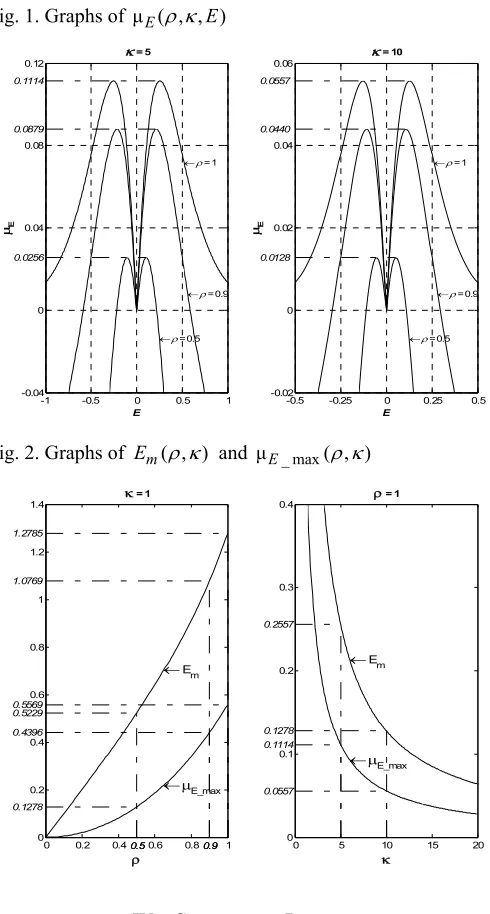
of (8) in cases of κ=5 and κ=10 with ρ =0.5, 0.9,1 in each example whereas Fig. 2 illustrates the graph of Em( , )ρ κ and
_ max
μE ( , )ρ κ with respect to ρ and in the case of κ κ=1
[image:4.612.53.298.132.589.2]and ρ =1 respectively. Fig. 1. Graphs of μE( , , )ρ κ E
-1 -0.5 0 0.5 1
-0.04 0 0.04 0.08 0.12
E μE
κ = 5
←ρ = 1
← ρ = 0.9 ←ρ = 0.5
0.1114
0.0879
0.0256
-0.5 -0.25 0 0.25 0.5 -0.02
0 0.02 0.04 0.06
E μE
κ = 10
←ρ = 1
←ρ = 0.9 ←ρ = 0.5
0.0557
0.0440
0.0128
Fig. 2. Graphs of Em( , )ρ κ and μE_ max( , )ρ κ
0 0.2 0.4 0.6 0.8 1 0
0.2 0.4 0.6 0.8 1 1.2
1.4 κ = 1
ρ
←Em
←μE_max
0.5 0.1278
0.5 0.5229
0.9 0.4396
0.9 1.0769
1.2785
0.5569
0 5 10 15 20
0 0.1 0.2 0.3
0.4 ρ = 1
κ
←Em
←μE_max 0.1114
0.2557
0.0557 0.1278
IV. CONTROLLER DESIGN
Recall from previous studies that we are going to develop a stable controller in the proposed approach called estimated replacement. The main concept in this approach is to seek estimated functions fitting the bounding requirement and to use a compensation technique to make the controller robust to uncertainties. The later problem can be considered in this section as follows.
Suppose that we have to design a controller for the tracking problem with the aim to keep the error system bounded by
W E
η
∞ = (it is assumed that E0 can be selected small
enough). However the estimated functions available for use only guarantee that
(
)
( , ) ( ) ( ) ( ) ( )
dxn u f f g g u W
Δ x = x − x + x − x ≤
for all x∈Ωx, u∈Ωu where W . We will search for a solution to cope with this problem.
W
>
As mentioned above, the error function Δdxn can be approximated by the universal approximator within a compact set, which hereafter we denote as FΔ( , , )x u θ where θ∈ ℜp is an adjustable parameter vector and FΔ( , , )x u θ ∈ ℜ. Right now let FΔ( , , )xu θ represent a neural network or fuzzy system with tunable parameters θ. Assume that be the known approximation error bounding constant, which satisfies
0
WΔ >
( , , ) dxn( , )
FΔ xu θ − Δ xu ≤WΔ (11)
for all x∈Ωx , u∈Ωu and θ∈ℜp is the best known parameter vector available from adjusting the parameters of the approximator. Therefore the problem for approximating xn with error bound W can be considered as the problem for approximating Δdxn with error bound W . Thus, we can avoid the difficulty of dealing with choosing estimated functions correctly by working with a proper approximator to compensate for the effect of the replacement error. But one must determine how small W must be to achieve the desired closed-loop system performance.
Δ
Δ
In order to solve this problem, now we introduce the compensation component defined as
(
( , , )
)
bsig , ( , , ) ( )
c F u
u E
g κ
ρ
Δ
Δ
= − x θ x θ
x F u (12)
where ρ, κ are constants satisfying 0< ≤ρ 1, κ>0 and u is specified by (5). Then adding the component (12) together with the state-feedback control law (5) forms the new control law
c
u u u= + (13)
and consequently the following theorem is the extension of Theorem 1 to this case.
Theorem 2: If there exist an approximator FΔ( , , )xu θ and a parameter vector θ such that FΔ( , , )x u θ can approximate
( , ) dxn u
Δ x with error bounded by WΔ satisfying 2
_ max 2
0<WΔ≤ W − ρημE ( , )ρ κ (14)
for all x∈Ωx , u∈Ωu where 0< ≤ρ 1, κ >0 and η >0 then the state-feedback control law (13) ensures that the solution of the error dynamic (3) is uniformly ultimately bounded by (6).
Proof:
x
then from E= −ηE g+ ( )xuc− Δdxn( , )u we have
(
2 2
2
( ) ( , )
1
bsig( , )
1 sign( ) bsig( , ) .
c dxn
dxn
dxn
V E Eg u E u
E EF EF E
E E F E EF
η
η κ
ρ
η ρ κ
ρ
Δ Δ
Δ
= − + − Δ
≤ − − + Δ
≤ − + Δ −
x x
)
Δ
Since sgn( )sgn(E FΔ) sgn(= EFΔ) and Δdxn ≤ FΔ +WΔ
so we obtain
(
)
(
)
(
)
2
2
2 2
2
_ max
sgn( ) bsig( , )
sgn( ) bsig( , )
1 1
μ ( , )
2 2
1
μ ( , )
2
E
E E
V E E W F F E EF
EF
E E W EF EF
W
V W E EF
W V
η ρ κ
ρ
η ρ κ
ρ
η η κ
η η ρ
η ρ κ
η ρ
Δ Δ Δ Δ
Δ Δ
Δ
Δ Δ
Δ
≤ − + + −
= − + + −
= − + − − +
≤ − + +
Δ
Δ
where μE( , , )ρ κ E is defined as in (8) and _ max
μE( , , )ρ κ E ≤μE ( , )ρ κ for all 0< ≤ρ 1 , κ >0 and as stated in Lemma 1.
E∈ℜ
Clearly, to have the error system bounded by (6), we need 2
2
W
V ηV
η
≤ − + , hence it follows that the requirement (14) holds. Notice that because WΔ >0, we must choose ρ, κ and
η such that 2ρημE_ max( , )ρ κ <W2.
Then similar to the proof of Theorem 1, we come to that the new control law (13) makes the solution of the error system (3) uniformly ultimately bounded by (6). This proves Theorem 2.
V. INPUT CONSTRAINTS ANALYSIS
Up to this point we have not taken a state boundedness and input constraints into account. However, for state boundedness, we can examine it using the error system boundedness. In this section, we only consider the case of input constraints. Notice that the original work on stabilization and tracking of feedback linearizable systems under input constraints in which we have utilized its concepts can be reviewed in [6].
The problem of input constraints can be stated here as how to select parameters (if they exist) for the control design so that the control input (13) always remains in a valid region Ωu,
which is defined as
{
:u u u u
Ω = ∈ℜ ≤ M
}
(15)where uM is positive bounded constant. Additionally, it assumes 0<gL ≤g(x) and f( )x , ( )g x can be chosen so that they are locally Lipschitz in x.
Theorem 3: The state-feedback control law (13) ensures that
the system error is uniformly ultimately bounded by (6) while satisfying input constraints u∈ Ωu where Ωu is defined as (15) if M
L W W u
g
ρ Δ
+
> and the condition (17) holds.
Proof: By assumption, the estimated functions f( )x , ( )g x are locally Lipschitz continuous, therefore we can find constants Kf , Kg such that
( ) ( ) ( ) ( )
f g
f f K
g g K
− ≤ −
− ≤ −
x x x
x x x x
x
for ∀x x, ∈ Ωx. From (13) and note that x e r= + we have
(
)
( )
( )
1
( ) bsig ,
( )
bsig( , )
( ) ( ) ( )
( ) ( )
( )
( )
n T
n T
r f F EF
u
g
F EF
r f f f
g g
g g
κ ρ
κ ρ
Δ Δ
Δ Δ
− − −
=
− − + + −
= −
× +
η e x x
η e e r r r
r r
r e r
Since FΔ ≤W W+ Δ and recall that W >W , we get
(
)
( )
( )
( )
( ) ( ) ( )
( ) ( ) ( )
bsig( , ) ( ) ( ) 1
( ) ( )
( )
1
( ) ( ) ( ) ( ) ( )
( ) ( )
n T
n f g
n
f L
r f f f
u
g g g
F EF g g
g g
F
K K
r f
g g g g g
W W
r f
K
g g
κ ρ
ρ
ρ
Δ Δ
Δ
Δ
⎛ − − +
⎜
≤ + +
⎜ ⎝
⎞ + −
+ ⎟⎟× −
+ ⎠
⎛ − ⎞ ⎛ ⎞
⎜ ⎟ ⎜ ⎟
≤ + + + +
⎜ ⎟
⎜ ⎟⎝ + ⎠
⎝ ⎠
+ −
≤ + + +
r r e r η e
r r r
e r r
r e r
e η e e
r
r r r r e r
e r
η
r gL 1 Kg gL
⎛ ⎞ ⎛ ⎞
⎜ ⎟ +⎜⎜ ⎟⎟
⎜ ⎟ ⎝ ⎠
⎝ ⎠
e
In order to have the control input remain in Ωu, we need
(
)
( ) ( )
. ( )
1 n
M
f
L L
g L
u W
r f
u K
g g
K g
ρ
W g
Δ
+ −
≤ = − + −
+
e r
η
r e (16)
In addition, as E = k eT ≤max
(
E0 ,E∞)
so we can write(
0)
( )t ≤Kmax E ,E∞ =eM
e where eM >0. Let’s define
(
)
1
M M
f
M L L
g L
u e
M K
e g g
K g
ρ
W W+ Δ
= − + −
+
η
then M ≤u and we see that if then (16) always holds. To have , it requires
0
M>
0
(
)
(
)
21
0
M M
M g f
L L L
M M
g f f g
L L L
M L
e e W W
u K K
g g g
e W W
K K K K e
g g g
W W u g
ρ
ρ
ρ
Δ
Δ
Δ
⎛ ⎞
⎛ ⎞ +
> +⎜ ⎟ ⎜⎜ + + ⎟⎟
⎝ ⎠ ⎝ ⎠
⎛
⎛ ⎞ +
⇔ + ⎜ ⎟ +⎜⎜ + +
⎝ ⎠ ⎝
+
+ − <
η
η η ⎞⎟⎟
⎠
The above quadratic inequation is in the form of where
2 0
Az +Bz C+ < M 0
L e z
g
= > and
(
)
00
.
g f
f g
L M L
A K K
W W
B K K
g W W
C u
g
ρ
ρ
Δ
Δ
= + >
+
= + + >
+
= −
η
η
Let z1<z2 are roots of the polynomial Az2+Bz C+ then the solution of the quadratic inequation is . Since if , the mentioned polinomial has non-positive roots so we need , i.e.,
1
z < <z z2
0
C≥
0
C< M
L W W u
g
ρ Δ
+
> so that it has a positive one. It follows that
(
0)
2 2 40 max ,
2
L
K B B AC
z E E z
g ∞
− + −
< = < =
A and therefore we must choose (if it exists)
(
0)
2max E ,E gL z K
∞ < and
( ) ( ) ( )
n
r f
M g
− ≤
r
r (17)
for solving the problem of input constraints. (Q.E.D.) VI. CONCLUSION
In summary, the proposed approach gives a new concept to design stable controllers for state-feedback linearizable systems with unknown functions of states. In this way we can also avoid the problem of singularities mentioned above because the estimated functions for replacement can be chosen at our intention and they are known in advance. However the controller we have developed in this paper is static, that is its parameters are not adjustable during operation and therefore it is “less robust” to uncertainties than an adaptive equivalent. Due to the scope of this topic, we will study adaptive schemes in another paper. Additionally, achieved results are intended to be used in real time control systems for industrial applications in the fields of control of chemical processes, water treatment control and robot control.
APPENDIX A
AN ERROR SYSTEM ASSUMPTION (ASSUMPTION 6.1 IN [3]) Assume the error system E x( , )t is such that E 0= implies
and that the function satisfies ( ) ( )
y t →r t E x( , )t
( ,t )
ψ
≤ x
x E for all , where is bounded
for any bounded and
t ψx:ℜ ×ℜ → ℜ+ +
E ψx( , )t e is nondecreasing with respect to e∈ℜ+ for each fixed . t
APPENDIX B
AULTIMATE BOUND STUDY (LEMMA 2.1 IN [3])
If V t( , ) :E ℜ ×ℜ → ℜ+ n + is positive definite and where and are bounded constants, then
1
V ≤ −m V m+ 2 m1>0 m2≥0
1
2 2
1 1
( , ) m (0) m m t
V t V e
m m
−
⎛ ⎞
≤ +⎜ − ⎟
⎝ ⎠
E for all . t
REFERENCES
[1] Hassan K. Khalil, “Nonlinear Systems”, 3rd ed., Prentice Hall, 2001. [2] Horacio J. Marquez; “Nonlinear Control Systems: Analysis and Design”,
Wiley Interscience, 2003.
[3] Jeffrey T. Spooner, Mangredi Maggiore, Raúl Ordónez, and Kelvin M. Passino, “Stable Adaptive Control and Estimation for Nonlinear Systems: Neural and Fuzzy Approximator Techniques”, Wiley Interscience, 2002. [4] Jyh-Shing Roger Jang, Chuen-Tsai Sun, and Eiji Mizutani, “Neuro-Fuzzy
and Soft Computing: A Computational Approach to Learning and Machine Intelligence”, Prentice Hall, 1996.
[5] Nguyen Duy Hung, “Some Neural Network-based Learning Methods and Problems on Applying in Industrial Control Systems”, Proceedings of 5th Vietnam Conference on Automation (VICA5), 2002, pp.163–168. [6] George J. Pappasy, John Lygeros, and Datta N. Godbole, “Stabilization
and Tracking of Feedback Linearizable Systems under Input Constraints”, Report, Intelligent Machines and Robotics Laboratory, University of California at Berkeley, 34th CDC, 1995.
[7] T. Zhang, S. S. Ge, and C. C. Hang, “Stable Adaptive Control for a Class of Nonlinear Systems using a Modified Lyapunov Function", IEEE Transactions on Automatic Control, vol. 45, no. 1, Jan. 2000.
[8] Jang-Hyun Park, Seong-Hwan Kim, and Chae-Joo Moon, “Adaptive Fuzzy Controller for the Nonlinear System with Unknown Sign of the Input Gain", International Journal of Control, Automation, and Systems, vol. 4, no. 2, Apr. 2006, pp. 178–186.
[9] Hugang Han, Chun-Yi Su, and Yury Stepanenko, “Adaptive Control of a Class of Nonlinear Systems with Nonlinearly Parameterized Fuzzy Approximators", IEEE Transactions on Fuzzy Systems, vol. 9, no. 2, Apr. 2001, pp. 315–323.
[10] Jun Nakanishi, Jay A. Farrell, and Stefan Schaal, “Composite adaptive control with locally weighted statistical learning”, Elsevier Neural Networks 18, 2005, pp. 71–90.
[11] Jun Nakanishi, Jay A. Farrell, and Stefan Schaal, “Learning Composite Adaptive Control for a Class of Nonlinear Systems”, Proceedings of the 2004 IEEE International Conference on Robotics & Automation, New Orleans, LA, pp. 2647–2652.
[12] Shouling He, Konrad Reif, Rolf Unbehauen, “A Neural Approach for Control of Nonlinear Systems with Feedback Linearization”, IEEE Transactions on Neural Networks, vol. 9, no. 6, Nov. 1998, pp. 1409–1421.