Proceedings of the 2019 Conference on Empirical Methods in Natural Language Processing 347
Event Detection with Trigger-Aware Lattice Neural Network
Ning Ding1,2∗, Ziran Li1,2∗, Zhiyuan Liu2,3,4, Hai-Tao Zheng1,2†, Zibo Lin1,2 1Tsinghua Shenzhen International Graduate School, Tsinghua University
2Department of Computer Science and Technology, Tsinghua University, Beijing, China 3Institute for Artificial Intelligence, Tsinghua University, Beijing, China
4State Key Lab on Intelligent Technology and Systems, Tsinghua University, Beijing, China
{dingn18}@mails.tsinghua.edu.cn
Abstract
Event detection (ED) aims to locate trigger words in raw text and then classify them into correct event types. In this task, neural net-work based models became mainstream in re-cent years. However, two problems arise when it comes to languages without natural delim-iters, such as Chinese. First, word-based mod-els severely suffer from the problem of word-trigger mismatch, limiting the performance of the methods. In addition, even if trigger words could be accurately located, the ambi-guity of polysemy of triggers could still af-fect the trigger classification stage. To ad-dress the two issues simultaneously, we pro-pose the Trigger-aware Lattice Neural Net-work (TLNN). (1) The frameNet-work dynami-cally incorporates word and character informa-tion so that the trigger-word mismatch issue can be avoided. (2) Moreover, for polysemous characters and words, we model all senses of them with the help of an external linguistic knowledge base, so as to alleviate the prob-lem of ambiguous triggers. Experiments on two benchmark datasets show that our model could effectively tackle the two issues and outperforms previous state-of-the-art methods significantly, giving the best results. The source code of this paper can be obtained from
https://github.com/thunlp/TLNN.
1 Introduction
Event Detection (ED) is a pivotal part of Event Extraction, which aims to detect the position of event triggers in raw text and classify them into corresponding event types. Conventionally, the stage of locating trigger words is known as
Trig-ger Identification (TI), and the stage of
clas-sifying trigger words into particular event types
∗
indicates equal contribution
†
Corresponding author: Hai-Tao Zheng. ( E-mail: [email protected] )
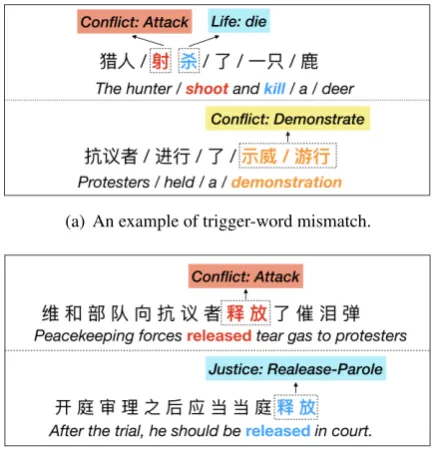
(a) An example of trigger-word mismatch.
[image:1.595.309.527.232.458.2](b) An example of polysemous trigger.
Figure 1: Examples about trigger-word mismatch and polysemous trigger in Event Detection.
is called Trigger Classification (TC). Although neural network methods have achieved significant progress in event detection (Nguyen and Grish-man,2015;Chen et al., 2015;Zeng et al.,2016), both steps are still exposed to the following two issues.
In the TI stage, the problem of trigger-word
mismatchcould severely impact the performance
Datasets Trigger-word Match Trigger Polysemy Match Mismatch Polysemy Univocal ACE 2005 85.39% 14.61% 41.64% 58.36% KBP 2017 76.28% 23.72% 52.14% 47.86%
Table 1: Proportion of Trigger-word mismatch and Pol-ysemous Triggers on ACE 2005 and KBP 2017.
are two triggers that both are parts of the word “射
杀” (shoot and kill) . In the other case, “示威游
行” (demonstration) is a trigger that crosses two words. Under this circumstance, triggers could not be located correctly with word-based methods, thereby becoming a serious limitation of the task. Some feature-based methods are proposed (Chen and Ji,2009;Qin et al.,2010;Li and Zhou,2012) to alleviate the issue, but they heavily rely on the hand-crafted features. Lin et al. (2018) proposes the nugget proposal networks (NPN) in terms of this issue, which uses a neural network to model character compositional structure of trigger words in a fix-sized window. However, the mechanism of the NPN limits the scope of trigger candidates within a fix-sized window, which is inflexible and suffering from the problem of trigger overlaps.
Even if the locations of triggers can be correctly detected in the TI step, the TC step could still be severely affected by the inherent problem of am-biguity of polysemy. Because a trigger word with multiple word senses could be classified into dif-ferent event types. Take 1(b) as an example, a polysemous trigger word “释放” (release) could represent two distinctly different event types. In the first case, the word ’release’ triggers anAttack event (release tear gas). But in the second case, the event triggered by ’release’ becomes Release-Parole(release a man in court).
To further illustrate that the two problems men-tioned above do exist, we make manual statistics on the proportion of mismatch triggers and poly-semous triggers on two widely used datasets. The statistics are illustrated in Table1, and we can ob-serve that data with trigger-word mismatch and trigger polysemy do account for a considerable proportion and then affect the task.
In this paper, we propose the Trigger-aware Lat-tice Network (TLNN), a comprehensive model that can simultaneously tackle both issues. To avoid error propagation by NLP tools like seg-mentor, we take characters as the basic units of the input sequence. Moreover, we utilize HowNet (Dong and Dong, 2003), an external knowledge
base that manually annotates polysemous Chinese and English words, to obtain the sense-level infor-mation. Further, we develop the trigger-aware lat-tice LSTM as the feature extractor of our model, which could leverage character-level, word-level and sense-level information at the same time. More specifically, in order to address the trigger-word mismatch issue, we construct short cut paths to link the cell state between the start and the end characters for each word. It is worth mentioning that the paths are sense-level, which means all the sense information of words that end in one spe-cific character will flow into the memory cell of the character. Hence, with the utilization of mul-tiple granularity of information (character, word and word sense), the problem of polysemous trig-gers could be effectively alleviated.
We conduct sets of experiments on two real-world datasets in the task of event detection. Em-pirical results of the main experiments show that our model can efficiently address both mentioned issues. With comprehensive comparisons with other proposed methods, our model achieves the state-of-the-art results on both datasets. Further, sets of subsidiary experiments are conducted to further analyze how TLNN addresses the two is-sues.
[image:2.595.317.517.468.716.2]2 Methodology
In the paper, event detection is regarded as a se-quence labelling task. For each character, the model should identify if it is a part of one trigger and correctly classify the trigger into one specific event type.
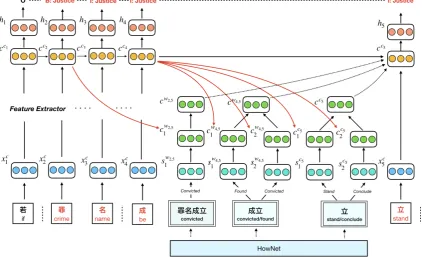
The architecture of our model is shown in Fig-ure2, which primarily includes the following three parts: (1) Hierarchical Representation Learn-ing, which reveals the character-level, word-level and sense-level embedding vectors in an unsuper-vised way. (2)Trigger-aware Feature Extractor, which automatically extracts different levels of se-mantic features by a tree structure LSTM model.
(3)Sequence Tagger, which calculates the
prob-ability of being a trigger for each character candi-date.
2.1 Hierarchical Representation Learning
Given an input sequence S = {c1, c2, ..., cN},
where ci represents the ith character in the se-quence. In character level, each character will be represented as an embedding vectorxc by
Skip-Gram method (Mikolov et al.,2013).
xci =e(ci) (1)
In the word level, the input sequenceScould also beS ={w1, w2, ..., wM}, where the basic unit is
a single wordwi. In this paper, we will use two indexesbandeto represent the start and the end of a word. In this case, the word embeddings are:
xwb,e=e(wb,e) (2)
However, the Skip-Gram method maps each word to only one single embedding, ignoring the fact that many words have multiple senses. Hence rep-resentation of finer granularity is still necessary to represent deep semantics. With the help of HowNet (Dong and Dong, 2003), we can obtain the representation of each sense of a character or a word. For each characterc, there are possible mul-tiple sensessen(ci) ∈ S(c) annotated in HowNet.
Similarly, for each word w, the senses could be
sen(wi) ∈S(w). Consequently, we can obtain the
embeddings of senses by jointly learning word and sense embeddings via Skip-gram manner. This mechanism is also applied to (Niu et al., 2017).
sci
j =e(sen
(ci)
j ) (3)
swb,e
j =e(sen
(wb,e)
j ) (4)
where sen(ci)
j and sen
(wb,e)
j represents the jth
sense for the characterci and wordwb,ein the se-quence. And thensci
j and s
wb,e
j are the
embed-dings ofciandwb,e.
2.2 Trigger-Aware Feature Extractor
The trigger-aware feature extractor is the core component of our model. After training, the out-puts of the extractor are the hidden state vectorsh
of an input sentence.
Conventional LSTM. LSTM (Hochreiter and
Schmidhuber, 1997) is an extension of the recur-rent neural network (RNN) with additional gates to control the information. Traditionally, there are following basic gates in LSTM: input gatei, out-put gate oand forget gate f. They collectively controls which information will be reserved, for-gotten and output. All three gates are accompanied by corresponding weight matrixW. Current cell state c records all historical information flow up to the current time. Therefore, the character-based LSTM functions are:
ici oc i
fic
˜
cci
= σ σ σ tanh
(Wc>
"
xc i
hci−1
#
+bc) (5)
cci =ficcci−1+ici c˜ci (6)
hci =oci tanh(cci) (7)
wherehci is the hidden state vector.
Trigger-Aware Lattice LSTM.Trigger-Aware
Lattice LSTM is the core feature extractor of our framework, which is an extension of LSTM and lattice LSTM. In this subsection, We will derive and theoretically analyze the model in detail.
In this section, characters and words are as-sumed to haveKsenses. As mentioned in2.1, for the jth sense of theith character ci, the embed-ding would besci
j . Then an additional LSTMCell
is utilized to integrate all senses of the character, hence the calculation of the cell gate of the multi-sense characterciwould be:
ici
j
fci
j ˜
cci
j = σ σ tanh (W
c> "
sci
j
hci−1
#
+bc) (8)
cci
j =f ci
j c
ci−1+ici
j c˜ ci
Figure 3: The structure ofTrigger-Aware Feature Extractor, the input of the example is a part of the sentence “若罪名成立,他将被逮捕” (If convicted, he will be arrested) . In this case, “罪名成立” (convicted) is a trigger with event typeJustice: Sentence. “成立” (convicted/found) and “立” (stand/conclude) are polysemous words. To keep the figure concise, we (1) only show two senses for each polysemous word; (2) only show the forward direction.
wherecci
j is the cell state of thejth sense of theith
character,cci−1 is the final cell state of thei−1th
character. In order to obtain the cell state of the character, an additional gate is used:
gci
j =σ(W >
"
xc i
cci
j #
+b) (10)
Then all the senses should be dynamically inte-grated into the temporary cell state:
c∗ci =
K X
j
αci
j c ci
j (11)
whereαci
j is the character sense gate after
normal-ization:
αci
j=
exp(gci
j ) K
P k
exp(gci
k)
(12)
Eq.11obtains the temporary cell state of the char-acterc∗ci by incorporating all the senses
informa-tion of the character. However, word-level infor-mation needs to be considered as well. As men-tioned in 2.1, swb,e
j is the embedding for thejth
sense of the word outwb,e. Similar to characters,
extra LSTMCell is used to calculate the cell state of each word that matches the lexiconD.
iwb,e
j
fjwb,e cwb,e
j
=
σ σ tanh
(W
c> "
swb,e
j
hcb−1
#
+bc) (13)
cwb,e
j =f wb,e
j ccb−1 +i wb,e
j c˜ wb,e
j (14)
Similar to Eq.11, the cell state of the word could be computed by incorporating all the cells of senses.
gjwb,e =σ(W>
"
xc b
cwb,e
j #
+b) (15)
cwb,e =
K X
j
αwb,e
j c
wb,e
j (16)
whereαwb,e
j is the word sense gate after
normal-ization:
αwb,e
j =
exp(gwb,e
j ) K
P k
exp(gkwb,e)
For a characterci, the temporary cell statec∗cithat
contains sense information is calculated by Eq.11. Moreover, we could calculate all the cell states of words that end in the indexiby Eq.16, which are represented as{cwb,i|b ∈ [1, i], wb,i ∈ D}. In
or-der to ensure the corresponding information could flow into the final cell state ofci, an extra gategb,im
is used to merge character and word cells:
gmb,i=σ(Wl>
"
xci cwb,i
#
+bl) (18)
and the computation of the final cell state of the charactercci is:
cci= X
b∈{b0|wd b0,i∈D}
αwb,icwb,i+αcic∗ci (19)
whereαwb,i andαci are word gate and character
gate after normalization. The computation is sim-ilar to Eq.12and Eq.17.
Therefore, the final cell state cci could
repre-sent the ambiguous characters and words in a dy-namic manner. Similar to Eq. 7, hidden state vec-tors could be calculated to transmit to the sequence tagger layer.
2.3 Sequence Tagger
In this paper, the event detection task is regarded as a sequence tagging problem. For an input se-quenceS ={c1, c2, ..., cN}, there is a
correspond-ing label sequenceL = {y1, y2, ..., yN}. Hidden vectors h for each character obtained in 2.2 are used as the input. We use a classic CRF layer to perform the sequence tagging, thus the probability distribution is:
P(L|S) = exp(
N P i=1
(S(yi)+T(yi−1, yi)))
P L0∈
C
exp( N P i=1
(S(yi0)+T(yi0−1, y0i))) ,
(20) whereSis the score function to compute the emis-sion score from hidden vectorhito the labelyi:
S(yi) =Wyi
CRFhi+b yi
CRF. (21)
Wyi
CRF andb yi
CRF are learned parameters specific
to yi. And in Eq. 20, T is the transition func-tion to compute the transifunc-tion score fromyi−1 to
yi. Ccontains all the possible label sequences on sequenceS andL0 is a random label sequence in C.
We use standard Viterbi (Viterbi, 1967) algo-rithm as a decoder to decode the highest scored label sequence. The loss function of our model is log-likelihood in sentence-level.
Loss= M X
i=1
log(P(Li|Si)) (22)
whereM is the number of sentences,Liis the cor-rect label for the sentenceSi.
3 Experiments
3.1 Datasets and Experimental Settings
Datasets. In this paper, we conduct a series
of experiments on two real-world datasets: ACE 2005 Chinese dataset (ACE2005) and TAC KBP 2017 Event Nugget Detection Evaluation dataset (KBP2017). For better comparison, we use the same data split as previous works (Chen and Ji, 2009; Zeng et al., 2016; Feng et al., 2018; Lin et al., 2018). Specifically, the ACE2005 (LDC2006T06) contains 697 articles, with 569 ar-ticles for training, 64 for validating and the rest 64 for testing. For KBP2017 Chinese dataset (LDC2017E55), we follow the same setup asLin et al.(2018), using 506/20/167 documents as train-ing/development/test set respectively.
Evaluation Metrics. Standard micro-averaged
Precision, Recall and F1 are used as evaluation metrics. For ACE2005 the computation is the same asChen and Ji(2009). To remain rigorous, we use the official evaluation toolkit1to perform the metrics for KBP2017.
Hyper-Parameter Settings. We tune the
pa-rameters of our models by grid searching on the validation dataset. Adam (Kingma and Ba,2014) with a learning rate decay is utilized as the op-timizer. The embedding sizes of characters and senses are all 50. To avoid overfitting, Dropout mechanism (Srivastava et al.,2014) is used in the system, and the dropout rate is set to 0.5. We se-lect the best models by early stopping using the F1 results on the validation dataset. Because of the limited influence, we follow empirical settings for other hyper-parameters.
3.2 Overall Results
In this section, we compare our model with previ-ous state-of-the-art methods. The proposed mod-els are as follows:
Model
ACE2005 KBP2017
Trigger Identification Trigger Classification Trigger Identification Trigger Classification P R F1 P R F1 P R F1 P R F1
Char
DMCNN 60.10 61.60 60.90 57.10 58.50 57.80 53.67 49.92 51.73 50.03 46.53 48.22 C-BiLSTM* 65.60 66.70 66.10 60.00 60.90 60.40 - - - -HBTNGMA 41.67 59.29 48.94 38.74 55.13 45.50 40.52 46.76 43.41 35.93 41.47 38.50
Word
DMCNN 66.60 63.60 65.10 61.60 58.80 60.20 60.43 51.64 55.69 54.81 46.84 50.51 HNN* 74.20 63.10 68.20 77.10 53.10 63.00 - - - -HBTNGMA 54.29 62.82 58.25 49.86 57.69 53.49 46.92 53.57 50.02 37.54 42.86 40.03
Feature Rich-C* 62.20 71.90 66.70 58.90 68.10 63.20 - - - -KBP2017 Best* - - - 67.76 45.92 54.74 62.69 42.48 50.64
[image:6.595.80.523.60.226.2]Hibird NPN 70.63 64.74 67.56 67.13 61.54 64.21 58.03 59.91 58.96 52.04 53.73 52.87 TLNN (Ours) 67.34 74.68 70.82 64.45 71.47 67.78 65.93 59.07 62.31 60.72 54.41 57.39
Table 2: Overall results of proposed methods and TLNN on ACE2005 and KBP2017. * indicates the results adapted from the original paper. For KBP2017, ”Trigger Identification” and ”Trigger Classification” correspond to the ”Span” and ”Type” metrics in the official evaluation.
DMCNN(Chen et al.,2015) put forward a
dy-namic Multi-pooling CNN as a sentence-level fea-ture extractor. Moreover, we add a classifier to DMCNN using IOB encoding.
C-BiLSTM(Zeng et al.,2016) put forward the Convolutional Bi-LSTM model for the event de-tection task.
HNN (Feng et al., 2018) designed a Hybrid Neural Network model which combines CNN with Bi-LSTM.
HBTNGMA (Chen et al., 2018) put forward
a Hierarchical and Bias Tagging Networks with Gated Multi-level Attention Mechanisms to inte-grate sentence-level and document-level informa-tion collectively.
NPN(Lin et al.,2018) proposed a comprehen-sive model by automatically learning the inner compositional structures of triggers to solve the trigger mismatch problem.
The results of all the models are shown in Table 2. From the results, we can observe that:
(1) Both for ACE2005 and KBP2017, TLNN outperform other proposed models significantly, achieving the best results on two datasets. This demonstrates that the trigger-aware lattice struc-ture could enhance the accuracy of locating trig-gers. Further, thanks to the usage of sense-level information, triggers could be more precisely clas-sified into correct event types.
(2) On the TI stage, TLNN gives the best perfor-mance. By linking shortcut paths of all word can-didates with the current character, the model could effectively exploit both character and word infor-mation, and then alleviates the issue of trigger-word mismatch.
Model ACE2005 KBP2017 TI TC TI TC
Word baseline 61.13 57.81 56.68 50.98 +char CNN 61.11 57.52 57.14 51.66 +char LSTM 61.51 58.15 56.14 50.46
Char baseline 64.97 61.78 53.95 49.63 +bigram 66.89 62.95 57.01 52.71 +softword 67.79 64.11 60.68 54.57 +softword+bigram 68.22 64.23 60.42 54.85
TLNN 70.82 67.78 62.31 57.39
Table 3: F1-score of Word-based and Character-based baselines and TLNN on ACE2005 and KBP2017.
(3) On the TC stage, TLNN still maintain its advantages. The results indicate that the linguis-tic knowledge of HowNet and the unique struc-ture to dynamically utilize sense-level information could enhance the performance on the TC stage. More located triggers could be classified into cor-rect event types by considering the ambiguity of triggers.
3.3 Effect of Trigger-aware Feature
Extractor
In this section, we design a set of experiments to explore the effect of the trigger-aware feature extractor. We implement strong character-based and word-based baselines by replacing the trigger-aware lattice LSTM with the standard Bi-LSTM.
[image:6.595.315.519.288.421.2]Model ACE2005 KBP2017
Match Mismatch Match Mismatch Char Baseline 65.58 63.89 55.65 42.76 Word Baseline 66.30 2.78 64.43 17.63
NPN 65.94 55.56 56.47 41.53
[image:7.595.321.512.61.130.2]TLNN 69.93 72.22 65.52 48.56
Table 4: Recall rates of two trigger-word match splits of two datasets on Trigger Identification task.
input sequence are characters. Then we enhance the character representation by adding external word-level features including bigram and softword (word in which the current character is located). Hence, both baselines could collectively utilize character and word information.
As shown in Table3, experiments of two types of baselines and our model are conducted on ACE2005 and KBP2017. For the word baseline, although adding character-level features can im-prove the performance, the effects are relative lim-ited. For the char baseline, it gains considerable improvements when word-level features are taken into account. The results of baselines indicate that integrating different level of information is an effective strategy to improve the performance of models. Compared with baselines, the TLNN achieves the best F1-score compared to all the baselines on both datasets, showing remarkable superiority and robustness. The results show that by dynamically combining multi-grained informa-tion, the trigger-aware feature extractor could ef-fectively explore deeper semantic features than the feature-based strategies used in baselines.
3.4 Influence of Trigger Mismatch
In order to explore the influence of trigger mis-match problem, we split the test data of ACE2005 and KBP2017 into two types: match and mis-match. Table 1 shows the proportion of word-trigger match and mismatch on two datasets.
The recall of different methods of each split on Trigger Identification task is shown in Table4. We can observe that:
(1) The result indicates that the word-trigger mismatch problem could severely impact the per-formance of the task. All approaches except ours give lower recall rates in the trigger-mismatch part than in the trigger-match part. In contrast, our model could robustly address the word-trigger mismatch problem, reaching the best results on both parts of the two datasets.
Model ACE2005 KBP2017 TI TC TI TC
NPN 67.56 64.21 58.96 52.87
TLNN 70.82 67.78 62.31 57.39
- w/o Sense info 68.65 65.83 61.17 56.55
Table 5: F1-score of NPN, TLNN and TLNN - w/o Sense info on ACE2005 and KBP2017.
Model ACE2005 KBP2017
Poly Mono Poly Mono
NPN 66.27 61.08 51.15 48.63
TLNN 69.11 62.56 58.61 56.56
[image:7.595.74.291.61.143.2]- w/o Sense info 67.53 62.89 56.01 55.96
Table 6: F1-score of two splits of two datasets on Trig-ger Classification task. The splits are based on the pol-ysemy of triggers. ”Poly” and ”Mono” correspond to polysemous and monosemous trigger splits.
(2) To a certain extent, the NPN model could alleviate the problem by utilizing hybrid represen-tation learning and nugget generator in a fix-sized window. However, the mechanism is still not flex-ible and robust to integrate character and word in-formation.
(3) The word-based baseline is most severely affected by the trigger-word mismatch problem. This phenomenon is explainable because if one trigger could not be segmented as a specific word in the preprocessing stage, it is impossible to be located correctly.
3.5 Influence of Trigger Polysemy
In this section, we mainly focus on the influence of polysemous triggers. We select NPN model for comparison. And we implement a version of TLNN without sense information, which is de-noted asTLNN - w/o Sense infoin Table 5 and Table6.
Empirical results in Table 5 show the overall performance on ACE2005 and KBP2017. We can observe that the TLNN is weakened by removing sense information, which indicates the effective-ness of the usage of sense-level information. Even without sense information, our model could still outperform the NPN model on both two datasets.
[image:7.595.317.512.173.241.2]With-Sentence 1 Word baseline NPN TLNN Answer 立刻/抗抗抗敌援友 (抗敌援友,Attack) (刻抗,Attack) (抗,Attack) (抗,Attack) Resistthe enemies and aid the allies at once
Sentence 2 NPN TLNN - Sense info TLNN Answer 送
送
[image:8.595.74.522.62.135.2]送/他/一笔/赴/欧洲/的/旅费 (送,TransferPerson) (送,TransferPerson) (送,TransferMoney) (送,TransferMoney) Sendhim money for European tourism
Table 7: Two model prediction examples. The first sentence is an example of trigger-word mismatch, while the second one is about polysemous triggers. For each prediction result, (A,B) indicates that A is a trigger with event type B.
out sense information, TLNN - w/o sense info could give comparable F1-scores with TLNN on the ”Mono” parts. The results indicate that the trigger-aware feature extractor could dynamically learn all the senses of characters and words, gain-ing significant improvements under the condition of polysemy.
3.6 Case Study
Table7shows two examples comparing the TLNN model with other ED methods. The former ex-ample is about trigger-word mismatch, in which the correct trigger “抗”(resist) is part of the idiom word “抗敌援友” (resist the enemies and aid the allies). In this case, the word baseline gives the whole word “抗敌援友” as prediction because it is impossible for word-based methods to detect part-of-word triggers. Additionally, the NPN model recognizes a non-existent word “刻抗”. The rea-son is that the NPN enumerates the combinations of all characters within a window as trigger candi-dates, which is likely to generate invalid words. In contrast, our model detects the event trigger “抗” accurately.
In the latter example, the trigger “送”(send) is a polysemous word with two different meanings: “送行”(see him off) and “送钱”(give him money). Without considering multiple word senses of pol-ysemes, the NPN and TLNN (w/o Sense info) classify trigger “送” into wrong event type Trans-ferPerson. On the contrary, the TLNN can dynam-ically select word sense for polysemous triggers by utilizing context information. Thus the correct event typeTransferMoneyis predicted.
4 Related Work
Event Detection (ED) is a crucial subtask in Event Extraction task. Feature-based methods (Ahn, 2006;Ji and Grishman,2008;Liao and Grishman, 2010; Huang and Riloff, 2012; Patwardhan and Riloff,2009;McClosky et al.,2011) were widely
used in the ED task, but these traditional methods are heavily rely on the manual features, limiting the scalability and robustness.
Recent developments in deep learning have led to a renewed interest in neural event detection. Neural networks can automatically learn features of the input sequence and conduct token-level classification. CNN-based models are the semi-nal neural network models in ED (Nguyen and Gr-ishman,2015;Chen et al.,2015;Nguyen and Gr-ishman, 2016). However, these models can only capture the local context features in a fixed size window. Some approaches design comprehen-sive models to explore the interdependency among trigger words (Chen et al.,2018;Feng et al.,2018). To further improve the ED task, some joint models are designed (Nguyen et al.,2016;Lu and Nguyen, 2018;Yang and Mitchell, 2016). These methods have achieved great success in English datasets.
problem. But in this work, word disambiguation datasets are necessary. In contrast, our model can solve both word-trigger mismatch and trigger pol-ysemy problems at the same time.
5 Conclusion and Future Work
We propose a novel framework TLNN for event detection, which can simultaneously address the problems of trigger-word mismatch and polyse-mous triggers. With the hierarchical representa-tion learning and the trigger-aware feature extrac-tor, TLNN efficaciously exploits multi-grained in-formation and learn deep semantic features. Sets of experiments on two real-world datasets show that TLNN could efficiently address the two issues and yield better empirical results than a variety of neural network models.
In future work, we will conduct experiments on more languages with and without explicit word delimiters. In addition, we will try developing a dynamic mechanism to selectively consider the sense-level information rather than take all the senses of characters and words into account.
6 Acknowledgement
This work is supported by National Natu-ral Science Foundation of China (Grant No. 61773229, 61572273, 61661146007), National Key Research and Development Program of China (No. 2018YFB1004503), Basic Scientific Re-search Program of Shenzhen City (Grant No. JCYJ20160331184440545), and Overseas Co-operation Research Fund of Graduate School at Shenzhen, Tsinghua Univeristy (Grant No. HW2018002), Shenzhen Giiso Information Tech-nology Co. Ltd. Finally, we would like to thank the anonymous reviewers for their helpful feed-back and suggestions.
References
David Ahn. 2006. The stages of event extraction. In Proceedings of the Workshop on Annotating and Reasoning about Time and Events, pages 1–8.
Yubo Chen, Liheng Xu, Kang Liu, Daojian Zeng, and Jun Zhao. 2015. Event extraction via dy-namic multi-pooling convolutional neural networks. In Proceedings of the 53rd Annual Meeting of the Association for Computational Linguistics and the 7th International Joint Conference on Natural Lan-guage Processing (Volume 1: Long Papers), vol-ume 1, pages 167–176.
Yubo Chen, Hang Yang, Kang Liu, Jun Zhao, and Yan-tao Jia. 2018. Collective event detection via a hier-archical and bias tagging networks with gated multi-level attention mechanisms. In Proceedings of the 2018 Conference on Empirical Methods in Natural Language Processing, pages 1267–1276.
Zheng Chen and Heng Ji. 2009. Language specific issue and feature exploration in chinese event ex-traction. InProceedings of Human Language Tech-nologies: The 2009 Annual Conference of the North American Chapter of the Association for Computa-tional Linguistics, Companion Volume: Short Pa-pers, pages 209–212.
Zhendong Dong and Qiang Dong. 2003. Hownet-a hy-brid language and knowledge resource. In Proceed-ings of NLP-KE.
Xiaocheng Feng, Bing Qin, and Ting Liu. 2018. A language-independent neural network for event detection. Science China Information Sciences, 61(9):092106.
Sepp Hochreiter and J¨urgen Schmidhuber. 1997. Long short-term memory. Neural computation, 9(8):1735–1780.
Ruihong Huang and Ellen Riloff. 2012. Modeling tex-tual cohesion for event extraction. InTwenty-Sixth AAAI Conference on Artificial Intelligence.
Heng Ji and Ralph Grishman. 2008. Refining event extraction through cross-document inference. Pro-ceedings of ACL-08: HLT, pages 254–262.
Diederik P Kingma and Jimmy Ba. 2014. Adam: A method for stochastic optimization. arXiv preprint arXiv:1412.6980.
Peifeng Li and Guodong Zhou. 2012. Employing mor-phological structures and sememes for chinese event extraction. Proceedings of COLING 2012, pages 1619–1634.
Ziran Li, Ning Ding, Zhiyuan Liu, Haitao Zheng, and Ying Shen. 2019. Chinese relation extraction with multi-grained information and external linguis-tic knowledge. InProceedings of the 57th Confer-ence of the Association for Computational Linguis-tics, pages 4377–4386.
Shasha Liao and Ralph Grishman. 2010. Using doc-ument level cross-event inference to improve event extraction. InProceedings of the 48th Annual Meet-ing of the Association for Computational LMeet-inguis- Linguis-tics, pages 789–797. Association for Computational Linguistics.
Hongyu Lin, Yaojie Lu, Xianpei Han, and Le Sun. 2018. Nugget proposal networks for chinese event detection.arXiv preprint arXiv:1805.00249.
In Proceedings of the 2018 Conference on Empiri-cal Methods in Natural Language Processing, pages 4822–4828.
David McClosky, Mihai Surdeanu, and Christopher D Manning. 2011. Event extraction as dependency parsing. InProceedings of the 49th Annual Meeting of the Association for Computational Linguistics: Human Language Technologies-Volume 1, pages 1626–1635. Association for Computational Linguis-tics.
Tomas Mikolov, Kai Chen, Greg Corrado, and Jef-frey Dean. 2013. Efficient estimation of word representations in vector space. arXiv preprint arXiv:1301.3781.
Thien Huu Nguyen, Kyunghyun Cho, and Ralph Gr-ishman. 2016. Joint event extraction via recurrent neural networks. In Proceedings of the 2016 Con-ference of the North American Chapter of the Asso-ciation for Computational Linguistics: Human Lan-guage Technologies, pages 300–309.
Thien Huu Nguyen and Ralph Grishman. 2015. Event detection and domain adaptation with convolutional neural networks. InProceedings of the 53rd Annual Meeting of the Association for Computational Lin-guistics and the 7th International Joint Conference on Natural Language Processing (Volume 2: Short Papers), volume 2, pages 365–371.
Thien Huu Nguyen and Ralph Grishman. 2016. Mod-eling skip-grams for event detection with convolu-tional neural networks. InProceedings of the 2016 Conference on Empirical Methods in Natural Lan-guage Processing, pages 886–891, Austin, Texas. Association for Computational Linguistics.
Yilin Niu, Ruobing Xie, Zhiyuan Liu, and Maosong Sun. 2017. Improved word representation learn-ing with sememes. InProceedings of the 55th An-nual Meeting of the Association for Computational Linguistics (Volume 1: Long Papers), pages 2049– 2058, Vancouver, Canada. Association for Compu-tational Linguistics.
Siddharth Patwardhan and Ellen Riloff. 2009. A uni-fied model of phrasal and sentential evidence for in-formation extraction. In Proceedings of the 2009 Conference on Empirical Methods in Natural Lan-guage Processing: Volume 1-Volume 1, pages 151– 160. Association for Computational Linguistics.
Bing Qin, Yanyan Zhao, Xiao Ding, Ting Liu, and Guofu Zhai. 2010. Event type recognition based on trigger expansion. Tsinghua Science and Technol-ogy, 15(3):251–258.
Nitish Srivastava, Geoffrey Hinton, Alex Krizhevsky, Ilya Sutskever, and Ruslan Salakhutdinov. 2014. Dropout: a simple way to prevent neural networks from overfitting. The Journal of Machine Learning Research, 15(1):1929–1958.
Andrew Viterbi. 1967. Error bounds for convolutional codes and an asymptotically optimum decoding al-gorithm. IEEE transactions on Information Theory, 13(2):260–269.
Bishan Yang and Tom Mitchell. 2016. Joint extrac-tion of events and entities within a document con-text. arXiv preprint arXiv:1609.03632.
Jie Yang, Yue Zhang, and Shuailong Liang. 2018. Sub-word encoding in lattice lstm for chinese Sub-word seg-mentation.arXiv preprint arXiv:1810.12594.
Ying Zeng, Honghui Yang, Yansong Feng, Zheng Wang, and Dongyan Zhao. 2016. A convolution bilstm neural network model for chinese event ex-traction. In Natural Language Understanding and Intelligent Applications, pages 275–287. Springer.