Domain Kernels for Text Categorization
Alfio Gliozzo and Carlo Strapparava
ITC-Irst
via Sommarive, I-38050, Trento, ITALY
{gliozzo,strappa}@itc.it
Abstract
In this paper we propose and evaluate a technique to perform semi-supervised learning for Text Categorization. In particular we defined a kernel function, namely the Domain Kernel, that allowed us to plug “external knowledge” into the supervised learning process. External knowledge is acquired from unlabeled data in a totally unsupervised way, and it is represented by means of Domain Mod-els.
We evaluated the Domain Kernel in two standard benchmarks for Text Categoriza-tion with good results, and we compared its performance with a kernel function that exploits a standard bag-of-words feature representation. The learning curves show that the Domain Kernel allows us to re-duce drastically the amount of training data required for learning.
1 Introduction
Text Categorization (TC) deals with the problem of assigning a set of category labels to documents. Cat-egories are usually defined according to a variety of topics (e.g. SPORT vs. POLITICS) and a set of hand tagged examples is provided for training. In the state-of-the-art TC settings supervised classifiers are used for learning and texts are represented by means ofbag-of-words.
Even if, in principle, supervised approaches reach the best performance in many Natural Language
Processing (NLP) tasks, in practice it is not always easy to apply them to concrete applicative settings. In fact, supervised systems for TC require to be trained a large amount of hand tagged texts. This situation is usually feasible only when there is some-one (e.g. a big company) that can easily provide al-ready classified documents to train the system.
In most of the cases this scenario is quite unprac-tical, if not infeasible. An example is the task of categorizing personal documents, in which the cate-gories can be modified according to the user’s inter-ests: new categories are often introduced and, pos-sibly, the available labeled training for them is very limited.
In the NLP literature the problem of providing large amounts of manually annotated data is known as the Knowledge Acquisition Bottleneck. Cur-rent research in supervised approaches to NLP often deals with defining methodologies and algorithms to reduce the amount of human effort required for col-lecting labeled examples.
A promising direction to solve this problem is to provide unlabeled data together with labeled texts to help supervision. In the Machine Learning lit-erature this learning schema has been called semi-supervised learning. It has been applied to the TC problem using different techniques: co-training (Blum and Mitchell, 1998), EM-algorithm (Nigam et al., 2000), Transduptive SVM (Joachims, 1999b) and Latent Semantic Indexing (Zelikovitz and Hirsh, 2001).
co-herence (i.e. co-occurence in texts of semantically related terms) (Magnini et al., 2002) is an inherent property of corpora, and it can be exploited to help a supervised classifier to build a better categorization hypothesis, even if the amount of labeled training data provided for learning is very low.
Our proposal consists of defining a Domain Kernel and exploiting it inside a Support Vector Machine (SVM) classification framework for TC (Joachims, 2002). The Domain Kernel relies on the notion of Domain Model, which is a shallow repre-sentation for lexical ambiguity and variability. Do-main Models can be acquired in an unsupervised way from unlabeled data, and then exploited to de-fine a Domain Kernel (i.e. a generalized similarity function among documents)1.
We evaluated the Domain Kernel in two stan-dard benchmarks for TC (i.e. Reuters and 20News-groups), and we compared its performance with a kernel function that exploits a more standard Bag-of-Words (BoW) feature representation. The use of the Domain Kernel got a significant improvement in the learning curves of both tasks. In particular, there is a notable increment of the recall, especially with few learning examples. In addition, F1 measure in-creases by 2.8 points in the Reuters task at full learn-ing, achieving the state-of-the-art results.
The paper is structured as follows. Section 2 in-troduces the notion of Domain Model and describes an automatic acquisition technique based on Latent Semantic Analysis (LSA). In Section 3 we illustrate the SVM approach to TC, and we define a Domain Kernel that exploits Domain Models to estimate sim-ilarity among documents. In Section 4 the perfor-mance of the Domain Kernel are compared with a standard bag-of-words feature representation, show-ing the improvements in the learnshow-ing curves. Section 5 describes the previous attempts to exploit semi-supervised learning for TC, while section 6 con-cludes the paper and proposes some directions for future research.
1The idea of exploiting a Domain Kernel to help a super-vised classification framework, has been profitably used also in other NLP tasks such as word sense disambiguation (see for ex-ample (Strapparava et al., 2004)).
2 Domain Models
The simplest methodology to estimate the similar-ity among the topics of two texts is to represent them by means of vectors in the Vector Space Model (VSM), and to exploit the cosine similarity. More formally, letT = {t1, t2, . . . , tn} be a corpus, let
V = {w1, w2, . . . , wk} be its vocabulary, let Tbe thek×nterm-by-document matrix representingT, such thatti,jis the frequency of wordwiinto the text
tj. The VSM is ak-dimensional spaceRk, in which
the texttj ∈ T is represented by means of the
vec-tort~j such that theith component oft~j isti,j. The
similarity among two texts in the VSM is estimated by computing the cosine.
However this approach does not deal well with lexical variability and ambiguity. For example the two sentences “he is affected by AIDS” and “HIV is a virus” do not have any words in common. In the VSM their similarity is zero because they have or-thogonal vectors, even if the concepts they express are very closely related. On the other hand, the sim-ilarity between the two sentences “the laptop has been infected by avirus” and “HIV is avirus” would turn out very high, due to the ambiguity of the word virus.
To overcome this problem we introduce the notion ofDomain Model(DM), and we show how to use it in order to define adomain VSM, in which texts and terms are represented in a uniform way.
A Domain Model is composed by soft clusters of terms. Each cluster represents a semantic domain (Gliozzo et al., 2004), i.e. a set of terms that often co-occur in texts having similar topics. A Domain Model is represented by ak×k0rectangular matrix
D, containing the degree of association among terms
and domains, as illustrated in Table 1.
MEDICINE COMPUTER SCIENCE
HIV 1 0
AIDS 1 0
virus 0.5 0.5
laptop 0 1
Table 1: Example of Domain Matrix
rep-resented by associating one term to more than one domain, while variability is represented by associat-ing different terms to the same domain. For example the term virus is associated to both the domain COMPUTER SCIENCE and the domain MEDICINE (ambiguity) while the domain MEDICINEis associ-ated to both the termsAIDSandHIV(variability).
More formally, let D = {D1, D2, ..., Dk0} be a set of domains, such that k0 k. A Domain Model is fully defined by a k ×k0 domain matrix
D representing in each cell di,z the domain
rele-vance of term wi with respect to the domain Dz.
The domain matrixD is used to define a function
D: Rk →Rk0, that maps the vectors t~j, expressed
into the classical VSM, into the vectorst~0
jin the
do-main VSM.Dis defined by2
D(t~j) =t~j(IIDFD) =t~0
j (1)
whereIIDFis a diagonal matrix such thatiIDFi,i =
IDF(wi), t~j is represented as a row vector, and
IDF(wi)is theInverse Document Frequencyofwi.
Vectors in the domain VSM are called Domain Vectors. Domain Vectors for texts are estimated by exploiting formula 1, while the Domain Vector w~0
i,
corresponding to the wordwi ∈V, is theithrow of
the domain matrixD. To be a valid domain matrix
such vectors should be normalized (i.e. hw~0
i, ~w0ii =
1).
In the Domain VSM the similarity among Domain Vectors is estimated by taking into account second order relations among terms. For example the simi-larity of the two sentences “He is affected by AIDS” and “HIV is a virus” is very high, because the terms AIDS,HIVandvirusare highly associated to the domain MEDICINE.
In this work we propose the use of Latent Se-mantic Analysis (LSA) (Deerwester et al., 1990) to induce Domain Models from corpora. LSA is an unsupervised technique for estimating the similar-ity among texts and terms in a corpus. LSA is per-formed by means of a Singular Value Decomposi-tion (SVD) of the term-by-document matrix T
de-scribing the corpus. The SVD algorithm can be ex-ploited to acquire a domain matrixD from a large
2In (Wong et al., 1985) a similar schema is adopted to define a Generalized Vector Space Model, of which the Domain VSM is a particular instance.
corpus T in a totally unsupervised way. SVD de-composes the term-by-document matrixTinto three
matrixesT 'VΣk0UT whereΣk0 is the diagonal k×k matrix containing the highestk0 k eigen-values ofT, and all the remaining elements set to
0. The parameterk0is the dimensionality of the Do-main VSM and can be fixed in advance3. Under this
setting we define the domain matrixDLSA4as
DLSA =INVpΣk0 (2)
where IN is a diagonal matrix such that iNi,i =
1
q
hw~0
i, ~w0ii
,w~0
iis theithrow of the matrixV
√Σ
k0.
3 The Domain Kernel
Kernel Methods are the state-of-the-art supervised framework for learning, and they have been success-fully adopted to approach the TC task (Joachims, 1999a).
The basic idea behind kernel methods is to embed the data into a suitable feature spaceF via a map-ping function φ : X → F, and then use a linear algorithm for discovering nonlinear patterns. Kernel methods allow us to build a modular system, as the kernel function acts as an interface between the data and the learning algorithm. Thus the kernel function becomes the only domain specific module of the sys-tem, while the learning algorithm is a general pur-pose component. Potentially a kernel function can work with any kernel-based algorithm, such as for example SVM.
During the learning phase SVMs assign a weight λi ≥ 0 to any example xi ∈ X. All the labeled
instancesxisuch thatλi >0are calledsupport
vec-tors. The support vectors lie close to the best sepa-rating hyper-plane between positive and negative ex-amples. New examples are then assigned to the class of its closest support vectors, according to equation 3.
3It is not clear how to choose the right dimensionality. In our experiments we used 400 dimensions.
4When
DLSAis substituted in Equation 1 the Domain VSM
f(x) =
n
X
i=1
λiK(xi, x) +λ0 (3)
The kernel function K returns the similarity be-tween two instances in the input spaceX, and can be designed in order to capture the relevant aspects to estimate similarity, just by taking care of satis-fying set of formal requirements, as described in (Sch¨olkopf and Smola, 2001).
In this paper we define the Domain Kernel and we apply it to TC tasks. The Domain Kernel, denoted byKD, can be exploited to estimate the topic
simi-larity among two texts while taking into account the external knowledge provided by a Domain Model (see section 2). It is a variation of the Latent Seman-tic Kernel (Shawe-Taylor and Cristianini, 2004), in which a Domain Model is exploited to define an ex-plicit mapping D : Rk → Rk0 from the classical
VSM into the domain VSM. The Domain Kernel is defined by
KD(ti, tj) = hD
(ti),D(tj)i
q
hD(tj),D(tj)ihD(ti),D(ti)i
(4)
whereDis the Domain Mapping defined in equa-tion 1. To be fully defined, the Domain Kernel re-quires a Domain MatrixD. In principle, Dcan be
acquired from any corpora by exploiting any (soft) term clustering algorithm. Anyway, we belive that adequate Domain Models for particular tasks can be better acquired from collections of documents from the same source. For this reason, for the experi-ments reported in this paper, we acquired the matrix
DLSA, defined by equation 2, using the whole
(un-labeled) training corpora available for each task, so tuning the Domain Model on the particular task in which it will be applied.
A more traditional approach to measure topic sim-ilarity among text consists of extracting BoW fea-tures and to compare them in a vector space. The BoW kernel, denoted byKBoW, is a particular case
of the Domain Kernel, in whichD =I, andIis the
identity matrix. The BoW Kernel does not require a Domain Model, so we can consider this setting as “purely” supervised, in which no external knowl-edge source is provided.
4 Evaluation
We compared the performance of both KD and
KBoW on two standard TC benchmarks. In
sub-section 4.1 we describe the evaluation tasks and the preprocessing steps, in 4.2 we describe some algo-rithmic details of the TC system adopted. Finally in subsection 4.3 we compare the learning curves of KD andKBoW.
4.1 Text Categorization tasks
For the experiments reported in this paper, we se-lected two evaluation benchmarks typically used in the TC literature (Sebastiani, 2002): the 20news-groupsand theReuterscorpora. In both the data sets we tagged the texts for part of speech and we consid-ered only the noun, verb, adjective, and adverb parts of speech, representing them by vectors containing the frequencies of each disambiguated lemma. The only feature selection step we performed was to re-move all the closed-class words from the document index.
20newsgroups. The 20Newsgroups data set5 is
a collection of approximately 20,000 newsgroup documents, partitioned (nearly) evenly across 20 different newsgroups. This collection has become a popular data set for experiments in text appli-cations of machine learning techniques, such as text classification and text clustering. Some of the newsgroups are very closely related to each other (e.g. comp.sys.ibm.pc.hardware / comp.sys.mac.hardware), while others are highly unrelated (e.g. misc.forsale / soc.religion.christian). We removed cross-posts (duplicates), newsgroup-identifying headers (i.e. Xref, Newsgroups, Path, Followup-To, Date), and empty documents from the original corpus, so to obtain 18,941 documents. Then we randomly divided it into training (80%) and test (20%) sets, containing respectively 15,153 and 3,788 documents.
Reuters. We used the Reuters-21578 collec-tion6, and we splitted it into training and test
5Available at http://www.ai.mit.edu-/people/jrennie/20Newsgroups/.
partitions according to the standard ModApt`e
split. It includes 12,902 documents for 90 cat-egories, with a fixed splitting between training and test data. We conducted our experiments by considering only the 10 most frequent categories, i.e. Earn, Acquisition, Money-fx, Grain, Crude, Trade, Interest, Ship, Wheat and Corn, and we included in our dataset all the non empty documents labeled with at least one of those categories. Thus the final dataset includes 9295 document, of which 6680 are included in the training partition, and 2615 are in the test set.
4.2 Implementation details
As a supervised learning device, we used the SVM implementation described in (Joachims, 1999a). The Domain Kernel is implemented by defining an explicit feature mapping according to formula 1, and by normalizing each vector to obtain vectors of uni-tary length. All the experiments have been per-formed on the standard parameter settings, using a linear kernel.
We acquired a different Domain Model for each corpus by performing the SVD processes on the term-by-document matrices representing the whole training partitions, and we considered only the first 400 domains (i.e.k0 = 400)7.
As far as the Reuters task is concerned, the TC problem has been approached as a set of binary fil-tering problems, allowing the TC system to pro-vide more than one category label to each document. For the20newsgroups task, we implemented a one-versus-all classification schema, in order to assign a single category to each news.
4.3 Domain Kernel versus BoW Kernel
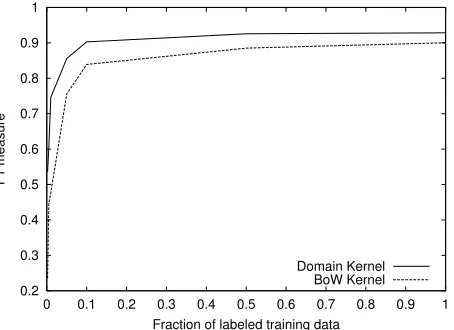
Figure 1 and Figure 2 report the learning curves for bothKD andKBoW, evaluated respectively on the
Reuters and the20newgroups task. Results clearly show that KD always outperforms KBoW,
espe-cially when very limited amount of labeled data is provided for learning.
7To perform the SVD operation we adopted LIBSVDC, an optimized package for sparse ma-trix that allows to perform this step in few minutes even for large corpora. It can be downloaded from http://tedlab.mit.edu/∼dr/SVDLIBC/.
0.2 0.3 0.4 0.5 0.6 0.7 0.8 0.9 1
0 0.1 0.2 0.3 0.4 0.5 0.6 0.7 0.8 0.9 1
F1 measure
Fraction of labeled training data Domain Kernel
[image:5.612.310.537.43.208.2]BoW Kernel
Figure 1: Micro-F1 learning curves forReuters
0.1 0.2 0.3 0.4 0.5 0.6 0.7 0.8 0.9 1
0 0.1 0.2 0.3 0.4 0.5 0.6 0.7 0.8 0.9 1
F1 measur
e
Fraction of labeled training data Domain Kernel
[image:5.612.313.544.252.418.2]BoW Kernel
Figure 2: Micro-F1 learning curves for 20news-groups
Table 2 compares the performances of the two kernels at full learning.KD achieves a better
micro-F1 thanKBoW in both tasks. The improvement is
particularly significant in theReuterstask (+ 2.8 %). Tables 3 shows the number of labeled examples required by KD and KBoW to achieve the same
micro-F1 in the Reuters task. KD requires only
146 examples to obtain a micro-F1 of 0.84, while KBoW requires 1380 examples to achieve the same
performance. In the same task,KD surpass the
per-formance of KBoW at full learning using only the
10% of the labeled data. The last column of the ta-ble shows clearly thatKD requires 90% less labeled
data thanKBoW to achieve the same performances.
F1 Domain Kernel Bow Kernel
Reuters 0.928 0.900
[image:6.612.323.527.40.97.2]20newsgroups 0.886 0.880
Table 2: Micro-F1 with full learning
F1 Domain Kernel Bow Kernel Ratio
.54 14 267 5%
.84 146 1380 10%
.90 668 6680 10%
Table 3: Number of training examples needed by KD and KBoW to reach the same micro-F1 on the
Reuterstask
20newsgroupstask. It is important to notice that the number of labeled documents is higher in this corpus than in the previous one. The benefits of using Do-main Models are then less evident at full learning, even if they are significant when very few labeled data are provided.
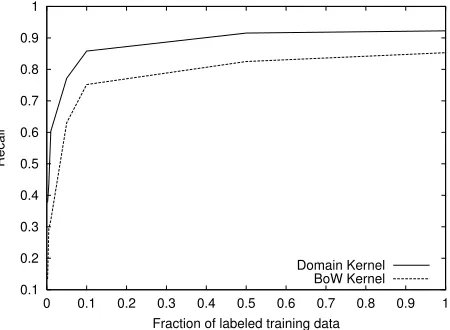
Figures 3 and 4 report a more detailed analysis by comparing the micro-precision and micro-recall learning curves of both kernels in theReuterstask8.
It is clear from the graphs that the main contribute ofKD is about increasing recall, while precision is
similar in both cases9. This last result confirms our
hypothesis that the information provided by the Do-main Models allows the system to generalize in a more effective way over the training examples, al-lowing to estimate the similarity among texts even if they have just few words in common.
Finally, KD achieves the state-of-the-art in the
Reuterstask, as reported in section 5.
5 Related Works
To our knowledge, the first attempt to apply the semi-supervised learning schema to TC has been reported in (Blum and Mitchell, 1998). Their co-training algorithm was able to reduce significantly the error rate, if compared to a strictly supervised
8For the 20-newsgroups task both micro-precision and micro-recall are equal to micro-F1 because a single category label has been assigned to every instance.
9It is worth noting that
KDgets a F1 measure of 0.54
(Preci-sion/Recall of 0.93/0.38) using just 14 training examples, sug-gesting that it can be profitably exploited for a bootstrapping process.
F1 Domain Kernel Bow Kernel Ratio
.50 30 500 6%
.70 98 1182 8%
[image:6.612.83.285.121.181.2].85 2272 7879 29%
Table 4: Number of training examples needed by KD and KBoW to reach the same micro-F1 on the
20newsgroupstask
0.2 0.3 0.4 0.5 0.6 0.7 0.8 0.9 1
0 0.1 0.2 0.3 0.4 0.5 0.6 0.7 0.8 0.9 1
Precision
Fraction of labeled training data Domain Kernel
[image:6.612.310.535.380.545.2]BoW Kernel
Figure 3: Learning curves forReuters(Precision)
0.1 0.2 0.3 0.4 0.5 0.6 0.7 0.8 0.9 1
0 0.1 0.2 0.3 0.4 0.5 0.6 0.7 0.8 0.9 1
Recall
Fraction of labeled training data Domain Kernel
BoW Kernel
Figure 4: Learning curves forReuters(Recall)
classifier.
A similar evaluation is also reported in (Joachims, 1999b), where a transduptive SVM is compared to a state-of-the-art TC classifier based on SVM. The semi-supervised approach obtained better re-sults than the standard with few learning data, while at full learning results seem to converge.
(Bekkerman et al., 2002) adopted a SVM classi-fier in which texts have been represented by their as-sociations to a set of Distributional Word Clusters. Even if this approach is very similar to ours, it is not a semi-supervised learning schema, because authors did not exploit any additional unlabeled data to in-duce word clusters.
In (Zelikovitz and Hirsh, 2001) background knowledge (i.e. the unlabeled data) is exploited to-gether with labeled data to estimate document sim-ilarity in a Latent Semantic Space (Deerwester et al., 1990). Their approach differs from the one pro-posed in this paper because a different categoriza-tion algorithm has been adopted. Authors compared their algorithm with an EM schema (Nigam et al., 2000) on the same dataset, reporting better results only with very few labeled data, while EM performs better with more training.
All the semi-supervised approaches in the liter-ature reports better results than strictly supervised ones with few learning, while with more data the learning curves tend to converge.
A comparative evaluation among semi-supervised TC algorithms is quite difficult, because the used data sets, the preprocessing steps and the splitting partitions adopted affect sensibly the final results. Anyway, we reported the best F1 measure on the Reuters corpus: to our knowledge, the state-of-the-art on the 10 top most frequent categories of the ModApte split at full learning is F1 92.0 (Bekker-man et al., 2002) while we obtained 92.8. It is im-portant to notice here that this results has been ob-tained thanks to the improvements of the Domain Kernel. In addition, on the20newsgroupstask, our methods requires about 100 documents (i.e. five documents per category) to achieve 70% F1, while both EM (Nigam et al., 2000) and LSI (Zelikovitz and Hirsh, 2001) requires more than 400 to achieve the same performance.
6 Conclusion and Future Works
In this paper a novel technique to perform semi-supervised learning for TC has been proposed and evaluated. We defined a Domain Kernel that allows us to improve the similarity estimation among docu-ments by exploiting Domain Models. Domain Mod-els are acquired from large collections of non anno-tated texts in a totally unsupervised way.
An extensive evaluation on two standard bench-marks shows that the Domain Kernel allows us to re-duce drastically the amount of training data required for learning. In particular the recall increases sen-sibly, while preserving a very good accuracy. We explained this phenomenon by showing that the sim-ilarity scores evaluated by the Domain Kernel takes into account both variability and ambiguity, being able to estimate similarity even among texts that do not have any word in common.
As future work, we plan to apply our semi-supervised learning method to some concrete ap-plicative scenarios, such as user modeling and cat-egorization of personal documents in mail clients. In addition, we are going deeper in the direction of semi-supervised learning, by acquiring more com-plex structures than clusters (e.g. synonymy, hyper-onymy) to represent domain models. Furthermore, we are working to adapt the general framework pro-vided by the Domain Models to a multilingual sce-nario, in order to apply the Domain Kernel to a Cross Language TC task.
Acknowledgments
This work has been partially supported by the ON-TOTEXT (From Text to Knowledge for the Se-mantic Web) project, funded by the Autonomous Province of Trento under the FUP-2004 research program.
References
R. Bekkerman, R. El-Yaniv, N. Tishby, and Y. Win-ter. 2002. Distributional word clusters vs. words for text categorization. Journal of Machine Learning Re-search, 1:1183–1208.
S. Deerwester, S. Dumais, G. Furnas, T. Landauer, and R. Harshman. 1990. Indexing by latent semantic anal-ysis. Journal of the American Society of Information Science.
A. Gliozzo, C. Strapparava, and I. Dagan. 2004. Unsu-pervised and suUnsu-pervised exploitation of semantic do-mains in lexical disambiguation. Computer Speech and Language, 18:275–299.
T. Joachims. 1999a. Making large-scale SVM learning practical. In B. Sch¨olkopf, C. Burges, and A. Smola, editors,Advances in kernel methods: support vector learning, chapter 11, pages 169 – 184. MIT Press, Cambridge, MA, USA.
T. Joachims. 1999b. Transductive inference for text classification using support vector machines. In Pro-ceedings of ICML-99, 16th International Conference on Machine Learning, pages 200–209. Morgan Kauf-mann Publishers, San Francisco, US.
T. Joachims. 2002. Learning to Classify Text using Sup-port Vector Machines. Kluwer Academic Publishers.
B. Magnini, C. Strapparava, G. Pezzulo, and A. Gliozzo. 2002. The role of domain information in word sense disambiguation. Natural Language Engineer-ing, 8(4):359–373.
K. Nigam, A. K. McCallum, S. Thrun, and T. M. Mitchell. 2000. Text classification from labeled and unlabeled documents using EM. Machine Learning, 39(2/3):103–134.
G. Salton and M.H. McGill. 1983. Introduction to mod-ern information retrieval. McGraw-Hill, New York.
B. Sch¨olkopf and A. J. Smola. 2001.Learning with Ker-nels. Support Vector Machines, Regularization, Opti-mization, and Beyond. MIT Press.
F. Sebastiani. 2002. Machine learning in automated text categorization.ACM Computing Surveys, 34(1):1–47.
J. Shawe-Taylor and N. Cristianini. 2004. Kernel Meth-ods for Pattern Analysis. Cambridge University Press.
C. Strapparava, A. Gliozzo, and C. Giuliano. 2004. Pat-tern abstraction and term similarity for word sense disambiguation: Irst at senseval-3. In Proc. of SENSEVAL-3 Third International Workshop on Eval-uation of Systems for the Semantic Analysis of Text, pages 229–234, Barcelona, Spain, July.
S.K.M. Wong, W. Ziarko, and P.C.N. Wong. 1985. Gen-eralized vector space model in information retrieval. InProceedings of the 8th
ACM SIGIR Conference.
S. Zelikovitz and H. Hirsh. 2001. Using LSI for text clas-sification in the presence of background text. In Hen-rique Paques, Ling Liu, and David Grossman, editors,