learning. As knowledge is the core of e-learning, knowledge identification, analysis, and modeling become the primary tasks in implementing e-learning. This paper presents a systematic approach for modeling teachers’ knowledge for an e-learning platform based on the theory and technology of system engineering, knowledge management and knowledge engineering. This paper focuses on modeling knowledge of mathematics teaching for students with mathematical learning difficulties to support a KM-based e-learning platform.
Index Terms —e-learning, knowledge management, knowledge
engineering, students with mathematical learning difficulties, mathematics teachers' professional knowledge
I. INTRODUCTION
Improving the educational system for children with mathematical learning difficulties has been a key focus of educational reforms. The subject area of mathematics is complex with multiple domains. Difficulties may result from deficits in one or several cognitive skills [1]. It is evident that the group of children with mathematical learning difficulties is very heterogeneous [2], and mathematical difficulties are persistent and evident from the early elementary grades through secondary levels [3]. In recent years, researchers have been paying increased attention to students who demonstrate challenges in learning and applying mathematics skills and concepts [4][5][6][7]. However, teachers have often found themselves lack of knowledge and skills required for mathematics teaching. It is imperative for teachers to improve their professional knowledge and competence through continuous learning. Moreover, factors such as geographic dispersion, resources disparity, and constraints of time and space have all made it pressing for the education community to provide teachers with opportunities for continuous learning and adequate support.
With the booming advances in information technologies and the ever-increasing popularity of Internet, e-Learning that features an integration of the Internet and information technologies has become a newly rising trend in learning as well as an important strategy and direction for upgrading and reforming education in all major countries of the world [8][9][10]. To improve the mathematics teaching for students with mathematical learning difficulties with the considerations of teachers’ knowledge development and problem-solving capabilities in real-life teaching situations, a national research project was conducted in developing a Problem-Based
* This research is financially supported by National Science Council of the Republic of China under Contract Nos: NSC 97-2511-S-024-001.
1Hui-Chuan Chu is with the National University of Tainan, Tainan, Taiwan, ROC (e-mail: [email protected]).
2Yuh-Min Chen is with the National Cheng Kung University, Tainan, Taiwan, ROC (phone: 886-6-2757575#34222; fax: 886-6-2085334; e-mail:
Since e-learning is a knowledge intensive process, the effectiveness of e-learning is highly dependent on the quality of its content knowledge. It is therefore necessary to manage the acquisition, storage, sharing, and innovation of knowledge to enhance the effectiveness of learning. Consequently, identification, exploration, modeling and building of knowledge become the primary tasks in implementing e-learning.
In this paper, a Problem-based e-Learning model, which was developed as the basis for the planning and design of a Problem-based e-Learning platform is first introduced. The focus of this paper is then a systematic approach for modeling teachers’ knowledge for the proposed Problem-based e-Learning platform. This paper focuses on modeling knowledge of mathematics teaching for students with mathematical learning difficulties to provide formal knowledge, practical knowledge and empirical knowledge through knowledge identification, exploration, modeling, and building to support pre-service and in-service teachers in developing knowledge of mathematics teaching for students with mathematical learning difficulties to effectively improve mathematics teaching.
II. PROBLEM-BASED E-LEARNING MODEL (PBEL)
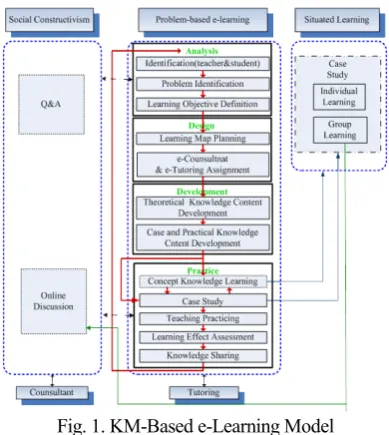
This study designed an e-Learning model with problem-based learning as its core and social constructivism and situated learning as its auxiliary theories. This model includes the stages of analysis, design, development, and practice as shown in Fig. 1.
Fig. 1. KM-Based e-Learning Model
A learner undertaking case studies may select either “individual learning” or “group learning”. The “group learning” takes the learner to a learning mode based on social constructivism, where the learner may initiate a group discussion and direct questions to experts or learners with related experience in any phase of the case study. During Q&A sessions or online discussions in this forum, an experienced teacher or expert plays the role of an e-consultant to guide the learners to complete their learning processes.
III. KNOWLEDGE MANAGEMENT IN PBEL
Knowledge management (KM) refers to the identification, acquisition, selection, storage, management, application, and sharing of knowledge, by an organization or individuals [11]. KM represents a systematic process of knowledge accumulation as well as the effective use of knowledge to help realize greater benefits when both individuals and the whole organization improve as a result of the popularization of knowledge.
As e-learning is a knowledge intensive process, the effectiveness of e-learning is highly dependent on the quality of its content knowledge, which in turn counts on the success of knowledge capture, storage, sharing and innovation. Therefore, the concepts and methods of knowledge management were employed in the approach of this research, which includes steps of knowledge identification, knowledge exploration, knowledge modeling and knowledge content building.
The objective of knowledge identification is to identify the knowledge requirements as well as the relationships among the areas of involved knowledge. The output of this phase is a knowledge framework that indicates the areas of the domain knowledge and their relationships.
The phase of knowledge exploration explores the elements of each area of knowledge and their relationships to present domain knowledge in a structured format. The output of this phase is a domain knowledge map illustrating the elements of domain knowledge and their relationships.
Knowledge modeling aims to analyze the type, characteristics, attributes, and structure of each area of knowledge and formalize them using modeling methods and conceptual representation schemes. The outputs of this step are the conceptual models of knowledge and their specifications.
Knowledge content building conducts the building of domain ontology (i.e concept map), domain corpus, cases and rule base
Fig. 2. Learning Resource Model.
based on the results of knowledge exploration and modeling. Each layer of knowledge was built through steps of identification, validation, acquiring and implementation.
IV. KNOWLEDGE IDENTIFICATION
The requirements of knowledge can be identified from the scope of applications, which in turn can be specified based on the objective of the e-learning platform. In this research, the application objective is to help pre-service and in-service teachers enhance knowledge to help elementary school students with mathematical learning difficulties improve mathematics ability. Therefore, the knowledge required in this application can be identified from the knowledge model of expert teachers.
Basically, an expert teacher possesses formal knowledge and practical know. Formal knowledge is acquired through a teacher’s formal training program and teaching principle that are categorized according to different scenarios. They include, as enumerated by Shulman [12], content knowledge, general content knowledge, curriculum knowledge, pedagogical content knowledge, knowledge of learners and their characteristics, and knowledge of educational contexts and objectives.
Practical knowledge is derived from the application of formal knowledge to real-life teaching situations and the resolution and rumination of teaching difficulties [13]. Teachers, through real-life teaching experience, are able to develop various principles, conventions, and effective practices and experiences based on formal knowledge through personal exposure, experiences, and observations made in different situations.
Practical knowledge can be further identified into procedural knowledge and strategic knowledge. The former is related to the procedure to carry an action out, which is the instruction-oriented knowledge about "how" to do something. For example, the methodology to solve students’ learning problems would be considered procedural knowledge. The latter is the principles or rules to carry out an action. Empirical knowledge was obtained from practical knowledge by capturing and generalizing the experiential principles, procedures and methods to solving problems without presenting the background, intent, logic, reasoning, principle, and thought that were implicit in the particular method.
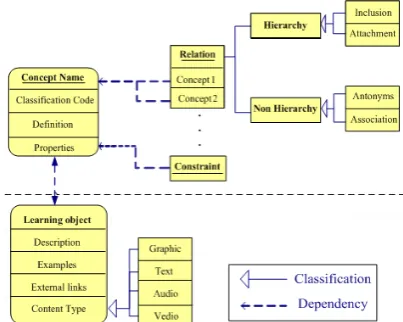
In light of aforementioned knowledge of teachers, this study has analyzed and modeled the learning resources as discussed below (See Fig. 2).
[image:2.595.313.540.47.235.2]practical knowledge presentation, each of which included parts of “teaching narration” and “teaching narration explanation.” The former consisted of student profile, teaching objective, teaching procedure, teaching activity and teaching content, and general assessments. The teaching activity and content contained students’ error patterns, teaching objectives, teaching strategies, teaching methods, teaching aids and unit assessments. The latter was the explanation of the teaching narration which included interpretation of disability assessment and problem identification, the reasons for proposed teaching objective, procedure, strategy, content, and assessment. A case presents the “know-what” of the encountered student’s learning problems and related concepts, the problem-solving “know-how” experienced by teachers, and the “know-why” involved in the “know-how”. To make practical and formal knowledge interoperable, the concepts appear in the cases can link back to formal knowledge layer for concept explanations. On the other hand, some of the concepts and theories defined in the formal knowledge layer may also link to related cases, giving learners relevant practical materials to study and verify. Besides, questions in forms of 5W1H (what, why, when, who, where, & how) and reference answers as well as explanations are embedded in each section of the cases to allow learners to repeatedly study the case content to enhance learning efficiency.
V. KNOWLEDGE EXPLORATION AND MODELING
This section presents the exploration and modeling of formal, practical and empirical knowledge.
5.1 Formal knowledge
To explore domain concepts, this study developed an “inside-out concept exploration approach” using domain core concepts as the basis to explore other domain concepts. Since this approach only defines the concepts that are directly related to the core concepts, one can control the scope of concept definition and decrease the amount of unneeded concept enumeration to speed up the development of domain concept model. Moreover, the further exploration of core concepts may enhance the completeness of the domain concept map.
[image:3.595.312.542.47.224.2]This study took “knowledge of mathematics teaching for students with mathematical learning difficulties” as its domain root concept and it included core concepts such as mathematics knowledge, general content knowledge, mathematics teaching knowledge, physical and psychological characteristics of students with mathematics difficulties, students’ cognition, and educational contextual knowledge by referencing teachers’ formal knowledge enumerated by Shulman [12]. These seven concepts were further explored and organized into a seven-layer core concept map. In order to reify the meanings of the concepts, the definitions, attributes and axioms of each knowledge concept and the relationships among concepts were defined. Moreover, the terms
Fig. 3. Part of the domain concept map.
appear in the definition of a core concept were defined as the auxiliary concepts of the core concept.
Ontology is believed as an effective method for defining entity, property and relationship of knowledge concepts of specific domain [17][18]. Therefore, to model and present the concept knowledge as well as to provide a basis for integration of formal knowledge and practical knowledge, an ontology for “mathematics teaching for students with mild disabilities” was developed as a domain knowledge map as shown in Fig. 3.
To enhance ordinary ontology models that simply use “hierarchy” to define relationships among concepts [17][18][19], this study proposed an ontology model with more concept relationships as shown in Fig. 4. The main constructs of the ontology model are concept and concept relation. A concept is defined in terms of Concept name, Classification code, Concept definition, Concept properties and Property constraints, and the concept relations can be hierarchical relations or non-hierarchical relations. The hierarchical relations can be further classified into types of inclusion and attachment, while non-hierarchical relations could be types of synonyms or association. “Inclusion” indicates a parent concept with a set of child concepts. “Attachment” which defines a child concept is a “sub-class” of its parent concept. “Synonyms” defines the synonyms of a concept. Finally, “association” defines the “auxiliary concepts” of a core concept.
The in-depth knowledge defines the detailed explanation, including the “know-what”, “know-why”, “know-how”, “know-with” and examples of each core concept defined in the concept map. The present study viewed in-depth knowledge as “learning object”, which is defined in terms of description, example, external links and content type.
[image:3.595.325.527.602.763.2]00 Learning case 02 Teaching content XXX Retrievalable Learning Object 0221 Teaching activity Legend: Non-retrievalable Learning Object Mathematics abilities Intelligence Cognitive abilities Strength & weakness Disabilities Preferences XXX Learning characteristics Learning attitude Learning style 01301 01302 01303 01304 01305 01306 01307 01308 01309 Error Pattern Personal data 011 01 Student profile Error Pattern Problem statement 012 Error Pattern Teaching objective 021 Error Pattern General assessment 023 Characteristics 013 Error Pattern Teaching procedure 022 Error Pattern Teaching
objective TeachingstrategyPatternError assessmentPatternErrorUnit
02211 02213 02215
Error Pattern
02212 Student
error pattern PatternError
02214 Teaching aids 1-n Obj_Name: Teaching Strategy 02213_ID Teaching Strategy & Method
(What & How)
Q&A Explanation (Why)
[image:4.595.60.277.49.312.2]Methods Fig. 5. The learning case model.
Learning difficulty identification Student awareness Teaching planning Teaching practice Performance evaluation Learning problem statement Difficulty identification Difficulty awareness Behavior analysis Learning affection assessment Strength & weakness assessment Disability type assessment Cognitive characteristics assessment Teaching objectiveprocedureTeaching
Teaching strategyTeaching content
Teaching Plan Implementation Performance assessment Assessment development Students’ learning problem solving What Strategic Procedural Why Why Why How
Fig. 6. The empirical knowledge model. 5.2 Practical knowledge
The procedure for practical knowledge model development includes steps of (1) teaching narration analysis and modeling, (2) common practical knowledge map development, and (3) case model development and verification. In the first step, teaching narrations developed by certified teachers from their own real teaching experience, observation, discussion, and expert assessments were analyzed and modeled into teaching narration knowledge maps. The teaching narration knowledge maps were used and generalized into a common knowledge map, which was the preliminary case model. The common knowledge map was then verified by a group of expert teachers to get a consensus of the learning case model.
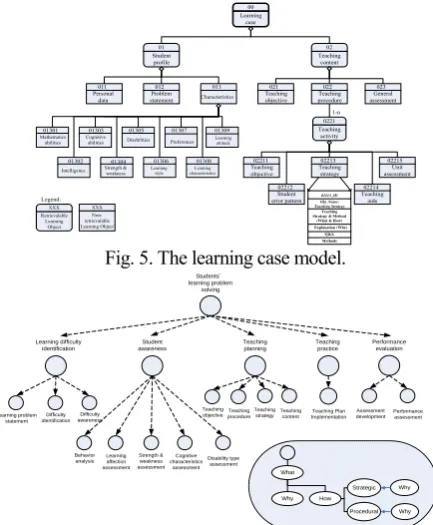
[image:4.595.305.536.659.773.2]The learning case model was composed of two parts: student profile and teaching plan. The student profile contains the statements of student problem identifications and analyses, as well as assessments of student’s learning characteristics, which included mathematics capability, intelligence, cognitive abilities, strengths and weaknesses, types of disability, and preferences. The teaching plan contains general teaching objective, teaching procedures, the teaching activities and general learning assessments. The teaching procedure consists of one or more teaching activities, which are basically teaching cases containing student’s error patterns, unit teaching objective, teaching strategy, teaching material and teaching aids.
Fig. 5 shows the learning case model defined in terms of UML [20] notations, where a box represents a class of learning objects and a diamond indicates a composite class which is composed of its component classes. As indicated in the figure, each class includes portions of what, why, how and Q&A, and together they explain what has been done in the teaching content and why and how it was done, as well as a series of related questions for discussion and the learners’ ruminations.
In order to effectively store, organize, manage, and use the case contents, this study defined the instances of each class in the case model as learning objects by employing object technology [21]. Besides the data (i.e content) of a learning object, methods were encapsulated in the objects as functions for manipulation of those
object data to improve its adaptivity. For example, the presentation formats and display sequence of the content may vary with the learner’s learning style and cognitive trait, which were manipulated by the methods of learning objects.
The learning objects are stored in an object database, and the links among the learning objects provide a basis for case configuration and object clustering. The learning contents can be retrieved through individual learning object retrieval, entire learning case retrieval or grouping of certain learning objects. For instance, besides retrieving a whole learning case for study, a learner may retrieve student profiles to investigate the relationships between students’ learning problems and their personal and learning characteristics. The learner may also search the teaching activity as teaching cases for reference.
5.3 Empirical knowledge
Empirical knowledge aims to provide the learners with concepts, experiential principles, procedures and methods to solve students learning problems without presenting the background, intent, logic, reasoning, principle, and thought that were implicit in the particular method.
Using problem solving process as reference, the empirical knowledge model on student’s learning problem solving was obtained through interviews with expert teachers. It includes stages of problem identification, problem analysis, solution development, solution implementation, and performance evaluation. Problem identification is to identify the student’s learning problem, clearly define it and establish a precise problem statement, and decide what teaching objective to achieve. The problem analysis is to identify root cause of student’s learning problem and collect and analyze data related to the problem. Possible solution that may address the root cause of the student’s learning problem is then proposed in the stage of solution development. Solution implementation is to put the possible solution into action based on a planning on when and how to do it. Re-planning and redesign on the solution may be required during the implementation. Performance evaluation is conducted to identify how effective the solution is, to assess if the teaching goal has been achieved, and to validate the consequences it has on the situation. Each stage of the problem solving process was further identified into detailed steps or activities as shown in Fig. 6.
This study presented the knowledge nodes defined in the empirical knowledge structure as “learning objects” containing knowledge of “know-what”, “know-why”, “know-how” and the “know-why of know-how” to structurally present the layers of empirical knowledge. Know-what which defines the concept of the knowledge is basically declarative knowledge. Know-why is causal knowledge to express the applications and the needs of the knowledge. The know-how knowledge which includes strategic how and procedural how is to express the experiential principles and detailed procedures or methods of student’s learning problem solving activities. Mathematics abilities Intelligence Cognitive abilities Strength & weakness DisabilitiesPreferences Learning characteristics Learning attitude Learning style Teaching
objective Teachingprocedure assessmentGeneral
Teaching
objective error patternStudent Teachingstrategy Teachingaids assessmentUnit Problem statement Characteristics why (with) Interpretation why Assessment methods how how (with) Reason why how Teaching activity how why (with) Explanation Assessment methods how why why Teaching details how why Assessment details how why Reason why why why Explanation Assessment details how why how (with) how (with) Reason Reason how Reason Reason Reason
validation and revision, (3) developing the content of knowledge hierarchy by referencing textbooks, (4) expanding the associated concepts by identifying the concepts appearing in the definition of concepts in the knowledge hierarchy, (5) distributing the preliminary ontology to domain experts and expert teachers for validation and revision, and (6) implementing the ontology in Protégé, a free, open source ontology editor and knowledge-base framework [17].
The concept learning objects (i.e. in-depth knowledge) were developed through the following steps: (1) identifying the concepts required for learning object development from the concept map, (2) acquiring the content of each concept from relevant textbooks, (3) distributing the preliminary pre-developed concept learning objects to the domain experts and expert teachers for validation and revision, (4) implementing the concept learning objects in Micro Soft SQL XML database, and (5) making the links between nodes in the concept map and the concept learning objects.
6.2 Learning case development
Learning cases were developed in two stages of teaching narration development and implicit knowledge acquisition. Teaching narrations were developed by certified teachers based on their own teaching records, and were analyzed through actual teaching, observation, discussion, and assessed by expert teachers. Implicit knowledge acquisition was to extract the “know-how”, “know-why” and “know-why” of the “know-how” in teaching narrations. Through implicit knowledge acquisition, practical knowledge of teaching not only recorded solutions, but also the motives, background, and insights of teaching expert for a particular problem.
To conduct implicit knowledge acquisition, this research developed a case-based map for implicit knowledge acquisition as shown in Fig. 7. The knowledge elicitation starts with inquiry of the cause of student’s learning problem indicated in the statement and the reason why making such statement, which can be explained using student’s personal characteristics. Since these characteristics are identified through the assessments results of mathematic abilities, cognitive abilities etc., the inquiries can be made on the interpretation of the assessment results (i.e. why) and the methods for characteristic assessment (i.e. how). For teaching objective, inquiry is made on the reason to set the objective and the “strategic how” to achieve the teaching objective. The former explains why the teaching objective is decided, while the latter indicates the approach to solving student’s learning problem as well as the relationship between teaching objective and teaching procedure. The reason for taking the teaching procedure is identified as “why”, and the teaching activities are the “how” of the procedure. Similarly, each teaching activity has
“why” explains “the reason why to make such statements” and the “how” depicts “the methods or approaches to achieve or obtain the facts in the statement”. Similarly, for procedural nodes such as “teaching procedure”, “teaching activity”, “teaching aids” and “assessments”, the “why” explains “the reason why to take such actions” and the “how” depicts “the methods or steps to accomplish the actions”. Most of the “why” and “how” are the implicit knowledge of expert teachers, and some may appear as casual relationships between nodes, which are indicated in terms of “why (with)” and “how (with)” respectively. For example, the teaching procedural is the “how (with)” of teaching objective and student characteristics is the “why (with)” of problem statement. 6.3 Empirical knowledge elicitation
In order to effectively acquire empirical knowledge from expert teachers, this study developed a knowledge elicitation method using Analysis Hierarchy Process (AHP) developed by Saaty [22]. The AHP method was developed to provide an analysis framework, using hierarchical approaches to divide complex and unstructured problems, and thereafter proceeding with the analysis. The analysis results of each layer were further summarized, drawn up an effective solution. It was often applied in solution creation, solution selection, and solution optimization, and implemented using survey questionnaires or interviews.
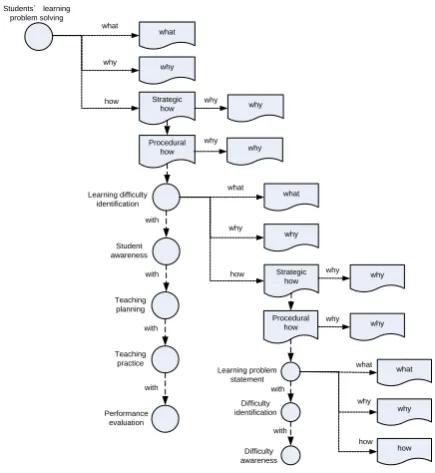
The framework of the knowledge elicitation method includes a sequence of know-what, know-why, know-how, and know-with analyses (see Fig. 8). The know-how is layered into strategic how and procedural how, where the procedural how itself may include a sequence of activities as the next layer’s what and how. The strategic how, procedural how, and the detailed activities are further analyzed into what, why, how and with.
By applying the method, a map for empirical knowledge elicitation was obtained as shown in Fig. 9. At the first layer, the know-what, know-why, know-how (including strategic how and procedural how) and know-why of the know-how are identified. The procedural how includes activities of learning difficulty identification, student awareness, teaching planning, teaching practice, and performance evaluation, each of which becomes the second layer’s what for further knowledge elicitation. The elicitation process continues until no further activity is identified.
Know-what Know-why Know-how
Strategic how
Procedural how
Know-with
Activity
[image:6.595.46.287.48.180.2]Know-what Know-why Know-how Know-with
Fig. 8. Framework of AHP-based empirical knowledge elicitation.
Learning difficulty identification
Student awareness
Teaching planning
Teaching practice
Performance evaluation
what
why what
why
how
Learning problem statement
Difficulty identification
Difficulty awareness
Strategic how
Procedural how
what
why what
why
how how why with
with
with
with with
with Students’ learning
problem solving
what
why what
why
how Strategic how
Procedural how
why why
why
why why why
why
Fig. 9. The map for empirical knowledge elicitation.
VII. CONCLUSION
This paper presented a systematic approach for modeling knowledge of mathematics teaching for students with mathematical learning difficulties. Through the proposed approach, a digital knowledge content repository was developed to support a KM-based e-learning platform for knowledge development of pre-service and in-service teachers. The domain concept map that contains practical knowledge is used to support the concept navigation, while the cases that are the sources of practical knowledge are used for problem-based e-learning [23]. Besides problem-solving context and methods, relevant theories are included to help teachers construct and integrate theoretical and practical knowledge and enhance capability of problem solving.
By employing the proposed approach, the tacit knowledge of problem resolution of expert teachers can be extracted and effectively stored through the transformation of concepts and their relations. And, the domain knowledge is made explicit and presented in a structured manner closed to the thinking of human being, that allows users to fully understand the conception and thinking of domain experts. Moreover, an object-oriented ontology schema was developed for building domain concept map of theoretical knowledge and topic maps of practical
knowledge. Through their links to content of corpus the alignment of the two layers of knowledge can be obtained to enhance the effectiveness of learning.
REFERENCES
[1] Jordan, N. C., & Hanich, L. B. “Mathematical thinking in second-grade children with different types of learning difficulties.” Journal of Learning Disabilities, 33, 2000, 567–578.
[2] Geary, D. C. “From infancy to adulthood: The development of numerical abilities.” European Child and Adolescent Psychiatry, 9, II11–II16,
2000
[3] Garnett, K. "Math learning disabilities: Teaching and learners." Reading, Writing, and Learning Disabilities, 3, 1987, 1-8.
[4] Bryant, B. R., & Bryant, D. P. “Introduction to the special series: Mathematics and learning disabilities.” Learning Disability Quarterly,
31 (1), 2008, p3-8.
[5] Fuchs, L., & Fuchs, D. "Enhancing mathematical problem solving for students with disabilities." The Journal of Special Education, 39 (1),
2005, 45-57.
[6] Maccini, P., & Gagnon, J. C. "Mathematics instructional practices and assessment accommodations by secondary special and general educators." Exceptional Children, 72, 2006, 217-234.
[7] Miller, S. P., & Hudson, P. "Using evidence-based practices to build mathematics competence related to conceptual, procedural, and declarative knowledge." Learning Disabilities Research & Practice,
22(1), 2007, 47-57.
[8] IEEE Learning Technology Standards Committee (LTSC). Retrieved from the World Wide Web:
[9] Learning Material Markup Language (LMML). Retrieved from the World Wide Web
[10]Advanced Distributed Learning. Shareable Content Object Reference Model (SCORM) 2004 2nd ed Overview. Retrieved from the World Wide Web
[11]Demarest, M. "Understanding knowledge management." Journal of Long Range Planning, 30 (3), 1997, 374-384.
[12]Shulman, L. S. "Knowledge and teaching: Foundations of the new reform." Harvard Educational Review, 57, 1987, l-22.
[13]Fenstermacher, G. D. "The knower and the known: The nature of knowledge in research on teaching." In L. Darling-Hammond (Ed.),
Review of research in teaching, 20, 1994, 3-56.
[14]Merseth, K. K. "Cases and case methods in teacher education." In J. Sikula (Ed.). Handbook of Research on Teacher Education 2nd, 1996,
722-744.
[15]Richardson, V. "Use of cases in considering methods for motivating students." In H. Harrington & M. Thompson (Eds.), Student motivation and case study manual, 1993, pp. 5760.
[16]Richert, A. E. "Using teacher cases for reflection and enhanced understanding." In A. Lieberman & L. Miller (Eds.), Staff development for education in the 90's, 1991, pp. 113-132.
[17]Asuncion, G. P., Oscar, C., & Mariano, F. L., Ontological engineering: With examples from the areas of knowledge management, e-commerce and the semantic web. Springer-Verlag London Limited. 2004.
[18]Staab, S., Schnurr, H-P., Studer, R., & Sure, Y. "Knowledge Processes and Ontologies." IEEE Intelligent Systems, 16 (1), 2001, 26-34.
[19]Schreiber, G. , Akkermans, H., Anjewierden, A., de Hoog, R. , Shadbolt, N., de Velde, W. V., & Wielinga, B., Knowledge engineering and management: The common KADS methodology. Cambridge: MIT Press,
1999.
[20]Booch, G., Rumbaugh, J. & Jacobson, I., The unified modeling language user guide. Reading, MA: Addison-Wesley, 1999.
[21]Bruegge, B., & Dutoit, A. H., Object-Oriented Software Engineering Using UML, Patterns, and Java 2nd ed. NJ: Prentice Hall, 2004.
[22]Saaty, T., The Analytic Hierarchy Process. NY: McGraw-Hill, 1980.
[23]Chu, H., Chen, Y., Lin, C., Chen, M., & Wang, C. "Problem-based e-learning: models and system framework." In T. Reeves & S. Yamashita (Eds.), Proceedings of World Conference on E-Learning in Corporate, Government, Healthcare, and Higher Education 2006 (pp. 2764-2771).
[image:6.595.60.278.225.462.2]