Introduction to the CoNLL-2004 Shared Task:
Semantic Role Labeling
Xavier Carreras and Llu´ıs M`arquez
TALP Research Centre
Technical University of Catalonia (UPC)
{
carreras,lluism
}
@lsi.upc.es
Abstract
In this paper we describe the CoNLL-2004 shared task: semantic role labeling. We intro-duce the specification and goal of the task, de-scribe the data sets and evaluation methods, and present a general overview of the systems that have contributed to the task, providing compar-ative description.
1
Introduction
In recent years there has been an increasing interest in semantic parsing of natural language, which is becoming a key issue in Information Extraction, Question Answer-ing, Summarization, and, in general, in all NLP applica-tions requiring some kind of semantic interpretation.
The shared task of CoNLL-20041concerns the recog-nition of semantic roles, for the English language. We will refer to it as Semantic Role Labeling (SRL). Given a sentence, the task consists of analyzing the propositions expressed by some target verbs of the sentence. In par-ticular, for each target verb all the constituents in the sen-tence which fill a semantic role of the verb have to be extracted (see Figure 1 for a detailed example). Typical semantic arguments include Agent, Patient, Instrument, etc. and also adjuncts such as Locative, Temporal, Man-ner, Cause, etc.
Most existing systems for automatic semantic role la-beling make use of a full syntactic parse of the sentence in order to define argument boundaries and to extract rel-evant information for training classifiers to disambiguate between role labels. Thus, the task has been usually ap-proached as a two phase procedure consisting of
recogni-tion and labeling of arguments.
1
CoNLL-2004 Shared Task web page —with data, software and systems’ outputs available— at
http://cnts.uia.ac.be/conll2004/roles.
Regarding the learning component of the systems, we find pure probabilistic models (Gildea and Juraf-sky, 2002; Gildea and Palmer, 2002; Gildea and Hock-enmaier, 2003), Maximum Entropy (Fleischman et al., 2003), generative models (Thompson et al., 2003), De-cision Trees (Surdeanu et al., 2003; Chen and Ram-bow, 2003), and Support Vector Machines (Hacioglu and Ward, 2003; Pradhan et al., 2003a; Pradhan et al., 2003b).
There have also been some attempts at relaxing the ne-cessity of using syntactic information derived from full parse trees. For instance, in (Pradhan et al., 2003a; Ha-cioglu and Ward, 2003), a SVM-based SRL system is devised which performs an IOB sequence tagging using only shallow syntactic information at the level of phrase chunks.
Nowadays, there exist two main English corpora with semantic annotations from which to train SRL systems: PropBank (Palmer et al., 2004) and FrameNet (Fillmore et al., 2001). In the CoNLL-2004 shared task we concen-trate on the PropBank corpus, which is the Penn Treebank corpus enriched with predicate–argument structures. It addresses predicates expressed by verbs and labels core arguments with consecutive numbers (A0 to A5), try-ing to maintain coherence along different predicates. A number of adjuncts, derived from the Treebank functional tags, are also included in PropBank annotations.
To date, the best results reported on the PropBank cor-respond to a F1 measure slightly over 83, when using
The challenge for CoNLL-2004 shared task is to come up with machine learning strategies which address the SRL problem on the basis of only partial syntactic in-formation, avoiding the use of full parsers and external lexico-semantic knowledge bases. The annotations pro-vided for the development of systems include, apart from the argument boundaries and role labels, the levels of pro-cessing treated in the previous editions of the CoNLL shared task, i.e., words, PoS tags, base chunks, clauses, and named entities.
The rest of the paper is organized as follows. Section 2 describes the general setting of the task. Section 3 pro-vides a detailed description of training, development and test data. Participant systems are described and compared in section 4. In particular, information about learning techniques, SRL strategies, and feature development is provided, together with performance results on the devel-opment and test sets. Finally, section 5 concludes.
2
Task Description
The goal of the task is to develop a machine learning sys-tem to recognize arguments of verbs in a sentence, and label them with their semantic role. A verb and its set of arguments form a proposition in the sentence, and typi-cally, a sentence will contain a number of propositions.
There are two properties that characterize the structure of the arguments in a proposition. First, arguments do not overlap, and are organized sequentially. Second, an argu-ment may appear split into a number of non-contiguous phrases. For instance, in the sentence “[A1 The apple],
said John, [C−A1is on the table]”, the utterance argument
(labeled with type A1) appears split into two phrases. Thus, there is a set of non-overlapping arguments la-beled with semantic roles associated with each proposi-tion. The set of arguments of a proposition can be seen as a chunking of the sentence, in which chunks are parts of the semantic roles of the proposition predicate.
In practice, number of target verbs are marked in a sen-tence, each governing one proposition. A system has to recognize and label the arguments of each target verb.
2.1 Methodological Setting
Training and development data are provided to build the learning system. Apart from the correct output, both data sets contain the correct input, as well as predictions of the input made by state-of-the-art processors. The training set is used for training systems, whereas the development set is used to tune parameters of the learning systems and select the best model.
Systems have to be developed strictly with the data provided, which consists of input and output data and the official external resources (described below). Since the correct annotations for the input data are provided, a sys-tem is allowed either to be trained to predict the input
part, or to make use of an external tool developed strictly within this setting, such as previous CoNLL shared task systems.
2.2 Evaluation
Evaluation is performed on a separate test set, which in-cludes only predicted input data. A system is evaluated with respect to precision, recall and the F1measure.
Pre-cision (p) is the proportion of arguments predicted by a system which are correct. Recall (r) is the proportion of correct arguments which are predicted by a system. Fi-nally, the F1 measure computes the harmonic mean of
precision and recall, and is the final measure to com-pare the performance of systems. It is formulated as:
Fβ=1= 2pr/(p+r).
For an argument to be correctly recognized, the words spanning the argument as well as its semantic role have to be correct.2
As an exceptional case, the verb argument of each proposition is excluded from the evaluation. This argu-ment is the lexicalization of the predicate of the proposi-tion. Most of the time, the verb corresponds to the target verb of the proposition, which is provided as input, and only in few cases the verb participant spans more words than the target verb.
Except for non-trivial cases, this situation makes the verb fairly easy to identify and, since there is one verb with each proposition, evaluating its recognition over-estimates the overall performance of a system. For this reason, the verb argument is excluded from evaluation.
3
Data
The data consists of six sections of the Wall Street Jour-nal part of the Penn Treebank (Marcus et al., 1993), and follows the setting of past editions of the CoNLL shared task: training set (sections 15-18), development set (sec-tion 20) and test set (sec(sec-tion 21). We first describe anno-tations related to argument structure. Then, we describe the preprocessing of input data. Finally, we describe the format of the data sets.
3.1 PropBank
The Proposition Bank (PropBank) (Palmer et al., 2004) annotates the Penn Treebank with verb argument struc-ture. The semantic roles covered by PropBank are the following:
• Numbered arguments (A0–A5, AA): Arguments
defining verb-specific roles. Their semantics de-pends on the verb and the verb usage in a sentence, or verb sense. In general,A0stands for the agent
2
andA1corresponds to the patient or theme of the proposition, and these two are the most frequent roles. However, no consistent generalization can be made across different verbs or different senses of the same verb. PropBank takes the definition of verb senses from VerbNet, and for each verb and each sense defines the set of possible roles for that verb usage, called the roleset. The definition of rolesets is provided in the PropBank Frames files, which is made available for the shared task as an official
re-source to develop systems.
• Adjuncts (AM-): General arguments that any verb
may take optionally. There are 13 types of adjuncts:
AM-ADV: general-purpose AM-MOD: modal verb
AM-CAU: cause AM-NEG: negation marker
AM-DIR: direction AM-PNC: purpose
AM-DIS: discourse marker AM-PRD: predication
AM-EXT: extent AM-REC: reciprocal
AM-LOC: location AM-TMP: temporal
AM-MNR: manner
• References (R-): Arguments representing
argu-ments realized in other parts of the sentence. The role of a reference is the same as the role of the ref-erenced argument. The label is anR-tag prefixed to the label of the referent, e.g.R-A1.
• Verbs (V): Participant realizing the verb of the
proposition, with exactly one verb for each one.
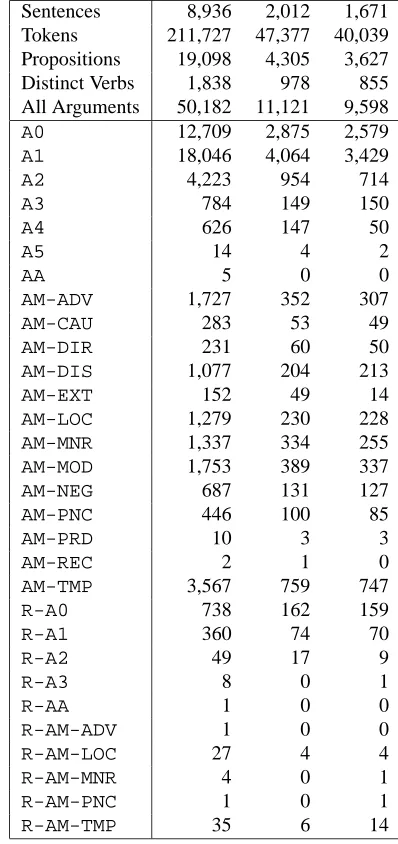
We used the February 2004 release of PropBank. Most predicative verbs were annotated, although not all of them (for example, most of the occurrences of the verb “to have” and “to be” were not annotated). We applied procedures to check consistency of propositions, looking for overlapping arguments, and incorrect semantic role labels. Also, co-referenced arguments were annotated as a single item in PropBank, and we automatically distin-guished between the referent and the reference with sim-ple rules matching pronominal expressions, which were tagged asRarguments. A total number of 68 proposi-tions were not compliant with our procedures, and were filtered out from the CoNLL data sets. The predicate-argument annotations, thus, are not necessarily complete in a sentence. Table 1 provides counts of the number of sentences, annotated propositions, distinct verbs and ar-guments in the three data sets.
3.2 Preprocessing
In this section we describe the pipeline of processors to compute the annotations which form the input part of the data: part-of-speech (PoS) tags, chunks, clauses and named entities. The preprocessors correspond to the fol-lowing state-of-the-art systems for each level of annota-tion:
Training Devel. Test Sentences 8,936 2,012 1,671 Tokens 211,727 47,377 40,039 Propositions 19,098 4,305 3,627 Distinct Verbs 1,838 978 855 All Arguments 50,182 11,121 9,598 A0 12,709 2,875 2,579 A1 18,046 4,064 3,429
A2 4,223 954 714
A3 784 149 150
A4 626 147 50
A5 14 4 2
AA 5 0 0
AM-ADV 1,727 352 307
AM-CAU 283 53 49
AM-DIR 231 60 50
AM-DIS 1,077 204 213
AM-EXT 152 49 14
AM-LOC 1,279 230 228
AM-MNR 1,337 334 255
AM-MOD 1,753 389 337
AM-NEG 687 131 127
AM-PNC 446 100 85
AM-PRD 10 3 3
AM-REC 2 1 0
AM-TMP 3,567 759 747
R-A0 738 162 159
R-A1 360 74 70
R-A2 49 17 9
R-A3 8 0 1
R-AA 1 0 0
R-AM-ADV 1 0 0
R-AM-LOC 27 4 4
R-AM-MNR 4 0 1
R-AM-PNC 1 0 1
[image:3.612.324.523.84.506.2]R-AM-TMP 35 6 14
Table 1: Counts on the three data sets.
• PoS tagger: (Gim´enez and M`arquez, 2003), based on Support Vector Machines, and trained on Penn Treebank sections 0–18.
• Chunker and Clause Recognizer: (Carreras and M`arquez, 2003), based on Voted Perceptrons, and following the CoNLL settings of 2000 and 2001 tasks (Tjong Kim Sang and Buchholz, 2000; Tjong Kim Sang and D´ejean, 2001). These two processors form a coherent partial syntax of a sentence, that is, chunks and clauses form a tree.
Precision Recall F1/Acc.
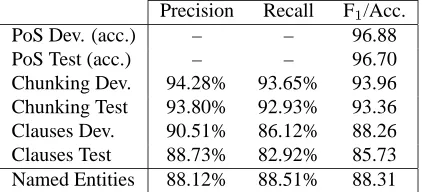
[image:4.612.81.292.72.168.2]PoS Dev. (acc.) – – 96.88 PoS Test (acc.) – – 96.70 Chunking Dev. 94.28% 93.65% 93.96 Chunking Test 93.80% 92.93% 93.36 Clauses Dev. 90.51% 86.12% 88.26 Clauses Test 88.73% 82.92% 85.73 Named Entities 88.12% 88.51% 88.31
Table 2: Results of the preprocessing modules on the de-velopment and test sets. Named Entity figures are based on the CoNLL-2003 test set.
Such processors were ran in a pipeline, from PoS tags, to chunks, clauses and finally named entities. Table 2 summarizes the performance of the processors on the de-velopment and test sections. These figures differ from the original results in the original due to a better quality of the input information in our runs. The figures of the named entity extractor are based on the corpus of the CoNLL-2003 shared task, since gold annotations of named enti-ties were not available for the current corpus.
3.3 Format
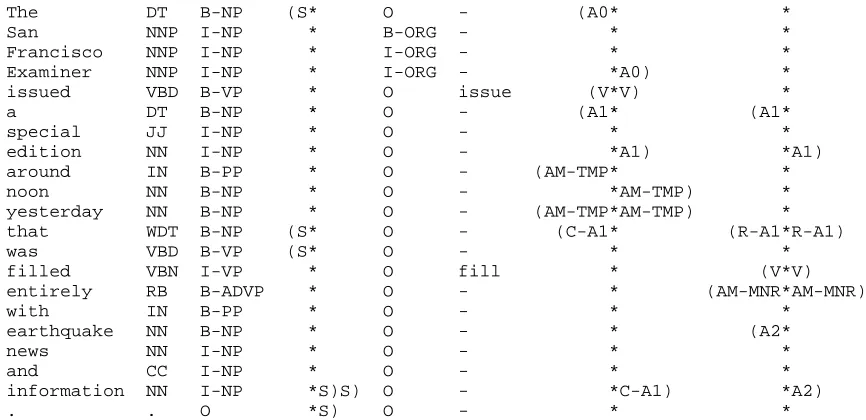
Figure 1 shows an example of a fully-annotated sentence. Annotations of a sentence are given using a flat represtation in columns, separated by spaces. Each column en-codes an annotation by associating a tag with every word. For each sentence, the following columns are provided:
1. Words.
2. Part of Speech tags. 3. Chunks in IOB2 format. 4. Clauses in Start-End format. 5. Named Entities in IOB2 format.
6. Target verbs, marking n predicative verbs. This column, provided as input, specifies the governing verbs of the propositions to be analyzed. Each target verb is in the base form. Occasionally this column does not mark any verb (i.e.,nmay be 0).
7. For each of thentarget verbs, a column in Start-End format specifying the arguments of the proposition. These columns are the output of a system, that is, the ones to be predicted, and are not available for the test set.
IOB2 format. Represents chunks which do not overlap
nor embed. Words outside a chunk receive the tag O. For words forming a chunk of typek, the first word receives theB-ktag (Begin), and the remaining words receive the tagI-k(Inside).
Start-End format. Represents non-overlapping
phrases (clauses or arguments) which may be
embed-ded3 inside one another. Each tag indicates whether a clause starts or ends at that word and is of the form START*END. TheSTARTpart is a concatenation of(k
parentheses, each representing that a phrase of type k
starts at that word. TheENDpart is a concatenation of
k)parentheses, each representing that a phrase of type
kends at that word. For example, the *tag represents a word with no starts and ends; the (A0*A0) tag represents a word constituting anA0argument; and the (S(S*S) tag represents a word which constitutes a base clause (labeled S) and starts another higher-level clause. Finally, the concatenation of all tags constitutes a well-formed bracketing. For the particular case of split arguments, of type k, the first part appears as a phrase with label k, and the remaining as phrases with label C-k(continuation prefix). See examples of annotations at columns 4th, 7th and 8th of Figure 1.
4
Participating Systems
Ten systems have participated in the CoNLL-2004 shared task. They approached the task in several ways, using dif-ferent learning components and labeling strategies. The following subsections briefly summarize the most impor-tant properties of each system and provide a qualitative comparison between them, together with a quantitative evaluation on the development and test sets.
4.1 Learning techniques
Up to six different learning algorithms have been ap-plied in the CoNLL-2004 shared task. None of them is new with respect to the past editions. Two teams used the Maximum Entropy (ME) statistical framework (Baldewein et al., 2004; Lim et al., 2004). Two teams used Brill’s Transformation-based Error-driven Learning (TBL) (Higgins, 2004; Williams et al., 2004). Two other groups applied Memory-Based Learning (MBL) (van den Bosch et al., 2004; Kouchnir, 2004). The remaining four teams employed vector-based linear classifiers of differ-ent types: Hacioglu et al. (2004) and Park et al. (2004) used Support Vector Machines (SVM) with polyno-mial kernels, Carreras et al. (2004) used Voted Percep-trons (VP) also with polynomial kernels, and finally, Punyakanok et al. (2004) used SNoW, a Winnow-based network of linear separators. Additionally, the team of Baldewein et al. (2004) used a EM–based clustering al-gorithm for feature development (see section 4.3).
As a main difference with respect to past editions, less effort has been put into combining different learning al-gorithms and outputs. Instead, the main effort of partici-pants went into developing useful SRL strategies and into the development of features (see sections 4.2 and 4.3). As an exception, van den Bosch et al. (2004) applied a
3
The DT B-NP (S* O - (A0* *
San NNP I-NP * B-ORG - * *
Francisco NNP I-NP * I-ORG - * *
Examiner NNP I-NP * I-ORG - *A0) *
issued VBD B-VP * O issue (V*V) *
a DT B-NP * O - (A1* (A1*
special JJ I-NP * O - * *
edition NN I-NP * O - *A1) *A1)
around IN B-PP * O - (AM-TMP* *
noon NN B-NP * O - *AM-TMP) *
yesterday NN B-NP * O - (AM-TMP*AM-TMP) *
that WDT B-NP (S* O - (C-A1* (R-A1*R-A1)
was VBD B-VP (S* O - * *
filled VBN I-VP * O fill * (V*V)
entirely RB B-ADVP * O - * (AM-MNR*AM-MNR)
with IN B-PP * O - * *
earthquake NN B-NP * O - * (A2*
news NN I-NP * O - * *
and CC I-NP * O - * *
information NN I-NP *S)S) O - *C-A1) *A2)
[image:5.612.85.518.69.279.2]. . O *S) O - * *
Figure 1: An example of an annotated sentence, in columns. Input consists of words (1st), PoS tags (2nd), base chunks (3rd), clauses (4th) and named entities (5th). The 6th column marks target verbs, and their propositions are found in remaining columns. According to the PropBank Frames, forissue(7th), theA0annotates the issuer, and theA1the thing issued, which appears split into two parts. Forfill(8th),A1is the the destination, andA2the theme.
voting strategy to derive the final sequence tagging as a voted combination of three overlappingn-gram output sequences. The same team also applied a meta-learning step, by using iterative classifier stacking, for correcting systematic errors committed by the low–level classifiers. This work is also worth mentioning because of the exten-sive work done on parameter tuning and feature selection.
4.2 SRL approaches
SRL is a complex task which has to be decomposed into a number of simpler decisions and tagging schemes in order to be addressed by learning techniques.
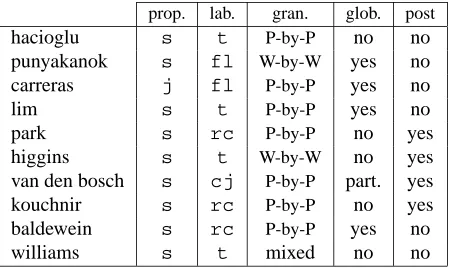
One first issue is the annotation of the different propo-sitions of a sentence. Most of the groups treated the annotation of semantic roles for each verb predicate as an independent problem. An exception is the system of Carreras et al. (2004), which performs the annotation of all propositions simultaneously. As a consequence, the former teams treat the problem as the recognition of se-quential structures (a.k.a. chunking), while the latter di-rectly derives a hierarchical structure formed by the argu-ments of all propositions. Table 3 summarizes the main properties of each system regarding the SRL strategy im-plemented. This property corresponds to the first column. Regarding the labeling strategy, we can distinguish at least three different strategies. The first one consists of performing role identification directly by a IOB-type se-quence tagging. The second approach consists of divid-ing the problem into two independent phases:
recogni-tion, in which the arguments are recognized, and
label-ing, in which the already recognized arguments are
as-signed role labels. The third approach also proceeds in two phases: filtering, in which a set of argument can-didates are decided and labeling, in which the set of optimal arguments is derived from the proposed can-didates. As a variant of the first two-phase strategy, van den Bosch et al. (2004) first perform a direct classi-fication of chunks into argument labels, and then decide the actual arguments in a post-process by joining previ-ously classified argument fragments. All this information is summarized in the second column of Table 3.
An implication of implementing the two-phase strat-egy is the ability to work with argument candidates in the second phase, allowing to develop feature patterns for complete arguments. Regarding the first phase, the recog-nition of candidate arguments is performed by means of a IOB or open–close tagging using classifiers, either argument–independent, or specialized by argument type. It is also worth noting that all participant systems per-formed learning of predicate-independent classifiers in-stead of specializing by the verb predicate. Information about verb predicates is captured through features and some global restrictions.
(2) P-by-P processing is computationally less expensive and allows to explore a relatively larger context. Most of the groups performed a P-by-P processing, but admitting a processing by words within the target verb chunks. The system by Baldewein et al. (2004) works with a bit more general elements called “chunk sequences”, extracted in a preprocess using heuristic rules. This information is presented in the third column of Table 3.
Information regarding clauses has proven to be very useful, as can be seen in section 4.3. All systems captured some kind of clause information through feature codifica-tion. However, some of the systems restrict the search for arguments only to the immediate clause (Park et al., 2004; Williams et al., 2004) and others use the clause hierarchy to guide the exploration of the sentence (Lim et al., 2004; Carreras et al., 2004).
Very relevant to the SRL strategy is the availability of global sentential information when decisions are taken. Almost all of the systems try to capture some global level information by collecting features describing the target predicate and its context, the “syntactic path” from the element under consideration to the predicate, etc. (see section 4.3). But only some of them include a global optimization procedure at sentence level in the labeling strategy. The systems working with Maximum Entropy Models (Baldewein et al., 2004; Lim et al., 2004) use beam search to find taggings that maximize the prob-ability of the output sequence. Carreras et al. (2004) and Punyakanok et al. (2004) also define a global scor-ing function to maximize. At this point, the system of Punyakanok et al. (2004) deserves special consideration, since it formally implements a set of structural and lin-guistic constraints directly in the global cost function to maximize. These constraints act as a filter for valid out-put sequences and ensure coherence of the outout-put. Au-thors refer to this part of the system as the inference
layer and they implement it using integer linear
program-ming. The iterative classifier stacking mechanism used by van den Bosch et al. (2004) also tries to alleviate the problem of locality of the low-level classifiers. This in-formation is found in the fourth column of Table 3.
Finally, some systems use some kind of postprocess-ing to ensure coherence of the final labelpostprocess-ing, correct some systematic errors, or to treat some types of adjunctive ar-guments. In most of the cases, this postprocess is per-formed on the basis of simple ad-hoc rules. This infor-mation is included in the last column of Table 3.
4.3 Features
With a very few exceptions all the participant systems have used all levels of linguistic information provided in the training data sets, that is, words, PoS and chunk la-bels, clauses, and named entities.
It is worth mentioning that the general type of features
prop. lab. gran. glob. post
[image:6.612.315.541.71.205.2]hacioglu s t P-by-P no no punyakanok s fl W-by-W yes no carreras j fl P-by-P yes no lim s t P-by-P yes no park s rc P-by-P no yes higgins s t W-by-W no yes van den bosch s cj P-by-P part. yes kouchnir s rc P-by-P no yes baldewein s rc P-by-P yes no williams s t mixed no no
Table 3: Main properties of the SRL strategies imple-mented by the ten participant teams (sorted by perfor-mance on the test set). “prop.” stands for the treatment of all propositions of a sentence; possible values are:s (sep-arate) andj(joint). “lab.” stands for labeling strategy; possible values are:t(one step tagging),rc(recognition + classification),fl(filtering + labeling),cj (classifica-tion + joining). “gran.” stands for granularity; “glob.” stands for global optimization. “post” stands for post-processing.
derived from the basic information are strongly inspired by previous works on the SRL task (Gildea and Jurafsky, 2002; Surdeanu et al., 2003; Pradhan et al., 2003a). Many systems used the same kind of ideas but implemented in different ways, since the particular learning strategies used (see section 4.2) impose different constraints on the type of information available or the way of expressing it. As a general idea, we can divide the features into four types: (1) basic features, evaluating some kind of local information on the context of the word or constituent be-ing treated; (2) Features characterizbe-ing the internal struc-ture of a candidate argument; (3) Feastruc-tures describing properties of the target verb predicate; (4) Features that capture the relations between the verb predicate and the constituent under consideration.
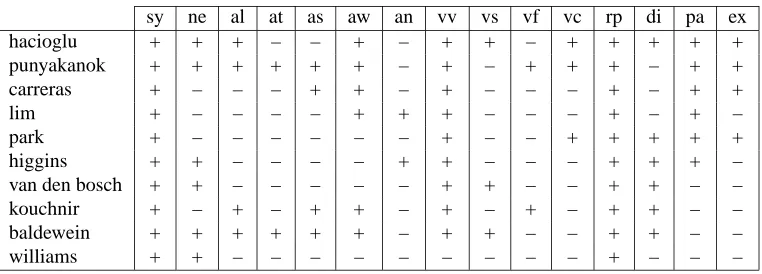
All systems used some kind of basic features. Roughly speaking, they consist of words, PoS tags, chunks, clause labels, and named entities extracted from a window-based context. These values can be considered with or without the relative position with respect to the el-ement under consideration, and some n-grams of them can also be computed. If the granularity of the sys-tem is at phrase level then typically a representative head word of the phrase is used as lexical information. As an exception to the general approach, the system of Williams et al. (2004) does not make use of word forms. The rest of the features are more interesting since they are task dependent, and deserve special attention. Table 4 summarizes the type of features exploited by systems.
general usage. Some systems count the length of it, with different granularities. Others make use of heuris-tics to derive its syntactic type. There are systems that extract a structured representation of the argument, ei-ther homogeneous (capturing different sequences of head words, PoS tags, chunks or clauses), or heterogeneous (combining all elements, based on the syntactic hierar-chy). A few systems have captured the existence of neighboring arguments, previously identified in the pro-cess. Interestingly, the system of Lim et al. (2004) rep-resents the context of an argument relative to the syntac-tic hierarchy by means of relative constituent sequences and syntactic levels. Concerning lexicalization of the argument, most of the techniques rely on head word rules based on Collins’, or content word rules as in Surdeanu et al. (2003). Only Carreras et al. (2004) de-cide to use a bag-of-words model, apart from heuristic-based lexicalization.
Regarding the target verb, the voice feature of the verb is generally used, in addition to basic features capturing the form and PoS tag of the verb. Some systems captured statistics on frequent argument patterns for each predi-cate. Also, systems represented the elements in the prox-imity of the target verb, inspired by local subcategoriza-tion patterns of a predicate.
As for features related to a constituent-predicate pair, all systems use the simple feature describing the relative position between them, and to a lesser degree, the dis-tance and the difference in clausal levels. Again, there is a general tendency to describe the structured path from the argument to the verb. Its design goes from sim-ple homogeneous sequences of head words or chunks, to more sophisticated paths combining chunks and clauses, and capturing hierarchical properties. The system of Park et al. (2004) also tracks the number of different syn-tactic elements found between the pair. Remarkably, the system of Baldewein et al. (2004) uses an EM clustering technique to derive features representing the affinity of an argument and a predicate.
On top of basic feature extraction, all teams work-ing with SVM and VP used polynomial kernels of de-gree 2. Similar in expressiveness, the system designed by Punyakanok et al. (2004) expanded the feature space with all pairs of basic features.
4.4 Evaluation
A baseline rate was computed for the task. It was pro-duced by a system developed by Erik Tjong Kim Sang, from the University of Antwerp, Belgium. The base-line processor finds semantic roles based on the following seven rules:
• Tag target verb and successive particles asV.
• Tagnotandn’tin target verb chunk asAM-NEG.
• Tag modal verbs in target verb chunk asAM-MOD.
• Tag firstNPbefore target verb asA0.
• Tag firstNPafter target verb asA1.
• Tagthat, whichandwho before target verb as R-A0.
• SwitchA0andA1, andR-A0andR-A1if the target verb is part of a passiveVPchunk. AVPchunk is considered in passive voice if it contains a form of to beand the verb does not end ining.
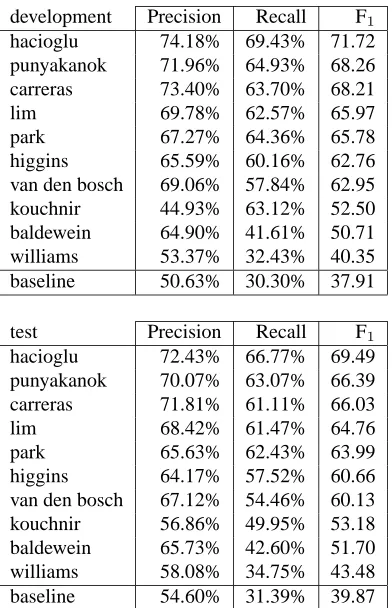
Table 5 presents the overall results obtained by the ten participating systems, on the development and test sets. The best performance was obtained by the SVM-based IOB tagger of (Hacioglu et al., 2004), which al-most reached the performance of 70 in F1 on the test.
The seven best systems obtained F1 scores in the range
of 60-70, and only three systems scored below that. Comparing the results across development and test cor-pora, most systems experienced a decrease in perfor-mance between 1.5 and 3 points. As in previous editions of the shared task, we attribute this behavior to a greater difficulty of the test set instead of an overfitting effect. Interestingly, the three systems performing below 60 in the development set did not experienced this decrease. In fact (Williams et al., 2004) and (Baldewein et al., 2004) even improved the results on the test set.
Table 6 details the performance of systems for the A0-A4 arguments, on the test set. Consistently, the best per-forming system of the task also outperforms all other sys-tems on these semantic roles.
5
Conclusion
We have described the CoNLL-2004 shared task on se-mantic role labeling. The task was based on the Prop-Bank corpus, and the challenge was to come up with ma-chine learning techniques to recognize and label semantic roles on the basis of partial syntactic structure. Ten sys-tems have participated to the task, contributing with a va-riety of standard or novel learning architectures. The best system, presented by the most experienced group on the task (Hacioglu et al., 2004), achieved a moderate perfor-mance of 69.49 at the F1measure. It is based on a SVM
tagging system, performing IOB decisions on the chunks of the sentence, and exploiting a wide variety of features based on partial syntax.
Most of the systems advance the state-of-the-art on se-mantic role labeling on the basis of partial syntax. How-ever, state-of-the-art systems working with full syntax still perform substantially better, although far from a de-sired behavior for real-task application. Two questions remain open: which syntactic structures are needed as in-put for the task, and what other sources of information are required to obtain a real-world, accurate performance.
sy ne al at as aw an vv vs vf vc rp di pa ex
hacioglu + + + – – + – + + – + + + + +
punyakanok + + + + + + – + – + + + – + +
carreras + – – – + + – + – – – + – + +
lim + – – – – + + + – – – + – + –
park + – – – – – – + – – + + + + +
higgins + + – – – – + + – – – + + + –
van den bosch + + – – – – – + + – – + + – –
kouchnir + – + – + + – + – + – + + – –
baldewein + + + + + + – + + – – + + – –
[image:8.612.117.498.69.206.2]williams + + – – – – – – – – – + – – –
Table 4: Main feature types used by the 10 participating systems in the CoNLL-2004 shared task, sorted by perfor-mance on the test set. “sy”: use of partial syntax (all levels); “ne”: use of named entities; “al”: argument length; “at”: argument type; “as”: argument internal structure; “aw”: head-word lexicalization of arguments; “an”: neighboring arguments; “vv”: verb voice; “vs”: verb statistics; “vf”: verb features derived from PropBank frames; “vc”: verb local context; “rp”: relative position; “di”: distance (horizontal or in the hierarchy); “pa”: path; “ex”: feature expansion.
most contributed to the performance of systems.
Acknowledgements
Authors would like to thank the following people and institutions. The PropBank team, and specially Martha Palmer and Scott Cotton, for making the corpus available. The CoNLL-2004 board for fruitful discussions and sug-gestions. In particular, Erik Tjong Kim Sang for useful comments from his valuable experience, and for making the baseline SRL processor available. Llu´ıs Padr´o and Mihai Surdeanu, Grzegorz Chrupała, and Hwee Tou Ng for helping us in the reviewing process and the prepara-tion of this document. Finally, the teams contributing to shared task, for their great interest in participating.
This work has been partially funded by the European Commission (Meaning, IST-2001-34460) and the Span-ish Research Department (Aliado, TIC2002-04447-C02). Xavier Carreras is supported by a pre-doctoral grant from the Catalan Research Department.
References
Ulrike Baldewein, Katrin Erk, Sebastian Pad ´o, and Detlef Prescher. 2004. Semantic role labeling with chunk sequences. In Proceedings of CoNLL-2004.
Xavier Carreras and Llu´ıs M`arquez. 2003. Phrase recog-nition by filtering and ranking with perceptrons. In
Proceedings of RANLP-2003, Borovets, Bulgaria.
Xavier Carreras, Llu´ıs M`arquez, and Grzegorz Chrupała. 2004. Hierarchical recognition of propositional argu-ments with perceptrons. In Proceedings of
CoNLL-2004.
John Chen and Owen Rambow. 2003. Use of deep lin-guistic features for the recognition and labeling of se-mantic arguments. In Proceedings of EMNLP-2003, Sapporo, Japan.
Hai Leong Chieu and Hwee Tou Ng. 2003. Named en-tity recognition with a maximum entropy approach. In
Proceedings of CoNLL-2003, Edmonton, Canada.
Charles J. Fillmore, Charles Wooters, and Collin F. Baker. 2001. Building a large lexical databank which provides deep semantics. In Proceedings of the
Pa-cific Asian Conference on Language, Informa tion and Computation, Hong Kong, China.
Michael Fleischman, Namhee Kwon, and Eduard Hovy. 2003. Maximum entropy models for framenet clas-sification. In Proceedings of EMNLP-2003, Sapporo, Japan.
Daniel Gildea and Julia Hockenmaier. 2003. Identifying semantic roles using combinatory categorial grammar. In Proceedings of EMNLP-2003, Sapporo, Japan.
Daniel Gildea and Daniel Jurafsky. 2002. Automatic la-beling of semantic roles. Computational Linguistics, 28(3):245–288.
Daniel Gildea and Martha Palmer. 2002. The necessity of parsing for predicate argument recognition. In
Pro-ceedings of ACL 2002, Philadelphia, USA.
Jes´us Gim´enez and Llu´ıs M`arquez. 2003. Fast and accu-rate part-of-speech tagging: The svm approach revis-ited. In Proceedings of RANLP-2003, Borovets, Bul-garia.
Kadri Hacioglu and Wayne Ward. 2003. Target word de-tection and semantic role chunking using support vec-tor machines. In Proceedings of HLT-NAACL 2003, Edmonton, Canada.
Kadri Hacioglu, Sameer Pradhan, Wayne Ward, James H. Martin, and Daniel Jurafsky. 2004. Semantic role la-beling by tagging syntactic chunks. In Proceedings of
CoNLL-2004.
Derrick Higgins. 2004. A transformation-based ap-proach to argument labeling. In Proceedings of
development Precision Recall F1
hacioglu 74.18% 69.43% 71.72 punyakanok 71.96% 64.93% 68.26 carreras 73.40% 63.70% 68.21 lim 69.78% 62.57% 65.97 park 67.27% 64.36% 65.78 higgins 65.59% 60.16% 62.76 van den bosch 69.06% 57.84% 62.95 kouchnir 44.93% 63.12% 52.50 baldewein 64.90% 41.61% 50.71 williams 53.37% 32.43% 40.35 baseline 50.63% 30.30% 37.91
test Precision Recall F1
[image:9.612.89.285.69.373.2]hacioglu 72.43% 66.77% 69.49 punyakanok 70.07% 63.07% 66.39 carreras 71.81% 61.11% 66.03 lim 68.42% 61.47% 64.76 park 65.63% 62.43% 63.99 higgins 64.17% 57.52% 60.66 van den bosch 67.12% 54.46% 60.13 kouchnir 56.86% 49.95% 53.18 baldewein 65.73% 42.60% 51.70 williams 58.08% 34.75% 43.48 baseline 54.60% 31.39% 39.87
Table 5: Overall precision, recall and F1rates obtained by
the ten participating systems in the CoNLL-2004 shared task on the development and test sets.
Beata Kouchnir. 2004. A memory-based approach for semantic role labeling. In Proceedings of
CoNLL-2004.
Joon-Ho Lim, Young-Sook Hwang, So-Young Park, and Hae-Chang Rim. 2004. Semantic role labeling using maximum entropy model. In Proceedings of
CoNLL-2004.
Mitchell P. Marcus, Beatrice Santorini, and Mary Ann Marcinkiewicz. 1993. Building a large annotated cor-pus of English: the Penn Treebank. Computational
Linguistics, 19.
Martha Palmer, Daniel Gildea, and Paul Kingsbury. 2004. The proposition bank: An annotated corpus of semantic roles. Computational Linguistics. Submit-ted.
Kyung-Mi Park, Young-Sook Hwang, and Hae-Chang Rim. 2004. Two-phase semantic role labeling based on support vector machines. In Proceedings of
CoNLL-2004.
Sameer Pradhan, Kadri Hacioglu, Valerie Krugler, Wayne Ward, James H. Martin, and Daniel Jurafsky. 2003a. Support vector learning for semantic argument classification. Technical Report TR-CSLR-2003-03, Center for Spoken Language Research, University of Colorado.
A0 A1 A2 A3 A4
hacioglu 81.37 71.63 49.33 51.11 66.67 punyakanok 79.38 68.16 46.69 34.04 65.22 carreras 79.05 66.96 43.28 31.22 62.07 lim 77.42 66.00 49.07 41.77 54.55 park 76.38 66.14 46.57 42.32 51.76 higgins 70.67 62.72 45.52 40.00 39.64 van den bosch 74.95 60.83 40.41 37.44 62.37 kouchnir 65.49 54.48 30.95 19.71 36.07 baldewein 66.76 53.37 37.60 22.89 27.69 williams 56.24 49.05 00.00 00.00 00.00 baseline 57.65 34.19 00.00 00.00 00.00
Table 6: F1 scores on the most frequent core argument
types obtained by the ten participating systems in the CoNLL-2004 shared task on the test set. Systems sorted by overall performance on the test set.
Sameer Pradhan, Kadri Hacioglu, Wayne Ward, James H. Martin, and Daniel Jurafsky. 2003b. Semantic role parsing: Adding semantic structure to unstructured text. In Proceedings of the International Conference
on Data Mining (ICDM-2003), Melbourne, USA.
Vasin Punyakanok, Dan Roth, Wen-Tau Yih, Dav Zimak, and Yuancheng Tu. 2004. Semantic role labeling via generalized inference over classifiers. In Proceedings
of CoNLL-2004.
Mihai Surdeanu, Sanda Harabagiu, John Williams, and Paul Aarseth. 2003. Using predicate-argument struc-tures for information extraction. In Proceedings of
ACL 2003, Sapporo, Japan.
Cynthia A. Thompson, Roger Levy, and Christopher D. Manning. 2003. A generative model for semantic role labeling. In Proceedings of ECML’03, Dubrovnik, Croatia.
E. F. Tjong Kim Sang and S. Buchholz. 2000. Intro-duction to the CoNLL-2000 shared task: Chunking. In Proceedings of the 4th Conference on Natural
Lan-guage Learning, CoNLL-2000.
Erik F. Tjong Kim Sang and Fien De Meulder. 2003. In-troduction to the CoNLL-2003 shared task: Language-independent named entity recognition. In Proceedings
of CoNLL-2003.
Erik F. Tjong Kim Sang and Herv´e D´ejean. 2001. Intro-duction to the CoNLL-2001 shared task: Clause identi-fication. In Proceedings of the 5th Conference on
Nat-ural Language Learning, CoNLL-2001.
Antal van den Bosch, Sander Canisius, Walter Daele-mans, Iris Hendrickx, and Erik Tjong Kim Sang. 2004. Memory-based semantic role labeling: Optimiz-ing features, algorithm, and output. In ProceedOptimiz-ings of
CoNLL-2004.
[image:9.612.314.541.71.192.2]