Unrestricted Coreference Resolution via Global Hypergraph Partitioning
Jie Cai and ´Eva M ´ujdricza-Maydt and Michael Strube Natural Language Processing Group
Heidelberg Institute for Theoretical Studies gGmbH Heidelberg, Germany
(jie.cai|eva.mujdriczamaydt|michael.strube)@h-its.org
Abstract
We present our end-to-end coreference res-olution system, COPA, which implements a global decision via hypergraph partitioning. In constrast to almost all previous approaches, we do not rely on separate classification and clustering steps, but perform coreference res-olution globally in one step. COPA represents each document as a hypergraph and partitions it with a spectral clustering algorithm. Various types of relational features can be easily incor-porated in this framwork. COPA has partici-pated in the open setting of the CoNLL shared task on modeling unrestricted coreference.
1 Introduction
Coreference resolution is the task of grouping men-tions of entities into sets so that all menmen-tions in one set refer to the same entity. Most recent ap-proaches to coreference resolution divide this task into two steps: (1) a classification step which de-termines whether a pair of mentions is coreferent or which outputs a confidence value, and (2) a cluster-ing step which groups mentions into entities based on the output of step 1.
In this paper we present an end-to-end corefer-ence resolution system, COPA, which avoids the di-vision into two steps and instead performs a global decision in one step. The system presents a doc-ument as a hypergraph, where the vertices denote mentions and the edges denote relational features between mentions. Coreference resolution is then performed globally in one step by partitioning the hypergraph into subhypergraphs so that all mentions
in one subhypergraph refer to the same entity (Cai and Strube, 2010). COPA assigns edge weights by applying simple descriptive statistics on the tranin-ing data. Since COPA does not need to learn an explicit model, we used only 30% of the CoNLL shared task training data. We did this not for effi-ciency reasons, only for convenience.
While COPA has been developed originally to perform coreference resolution on MUC and ACE data (Cai and Strube, 2010), the move to the OntoNotes data (Weischedel et al., 2011) required mainly to update the mention detector and the fea-ture set. Since several off-the-shelf preprocessing components are used, COPA participated in the open setting of the CoNLL shared task on modeling unre-stricted coreference (Pradhan et al., 2011). We did not make extensive use of information beyond infor-mation from the closed class setting.
2 Preprocessing
COPA is implemented on top of the BART-toolkit
(Versley et al., 2008). Documents are transformed into the MMAX2-format (M¨uller and Strube, 2006) which allows for easy visualization and (linguis-tic) debugging. Each document is stored in several XML-files representing different layers of annota-tions. These annotations are created by a pipeline of preprocessing components. We use the
Stan-ford MaxentTagger (Toutanova et al., 2003) for
part-of-speech tagging, and the Stanford Named
En-tity Recognizer (Finkel et al., 2005) for
annotat-ing named entities. In order to derive syntactic information, we use the Charniak/Johnson
rerank-ing parser (Charniak and Johnson, 2005)
bined with a constituent-to-dependency conversion Tool (http://nlp.cs.lth.se/software/ treebank_converter). The preprocessing models are not trained on CoNLL data, so we only participated in the open task.
We have implemented an in-house mention detec-tor, which makes use of the parsing output, the part-of-speech tags, as well as the chunks from the
Yam-cha Chunker (Kudoh and Matsumoto, 2000). For
the OntoNotes data, the mention detector annotates the biggest noun phrase spans.
3 COPA: Coreference Partitioner
The COPA system consists of modules which derive hyperedges from features and assign edge weights indicating a positive correlation with the coreference relation, and resolution modules which create a hy-pergraph representation for the testing data and per-form partitioning to produce subhypergraphs, each of which represents an entity.
3.1 HyperEdgeCreator
COPA needs training data only for computing the
hyperedge weights. Hyperedges represent features. Each hyperedge corresponds to a feature instance modeling a simple relation between two or more mentions. This leads to initially overlapping sets of mentions. Hyperedges are assigned weights which are calculated on the training data as the percentage of the initial edges being in fact coreferent. Due to the simple strategy of assigning edge weights, only a reasonable size of training data is needed.
3.2 Coreference Resolution Modules
Unlike pairwise models, COPA processes a docu-ment globally in one step, taking care of the pref-erence information among all the mentions simul-taneously and clustering them into sets directly. A document is represented as a single hypergraph with multiple edges. The hypergraph resolver partitions the hypergraph into several sub-hypergraphs, each corresponding to one set of coreferent mentions.
3.2.1 HGModelBuilder
A single document is represented in a hypergraph with basic relational features. Each hyperedge in a graph corresponds to an instance of one of those fea-tures with the weight assigned by the
HyperEdge-Learner. Instead of connecting nodes with the
tar-get relation as usually done in graph models, COPA builds the graph directly out of low dimensional fea-tures without assuming a distance metric.
3.2.2 HGResolver
In order to partition the hypergraph we adopt a spectral clustering algorithm (Agarwal et al., 2005). All experimental results are obtained using symmet-ric Laplacians (L
sym) (von Luxburg, 2007).
We apply the recursive variant of spectral clus-tering, recursive 2-way partitioning (R2 partitioner) (Cai and Strube, 2010). This method does not need any information about the number of target sets (the numberk of clusters). Instead a stopping criterion α⋆has to be provided which is adjusted on
develop-ment data.
3.3 Complexity of HGResolver
Since edge weights are assigned using simple de-scriptive statistics, the time HGResolver needs for building the graph Laplacian matrix is not substan-tial. For eigensolving, we use an open source library provided by the Colt project1which implements a Householder-QL algorithm to solve the eigenvalue decomposition. When applied to the symmetric graph Laplacian, the complexity of the eigensolv-ing is given by O(n3
), where n is the number of mentions in a hypergraph. Since there are only a few hundred mentions per document in our data, this complexity is not an issue. Spectral clustering gets problematic when applied to millions of data points.
4 Features
In our system, features are represented as types of hyperedges. Any realized edge is an instance of the corresponding edge type. All instances derived from the same type have the same weight, but they may get reweighed by the distance feature (see Cai and Strube (2010)). We use three types of features:
negative: prevent edges between mentions; positive: generate strong edges between mentions;
weak: add edges to an existing graph without intro-ducing new vertices;
1
In the following subsections we describe the tures used in our experiments. Some of the fea-tures described in Cai and Strube (2010) had to be changed to cope with the OntoNotes data. We also introduced a few more features (in particular in or-der to deal with the dialogue section in the data).
4.1 Negative Features
Negative features describe pairwise relations which are most likely not coreferent. While we imple-mented this information as weak positive features in Cai and Strube (2010), here we apply these features before graph construction as global variables.
When two mentions are connected by a negative relation, no edges will be built between them in the graph. For instance, no edges are allowed between the mention Hillary Clinton and the mention he due to incompatible gender.
(1) N Gender, (2) N Number: Two mentions do not agree in gender or number.
(3) N SemanticClass: Two mentions do not agree in semantic class (only the Object, Date and
Person top categories derived from WordNet
(Fell-baum, 1998) are used).
(4) N Mod: Two mentions have the same syntac-tic heads, and the anaphor has a pre-modifier which does not occur in the antecedent and does not con-tradict the antecedent.
(5) N DSPrn: Two first person pronouns in direct speeches assigned to different speakers.
(6) N ContraSubjObj: Two mentions are in the subject and object positions of the same verb, and the anaphor is a non-possesive pronoun.
4.2 Positive Features
The majority of well studied coreference features (e.g. Stoyanov et al. (2009)) are actually positive coreference indicators. In our system, the mentions which participate in positive relations are included in the graph representation.
(7) StrMatch Npron & (8) StrMatch Pron: Af-ter discarding stop words, if the strings of mentions completely match and are not pronouns, they are put into edges of the StrMatch Npron type. When the matched mentions are pronouns, they are put into the StrMatch Pron type edges.
(9) Alias: After discarding stop words, if men-tions are aliases of each other (i.e. proper names with
partial match, full names and acronyms, etc.). (10) HeadMatch: If the syntactic heads of men-tions match.
(11) Nprn Prn: If the antecedent is not a pro-noun and the anaphor is a propro-noun. This feature is restricted to a sentence distance of 2. Though it is not highly weighted, it is crucial for integrating pro-nouns into the graph.
(12) Speaker12Prn: If the speaker of the second person pronoun is talking to the speaker of the first person pronoun. The mentions contain only first or second person pronouns.
(13) DSPrn: If one of the mentions is the subject of a speak verb, and other mentions are first person pronouns within the corresponding direct speech.
(14) ReflexivePrn: If the anaphor is a reflexive pronoun, and the antecedent is subject of the sen-tence.
(15) PossPrn: If the anaphor is a possesive pro-noun, and the antecedent is the subject of the sen-tence or the subclause.
(16) GPEIsA: If the antecedent is a Named Entity of GPE entity type (i.e. one of the ACE entity type (NIST, 2004)), and the anaphor is a definite expres-sion of the same type.
(17) OrgIsA: If the antecedent is a Named En-tity of Organization enEn-tity type, and the anaphor is a definite expression of the same type.
4.3 Weak Features
Weak features are weak coreference indicators. Us-ing them as positive features would introduce too much noise to the graph (i.e. a graph with too many singletons). We apply weak features only to men-tions already integrated in the graph, so that weak information provides it with a richer structure.
(18) W Speak: If mentions occur with a word meaning to say in a window size of two words.
(19) W Subject: If mentions are subjects. (20) W Synonym: If mentions are synonymous as indicated by WordNet.
5 Results
(randomly selected) and the 20 features described in Section 4.
The stopping criterionα∗(see Section 3) is tuned on development data to optimize the final corefer-ence scores. A value of0.06is chosen for testing.
COPA’s results on development set (which
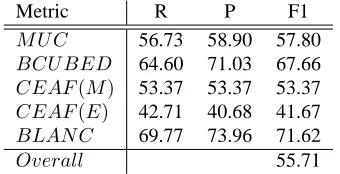
con-sists of 202 files) and on testing set are displayed in Table 1 and Table 2 respectively. The Overall num-bers in both tables are the average scores ofM U C, BCU BEDandCEAF(E).
Metric R P F1
M U C 52.69 57.94 55.19
BCU BED 64.26 73.39 68.52
CEAF(M) 54.44 54.44 54.44 CEAF(E) 45.73 40.92 43.19
BLAN C 69.78 75.26 72.13
[image:4.612.102.269.202.291.2]Overall 55.63
Table 1: COPA’s results on CoNLL development set
Metric R P F1
M U C 56.73 58.90 57.80
BCU BED 64.60 71.03 67.66
CEAF(M) 53.37 53.37 53.37 CEAF(E) 42.71 40.68 41.67
BLAN C 69.77 73.96 71.62
[image:4.612.100.270.343.430.2]Overall 55.71
Table 2: COPA’s results on CoNLL testing set
6 Mention Detection Errors
As described in Section 2, our mention detection is based on automatically extracted information, such as syntactic parses and basic noun phrase chunks. Since there is no minimum span information pro-vided in the OntoNotes data (in constrast to the pre-vious standard corpus, ACE), exact mention bound-ary detection is required. A lot of the spurious mentions in our system are generated due to mis-matches of ending or starting punctuations, and the OntoNotes annotation is also not consistent in this regard. Our current mention detector does not ex-tract verb phrases. Therefore it misses all the Event mentions in the OntoNotes corpus.
We are planning to include idiomatic expression identification into our mention detector, which will
help to avoid detecting a lot of spurious mentions, such as God in the phrase for God’s sake.
7 COPA Errors
Besides the fact that the current COPA is not resolv-ing any event coreferences, our in-house mention de-tector performs weakly in extracting date mentions too. As a result, the system outputs several spuri-ous coreference sets, for instance a set containing the September from the mention 15th September.
A large amount of the recall loss in our system is due to the lack of the world knowledge. For exam-ple, COPA does not resolve the mention the Europe
station correctly into the entity Radio Free Europe,
for it has no knowledge that the entity is a station. Some more difficult coreference phenomena in
OntoNotes data might require a reasoning
mecha-nism. To be able to connect the mention the
vic-tim with the mention the groom’s brother, the event
of the brother being killed needs to be intepreted by the system.
We also observed from the experiments that the resolution of the it mentions are quite inaccurate. Although our mention detector takes care of dis-carding pleonastic it’s, there are still a lot of them left which introduce wrong coreference sets. Since the it’s do not contain enough information by them-selves, more features exploring their local syntax are necessary.
8 Conclusions
In this paper we described a coreference resolution system, COPA, which implements a global decision in one step via hypergraph partitioning. COPA’s hypergraph-based strategy is a general preference model, where the preference for one mention de-pends on information on all other mentions.
The system implements three types of relational features — negative, positive and weak features, and assigns the edge weights according to the statitics from the training data. Since the weights are robust with respect to the amount of training data we used only30%of the training data.
References
Sameer Agarwal, Jonwoo Lim, Lihi Zelnik-Manor, Pietro Perona, David Kriegman, and Serge Belongie. 2005. Beyond pairwise clustering. In Proceedings of the IEEE Computer Society Conference on Computer Vi-sion and Pattern Recognition (CVPR’05), volume 2, pages 838–845.
Jie Cai and Michael Strube. 2010. End-to-end coref-erence resolution via hypergraph partitioning. In Proceedings of the 23rd International Conference on Computational Linguistics, Beijing, China, 23–27 Au-gust 2010, pages 143–151.
Eugene Charniak and Mark Johnson. 2005. Coarse-to-fine n-best parsing and MaxEent discriminative reranking. In Proceedings of the 43rd Annual Meet-ing of the Association for Computational LMeet-inguistics, Ann Arbor, Mich., 25–30 June 2005, pages 173–180. Christiane Fellbaum, editor. 1998. WordNet: An
Elec-tronic Lexical Database. MIT Press, Cambridge, Mass.
Jenny Rose Finkel, Trond Grenager, and Christopher Manning. 2005. Incorporating non-local informa-tion into informainforma-tion extracinforma-tion systems by Gibbs sam-pling. In Proceedings of the 43rd Annual Meeting of the Association for Computational Linguistics, Ann Arbor, Mich., 25–30 June 2005, pages 363–370. Taku Kudoh and Yuji Matsumoto. 2000. Use of Support
Vector Machines for chunk identification. In Proceed-ings of the 4th Conference on Computational Natural Language Learning, Lisbon, Portugal, 13–14 Septem-ber 2000, pages 142–144.
Christoph M¨uller and Michael Strube. 2006. Multi-level annotation of linguistic data with MMAX2. In Sabine Braun, Kurt Kohn, and Joybrato Mukherjee, editors, Corpus Technology and Language Pedagogy: New Re-sources, New Tools, New Methods, pages 197–214. Pe-ter Lang: Frankfurt a.M., Germany.
NIST. 2004. The ACE evaluation plan:
Evaluation of the recognition of ACE
en-tities, ACE relations and ACE events.
http://www.itl.nist.gov/iad/mig//tests/ace/2004/doc/ ace04-evalplan-v7.pdf.
Sameer Pradhan, Lance Ramshaw, Mitchell Marcus, Martha Palmer, Ralph Weischedel, and Nianwen Xue. 2011. CoNLL-2011 Shared Task: Modeling unre-stricted coreference in OntoNotes. In Proceedings of the Shared Task of 15th Conference on Computational Natural Language Learning, Portland, Oreg., 23–24 June 2011.
Veselin Stoyanov, Nathan Gilbert, Claire Cardie, and Ellen Riloff. 2009. Conundrums in noun phrase coref-erence resolution: Making sense of the state-of-the-art. In Proceedings of the Joint Conference of the 47th
Annual Meeting of the Association for Computational Linguistics and the 4th International Joint Conference on Natural Language Processing, Singapore, 2–7 Au-gust 2009, pages 656–664.
Kristina Toutanova, Dan Klein, Christopher D. Manning, and Yoram Singer. 2003. Feature-rich part-of-speech tagging with a cyclic dependency network. In Pro-ceedings of the Human Language Technology Confer-ence of the North American Chapter of the Associ-ation for ComputAssoci-ational Linguistics, Edmonton, Al-berta, Canada, 27 May –1 June 2003, pages 252–259. Yannick Versley, Simone Paolo Ponzetto, Massimo
Poe-sio, Vladimir Eidelman, Alan Jern, Jason Smith, Xiaofeng Yang, and Alessandro Moschitti. 2008. BART: A modular toolkit for coreference resolution. In Companion Volume to the Proceedings of the 46th Annual Meeting of the Association for Computational Linguistics, Columbus, Ohio, 15–20 June 2008, pages 9–12.
Ulrike von Luxburg. 2007. A tutorial on spectral cluster-ing. Statistics and Computing, 17(4):395–416. Ralph Weischedel, Martha Palmer, Mitchell Marcus,