Incremental Graph-based Neural Dependency Parsing
Xiaoqing Zheng
School of Computer Science, Fudan University, Shanghai, China Shanghai Key Laboratory of Intelligent Information Processing
Abstract
Very recently, some studies on neural de-pendency parsers have shown advantage over the traditional ones on a wide va-riety of languages. However, for graph-based neural dependency parsing systems, they either count on the long-term mem-ory and attention mechanism to implicitly capture the high-order features or give up the global exhaustive inference algorithms in order to harness the features over a rich history of parsing decisions. The former might miss out the important features for specific headword predictions without the help of the explicit structural information, and the latter may suffer from the error propagation as false early structural con-straints are used to create features when making future predictions. We explore the feasibility of explicitly taking high-order features into account while remaining the main advantage of global inference and learning for graph-based parsing. The pro-posed parser first forms an initial parse tree by head-modifier predictions based on the first-order factorization. High-order fea-tures (such as grandparent, sibling, and un-cle) then can be defined over the initial tree, and used to refine the parse tree in an iterative fashion. Experimental result-s result-showed that our model (called INDP) archived competitive performance to ex-isting benchmark parsers on both English and Chinese datasets.
1 Introduction and Motivation
The rise of machine learning methods in natural language processing (NLP) coupled with the avail-ability of treebanks (Buchholz and Marsi, 2006)
for a wide variety of languages has led to a rapid increase in research on data-driven dependency parsing. Two predominant paradigms for the data-driven dependency parsing are often called graph-based and transition-graph-based dependency parsing (McDonald and Nivre,2007,2011). The first cat-egory learns the parameters to score correct de-pendency subgraphs over incorrect ones, typically by factoring the graphs into their component di-rected arcs, and performs parsing by searching the highest-scoring graph for a given sentence. The second category of parsing systems instead learns to predict one transition from one parse state to the next given a parse history, and performs parsing by taking the predicted transitions at each parse state until a complete dependency graph is derived.
Empirical studies show that the graph-based and transition-based models exhibit no statistical-ly significant difference in accuracy on a variety of languages, although they are very different the-oretically (McDonald and Nivre, 2011). Graph-based models are usually trained by maximizing the difference in score between the entire correct dependency graph and all incorrect ones for ev-ery training sentence. However, exhaustive infer-ence is generally NP-hard when the score is fac-tored over any extended scope of the dependency subgraph beyond a single arc (McDonald and Sat-ta,2007), which is the primary shortcoming of the graph-based systems. In transition-based parsing, the feature representations are not restricted to a small number of arcs in the graph but can be de-rived from all the dependency subgraphs built so far, while the main disadvantage of these models is that the local greedy parsing strategy may lead to the error propagation because false early predic-tions can eliminate valid parse trees.
With a few exceptions (Zeman and ˘Zabokrtsk`y,
2005;Zhang and Clark,2008;Zhang et al.,2014), the graph-based parsers usually require global
learning and inference, but define features over a limited scope of the dependency graph, while the transition-based ones typically use local, greedy training and inference, but introduce a rich feature space based on the history of parsing decisions.
Many approaches have been proposed to over-come the weaknesses of traditional graph-based or transition-based models. There are at least three ways for potential improvement: ensemble— weighting the predictions of multiple parsing sys-tems (Sagae and Lavie, 2006;Hall et al., 2007), feature integration—combining the two models by allowing the output of one model to define fea-tures for the other (Martins et al.,2008;Nivre and McDonald, 2008; McDonald and Nivre, 2011), and novel approaches—changing the underlying model structure directly by constructing globally trained transition-based parsers (Zhang and Clark,
2008; Huang and Sagae, 2010) or graph-based parsers with rich features (Riedel and Clarke,
2006;Nakagawa,2007;Smith and Eisner, 2008;
Martins et al.,2009).
Very recently, some studies on the deep archi-tectures have shown advantage over the shallow ones on a wide variety of dependency parsing benchmarks. Deep neural networks were used to replace the classifiers for predicting optimal tran-sitions in transition-based parers (Chen and Man-ning, 2014) or the scoring functions for ranking the subgraphs in graph-based rivals ( Kiperwass-er and GoldbKiperwass-erg,2016a,b). There are several re-cent developments in neural dependency parsing (Weiss et al.,2015;Zhou et al.,2015;Dyer et al.,
2015), which can be viewed as targeting the weak-nesses of locally greedy algorithms in transition-based models by using the beam search and con-ditional random field loss objective, although us-ing the beam search instead of strictly determin-istic parsing can to some extent alleviate the error propagation problem but does not eliminate it.
For graph-based neural dependency parsing systems, they either count on the long-term mem-ory and neural attention to implicitly capture the high-order features (Kiperwasser and Goldberg,
2016b; Cheng et al., 2016; Dozat and Manning,
2017) or give up the global inference algorithm-s in order to introduce featurealgorithm-s over a rich hialgorithm-s- his-tory of parsing decisions by a greedy, bottom-up method (Kiperwasser and Goldberg,2016a). The former might miss out the important information for specific headword predictions without the help
of the structural features derived from the entire parse tree, while the latter may suffer from the er-ror propagation as false structural constraints are used to create features when making future pre-dictions. In this study, we explore the feasibility of explicitly taking advantage of high-order features while remaining the strength of global exhaustive inference and learning as a graph-based parser.
The proposed parser first encodes each word in a sentence by distributed embeddings using a con-volutional neural network and constructs an initial parse graph by head-modifier predictions with a maximum directed spanning tree algorithm based on the first-order features (i.e. the score is fac-tored over the arcs in a graph). Once an initial parse graph is built, the high-order features (such as grandparent, sibling, and uncle) can be defined, and used to refine the structure of the parse tree in an iterative way. Theoretically, the refinement will continue until no change is made in the iteration. But experimental results demonstrated that pretty good performance can be achieved with no more than twice updates because many dependencies are determined by independent arc prediction and a few head-modifier pairs need to be re-estimated after one update (i.e. only a few changes above and beyond the dominant first-order scores). We call this proposed model an incremental neural de-pendency parsing (INDP)1.
2 Incremental Neural Dependency Parser
Given an input sentence x, we denote the set of all valid dependency parse trees that can be con-structed fromxasY(x). Assuming there exists a graph scoring functions, the dependency parsing problem can be formulated as finding the highest scoring directed spanning tree for the sentencex.
y∗(x) = argmax ˆ
y∈Y(x) s(x,yˆ;θ) (1) where y∗(x) is the parse tree with the highest s-core, andθis a set of the parameters used to com-pute the scores. To make the search tractable, the score of a graph is usually factorized into the sum of its arc (head-modifier) scores (McDonald et al.,
2005a).
s(x,yˆ;θ) = X
(h,m)∈A(ˆy)
s(h, m;θ) (2)
1The source code is available at http://homepage.fudan.
whereA(ˆy)represents a set of directed arcs in the parse treeyˆ. The score of an arc(h, m)represents the likelihood of creating a dependency from head
h to modifier (or dependent) m in a dependency tree. If each arc score is estimated independent-ly, we call it a first-order factorization. When the scoring is based on two or more arcs, second- or high-order factorizations are applied.
In traditional approaches, this score is common-ly defined to be the product of a high dimension-al feature representation of the arc and a learned weighting parameter vector. The performance of those systems is heavily dependent on the choice of features. For that reason, much effort in design-ing such systems goes into the feature engineer-ing, which is important but labor-intensive, mainly first based on human ingenuity and linguistic intu-ition, and then confirmed or refined by empirical analyses. In this study, a neural network is de-signed instead to estimate the arc scores using the high-order features. In the following, we first de-scribe how the word representations are produced. Then, the key components of the INDP, direction-specific scoring with special normalization and in-cremental refinement with high-order features, are discussed in detail. Finally, we present the entire parsing algorithm of the INDP.
2.1 Word Feature Representations
In graph-based neural dependency parsing work, such as (Kiperwasser and Goldberg, 2016a,b;
Dozat and Manning, 2017), recurrent neural net-work (RNN) is a popular statistical learner used to produce the continuous vector representation-s for each word in a representation-sentence due to itrepresentation-s ability to bridge long time lags between relevant inputs. We chose to use one-dimensional convolution instead as a building block because it is good enough to capture the interactions of word feature represen-tations in a context window with less computa-tional cost. Such a design makes the parameters of our first-order parser to be optimized efficient-ly, which will be augmented with the high-order features (i.e. long distance dependencies) at incre-mental refinement stages.
The words are fed into the network as indices that are used by a lookup operation to transform words into their feature vectors. We consider a fixed-sized word dictionaryD2. The vector
repre-2Unless otherwise specified, the word dictionary is
ex-tracted from the training set. Unknown words are mapped to a special symbol that is not used elsewhere.
sentations are stored in a word embedding matrix
Eword∈Rd×|D|, wheredis the dimensionality of the vector space (a hyper-parameter to be chosen) and|D| is the size of the dictionary. Like (Chen and Manning,2014;Dyer et al.,2015;Weiss et al.,
2015;Cheng et al., 2016), we also map part-of-speech (POS) tags to anotherq-dimensional vector space, and provide POS type features for words. Formally, assume we are given a sentence x[1:n] that is a sequence ofnwordsxi,1 ≤ i≤ n. For each wordxi ∈ Dthat has an associated indexki into the column of the matrixEword, and is labeled as a POS tag of typeli, its feature representation is obtained by concatenating both word and POS tag embeddings as:
E(xi) =Ewordeki⊕Eposeli (3)
where Epos ∈ Rq×|P| is a POS tag embedding matrix and|P|is the size of POS tag setP (fine-grained POS tags are used if available). Binary
ekiandeliare one-hot encoding vectors for theith word in the sentence.
The lookup table layer extracts features for each single word, but the meaning of a word is strong-ly related to its surrounding words. Given a word, we consider a fixed size windoww(another hyper-parameter) of words around it. More precisely, given an input sentencex[1:n], the feature window produced by the first lookup table layer at position
xican be written as:
fwin
xi = (E(xi−w/2)· · ·E(xi)· · ·E(xi+w/2)) (4)
where the word feature window is a matrixfwin∈
R(d+q)×w, and each column of the matrix is the word feature vector in the context window. A one-dimensional convolution is used to yield another feature vector by taking the dot product of filter vectors with the rows of the matrix fwin at the same dimension. After each row of fwin is con-volved with the corresponding column of a filter matrixW1, some non-linear functionφ(·)will be applied as:
fcon=φ(fwinW1) (5) where the weights in the matrixW1 ∈ Rw×(d+q) are the parameters to be trained, and the output
2.2 Direction-Specific Scoring
For the same head-modifier arc (h, m), the head wordh may occur on the left size ofm(i.e. left-arc) in some sentences while it also can appear on the right size of m (i.e. right-arc) in other ones. Considering two English sentences excerpt-ed from the Penn Treebank (Buchholz and Marsi,
2006): “A group of workers exposed to it.”, and “Mr. Vinken is chairman of Elsevier, the Dutch publishing group.”, they have the same (group, of) head-modifier arc, but those two words occur in different orders. This would not be problem in the traditional models, such as (McDonald et al.,
2005a;Nivre and McDonald,2008), in which the arc directions are directly used as features by their structured learning algorithms. However, it is hard to train a single neural network that gives a higher score to the left-arc case than the right-arc one in some situations while reverses in others because of the symmetries in weight space (Note that we can-not tell which case is correct in advance, and both cases need to be scored). It would be more serious when the first-order factorization is applied due to the lack of context information.
Based on the above observations, we use a multi-layer perceptron (MLP) to score the left-arc cases, and another MLP to score the right-left-arc ones. Those two MLPs share the word and POS tag embeddings, and can update them when nec-essary during the training process. Formally, if a MLP with one hidden layer is used, the score of each possible head-modifier arc is computed as:
s(h, m;θ) =W3(φ(W2(fcon
h ⊕fmcon⊕fh,mdis) +b2)) (6) where the convolutional outputs of the head and dependent words are concatenated with a bucket-ed distance between the head and modifier, denot-ed byfdis
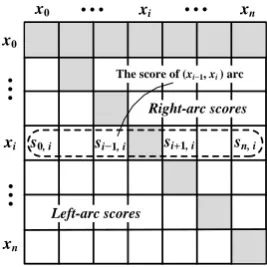
h,m, in buckets of0(root),1,2,3-5, and6+, and feed into the MLP for scoring. The weights in the hidden and output layers are denoted by W2 andW3 respectively, and the corresponding bias by b2. Once every possible arc is scored, we ob-tain a matrix like Figure 1, in which the element at the rowiand columnjis the score for(xi, xj) arc, denoted bys(i, j). An artificial word,x0, has been inserted at the beginning of a sentence that will always serve as the single root of the graph and is primarily a means to simplify computation. The scores at the lower (or upper) triangular are computed by the left-arc (or right-arc) MLP, and the shaded elements do not need to be calculated.
We can treats(i, j)as a score of the corresponding arc and then search for the highest scoring directed spanning tree to form a dependency parse tree as proposed in (McDonald et al.,2005b). This prob-lem can be solved using the Chu-Liu-Edmonds algorithm (Chu and Liu, 1965;Edmonds, 1967), which can be implemented inO(n2).
• • •
x0 xi • • • xn
x0
•
•
•
xi
•
•
•
xn
The score of (xi−1, xi ) arc
Left-arc scores
Right-arc scores
[image:4.595.350.484.172.306.2]s0, i si−1, i si+1, i sn, i
Figure 1: Scoring matrix for possible head and modifier arcs, in which the element at the rowiand columnjis the score for(xi, xj)arc, denoted bys(i, j). A dependency tree can be formed by finding the highest scoring directed span-ning tree over the scoring matrix.
The left-arc and right-arc MLPs should care-fully collaborate with each other; otherwise, one MLP would be overwhelmed by another (i.e. the maximum score produced by one MLP is less than the minimum by another). To overcome this bias problem, we use the partition function by sum-ming over the elements in each row of the scoring matrix, namely the scores/probabilities are nor-malized across the two MLPs. The conditional probability of arc(xi, xj) given a sentence x[1:n] is defined as:
p((xi, xj)|x[1:n];θ) = expZi(sx(x[1:n];i, xj;θ)θ)
whereZi(x[1:n];θ) = Σ
i∈{0...n},i6=jexps(xi, xj;θ) (7)
EachZi(x[1:n];θ)is a normalization term used to predictxi’s head word.
2.3 Incremental Refinement with High-order Features
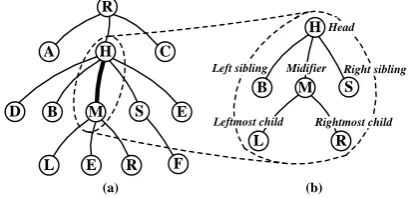
MLPs to update the scoring matrix. Like the head and modifier, those additional feature representa-tions are added as the results produced by the con-volution layer. As shown in Figure2, commonly-used high-order features have been take into ac-count, such as consecutive sibling (H, B, S), tri-siblings (B, M, S), and grandparent (H, M, R). The missing feature vectors are replaced by one of four special vectors, namely “left-sibling”, “right-sibling”, “leftmost-child”, and “rightmost-child” according to their relations to the modifier word.
R
H
M
B S
L A
R E
D E
F C
H
M
B S
L R
Right sibling
Leftmost child Rightmost child Head
Midifier Left sibling
(a) (b)
Figure 2:High-order features. (a) An example dependency parse tree. (b) The subgraph used to define high-order fea-tures for the head-modifier arc (H, M).
Although order features are used, the high-est scoring parse tree still can be founded efficient-ly in O(n2) by the Chu-Liu-Edmonds algorithm (Chu and Liu,1965;Edmonds,1967). The main rationale is that, even in the presence of high-order features, the resulting scores remain based on s-ingle head-modifier arcs. The higher-order fea-tures are derived from the parse tree obtained with first-order inference, and because that tree is al-ready pretty good, these higher-order features end up being a good approximation, and such approx-imation can be further improved by incremental refinements upon the parse tree. Thus, the high-order features used by the scoring MLPs can offer deliberate refinement above and beyond the first-order results. Theoretically, the refinement can be made until there is no update in the scoring matrix. However, experimental results show that compa-rable performance can be achieved with no more than twice high-order refinements (see Section3). We add a softmax layer to the network (after re-moving the last scoring layer) to predict syntactic labels for each arc. Labeling is trained by mini-mizing the cross-entropy error of the softmax layer using backpropagation. The network performs the structure prediction and labeling jointly. The two tasks shared the several layers (from the input to convolutional layers) of the network. When
mini-Inputs:
θ: neural network parameters. x: an input sentence.
T: maximum number of iterations.
Output:optimal dependency treey∗. Algorithm:
1: form an initial tree using the first-order features; 2:t= 0;
3:repeat
4: update the scoring matrix using the high-order features; 5: find the highest scoring treeyby Chu-Liu-Edmonds
algorithm; 6: t=t+ 1;
[image:5.595.75.280.229.328.2]7:untilno change in this iterationort≥T; 8: predict syntactic labels based on the parse treey; 9:returny∗=y;
Figure 3: Incremental neural dependency parsing (INDP) algorithm.
mizing the cross-entropy error of the softmax lay-er, the error will also backpropagate and influence both the network parameters and the embeddings. We list our incremental neural dependency pars-ing algorithm in Figure3. Staring with an initial tree formed using the first-order features, the al-gorithm makes changes to the parse tree with the high-order refinements in an attempt to climb the objective function.
2.4 Training
Given a training example (x, y), we defined a structured margin∆(x, y,yˆ)loss for proposing a parseyˆfor sentence x when y is the true parse. This penalty is proportional to the number of un-labeled arcs on which the two parse trees do not agree. In general,∆(x, y,yˆ)is equal to0ify= ˆy. The loss function is defined as a penalization of incorrect arcs:
∆(x, y,yˆ) = X
(h,m)∈A(ˆy)
κ1{(h, m)∈/A(y)} (8)
where κ is a penalization term to each incorrect arc, andA(y)is a set of arcs in the true parsey.
For a training set, we seek a function with small expected loss on unseen sentences. The function we consider take the following form as Equation (1). The score of a treeyˆis higher if the algorithm is more confident that the structure of the tree is correct. In the max-margin estimation framework, we want to ensure that the highest scoring tree is the true parse for all training instances(xi, yi), i=
1,· · · , h, and it’s score to be larger up to a margin defined by the loss. For alliin the training data:
These lead us to minimize the following regu-larized objective forhtraining instances:
J(θ) = 1
h
h
X
i=1
Ei(θ) +λ
2||θ||2,where
Ei(θ) = max ˆ
y∈Y(xi)(0,(s(θ, x
i,yˆ) + ∆(xi, yi,yˆ))
−s(θ, xi, yi))
(10)
where the coefficientλgoverns the relative impor-tance of the regularization term compared with the error. The trees are penalized more by the loss when they deviate from the correct one. Minimiz-ing this objective maximizes the score of the cor-rect tree, and minimizes that of the highest scoring but incorrect parse tree. The objective is not differ-entiable due to the hinge loss. We use the subgra-dient method to compute a grasubgra-dient-like direction for minimizing the objective function.
3 Experiments
We conducted three sets of experiments. The first one is to test several variants of the INDP on the development set, to gain some understanding of how the choice of hyper-parameters impacts up-on the performance. The goal of the secup-ond up-one is to see how well the incremental approach en-hanced with the high-order features to improve the first-order results by analysing parsing errors rela-tive to sentence length. In the third set, we com-pared the performance of the INDP with existing state-of-the-art models on both English and Chi-nese datasets. We report unlabeled attachment s-cores (UAS) and labeled attachment ss-cores (LAS) with punctuations being omitted from evaluation.
3.1 Datasets
We show test results for the proposed model on the English Penn Treebank (PTB), converted into Stanford dependencies using version 3.3.0 of the Stanford dependency converter, and the Chinese Penn Treebank (CTB). We follow the standard s-plits of PTB, using section 2-21 for training, sec-tion 22 as development set and 23 as test set. We use POS tags generated from the Stanford POS tagger (Toutanova et al., 2003); for the Chinese PTB dataset, we use gold word segmentation and POS tags.
3.2 Training Strategy
Previous work demonstrated that the performance can be improved by using word embeddings
learned from large-scale unlabeled data in many NLP tasks both in English (Collobert et al.,2011;
Socher et al., 2011) and Chinese (Zheng et al.,
2013). Unsupervised pretraining guides the learn-ing towards basins of attraction of minima that support better generalization (Erhan et al.,2010). We leveraged large unlabeled corpus to learn word embeddings, and then used these improved em-beddings to initialize the word embedding ma-trices of the neural networks. English and Chi-nese Wikipedia documents were used to train the word embeddings by Word2Vec tool3proposed in
(Mikolov et al.,2013).
Previous studies show that a joint solution (i.e., performing several tasks at the same time) usu-ally leads to the improvement in accuracy over pipelined systems because the error propagation is avoided and the various information normally used in the different steps of pipelined systems can be integrated. The INDP networks are also trained in a joint way, but adopting three-step strat-egy. The parameters of the parsing neural network using the first-order factorization are first learned, and when its unlabeled parsing accuracy exceeds a given threshold (e.g. 85%), we start to train the high-order parsing network. The weights already trained in the first step will remain unchanged for the first several epochs, and they are in fact used to generate the high-order features. After the parsing accuracy reaches another threshold (e.g.90%), all the parameters for the first-order, and high-order predictions as well as labeling are trained jointly.
3.3 Hyper-parameter Choices
Hyper-parameters was tuned with the PTB 3.3.0 development set by trying only a few different net-works. Generally, the dimensionality of the em-beddings, and the numbers of hidden units, pro-vided they are large enough, have a limited impact on the generalization performance. In the follow-ing experiments, the window size was set to5, the learning rate to 0.02, and the number of hidden layer to300. The embedding size of words was set to50, and that of tags to30, which achieved a good trade-off between speed and performance. All ex-periments were run on a computer equipped with an Intel Xeon processor working at2.2GHz, with 16GB RAM and a NVIDIA Titan GPU. The pars-ing speed of the INDP is around250-300sents/sec in average on the PTB dataset.
3.4 Sentence Length Factors
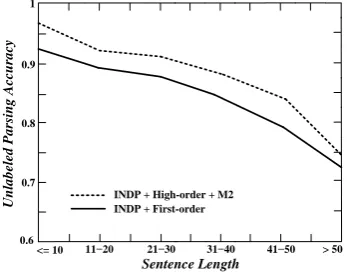
It is well known that dependency parsers tend to have lower accuracies for longer sentences be-cause the increased presence of complex syntactic structures. In order to get a better understanding of how well the incremental strategy and high-order features benefit the models, Figure4shows the ac-curacy of our neural dependency parser using the first-order features only (indicated with “NDP + First-order”) and INDP with at most twice high-order refinements (indicated with “INDP + High-order + M2”) on the English PTB develop set. For simplicity, the experiments report unlabeled pars-ing accuracy, and identical experiments uspars-ing la-beled parsing accuracy did not reveal any addition-al information.
0.9
0.8
0.7
0.6
<= 10 11−20 21−30 31−40 > 50 Sentence Length
U
n
la
b
el
ed
P
a
rs
in
g
A
cc
u
ra
cy
1
41−50 INDP + First-order
[image:7.595.308.531.236.394.2]INDP + High-order + M2
Figure 4:Accuracy relative to sentence length.
The INDP with the high-order refinements is more precise than the parser using only the first-order features. Due to the fact that longer de-pendencies are typically harder to parse, there is still a degradation in performance for our INDP. However, the accuracy curve for INDP is slightly flatter than its reduced version in which the high-order features and incremental recipe are not ap-plied when the sentence length is within 11-50. This behavior can be explained by the reasons that the feature representations are not restricted to a limited number of graph arcs, but can take into ac-count with the (almost) entire dependency graph built so far at the refinement stages of the INDP, and it do offer substantial refinements.
3.5 Results
We report the experimental results on the English PTB and Chinese CTB datasets in Table 1and2
respectively, in which our networks are denoted by “INDP”. The “M1” indicates that the results
[image:7.595.90.264.298.436.2]are obtained by the INDP with just one refinemen-t over refinemen-the parse graphs builrefinemen-t using refinemen-the firsrefinemen-t-order features, and similarly, the “M2” indicates the re-sults are achieved by the INDP with at most twice high-order refinements, while the “UNC” in the last row indicates that the refinements will contin-ue until no change is made in the structure pre-dictions (see the algorithm listed in Figure3). All compared transition-based parsing systems are in-dicated by a “‡”, and graph-based ones by “§”.
Table 1: Results on the English PTB dataset.
Model UAS LAS
Zhou et al (2015)‡ 93.28 92.35 Weiss et al (2015)‡ 94.26 92.41 Ballesteros et al (2016)‡ 93.56 91.42 Kiperwasser and Goldberg (2016b)‡ 93.90 91.90 Andor et al (2016)‡ 94.61 92.79 Kuncoro et al (2016)‡ 95.80 94.60
Kiperwasser and Goldberg (2016a)§ 93.00 90.90 Cheng et al (2016)§ 94.10 91.49 Hashimoto et al (2016)§ 94.67 92.90 Dozat and Manning (2017)§ 95.74 94.08 NDP + First-order 90.88 88.93 INDP + High-order + M1 93.31 91.51 INDP + High-order + M2 94.76 93.12 INDP + High-order + UNC 95.53 93.94
From these numbers, a handful of trends are readily apparent. Firstly, we note that the “full-fledged” INDP (indicated with “UNC”) is superi-or to that without the high-superi-order refinements by a fairly significant margin (5.01% for English and 6.55% for Chinese in LAS). Another striking re-sult of these experiments is that comparable per-formance can be obtained by no more than twice refinements with high-order features, and “INDP + High-order + M2” achieves a good trade-off be-tween the performance and parsing complexity.
Table 2: Results on the Chinese CTB dataset.
Model UAS LAS
Ballesteros et al (2016)‡ 87.65 86.21 Kiperwasser and Goldberg (2016b)‡ 87.60 86.10 Kiperwasser and Goldberg (2016a)§ 87.10 85.50 Cheng et al (2016)§ 88.10 85.70 Dozat and Manning (2017)§ 89.30 88.23
NDP + First-order 82.97 81.39 INDP + High-order + M1 87.35 85.82 INDP + High-order + M2 88.78 87.28 INDP + High-order + UNC 89.42 87.94
[image:7.595.308.530.600.707.2]in spite of its simpler architectures, and gets state-of-the-art UAS accuracy on the Chinese CTB. The INDP lags behind in LAS, indicating one of a few possibilities. Firstly, we tried only a few differ-ent network configurations, and there are many ways (such as using deeper architectures, and re-cruiting bi-directional recurrent neural networks to produce word feature representations) that we could improve it further. Secondly, the model of (Kuncoro et al.,2016) is particularly designed to capture phrase compositionality, and thus, another possible improvement is to capture such composi-tionality by optimizing the network architectures, which may also lead to a better label score.
4 Related Work
Dependency-based syntactic representations of sentences have been found to be useful for vari-ous NLP tasks, especially for those involving nat-ural language understanding in some way. We briefly review prior work both on graph-based and transition-based neural dependency parsers.
In transition-based parsing, we learn a model for scoring transitions from one state to the next, conditioned on the parse history, and parse a sen-tence by taking the highest-scoring transition out of every state until a complete dependency graph has been derived. Chen and Manning (2014) made the first successful attempt at introducing deep learning into a transition-based dependency pars-er. At each step, the feed-forward neural network assigns a probability to every action the parse can take from certain state (words on the stack and buffer). Some researchers have attempted to ad-dress the limitations of (Chen and Manning,2014) by augmenting it with additional complexity.
A beam search and a conditional random field loss function were incorporated into the transition-based neural network models (Weiss et al.,2015;
Zhou et al.,2015;Andor et al.,2016), which allow the parsers to keep the top-kpartial parse trees and revoke previous actions once it finds evidence that they may have been incorrect by locally greedy choices. Dyer et al (2015) used three LSTMs to represent the buffer, stack, and parsing history, getting state-of-the-art results on Chinese and En-glish dependency parsing tasks.
Graph-based parsers use machine learning for scoring each possible edge for a given sentence, typically by factoring the graphs into their compo-nent arcs, and constructing the parse tree with the
highest score from these weighted edges. Kiper-wasser and Goldberg (2016b) presented a neural graph-based parser in which the bi-directional L-STM’s recurrent output vector for each word is concatenated with each possible head’s vector (al-so produced by the same biLSTM), and the result is used as input to a multi-layer perceptron (MLP) for scoring this modifier-head pair. Given the s-cores of the arcs, the highest scoring tree is con-structed using Eisner’s decoding algorithm ( Eis-ner, 1996). Labels are predicted similarly, with each word’s recurrent output vector and its head’s vector being used in a multi-class MLP.
Kiperwasser and Goldberg (2016a) also pro-posed a hierarchical tree LSTM to model the de-pendency tree structures in which each word is represented by the concatenation of its left and right modifier (child) vectors, and the modifier vectors are generated by two (leftward or right-ward) recurrent neural networks. The tree repre-sentations were produced in a bottom-up recursive way with the (greedy) easy-first parsing algorithm (Goldberg and Elhadad,2010). Similarly, Cheng et al (2016) proposed a graph-based neural depen-dency parser that is able to predict the scores for the next arc, conditioning on previous parsing de-cisions. In addition to using one bi-directional re-current network that produces a rere-current vector for each word, they also have uni-directional re-current neural networks (left-to-right and right-to-left) that keep track of the probabilities of each previous parsing actions.
In their many-task neural model, Hashimoto et al (2016) included a graph-based dependency parse in which the traditional MLP-based method that Kiperwasser and Goldberg (2016b) used was replaced with a bilinear one. Dozat and Manning (2017) modified the neural graph-based approach of (Kiperwasser and Goldberg, 2016b) in a few ways to improve the performance. In addition to building a network that is larger and uses more regularization, they replace the traditional MLP-based attention mechanism and affine label classi-fier with biaffine ones.
This work is most closely related to the graph-based parsing approaches with multiple high-order refinements (Rush and Petrov,2012;Zhang et al.,
in order to make the inference with up to third-order features practical. They start with a linear-time vine pruning pass and build up to high-order models. Zhang et al (2014) introduced a random-ized greedy algorithm for dependency parsing in which they begin with a tree drawn from the u-niform distribution and use hill-climbing strategy to find the optimal parse tree. Although they ported that drawing the initial tree randomly re-sults in the same performance as when initialized from a trained first-order distribution, but multi-ple random restarts are required to avoid getting stuck in a locally optimal solution. Their greedy algorithm breaks the parsing into a sequence of lo-cal steps, which correspond to choosing the head for each modifier word (one arc at a time) in the bottom-up order relative to the current tree. In contrast, we employed the global inference algo-rithm to change the entire tree (all at a time) in each refinement step, which makes the improve-ment more efficient.
5 Conclusion
Graph-based parsers cannot easily condition on any extended scope of the dependency parse tree beyond a single arc, which is their primary short-coming relative to transition-based competitors. We have shown that a simple, generally applica-ble incremental neural dependency parsing algo-rithm can deliver close to state-of-the-art parsing performance, which allows the high-order features to be taken into account without hurting the advan-tage of global exhaustive inference and learning as a member of graph-based parsing systems. Fu-ture work will involve exploring ways of augment-ing the parser with a more innovative architecture than the relatively simple one used in current neu-ral graph-based parsers.
Acknowledgments
The authors would like to thank the anonymous reviewers for their valuable comments. This work was partly supported by a grant from Shang-hai Municipal Natural Science Foundation (No. 15511104303).
References
Daniel Andor, Chris Alberti, David Weiss, Aliaksei Severyn, Alessandro Presta, Kuzman Ganchev, Slav Petrov, and Michael Collins. 2016. Globally
nor-malized transition-based neural networks. In
Pro-ceedings of the 54th Annual Meeting of the Associa-tion for ComputaAssocia-tional Linguistics (ACL’16). Miguel Ballesteros, Yoav Goldberg, Chris Dyer, and
Noah A. Smith. 2016. Training with exploration
im-proves a greedy stack-LSTM parser. InProceedings
of the International Conference on Empirical Meth-ods in Natural Language Processing (EMNLP’16). Sabine Buchholz and Erwin Marsi. 2006.
CoNLL-X shared task on multilingual dependency parsing. In Proceedings of the International Conference on Computational Natural Language Learning (CoNL-L’06).
Danqi Chen and Christopher D. Manning. 2014. A fast and accurate dependency parser using neural
net-works. In Proceedings of the International
Con-ference on Empirical Methods in Natural Language Processing (EMNLP’14).
Hao Cheng, Hao Fang, Xiaodong He, Jianfeng Gao, and Li Deng. 2016. Bi-directional attention with
agreement for dependency parsing. In arXiv:
1608.02076.
Yoeng-Jin Chu and Tseng-Hong Liu. 1965. On the
shortest arborescence of a directed graph. Scientia
Sinica, 14:1396–1400.
Ronan Collobert, Jason Weston, L´eon Bottou, Michael Karlen, Koray Kavukcuoglu, and Pavel Kuksa. 2011. Natural language processing (almost) from
scratch. Journal of Machine Learning Research,
12:2493–2537.
Timothy Dozat and Christopher D. Manning. 2017. Deep biaffine attention for neural dependency
pars-ing. InProceedings of the International Conference
on Learning Representations (ICLR’17).
Chris Dyer, Miguel Ballesteros, Wang Ling, Austin Matthews, and Noah A. Smith. 2015. Transition-based dependency paring with stack long short-term
memory. InProceedings of the 53rd Annual
Meet-ing of the Association for Computational LMeet-inguistics (ACL’15).
Jack Edmonds. 1967. Optimum branchings. Journal
of Research of the National Bureau of Standards, 71:233–240.
Jason Eisner. 1996. Three new probabilistic models for
dependency parsing: An exploration. In
Proceed-ings of the 16th International Conference on Com-putational Linguistics (COLING’96).
Dumitru Erhan, Yoshua Bengio, Aaron Courville, Pierre-Antoine Manzagol, and Pascal Vincent. 2010. Why does unsupervised pre-training help deep
learning. Journal of Machine Learning Research,
11:625–660.
Yoav Goldberg and Michael Elhadad. 2010. An effi-cient algorithm for easy-first non-directional
depen-dency parsing. InProceedings of the Annual
Johan Hall, Jens Nilsson, Joakim Nivre, G¨ulsen Ery-i˘git, Be´ata Megyesi, Mattias Nilsson, and Markus Saers. 2007. Single Malt or blended? a study in
multilingual parser optimization. InProceedings of
the Joint Conference on Empirical Methods in ural Language Processing and Computational Nat-ural Language Learning (EMNLP-CoNLL’07). Kazuma Hashimoto, Yoshimasa Tsuruoka Caiming
X-iong, and Richard Socher. 2016. A joint many-task model: Growing a neural network for multiple NLP
tasks. InarXiv: 1611.01587.
Liang Huang and Kenjie Sagae. 2010. Dynamic pro-gramming for linear-time incremental parsing. In
Proceedings of the 48th Annual Meeting of the As-sociation for Computational Linguistics (ACL’10). Nal Kalchbrenner, Edward Grefenstette, and
Fernan-do Pereira. 2014. A convolutional neural network
for modelling sentences. InProceedings of the 52nd
Annual Meeting of the Association for Computation-al Linguistics (ACL’14).
Eliyahu Kiperwasser and Yoav Goldberg. 2016a. Easy-first dependency parsing with hierarchical tree
L-STMs. Transactions of the Association for
Compu-tational Linguistics, 4:445–461.
Eliyahu Kiperwasser and Yoav Goldberg. 2016b. Sim-ple and accurate dependency parsing using
bidirec-tional LSTM feature representations.
Transaction-s of the ATransaction-sTransaction-sociation for Computational LinguiTransaction-sticTransaction-s, 4:313–327.
Adhiguna Kuncoro, Miguel Ballesteros, Chris Dy-er Lingpeng Kong, Graham Neibig, and Noah A.
Smith. 2016. What do recurrent neural
net-work grammars learn about syntax? In arXiv:
1611.05774.
Andr´e F. T. Martins, Dipanian Das, Noah A. Smith, and Eric P. Xing. 2008. Stacking dependency parsers. In Proceedings of the International Conference on Empirical Methods in Natural Language Processing (EMNLP’08).
Andr´e F. T. Martins, Noah A. Smith, and Eric P. Xing. 2009. Concise integer liear programming
formula-tions for dependency parsing. InProceedings of the
47th Annual Meeting of the Association for Compu-tational Linguistics and the 4th International Joint Conference on Natural Language Processing (ACL-IJCNLP’09).
Ryan McDonald, Koby Crammer, and Fernando Pereira. 2005a. Online large-margin training of
de-pendency parsers. In Proceedings of the 43rd
An-nual Meeting of the Association for Computational Linguistics (ACL’05).
Ryan McDonald and Joakim Nivre. 2007. Character-izing the errors of data-driven dependency parsing
models. InProceedings of the Joint Conference on
Empirical Methods in Natural Language Process-ing and Computational Natural Language LearnProcess-ing (EMNLP-CoNLL’07).
Ryan McDonald and Joakim Nivre. 2011. Analyzing
and integrating dependency parsers. Computational
Lingustics, 37:197–230.
Ryan McDonald, Fernando Pereira, Kiril Ribarov, and
Jan Hanji˘c. 2005b. Non-projective dependency
parsing using spanning tree algorithms. In
Pro-ceedings of the Human Language Technology Con-ferece and the International Conference on Empiri-cal Methods in Natural Language Processing (HLT-EMNLP’05).
Ryan McDonald and Giorgio Satta. 2007. On the complexity of non-projective data-driven
dependen-cy parsing. In Proceedings of the International
Workshop on Parsing Technologies (IWPT’07). Tomas Mikolov, Kai Chen, Greg Corrado, and Jeffrey
Dean. 2013. Efficient estimation of word represen-tations in vector space.
Tetsuji Nakagawa. 2007. Multilingual depdendency
parsing using global features. In Proceedings of
the Joint Conference on Empirical Methods in ural Language Processing and Computational Nat-ural Language Learning (EMNLP-CoNLL’07). Joakim Nivre and Ryan McDonald. 2008.
Integrat-ing graph-based and transition-based dependency
parsers. InProceedings of the 46th Annual
Meet-ing of the Association for Computational LMeet-inguistic- Linguistic-s: Human Language Technologies (ACL’08:HLT). Sebastian Riedel and James Clarke. 2006. Incremental
integer linear programming for non-projective
de-pendency parsing. In Proceedings of the
Interna-tional Conference on Empirical Methods in Natural Language Processing (EMNLP’06).
Alexander M. Rush and Slav Petrov. 2012. Vine prun-ing for efficient multi-pass dependency parsprun-ing. In
Proceedings of the North American Chapter of the Association for Computational Linguistics (NAA-CL’12).
Kenji Sagae and Alon Lavie. 2006. Parser combination
by reparsing. InProceedings of the North American
Chapter of the Association for Computational Lin-guistics (NAACL’06).
David Smith and Jason Eisner. 2008. Dependency
parsing by belief propagation. InProceedings of the
International Conference on Empirical Methods in Natural Language Processing (EMNLP’08). Richard Socher, Cliff C-Y. Lin, Andrew Y. Ng, and
Christopher D. Manning. 2011. Parsing natural scenes and natural language with recursive neural
networks. InProceedings of the International
Con-ference on Machine learning (ICML’11).
Kristina Toutanova, Dan Klein, Christopher D. Man-ning, and Yoram Singer. 2003. Feature-rich part-of-speech tagging with a cyclic dependency
net-work. InProceedings of the Annual Conference of
David Weiss, Chris Alberti, Michael Collins, and Slav Petrov. 2015. Stuctured training for neural network
transition-based parsing. InProceedings of the 53rd
Annual Meeting of the Association for Computation-al Linguistics (ACL’15).
Daniel Zeman and Zden˘ek ˘Zabokrtsk`y. 2005. Improv-ing parsImprov-ing accuracy by combinImprov-ing diverse
depen-dency parsers. In Proceedings of the International
Workshop on Parsing Technologies (IWPT’05). Yuan Zhang, Tao Lei, Regina Barzilay, and Tommi
Jaakkola. 2014. Greed is good if randomized: New
inference for dependency parsing. InProceedings of
the International Conference on Empirical Methods in Natural Language Processing (EMNLP’14). Yue Zhang and Stephen Clark. 2008. A tale of two
parses: Investigating and bombining graph-based
and transition-based dependency parsing. In
Pro-ceedings of the International Conference on Em-pirical Methods in Natural Language Processing (EMNLP’08).
Xiaoqing Zheng, Hanyang Chen, and Tianyu Xu. 2013. Deep learning for Chinese word segmentation and
pos tagging. In Proceedings of the International
Conference on Empirical Methods in Natural Lan-guage Processing (EMNLP’13).
Hao Zhou, Yue Zhang, Shujian Huang, and Jiajun
Chen. 2015. A neural probabilistic
structured-prediction model for transition-based dependency
parsing. In Proceedings of the 53rd Annual