A Rudimentary Lexicon and Semantics Help Bootstrap Phoneme
Acquisition
Abdellah Fourtassi———————————–Emmanuel Dupoux
Laboratoire de Sciences Cognitives et Psycholinguistique, ENS/EHESS/CNRS, Paris
{abdellah.fourtassi, emmanuel.dupoux}@gmail.com
Abstract
Infants spontaneously discover the rele-vant phonemes of their language without any direct supervision. This acquisition is puzzling because it seems to require the availability of high levels of linguistic structures (lexicon, semantics), that logi-cally suppose the infants having a set of phonemes already. We show how this cir-cularity can be broken by testing, in real-size language corpora, a scenario whereby infants would learn approximate represen-tations at all levels, and then refine them in a mutually constraining way. We start with corpora of spontaneous speech that have been encoded in a varying number of de-tailed context-dependent allophones. We derive, in an unsupervised way, an approx-imate lexicon and a rudimentary seman-tic representation. Despite the fact that all these representations are poor approxi-mations of the ground truth, they help re-organize the fine grained categories into phoneme-like categories with a high de-gree of accuracy.
One of the most fascinating facts about human infants is the speed at which they acquire their native language. During the first year alone, i.e., before they are able to speak, infants achieve im-pressive landmarks regarding three key language components. First, they tune in on the phone-mic categories of their language (Werker and Tees, 1984). Second, they learn to segment the continu-ous speech stream into discrete units (Jusczyk and Aslin, 1995). Third, they start to recognize fre-quent words (Ngon et al., 2013), as well as the semantics of many of them (Bergelson and Swing-ley, 2012).
Even though these landmarks have been doc-umented in detail over the past 40 years of
re-search, little is still known about the mechanisms that are operative in infant’s brain to achieve such a result. Current work in early language acquisi-tion has proposed two competing but incomplete hypotheses that purports to account for this stun-ning development path. The bottom-up hypothesis holds that infants converge onto the linguistic units of their language through a statistical analysis over of their input. In contrast, the top-down hypothesis emphasizes the role of higher levels of linguistic structure in learning the lower level units.
1 A chicken-and-egg problem
1.1 Bottom-up is not enough
Several studies have documented the fact that in-fants become attuned to the native sounds of their language, starting at 6 months of age (see Ger-vain & Mehler, 2010 for a review). Some re-searchers have claimed that such an early attune-ment is due to a statistical learning mechanism that only takes into account the distributional prop-erties of the sounds present in the native input (Maye et al., 2002). Unsupervised clustering al-gorithms running on simplified input have, indeed, provided a proof of principle for bottom-up learn-ing of phonemic categories from speech (see for instance Vallabha et al., 2007).
It is clear, however, that distributional learning cannot account for the entire developmental pat-tern. In fact, phoneme tokens in real speech ex-hibit high acoustic variability and result in phone-mic categories with a high degree of overlap (Hil-lenbrand et al., 1995). When purely bottom up clustering algorithms are tested on realistic input, they ended up in either a too large number of sub-phonemic units (Varadarajan et al., 2008) or a too small number of coarse grained categories (Feld-man et al., 2013a).
1.2 The top-down hypothesis
Inspection of the developmental data shows that infants do not wait to have completed the acqui-sition of their native phonemes to start to learn words. In fact, lexical and phonological acquisi-tion largely overlap. Infant can recognize highly frequent word forms like their own names, by as early as 4 months of age (Mandel et al., 1995). Vice versa, the refinement of phonemic categories does not stop at 12 months. The sensitivity to pho-netic contrasts has been reported to continue at 3 years of age (Nittrouer, 1996) and beyond (Hazan and Barrett, 2000), on par with the development of the lexicon.
Some researchers have therefore suggested that there might be a learning synergy which allows in-fants to base some of their acquisition not only on bottom up information, but also on statistics over lexical items or even on the basis of word mean-ing (Feldman et al., 2013a; Feldman et al., 2013b; Yeung and Werker, 2009)
These experiments and computational models, however, have focused on simplified input or/and used already segmented words. It remains to be shown whether the said top-down strategies scale up when real size corpora and more realistic repre-sentations are used. There are indeed indications that, in the absence of a proper phonological repre-sentation, lexical learning becomes very difficult. For example, word segmentation algorithms that work on the basis of phoneme-like units tend to degrade quickly if phonemes are replaced by con-textual allophones (Boruta et al., 2011) or with the output of phone recognizers (Jansen et al., 2013; Ludusan et al., 2014).
In brief, we are facing a chicken-and-egg prob-lem: lexical and semantic information could help to learn the phonemes, but phonemes are needed to acquire lexical information.
1.3 Breaking the circularity: An incremental discovery procedure
Here, we explore the idea that instead of learning adult-like hierarchically organized representations in a sequential fashion (phonemes, words, seman-tics), infants learn approximate, provisional lin-guistic representations in parallel. These approxi-mate representations are subsequently used to im-prove each other.
More precisely, we make four assumptions. First, we assume that infants start by paying
atten-tion to fine grained variaatten-tion in the acoustic input, thus constructing perceptual phonetic categories that are not phonemes, but segments encoding fine grained phonetic details (Werker and Curtin, 2005; Pierrehumbert, 2003). Second, we assume that these units enable infants to segment proto-words from continuous speech and store them in this de-tailed format. Importantly, this proto-lexicon will not be adult-like: it will contain badly segmented word forms, and store several alternant forms for the same word. Ngon et al. (2013) have shown that 11 month old infants recognize frequent sound sequences that do not necessarily map to adult words. Third, we assume that infants can use this imperfect lexicon to acquire some semantic repre-sentation. As shown in Shukla et al. (2011), in-fants can simultaneously segment words and asso-ciate them with a visual referent. Fourth, we as-sume that as their exposure to language develops, infants reorganize these initial categories along the relevant dimensions of their native language based on cues from all these representations.
The aim of this work is to provide a proof of principle for this general scenario, using real size corpora in two typologically different languages, and state-of-the-art learning algorithms.
The paper is organized as follows. We begin by describing how we generated the input and how we modeled different levels of representation. Then, we explain how information from the higher levels (word forms and semantics) can be used to refine the learning of the lower level (phonetic cat-egories). Next, we present the results of our sim-ulations and discuss the potential implications for the language learning process.
2 Modeling the representations
Here, we describe how we model different levels of representation (phonetic categories, lexicon and semantics) starting from raw speech in English and Japanese.
2.1 Corpus
we use an inventory of 25 phonemes for transcrib-ing Japanese, and for English, we use the set of 45 phonemes in the phonemic transcription of Pitt et al. (2007).
2.2 Phonetic categories
Here, we describe how we model the percep-tual phonetic categories infants learn in a first step before converging on the functional cate-gories (phonemes). We make the assumption that these initial categories correspond to fine grained
allophones, i.e., different systematic realizations of phonemes, depending on context. Allophonic variation can range from categorical effects due to phonological rules to gradient effects due to coar-ticulation, i.e, the phenomenon whereby adjacent sounds affect the physical realization of a given phoneme. An example of a rather categorical allo-phonic rule is given by /r/ devoicing in French:
/r/→
[X]/ before a voiceless obstruent [K] elsewhere
Figure 1: Allophonic variation of French /r/
The phoneme /r/ surfaces as voiced ([K]) be-fore a voiced obstruent like in [kanaK Zon] (“ca-nard jaune”, yellow duck) and as voiceless ([X]) before a voiceless obstruent as in [kanaX puXpK] (“canard pourpre”, purple duck). The challenge facing the leaner is, therefore, to distinguish pairs of segments that are in an allophonic relationship ([K], [X]) from pairs that are two distinct phonemes and can carry a meaning difference ([K],[l]).
Previous work has generated allophonic varia-tion artificially (Martin et al., 2013). Here, we fol-low Fourtassi et al. (2014b) in using a linguisti-cally and statistilinguisti-cally controlled method, starting from audio recordings and using a standard Hid-den Markov Models (HMM) phone recognizer to generate them, as follows.
We convert the raw speech waveform into suc-cessive 10ms frames containing a vector of Mel Frequency Cepstrum Coefficients (MFCC). We use 12 MFC coefficients (plus the energy) com-puted over a 25ms window, to which we add the first and second order derivatives, yielding 39 di-mensions per frame.
The HMM training starts with one three-state model per phoneme. Each state is modeled by a mixture of 17 diagonal Gaussians. After
train-ing, each phoneme model is cloned into context-dependent triphone models, for each context in which the phoneme actually occurs (for example, the phoneme /A/ occurs in the context [d–A–g] as in the word /dAg/ (“dog”). The triphone models cloned from the phonemes are then retrained, but, this time, only on the relevant subset of the data, corresponding to the given triphone context. Fi-nally, these detailed models are clustered back into inventories of various sizes (from 2 to 20 times the size of the phonemic inventory) and retrained. Clustering is done state by state using a phonetic feature-based decision tree, and results in tying together the HMM states of linguistically simi-lar triphones so as to maximize the likelihood of the data. The HMM were built using the HMM Toolkit (HTK: Young et al., 2006).
2.3 The proto-lexicon
Finding word boundaries in the continuous se-quence of phones is part of the problem infants have to solve without direct supervision. We model this segmentation using a state-of-the-art unsupervised word segmentation model based on the Adaptor Grammar framework (Johnson et al., 2007). The input consists of a phonetic transcrip-tion of the corpus, with boundaries between words eliminated (we vary this transcription to corre-spond to different inventories with different granu-larity in the allophonic representation as explained above). The model tries to reconstruct the bound-aries based on a Pitman-Yor process (Pitman and Yor, 1997), which uses a language-general sta-tistical learning process to find a compact rep-resentation of the input. The algorithm stores high frequency chunks and re-uses them to parse novel utterances. We use a grammar which learns a hierarchy of three levels of chunking and use the intermediate level to correspond to the lexi-cal level. This grammar was shown by Fourtassi et al. (2013) to avoid both over-segmentation and under-segmentation.
2.4 The proto-semantics
transcribed and segmented corpus, we use one of the simplest and most commonly used distribu-tional semantic models, Latent Semantic Analysis (LSA: Landauer & Dumais, 1997). The LSA al-gorithm takes as input a matrix consisting of rows representing word types and columns represent-ing contexts in which tokens of the word type oc-cur. A context is defined as a fixed number of utterances. Singular value decomposition (a kind of matrix factorization) is used to extract a more compact representation. The cosine of the angle between vectors in the resulting space is used to measure the semantic similarity between words. Two words have a high semantic similarity if they have similar distributions, i.e., if they co-occur in most contexts. The model parameters, namely the dimension of the semantic space and the number of utterances to be taken as defining the context of a given word form, are set in an unsupervised way to optimize the latent structure of the seman-tic model (Fourtassi and Dupoux, 2013). Thus, we use 20 utterances as a semantic window and set the semantic space to 100 dimensions.
3 Method
Here we explore whether the approximate high level representations, built bottom-up and with-out supervision, still contain useful information one can use to refine the phonetic categories into phoneme-like units. To this end, we extract po-tential cues from the lexical and the semantic in-formation, and test their performance in discrim-inating allophonic contrasts from non-allophonic (phonemic) contrasts.
3.1 Top down cues 3.1.1 Lexical cue
The top down information from the lexicon is based on the insight of Martin et al. (2013). It rests on the idea that true lexical minimal pairs are not very frequent in human languages, as compared to minimal pairs due to mere phonological processes (figure 1). The latter creates alternants of the same lexical item since adjacent sounds condition the realization of the first and final phoneme. There-fore, finding a minimal pair of words differing in the first or last segment (as in [kanaX] and [kanaK]) is good evidence that these two phones ([K], [X]) are allophones of one another. Conversely, if a pair of phones is not forming any minimal pair, it is classified as non-allophonic (phonemic).
However, this binary strategy clearly gives rise to false alarms in the (albeit relatively rare) case of true minimal pairs like [kanaX] (“duck”) and [kanal] (“canal”), where ([X], [l]) will be mis-takenly labeled as allophonic. In order to miti-gate the problem of false alarms, we use Boruta’s continuous version (Boruta, 2011) and we define the lexical cue of a pair of phones Lex(x, y) as the number of lexical minimal pairs that vary on the first segment (xA, yA) or the last segment
(Ax, Ay). The higher this number, the more the pair of phones is likely to be considered as allo-phonic.
The lexical cue is consistent with experimen-tal findings. For example Feldman et al. (2013b) showed that 8 month-old infants pay attention to word level information, and demonstrated that they do not discriminate between sound contrasts that occur in minimal pairs (as suggested by our cue), and, conversely, discriminate contrasts that occur in non-minimal pairs.
3.1.2 Semantic cue
The semantic cue is based on the intuition that true minimal pairs ([kanaX] and [kanal]) are asso-ciated with different events, whereas alternants of the same word ([kanaX] and [kanal]) are expected to co-occur with similar events.
We operationalize the semantic cue associated with a pair of phones Sem(x, y) as the average semantic similarity between all the lexical mini-mal pairs generated by this pair of phones. The higher the average semantic similarity, the more the learner is prone to classify them as allophonic. We take as a measure of the semantic similar-ity, the cosine of the angle between word vec-tors of the pairs that vary on the final segment cos(Ax, Ay\ )or the first segmentcos(xA, yA\ ).
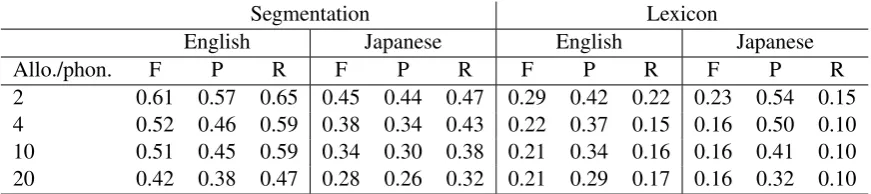
— Segmentation Lexicon
— English Japanese English Japanese
Allo./phon. F P R F P R F P R F P R
[image:5.595.78.514.62.159.2]2 0.61 0.57 0.65 0.45 0.44 0.47 0.29 0.42 0.22 0.23 0.54 0.15 4 0.52 0.46 0.59 0.38 0.34 0.43 0.22 0.37 0.15 0.16 0.50 0.10 10 0.51 0.45 0.59 0.34 0.30 0.38 0.21 0.34 0.16 0.16 0.41 0.10 20 0.42 0.38 0.47 0.28 0.26 0.32 0.21 0.29 0.17 0.16 0.32 0.10 Table 1 : Scores of the segmentation and the resulting lexicon, as a function of the average number of
allophones per phoneme. P=Precison, R=Recall and F=F-score.
3.1.3 Combined cue
Finally, we consider the combination of both cues in one single cue where the contextual information (semantics) is used as a weighing scheme of the lexical information, as follows:
Comb(x, y) = P
(Ax,Ay)∈L2cos(
\
Ax, Ay) + P
(xA,yA)∈L2cos(
\ xA, yA)
(1) where{Ax∈L}is the set of words in the lex-iconLthat end in the phonex, and{(Ax, Ay) ∈
L2} is the set of phonological minimal pairs in
L×Lthat vary on the final segment.
The lexical cue is incremented by one, for ev-ery minimal pair. The combined cue is, instead, incremented by one, times the cosine of the angle between the word vectors of this pair. When the words have similar distributions, the angle goes to zero and the cosine goes to 1, and when the words have orthogonal distributions, the angle goes to
90◦ and the cosine goes to 0.
The semantic information here would basically enable us to avoid false alarms generated by poten-tial true minimal pairs like the above-mentioned example of ( [kanaX] and [kanal]). Such a pair will probably score high as far as the lexical cue is con-cerned, but it will score low on the semantic level. Thus, by taking the combination, the model will be less prone to mistakenly classify ([X], [l]) as al-lophones.
3.2 Task
For each corpus we list all possible pairs of al-lophones. Some of these pairs are allophones of the same phoneme (allophonic pair) and others are allophones of different phonemes (non-allophonic pairs). The task is a same-different classification, whereby each of these pairs is given a score from the cue that is being tested. A good cue gives higher scores to allophonic pairs.
Only pairs of phones that generate at least one lexical minimal pair are considered. Phonetic vari-ation that does not cause lexical varivari-ation is “in-visible” to top down strategies, and is, therefore, more probably clustered through purely bottom up strategies (Fourtassi et al., 2014b)
3.3 Evaluation
We use the same evaluation procedure as Martin et al. (2013). This is carried out by computing the as-sociated ROC curve (varying the z-score threshold and computing the resulting proportions of misses and false alarms). We then derive the Area Under the Curve (AUC), which also corresponds to the probability that given two pairs of phones, one al-lophonic, one not, they are correctly classified on the basis of the score. A value of 0.5 represents chance and a value of 1 represents perfect perfor-mance.
In order to lessen the potential influence of the structure of the corpus (mainly the order of the ut-terances) on the results, we use a statistical resam-pling scheme. The corpus is divided into small blocks of 20 utterances each (the semantic win-dow). In each run, we draw randomly with re-placement from this set of blocks a sample of the same size as the original corpus. This sam-ple is then used to retrain the acoustic models and generate a phonetic inventory that we used to re-transcribe the corpus and re-compute the cues. We report scores averaged over 5 such runs.
4 Results and discussion
4.1 Segmentation
as the number of correct word tokens found, out of all tokens posited. Recall is the number of correct word tokens found, out of all tokens in the ideal segmentation. The F-score is defined as the har-monic mean of Precision and Recall:
F = 2∗P ∗R
P +R
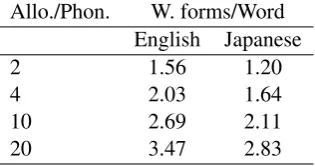
We define similar measures for word types (lex-icon). Table 1 shows the scores as a function of the number of allophones per phonemes. For both corpora, the segmentation performance decreases as we increase the number of allophones. As for the lexicon, the recall scores show that only 15 to 22% of the ’words’ found by the algorithm in the English corpus are real words; in Japanese, this number is even lower (between 10 and 15%). This pattern can be attributed in part to the fact that increasing the number of allophones increases the number of word forms, which occur therefore with less frequency, making the statistical learn-ing harder. Table 2 shows the average number of word forms per word as a function of the average number of allophones per phoneme, in the case of ideal segmentation.
Allo./Phon. W. forms/Word
— English Japanese
2 1.56 1.20
4 2.03 1.64
10 2.69 2.11
[image:6.595.93.251.417.500.2]20 3.47 2.83
Table 2 : Average number of word-forms per word as a function of the average number of
allophones per phoneme.
Another effect seen in Table 1 is the lower overall performance of Japanese compared to En-glish. This difference was shown by Fourtassi et al. (2013) to be linked to the intrinsic segmenta-tion ambiguity of Japanese, caused by the fact that Japanese words contain more syllables compared to English.
4.2 Allophonic vs phonemic status of sound contrasts
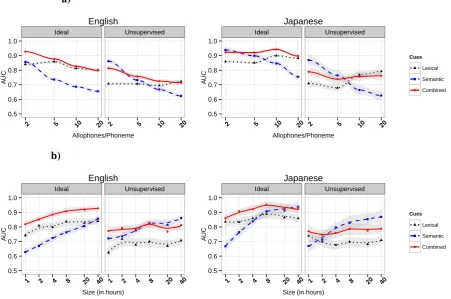
Here we test the performance of the cues described above, in discriminating between allophonic con-trasts from phonemic ones. We vary the number of allophones per phoneme, on the one hand (Fig-ure 2a), and the amount of data available to the
learner, on the other hand, in the case of two allo-phones per phonemes (Figure 2b). In both situa-tions, we compare the case wherein the lexical and semantic cues are computed on the output of the unsupervised segmentation (right), to the control case where these cues are computed on the ideally segmented speech (left).
We see that the overall accuracy of the cues is quite high, even in the case of bad word segmen-tation and very small amount of data.
The lexical cue is robust to extreme variation and to the scarcity of data. Indeed, it does not seem to vary monotonically neither with the number of allophones, nor with the size of the corpus. The as-sociated f-score generally remains above the value of 0.7 (chance level is 0.5). The semantics, on the other hand, gets better as the variability de-creases and as the amount of data inde-creases. This is a natural consequence of the fact that the se-mantic structure is more accurate with more data and with word forms consistent enough to sustain a reasonable co-occurrence statistics.
The comparison with the ideal segmentation, shows, interestingly, that the semantics is more ro-bust to segmentation errors than the lexical cue. In fact, while the lexical strategy performs, overall, better than the semantics under the ideal segmen-tation, the patterns reverses as we move to a a more realistic (unsupervised) segmentation.
These results suggest that both lexical and se-mantic strategies can be crucial to learning the phonemic status of phonetic categories since they provide non-redundant information. This finding is summarized by the combined cue which resists to both variation and segmentation errors, overall, better than each of the cues taken alone.
a)
Ideal Unsupervised
0.5 0.6 0.7 0.8 0.9 1.0
2 5 10 20 2 5 10 20
Allophones/Phoneme
A
UC
English
Ideal Unsupervised
0.5 0.6 0.7 0.8 0.9 1.0
2 5 10 20 2 5 10 20
Allophones/Phoneme
A
UC
Japanese
Cues
Lexical
Semantic
Combined
b)
Ideal Unsupervised
0.5 0.6 0.7 0.8 0.9 1.0
1 2 4 8 20 40 1 2 4 8 20 40
Size (in hours)
A
UC
English
Ideal Unsupervised
0.5 0.6 0.7 0.8 0.9 1.0
1 2 4 8 20 40 1 2 4 8 20 40
Size (in hours)
A
UC
Japanese
Cues
Lexical
Semantic
[image:7.595.78.530.68.367.2]Combined
Figure 2: Same-different scores (AUC) for different cues as a function of the average number of allo-phones per phoneme (a), and as a function of the size of the corpus, in the case of two alloallo-phones per phonemes (b). The scores are shown for both ideal and unsupervised word segmentation in English and Japanese. The points show the mean scores over 5 runs. The lines are smoothed interpolations (local regressions) through the means. The grey band shows a 95% confidence interval.
intentions) (Waxman and Gelman, 2009). What we call the “semantics” of a word in this study, is the general context provided by the co-occurrence with other words. Infants have been shown to have a powerful mechanism for tracking co-occurrence relationships both in the speech and the visual do-main (Lany and Saffran, 2013) . Our experiments demonstrate that a similar mechanism could be enough to develop a sense of semantic similarity that can successfully be used to refine phonetic categories.
5 General discussion and future work
Phonemes are abstract categories that form the ba-sis for words in the lexicon. There is a traditional view that they should be defined by their ability to contrast word meanings (Trubetzkoy, 1939). Their full acquisition, therefore, requires lexical and se-mantic top-down information. However, since the quality of the semantic representations depends on the quality of the phonemic representations that
are used to build the lexicon, we face a chicken-and-egg problem. In this paper, we proposed a way to break the circularity by building approxi-mate representation at all the levels.
al., 2013a; Frank et al., 2014), and, interestingly, that this role remains functional under more realis-tic assumptions (unsupervised word segmentation, and bottom-up inferred semantics). We also found that lexical and semantic information were not re-dundant and could be usefully combined, the for-mer being more resistant to the scarcity of data and variation, and the latter being more resistant to segmentation errors.
That being said, this work relies on the assump-tion that infants start with initial perceptual cate-gories (allophones), but we did not show how such categories could be constructed from raw speech. More work is needed to explore the robustness of the model when these units are learned in an unsu-pervised fashion (Lee and Glass, 2012; Huijbregts et al., 2011; Jansen and Church, 2011; Varadarajan et al., 2008).
This work could be seen as a proof of princi-ple for an iterative learning algorithm, whereby phonemes emerge from the interaction of low level perceptual categories, word forms, and the seman-tics (see Werker and Curtin (2005) for a similar theoretical proposition). The algorithm has yet to be implemented, but it has to address at least two major issues: First, the fact that some sound pairs are not captured by top down cues because they do not surface as minimal word forms. For in-stance, in English, /h/ and /N/ occur in different syllable positions and therefore, cannot appear in any minimal pair. Second, even if we have enough information about how phonetic categories are or-ganized in the perceptual space, we still need to know how many categories are relevant in a par-ticular language (i.e., where to stop the categoriza-tion process).
For the first problem, Fourtassi et al. (2014b) showed that the gap could, in principle, be filled by bottom-up information (like acoustic similarity). As for the second problem, a possible direction could be found in the notion ofSelf-Consistency. In fact, (Fourtassi et al., 2014a) proposed that an optimal level of clustering is also a level that glob-ally optimizes the predictive power of the lexicon. Too detailed allophones result in too many syn-onyms. Too broad classes result in too many ho-mophones. Somewhere in the middle, the optimal number of phonemes optimizes how lexical items predict each other. Future work will address these issues in more detail in order to propose a com-plete phoneme learning algorithm.
Acknowledgments
This work was supported in part by the Euro-pean Research Council (ERC-2011-AdG-295810 BOOTPHON), the Agence Nationale pour la Recherche (LABX-0087 IEC, ANR-10-IDEX-0001-02 PSL*), the Fondation de France, the Ecole de Neurosciences de Paris, and the R´egion Ile de France (DIM cerveau et pens´ee).
References
Elika Bergelson and Daniel Swingley. 2012. At 6 to 9 months, human infants know the meanings of many common nouns. Proceedings of the National Academy of Sciences, 109(9).
Luc Boruta, Sharon Peperkamp, Benoˆıt Crabb´e, and Emmanuel Dupoux. 2011. Testing the robustness of online word segmentation: Effects of linguistic diversity and phonetic variation. InProceedings of CMCL, pages 1–9. Association for Computational Linguistics.
Luc Boruta. 2011. Combining Indicators of Al-lophony. InProceedings ACL-SRW, pages 88–93. Luc Boruta. 2012. Indicateurs d’allophonie et
de phon´emicit´e. Doctoral dissertation, Universit´e Paris-Diderot - Paris VII.
M. Brent. 1999. An efficient, probabilistically sound algorithm for segmentation and word discovery.
Machine Learning, 34:71–105.
N. Feldman, T. Griffiths, S. Goldwater, and J. Morgan. 2013a. A role for the developing lexicon in pho-netic category acquisition. Psychological Review, 120(4):751–778.
N. Feldman, B. Myers, K. White, T. Griffiths, and J. Morgan. 2013b. Word-level information influ-ences phonetic learning in adults and infants. Cog-nition, 127:427–438.
Abdellah Fourtassi and Emmanuel Dupoux. 2013. A corpus-based evaluation method for distributional semantic models. In 51st Annual Meeting of the Association for Computational Linguistics Proceed-ings of the Student Research Workshop, pages 165– 171, Sofia, Bulgaria. Association for Computational Linguistics.
Abdellah Fourtassi, Benjamin B¨orschinger, Mark Johnson, and Emmanuel Dupoux. 2013. WhyisEn-glishsoeasytosegment? InProceedings of CMCL, pages 1–10. Association for Computational Linguis-tics.
Abdellah Fourtassi, Thomas Schatz, Balakrishnan Varadarajan, and Emmanuel Dupoux. 2014b. Ex-ploring the Relative Role of Bottom-up and Top-down Information in Phoneme Learning. In Pro-ceedings of the 52nd Annual Meeting of the Asso-ciation for Computational Linguistics.
Stella Frank, Naomi Feldman, and Sharon Goldwater. 2014. Weak semantic context helps phonetic learn-ing in a model of infant language acquisition. In
Proceedings of the 52nd Annual Meeting of the As-sociation of Computational Linguistics.
Judit Gervain and Jacques Mehler. 2010. Speech per-ception and language acquisition in the first year of life.Annual Review of Psychology, 61:191–218.
Sharon Goldwater, Thomas L. Griffiths, and Mark Johnson. 2009. A Bayesian framework for word segmentation: Exploring the effects of context.
Cognition, 112(1):21–54.
Zellig Harris. 1954. Distributional structure. Word, 10(23):146–162.
Valerie Hazan and Sarah Barrett. 2000. The develop-ment of phonemic categorization in children aged 6 to12. Journal of Phonetics, 28:377–396.
James Hillenbrand, Laura A. Getty, Michael J. Clark, and Kimberlee Wheeler. 1995. Acoustic charac-teristics of american english vowels. Journal of the Acoustical Society of America, 97:3099–3109.
M. Huijbregts, M. McLaren, and D. van Leeuwen. 2011. Unsupervised acoustic sub-word unit detec-tion for query-by-example spoken term detecdetec-tion. In
Proceedings of ICASSP, pages 4436–4439.
A. Jansen and K. Church. 2011. Towards unsupervised training of speaker independent acoustic models. In
Proceedings of INTERSPEECH, pages 1693–1696.
Aren Jansen, Emmanuel Dupoux, Sharon Goldwa-ter, Mark Johnson, Sanjeev Khudanpur, Kenneth Church, Naomi Feldman, Hynek Hermansky, Flo-rian Metze, Richard Rose, Mike Seltzer, Pascal Clark, Ian McGraw, Balakrishnan Varadarajan, Erin Bennett, Benjamin Borschinger, Justin Chiu, Ewan Dunbar, Abdallah Fourtassi, David Harwath, Chia ying Lee, Keith Levin, Atta Norouzian, Vijay Peddinti, Rachel Richardson, Thomas Schatz, and Samuel Thomas. 2013. A summary of the 2012 jhu clsp workshop on zero resource speech technologies and models of early language acquisition. In Pro-ceedings of ICASSP.
Mark Johnson, Thomas L. Griffiths, and Sharon Gold-water. 2007. Adaptor Grammars: A framework for specifying compositional nonparametric Bayesian models. In B. Sch¨olkopf, J. Platt, and T. Hoffman, editors,Advances in Neural Information Processing Systems 19, pages 641–648. MIT Press, Cambridge, MA.
Peter W Jusczyk and Richard N Aslin. 1995. Infants’ detection of the sound patterns of words in fluent speech. Cognitive psychology, 29(1):1–23.
Thomas K Landauer and Susan T Dumais. 1997. A solution to Plato’s problem: The Latent Semantic Analysis theory of acquisition, induction and rep-resentation of knowledge. Psychological Review, 104(2):211–240.
J. Lany and J. Saffran. 2013. Statistical learning mech-anisms in infancy. In J. Rubenstein and P. Rakic, ed-itors,Comprehensive Developmental Neuroscience: Neural Circuit Development and Function in the Brain, volume 3, pages 231–248. Elsevier, Amster-dam.
D.H. Lawrence. 1949. Acquired distinctiveness of cues: I. transfer between discriminations on the ba-sis of familiarity with the stimulus. Journal of Ex-perimental Psychology, 39(6):770–784.
C. Lee and J. Glass. 2012. A nonparametric bayesian approach to acoustic model discovery. In Proceed-ings of the 50th Annual Meeting of the Associa-tion for ComputaAssocia-tional Linguistics: Long Papers-Volume 1, pages 40–49.
Bogdan Ludusan, Maarten Versteegh, Aren Jansen, Guillaume Gravier, Xuan-Nga Cao, Mark Johnson, and Emmanuel Dupoux. 2014. Bridging the gap be-tween speech technology and natural language pro-cessing: an evaluation toolbox for term discovery systems. InProceedings of LREC.
Kikuo Maekawa, Hanae Koiso, Sadaoki Furui, and Hi-toshi Isahara. 2000. Spontaneous speech corpus of japanese. InLREC, pages 947–952, Athens, Greece. D.R. Mandel, P.W. Jusczyk, and D.B. Pisoni. 1995. In-fants’ recognition of the sound patterns of their own names. Psychological Science, 6(5):314–317. Andrew Martin, Sharon Peperkamp, and Emmanuel
Dupoux. 2013. Learning phonemes with a proto-lexicon.Cognitive Science, 37(1):103–124. J. Maye, J. F. Werker, and L. Gerken. 2002. Infant
sen-sitivity to distributional information can affect pho-netic discrimination. Cognition, 82:B101–B111.
C. Ngon, A. Martin, E. Dupoux, D. Cabrol, M. Duthat, and S. Peperkamp. 2013. (non)words, (non)words, (non)words: evidence for a protolexicon during the first year of life. Developmental Science, 16(1):24– 34.
S. Nittrouer. 1996. Discriminability and perceptual weighting of some acoustic cues to speech percep-tion by 3-year-olds. Journal of Speech and Hearing Research, 39:278–297.
J. Pitman and M. Yor. 1997. The two-parameter Poisson-Dirichlet distribution derived from a stable subordinator. Annals of Probability, 25:855–900. M. A. Pitt, L. Dilley, K. Johnson, S. Kiesling, W.
Ray-mond, E. Hume, and Fosler-Lussier. 2007. Buckeye corpus of conversational speech.
M Shukla, K White, and R Aslin. 2011. Prosody guides the rapid mapping of auditory word forms onto visual objects in 6-mo-old infants.Proceedings of the National Academy of Sciences, 108(15):6038– 6043.
N. S. Trubetzkoy. 1939. Grundz¨uge der Phonolo-gie (Principles of phonology). Vandenhoeck & Ruprecht, G¨ottingen, Germany.
G. K. Vallabha, J. L. McClelland, F. Pons, J. F. Werker, and S. Amano. 2007. Unsupervised learn-ing of vowel categories from infant-directed speech.
Proceedings of the National Academy of Sciences, 104(33):13273.
Balakrishnan Varadarajan, Sanjeev Khudanpur, and Emmanuel Dupoux. 2008. Unsupervised learning of acoustic sub-word units. InProceedings of ACL-08: HLT, Short Papers, pages 165–168. Association for Computational Linguistics.
Sandra R. Waxman and Susan A. Gelman. 2009. Early word-learning entails reference, not merely associa-tions. Trends in Cognitive Sciences, 13(6):258–263. J. F. Werker and S. Curtin. 2005. PRIMIR: A develop-mental framework of infant speech processing. Lan-guage Learning and Development, 1(2):197–234. Janet F. Werker and Richard C. Tees. 1984.
Cross-language speech perception: Evidence for percep-tual reorganization during the first year of life. In-fant Behavior and Development, 7(1):49 – 63. H Yeung and J Werker. 2009. Learning words’ sounds
before learning how words sound: 9-month-olds use distinct objects as cues to categorize speech infor-mation. Cognition, 113:234–243.