Abstract— Advanced wireless technologies are rising our hopes to meet the demands in health and communication. After 3G, the new orthogonal FDM (OFDM) is bringing new facility in terms of secured data transmission over a network without multipath fading. Biomedical data which are generally bulky and need a very reliable and efficient data communication network can use this technique without failure, thus meeting our goal to develop an advanced WHMS enabled society. Recently, orthogonal frequency-division multiplexing (OFDM) is being widely used as a means of data communication. OFDM system is capable of error free, high speed wireless transmission with almost zero Inter–symbol interference. Here, we present a way to design an OFDM network using TMS320C6713 DSK and provide a way to implement UART using McBSP and ER900TRS transceiver. In this paper we also analyze the performance of different codes used in code-division-multiple-access (CDMA) system. The performance of the system is evaluated using experimental data obtained from the design and implementation on Texas Instrument’s TMS320C6713 DSK kit.
Index Terms — BAN, HEALTH MONITORING, OFDM, WHMS.
I. INTRODUCTION
Industrialists and researchers from wireless communication domain are presently showing interest in Wireless Health Monitoring Systems (WHMSs) which promises huge contribution to the welfare of the society.
Manuscript received March 24, 2010. This work was supported by Central Mechanical Engineering Research Institute, Durgapur, India under Supra Institutional Project (SIP-24), ‘Development of snake robot for disaster management’.
Avinash Jha is a final year B.Tech student in Asansol Engineering College,WB,India.(ph:+919800078576;e-mail:[email protected]).
Manish kr. Upadhyay is a final year B.Tech student in AEC, WB, India.(ph:+919932702876;e-mail:[email protected]).
Pankaj kr. Singh is a final year B.Tech student in AEC,WB, India. (ph:+919163582797;e-mail:[email protected]).
Antara Das is a final year B.Tech student in AEC ,WB,India.(ph:+919732060080;e-mail:[email protected]).
Rudra Prasad Chatterjeeis a scientist inCentral Mechanical Engineering Research Institute, Durgapur, India. His work area includes wireless control of robotic devices, mobile network etc. (ph:+91-343-6452051 ; e-mail: [email protected]).
Development of such devices, which are commercially viable and reliable for wireless data transmission by reducing bit-error rate and inter-symbol interference (ISI), is a big challenge in order to meet the world’s increasingly aging population. For example, one third or more of the 78 million baby boomers and 34 million of their parents may be at the risk of the development of fatal diseases including cardiovascular diseases, stroke and cancer [1]. An important prediction made by the medical experts, regarding pre-symptomatic testing, states that it can prevent millions of lives and cost in the coming decades. These have made the following features paramount of wearable health monitoring technologies: (1) detection of early signs of health deterioration; (2) notification to health care providers in critical situations; (3) connectivity with loved ones by sharing real-time raw or interpreted physiological data; (4) correlation between lifestyle and health; (5) sports conditioning into a new dimension, by providing detailed information about physiological signals under various exercise conditions; (6) healthcare to remote locations and developing countries, where cellular phones are pervasive and in some cases the only available communications device; and ultimately (7) connecting doctors with multi-sourced, real-time physiological data. However, in order to make these wearable devices practical, a series of technical, legal and sociological obstacles need to be overcome. For example, these devices need to be non-intrusive, comfortable to wear, efficient in power consumption, preserve privacy and have a user-friendly interface. They would also need to have very low failure rate and highly accurate alarm triggers, especially if used for diagnostic purposes.
II. RELATED WORKS AND WHMS ARCHITECTURE
In the year 2005, a very impressive product, HealthGear, was launched. HealthGear is a wearable real-time monitoring device consisting of a set of physiological sensors connected via Bluetooth to a Bluetooth-enabled cell phone. HealthGear can monitor and analyze the user’s blood oxygen level (SpO2), heart rate and plethysmographic signal in a light-weight fashion. There are sophisticated watches available today which provide real-time heart rate information and let users store and analyze their data on their home PCs [2], [3]. Another armband has been developed by Bodymedia, that has multiple sensors (galvanic skin response, skin and near-body temperature, two-axis accelerometer and heat flux) to continuously collect physiological data for few
Body Area Network (BAN) with OFDM
Enhances Data Transmission in Wireless Health
Monitoring Systems (WHMS)
3rd Tier Kiosk 2nd Tier Kiosk 1st Tier Kiosk as energy expenditure, duration of physical activity,
number of steps, etc. However, such products can analyze the physiological data in home PC. In the medical domain, there are numerous projects for tele-monitoring physiological data running throughout the world [5]. Traditionally, personal medical monitoring systems, such as Holter monitors, have been used to collect data for off-line processing. Systems with multiple sensors for physical rehabilitation typically feature many wires between the electrodes and the monitoring system. These wires limit a patient’s activity and level of comfort, thus potentially affecting the reliability of the measured results. Therefore, there has been an increasing interest in health monitoring in the wearable computing community. Martin et al discuss in [6] issues surrounding wearable computers used for health monitoring where the devices provide a real-time feedback to the patient. To be very specific, it is a wearable ECG device. A Bluetooth-enabled health monitoring system is described in [7], where the authors present a PDA-based ECG monitoring system with the sensors embedded in a shirt. The analysis of the data would be done in a central computer. A wearable health-monitoring device using a Personal Area Network (PAN) or Body Area Network (BAN) could be integrated into a user’s clothing [8], as given in Foster-Miller’s health monitoring garment for soldiers [9]. Paradiso describes quite preliminary work on the WEALTHY system, a garment with embedded ECG sensors for continuous cardiac monitoring [10]. Jovanov et al present in [11] a wireless BAN with motion sensors for computer-assisted physical rehabilitation and ambulatory monitoring. Husemann et al propose a Personal Area Hub to manage interactions between wearable devices and act as a proxy for these devices [12]. The authors have developed architecture for logging and subscribing to events occurring in the system and have implemented it
on a Sony Ericsson P900 smart phone. Their test bed is a health care application for tracking patient compliance in taking blood pressure medication. In the area of wireless sensor networks, the MobiHealth European project aims to provide continuous monitoring of patients outside the hospital environment by developing the concept of a 3G-enabled BAN [13]. CodeBlue is a wireless infrastructure intended for deployment in emergency medical care, integrating low-power wireless vital sign sensors, PDAs and PCs. Some of their research interests include the integration of medical sensors with low-power wireless networks, wireless ad-hoc routing protocols and adaptive resource management [14]. AMON system [15] is another wearable (wrist-worn) device for medical monitoring and alert system targeting high-risk cardiac/respiratory patients. The system includes continuous collection and evaluation of multiple vital signs (blood pressure, SpO2, one lead ECG and two-axis accelerometer), multi-parameter medical emergency detection (via a rule-based approach with some heuristics) and cellular connection to a medical centre.
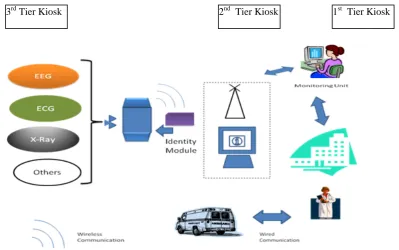
[image:2.595.115.515.478.728.2]This paper describes a wearable health monitoring system linked with a network which is composed of different tier kiosks and network hospitals. The next section briefs the architecture of 1st tier and 2nd tier kiosks followed by a typical biomedical data transmitted over the network. Section III gives an overview of OFDM communication technique with different coding techniques: a) Walsh code and Gold code. Finally, graphs obtained for different coding techniques in TMS320C6713 DSP platform are shown that differentiate the two coding technique.Fig.1 and Fig.2 provide a complete architecture of a WHMS network and typical EMG signal as a reference of biomedical signal, respectively.
Fig. 2 Typical EMG Signal Transmitted from a Patient body over OFDM Network
III.OFDMANDDIFFERENTCODINGTECHNIQUES
Orthogonal FDM's (OFDM) spread spectrum technique distributes data over a large number of carriers that are spaced at precise frequencies. This spacing provides the "orthogonality" in this technique, which prevents the demodulators from detecting frequencies other than their own. OFDM provides high spectral efficiency and low multi-path distortion. This is useful because in a typical terrestrial broadcasting scenario, there are multipath-channels (i.e. the transmitted signal arrives at the receiver using various paths of different length ). Since , multiple versions of the signal interfere with each other, it becomes very difficult to extract the original information. OFDM exhibits lower multi-path distortion (delay spread) due to sending of the high speed composite’s “sub-signals” at lower data rates. The lower data rate transmission ensures that multi-path-based delays are not nearly as significant as they would be with a single channel high rate system. In OFDM, the sub-carrier pulse used for transmission is chosen to be rectangular. However, for an OFDM system to work in this way, the receiver and the transmitter must be perfectly synchronized and there should be no multipath fading.
A. WALSH CODE
Walsh code is an orthogonal code, used to generate statistically unique set of numbers which are used in encryption and cellular communications. These are the backbone of CDMA systems and are used to develop individual channels in CDMA. The correlation of two walsh codes is zero i.e. each Walsh encoded signal has zero interference with other encoded signals.
Walsh codes are easy to generate and are deduced using Walsh-Hadamard matrix. The general form of a Walsh matrix is given below:
Every Hadamard matrix has the following properties- 1) It is a square symmetric matrix of size 2n by 2n. 2) Each row in the matrix is a Walsh code.
Walsh code provides excellent orthogonality for coding purpose. Here we describe the methods for coding and decoding a data using walsh code.
Coding: -
1) Suppose user A has to transmit (1 1 0 1) and user B has to transmit (1 0 1 1).
2) Let the unique walsh code for user A be (1 -1) and that for user B be (1 1). For user A, for each 1 in the message sequence, code (1 -1) is transmitted and for each 0 in the message sequence, code (-1 1) gets transmitted. For user B, for each 1 in the message sequence, code (1 1) is transmitted and for each 0 in the message sequence, code (-1 -1) gets transmitted.
3) The encoded signal is thus given by, E = signal*code. For user A it is
(1 1 0 1) * (1 -1) i.e. {(1 -1), (1 -1), (-1 1), (1 -1)} and for user B we have
(1 0 1 1) * (1 1) i.e {(1 1), (-1 -1), (1 1), (1 1)}. 4) The transmitted signals for both the users are,
A = (1 -1 1 -1 -1 1 1 -1), B = (1 1 -1 -1 1 1 1 1). Decoding: -
The signals being transmitted for user A and B, being orthogonal to each other, can be decoded using it’s own unique code only. Below is the procedure for decoding the transmitted signals.
Decoding Process :- 1) The data transmitted is
A = ((1, -1), (1, -1), (-1, 1), (1, -1)) .
2) Now, this will be combined with the walsh code of A and that of B.
3) Using the walsh code (1, -1) of user A, we get, decoded signal as,
= ((1, -1), (1, -1), (-1, 1), (1, -1)) * (1, -1) = ((1+1), (1+1), (-1-1), (1+1))
4) Using walsh code (1, 1) of user B, we get, decoded signal = ((1, -1), (1, -1), (-1, 1), (1,- 1)) * (1, 1)
= ((1 -1), (1 -1), (-1 + 1), (1 -1))
= (0, 0, 0, 0). Thus user B detects no signal. Now we consider a situation where two users A and B transmit at the same time. In this case, interference between two may arise. To get the original signal, each transmitted waveform is multiplied with it’s own unique Walsh code.
1) A and B interferes to give A + B = (2 0 0 -2 0 2 2 0).
2) This pattern is then combined using the unique code for each user i.e.
Decoded signal = (A + B) * (Walsh code) Thus, for A, we get the decoded signal as, = ((2 , 0), (0, -2), (0, 2), (2, 0)) * (1, -1) = ((2 + 0), (0 + 2), (0 - 2), (2 + 0)) = (2, 2, -2, 2).
And for B, we get, decoded signal = = ((2, 0), (0, -2), (0, 2), (2, 0)) * (1, 1) = ((2 + 0), (0 - 2), (0 + 2), (2 + 0)) = (2, -2, 2, 2).
For decoding purpose, we take all the values greater than binary 0 as 1, and those less than binary 0 as 0. 3) Thus, finally we get
A = (1, 1, 0, 1) and B = (1, 0, 1, 1 ).
The original signal is spread in the frequency spectrum using walsh code. This reduces the intersymbolic interference and also makes CDMA more robust. B. GOLD CODE
Gold codes are non-orthogonal codes which are widely used in communication system.To generate a gold code we use a simple counter here. The order of the counter depends upon the number of users available i.e. for a counter of order eight, 256 different codes can be generated. Gold codes generate
direct sequence spread spectrum, thus increasing the SNR of the signal.
Encoding:
1) The programme is implemented using Code Composer studio software and the DSK kit.
2) The message (M) to be transmitted is taken as the user input.
3) 9’s complement of the message (M9) is calculated . 4) 9’s complement of the Gold sequence (G9) for that user is calculated.
5) M9 and G9 are bitwise added. The carry bit is dis- carded.
6) The final sequence is the encoded signal (D) to be transmitted.
Decoding:
1) 9’s complement of D is calculated (D9). D9 and G9 are again bitwise added to get back the original transmitted data.
The procedure is explained below with the help of an example.
Encoding: Let the message signal be M1 = 36784531. Let the gold code sequence G1 = 11001011. Finding 9’s complement of message signal, M9 = ( 99999999 – 36784531) = 63215468. Finding 9’s complement of Gold code, G9 = (99999999 - 11001011) = 88998988. Now, we do the bitwise addition of M9 and G9 to get 41103356.
Decoding of the encoded data: 9’s complement of the data obtained, D9 = (99999999 – 41103356) = 58896643. D9 and G9 are bitwise added to get 36784521, which is similar to the original transmitted message.
IV. RESULTS
Fig.3Walsh code encode data (input and output)
Fig.4 FFT of walsh code encoded data
Fig.6 FFT ( phase and magnitude ) of gold code encoded
data
V. CONCLUSION
Body-area-network development with high resolution sensor demands the availability of high end processors along with being cost effective. With advancements in technology this is becoming a reality day by day. Today replacement or repair of wearable devices can be provided as a service to the customers. Still, this communication technique for WHMS needs some infrastructural support for rural development. Study on 4G mobile communication and its compatibility with lower generations can provide good results to the world of technically advanced society. However, proprietary data formats prevent users from consolidating and correlating health monitoring data from different devices. This problem can be avoided by logging transmitted data from different sensor sources with a universal format. After all, the principle aim of such initiative is to build a modern society having an any-time health care facility.
ACKNOWLEDGMENT
The authors are grateful to the Director, CMERI for providing support in the research work. The authors also acknowledge the guidance provided by Dr. S. Majumder, Head, SR Lab in carrying out experiments on the specified topics. Finally, the authors express their gratitude to IAENG for considering this paper for publication.
REFERENCES
[1] Nuria Oliver and Fernando Flores-Mangas, “HealthGear: A
Real-time Wearable System for-Monitoring and Analyzing Physiological Signals”. Microsoft Research, Redmond, WA 98052 USA, Technical Report MSR-TR-2005-182, 2005.
[2] Polar. Polar watches. http://www.polarusa.com. [3] Suunto. T6, foot pod, n6hr. http://www.suunto.com.
[4] BodyMedia. Healthwear armband, bodybugg.
http://www.bodymedia.com.
[5] K.M. Scannell, D.A. Perednia, and H.M. Kiss-man. Telemedicine: Past, present, future. Technical report, U.S. Department of Health and Human Ser-vices. National Library of Medicine. Reference Sec-tion., 1995.
[6] Martin. T., E. Jovanov, and Raskovic. D. Issues in wearable
computing for medical monitoring applica-tions: A case study of a wearable ecg monitoring device. In Proc. Intl. Symp. Wearable Computers (ISWC’00), pages 43–49, 2000.
[7] P.T. Cheng, L.M. Tsai, L.W. Lu, and D.L. Yang. The design of pda-based biomedical data processing and analysis for intelligent wearable health monitor-ing systems. In Proc. Intl. Conf. Computer and In-formation Technology (CIT’04).
[8] S. Park and S. Jayaraman. Enhancing the quality of life thourgh wearable technology. IEEE Engineer-ing in Medicine and Biology Magazine, 22:3:41–48, 2003.
[9] Foster-Miller. Foster-miller receives additional $3 million from dod for electro-textile health-monitoring vest development. http://www.foster-miller.com.
[10] R. Paradiso. Wearable health care system for vital signs monitoring. In Proc. IEEE Int.Conf. In-formation Technology Applications in Biomedicine, pages 283–286, 2003.
[11] E. Jovanov, A. Milenkovic, C. Otto, and P.C. de Groen. A wireless body area network of intelligent motion sensors for computer assisted physical reha-bilitation. Journal of Neuroengineering and Rehabili-tation, 22:6, 2005.
[12] D. Husesmann, C. Narayanaswami, and M. Nidd. Personal mobile hub. In Proc. Intl. Symp. Wearable Computers (ISWC’04), pages 43–49.
[13] D. Konstantas, A.V. Halteren, R. Bults, K. Wac, I. Widya, N. Dokovsky, G. Koprinkov, V. Jones, and R. Herzog. Mobile patient monitoring: the mobi-health system. In Proc.
[14] [ D. Malan, T. Fulford-Jones, M. Welsh, and S. Moulton. Codeblue: An ad-hoc sensor network infra-structure for emergency medical care. In Proc. Int. Workshop on Wearable and Implantable Body Sen-sor Networks, 2004.