Learning to Map into a Universal POS Tagset
Yuan Zhang, Roi Reichart, Regina Barzilay
Massachusetts Institute of Technology
{yuanzh, roiri, regina}@csail.mit.edu
Amir Globerson
The Hebrew University
Abstract
We present an automatic method for mapping language-specificpart-of-speech tags to a set ofuniversal tags. This unified representation plays a crucial role in cross-lingual syntactic transfer of multilingual dependency parsers. Until now, however, such conversion schemes have been created manually. Our central hy-pothesis is that a valid mapping yields POS annotations with coherent linguistic proper-ties which are consistent across source and target languages. We encode this intuition in an objective function that captures a range of distributional and typological characteris-tics of the derived mapping. Given the ex-ponential size of the mapping space, we pro-pose a novel method for optimizing over soft mappings, and use entropy regularization to drive those towards hard mappings. Our re-sults demonstrate that automatically induced mappings rival the quality of their manually designed counterparts when evaluated in the context of multilingual parsing.1
1 Introduction
In this paper, we explore an automatic method for mapping language-specificpart-of-speech tags to a universal tagset. In multilingual parsing, this uni-fied input representation is required for cross-lingual syntactic transfer. Specifically, the universal tagset annotations enable an unlexicalized parser to capi-talize on annotations from one language when learn-ing a model for another.
1
The source code and data for the work presented in this paper is available athttp://groups.csail.mit.edu/ rbg/code/unitag/emnlp2012
While the notion of a universal POS tagset is widely accepted, in practice it is hardly ever used for annotation of monolingual resources. In fact, available POS annotations are designed to capture language-specific idiosyncrasies and therefore are substantially more detailed than a coarse universal tagset. To reconcile these cross-lingual annotation differences, a number of mapping schemes have been proposed in the parsing community (Zeman and Resnik, 2008; Petrov et al., 2011; Naseem et al., 2010). In all of these cases, the conversion is performed manually and has to be repeated for each language and annotation scheme anew.
Despite the apparent simplicity, deriving a map-ping is by no means easy, even for humans. In fact, the universal tagsets manually induced by Petrov et al. (2011) and by Naseem et al. (2010) disagree on 10% of the tags. An example of such discrep-ancy is the mapping of the Japanese tag “PVfin” to the universal tag “particle” according to one scheme, and to “verb” according to another. Moreover, the quality of this conversion has a direct implication on the parsing performance. In the Japanese example above, this difference in mapping yields a 6.7% dif-ference in parsing accuracy.
The goal of our work is to induce the mapping for a new language, utilizing existing manually-constructed mappings as training data. The exist-ing mappexist-ings developed in the parsexist-ing community rely on gold POS tags for the target language. A more realistic scenario is to employ the mapping technique to resource-poor languages where gold POS annotations are lacking. In such cases, a map-ping algorithm has to operate over automatically
duced clusters on the target language (e.g., using the Brown algorithm) and convert them to universal tags. We are interested in a mapping approach that can effectively handle both gold tags and induced clusters.
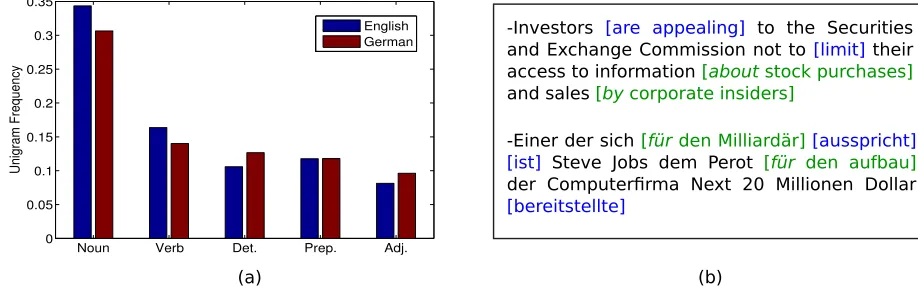
Our central hypothesis is that a valid mapping yields POS annotations with coherent linguistic properties which are consistent across languages. Since universal tags play the same linguistic role in source and target languages, we expect similar-ity in theirglobal distributional statistics. Figure 1a shows statistics for two close languages, English and German. We can see that their unigram frequencies on the five most common tags are very close. Other properties concernPOS tag per sentence statistics– e.g., every sentence has to have at least one verb. Fi-nally, the mappings can be further constrained by ty-pological propertiesof the target language that spec-ify likely tag sequences. This information is readily available even for resource poor language (Haspel-math et al., 2005). For instance, since English and German are prepositional languages, we expect to observe adposition-noun sequences but not the re-verse (see Figure 1b for sample sentences). We en-code these heterogeneous properties into an objec-tive function that guides the search for the optimal mapping.
Having defined a quality measure for mappings, our goal is to find the optimal mapping. However, such partition optimization problems2 are NP hard (Garey and Johnson, 1979). A naive approach to the problem is to greedily improve the map, but it turns out that this approach yields poor quality map-pings. We therefore develop a method for optimiz-ing over soft mappoptimiz-ings, and use entropy regulariza-tion to drive those towards hard mappings. We con-struct the objective in a way that facilitates simple monotonically improving updates corresponding to solving convex optimization problems.
We evaluate our mapping approach on 19 languages that include representatives of Indo-European, Semitic, Basque, Japonic and Turkic fam-ilies. We measure mapping quality based on the target language parsing accuracy. In addition to considering gold POS tags for the target language,
2Instances of related hard problems are 3-partition and subset-sum.
we also evaluate the mapping algorithm on auto-matically induced POS tags. In all evaluation sce-narios, our model consistently rivals the quality of manually induced mappings. We also demon-strate that the proposed inference procedure outper-forms greedy methods by a large margin, highlight-ing the importance of good optimization techniques. We further show that while all characteristics of the mapping contribute to the objective, our largest gain comes from distributional features that capture global statistics. Finally, we establish that the map-ping quality has a significant impact on the accuracy of syntactic transfer, which motivates further study of this topic.
2 Related Work
Multilingual Parsing Early approaches for multi-lingual parsing used parallel data to bridge the gap between languages when modeling syntactic trans-fer. In this setup, finding the mapping between var-ious POS annotation schemes was not essential; in-stead, the transfer algorithm could induce it directly from the parallel data (Hwa et al., 2005; Xi and Hwa, 2005; Burkett and Klein, 2008). However, more recent transfer approaches relinquish this data requirement, learning to transfer from non-parallel data (Zeman and Resnik, 2008; McDonald et al., 2011; Cohen et al., 2011; Naseem et al., 2010). These approaches assume access to a common input representation in the form of universal tags, which enables the model to connect patterns observed in the source language to their counterparts in the tar-get language.
Noun Verb Det. Prep. Adj. 0
0.05 0.1 0.15 0.2 0.25 0.3 0.35
U
nigram
Freque
ncy
English
German -Investors and Exchange Commission not to [are appealing] to the Securities [limit] their
access to information [about stock purchases]
and sales [by corporate insiders]
-Einer der sich [für den Milliardär] [ausspricht] [ist] Steve Jobs dem Perot [für den aufbau]
der Computerfirma Next 20 Millionen Dollar
[bereitstellte]
[image:3.612.76.535.68.212.2](a) (b)
Figure 1: Illustration of similarities in POS tag statistics across languages. (a) The unigram frequency statistics on five tags for two close languages, English and German. (b) Sample sentences in English and German. Verbs are shown in blue, prepositions in red and noun phrases in green. It can be seen that noun phrases follow prepositions.
on a broad range of languages and evaluation sce-narios.
Syntactic Category Refinement Our work also relates to work in syntactic category refinement in which POS categories and parse tree non-terminals are refined in order to improve parsing perfor-mance (Finkel et al., 2007; Klein and Manning, 2003; Matsuzaki et al., 2005; Petrov et al., 2006; Petrov and Klein, 2007; Liang et al., 2007). Our work differs from these approaches in two ways. First, these methods have been developed in the monolingual setting, while our mapping algorithm is designed for multilingual parsing. Second, these ap-proaches are trained on the syntactic trees of the tar-get language, which enables them to directly link the quality of newly induced categories with the quality of syntactic parsing. In contrast, we are not given trees in the target language. Instead, our model is informed by mappings derived for other languages.
3 Task Formulation
The input to our task consists of atargetcorpus writ-ten in a languageT, and a set of non-parallelsource corpora written in languages {S1, . . . , Sn}. In the
source corpora, each word is annotated with both a language-specific POS tag and a universal POS tag (Petrov et al., 2011). In the target corpus each word is annotated only with a language-specific POS tag, either gold or automatically induced.
Our goal is to find a map from the set ofLT target
language tags to the set ofKuniversal tags. We
as-sume that each language-specific tag is only mapped to one universal tag, which means we never split a language-specific tag andLT ≥ K holds for every
language. We represent the map by a matrixAof size K ×LT whereA(c|f) = 1 if the target
lan-guage tag f is mapped to the universal tag c, and A(c|f) = 0otherwise.3 Note that each column of Ashould contain a single value of1. We will later relax the requirement thatA(c|f)∈ {0,1}. A candi-date mappingAcan be applied to the target language to produce sentences labeled with universal tags.
4 Model
In this section we describe an objective that reflects the quality of an automatic mapping.
Our key insight is that for a good mapping, the statistics over the universal tags should be similar for source and target languages because these tags play the same role cross-linguistically. For example, we should expect the frequency of a particular universal tag to be similar in the source and target languages.
One choice to make when constructing an objec-tive is the source languages to which we want to be similar. It is clear that choosing all languages is not a good idea, since they are not all expected to have dis-tributional properties similar to the target language. There is strong evidence that projecting from sin-gle languages can lead to good parsing performance
3
(McDonald et al., 2011). Therefore, our strategy is to choose a single source language for comparison. The choice of the source language is based on sim-ilarity between typological properties; we describe this in detail in Section 5.
We must also determine which statistical proper-ties we expect to be preserved across languages. Our model utilizes three linguistic phenomena which are consistent across languages: POS tag global distri-butional statistics, POS tag per sentence statistics, and typology-based ordering statistics. We define each of these below.
4.1 Mapping Characterization
We focus on three categories of mapping properties. For each of the relevant statistics we define a func-tionFi(A)that has low values if the source and
tar-get statistics are similar.
Global distributional statistics: The unigram and bigram statistics of the universal tags are expected to be similar across languages with close typological profiles. We usepS(c1, c2)to denote the bigram dis-tribution over universal tags in the source language, andpT(f1, f2)to denote the bigram distribution over language specific tags in the target language. The bigram distribution over universal tags in the target language depends onAandpT(f1, f2)and is given
by:
pT(c1, c2;A) =
X
f1,f2
A(c1|f1)A(c2|f2)pT(f1, f2)
(1) To enforce similarity between source and target dis-tributions, we wish to minimize the KL divergence between the two:4
Fbi(A) =DKL[pS(c1, c2)|pT(c1, c2;A)] (2)
We similarly define Funi(A) as the distance
be-tween unigram distributions.
Per sentence statistics: Another defining property of POS tags is their average count per sentence. Specifically, we focus on the verb count per sen-tence, which we expect be similar across languages.
4We use the KL divergence because it assigns low weights to infrequent universal tags. Furthermore, this choice results in a simple, EM-like parameter estimation algorithm as discussed in Section 5.
To express this constraint, we use nv(s, A) to
denote the number of verbs (i.e., the universal tags corresponding to verbs according to A) in sentences. This is a linear function ofA. We also use E[nv(s, A)] to denote the average number of
verbs per sentence, and V[nv(s, A)] to denote the
variance. We estimate these two statistics from the source language and denote them by ESv, VSv.
Good mappings are expected to follow these patterns by having a variance upper bounded by VSv and an average lower bounded byESv.5 This
corresponds to minimizing the following objectives:
FEv(A) = max [0, ESv−E[nv(s, A)]]
FV v(A) = max [0, V[nv(s, A)]−VSv]
Note that the above objectives are convex in A, which will make optimization simpler. We refer to the two terms jointly asFverb(A).
Typology-based ordering statistics: Typolog-ical features can be useful for determining the relative order of different tags. If we know that the target language has a particular typological feature, we expect its universal tags to obey the given relative ordering. Specifically, we expect it to agree with ordering statistics for source languages with a similar typology. We consider two such features here. First, in pre-position languages the preposition is followed by the noun phrase. Thus, if T is such a language, we expect the probability of a noun phrase following the adposition to be high, i.e., cross some threshold. Formally, we defineC1=
{noun, adj, num, pron, det}and consider the set of bigram distributionsSpre that satisfy the following
constraint:
X
c∈C1
pT(adp,c)≥apre (3)
whereapre = P
c∈C1pS(adp,c) is calculated from
the source language. This constraint set is non-convex in A due to the bilinearity of the bi-gram term. To simplify optimization6 we take an
5
The rationale is that we want to put a lower bound on the number of verbs per sentence, and induce it from the source language. Furthermore, we expect the number of verbs to be well concentrated, and we induce its maximal variance from the source language.
approach inspired by the posterior regularization method (Ganchev et al., 2010) and use the objective:
Fc(A) = min
r(c1,c2)∈Spre
DKL[r(c1, c2)|pT(c1, c2;A)]
(4) The above objective will attain lower values for A such thatpT(c1, c2;A)is close to the constraint set. Specifically, it will have a value of zero when the bigram distribution induced by A has the property specified inSpre. We similarly define a set Spost
for post-positional languages.
As a second typological feature, we consider the Demonstrative-Noun ordering. In DN languages we want the probability of a determiner to come be-foreC2={noun, adj, num}, (i.e., frequent universal noun-phrase tags), to cross a threshold. This con-straint translates to:
X
c∈C2
pT(det, c)≥adet (5)
where adet = P
c∈C2pS(det, c) is a threshold
de-termined from the source language. We denote the set of distributions that have this property bySDN,
and add them to the constraint in (4). The overall constraint set is denoted byS.
4.2 The Overall Objective
We have defined a set of functions Fi(A) that are
expected to have low values for good mappings. To combine those, we use a weighted sum: Fα(A) =
P
iαi ·Fi(A). (The weights in this equation are
learned; we discussed the procedure in Section 5) Optimizing over the set of mappings is difficult since each mapping is a discrete set whose size is exponential size in LT. Technically, the difficulty
comes from the requirement that elements ofAare integral and its columns sum to one. To relax this restriction, we will allow A(c|f) ∈ [0,1]and en-courageAto correspond to a mapping by adding an entropy regularization term:
H[A] =−X
f
X
c
A(c|f) logA(c|f) (6)
This term receives its minimal value when the con-ditional probability of the universal tags given a language-specific tag is1for one universal tag and zero for the others.
The overall objective is then: F(A) = Fα(A) +
λ·H[A], whereλis the weight of the entropy term.7 The resulting optimization problem is:
min
A∈∆F(A) (7)
where∆is the set of non-negative matrices whose columns sum to one:
∆ =
A: AP(Kc|f)≥0 ∀c, f
c=1A(c|f) = 1 ∀f
(8)
5 Parameter Estimation
In this section we describe the parameter estimation process for our model. We start by describing how to optimizeA. Next, we discuss the weight selec-tion algorithm, and finally the method for choosing source languages.
5.1 Optimizing the MappingA
Recall that our goal is to solve the optimization problem in Eq. (7). This objective is non convex since the functionH[A]is concave, and the objec-tive F(A) involves bilinear terms in A and loga-rithms of their sums (see Equations (1) and (2)).
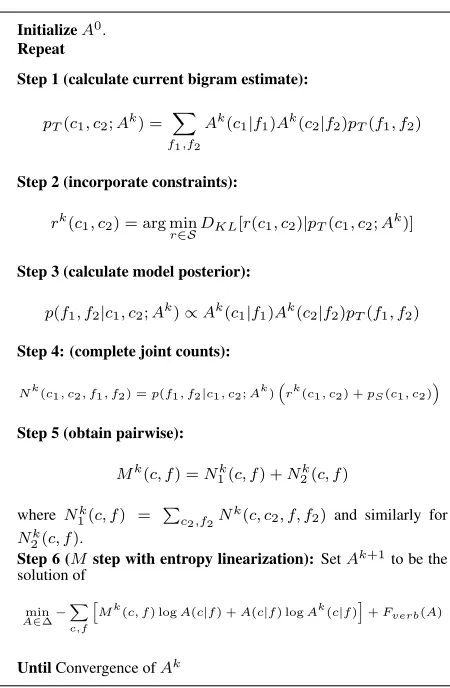
While we do not attempt to solve the problem globally, we do have a simple update scheme that monotonically decreases the objective. The update can be derived in a similar manner to expectation maximization (EM) (Neal and Hinton, 1999) and convex concave procedures (Yuille and Rangarajan, 2003). Figure 2 describes our optimization algo-rithm. The key ideas in deriving it are using pos-terior distributions as in EM, and using a variational formulation of entropy. The termFc(A)is handled
in a similar way to the posterior regularization algo-rithm derivation. A detailed derivation is provided in the supplementary file.8
Thekthiteration of the algorithm involves several
steps:
• In step 1, we calculate the current esti-mate of the bigram distribution over tags, pT(c1, c2;Ak).
7
Note that asλ→ ∞, only valid maps will be selected by the objective.
• In step 2, we find the bigram distribution in the constraint set S that is closest in KL di-vergence to pT(c1, c2;Ak), and denote it by rk(c1, c2). This optimization problem is con-vex inr(c1, c2).
• In step 3, we calculate the bigram posterior over language specific tags given a pair of uni-versal tags. This is analogous to the standard E-step in EM.
• In step 4, we use the posterior in step 3 and the bigram distributions pS(c1, c2) and rk(c1, c2)
to obtain joint counts over language specific and universal bigrams.
• In step 5, we use the joint counts from step 4 to obtain counts over pairs of language specific and universal tags.
• In step 6, analogous to the M-step in EM, we optimize over the mapping matrixA. The ob-jective is similar to the Q function in EM, and also includes the Fverb(A) term, and a linear
upper bound on the entropy term. The objec-tive can be seen to be convex inA.
As mentioned above, each of the optimization prob-lems in steps 2 and 6 is convex, and can therefore be solved using standard convex optimization solvers. Here, we use the CVX package (Grant and Boyd, 2008; Grant and Boyd, 2011). It can be shown that the algorithm improvesF(A) at every iteration and converges to a local optimum.
The above algorithm generates a mappingAthat may contain fractional entries. To turn it into ahard mapping we round A by mapping each f to the c that maximizesA(c|f)and then perform greedy im-provement steps (onefat a time) to further improve the objective. The regularization constantλis tuned to minimize theFα(A)value of the roundedA.
5.2 Learning the Objective Weights
Our Fα(A) objective is a weighted sum of the
in-dividualFi(A)functions. In the following, we
de-scribe how to learn the αi weights for every target
language. We would likeFα(A)to have low values
whenAis agoodmap. Since our performance goal is parsing accuracy, we consider a map to be good
InitializeA0.
Repeat
Step 1 (calculate current bigram estimate):
pT(c1, c2;Ak) = X
f1,f2
Ak(c1|f1)Ak(c2|f2)pT(f1, f2)
Step 2 (incorporate constraints):
rk(c1, c2) = arg min
r∈SDKL[r(c1, c2)|pT(c1, c2;A k)]
Step 3 (calculate model posterior):
p(f1, f2|c1, c2;Ak)∝Ak(c1|f1)Ak(c2|f2)pT(f1, f2)
Step 4: (complete joint counts):
Nk(c1, c2, f1, f2) =p(f1, f2|c1, c2;Ak)rk(c1, c2) +pS(c1, c2)
Step 5 (obtain pairwise):
Mk(c, f) =N1k(c, f) +N2k(c, f)
where N1k(c, f) = P
c2,f2N
k(c, c
2, f, f2) and similarly for
Nk
2(c, f).
Step 6 (Mstep with entropy linearization):SetAk+1to be the solution of
min
A∈∆− X c,f h
Mk(c, f) logA(c|f) +A(c|f) logAk(c|f)i+Fverb(A)
[image:6.612.316.541.52.396.2]UntilConvergence ofAk
Figure 2: An iterative algorithm for minimizing our ob-jective in Eq. (7). For simplicity we assume that all the weightsαi andλare equal to one. It can be shown that
the objective monotonically decreases in every iteration.
if it results in high parsing accuracy, as measured when projecting a parser from toStoT.
Since we do not have annotated parses inT, we use the other source languagesS = {S1, . . . , Sn}
to learn the weight. For each Si as the target, we
first train a parser for each language inS \ {Si}as
if it was the source, using the map of Petrov et al. (2011), and chooseSi∗ ∈S \ {Si}which gives the
highest parsing accuracy on Si. Next we generate
7000 candidate mappings for Si by randomly
per-turbing the map of (Petrov et al., 2011). We evalu-ate the quality of each candidevalu-ateAby projecting the parser ofSi∗ toSi, and recording the parsing
accu-racy. Among all the candidates we choose the high-est accuracy one and denote it byA∗(Si). We now
want the scoreF(A∗(Si))to be lower than that of all
an-otherworseA(Si). These map pairs are taken from
many different traget languages, i.e. many different Si. The features given to the SVM are the terms of
the scoreFi(A). The goal of the SVM is to weight
these terms such that the better map A∗(Si) has a
lower score. The weights assigned by the SVM are taken asαi.
5.3 Source Language Selection
As noted in Section 4 we constructF(A)by choos-ing a schoos-ingle source languageS. Here we describe the method for choosingS. Our goal is to chooseSthat is closest to T in terms of typology. Assume that languages are described by binary typological vec-torsvL. We would like to learn a diagonal matrix
Dsuch thatd(S, T;D) = (vS−vT)TD(vS−vT)
reflects the similarity between the languages. In our context, a good measure of similarity is the perfor-mance of a parser trained onS and projected onT (using the optimal mapA). We thus seek a matrix D such that d(S, T;D) is ranked according to the parsing accuracy. The matrixDis trained using an SVM ranking algorithm that tries to follow the rank-ing of parsrank-ing accuracy. Similar to the technique for learning the objective weights, we train across many pairs of source languages.9
The typological features we use are a subset of the features described in “The World Atlas of Languages Structure” (WALS, (Haspelmath et al., 2005)), and are shown in Table 1.
6 Evaluation Set-Up
Datasets We test our model on 19 languages: Ara-bic, Basque, Bulgarian, Catalan, Chinese, Czech, Danish, Dutch, English, German, Greek, Hungar-ian, ItalHungar-ian, Japanese, Portuguese, Slovene, Span-ish, SwedSpan-ish, and Turkish. Our data is taken from the CoNLL 2006 and 2007 shared tasks (Buch-holz and Marsi, 2006; Nivre et al., 2007). The CoNLL datasets consist of manually created depen-dency trees and language-specific POS tags. Fol-lowing Petrov et al. (2011), our model maps these language-specific tags to a set of 12 universal tags: noun, verb, adjective, adverb, pronoun, determiner, adposition, numeral, conjunction, particle, punctua-tion mark and X (a general tag).
9
Ties are broken using theF(A)objective.
Evaluation Procedure We perform a separate ex-periment for each of the 19 languages as the tar-get and a source language chosen from the rest (us-ing the method from Section 5.3). For the selected source language, we assume access to the mapping of Petrov et al. (2011).
Evaluation Measures We evaluate the quality of the derived mapping in the context of the target lan-guage parsing accuracy. In both the training and test data, the language-specific tags are replaced with universal tags: Petrov’s tags for the source lan-guages and learned tags for the target language. We train two non-lexicalized parsers using source anno-tations and apply them to the target language. The first parser is a non-lexicalized version of the MST parser (McDonald et al., 2005) successfully used in the multilingual context (McDonald et al., 2011). In the second parser, parameters of the target language are estimated as a weighted mixture of parameters learned from supervised source languages (Cohen et al., 2011). For the parser of Cohen et al. (2011), we trained the model on the four languages used in the original paper — English, German, Czech and Ital-ian. When measuring the performance on each of these four languages, we selected another set of four languages with a similar level of diversity.10
Following the standard evaluation practice in parsing, we use directed dependency accuracy as our measure of performance.
Baselines We compare mappings induced by our model against three baselines: the manually con-structed mapping of Petrov et al. (2011), a randomly constructed mapping and a greedy mapping. The greedy mapping uses the same objective as our full model, but optimizes it using a greedy method. In each iteration, this method makes|LT|passes over
the language-specific tags, selecting a substitution that contributes the most to the objective.
Initialization To reduce the dimension of our al-gorithm’s search space and speed up our method, we start by clustering the language-specific POS tags of the target into|K|= 12clusters using an
ID Feature Description Values
81A Order of Subject, Object and Verb SVO, SOV, VSO, VOS, OVS, OSV 85A Order of Adposition and Noun Postpositions, Prepositions, Inpositions 86A Order of Genitive and Noun Genitive-Noun, Noun-Genitive 87A Order of Adjective and Noun Adjective-Noun, Noun-Adjective
[image:8.612.131.485.56.115.2]88A Order of Demonstrative and Noun Demonstrative-Noun, Noun-Demonstrative, before and after
Table 1: The set of typological features that we use for source language selection. The first column gives the ID of the feature as listed in WALS. The second column describes the feature and the last column enumerates the allowable values for each feature; besides these values each feature can also have a value of ‘No dominant order’.
vised POS induction algorithm (Lee et al., 2010).11 Our mapping algorithm then learns the connection between these clusters and universal tags.
For initialization, we perform multiple random restarts and select the one with the lowest final ob-jective score.
7 Results
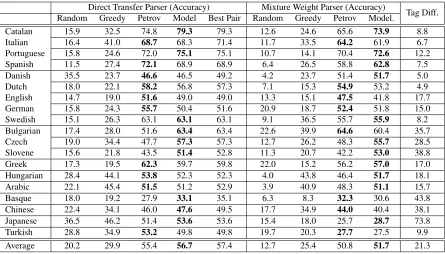
We first present the results of our model using the gold POS tags for the target language. Table 2 sum-marizes the performance of our model and the base-lines.
Comparison against Baselines On average, the mapping produced by our model yields parsers with higher accuracy than all of the baselines. These re-sults are consistent for both parsers (McDonald et al., 2011; Cohen et al., 2011). As expected, random mappings yield abysmal results — 20.2% and 12.7% for the two parsers. The low accuracy of parsers that rely on theGreedymapping — 29.9% and 25.4% — show that a greedy approach is a poor strategy for mapping optimization.
Surprisingly, our model slightly outperforms the mapping of (Petrov et al., 2011), yielding an aver-age accuracy of 56.7% as compared to the 55.4% achieved by its manually constructed counterpart for the direct transfer method (McDonald et al., 2011). Similar results are observed for the mixture weights parser (Cohen et al., 2011). The main reason for these differences comes from mistakes introduced in the manual mapping. For example, in Czech tag “R” is labeled as “pronoun”, while actually it should be mapped to “adposition”. By correcting this mistake, we gain 5% in parsing accuracy for the direct trans-fer parser.
11
This clustering results in about 3% improvement, pre-sumably since it uses contextual information beyond what our algorithm does.
Overall, the manually constructed mapping and our model’s output disagree on 21% of the assign-ments (measured on the token level). However, the extent of disagreement is not necessarily predic-tive of the difference in parsing performance. For instance, the manual and automatic mappings for Catalan disagree on 8% of the tags and their pars-ing accuracy differs by 5%. For Greek on the other hand, the disagreement between mappings is much higher — 17%, yet the parsing accuracy is very close. This phenomenon shows that not all mistakes have equal weight. For instance, a confusion be-tween “pronoun” and “noun” is less severe in the parsing context than a confusion between “pronoun” and “adverb”.
Impact of Language Selection To assess the quality of our language selection method, we com-pare the model against an oracle that selects the best source for a given target language. As Table 2 shows our method is very close to the oracle performance, with only 0.7% gap between the two. In fact, for 10 languages our method correctly predicts the best pairing. This result is encouraging in other contexts as well. Specifically, McDonald et al. (2011) have demonstrated that projecting from a single oracle-chosen language can lead to good parsing perfor-mance, and our technique may allow such projection without an oracle.
Over-Direct Transfer Parser (Accuracy) Mixture Weight Parser (Accuracy)
Tag Diff. Random Greedy Petrov Model Best Pair Random Greedy Petrov Model.
Catalan 15.9 32.5 74.8 79.3 79.3 12.6 24.6 65.6 73.9 8.8
Italian 16.4 41.0 68.7 68.3 71.4 11.7 33.5 64.2 61.9 6.7
Portuguese 15.8 24.6 72.0 75.1 75.1 10.7 14.1 70.4 72.6 12.2
Spanish 11.5 27.4 72.1 68.9 68.9 6.4 26.5 58.8 62.8 7.5
Danish 35.5 23.7 46.6 46.5 49.2 4.2 23.7 51.4 51.7 5.0
Dutch 18.0 22.1 58.2 56.8 57.3 7.1 15.3 54.9 53.2 4.9
English 14.7 19.0 51.6 49.0 49.0 13.3 15.1 47.5 41.8 17.7
German 15.8 24.3 55.7 50.4 51.6 20.9 18.7 52.4 51.8 15.0
Swedish 15.1 26.3 63.1 63.1 63.1 9.1 36.5 55.7 55.9 8.2
Bulgarian 17.4 28.0 51.6 63.4 63.4 22.6 39.9 64.6 60.4 35.7
Czech 19.0 34.4 47.7 57.3 57.3 12.7 26.2 48.3 55.7 28.5
Slovene 15.6 21.8 43.5 51.4 52.8 11.3 20.7 42.2 53.0 38.8
Greek 17.3 19.5 62.3 59.7 59.8 22.0 15.2 56.2 57.0 17.0
Hungarian 28.4 44.1 53.8 52.3 52.3 4.0 43.8 46.4 51.7 18.1
Arabic 22.1 45.4 51.5 51.2 52.9 3.9 40.9 48.3 51.1 15.7
Basque 18.0 19.2 27.9 33.1 35.1 6.3 8.3 32.3 30.6 43.8
Chinese 22.4 34.1 46.0 47.6 49.5 17.7 34.9 44.0 40.4 38.1
Japanese 36.5 46.2 51.4 53.6 53.6 15.4 18.0 25.7 28.7 73.8
Turkish 28.8 34.9 53.2 49.8 49.8 19.7 20.3 27.7 27.5 9.9
[image:9.612.83.528.56.310.2]Average 20.2 29.9 55.4 56.7 57.4 12.7 25.4 50.8 51.7 21.3
Table 2: Directed dependency accuracy of our model and the baselines using gold POS tags for the target language. The first section of the table is for the direct transfer of the MST parser (McDonald et al., 2011). The second section is for the weighted mixture parsing model (Cohen et al., 2011). The first two columns (Random and Greedy) of each section present the parsing performance with a random or a greedy mapping. The third column (Petrov) shows the results when the mapping of Petrov et al. (2011) is used. The fourth column (Model) shows the results when our mapping is used and the fifth column in the first section (Best Pair) shows the performance of our model when the best source language is selected for every target language. The last column (Tag Diff.) presents the difference between our mapping and the mapping of Petrov et al. (2011) by showing the percentage of target language tokens for which the two mappings select a different universal tag.
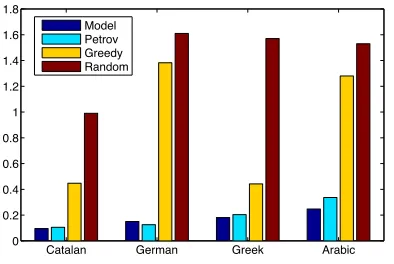
all, our method and the manual mappings reach sim-ilar values, both considerably better than other base-lines. While the parsing performance correlates with the objective, the correlation is not perfect. For in-stance, on Greek our mapping has a better objective value, but lower parsing performance.
Ablation Analysis We next analyze the contribu-tion of each component of our objective to the result-ing performance.12 The strongest factor in our
ob-jective is the distributional features capturing global statistics. Using these features alone achieves an average accuracy of 51.1%, only 5.6% less than the full model score. Adding just the verb-related constraints to the distributional similarity objectives improves the average model performance by 2.1%.
12
The results are consistent for both parsers, here we report the accuracy for the direct transfer method (McDonald et al., 2011).
Adding just the typological constraints yields a very modest performance gain of 0.5%. This is not sur-prising — the source language is selected to be typo-logically similar to the target language, and thus its distributional properties are consistent with typolog-ical features. However, adding both the verb-related constraints and the typological constraints results in a synergistic performance gain of 5.6% over the dis-tributional similarity objective, a gain which is much better than the sum of the two individual gains.
Application to Automatically Induced POS Tags
A potential benefit of the proposed method is to re-late automatically induced clusters in the target lan-guage to universal tags. In our experiments, we in-duce such clusters using Brown clustering,13 which
13
Catalan German Greek Arabic 0
0.2 0.4 0.6 0.8 1 1.2 1.4 1.6 1.8
[image:10.612.92.289.64.196.2]Model Petrov Greedy Random
Figure 3: Objective values for the different mappings used in our experiments for four languages. Note that the goal of the optimization procedure is to minimize the objective value.
has been successfully used for similar purposes in parsing research (Koo et al., 2008). We then map these clusters to the universal tags using our algo-rithm.
The average parsing accuracy on the 19 languages is 45.5%. Not surprisingly, automatically induced tags negatively impact parsing performance, yield-ing a decrease of 11% when compared to mappyield-ings obtained using manual POS annotations (see Ta-ble 2). To further investigate the impact of inaccu-rate tags on the mapping performance, we compare our model against the oracle mapping model that maps each cluster to the most common universal tag of its members. Parsing accuracy obtained using this method is 45.1%, closely matching the performance of our mapping algorithm.
An alternative approach to mapping words into universal tags is to directly partition words intoK clusters (without passing through language specific tags). In order for these clusters to be meaningful as universal tags, we can provide several prototypes for each cluster (e.g., “walk” is a verb etc.). To test this approach we used the prototype driven tagger of Haghighi and Klein (2006) with15 prototypes per universal tag.14 The resulting universal tags yield an average parsing accuracy of 40.5%. Our method (using Brown clustering as above) outperforms this
14Oracle prototypes were obtained by taking the 15 most frequent words for each universal tag. This yields almost the same total number of prototypes as those in the experiment of (Haghighi and Klein, 2006).
baseline by about 5%.
8 Conclusions
We present an automatic method for mapping language-specificpart-of-speech tags to a set of uni-versal tags. Our work capitalizes on manually de-signed conversion schemes to automatically create mappings for new languages. Our experimental re-sults demonstrate that automatically induced map-pings rival the quality of their hand-crafted coun-terparts. We also establish that the mapping quality has a significant impact on the accuracy of syntactic transfer, which motivates further study of this topic. Finally, our experiments show that the choice of mapping optimization scheme plays a crucial role in the quality of the derived mapping, highlighting the importance of optimization for the mapping task.
Acknowledgments
The authors acknowledge the support of the NSF (IIS-0835445), the MURI program (W911NF-10-1-0533) and the DARPA BOLT program. We thank Tommi Jaakkola, the members of the MIT NLP group and the ACL reviewers for their suggestions and comments. Any opinions, findings, conclu-sions, or recommendations expressed in this paper are those of the authors, and do not necessarily re-flect the views of the funding organizations.
References
Sabine Buchholz and Erwin Marsi. 2006. CoNLL-X shared task on multilingual dependency parsing. In Proceedings of CoNLL, pages 149–164.
David Burkett and Dan Klein. 2008. Two languages are better than one (for syntactic parsing). InProceedings of EMNLP, pages 877–886.
Shay B. Cohen, Dipanjan Das, and Noah A. Smith. 2011. Unsupervised structure prediction with non-parallel multilingual guidance. In Proceedings of EMNLP, pages 50–61.
Frank Van Eynde. 2004. Part of speech tagging en lem-matisering van het corpus gesproken nederlands. In Technical report.
Jenny Rose Finkel, Trond Grenager, and Christopher D. Manning. 2007. The infinite tree. InProceedings of ACL, pages 272–279.
Michael Garey and David S. Johnson. 1979. Comput-ers and Intractability: A Guide to the Theory of NP-Completeness. W. H. Freeman & Co.
Michael C. Grant and Stephen P. Boyd. 2008. Graph im-plementations for nonsmooth convex programs. In Re-cent Advances in Learning and Control, Lecture Notes in Control and Information Sciences, pages 95–110. Springer-Verlag Limited.
Michael C. Grant and Stephen P. Boyd. 2011. CVX: Matlab software for disciplined convex programming, version 1.21.
Aria Haghighi and Dan Klein. 2006. Prototype-driven learning for sequence models. In Proceedings of NAACL, pages 320–327.
Martin Haspelmath, Matthew S. Dryer, David Gil, and Bernard Comrie, editors. 2005. The World Atlas of Language Structures. Oxford University Press. Rebecca Hwa, Philip Resnik, Amy Weinberg, Clara
Cabezas, and Okan Kolak. 2005. Bootstrapping parsers via syntactic projection across parallel texts. Journal of Natural Language Engineering, 11:311– 325.
Dan Klein and Christopher Manning. 2003. Accurate unlexicalized parsing. InProceedings of ACL, pages 423–430.
Terry Koo, Xavier Carreras, and Michael Collins. 2008. Simple semi-supervised dependency parsing. In Pro-ceedings of ACL, pages 595–603.
Yoong Keok Lee, Aria Haghighi, and Regina Barzilay. 2010. Simple type-level unsupervised pos tagging. In Proceedings of EMNLP, pages 853–861.
Percy Liang, Slav Petrov, Michael I. Jordan, and Dan Klein. 2007. The infinite pcfg using hierarchi-cal dirichlet processes. In Proceedings of EMNLP-CoNLL, pages 688–697.
Takuya Matsuzaki, Yusuke Miyao, and Jun’ichi Tsujii. 2005. Probabilistic cfg with latent annotations. In Proceedings of ACL, pages 75–82.
Ryan McDonald, Fernando Pereira, Kiril Ribarov, and Jan Hajic. 2005. Non-projective dependency pars-ing uspars-ing spannpars-ing tree algorithms. In Proceedings of EMNLP, pages 523–530.
Ryan McDonald, Slav Petrov, and Keith Hall. 2011. Multi-source transfer of delexicalized dependency parsers. InProceedings of EMNLP, pages 62–72. Tahira Naseem, Harr Chen, Regina Barzilay, and Mark
Johnson. 2010. Using universal linguistic knowl-edge to guide grammar induction. In Proceedings of EMNLP, pages 1234–1244.
Radford M. Neal and Geoffrey E. Hinton. 1999. A view of the em algorithm that justifies incremental, sparse, and other variants. In Michael I. Jordan, editor, Learn-ing in Graphical Models, pages 355–368. MIT Press.
Joakim Nivre, Johan Hall, Sandra K¨ubler, Ryan McDon-ald, Jens Nilsson, Sebastian Riedel, and Deniz Yuret. 2007. The CoNLL 2007 shared task on dependency parsing. In Proceedings of the CoNLL Shared Task Session of EMNLP-CoNLL 2007, pages 915–932. Slav Petrov and Dan Klein. 2007. Improved inference
for unlexicalized parsing. InProceedings of NAACL, pages 404–411.
Slav Petrov, Leon Barrett, Romain Thibaux, and Dan Klein. 2006. Learning accurate, compact, and in-terpretable tree annotation. In Proceedings of ACL-COLING, pages 433–440.
Slav Petrov, Dipanjan Das, and Ryan McDonald. 2011. A universal part-of-speech tagset. InArXiv, April. Chenhai Xi and Rebecca Hwa. 2005. A backoff model
for bootstrapping resources for non-english languages. InProceedings of EMNLP, pages 851–858.
Alan Yuille and Anand Rangarajan. 2003. The concave-convex procedure (cccp). In Proceedings of Neural Computation, volume 15, pages 915–936.