Proceedings of the 2019 Conference on Empirical Methods in Natural Language Processing 2954
Nonsense!: Quality Control via Two-Step Reason Selection for Annotating
Local Acceptability and Related Attributes in News Editorials
Wonsuk Yang Seungwon Yoon Ada Carpenter Jong C. Park†
School of Computing
Korea Advanced Institute of Science and Technology
{derrick0511, swyoon, ada, park}@nlp.kaist.ac.kr
Abstract
Annotation quality control is a critical aspect for building reliable corpora through linguistic annotation. In this study, we present a sim-ple but powerful quality control method using two-step reason selection. We gathered sen-tential annotations of local acceptability and three related attributes through a crowdsourc-ing platform. For each attribute, the reason for the choice of the attribute value is selected in a two-step manner. The options given for rea-son selection were designed to facilitate the detection of a nonsensical reason selection. We assume that a reliable annotation may not contain a nonsensical reason selected for the choice of the attribute value, and an annota-tion that contains a nonsensical reason is less reliable than the one without such reason. Our method, based solely on this assumption, is found to retain the annotations with remark-able quality out of the entire annotations mixed with those of low quality.
1 Introduction
Crowdsourcing has recently enabled the collection of large amounts of data quickly. However, crowd-sourced annotations require more quality control than traditional in-house annotations. This is be-cause it is difficult to assure the expertise of the participating crowdsource workers in the linguis-tic annotation.
To ensure the quality of the annotations ob-tained through crowdsourcing, a frequently uti-lized approach is to request several workers an-notate the same data, aggregate the annotations, and infer the ground truth based on the assumption that the consensus of the workers would lead to the ground truth (Lease,2011). Various statistical methods have also been proposed to filter out the mistakes or (spamming) random responses of the
†Corresponding author
crowdsource workers (Liu et al.,2012;Hovy et al.,
2013; Nguyen et al., 2017). However, the way to filter out the mistakes or the random responses through statistical means is difficult to utilize for a fundamentally subjective annotation task. This is because statistical methods make it hard to dif-ferentiate the annotator’s mistakes from their sub-jective annotations, as the individual subjectivity of views on different topics can make the gathered data apparently random.
Local acceptability, which is for how much the given text is rationally worthy of being believed to be true (Wachsmuth et al., 2017; Yang et al.,
2019), is a fundamentally subjective measure. It is thus hard to utilize only statistical methods for the annotation quality control. Yet, local accept-ability is also understood as a strong factor influ-encing the argumentation quality in writing, which is of great importance for computer-assisted writ-ing. In this work, we present a simple but pow-erful method for annotation quality control of lo-cal acceptability using two-step reason selection, where the options given for reason selection were designed to facilitate the detection of a nonsensical reason selection. In order to show the effective-ness of the method, we performed the sentential annotation of local acceptability and three possi-bly related attributes through crowdsourcing.
cor-relation patterns whereas those non-filtered do not. The contributions of this paper are as follows. (1) We present a new method of using reason se-lection for the quality control of the annotation of local acceptability and three (possibly related) at-tributes. (2) We provide a statistical analysis of the annotation results and detailed statistics on the filtering and show that our method has a good po-tential for future research into annotation quality control. (3) We make all the related data and the code for filtering publicly available.
To the best of our knowledge, our method is the first in utilizing nonsensical reason selection for the quality control of the linguistic annotation.
2 Related Work
2.1 Argument mining and the annotation of the reasons
Hasan and Ng (2014) annotated the reasons for ideological debate posts and built the classifiers for such reasons. They set out four target do-mains, and categorized possible reasons into sev-eral groups for each of the two stances of sup-port and opposition. Habernal and Gurevych
(2016) annotated the convincingness of arguments through crowdsourcing, with a specified reason for the annotated convincingness. They presented a decision tree that restricts the scope of the possi-ble reasons and enapossi-bles a structured analysis of the reasons selected by workers. Ding et al. (2018) annotated the reasons for an event being affec-tive, based on seven categories of common human needs. They formalized a classification task for such seven categories by assigning a gold label on the reason for each event. They also showed that baseline classifiers could achieve moderate perfor-mance on the task. On the other hand, we focus on local acceptability of arguments with restricted options for reason selection. We choose the rea-sons not only for a deeper understanding of the reasons for local acceptability judgment itself, but also for an automated identification of the random responses by the workers.
2.2 Quality control of crowdsourced annotation
Raykar et al. (2010) proposed a nonlinear sta-tistical method to infer the actual, hidden label among the multiple and possibly noisy labels pro-vided by multiple annotators, and showed that their method is superior to that of majority
vot-Score Description
Local Acceptability
7
Istrongly acceptthe information given by the sentence to be true. I have sound and cogent arguments to justify my acceptance.
6 Isentence to be true. I have someacceptthe information given by the arguments to justify my acceptance.
5
Iweakly acceptthe information given by the sentence to be true. I do not have arguments justifying my acceptance. Still, I will accept it rather than reject it.
4 It isaccept or reject the information given byhard to judgewhether I should the sentence to be true.
3
Iweakly rejectthe information given by the sentence to be true. I do not have arguments for the rejection. Still, I will reject it rather than accept it.
2 Isentence to be true, and I have argumentsrejectthe information given by the for the rejection.
1
Istrongly rejectthe information given by the sentence to be true. I have sound and cogent arguments for the rejection.
Knowledge Awareness
3 Iread this document.already knewthe information before I
2
Idid not knowthe information before I read this document,but came to know it by reading the previous sentences in this document.
1 Idid not knowthe information.
Verifiability
5 I can verify itI do not need to google it to verify.using my knowledge. 4 I can verify it byshort-time googling.
3 I can verify it bycould verify it using deduction if I googlelong-time googling. I it for some time for deeper understanding. 2 I might find anbut it will be very hard.off-line wayto verify it, 1 There isno way to verifyit.
Disputability
4 Whether or not it is reasonable to acceptthe information given by the sentence as true, it ishighly disputable.
3 Whether ... true, it isdisputable. 2 Whether ... true, it isweakly disputable. 1 Whether true, it isnot disputable.
Table 1: Description of Local Acceptability and re-lated attributes.
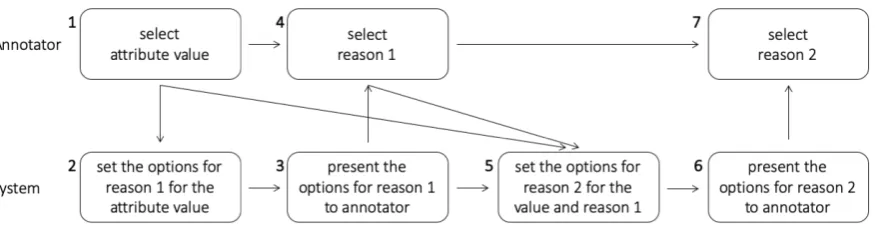
[image:2.595.307.526.58.519.2]Figure 1: The process of the annotation for an attribute value. For a sentence, the annotator iterates the process four times for the four attributes to annotate. The number at the upper left side of each box indicates the order of the process. The arrow indicates the passing of the information.
and showed that their method works satisfactorily on the sequential labeling tasks of Named Entity Recognition and Information Extraction.
Guillaume et al.(2016) presented ZombiLingo, which is a ‘Game with a Purpose’ (GWAP) for dependency syntax annotation. Even though the annotation of dependency syntax is expected to require moderate linguistic expertise, they gath-ered more than 100,000 annotations in 9 months for French dependency syntax with 0.93 precision by decomposing the task into sub-tasks and by including the annotator training as a part of the game. Abad et al. (2017) presented a method for crowdsourced annotation, in which an automatic classifier is used for self-training. For some data with which the classifier shows high confidence for the predicted label, their self-training system guides the annotators to the (highly likely) correct labels predicted by the classifier. For the task of assessing the quality of the machine translated re-sults, Mathur et al. (2018) estimated the reliabil-ity of the workers by presenting multiple transla-tions as an assignment. For the translatransla-tions in an assignment, some were already scored by human experts, and some were presented twice in the as-signment. They assessed the reliability of each annotator by seeing how close their annotations were to the expert-annotated results, and whether they annotated the same translations with the same score.
In this study, unlike the previous researches, we use the reason selection method for an auto-mated identification of the random responses by the workers. To the best of our knowledge, there has been no method utilizing reason selection for automated identification, even though incoherence between the selected reason and the attribute value
can be a strong indicator for random responses. Our experiment shows that the reason selection method is simple, but very powerful.
3 Data
We used the Webis-Editorials-16 corpus provided by Al-Khatib et al. (2016). For 300 news edito-rials, they annotated discourse units in each news editorial with the labels that are related to an argu-mentation strategy, such as (1)Common Ground, (2) Assumption, (3) Testimony, (4) Statistics, (5)
Anecdote, and (6) Other. We randomly selected 105 news editorials among the original 300 news editorials in the corpus and annotated local accept-ability and the related attributes for each sentence in the 105 news editorials. The news editorials are somewhat out-dated, but we have chosen to use the data with two reasons: (1) Their annotation of argumentation strategy has high and reliabile qual-ity. (2) Our previous sentential annotation of local acceptability (Yang et al., 2019) is based on the news editorial corpus.
4 Annotation 4.1 Definition
Local acceptability is defined, for the premises of an argument, as “rationally worthy of being be-lieved to be true” (Wachsmuth et al., 2017). A premise gives the reason for justifying (or refut-ing) a claim, where the claim is a possibly contro-versial statement and the central argument ponent. A claim and one or more premises com-pose an argument (Stab and Gurevych, 2017). Following the definition of local acceptability by
Attribute Value Reason 1 Reason 2
I did not know the information I am not familiar with the topic I am an expert on the subject I did not know the information before,
but came to know it by reading the previous sentences
It is not directly stated so far, but I can
infer it from the previous sentences The same information was stated inone of the previous sentences
I can verify it using my knowledge I can logically verify the information It is a transition sentence that ismeaningless
[image:4.595.71.526.61.156.2]strong accept It is not a factual information, but Iagree with the statement It is a fact
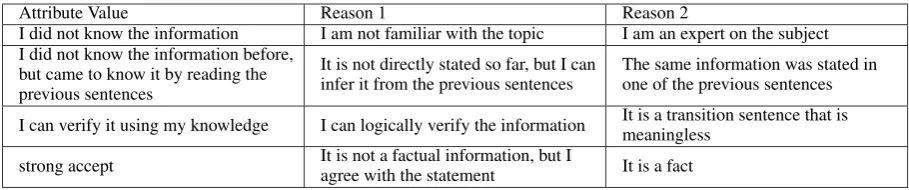
Table 2: Examples for nonsensical reason
Attribute Value Reason 1 Reason 2
weakly disputable Some may think different on somedetails It is a famous conflict I already knew the information
before I read this document I know it from my personal experience I am not familiar with the topic I can verify it by short-time googling I would find a direct reference toverify it I can interview the people related to it
[image:4.595.69.530.187.281.2]accept It is a subjective statement, but I agreewith the statement It can easily be verified
Table 3: Examples for unnatural reason
theory(Lewis,1970), as: A sentence is locally ac-ceptable if the truth-value of the sentence is ratio-nally worthy of being believed to be true (Yang et al.,2019).
4.2 Attributes
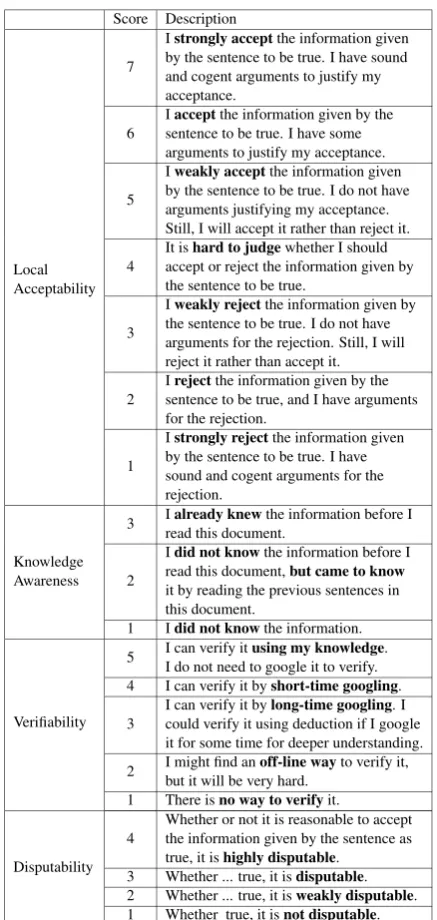
Table 1 shows the rubrics for local acceptability and the other three attributes that we annotated through crowdsourcing. We introduced the three attributes (and the rubrics) inYang et al.(2019) for a more in-depth understanding of local acceptabil-ity, focusing on the aspects of computational jour-nalism (Cheruiyot and Ferrer-Conill, 2018; Aha-roni and Tenenboim-Weinblatt,2019).
Local Acceptability (LA) is an indicator of whether the truth-value of the sentence is ratio-nally worthy of being believed to be true. We di-vide each of theacceptandrejectjudgments into three subcategories. Foraccept, we divided it into
strong accept, accept, and weak accept, and the same goes for reject. We did so as the judgment on the truth-value can be unclear (Hamblin,1970).
Knowledge Awareness (KA)is an indicator of whether or not an annotator already knew the in-formation given by the sentence before reading a document.
Verifiability (V) is an indicator of how easy it is to verify the information given by the sen-tence. We include this attribute because we an-ticipate that the information recognized as easily verifiable by a reader would be more likely to be accepted by the reader.
Disputability (D) is an indicator of how con-troversial the information given by the sentence is. We anticipate that the personal acceptance of information by a reader would be different from the reader’s expectation of the public acceptance of the information by others.
5 Method
5.1 Two-step reasons for each attribute
For each attribute of a sentence, after the annotator chose its value according to the rubrics, they were asked also to choose the reasons for the value, in a two-step manner. At the first step, the annotator was asked to select one of the possible options as a reason (reason 1). Then, they were asked to select another reason (reason 2), where the options for the second step were determined by the attribute value and the reason selected in the first step. Fig-ure1 illustrates the process of the attribute value and reason selection.
The options for a reason were designed manu-ally, based on our previous sentence-level in-house annotation result (Yang et al., 2019), mainly be-cause the automatic categorization of reasons is a fundamentally challenging problem (Skorupski,
Attribute Attribute Value Reason 1 Reason 2 label Local
Acceptability strong accept It is a subjective statement,but I agree with the statement It is a fact Nonsensical Knowledge
Awareness I did not know the information I am not familiar with the topic I am an expert on the subject Nonsensical Verifiability I might find an off-line way to verify it,but it will be very hard I could visit related placesto obtain the information I can interview the people related to it Natural
[image:5.595.72.527.62.140.2]Disputability weakly disputable Some may think differenton some details It is a famous conflict Unnatural
Table 4: An example for the two-step reason selection for a sentence
option. The in-house annotation gathered 4,623 sentential annotations for the 105 news editorials with specific reasons written without any given op-tion. One of the authors thoroughly read all of the 4,623 sentential annotations, and two other au-thors inspected part of the annotations. Based on the in-house annotation result, three of the authors discussed and designed the options so that they can cover all the responses on the in-house annotation result. Yet, anticipating that there may be a case where the options for the reasons were not enough for a sentence, we allowed the workers to choose
n/aat each of the three steps to select (1) attribute value, (2) reason 1, and (3) reason 2. When a worker chosen/afor an attribute value, we asked the annotator to select the reasons in a two-step manner, and if a worker chosen/afor either reason 1 or reason 2, we did not ask the worker for further details. We expect that the selections ofn/awould enable us to estimate the range of sentences that the option design may not cover.
5.2 Nonsensical/Unnatural Reason
For each attribute, we intentionally added nonsen-sical/unnatural options for a reason at the second step. Those were designed to identify the mis-takes or the (spamming) random responses by the workers. We deemed the selection of the nonsen-sical/unnatural reason as an indicator for the un-reliability of the annotation. The definition of the nonsensical/unnatural reason is as follows.
Nonsensical reason is the reason that a reli-able annotator would not select for the annotation and is the reason that works as an indicator for a (spamming) random response. For example, if the reason ‘I am not familiar with the topic’ for knowl-edge awareness is selected with the reason ‘I am an expert on the subject,’ we find that it does not make any sense. Table2shows examples for non-sensical reason.
Unnatural reason is the reason that a reliable annotator is less likely select than the other given options, but it is the reason behind which the
an-notator might have a sophisticated rationale. For example, if an attribute value ofweakly disputable
for disputability is selected with the reason of ‘It is a famous conflict,’ it makes some sense, but it is deemed as unnatural. This is because if a sentence is about a famous conflict, the attribute values of
disputable orhighly disputable would have been more suitable. Table3shows examples for unnat-ural reason.
For each of the triples of (attribute value, reason 1, reason 2) that can be selected by the worker, we assigned one of the following labels: (1) nat-ural, (2) unnatnat-ural, and (3) nonsensical. The as-signment was also conducted manually by three of the authors. The reader is referred to Appendix A for the entire set of options and the correspond-ing labels for the two-step reason selection. Ta-ble4 shows an example of the possible selection for a sentence. It should be noted that a senten-tial annotation can contain more than one nonsen-sical/unnatural reason. If an annotator chose the options in Table4for a sentence, the sentential an-notation contains two nonsensical reasons and an unnatural reason.
5.3 Unreliability Score
For sentential annotation, we compute the unrelia-bility score of the annotation as follows:
u(x) = 0.5×Nu(x) +Nn(x) (1)
wherexis a sentential annotation,u(x)is the
un-reliability score ofx,Nu(x)is the number of the unnatural reasons over the four attributes within
x, andNn(x)is the number of nonsensical reasons withinx. For example,u(x)is 2.5 for the selection
in Table4. Regarding the coefficient 0.5, another value can also be chosen in its place. The unrelia-bility score can be defined as a function that takes
For a worker, we compute his or her unreliabil-ity score as follows:
U(w) =Average(u(x)) (2)
forx inX(w) wherewis a worker, U(w)is the
unreliability score ofw,X(w)is the set of
annota-tions annotated byw(possibly over multiple news
editorials), andAverage(u(x))forxinX(w)
in-dicates the average of the unreliability scores of all the annotations conducted by the workerw.
6 Experiment 6.1 Setting
In this study, the annotators were asked to pro-ceed with the annotation in one direction. In other words, they were asked to read a sentence, to an-notate the sentence, then to read the next sentence, and so on. Therefore, before proceeding with the annotation, we built an annotation tool in order to provide an environment that helps unidirectional reading. The annotation tool shows only a single sentence at a time on the screen, and the annotator could proceed to the next sentence by a keystroke. We allowed the annotators to go back to the previ-ous sentence, and modify the previprevi-ous annotation. The tool also recorded the time of each keystroke. We conducted the annotation through the Ama-zon Mechanical Turk (AMT) crowdsourcing plat-form. In each assignment, the workers were pre-sented with the annotation guideline and URL for a news editorial. For each sentence, workers were asked to select an attribute value for each attribute and to select the reasons for the attribute value in a two-step manner. The workers were asked to proceed to the annotation using the annotation tool. Although we used the corpus of argument strategies as the basis for our annotation, we pro-vided the annotators only with plain sentences, without any extra information hinting at the argu-ment strategies. Moreover, we paid attention not to inform the workers of the fact that we could assess the annotation quality based on the non-sensical/unnatural reason selection during the en-tire communication with the workers. We also did not reject any worker for the nonsensical/unnatural reason selection.
We made an additional request for the anno-tations from annotators who completed them too quickly, for instance in less than 20 seconds for all the 12 values for a sentence. If the annotators did not agree to re-do the annotation for the second
time, we rejected the first annotation. We made this additional request on 29% of the initially quested assignments. Among these, 90% were annotated, and 10% were rejected. For the re-requested annotations, we dismissed the first an-notations and took only the re-annotated results for our experiment. As a result, counting only the ap-proved (and not rejected) annotations, 218 work-ers (with the lifetime approval rate>95%)
partic-ipated in our annotation, over about two weeks in-cluding the time for the re-request. One annotator was allowed to annotate multiple news editorials, but not the same news editorials multiple times.
Using our method, we ranked the workers based on his or her unreliability score, and divided the workers into three groups as follows: (1) the group of top 1/3 workers with the lowest unreliability score per worker, (2) the group of bottom 1/3 workers with the highest unreliability score per worker, and (3) the group of the other workers. Among the 218 workers who participated in our annotation, the size of each group was (1) 72, (2) 73, and (3) 73, respectively, as 218 is not a multi-ple of three.
Then, we grouped the annotations conducted by the annotators in each of the (1)-(3) groups and named the groups of annotations as (1)good, (2)
bad, and (3) moderate annotations, respectively. Among thegoodannotations, we filtered out some of the annotations again with the lowest unrelia-bility score per annotation so that the number of retaining annotations in the group would be 10% of the total annotations gathered from our exper-iment, and named the group asgood squared an-notations. In short, thegood,bad, and moderate
annotations were filtered based on the unreliabil-ity of the annotators, and thegood squared anno-tations were those filtered again from thegood an-notations based on the unreliability score of each annotation. It should be noted that the four groups are those of annotations, not those of workers.
6.2 Results 6.2.1 Statistics
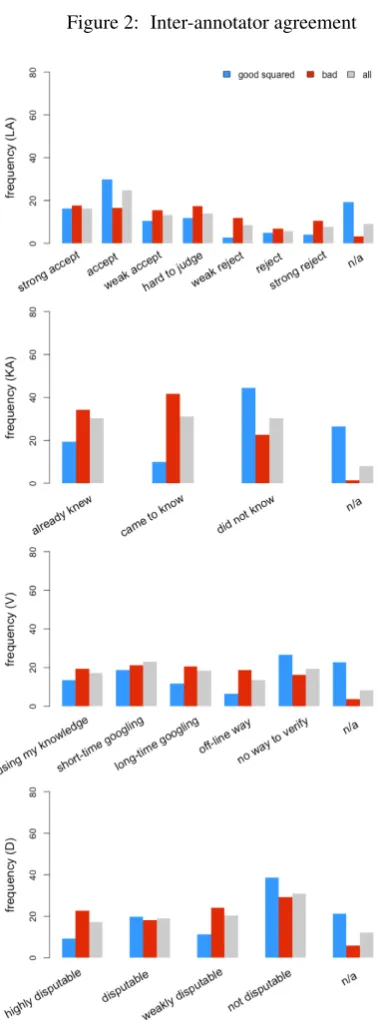
unrelia-Figure 2: Inter-annotator agreement
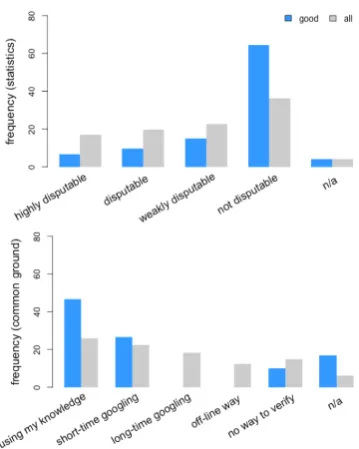
Figure 3: Relative occurrence frequency (unit: %)
bility score of annotation, the average of the un-reliability score, over the annotations in thegood squared,good,moderate,badannotations, is zero, 0.05, 0.48, and 0.84, respectively. The number of annotations within thegood squared, good, mod-erate, andbadgroup is 1,741 (10%), 3,024 (17%), 6,304 (36%), and 8,086 (46%), respectively.
We speculate that the imbalance on the number of annotations for each of thegood,moderate,bad
annotations might have been due to the difference in the time that took for the annotation per annota-tor. The average time that took for a news editorial
1 was 54 minutes per assignment (per document,
i.e., per news editorial) for overall annotators. For the good, moderate, and bad annotations, it was 122, 66, and 19 minutes, respectively. For the
good squaredannotations, it was the same as the
good annotations, as the filtering from the good
annotations to good squared annotations is con-ducted only on an annotation-level filtering within an assignment, not affecting the calculation. As the workers could be assigned to another news ed-itorial until the study ends, the workers who com-pleted an assignment faster could be given another assignment, hence the different number of annota-tions.
6.2.2 Inter-annotator Agreement
In order to check for the effectiveness of the qual-ity control method using the two-step reason selec-tion, for each of the four groups, we retained only the annotations by the annotators in the group and measured the inter-annotator agreement (IAA) of the annotations that were retained, dismissing all the other annotations in the other groups. For ex-ample, for the good squared annotations, we re-tained only the 1,741 good squared annotations among the 17,414 crowdsourced annotations, dis-missing all the other 15,673 (=17,414−1,741)
notations and measured the IAA for the 1,741 an-notations that were retained. The IAA forgood,
moderate, and badannotations was calculated in the same way. Figure 1 shows the inter-annotator agreement for each group. We measured the IAA based on the Krippendorffs alpha, as the attribute values are ordinal. For local acceptability, alpha was 0.33 for good squared annotations and 0.23 for good annotations. On the other hand, for all ofmoderate,bad, andallannotations, the IAA for each attribute was less than 0.03, which is very
1We dismissed 18 outliers taking time longer than 10
[image:7.595.75.268.197.711.2]Figure 4: Relative occurrence frequency (unit: %)
low. The alphas ofgood squaredannotations and
good annotations are comparable to those of in-house annotations by Yang et al. (2019), which is the basis for the design of the reason options (see Section 5.1), showed IAA of 0.24 alpha.
Wachsmuth et al.(2017) reported that the IAA of the document-level local acceptability annotations was measured between the most agreeing annota-tor pair among the three annotaannota-tors and that the result was 0.46. Besides, seven experts who par-ticipated in their pilot study are found to show the IAA lower than 0.22 on pilot data, which is com-parable to the alpha of ourgood squaredandgood
annotations.
We also note that the sample size (the num-ber of annotations) of each of the good squared,
good,moderate, andbadannotations is different. To make sure that the IAA of good squared and
good annotations is not the result of a different sample size, we randomly sampled 10%, 20%, ..., and 90% of all the annotations. In other words, we adopted random sampling as a baseline method to compare with our proposed method of the two-step reason selection, and checked the effect of the sample size on IAA. For each of the groups of ran-domly selected annotations with a different sam-ple size, the IAA was less than 0.03 alpha for all the attributes. This confirms that the IAA ofgood squaredandgoodannotations is not due to a dif-ferent sample size of the annotations.
[image:8.595.91.271.59.284.2]6.2.3 Occurrence Frequency
Figure 2 shows the occurrence frequency of the at-tribute values for each atat-tribute. It is notable that for local acceptability, the imbalance of the data was quite significant. The occurrence frequencies ofacceptandstrong acceptwere much higher than those of the other labels. Thebadannotations con-tain fewern/a’s thanallannotations, or the entire crowdsourced dataset. We find that the bad an-notations have a more balanced distribution of the attribute values selected for each attribute. We be-lieve that this is an indicator for more randomized selections in thebadannotations.
We also looked into the relative frequency of the attribute values for the sentences that contain a dis-course unit with a strategy label. We report two cases ofCommon GroundandStatisticsfor the at-tributes of verifiability and disputability, respec-tively. Figure 4 shows the relative frequency of the attribute values for the two strategy labels. For
Common Ground, the distribution of the attribute values for disputability ofgoodannotations shows a higher bias tonot disputablethan those ofall an-notations. ForStatistics, the distribution for veri-fiability forgoodannotations shows a higher bias tousing my knowledgethan those for all annota-tions. We believe that these biases match good lin-guistic intuition and that the higher biases ofgood
annotations thanallshow the effectiveness of our method.
6.2.4 Correlation Analysis
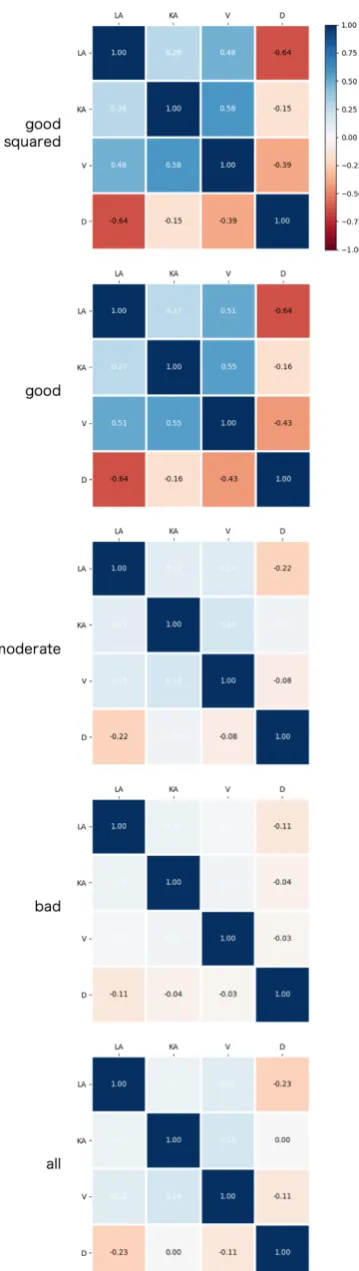
Figure 5: Pearson’s Correlation Coefficient between local acceptability and the related attributes.
match good linguistic intuition, and that those of the other annotation groups do not. We also be-lieve that the difference in the correlation pattern between the annotation groups shows the effec-tiveness of our quality control method using the two-step reason selection.
7 Conclusion and Future Work
In this study, we presented a simple but power-ful method of quality control for annotating local acceptability and the related attributes using two-step reason selection. We designed a system in which a nonsensical reason can be selected within a sentential annotation and regarded it as an indi-cator for the unreliability of the annotation. The analysis of inter-annotator agreement shows that the method is effective at retaining only the anno-tations with remarkable quality. We conducted our annotation through crowdsourcingwithoutthe as-surance of the expertise of the participating work-ers in the linguistic annotation, andwithouta sep-arate training phase. Yet, the good squared and
good annotations identified by our method show comparable quality to our previous in-house an-notation results which were performedwiththe re-quired expertise andwiththe training for linguis-tic annotation (Yang et al.,2019). Therefore, we believe that our results show a great potential for the crowdsourced annotation, especially when it is followed by a working quality control method.
One limitation of this study is that the annota-tors should not know about our use of the nonsen-sical reason selection as the indicator for unreli-ability during the annotation. As such, we paid attention not to inform the workers of this and did not reject workers for their selections of the non-sensical reasons. Therefore, we leave it as future work to develop a method that is effective even when workers are aware of quality control meth-ods that employ nonsensical reasons, possibly by making the nonsensical reasons change automati-cally between annotations.
Acknowledgements
[image:9.595.81.261.61.698.2]References
Azad Abad, Moin Nabi, and Alessandro Moschitti. 2017. Self-crowdsourcing training for relation ex-traction. InProceedings of the 55th Annual Meet-ing of the Association for Computational LMeet-inguis- Linguis-tics: Volume 2, Short Papers, pages 518–523. Tali Aharoni and Keren Tenenboim-Weinblatt. 2019.
Unpacking journalists’(dis) trust: Expressions of suspicion in the narratives of journalists covering the israeli-palestinian conflict. The International Jour-nal of Press/Politics.
Khalid Al-Khatib, Henning Wachsmuth, Johannes Kiesel, Matthias Hagen, and Benno Stein. 2016. A news editorial corpus for mining argumentation strategies. InProceedings of the 26th International Conference on Computational Linguistics: Techni-cal Papers, pages 3433–3443.
David Cheruiyot and Raul Ferrer-Conill. 2018. “fact-checking africa” epistemologies, data and the expan-sion of journalistic discourse. Digital Journalism, 6(8):964–975.
Haibo Ding, Tianyu Jiang, and Ellen Riloff. 2018. Why is an event affective? classifying affective events based on human needs. InWorkshops at the 32nd AAAI Conference on Artificial Intelligence. Bruno Guillaume, Kar¨en Fort, and Nicolas Lefebvre.
2016. Crowdsourcing complex language resources: Playing to annotate dependency syntax. In Pro-ceedings of the 26th International Conference on Computational Linguistics: Technical Papers, pages 3041–3052.
Ivan Habernal and Iryna Gurevych. 2016. What makes a convincing argument? empirical analysis and de-tecting attributes of convincingness in web argumen-tation. In Proceedings of the 2016 Conference on Empirical Methods in Natural Language Process-ing, pages 1214–1223.
Charles L. Hamblin. 1970. Fallacies. Londres, Methuen.
Kazi S. Hasan and Vincent Ng. 2014. Why are you taking this stance? identifying and classifying rea-sons in ideological debates. In Proceedings of the 2014 Conference on Empirical Methods in Natural Language Processing, pages 751–762.
Dirk Hovy, Taylor Berg-Kirkpatrick, Ashish Vaswani, and Eduard Hovy. 2013. Learning whom to trust with MACE. In Proceedings of the 2013 Confer-ence of the North American Chapter of the Associ-ation for ComputAssoci-ational Linguistics: Human Lan-guage Technologies, pages 1120–1130.
Matthew Lease. 2011. On quality control and machine learning in crowdsourcing. InWorkshops at the 35th AAAI Conference on Artificial Intelligence.
David Lewis. 1970. General semantics. Synthese, 22(1):18–67.
Qiang Liu, Jian Peng, and Alexander Ihler. 2012. Vari-ational inference for crowdsourcing. In Proceed-ings of the 25th International Conference on Neural Information Processing Systems: Volume 1, pages 692–700.
Nitika Mathur, Timothy Baldwin, and Trevor Cohn. 2018. Towards efficient machine translation eval-uation by modelling annotators. In Proceedings of the Australasian Language Technology Association Workshop 2018, pages 77–82.
An T. Nguyen, Byron C. Wallace, Junyi J. Li, Ani Nenkova, and Matthew Lease. 2017. Aggregating and predicting sequence labels from crowd annota-tions. InProceedings of the 55th Annual Meeting of the Association for Computational Linguistics: Vol-ume 1, Long Papers, pages 299–309.
Vikas C. Raykar, Shipeng Yu, Linda H. Zhao, Ger-ardo H. Valadez, Charles Florin, Luca Bogoni, and Linda Moy. 2010. Learning from crowds. Journal of Machine Learning Research, 11:1297–1322. John Skorupski. 2002. The ontology of reasons.Topoi,
21(1):113–124.
Christian Stab and Iryna Gurevych. 2017. Parsing ar-gumentation structures in persuasive essays. Com-putational Linguistics, 43(3):619–659.
Henning Wachsmuth, Nona Naderi, Yufang Hou, Yonatan Bilu, Vinodkumar Prabhakaran, Tim A. Thijm, Graeme Hirst, and Benno Stein. 2017. Com-putational argumentation quality assessment in nat-ural language. InProceedings of the 15th Confer-ence of the European Chapter of the Association for Computational Linguistics: Volume 1, Long Papers, pages 176–187.