Proceedings of the 2019 Conference on Empirical Methods in Natural Language Processing 2672
Collaborative Policy Learning for Open Knowledge Graph Reasoning
Cong Fu1∗, Tong Chen2∗, Meng Qu3, Woojeong Jin4, Xiang Ren4
1Zhejiang University,2Carnegie Mellon University,3University of Montreal
4University of Southern California
[email protected], [email protected], [email protected]
{woojeong.jin, xiangren}@usc.edu
Abstract
In recent years, there has been a surge of inter-ests in interpretable graph reasoning methods. However, these models often suffer from lim-ited performance when working on sparse and incomplete graphs, due to the lack of eviden-tial paths that can reach target entities. Here
we studyopen knowledge graph reasoning—a
task that aims to reason for missing facts over a graph augmented by a background text corpus. A key challenge of the task is to filter out “ ir-relevant” facts extracted from corpus, in order to maintain an effective search space during path inference. We propose a novel reinforce-ment learning framework to train two collab-orative agents jointly, i.e., amulti-hop graph reasonerand afact extractor. The fact extrac-tion agent generates fact triples from corpora to enrich the graph on the fly; while the reason-ing agent provides feedback to the fact extrac-tor and guides it towards promoting facts that are helpful for the interpretable reasoning. Ex-periments on two public datasets demonstrate the effectiveness of the proposed approach. Source code and datasets used in this paper
can be downloaded athttps://github.
com/shanzhenren/CPL.
1 Introduction
Knowledge graph completion or reasoning—i.e., the task of inferring the missing facts (entity re-lationships) for a given graph—is an important problem in natural language processing and has a
wide range of applications (Bordes et al., 2011;
Socher et al., 2013; Trouillon et al., 2016). Re-cent neural graph reasoning methods, such as
MINERVA (Das et al., 2017), DeepPath (Xiong
et al., 2017) and Multi-Hop (Lin et al., 2018), have achieved impressive results on the task,
of-fering both good prediction accuracy (compared
to embedding-based methods (Trouillon et al.,
∗
Work done while the authors interned at USC.
EU USA B.M.W.
USA China Stainless Steel trade_war_with is_main_producer_ of
trade_war_with raise_tariff_of
trade_war_with∧is_main_producer_ of→raise_tariff_of
reasoning summarize pattern
???
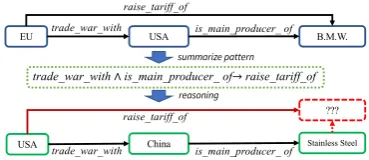
[image:1.595.322.507.219.299.2]is_main_producer_ of raise_tariff_of
Figure 1:Illustration of the Knowledge Graph
Rea-soning Task.Given an entity (e.g.,Miami) and a query relation (e.g., located in), we learn to infer reasoning paths over the existing graph structure to help predict the answer entity (i.e.,USA).
2016;Dettmers et al., 2018)) and interpretability
of the model predictions. These reasoning meth-ods frame the link inference task as a path finding
problem over the graph (see Fig.1for example).
However, current neural graph reasoning meth-ods encounter two main challenges as follows: (1) their performance are often sensitive to the sparsity and completeness of the graph—missing edges (i.e., potential false positives) make it harder to find evidential paths reaching target entities. (2) existing models assume the graph is static, and cannot adapt to dynamically enriched graphs where emerging new facts are constantly added.
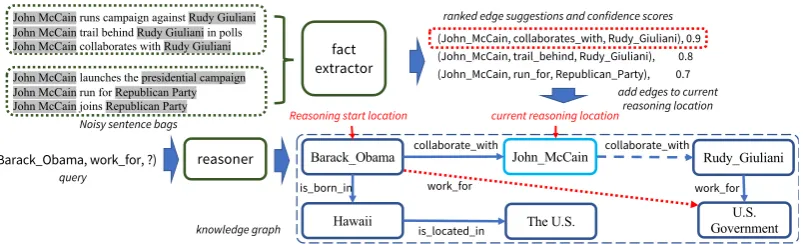
In this paper, we study the new task of Open Knowledge Graph Reasoning (OKGR), where the new facts extracted from the text corpora will be used to augment the graph dynamically while
per-forming reasoning (as illustrated in Figure2). All
the recent joint graph and text embedding methods focus on learning better knowledge graph
embed-dings for reasoning (Xu et al., 2014; Han et al.,
2018), but we consider adding more facts to the
(Barack_Obama, work_for, ?)
query
reasoner Barack_Obama collaborate_with John_McCain collaborate_with Rudy_Giuliani
U.S. Government
work_for
The U.S. Hawaii
is_born_in
is_located_in
knowledge graph
John McCain runs campaign against Rudy Giuliani John McCain trail behind Rudy Giuliani in polls John McCain collaborates with Rudy Giuliani
John McCain launches the presidential campaign John McCain run for Republican Party John McCain joins Republican Party
Noisy sentence bags
fact extractor
ranked edge suggestions and confidence scores
(John_McCain, collaborates_with, Rudy_Giuliani), 0.9 (John_McCain, trail_behind, Rudy_Giuliani), 0.8 (John_McCain, run_for, Republican_Party), 0.7
add edges to current reasoning location
current reasoning location Reasoning start location
[image:2.595.99.501.60.182.2]work_for
Figure 2: Overview of our CPL framework for the OKGR problem. To augment the reasoning with the
information from a background corpus, CPL extracts relevant facts (e.g., the triple linked by the blue dotted arrow) to augment the KG dynamically. CPL involves two agents: one learns fact extraction policy to suggest relevant facts; the other learns to reason on dynamically augmented graphs to make predictions (e.g., the red dotted arrow).
to the path inference process. Moreover, adding a large number of edges to the graph will create an ineffective search space and cause scalability is-sues to the path finding models. Therefore, it is desirable to design a method that can filter out ir-relevant facts for augmenting the reasoning model.
To address the above challenges for OKGR,
we propose a novel collaborative policy learning
(CPL) framework to jointly train two RL agents in a mutually enhancing manner. In CPL, besides
training areasoningagent for path finding, we
fur-ther introduce afact extractionagent, which learns
the policy to select relevant facts extracted from the corpus, based on the context of the
reason-ing process and the corpus (see Fig. 2). At
infer-ence time, the fact extraction agent dynamically augments the graph with only the most informa-tive edges, and thus enables the reasoning agent to identify positive paths effectively and efficiently.
Specifically, during policy learning, the reason-ing agent will be rewarded when reachreason-ing the targets, while this positive feedback will also be transferred back to the fact extracting agent if its edge suggestions are adopted by the reason-ing agent, i.e. makreason-ing up correct reasonreason-ing paths. This ensures that the fact extraction policy can be learned in a way that edges which are beneficial to path inference will be preferred. By doing so, the fact extraction agent can learn to augment knowl-edge graphs dynamically to facilitate the reason-ing agent, while the reasonreason-ing agent performs ef-fective path-inference and provides reward signals
to the fact extraction agent. Please refer to Sec. 3
and Fig.3for more implementation details.
The major contributions of our work are as fol-lows: (1) We study knowledge graph reasoning in an “open-world” setting, where new facts
ex-tracted from background corpora can be used to facilitate path finding; (2) We propose a novel col-laborative policy learning framework which mod-els the interactions between fact extraction and graph reasoning; (3) Extensive experiments and analysis are conducted to demonstrate the effec-tiveness and strengths of our proposed method.
2 Background and Problem
This section introduces basic concepts and nota-tions related to the knowledge graph reasoning task and provides a formal problem definition.
Aknowledge graph(KG) can be represented by a set of triples (facts) G = {(es, r, eo)|es, eo ∈
E, r ∈ R}, where E is the set of entities and R
is the set of relations.es,r, andeoare the subject entity, relation, and object entity respectively.
The task ofknowledge graph reasoning(KGR)
is defined as follows. Given the KG G, a query
triple (es, rq, eq) where eq is unknown, KGR is
to infereq through finding a path starting fromes
toeq on G, namely{(es, r1, e1), ...,(en, rn, eq)}. Usually, KGR methods produce multiple candi-date answers by ranking the found paths, while traditional KG completion methods rank all pos-sible answer triples by exhaustively enumerating.
A background corpus is a set of sentences
la-beled with respective entity pairs, namely C =
{(si : (ek, ej))|si ∈ S, ek, ej ∈ E}, where S is the set of sentences, and the corpus shares the
same entity set withG. In our problem setting, we
assume the entities have already been extracted; thus, extracting facts from the corpus is equiva-lent to the relation extraction task. We process the corpus by labeling the sentences with subject and object entity pairs through Distant
sen-tences labeled with the same entity pair.
Follow-ing the formulation of previous work (Lin et al.,
2016), we organize the sentences into sentence
bags, i.e., A sentence bag contains the sentences
which are labeled with the same entity pair.
Problem.Formally,Open Knowledge Graph
Rea-soning(OKGR) aims to perform KGR based on
both GandC, whereGis dynamically enriched
by the facts extracted fromC. This paper focuses
on OKGR, i.e., empowering KGR with the corpus information and enriching the graph with relevant facts dynamically. Thus, the evaluation of the re-lation extraction performance are out of the scope of this paper. We leave this as future work.
3 Proposed Framework
Overview. To resolve the challenges in OKGR,
we propose a novel collaborative policy learning
(CPL) framework (see Fig.2), which jointly train
two RL agents, i.e., a path reasoning agent and a
fact extraction agent. Given a query (es, rq, eq),
the reasoning agent tries to infereq via finding a
reasoning path on the (augmented) G, while the
fact extraction agent aims to select the most
in-formative facts fromC to enrich Gdynamically.
With such an extractor, the framework can effec-tively overcome the edge sparsity problem while remaining reasonably efficient (compared to the
naive solution that adds all possible facts to G).
We train the extraction agent by rewarding it ac-cording to the the reasoning agent’s performance. Hence the fact extractor can learn how to extract the most informative facts to benefit the reasoning.
3.1 Graph Reasoning Agent
The goal of the reasoner is learning to reason via
paths finding on KGs. Specifically, given es, rq,
the reasoner aims at inferring a path from es to
some entityeo regarding rq, and specifying how
likely the relationship rq holds between es and
eo. The inference path acts as the evidence of the
prediction, and thus offers interpretation (see Fig.
1). At each time step, the reasoner tries to select
an edge based on the observed information. The Markov Decision Process (MDP) of the reasoner is defined as follows:
State. In path-based reasoning, each succeeding
edge is closely related to the preceding edge on the path and the query in semantics. Similar to
MINERVA(Das et al., 2017), we want the state
to encode all observed information, i.e., we define
stR= (es, rq, ht)∈ SR, wherehtencodes the path history, and (es,rq) is the context shared among all states. Specifically, we use a LSTM module to en-code the history, ht =LSTM(ht−1,[rt, et]) (see
Fig.3).etis the current reasoning location andrt
is the previous relation connectinget.
Action.At timet, the reasoner will select an edge
amonget’s out-edges. The reasoner’s action space
is a union of the edges in the current KG and edges
extracted from the corpus. See Sec.3.3for details.
Transition. The transition function f : SR ×
AR → SR is defined as f(stR, atR) =
(es, rq, ht+1)naturally.
Reward. The reasoner is expected to learn
effec-tive reasoning path patterns. We let it explore for a fixed number of steps, which is a hyper-parameter. Only when it reaches the correct target entity, it receives a terminal reward 1, and 0 otherwise. All intermediate states always receive reward 0.
3.2 Fact Extraction Agent
The fact extractor learns to suggest the most rel-evant facts w.r.t. the current inference step of the reasoner. Suppose the reasoner arrives at entity
et on the graph at time t, the fact extractor will
extract facts in the form of(et, r0, e0) ∈/ G from the corpus and add them to the graph temporar-ily. Consequently, the reasoner is offered more choices to expand the reasoning path.
State.When the reasoner is atet, the fact extractor tries to extract information from the corpus (sen-tences) and suggests promising out-edges of entity
et. Letb
et denote the sentence bags labeled with
(et, e0), e0 ∈E. We define the state of the fact ex-tractor to encode the current observed information, i.e.,stE = (bet, et) ∈ SE, whereSE is the whole state space, containing all possible combinations of entities and corresponding sentence bags.
Action. The goal of the fact extractor is to select
a reasoning-relevant fact contained in the corpus
semantically. At step t, the reasoner will move
to a new entity fromet, and hence only the
out-edges ofet should be considered, e.g.,(et, r0, e0)
(see Fig. 3). Therefore, for each fact (et, r0, e0)
which can be extracted from the sentence bagbet,
we can derive an action atE = (r0, e0), and the
action space at step t can be denoted as AtE =
{(r0, e0)}(et,r0,e0)∈b
et ⊂ AE. AE is the whole
ac-tion space containing all facts in the corpus.
Transition. The transition function f : SE ×
Gates resign as CEO of
MS Word and position embeddings
PCNN-ATT
state embeddings
SoftMax
!"
#$
!$ ℎ$'( #%
RNN
ℎ$ SoftMax
suggested
edges original edges
!$ !$
!)$*(
!+$*(
!($*( !,$*(
!-$*(
!.$*(
!$ !
)$*(
#$*(
Extractor
Reasoner
stacked action embeddings
state
[image:4.595.109.488.62.204.2]embeddings stacked action embeddings
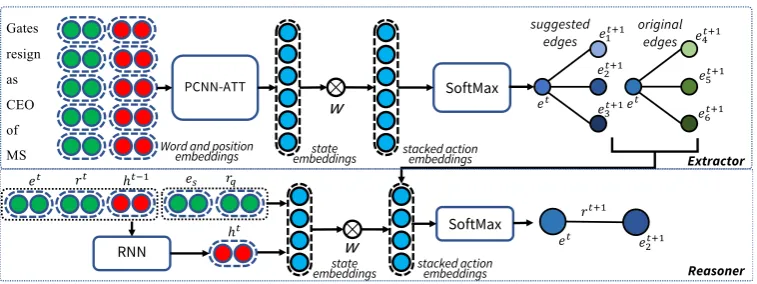
Figure 3:Detailed Model Design of Collaborative Policy Learning (CPL).Take PCNN-ATT as an example of
the sentence encoder. The figure shows how it works at a certain inference time stept, the reasoner is at entityet
and will select one edge from thejoint action space, which consists of new edges extracted by the extractor and
the edges in the original graph.
Reward. The fact extractor receives a step-wise
delayed reward from the reasoner according to how it improves the reasoners performance. The extractor will be positively rewarded when its sug-gestion benefits the reasoning process. Please see
Sec.3.3for details.
3.3 Collaborative Policy Learning
In this section, we will introduce the detailed train-ing process and the collaboration mechanism be-tween the two agents. At the high level, we adopt analternative training procedureto update the two agents jointly: training one of the agents for a few iterations while freezing the other; and vice versa. The policies of both agents are updated via
RE-INFORCE algorithm (Williams,1992) (details are
in later of this section). Specifically, we introduce the details on agent collaboration as follows.
Augmented Action Space for Reasoning. At
timet, the fact extractor helps the reasoner via
ex-panding its action space with new edges extracted
from the corpus (see Fig. 3). Due to the
spar-sity and incompleteness of the KG, there may be missing edges preventing the reasoner from
infer-ring the correct reasoning path (Fig. 2).
There-fore, we add high-confidence edges extracted by the extractor to the action space of the reasoner.
Formally, at timet, the reasoner is at locationet
(Fig. 3) and tries to select an edge out of all
out-edges of et. Let AtK denote the edge set in the
current KG, At
K = {(r, e)|(et, r, e) ∈ G}. Let
AtC denote the edge set suggested by the
extrac-tor, AtC = {(r0, e0)|(et, r0, e0) ∈ C}. The
ac-tion space at time tof the reasoner is defined as
AtR = AtK∪ACt ,AtR ⊂ AR, whereARdenotes
the whole action space of the reasoner, i.e., all
pos-sible edges in the KG and the corpus. The reasoner learns a policy to select the best edges out of the joint action space for reasoning.
Reasoning Feedback for Fact Extraction. The
reasoner helps the extractor to learn the extract-ing policy through providextract-ing feedbacks regardextract-ing how much the extractor contributes to the reason-ing. Therefore we define that the fact extractor re-ceives a step-wise delayed reward from the rea-soner. Specifically, when the reasoner finishes
ex-ploration (at timeT) and arrives at the correct
tar-get, we consider the path is effective and positive for reasoning. If the fact extractor contributes to this positive path, it can be rewarded positively, i.e., if an edge on the positive path is suggested
by the extractor at timet,0 ≤ t ≤T, the
extrac-tor will be rewarded 1 at timet, and 0 otherwise.
Extracted edges triggering positive rewards will be kept in the graph, while the others will be removed when both agents move to the next state.
Policy Update. The MDPs of both agents are
ex-plicitly defined above now, and we can use the
typ-ical REINFORCE algorithm (Williams, 1992) to
train the two agents. Specifically, their goals are maximizing the reward expectation, defined as
J(θ) =Eπθ(a|s)[R(s, a)], (1)
whereR(s, a)is the reward of selectingagivens,
andπθ(a|s)is the policy learned by the agents and
will be defined formally in Section.4.
Given a training sequence sampled from πθ:
{(s1, a1, r1), ...,(sT, aT, rT)}, rt = R(st, at), at
time stept, the parameters are updated according
θ←θ+α∇θlogπθ(at|st)Gt
Gt=
T
X
k=t
γk−tR(sk, ak), (2)
whereGtis the discounted accumulated reward.
According to Eq. (2), we can see that
REIN-FORCE will update the parameters only whenGt
is non-zero. In other words, the value of γ
de-termines how the parameters are updated and to what extent the the internal states will be
influ-enced by the future. Ifγ >0, for positive training
sequences, it is easy to verify that the Gt of all
states will be non-zero. Thus, the internal states will be positively rewarded, and the model param-eters will be updated by the gradients of the inter-nal states. For different task, we should carefully
select the value of γ. For the extractor, we set
γ = 0 for the extractor to avoid policy updating
on zero-rewarded state-action experiences. This is because zero-rewarded experiences are mostly negative examples. Specifically, if a state of the extractor is zero-rewarded, we can infer that either the suggested edge is not selected by the reasoner, or the selected edge does not contribute to reach-ing the target. We can not allow the model to be
updated on such experiences, so we setγ = 0 to
avoid the influence of future. In contrast, we set
γ = 1 for the reasoner because all the
interme-diate selected edges are meaningful as long as it leads to the target finally.
4 Model Implementation
In this section, we introduce the policy network
ar-chitectures (cf. Fig.3) of the two agents and
pro-vide details on model training and inference.
4.1 Policy Network Architectures
Reasoning Agent. We construct the state
em-bedding by concatenating all related
embed-dings, st
R = [es, rq, ht], where ht = LSTM
(ht−1,[rt, et]). We construct the action ding by concatenating the relation-entity embed-ding pair, i.e.,at
R= [r, e],(et, r, e)∈G∪C. We
stack all action embeddings in AtR. The policy
network is defined as:
πθ(atR|stR) =σ(AtRW2(Relu(W1[es, rq, ht]))),
σis softmax, andW1,W2are learnable weights.
Fact extraction Agent. We use a PCNN-ATT as
the sentence encoder in our experiments to con-struct the distributed representations for the
sen-tences. Letbetdenote all the sentence bags labeled
by(et, e0), e0 ∈E. At timet, we inputbet into the PCNN-ATT to obtain the sentence-bag-level
em-beddingsEbt, which is regarded as the latent state
embeddings. As mentioned in Sec. 2, the object
entity has been labeled beforehand. We need to select the best relation first, then select the best en-tity under this relation. Thus, we stack the relation embeddings inAtE asAtE ∈ R|AtE|×d, wheredis the dimension of relation embedding. The policy network is defined formally as:
πθ(atE|stE) =σ(AtEW Ebt),
whereW is a learnable weight.
The extractor will predict the scores for each sentence bag regarding the relation. We will se-lect the sentence bag with the highest score, more formally, the corresponding relation-entity pair in that sentence bag will be chosen as the next action.
We train the agents as introduced in Sec.3.3.
4.2 Model Training and Inference
Training.We usemodel pre-trainingandadaptive
samplingto increase training efficiency. In partic-ular, we first train the reasoner on the original KG to get a better initialization. Similarly, we train the extractor on the corpus labeled by distant super-vision. Next, we use adaptive sampling to adap-tively increase the selecting-priority of corpus-extracted-edges when generating training experi-ences for the two agents. Adaptive sampling is de-signed to encourage the reasoner to explore more on new edges and facilitate the collaboration
dur-ing the joint traindur-ing. Replay memories (Mnih
et al.,2013) are also used to increase training effi-ciency. We develop several model variants such as removing adaptive sampling or replay memory, or freezing the extractor all the time to conduct ab-lation studies. Please see Supplementary Material for more details.
Inference. At inference (reasoning) time, we use
Dataset #triples(C) #triple(G) #entities(C) #entities(G) #rel(C) #rel(G) S(train) S(test) CT/CE CR/KR FB60K-NYT10 172,448 268,280 63,696 69,514 57 1,327 570k 172k 2.71 0.04 UMLS-PubMed 910,320 2,030,841 6,575 59,226 271 443 4,73M 910k 138.45 0.61
Table 1: The dataset information. #triples(C) & #triples(G) denote the number of triples in the corpus and the
KG respectively, and so on. S(train) denotes the number of sentences in the training corpus, while S(test) denotes the number of sentences in the testing corpus. CT/CE denotes triple-entity ratio. Lower triple-entity ratio indicates less triples per entity in average can be extracted from the corpus. CR/KR denotes corpus-relation-quantity/KG-relation-quantity ratio. Lower CR/KR indicates less information overlap between the corpus and the KG.
5 Experiment
5.1 Datasets and Compared Methods
Dataset Relations
UP
’gene associated with disease’ ’disease has associated gene’ ’gene mapped to disease’ ’disease mapped to gene’
’may be treated by’ ’may treat’ ’may be prevented by’
’may prevent’
FN
’people/person/nationality’ ’location/location/contains’ ’people/person/place lived’ ’people/person/place of birth’ ’people/deceased person/place of death’
’people/person/ethnicity’ ’people/ethnicity/people’ ’business/person/company’
’people/person/religion’ ’location/neighborhood/neighborhood of ’
’business/company/founders’ ’people/person/children’ ’location/administrative division/country’ ’location/country/administrative divisions’
’business/company/place founded’ ’location/us county/county seat’
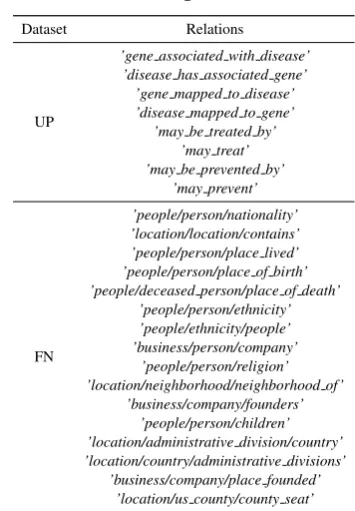
Table 2:The concerned relations in two datasets.UP
means the UMLS-PubMed dataset, while FB means the FB60K-NYT10 dataset.
Datasets. We construct two datasets for
eval-uation: FB60K-NYT101 and UMLS-PubMed2.
FB60K-NYT10 dataset includes the FB-60K KG and the NYT10 corpus; The UMLS dataset con-tains the UMLS KG and the PubMed corpus. Statistics of both datasets are summarized in
Ta-ble1. We study the datasets and find that the
rela-tion distriburela-tions of the two datasets are very im-balanced. There are not enough reasoning paths for some relation types. Moreover, some relations are meaningless and of no reasoning value. Thus, we select a few meaningful and valuable relations
(suggested by domain experts, in Table 2) with
enough reasoning paths and construct two sub-graphs accordingly. To show the impact of graph
1
https://github.com/thunlp/OpenNRE
2http://umlsks.nlm.nih.gov/
https://www.ncbi.nlm.nih.gov/pubmed/
size, we sample the KG into different sub-graph. Specifically, for the two datasets, we first partition the whole KG into three parts according to the proportion 8:1:1 (The training set, validation set, and testing set). Next we create sub-train-sets with different ratio via random sampling.
Analysis of corpus-KG alignment. We analyze
the information overlap (i.e., alignment) between
the corpus and the KG in Table1. The CT/CE (the
ratio of triple quantity against entity quantity) of PubMed is far higher than NYT10. Higher CT/CE indicates adding corpus-edges to the KG increases the average degree more significantly, leading to more reduction in sparsity. The low CR/KR ratio of FB60K-NYT10 indicates the overlap between FB60K and NYT10 is lower than that between UMLS and PubMed. We can conclude that the alignment level of FB60K-NYT10 is lower than UMLS-PubMed. Intuitively, FB60K-NYT10 is a more difficult dataset than UMLS-PubMed.
Compared Algorithms. We compare our
algo-rithm with (1) SOTA methods for KG embedding ; (2) methods for joint text and graph embedding; and (3) neural graph reasoning methods.
For triple-ranking-based KG embedding
meth-ods, we evaluate DistMult (Yang et al., 2014),
ComplEx (Trouillon et al., 2016), and ConvE
(Dettmers et al.,2018). For joint text and graph
embedding methods, we evaluate RC-Net (Xu
et al.,2014) andJoint-NRE(Han et al.,2018). We
also construct a baseline,TransE+LINE, by
con-structing a word-entity co-occurrence network as
RC-Net does. We use LINE (Tang et al.,2015) and
TransE (Bordes et al.,2011) to jointly learn the
en-tity and relation embeddings to preserve the struc-ture information within the co-occurrence network and the KG. For neural graph reasoning method,
we useMINERVA(Das et al.,2017), a
reinforce-ment learning based path reasoning method4.
4There are other SOTA path-based knowledge reasoning
suf-Model / Dataset 20% 40% 70% 100% Hits@5 Hits@10 Hits@5 Hits@10 Hits@5 Hits@10 Hits@5 Hits@10
[image:7.595.85.511.61.203.2]TransE (Bordes et al.,2011) 7.12 11.17 26.86 38.08 31.32 43.58 32.28 45.52 DisMult (Yang et al.,2014) 14.66 21.16 26.90 38.35 31.65 44.98 32.80 47.50 ComplEx (Trouillon et al.,2016) 18.58 18.18 23.77 34.15 30.04 43.60 31.84 46.57 ConvE (Dettmers et al.,2018) 20.51 30.11 28.01 42.04 31.01 45.81 30.35 45.35 RotatE (Sun et al.,2019) 4.03 6.50 8.65 13.21 14.90 21.67 20.75 27.82 RC-Net (Xu et al.,2014) 7.94 10.77 7.56 11.43 8.31 11.81 9.26 12.00 TransE+LINE 23.63 31.85 24.86 38.58 25.43 34.88 22.31 33.65 JointNRE (Han et al.,2018) 21.05 31.37 27.96 40.10 30.87 44.47 - -MINERVA (Das et al.,2017) 11.55 19.87 24.65 35.71 35.8 46.26 57.63 63.83 Two-Step 8.37 13.5 22.75 32.79 33.14 43.35 55.59 63.49 CPL (our method) 15.32 24.22 26.96 38.03 37.23 47.60 58.10 65.16
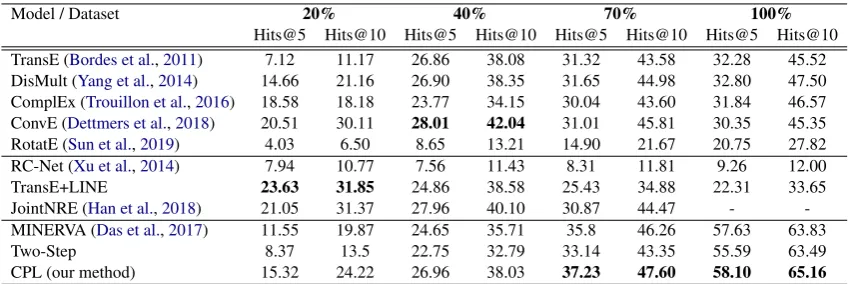
Table 3:Performance comparison on the KG reasoning on the UMLS-PubMed dataset.3 We test on different
graph sizes (i.e., 20-100% of the original graph) using Hits@K (in %). CPL is the best performing graph reasoning method, and gradually outperforms the others when the graphs are denser.
To validate the effectiveness of fact extraction policy in CPL, we design a two-step baseline (i.e.,
Two-Step). It first uses PCNN-ATT to extract
relational triples from the corpora, and augments KG with the triples whose prediction confidences
are greater than a threshold. PCNN-ATT (Lin
et al.,2016) is a fact extraction model, which com-pletes the fact extraction part. We tune the thresh-old on the dev-set. Then, a MINERVA model is trained on the augmented KG for reasoning.
CPLis our full-fledged model as introduced in
Sec.3. For all the methods, we upload the source
codes and list hyper-parameters we used in the supplemental materials.
5.2 Evaluation and Experimental Setup
Following previous work on KG completion (
Bor-des et al.,2011), we use Hits@K and mean recip-rocal rank (MRR) to evaluate the effectiveness of
the KGR and OKGR. Given a query(es, r,?)(for
each triple in the test set, we pretend not to know
the object entity), we rank the correct entity eq
among a list of candidates entities. Supposeranki
is the rank of the correct answer entity for theith
query. We define Hit@K = P
i1(ranki< K)/N
andM RR= N1 P
i 1 ranki.
In our experiments, we use a held-out valida-tion set for all compared methods to search for the best hyper-parameters and the best model for test-ing (via loggtest-ing checkpoints). For all methods, we train models using three fixed random seeds (55, 83, 5583), and report the metrics in average. More details on model training can be found in the Sup-plementary Material.
fers from out-of-memory problems on large-scale datasets.
5.3 Performance Comparison
Performances of the KG reasoning of all the
algo-rithms are given in Table3, 4and Figure 6. We
can draw conclusions as follows:
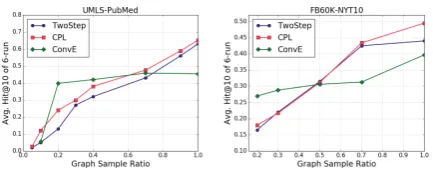
1. Triple ranking vs. path inference. CPL
and MINERVA perform worse than triple-ranking methods when the size of KGs is small, while outperforms them significantly when adding more
triples to the KGs (Figure 6). This is because
the general and evidential paths for reasoning on sparse KGs are not enough, and path-based mod-els cannot capture the underlying patterns.
2. CPL vs. joint embedding methods. CPL is
inferior to RC-net, TransE+Line, and JointNRE on small KG partitions because they are not path-based models and the connections on small KGs
are too sparse. CPL outperforms them
signifi-cantly on larger datasets. The reasons are two-fold : 1) the graphs are denser to provide enough rea-soning paths for training; 2) other algorithms do not filter noisy text information in joint-training.
3. CPL vs. other graph reasoning
meth-ods. CPL outperforms MINERVA significantly
because CPL makes use of relevant text informa-tion for predicinforma-tion. MINERVA is better than CPL on full FB60K-NYT10 because the alignment be-tween FB60K and NYT10 is very limited (Sec.
5.1). The graph is dense at 100%, and the
bene-fits from the corpus information are indiscernible.
5.4 Performance Analysis
1. Ablation Study on Model Components. In
CPL, we apply multiple learning techniques to im-prove the performance, including collaboration, replay memory, and adaptive sampling as
differ-Model / Dataset 20% 50% 100%
Hits@5 Hits@10 MRR Hits@5 Hits@10 MRR Hits@5 Hits@10 MRR
[image:8.595.80.515.61.204.2]TransE (Bordes et al.,2011) 15.12 18.83 12.57 19.38 23.2 13.36 38.53 43.38 29.90 DisMult (Yang et al.,2014) 1.42 2.55 1.05 15.23 19.05 12.36 32.11 35.88 24.95 ComplEx (Trouillon et al.,2016) 4.22 5.97 3.44 19.10 23.08 12.99 32.91 34.62 24.67 ConvE (Dettmers et al.,2018) 20.6 26.9 11.96 24.39 30.59 18.51 33.02 39.78 24.45 RotatE (Sun et al.,2019) 9.25 11.83 8.04 25.96 31.63 23.34 58.32 60.66 51.85 RC-Net (Xu et al.,2014) 13.48 15.37 13.26 14.87 16.54 14.63 14.69 16.34 14.41 TransE+Line 12.17 15.16 4.88 21.7 25.75 8.81 26.76 31.65 10.97 JointNRE (Han et al.,2018) 16.93 20.74 11.39 26.96 31.54 21.24 42.02 47.33 32.68 MINERVA (Das et al.,2017) 11.64 14.16 8.93 25.16 31.54 22.24 43.80 44.70 34.62 Two-Step 12.14 16.5 9.27 21.66 31.50 19.82 39.22 44.64 34.18 CPL (our method) 15.19 18.00 10.87 26.81 31.7 23.80 43.25 49.50 33.52
Table 4:Performance comparison on the KG reasoning on the FB60K-NYT10 dataset.We can observe similar
performance trends as those on the UMLS-PubMed dataset.
ent components, we remove them one by one and train the respective model variants. In addition, to shown the effect of collaboration, we train a model variation with the parameters of the
extrac-tor frozen. The result is shown in Fig.5.
From the result, we find that 1) replay memory is only effective when adaptive sampling is also enabled. This is because adaptive sampling solves the sparse positive sample problem to some ex-tent. There are enough positive experiences for re-play. 2) Collaboration improves performance sig-nificantly. CPL with a trainable extractor performs better than with a frozen extractor, which means the suggestions of the extractor can be improved by the reasoner’s feedbacks. 3) The improvement of CPL over MINERVA reduces as we increase the KG size. This is because with more data for training, the graph becomes denser, and hence the contribution from texts will be diluted.
2. Effectiveness of Fact Selection.As mentioned
above, Two-Step is the naive solution to OKGR. The best performing Two-Step model adds tens times more edges into the KG than CPL, whereas the Two-Step model’s performance is inferior to
CPL and MINERVA on all the datasets (Table3,
4). The reasons are 1) most of the extracted edges
used in the Two-Step model are noisy; 2) adding so many edges significantly enlarges the explo-ration space for reasoning.
2. We perform a case study on the
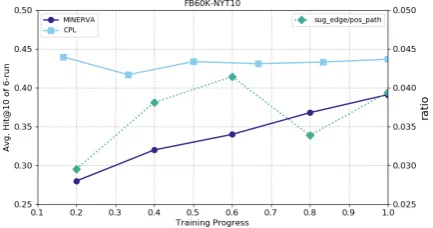
FB60K-NYT10 dataset to show the effectiveness of dy-namically fact-filtering. We check the reasoning performance of the MINERVA and CPL periodi-cally during the training. The results show that the extractor’s contribution increases along with the training progress and the adaptive sampling can generate sufficient positive training experiences at
Figure 4: KG reasoning performance change w.r.t.
time. sug edge/pos path means the ratio of positive
edges suggested by the extractor w.r.t. the positive
paths found by the reasoner.
the very beginning.
The result is shown in Figure 4. We find
a few interesting points as follows: 1) the
sug edge/pos path ratio curve in Figure4suggests
that the extractor’s contribution increases along
with the training progress;2)CPL has a high
ini-tial performance because the adaptive sampling generates sufficient positive training experiences
quickly. 3)The valley shape in the performance
curve is because the agent has not learned a sta-ble exploring policy when the adaptive sampling stops, and the adaptive sampling somehow twisted the true pattern distribution in the dataset. But with a good start, the agent can explore on its own to approach the true distribution.
5.5 Case Study of Reasoning Paths
[image:8.595.307.524.244.358.2]rel-Figure 5: Ablation Study on UMLS-PubMed dataset. CPL1 denotes CPL without adaptive
sam-pling, and the extractor is frozen during training. CPL2
[image:9.595.72.287.57.188.2]denotes CPL without adaptive sampling. CPL denotes our proposed final model (with all the components).
Figure 6: KG reasoning performance change w.r.t.
the size of the graph. Triple-ranking based methods perform pretty well on smaller partitions, but are soon surpassed by path-based KG reasoning methods with the increase of graph size.
evant edges for each positive paths; 4) how the extractor extracts the relevant facts from related
sentences. In summary, these cases show how
CPL performs interpretable knowledge graph rea-soning (infer the query entity through semantics-related path searching) and how CPL performs in-terpretable fact-filtering (suggest edges w.r.t the learned reasoning path patterns).
6 Related Work
Knowledge Graph Reasoning. Diverse
ap-proaches of embedding-based KG reasoning are
presented, including linear models (Bordes et al.,
2011), latent factor models (Trouillon et al.,2016),
matrix factorization models (Yang et al.,2014) and
convolutional neural networks (Dettmers et al.,
2018). Performances of these methods are
promis-ing, but their predictions are barely interpretable. RL plays a crucial role in interpretable KG
rea-soning. MINERVA (Das et al., 2017) and
Deep-Path (Xiong et al.,2017) employ policy networks;
(Xiong et al.,2017) uses extra rule-based
supervi-sion. Multi-hop (Lin et al.,2018) improves
MIN-ERVA via reward shaping and action drop-out.
Joint Embedding of Text and KG.Joint
embed-ding methods aim to unite text corpus and KG. Contrary to our focus, they mainly utilize KGs
for better performances of other tasks. (Toutanova
et al.,2015) focuses on fact-extraction on the cor-pus labeled via dependency parsing with the aids
of KG and word embeddings, while (Han et al.,
2016) conducts the same task with the raw corpus
text. As a newer joint model developed from (Han
et al.,2016), (Han et al.,2018) deals with fact ex-traction by employing the mutual attention.
Open-World KG Completion. There are works
focusing on similar topics as ours. (Shi and
Weninger,2018) defines an Open World KG Com-pletion problem, in which they complete the KG
with unseen entities. (Friedman and Broeck,
2019) introduces the Open-World Probabilistic
Databases, an analogy to KGs. Unlike our setting, they try to complete the KG with logical
infer-ences without extra information. (Sun et al.,2018)
proposes an open, incomplete KB environment (or KG) with text corpora, but they focus on extract-ing answers from question-specific subgraphs.
7 Conclusion
In this paper, we focus on a new task named as Open Knowledge Graph Reasoning, which aims at boosting the knowledge graph reasoning with new knowledge extracted from the background corpus. We propose a novel and general frame-work, namely Collaborative Policy Learning, for
this task. CPL trains two collaborative agents,
the reasoner and fact extractor, which learns the path-reasoning policy and relevant-fact-extraction policy respectively. CPL can perform efficient in-terpretable reasoning on the KG and filtering of noisy facts. Experiments on two large real-world datasets demonstrate the strengths of CPL. Our work can cope with different path-finding modules such as MultHop with reward shaping by ConvE or RotatE and thus can improve its performance as the module improves.
8 Acknowledgement
[image:9.595.72.289.253.338.2]References
Antoine Bordes, Jason Weston, Ronan Collobert, Yoshua Bengio, et al. 2011. Learning structured
em-beddings of knowledge bases. In AAAI, volume 6,
page 6.
Rajarshi Das, Shehzaad Dhuliawala, Manzil Zaheer, Luke Vilnis, Ishan Durugkar, Akshay Krishna-murthy, Alex Smola, and Andrew McCallum. 2017. Go for a walk and arrive at the answer: Reasoning over paths in knowledge bases using reinforcement
learning.arXiv preprint arXiv:1711.05851.
Tim Dettmers, Pasquale Minervini, Pontus Stenetorp,
and Sebastian Riedel. 2018. Convolutional 2d
knowledge graph embeddings. In Thirty-Second
AAAI Conference on Artificial Intelligence.
Tal Friedman and Guy Van den Broeck. 2019. On
con-strained open-world probabilistic databases. arXiv
preprint arXiv:1902.10677.
Xu Han, Zhiyuan Liu, and Maosong Sun. 2016. Joint representation learning of text and knowledge
for knowledge graph completion. arXiv preprint
arXiv:1611.04125.
Xu Han, Zhiyuan Liu, and Maosong Sun. 2018. Neural knowledge acquisition via mutual attention between
knowledge graph and text. InProceedings of AAAI.
Xi Victoria Lin, Richard Socher, and Caiming Xiong. 2018. Multi-hop knowledge graph reasoning with
reward shaping. arXiv preprint arXiv:1808.10568.
Yankai Lin, Shiqi Shen, Zhiyuan Liu, Huanbo Luan, and Maosong Sun. 2016. Neural relation extraction
with selective attention over instances. In
Proceed-ings of the 54th Annual Meeting of the Association for Computational Linguistics (Volume 1: Long Pa-pers), volume 1, pages 2124–2133.
Mike Mintz, Steven Bills, Rion Snow, and Dan
Juraf-sky. 2009. Distant supervision for relation
extrac-tion without labeled data. In Proceedings of the Joint Conference of the 47th Annual Meeting of the ACL and the 4th International Joint Conference on Natural Language Processing of the AFNLP: Vol-ume 2 - VolVol-ume 2, ACL ’09, pages 1003–1011, Stroudsburg, PA, USA. Association for Computa-tional Linguistics.
Volodymyr Mnih, Koray Kavukcuoglu, David Sil-ver, Alex Graves, Ioannis Antonoglou, Daan
Wier-stra, and Martin Riedmiller. 2013. Playing atari
with deep reinforcement learning. arXiv preprint
arXiv:1312.5602.
Baoxu Shi and Tim Weninger. 2018. Open-world
knowledge graph completion. In Thirty-Second
AAAI Conference on Artificial Intelligence.
Richard Socher, Danqi Chen, Christopher D Manning, and Andrew Ng. 2013. Reasoning with neural
ten-sor networks for knowledge base completion. In
Advances in neural information processing systems, pages 926–934.
Haitian Sun, Bhuwan Dhingra, Manzil Zaheer, Kathryn Mazaitis, Ruslan Salakhutdinov, and William W
Co-hen. 2018. Open domain question answering
us-ing early fusion of knowledge bases and text. arXiv
preprint arXiv:1809.00782.
Zhiqing Sun, Zhi-Hong Deng, Jian-Yun Nie, and Jian
Tang. 2019. Rotate: Knowledge graph
embed-ding by relational rotation in complex space. arXiv
preprint arXiv:1902.10197.
Jian Tang, Meng Qu, Mingzhe Wang, Ming Zhang, Jun
Yan, and Qiaozhu Mei. 2015. Line: Large-scale
information network embedding. In Proceedings
of the 24th international conference on world wide
web, pages 1067–1077. International World Wide
Web Conferences Steering Committee.
Kristina Toutanova, Danqi Chen, Patrick Pantel, Hoi-fung Poon, Pallavi Choudhury, and Michael Gamon. 2015. Representing text for joint embedding of text
and knowledge bases. In Proceedings of the 2015
Conference on Empirical Methods in Natural Lan-guage Processing, pages 1499–1509.
Th´eo Trouillon, Johannes Welbl, Sebastian Riedel, ´Eric
Gaussier, and Guillaume Bouchard. 2016.
Com-plex embeddings for simple link prediction. In
In-ternational Conference on Machine Learning, pages 2071–2080.
Ronald J Williams. 1992. Simple statistical gradient-following algorithms for connectionist
reinforce-ment learning. Machine learning, 8(3-4):229–256.
Wenhan Xiong, Thien Hoang, and William Yang
Wang. 2017. Deeppath: A reinforcement
learn-ing method for knowledge graph reasonlearn-ing. arXiv
preprint arXiv:1707.06690.
Chang Xu, Yalong Bai, Jiang Bian, Bin Gao, Gang Wang, Xiaoguang Liu, and Tie-Yan Liu. 2014. Rc-net: A general framework for incorporating
knowl-edge into word representations. InProceedings of
the 23rd ACM international conference on confer-ence on information and knowledge management, pages 1219–1228. ACM.
Bishan Yang, Wen-tau Yih, Xiaodong He, Jianfeng Gao, and Li Deng. 2014. Embedding entities and relations for learning and inference in knowledge