Proceedings of the 2019 Conference on Empirical Methods in Natural Language Processing and the 9th International Joint Conference on Natural Language Processing, pages 3444–3450,
3444
Text Level Graph Neural Network for Text Classification
Lianzhe Huang, Dehong Ma, Sujian Li, Xiaodong Zhang and Houfeng WANG
MOE Key Lab of Computational Linguistics, Peking University, Beijing, 100871, China
{hlz, madehong, lisujian, zxdcs, wanghf}@pku.edu.cn
Abstract
Recently, researches have explored the graph neural network (GNN) techniques on text clas-sification, since GNN does well in handling complex structures and preserving global in-formation. However, previous methods based on GNN are mainly faced with the practical problems of fixed corpus level graph structure which do not support online testing and high memory consumption. To tackle the problems, we propose a new GNN based model that builds graphs for each input text with global parameters sharing instead of a single graph for the whole corpus. This method removes the burden of dependence between an individ-ual text and entire corpus which support online testing, but still preserve global information. Besides, we build graphs by much smaller windows in the text, which not only extract more local features but also significantly re-duce the edge numbers as well as memory con-sumption. Experiments show that our model outperforms existing models on several text classification datasets even with consuming less memory.
1 Introduction
Text classification is a fundamental problem of natural language processing (NLP), which has lots of applications like SPAM detection, news filter-ing, and so on (Jindal and Liu, 2007; Aggarwal and Zhai,2012). The essential step for text classi-fication is text representation learning.
With the development of deep learning, neu-ral networks like Convolutional Neuneu-ral Net-works (CNN) (Kim, 2014) and Recurrent Neu-ral Networks (RNN) (Hochreiter and Schmidhu-ber, 1997) have been employed for text repre-sentation. Recently, a new kind of neural net-work named Graph Neural Netnet-work (GNN) has attracted wide attention (Battaglia et al., 2018). GNN was first proposed in (Scarselli et al.,2009)
and has been used in many tasks in NLP includ-ing text classification (Defferrard et al.,2016), se-quence labeling (Zhang et al.,2018a), neural ma-chine translation (Bastings et al.,2017), and rela-tional reasoning (Battaglia et al., 2016). Deffer-rard et al.(2016) first employed Graph Convolu-tional Neural Network (GCN) in text classifica-tion task and outperformed the tradiclassifica-tional CNN models. Further,Yao et al.(2019) improved Def-ferrard et al. (2016)’s work by applying article nodes and weighted edges in the graph, and their model outperformed the state-of-the-art text clas-sification methods.
However, these GNN-based models usually adopt the way of building one graph for the whole corpus, which causes the following problems in practice. First, high memory consumption is re-quired due to numerous edges. Because this kind of methods build a single graph for the whole cor-pus and use edges with fixed weights, which con-siderably limits the expression ability of edges, they have to use a large connection window to get a global representation. Second, it is difficult for this kind of models to conduct the online test, be-cause the structure and parameters of their graph are dependent on the corpus and cannot be modi-fied after training.
nodes in the graph to predict the results. With our design, text level graphs remove the burden of de-pendency between a single input text and the entire corpus, which support online test. Besides, it has the benefit of consuming less memory by connect-ing words in a small contextual window, because it excludes a good many words that are far away in the text and have little relation with the current word and thus significantly reduces the number of edges. The message passing mechanism makes nodes in the graph perceive information around them to get precise meaning in a specific context.
In our experiments, our method achieves state-of-the-art results in several text classification datasets and consumes significantly fewer mem-ory resources compared with previous methods.
2 Method
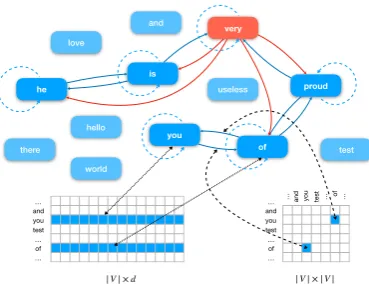
In this section, we will introduce our method in de-tail. First, we show how to build a text level graph for a given text; all the parameters for the text level graph are taken from some global-sharing matrices. Then, we introduce the message passing mechanism on these graphs to obtain information from the context. Finally, we depict how to predict the label for a given text based on the learned rep-resentations. The overall architecture of our model is shown in Figure1.
2.1 Building Text Graph
We notate a text with l words as T =
{r1, ...ri, ...,rl}, whereridenotes the
representa-tion of the ith word. ri is a vector initialized by ddimension word embedding and can be updated by training. To build a graph for a given text, we regard all the words that appeared in the text as the nodes of the graph. Each edge starts from a word in the text and ends with its adjacent words. Concretely, the graph of textT is defined as:
N ={ri|i∈[1, l]}, (1) E={eij|i∈[1, l];j[i−p, i+p]}, (2)
whereN andE are the node set and edge set of the graph, and word representations inNand edge weights inE are taken from global shared matri-ces. pdenotes the number of adjacent words con-nected to each word in the graph. Besides, we uni-formly map the edges that occur less thanktimes in the training set to a “public” edge to make pa-rameters adequately trained.
… and you test … of …
… and you test … of …
|V|×|V|
he
is
very
of proud
you
there
useless love
and
test hello
world
… and you test … of …
[image:2.595.321.506.63.205.2]|V|×d
Figure 1: Structure of graph for a single text “he is very proud of you.”. For the convenience of display, in this figure, we setp = 2 for the node “very” (nodes and edges are colored in red) andp= 1for the other nodes(colored in blued). In actual situations, the value ofpduring a session is unique. All the parameters in the graph come from the global shared representation matrix, which is shown at the bottom of the figure.
Compared with the previous methods in build-ing graph, our approach can exceedbuild-ingly reduce the scale of the graph in terms of nodes and edges. That means that the text-level graph can consume much less GPU memory. Besides, their method is unfriendly to new-coming text, while our ap-proach can solve this problem because the graph for each text is only dependent on its content.
2.2 Message Passing Mechanism
Convolution can extract information from local features (LeCun et al., 1989). In the graph do-main, convolution is implemented by spectral ap-proaches (Bruna et al.,2014;Henaff et al.,2015), or non-spectral approaches (Duvenaud et al.,
2015). In this paper, a non-spectral method named message passing mechanism (MPM) (Gilmer et al., 2017) is employed for convolution. MPM first collects information from adjacent nodes and updates its representations based on its original representations and collected information, which is defined as:
Mn = max
a∈Nnp
eanra, (3)
r0n = (1−ηn)Mn+ηnrn (4)
whereMn ∈ Rd is the messages that noden re-ceives from its neighbors;maxis a reduction func-tion which combines the maximum values on each dimension to form a new vector as an output. Nnp
denotes nodes that represent the nearestpwords of
from nodeato noden, and it can be updated dur-ing traindur-ing; andrn∈Rddenotes the former rep-resentation of noden.ηn∈R1is a trainable vari-able for nodenthat indicates how much informa-tion ofrnshould be kept. r0n denotes the updated
representation of noden.
MPM makes the representations of nodes influ-enced by neighborhoods, which means the repre-sentations can bring the information from context. Therefore, even for polysemous words, the precise meaning in the context can be determined by the influence of weighted information from neighbors. Besides, the parameters of text level graphs are taken from global shared matrices, which means the representations can also bring global informa-tion as other graph-based models do.
Finally, the representations of all nodes in the text are used to predict the label of the text:
yi =softmax(Relu(W
X
n∈Ni
r0n+b)) (5)
whereW ∈ Rd×c is a matrix mapping the vector
into an output space, Ni is the node set of texti
andb∈Rcis bias.
The goal of training is to minimize the cross-entropy loss between ground truth label and pre-dicted label:
loss=−gilogyi, (6)
where gi is the “one-hot vector” of ground truth
label.
3 Experiments
In this section, we describe our experimental setup and report our experimental results.
3.1 Experimental Setup
For experiments, we utilize datasets including R8, R521, and Ohsumed2. R8 and R52 are both the subsets of Reuters 21578 datasets. Ohsumed cor-pus is extracted from MEDLINE database. MED-LINE is designed for multi-label classification, we remove the text with two or more labels. For all the datasets above, we randomly select 10% text from the training set to build validation set. The overview of datasets is listed in Table1.
We compare our method with the following baseline models. It is noted that the results of some models are directly taken from (Yao et al.,2019).
1
https://www.cs.umb.edu/˜smimarog/textmining/datasets/
2http://disi.unitn.it/moschitti/corpora.htm
Datasets # Train # Test Categories Avg. Length
R8 5485 2189 8 65.72
R52 6532 2568 52 69.82
Ohsumed 3357 4043 23 135.82
Table 1: Datasets overview.
• CNNProposed by (Kim,2014), perform con-volution and max pooling operation on word embeddings to get representation of text.
• LSTMDefined in (Liu et al.,2016), use the last hidden state as the representation of the text. Bi-LSTM is a bi-directional LSTM.
• fastText Proposed by (Joulin et al., 2017), average word or n-gram embeddings as doc-uments embeddings.
• Graph-CNNOperate convolution over word embedding similarity graphs by fourier filter, proposed by (Defferrard et al.,2016).
• Text-GCNA graph based text classification model proposed by (Yao et al.,2019), which builds a single large graph for whole corpus.
3.2 Implementation Details
We set the dimension of node representation as 300 and initialize with random vectors or Glove (Pennington et al., 2014). k discussed in Section 2.1 is set to 2. We use the Adam opti-mizer (Kingma and Ba,2014) with an initial learn-ing rate of 10−3, and L2 weight decay is set to 10−4. Dropout with a keep probability of 0.5 is
applied after the dense layer. The batch size of our model is 32. We stop training if the validation loss does not decrease for 10 consecutive epochs.
For baseline models, we use default parameter settings as in their original papers or implemen-tations. For models using pre-trained word em-beddings, we used 300-dimensional GloVe word embeddings.
3.3 Experimental Results
Table 2 reports the results of our models against other baseline methods. We can see that our model can achieve the state-of-the-art result.
Model R8 R52 Ohsumed
CNN 94.0±0.5 85.3±0.5 43.9±1.0 LSTM 93.7±0.8 85.6±1.0 41.1±1.0 Graph-CNN 97.0±0.2 92.8±0.2 63.9±0.5 Text-GCN 97.1±0.1 93.6±0.2 68.4±0.6
[image:4.595.76.286.62.191.2]CNN* 95.7±0.5 87.6±0.5 58.4±1.0 LSTM* 96.1±0.2 90.5±0.8 51.1±1.5 Bi-LSTM* 96.3±0.3 90.5±0.9 49.3±1.0 fastText* 96.1±0.2 92.8±0.1 57.7±0.5 Text-GCN* 97.0±0.1 93.7±0.1 67.7±0.3 Our Model* 97.8±0.2 94.6±0.3 69.4±0.6
Table 2: Accuracy on several text classification datasets. Model with ”*” means that all word vectors are initialized by Glove word embeddings. We run all models 10 times and report mean results.
allows a different number of neighbor nodes to ex-ist, which enables word nodes to learn more accu-rate representations through different collocations. Besides, the relationship between words can be recorded in the edge weights and shared globally. These are all impossible for traditional models.
We also find that our model performs better than graph-based models like CNN. Graph-CNN represents documents using the bag-of-word model, which is similar to ours, but they con-nect word nodes within a large window with-out weighted edges, which cannot distinguish the importance between different words. While our model employed trainable edge weights, which let words express themselves differently when faced with various collocation. Besides, the weights are shared globally which means they can be trained by all the text contains the same collocation in the entire corpus.
We also note that our model performs bet-ter than former state-of-the-art model Text-GCN. That is likely due to more expressive edges, which have been discussed before, and the dif-ference of representations learning. Text-GCN learns word representations by corpus level co-occurrence while our model is trained within a contextual window like traditional word embed-dings. Therefore our model can benefit from ptrained word embeddings and achieve better re-sults.
3.4 Analysis of Memory Consumption
Table 3 reports the comparison of memory con-sumption and edges numbers between Text-GCN and our model. Results show that our model has a significant advantage in memory consumption.
Datasets Text-GCN Our Model
[image:4.595.315.526.164.274.2]R8 9,979M(2,841,760) 954M(250,623) R52 8,699M(3,574,162) 951M(316,669) Ohsumed 13,510M(6,867,490) 1,167M(419,583)
Table 3: Comparison of memory consuming. The number of edges in the whole model is in parentheses.
64 65.5 67 68.5 70
96.4 96.8 97.2 97.6 98
1 6 11 16 ∞
Acc. oh Acc. r8
p
r8 ohsumed
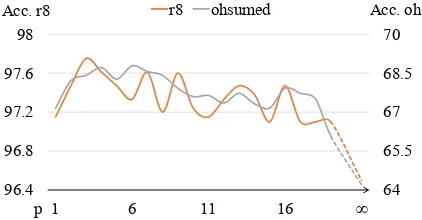
Figure 2: Model performance usingpfrom 1 to 19 and “∞” (fully-connected). All hyperparameters are set the same exceptp. The left and right ordinate indicate the accuracy on the r8 and ohsumed dataset respectively.
As discussed in 2.1, the words in our model are only connected to adjacent words in the texts, while Text-GCN , which is based on the cor-pus level graph, connects nodes within a reason-ably large window. Because Text-GCN uses co-occurrence information as fixed weights, it has to enlarge the window size to get a more accurate co-occurrence weight. Therefore, we will get a much more sparse edge weights matrix than Text-GCN. Also, since the representation of a text is calculated by the sum of the representations of word nodes in the text, there is no text node in our model, which also reduces memory consumption.
3.5 Analysis of Edges
Setting R8 R52 Ohsumed
Original 97.8±0.2 94.6±0.3 69.4±0.6
[image:5.595.75.289.63.117.2](1)Fixed PMI Edges W. 97.7±0.2 94.0±0.2 67.6±0.5 (2)Mean Reduction 97.7±0.1 94.5±0.3 62.6±0.2 (3)Random Word Emb. 97.4±0.2 93.7±0.2 67.3±0.5
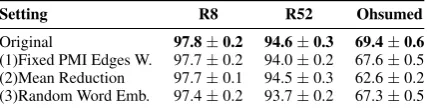
Table 4: Results of ablation studies. We run all models for 5 times and give mean results.
fewer memory consumption. Our model has fewer edges compared with previous methods, and this also show the advantages of our proposed model.
3.6 Ablation Study
To further analyze our model, we perform ablation studies and Table4shows the results.
In (1), we fix the weights of edges and initialize them with point-wise mutual information (PMI), and the size of sliding windows is set to 20, which is the same as (Yao et al.,2019). Removing the trainable edges makes the model perform worse on all data sets, which demonstrates the effectiveness of trainable edges. In our opinion, the main reason is that trainable edges can better model the rela-tions between words compared with fixed edges.
In (2), we change the max-reduction by mean-reduction. In the original model, the node gets its new representation from received messages by ob-taining the maximum value alone each dimension. From Table 4, we can see that the max tion can achieve better results. The node reduc-tion funcreduc-tion is similar to the pooling operareduc-tion on CNN. Reduction by max highlights features that are highly discriminating and provides non-linearity, which helps to achieve better results.
In (3), we remove the pre-trained word em-beddings from nodes and initialize all the nodes with random vectors. Compared with the origi-nal model, the performances are slightly decreased without pre-trained word embeddings. Therefore, we believe that the pre-trained word embeddings have a particular effect on improving the perfor-mance of our model.
4 Related Work
In this section, we will introduce the related works about GNN and text classification in detail.
4.1 Graph Neural Networks
Graph Neural Networks (GNN) has got extensive attention recently (Zhou et al.,2018;Zhang et al.,
2018b; Wu et al., 2019). GNN can model
non-Euclidean data, while traditional neural networks can only model regular grid data. While many tasks in reality such as knowledge graphs ( Ham-aguchi et al., 2017), social networks (Hamilton et al.,2017) and many other research areas (Khalil et al.,2017) are with data in the form of trees or graphs. So GNN are proposed (Scarselli et al.,
2009) to apply deep learning techniques to data in graph domain.
4.2 Text Classification
Text classification is a classic problem of nat-ural language processing and has a wide range of applications in reality. Traditional text clas-sification like bag-of-words (Zhang et al., 2010), n-gram (Wang and Manning, 2012) and Topic Model (Wallach, 2006) mainly focus on feature engineering and algorithms. With the develop-ment of deep learning techniques, more and more deep learning models are applied for text classifi-cation.Kim(2014);Liu et al.(2016) applied CNN and RNN into text classification and achieved re-sults which are much better than traditional mod-els.
With the development of GNN, some graph-based classification models are gradually emerg-ing (Hamilton et al.,2017;Veliˇckovi´c et al.,2017;
Peng et al., 2018). Yao et al. (2019) proposed Text-GCN and achieved state-of-the-art results on several mainstream datasets. However, Text-GCN has the disadvantages of high memory consump-tion and lack of support online training. The model presents in this paper solves the mentioned problems in Text-GCN and achieves better results.
5 Conclusion
In this paper, we proposed a new graph based text classification model, which uses text level graphs instead of a single graph for the whole corpus. Ex-perimental results show that our model achieves state-of-the-art performance and has a significant advantage in memory consumption.
Acknowledgments
References
Charu C Aggarwal and ChengXiang Zhai. 2012. A sur-vey of text classification algorithms. InMining text data, pages 163–222. Springer.
Joost Bastings, Ivan Titov, Wilker Aziz, Diego Marcheggiani, and Khalil Simaan. 2017. Graph convolutional encoders for syntax-aware neural ma-chine translation. InProceedings of the 2017 Con-ference on Empirical Methods in Natural Language Processing, pages 1957–1967.
Peter Battaglia, Razvan Pascanu, Matthew Lai, Danilo Jimenez Rezende, et al. 2016. Interaction networks for learning about objects, relations and physics. InAdvances in neural information process-ing systems, pages 4502–4510.
Peter W Battaglia, Jessica B Hamrick, Victor Bapst, Alvaro Sanchez-Gonzalez, Vinicius Zambaldi, Ma-teusz Malinowski, Andrea Tacchetti, David Raposo, Adam Santoro, Ryan Faulkner, et al. 2018. Rela-tional inductive biases, deep learning, and graph net-works. arXiv preprint arXiv:1806.01261.
Joan Bruna, Wojciech Zaremba, Arthur Szlam, and Yann Lecun. 2014. Spectral networks and lo-cally connected networks on graphs. In Inter-national Conference on Learning Representations (ICLR2014), CBLS, April 2014.
Micha¨el Defferrard, Xavier Bresson, and Pierre Van-dergheynst. 2016. Convolutional neural networks on graphs with fast localized spectral filtering. In
Advances in neural information processing systems, pages 3844–3852.
David K Duvenaud, Dougal Maclaurin, Jorge Ipar-raguirre, Rafael Bombarell, Timothy Hirzel, Al´an Aspuru-Guzik, and Ryan P Adams. 2015. Convo-lutional networks on graphs for learning molecular fingerprints. InAdvances in neural information pro-cessing systems, pages 2224–2232.
Justin Gilmer, Samuel S Schoenholz, Patrick F Riley, Oriol Vinyals, and George E Dahl. 2017. Neural message passing for quantum chemistry. In Pro-ceedings of the 34th International Conference on Machine Learning-Volume 70, pages 1263–1272.
Takuo Hamaguchi, Hidekazu Oiwa, Masashi Shimbo, and Yuji Matsumoto. 2017. Knowledge transfer for out-of-knowledge-base entities: A graph neural net-work approach. arXiv preprint arXiv:1706.05674.
Will Hamilton, Zhitao Ying, and Jure Leskovec. 2017. Inductive representation learning on large graphs. InAdvances in Neural Information Processing Sys-tems, pages 1024–1034.
Mikael Henaff, Joan Bruna, and Yann LeCun. 2015. Deep convolutional networks on graph-structured data.arXiv preprint arXiv:1506.05163.
Sepp Hochreiter and J¨urgen Schmidhuber. 1997. Long short-term memory. Neural computation, 9(8):1735–1780.
Nitin Jindal and Bing Liu. 2007. Review spam detec-tion. InProceedings of the 16th international con-ference on World Wide Web, pages 1189–1190.
Armand Joulin, Edouard Grave, Piotr Bojanowski, and Tomas Mikolov. 2017. Bag of tricks for efficient text classification. InProceedings of the 15th Con-ference of the European Chapter of the Association for Computational Linguistics: Volume 2, Short Pa-pers, pages 427–431.
Elias Khalil, Hanjun Dai, Yuyu Zhang, Bistra Dilk-ina, and Le Song. 2017. Learning combinatorial optimization algorithms over graphs. In Advances in Neural Information Processing Systems, pages 6348–6358.
Yoon Kim. 2014. Convolutional neural networks for sentence classification. InProceedings of the 2014 Conference on Empirical Methods in Natural Lan-guage Processing (EMNLP), pages 1746–1751.
Diederik P Kingma and Jimmy Ba. 2014. Adam: A method for stochastic optimization. arXiv preprint arXiv:1412.6980.
Yann LeCun, Bernhard Boser, John S Denker, Don-nie Henderson, Richard E Howard, Wayne Hubbard, and Lawrence D Jackel. 1989. Backpropagation ap-plied to handwritten zip code recognition. Neural computation, 1(4):541–551.
Pengfei Liu, Xipeng Qiu, and Xuanjing Huang. 2016. Recurrent neural network for text classification with multi-task learning. InProceedings of the Twenty-Fifth International Joint Conference on Artificial In-telligence, pages 2873–2879.
Hao Peng, Jianxin Li, Yu He, Yaopeng Liu, Mengjiao Bao, Lihong Wang, Yangqiu Song, and Qiang Yang. 2018. Large-scale hierarchical text classification with recursively regularized deep graph-cnn. In Pro-ceedings of the 2018 World Wide Web Conference, pages 1063–1072. International World Wide Web Conferences Steering Committee.
Jeffrey Pennington, Richard Socher, and Christopher Manning. 2014. Glove: Global vectors for word representation. InProceedings of the 2014 confer-ence on empirical methods in natural language pro-cessing (EMNLP), pages 1532–1543.
Franco Scarselli, Marco Gori, Ah Chung Tsoi, Markus Hagenbuchner, and Gabriele Monfardini. 2009. The graph neural network model. IEEE Transactions on Neural Networks, 20(1):61–80.
Hanna M Wallach. 2006. Topic modeling: beyond bag-of-words. InProceedings of the 23rd interna-tional conference on Machine learning, pages 977– 984. ACM.
Sida Wang and Christopher D Manning. 2012. Base-lines and bigrams: Simple, good sentiment and topic classification. In Proceedings of the 50th annual meeting of the association for computational lin-guistics: Short papers-volume 2, pages 90–94. As-sociation for Computational Linguistics.
Zonghan Wu, Shirui Pan, Fengwen Chen, Guodong Long, Chengqi Zhang, and Philip S. Yu. 2019. A comprehensive survey on graph neural networks.
Liang Yao, Chengsheng Mao, and Yuan Luo. 2019. Graph convolutional networks for text classification. InProceedings of the AAAI Conference on Artificial Intelligence, volume 33, pages 7370–7377.
Yin Zhang, Rong Jin, and Zhi-Hua Zhou. 2010. Un-derstanding bag-of-words model: a statistical frame-work. International Journal of Machine Learning and Cybernetics, 1(1-4):43–52.
Yue Zhang, Qi Liu, and Linfeng Song. 2018a. Sentence-state lstm for text representation. In Pro-ceedings of the 56th Annual Meeting of the Associa-tion for ComputaAssocia-tional Linguistics (Volume 1: Long Papers), pages 317–327.
Ziwei Zhang, Peng Cui, and Wenwu Zhu. 2018b. Deep learning on graphs: A survey.
Jie Zhou, Ganqu Cui, Zhengyan Zhang, Cheng Yang, Zhiyuan Liu, and Maosong Sun. 2018. Graph neu-ral networks: A review of methods and applications.