Learning from Explicit and Implicit Supervision Jointly
For Algebra Word Problems
Shyam Upadhyay1 Ming-Wei Chang2 Kai-Wei Chang3 Wen-tau Yih2 1University of Illinois at Urbana-Champaign, Urbana, IL, USA
2Microsoft Research, Redmond, WA, USA 3University of Virginia, Charlottesville, VA, USA
Abstract
Automatically solving algebra word problems has raised considerable interest recently. Ex-isting state-of-the-art approaches mainly rely on learning from human annotated equations. In this paper, we demonstrate that it is pos-sible to efficiently mine algebra problems and their numerical solutions with little to no man-ual effort. To leverage the mined dataset, we propose a novel structured-output learning al-gorithm that aims to learn from both explicit (e.g., equations) and implicit (e.g., solutions) supervision signals jointly. Enabled by this new algorithm, our model gains 4.6% abso-lute improvement in accuracy on the ALG
-514 benchmark compared to the one without using implicit supervision. The final model also outperforms the current state-of-the-art approach by 3%.
1 Introduction
Algebra word problemsexpress mathematical rela-tionships via narratives set in a real-world scenario, such as the one below:
Maria is now four times as old as Kate. Four years ago, Maria was six times as
old as Kate. Find their ages now.
The desired output is anequation systemwhich
ex-presses the mathematical relationship symbolically:
m= 4×nandm−4 = 6×(n−4)wheremand
nrepresent the age of Maria and Kate, respectively.
Thesolution(i.e.,m= 40, n= 10) can be found by
a mathematical enginegiven the equation systems. Building efficient automatic algebra word problem
solvers have clear values for online education sce-narios. The challenge itself also provides a good test bed for evaluating an intelligent agent that un-derstands natural languages, a direction advocated by artificial intelligence researchers (Clark and Et-zioni, 2016).
One key challenge of solving algebra word prob-lems is the lack of fully annotated data (i.e., the an-notated equation system associated with each prob-lem). In contrast to annotating problems with binary or categorical labels, manually solving algebra word problems to provide correct equations is time con-suming. As a result, existing benchmark datasets are small, limiting the performance of supervised learning approaches. However, thousands of alge-bra word problems have been posted and discussed in online forums, where the solutions can be easily mined, despite the fact that some of them could be incorrect. It is thus interesting to ask whether a bet-ter algebra problem solver can be learned by
lever-aging these noisy andimplicit supervision signals,
namely the solutions.
In this work, we address the technical difficulty of leveraging implicit supervision in learning an alge-bra word problem solver. We argue that the effec-tive strategy is to learn from both explicit and
im-plicit supervision signals jointly. In particular, we
design a novel online learning algorithm based on structured-output Perceptron. By taking both kinds of training signals together as input, the algorithm iteratively improves the model, while at the same time it uses the intermediate model to find candidate equation systems for problems with only numerical solutions.
Our contributions are summarized as follows.
• We propose a novel learning algorithm
(Sec-tion 3 and 4) that jointly learns from both ex-plicit and imex-plicit supervision. Under different settings, the proposed algorithm outperforms the existing supervised and weakly supervised algorithms (Section 6) for algebra word prob-lems.
• We mine the problem-solution pairs for
alge-bra word problems from an online forum and show that we can effectively obtain the implicit supervision with little to no manual effort (Sec-tion 5).1
• By leveraging both implicit and explicit
su-pervision signals, our final solver outperforms
the state-of-the-art system by 3% on ALG
-514, a popular benchmark data set proposed by (Kushman et al., 2014).
2 Related Work
Automatically solving mathematical reasoning problems expressed in natural language has been a long-studied problem (Bobrow, 1964; Newell et al., 1959; Mukherjee and Garain, 2008). Recently, Kushman et al. (2014) created a template-base search procedure to map word problems into equations. Then, several following papers studied different aspects of the task: Hosseini et al. (2014) focused on improving the generalization ability of the solvers by leveraging extra annotations; Roy and Roth (2015) focused on how to solve arithmetic problems without using any pre-defined template. In (Shi et al., 2015), the authors focused on number word problems and proposed a system that is created using semi-automatically generated rules. In Zhou et al. (2015), the authors simplified the inference procedure and pushed the state-of-the-art benchmark accuracy. The idea of learning from implicit supervision is discussed in (Kushman et al., 2014; Zhou et al., 2015; Koncel-Kedziorski et al., 2015), where the authors train the algebra solvers using only the solutions with little or no annoated equation systems. We discuss this in detail in Section 4.
1The new resource and the dataset we used for training is
available soon onhttps://aka.ms/dataimplicitand https://aka.ms/datadraw
Solving automatic algebra word problems can be viewed as a semantic parsing task. In the semantic parsing community, the technique of learning from implicit supervision signals has been applied
(un-der the nameresponse-driven learning(Clarke et al.,
2010)) to knowledge base question answering tasks such as Geoquery (Zelle and Mooney, 1996) and WebQuestions (Berant et al., 2013) or mapping in-structions to actions (Artzi and Zettlemoyer, 2013). In these tasks, researchers have shown that it is pos-sible to train a semantic parser only from
question-answer pairs, such as “What is the largest state
bor-dering Texas?” and “New Mexico” (Clarke et al., 2010; Liang et al., 2013; Yih et al., 2015).
One key reason that such implicit supervision is effective is because the correct semantic parses of the questions can often be found using the answers and the knowledge base alone, with the help of heuristics developed for the specific domain. For instance, when the question is relatively simple and does not have complex compositional structure, paths in the knowledge graph that connect the an-swers and the entities in the narrative can be inter-preted as legitimate semantic parses. However, as we will show in our experiments, learning from im-plicit supervision alone is not a viable strategy for algebra word problems. Compared to the knowl-edge base question answering problems, one key dif-ference is that a large number (potentially infinitely many) of different equation systems could end up having the same solutions. Without a database or special rules for combining variables and coeffi-cients, the number of candidate equation systems cannot be trimmed effectively, given only the solu-tions.
From the algorithmic point of view, our proposed learning framework is related to several lines of work. Similar efforts have been made to develop la-tent structured prediction models (Yu and Joachims, 2009; Chang et al., 2013; Zettlemoyer and Collins, 2007) to find latent semantic structures which best explain the answer given the question. Our algo-rithm is also influenced by the discriminative re-ranking algorithms (Collins, 2000; Ge and Mooney, 2006; Charniak and Johnson, 2005) and models for learning from intractable supervision (Steinhardt and Liang, 2015).
number of noisily annotated word problems from online forums. While they collected a large-scale dataset, unlike our work, they did not demonstrate how to utilize the newly crawled dataset to improve existing systems. It will be interesting to see if our proposed algorithm can make further improvements
using their newly collected dataset.2
[image:3.612.316.541.68.155.2]3 Problem Definition
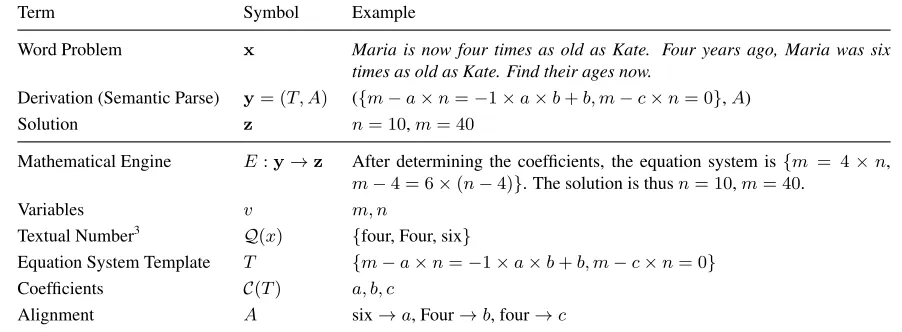
Table 1 lists all the symbols representing the compo-nents in the process. The input algebra word
prob-lem is denoted byx, and the output y = (T, A)is
called a derivation, which consists of an equation
system templateT and analignmentA. A template
T is a family of equation systems parameterized by
a set of coefficientsC(T) ={ci}ki=1, where each
co-efficientcialigns to a textual number (e.g.,four) in a
word problem. LetQ(x)be all thetextual numbers
in the problemx, andC(T)be the coefficients to be
determined in the templateT. An alignment is a set
of tuplesA={(q, c)|q ∈ Q(x), c ∈ C(T)∪ {}},
where the tuple(q, )indicates that the numberqis
not relevant to the final equation system. By spec-ifying the value of each coefficient, it identifies an equation system belonging to the family represented
by templateT. Together,T andAgenerate a
com-plete equation system, and the solutionzcan be
de-rived by the mathematical engineE.
Following (Kushman et al., 2014; Zhou et al., 2015), our strategy of mapping a word problem to an equation system is to first choose a template that consists of variables and coefficients, and then align each coefficient to a textual number mentioned in the problem. We formulate the mapping between an algebra word problem and an equation system as a structured learning problem. The output space is the set of all possible derivations using templates that are observed in the training data. Our model
mapsxtoy = (T, A)by a linear scoring function
wTΦ(x,y), wherew is the model parameters and
Φis the feature functions. At test time, our model
scores all the derivation candidates and picks the best one according to the model score. We often
refer toy as a semantic parse, as it represents the
semantics of the algebra word problem.
2The dataset has not been made public at the time of
publi-cation.
... x2
y1
y2
y3
y17650
y4
... z1
z2
z3
z17650
z4
... x1
y1
y2
y*
y17650
y4
... z1
z2
z*
z17650
z4
? z2*
Input
Sematic Parses
Derived Solutions
Input
Sematic Parses
Derived Solutions
Annotated Response
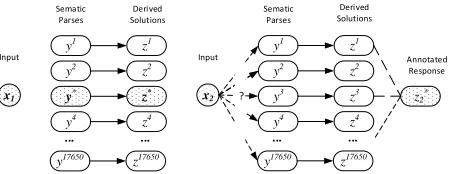
Figure 1: Left: Explicit supervision signals. Note that the solutionzcan be derived by the semantic parsesy. Right:Implicit supervision signals. In this case, we only have the annotated responsez∗2. It is difficult to usez∗ 2 to find the correct derivation, as multiple derivations may lead to the same solution. Therefore, the learning algo-rithm has to explore the output space to guide the model in order to match the annotated response.
Properties of Implicit Supervision Signals We discuss some key properties of the implicit supervi-sion signal to explain several design choices of our algorithm. Figure 1 illustrates the main differences between implicit and explicit supervision signals.
Algorithms that learn from implicit supervision signals face the following challenges. First, the learning system usually does not model directly the
correlations between the input x and the solution
z. Instead, the mapping is handled by an external
procedure such as a mathematical engine.
There-fore,E(y)is effectively a one-directional function.
As a result, finding semantic parses (derivations)
from responses (solutions) E−1(z) can sometimes
be very slow or even intractable. Second, in many cases, even if we could find a semantic parse from responses, multiple combinations of templates and alignments could end up with the same solution set
(e.g., the solutions of equations 2 + x = 4 and
2×x = 4 are the same). Therefore, the implicit
supervision signals may be incomplete and noisy, and using the solutions alone to guide the training procedure might not be sufficient. Finally, since we need to have a complete derivation before we can
observe the response of the mathematical engineE,
Term Symbol Example
Word Problem x Maria is now four times as old as Kate. Four years ago, Maria was six times as old as Kate. Find their ages now.
Derivation (Semantic Parse) y= (T, A) ({m−a×n=−1×a×b+b, m−c×n= 0},A)
Solution z n= 10,m= 40
Mathematical Engine E:y→z After determining the coefficients, the equation system is {m = 4×n, m−4 = 6×(n−4)}. The solution is thusn= 10,m= 40.
Variables v m, n
Textual Number3
Q(x) {four, Four, six}
Equation System Template T {m−a×n=−1×a×b+b, m−c×n= 0}
Coefficients C(T) a, b, c
[image:4.612.79.530.62.228.2]Alignment A six→a, Four→b, four→c
Table 1: Notation used in this paper to formally describe the problem of mapping algebra word problems to equations.
4 Learning from Mixed Supervision
We assume that we have two sets:De={(xe,ye)}
andDm = {(xm,zm)}. De contains the fully
an-notated equation system ye for each algebra word
problemxe, whereas inDm, we have access to the
numerical solutionzm to each problem, but not the
equation system (ym =∅). We refer toDeas the
ex-plicit setandDmas theimplicit set. For the sake of simplicity, we explain our approach by modifying the training procedure of the structured Perceptron
algorithm (Collins, 2002).4
As discussed in Section 3, the key challenge of learning from implicit supervision is that the
map-pingE(y)is one-directional. Therefore, the correct
equation system cannot be easily derived from the numerical solution. Intuitively, for data with only implicit supervision, we can explore the structure
spaceY and find the best possible derivationy˜ ∈Y
according to the current model. IfE(˜y)matchesz,
then we can update the model based ony˜. Following
this intuition, we proposeMixedSP(Algorithm 1).
For each example, we use an approximate search algorithm to collect top scoring candidate structures.
The algorithm first ranks the top-K templates
ac-cording to the model score, and forms a candidate set by expanding all possible derivations that use
the K templates (Line 3). The final candidate set
isΩ ={y1,y2, . . . ,yK} ⊂Y.
When the explicit supervision is available (i.e.,
4Our approach can be easily extended to other structured
learning algorithms such as Structured SVM (Taskar et al., 2004; Tsochantaridis et al., 2004).
(xi,yi) ∈ De), our algorithm follows the standard
structured prediction update procedure. We find the
best scoring structure yˆ in Ω and then update the
model using the difference of the feature vectors
be-tween the gold output structureyiand the best
scor-ing structureyˆ(Line 6).
When only implicit supervision is available (i.e.,
(xi,zi) ∈ Dm), our algorithm uses the current
model to conduct a guided exploration, which it-eratively finds structures that best explain the im-plicit supervision, and use the explanatory structure for making updates. As mentioned in Section 3, we have to explore and examine each structure in
the candidate set Ω. This is due the fact that
par-tial structure cannot be used for finding the right
re-sponse, as getting responseE(y)requires complete
derivations. In Line 9, we want to find the
deriva-tionsywhere its solutionE(y)matches the implicit
supervisionzi. More specifically,
˜
y= arg min
y∈Ω∆(E(y),zi), (1)
where ∆ is a loss function to estimate the
dis-agreement between E(y) and zi. In our
experi-ments, we simply set ∆(E(y),zi) to be 0 if the
solution partially matches, and 1 otherwise.5 If
more than one derivation achieves the minimal value
of ∆(E(y),zi), we break ties by choosing the
derivation with higher scorewTφ(xi,y). This
tie-5The mined solutions are often incomplete for some
Algorithm 1Structured Perceptron with Mixed Super-vision. (MixedSP)
Input: De,Dm,L=|De|+|Dm|,T,K,γ∈[0,1)
1: for t= 1. . . N do .training epochs
2: for i= 1. . . Ldo
3: Ω ← find top-K structures {y} approxi-mately
4: ifyi6=∅then .explicit supervision
5: yˆ ←arg max
y∈Ω
wTφ(x
i,y)
6: w←w+η(φ(x,yi)−φ(x,yˆ))
7: else ift≥γNthen .implicit supervision
8: yˆ ←arg max
y∈Ω
wTφ(x
i,y)
9: Picky˜fromΩby Eq. (1). .exploration
10: w←w+η(φ(x,˜y)−φ(x,yˆ))
11: Return the average ofw
breaking strategy is important – in practice, several derivations may lead to the gold numerical solution; however, only few of them are correct. The tie-breaking strategy relies on the current model and
the structured features φ(xi,y) to filter out
incor-rect derivations during training. Finally, the model
is updated usingy˜ in Line 10.
Similar to curriculum learning (Bengio et al., 2009), it is important to control when the algorithm starts exploring the output space using weak super-vision. Exploring too early may mislead the model,
as the structured feature weightswmay not be able
to help filter out incorrect derivations, while explor-ing too late may lead to under-utilization of the
im-plicit supervision. We use the parameterγto control
when the model starts to learn from implicit
supervi-sion signals. The parameterγdenotes the fraction of
the training time that the model uses purely explicit supervision.
Key Properties of Our Algorithm The idea of us-ing solutions to train algebra word problem solvers has been discussed in (Kushman et al., 2014) and (Zhou et al., 2015). However, their implicit su-pervision signals are created from clean, fully super-vised data, and the experiments use little to no
ex-plicit supervision examples.6While their algorithms
are interesting, the experimental setting is somewhat unrealistic as the implicit signals are simulated.
6Prior work (Kushman et al., 2014) has used only 5 explicit
supervision examples when training with solutions.
On the other hand, the goal of our algorithm is to significantly improve a strong solver with a large quantity of unlabeled data. Moreover, our implicit supervision signals are noisier given that we crawled the data automatically, and the clean labeled equa-tion systems are not available to us. As a result, we have made several design choices to address issues of learning from noisy implicit supervision signals in practice.
First, the algorithm is designed to perform
up-datesconservatively. Indeed, in Line 10, the
algo-rithm will not perform an update if the model could not find any parses matching the implicit signals in
Line 9. That is, if∆(E(y),zi) = 1 for ally ∈ Ω,
˜
y = ˆy due to the tie-breaking mechanism. This
ensures that the algorithm drives the learning using only those structures which lead to the correct solu-tion, avoiding undesirable effects of noise.
Second, the algorithm does not use implicit
su-pervision signals in the early stage of model train-ing. Learning only on clean and explicit supervision helps derive a better intermediate model, which later allows exploring the output space more efficiently using the implicit supervision signals.
Existing semantic parsing algorithms typically
use either implicit or explicit supervision signals
ex-clusively(Zettlemoyer and Collins, 2007; Berant et al., 2013; Artzi and Zettlemoyer, 2013). In contrast,
MixedSPmakes use of both explicit and implicit su-pervised examples mixed at the training time.
5 Mining Implicit Supervision Signals
In this section, we describe the process of
collect-ing SOL-2K, a data set containing question-solution
pairs of algebra word problems from a Web forum7,
where students and tutors interact to solve math problems.
A word problem posted on the forum is often ac-companied by a detailed explanation provided by tu-tors, which includes a list of the relevant equations. However, these posted equations are not suitable for direct use as labeled data, as they are often imprecise or incomplete. For instance, tutors often omit many simplification steps when writing the equations. A
commonly observed example is that (5-3)x+2y
would be directly written as2x+2y. Despite being
mathematically equivalent, learning from the latter equation is not desirable as the model may learn that 5 and 3 appearing the text are irrelevant. An ex-treme case of this is when tutors directly post the
so-lution (such asx=2 andy=5), without writing any
equations. Another observation is that tutors often write two-variable equation systems with only one
variable. For example, instead of writingx+y=10,
x-y=2, many tutors pre-compute x=10-y using
the first equation and substitute it in the second one,
which results in10-y-y=2. It is also possible that
the tutor wrote the incorrect equation system, but while explaining the steps, made corrections to get the right answer. These practical issues make it dif-ficult to use the crawled equations for explicit super-vision directly.
On the other hand, it is relatively easy to ob-tain question-solution pairs with simple heuristics. We use a simple strategy to generate the solution from the extracted equations. We greedily select equations in a top-down manner, declaring suc-cess as soon as we find an equation system that can be solved by a mathematical engine (we used SymPy (Sympy Development Team, 2016)). Equa-tions that cause an exception in the solver (due to improper extraction) are rejected. Note that the solu-tion thus found may be incorrect (making the mined supervision noisy), as the equation system used by the solver may contain an incorrect equation. To en-sure the quality of the mined supervision, we use several simple rules to further filter the problems. For example, we remove questions that have more than 15 numbers. We found that usually such ques-tions were not a single word problem, but instead concatenations of several problems.
Note that our approach relies only on a few rules and a mathematical engine to generate (noisy) im-plicit supervision from crawled problems, with no human involvement. Once the solutions are gener-ated, we discarded the equation systems used to ob-tain them. Using this procedure, we collected 2,039 question-solution pairs. For example, the solution to the following mined problem was “6” (The correct
solutions are6and12.):
Roz is twice as old as Grace. In 5 years the sum of their ages will be 28. How old are they now?
Settings Explicit sets Implicit sets
(De) (Dm) Dataset ALG-514 DRAW-1K SOL-2K
# temp. 24 224 Unknown
# prob. 514 1,000 2,039
[image:6.612.319.536.57.147.2]Vocab. 1.83k 2.2k 6.8k
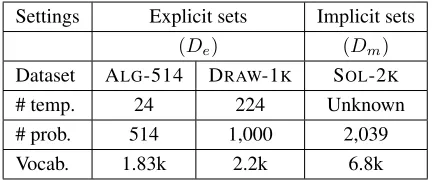
Table 2: The statistics of the data sets.
6 Experiments
In this section, we demonstrate the effectiveness of the proposed approach and empirically verify the de-sign choices of the algorithm. We show that our joint learning approach leverages mined implicit super-vision effectively, improving system performance without using additional manual annotations (Sec-tion 6.1). We also compare our approach to existing methods under different supervision settings (Sec-tion 6.2).
Experimental Settings Table 2 shows the
statis-tics of the datasets. The ALG-514 dataset
(Kush-man et al., 2014) consists of 514 algebra word prob-lems, ranging over a variety of narrative scenarios (object counting, simple interest, etc.). Although it is a popular benchmark for evaluating algebra word
solvers, ALG-514 has only 24 templates. To test the
generality of different approaches, we thus conduct
experiments on a newly released data set, DRAW
-1K8 (Upadhyay and Chang, 2016), which covers
more than 200 templates and contains 1,000 alge-bra word problems. The data is split into training, development, and test sets, with 600/200/200 exam-ples, respectively.
The SOL-2K dataset contains the word
problem-solution pairs we mined from online forum (see
Sec-tion 5). Unlike ALG-514 and DRAW-1K, there are
no annotated equation systems in this dataset, and only the solutions are available. Also, no prepro-cessing or cleaning is performed, so the problem descriptions might contain some irrelevant phrases such as “please help me”. Since all the datasets are generated from online forums, we carefully
exam-ined and removed problems from SOL-2K that are
identical to problems in ALG-514 and DRAW-1K,
to ensure fairness. We set the number of iterations
to 15 and the learning rateηto be 1.
For all experiments, we report solution accuracy
(whether the solution was correct). Following Kush-man et al. (2014), we ignore the ordering of answers when calculating the solution accuracy. We report
the 5-fold cross validation accuracy on ALG-514 in
order to have a fair comparison with previous work.
For DRAW-1K, we report the results on the test set.
In all the experiments, we only use the templates that appear in the corresponding explicit supervision.
Following (Zhou et al., 2015), we do not model the alignments between noun phrases and vari-ables. We use a similar set of features introduced in (Zhou et al., 2015), except that our solver does not use rich NLP features from dependency parsing or coreference-resolution systems. We follow
(Kush-man et al., 2014) and set the beam-size K to 10,
unless stated otherwise.
6.1 Joint Learning from Mixed Supervision Supervision Protocols We compare the following training protocols:
• Explicit (D = {(xe,ye)}): the standard set-ting, where fully annotated examples are used to train the model (we use the structured Per-ceptron algorithm as our training algorithm here).
• Implicit (D = {(xm,zm))}): the model is
trained on SOL-2K dataset only (i.e., only
im-plicit supervision). This setting is similar to the one in (Liang et al., 2013; Clarke et al., 2010).
• Pseudo(D = {(xm,Z˜−1(zm,xm))}): where
we use Z˜−1(z,x) to denote a pseudo
deriva-tion whose soluderiva-tions match the mined solu-tions. Similar to the approach in (Yih et al., 2015) for question answering, here we attempts to recover (possibly incorrect) explicit supervi-sion from the implicit supervisupervi-sion by finding parses whose solution matches the mined so-lution. For each word problem, we generated
a pseudo derivation Z˜−1(z,x) by finding the
equation systems whose solutions that match the mined solutions. We conduct a brute force
search to find Z˜−1(z,x) by enumerating all
possible derivations. Note that this process can
be very slow for datasets like DRAW-1K
be-cause the brute-force search needs to examine more than 200 templates for each word prob-lem. Ties are broken by random.
• E+P (D={(xe,ye)}∪ {(xm,Z˜−1(zm,xm))}): a baseline approach that jointly learns by
com-bining the dataset generated byPseudowith the
Explicitsupervision.
• MixedSP(D={(xe,ye)}∪{(xm,zm))}): the setting used by our proposed algorithm. The al-gorithm trained the word problem solver using both explicit and implicit supervision jointly.
We set the parameterγ to0.5unless otherwise
stated. In other words, the first half of the train-ing iterations use only explicit supervision.
Note that Explicit, E+P, and MixedSP use the
same amount of labeled equations, although E+P
andMixedSPuse additional implicit supervised re-sources.
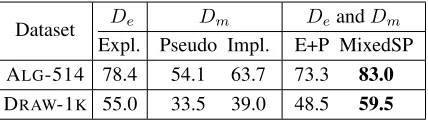
Results Table 3 lists the main results. With implicit supervision from mined question-solution
pairs, MixedSP outperforms Explicit by around
4.5% on both datasets. This verifies the claim that the joint learning approach can benefit from the noisy implicit supervision. Note that with the same
amount of supervision signals,E+Pperforms poorly
and even under-performsExplicit. The reason is that
the derived derivations in SOL-2Kcan be noisy.
In-deed, we found that about 70% of the problems in the implicit set have more than one template that can produce a derivation which matches the mined solutions. Therefore, the pseudo derivation selected by the system might be wrong, even if they generate
the correct answers. As a result, E+Pcan commit
to the possibly incorrect pseudo derivations before training, and suffer from error propagation. In
con-trast,MixedSPdoes not commit to a derivation and
allows the model to choose the one best explaining the implicit signals as training progresses.
As expected, using only the implicit setDm
per-forms poorly. The reason is that in both Implicit
Dataset De Dm DeandDm Expl. Pseudo Impl. E+P MixedSP ALG-514 78.4 54.1 63.7 73.3 83.0
[image:8.612.78.292.57.117.2]DRAW-1K 55.0 33.5 39.0 48.5 59.5
Table 3: The solution accuracies of different protocols on ALG-514 and DRAW-1K.
signals, the model can use incorrect derivations to update the model. As a result, models on both
Implicit and Pseudo settings perform significantly
worse than the Explicit baseline in both datasets,
even if the size of SOL-2K is larger than the fully
supervised data.
6.2 Comparisons to Previous Work
We now compare to previous approaches for solving algebra word problems, both in fully supervised and weakly supervised settings.
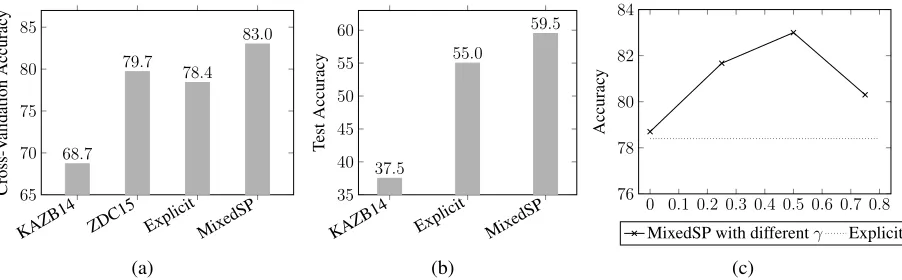
Comparisons of Overall Systems We first com-pare our systems to the systems that use the same level of explicit supervision (fully labeled exam-ples). The comparison between our system and ex-isting systems are in Fig 2a and 2b. Compared to previous systems that were trained only on explicit
signals, our Explicit baseline is quite competitive.
On ALG-514, the accuracy of our baseline system
is 78.4%, which is 1.3% lower than the best reported accuracy achieved by the system ZDC15 (Zhou et al., 2015). We suspect that this is due to the richer feature set used by ZDC15, which includes fea-tures based on POS tags, coreference and depen-dency parses, whereas our system only uses fea-tures based on POS tags. Our system is also the
best system on DRAW-1K, and performs much better
than the system KAZB14 (Kushman et al., 2014). Note that we could not run the system ZDC15 on
DRAW-1K because it can only handle limited types
of equation systems. Although theExplicitbaseline
is strong, theMixedSPalgorithm is still able to
im-prove the solver significantly through noisy implicit supervision signals without using manual annotation of equation systems.
Comparisons of Weakly Supervised Algorithms
In the above comparisons, MixedSP benefits from
the mined implicit supervision as well as using Al-gorithm 1. Since there are several practical
limita-tions for us to run previously proposed weakly su-pervised algorithms in our settings, in the following,
we perform a direct comparison between MixedSP
and existing algorithms in their corresponding set-tings. Note that the implicit supervision in weak su-pervision settings proposed in earlier work is noise-free, as it was simulated by hiding equation systems of a manually annotated dataset.
Zhou et al. (2015) proposed a weak supervision setting where the system was provided with the set of all templates, as well as the solutions of all prob-lems during training. Under this setting, they
re-ported 72.3% accuracy on ALG-514. Note that such
high accuracy can be achieved mainly because that the complete and correct templates were supplied.
In this setting, running theMixedSPalgorithm is
equivalent to using the Implicit setting with clean
implicit supervision signals. Surprisingly,MixedSP
can obtain 74.3% accuracy, surpassing the weakly
supervised model in (Zhou et al., 2015) on ALG
-514. Compared to the results in Table 3, note that when using noisy implicit signals, it cannot obtain the same level of results, even though we had more training problems (2,000 mined problems instead of 514 problems). This shows that working with real, noisy weak supervision is much more challenging than working on simulated, noise-free, weak super-vision.
Kushman et al. (2014) proposed another weak
su-pervision setting (5EQ+ANSin the paper), in which
explicit supervision is provided for only 5 prob-lems in the training data. For the rest of probprob-lems, only their solutions are provided. The 5 problems are chosen such that their templates constitute the 5 most common templates in the dataset. This weak supervision setting is harder than that of (Zhou et al., 2015), as the solver only has the templates for 5 problems, instead of the templates for all
prob-lems. Under this setting, our MixedSP algorithm
achieves 53.8%, which is better than 46.1% reported in (Kushman et al., 2014).
6.3 Analysis
In Figure 2c, we investigate the impact of tuningγ
in MixedSP on the dataset ALG-514. Recall that
γ controls the fraction of the training time that
im-KAZB14 ZDC15 Explicit MixedSP 65
70 75 80 85
68.7 79.7
78.4 83.0
Cross-V
alidation
Accurac
y
(a)
KAZB14 Explicit MixedSP 35
40 45 50 55 60
37.5
55.0
59.5
Test
Accurac
y
(b)
0 0.1 0.2 0.3 0.4 0.5 0.6 0.7 0.8 76
78 80 82 84
Accurac
y
MixedSP with differentγ Explicit
[image:9.612.78.529.58.198.2](c)
Figure 2: (a)Comparisons between our system to state-of-the-art systems on ALG-514. ZDC15 is the system
pro-posed in (Zhou et al., 2015), and KAZB14 is the system propro-posed in (Kushman et al., 2014). (b) Comparisons between our system and other systems on DRAW-1K. Note that we are not able to run ZDC15 on DRAW-1Kbecause
it cannot handle some equation systems in the dataset.(c)Analysis of the impact ofγin MixedSP.
plicit supervision throughout training (set γ = 0).
But setting γ to 0 hurts overall performance,
sug-gesting in this setting that the algorithm uses a weak model to guide the exploration for using implicit supervision. On the other hand, by delaying
ex-ploration (γ > 0.5) for too long, the model could
not fully utilize the implicit supervision. We
ob-serve similar trend on DRAW-1Kas well. We found
γ = 0.5works well across the experiments.
We also analyze the impact of the parameter K,
which controls the size of the candidate set Ω in
MixedSP. Specifically, for DRAW-1K, when setting
Kto 5 and 10, the accuracy ofMixedSPis at 59.5%.
On setting K to 15, the accuracy of MixedSP
im-proves to 61%. We suspect that enlarging K
in-creases the chance to have good structures in the candidate set that can match the correct responses.
7 Conclusion
In this paper, we propose an algorithmic approach for training a word problem solver based on both explicit and implicit supervision signals. By extract-ing the question answer pairs from a Web-forum, we show that the algebra word problem solver can be improved significantly using our proposed tech-nique, surpassing the current state-of-the-art.
Recent advances in deep learning techniques demonstrate that the error rate of machine learning models can decrease dramatically when large quan-tities of labeled data are presented (Krizhevsky et al., 2012). However, labeling natural language data has been shown to be expensive, and it has become
one of the major bottleneck for advancing natural language understanding techniques (Clarke et al., 2010). We hope the proposed approach can shed light on how to leverage data on the web, and even-tually improves other semantic parsing tasks such as knowledge base question answering and mapping natural instructions to actions.
References
Yoav Artzi and Luke Zettlemoyer. 2013. Weakly su-pervised learning of semantic parsers for mapping in-structions to actions. InProc. of TACL.
Yoshua Bengio, J´erˆome Louradour, Ronan Collobert, and Jason Weston. 2009. Curriculum learning. InProc. of ICML.
Jonathan Berant, Andrew Chou, Roy Frostig, and Percy Liang. 2013. Semantic parsing on Freebase from question-answer pairs. InProc. of EMNLP.
Daniel G. Bobrow. 1964. A question-answering system for high school algebra word problems. In Proceed-ings of the October 27-29, 1964, Fall Joint Computer Conference, Part I.
K.-W. Chang, R. Samdani, and D. Roth. 2013. A con-strained latent variable model for coreference resolu-tion. InProc. of EMNLP.
Eugene Charniak and Mark Johnson. 2005. Coarse-to-fine n-best parsing and maxent discriminative rerank-ing. InProc. of ACL.
Peter Clark and Oren Etzioni. 2016. My computer is an honor student-but how intelligent is it? Standardized tests as a measure of AI. AI Magazine., 37(1). J. Clarke, D. Goldwasser, M. Chang, and D. Roth. 2010.
M. Collins. 2000. Discriminative reranking for natural language parsing. InProc. of ICML.
M. Collins. 2002. Discriminative training methods for hidden Markov models: Theory and experiments with perceptron algorithms. InProc. of EMNLP.
R. Ge and R. Mooney. 2006. Discriminative reranking for semantic parsing. InProc. of ACL.
Javad Mohammad Hosseini, Hannaneh Hajishirzi, Oren Etzioni, and Nate Kushman. 2014. Learning to solve arithmetic word problems with verb categorization. In
Proc. of EMNLP.
Danqing Huang, Shuming Shi, Chin-Yew Lin, Jian Yin, and Wei-Ying Ma. 2016. How well do computers solve math word problems? Large-scale dataset con-struction and evaluation. InProc. of ACL.
Rik Koncel-Kedziorski, Hannaneh Hajishirzi, Ashish Sabharwal, Oren Etzioni, and Siena Dumas Ang. 2015. Parsing algebraic word problems into equations.
Proc. of TACL.
Alex Krizhevsky, Ilya Sutskever, and Geoffrey E Hinton. 2012. Imagenet classification with deep convolutional neural networks. InProc. of NIPS.
Nate Kushman, Yoav Artzi, Luke Zettlemoyer, and Regina Barzilay. 2014. Learning to automatically solve algebra word problems. InProc. of ACL. Percy Liang, Michael I Jordan, and Dan Klein. 2013.
Learning dependency-based compositional semantics.
Computational Linguistics.
Christopher D. Manning, Mihai Surdeanu, John Bauer, Jenny Finkel, Steven J. Bethard, and David McClosky. 2014. The Stanford CoreNLP natural language pro-cessing toolkit. InProc. of ACL.
Anirban Mukherjee and Utpal Garain. 2008. A re-view of methods for automatic understanding of nat-ural language mathematical problems. Artif. Intell. Rev., 29(2):93–122.
Allen Newell, John C Shaw, and Herbert A Simon. 1959. Report on a general problem-solving program. InIFIP Congress, pages 256–264.
Subhro Roy and Dan Roth. 2015. Solving general arith-metic word problems. InProc. of EMNLP.
Shuming Shi, Yuehui Wang, Chin-Yew Lin, Xiaojiang Liu, and Yong Rui. 2015. Automatically solving num-ber word problems by semantic parsing and reasoning. InProc. of EMNLP.
J. Steinhardt and P. Liang. 2015. Learning with relaxed supervision. InProc. of NIPS.
Sympy Development Team, 2016. SymPy: Python li-brary for symbolic mathematics.
B. Taskar, C. Guestrin, and D. Koller. 2004. Max-margin markov networks. InProc. of NIPS.
I. Tsochantaridis, T. Hofmann, T. Joachims, and Y. Altun. 2004. Support vector machine learning for interdepen-dent and structured output spaces. InProc. of ICML.
Shyam Upadhyay and Ming-Wei Chang. 2016. Annotating derivations: A new evaluation strat-egy and dataset for algebra word problems. In
https://aka.ms/derivationpaper.
Wen-tau Yih, Ming-Wei Chang, Xiaodong He, and Jian-feng Gao. 2015. Semantic parsing via staged query graph generation: Question answering with knowl-edge base. InProc. of ACL.
C. Yu and T. Joachims. 2009. Learning structural SVMs with latent variables. InProc. of ICML.
J. M. Zelle and R. J. Mooney. 1996. Learning to parse database queries using inductive logic proramming. In
Proc. of AAAI.
Luke Zettlemoyer and Michael Collins. 2007. Online learning of relaxed CCG grammars for parsing to log-ical form. InEMNLP-CoNLL.