Tense Manages to Predict Implicative Behavior in Verbs
Ellie Pavlick
University of Pennsylvania
Chris Callison-Burch
University of Pennsylvania
Abstract
Implicative verbs (e.g. manage) entail their complement clauses, while non-implicative verbs (e.g. want) do not. For example, while
managing to solve the problementailssolving the problem, no such inference follows from
wanting to solve the problem. Differentiat-ing between implicative and non-implicative verbs is therefore an essential component of natural language understanding, relevant to applications such as textual entailment and summarization. We present a simple method for predicting implicativeness which exploits known constraints on the tense of implicative verbs and their complements. We show that this yields an effective, data-driven way of capturing this nuanced property in verbs.
1 Overview
Understanding language requires the ability to per-form basic inference– to make conclusions about what is likely true or false based on what is said. For example, given the sentence She fixed the bug, we should almost certainly infer that the bug is fixed. However, rather than stating plainly that She fixed the bug, one might instead say:
(1a) Shemanaged to fixthe bug before midnight.
(1b) Shehappened to fixthe bug while refactoring.
In either case, the hearer should still infer that the bug is fixed. But it is not as easy as always inferring that embedded clauses are true. By changing only one word, these sentence no longer give a clear indi-cation as to whether or not the bug has been fixed:
(2a) Shewanted to fixthe bug before midnight. (2b) Sheplanned to fixthe bug while refactoring.
Implicative verbs, like those in (1), give rise to en-tailments, while non-implicative verbs, like those in (2), do not. It is therefore vital to natural language understanding to differentiate between clauses that are embedded under implicatives, which we can of-ten infer to be either true or false, and those which are embedded under non-implicatives, for which such inferences cannot be made. In this paper, we exploit a known linguistic property of implicative verbs– that their complement clause is constrained to be in the same tense as the main clause– in or-der to predict the tendency of verbs to behave im-plicatively. We show that our method almost per-fectly separates non-implicatives from implicatives in a small hand-labeled dataset, and that it provides strong signal for predicting entailments in sentences involving implicative verbs.
2 Implicative Verbs
Some English verbs can take infinitival comple-ments, meaning they can appear in constructions of the formVB∗
1 to VB2, whereVB∗1is the “main” verb
(which can be conjugated1) and VB
2 is the
“com-plement” verb (which is in infinitive form). Exam-ples (1a)-(2b) illustrate verbs taking infinitive com-plements.
Implicative verbs are a special subclass2 of such
verbs which give rise to entailments involving their
1Here, * indicates that VB
1 can match any verb form, e.g. VB, VBD, VBP, etc. VB2can only match the base form VB.
2We note thatfactive verbsrepresent another special class of
verbs which can take infinitival complements. Unlike
Is the main verb Is the complement
Example negated? entailed?
Implicative − Yes I managed to solve the problem.⇒I solved the problem.
Implicative + No I did not manage to solve the problem.⇒I did not solve the problem. Implicative − No I failed to solve the problem.⇒I did not solve the problem.
Implicative + Yes I did not fail to solve the problem.⇒I solved the problem. Non-Impl. − Unknown I wanted to solve the problem.6⇒I solved the problem.
[image:2.612.76.541.57.145.2]Non-Impl. + Unknown I did not want to solve the problem.6⇒I did not solve the problem.
Table 1: Implicative verbs give rise to entailments involving their complement clauses. Non-implicatives entail neither the truth nor the falsity of their complements, and thus the truth/falsity of the complement is unaffected by negation of the main clause.
complement clauses. Individual implicatives can differ in the entailments they generate: e.g. while
manageentails the truth of its complement,fail en-tails the falsity of its complement (failed to solve the problem⇒didn’t solve the problem). Despite these
differences, however, implicatives represent a coher-ent class of verbs in that they permit some inference to be made about their complements, and this infer-ence is sensitive to the context (positive/negated) of the main clause. This contrasts withnon-implicative verbs, likewant, which do not permit any inference regarding their complements, and for which the truth of the complement is unaffected by negation in the main clause (Table 1).
The method described in this paper aims to sep-arate implicatives from non-implicatives (manage
vs. want), rather than to differentiate between types implicatives (manage vs. fail). Making this implicative/non-implicative distinction is a neces-sary first step toward handling inferences involving embedded clauses, and one that, to date, has only been performed using manually-constructed word lists (MacCartney, 2009; Recasens et al., 2013).
2.1 Tense Constraints on Complement Clauses
Karttunen (1971) observed that, in sentences in-volving implicatives, the tense of the main verb must necessarily match the tense of the complement clause. For example, (3), in which the main clause and the complement are both in the past tense, is ac-ceptable but (4), in which the complement is in the future, is clearly not. For non-implicatives, however,
tives, factives presuppose, rather than entail, their complements. E.g. bothI was/was not glad to solve the problementailI solved the problem. We do not address factives here, as factives rarely take infinitival complements: more often, they take “that” com-plements (e.g. know that, realize that). Factives that do take infinitival complements are mostly phrasal (e.g.be glad to).
no such constraint exists: (6) is perfectly felicitous.
(3) I managed to solve the problem last night.
(4) #I managed to solve the problem tomorrow.
(5) I planned to solve the problem last night.
(6) I planned to solve the problem tomorrow.
We exploit this property to predictimplicativeness– whether the truth of a verb’s complement can be inferred– by observing the verb’s usage in practice.
3 Method
We hypothesize that, given a large corpus, we should be able to distinguish implicative verbs from non-implicative verbs by observing how often the main verb tense agrees/disagrees with the tense of the complement clause. Unfortunately, verbs in infini-tival complement clauses are not conjugated, and so are not necessarily marked for tense. We therefore use the Stanford Temporal Tagger (TT) (Chang and Manning, 2012) in order to identify time-referring expressions (e.g.tomorroworlast night) and resolve them to either past, present, or future tense.
We find all sentences containing VB∗
1 to VB2
constructions in the Annotated Gigaword corpus (Napoles et al., 2012). We run the the TT over all of the sentences in order to identify time-referring expressions. We only consider sentences in which a time-referring expression appears and is in a di-rect dependency relationship with the complement verb (VB2). We provide the TT with the document
publication dates,3 which are used to resolve each
time mention to a specific calendar date and time. We then map these time expressions coarsely to ei-ther past, present, or future tense by comparing the
resolved time to the document creation time. Be-cause of the fact that days were often not resolved correctly, or at all, we eventually throw away sen-tences in which the complement clause is labeled as present tense, as these are rarely true references to the present, and rather the result of incorrect time resolution, or implicit future references (e.g. I am going to solve the problem todayimplies the future as inlater today, but this is not captured by the TT). We also assign the main clause to past, present, or future tense by using the fine-grained POS tag and a set of heuristics (for example, to check for modals).4
We assign a tense agreement score to each verb v as follows. Let S be the set of all VB∗
1 to VB2 constructions in which VB∗1 = v. Then
tense agreement is simply 1
|S| × |{s ∈ S |
complement tense = main tense}|, i.e. the fraction of constructions inSin which the tenses of the main
and complement clauses agree. We expect implica-tive verbs to occur mostly in agreeing constructions, and thus have high tense agreement, while implicatives may occur in both agreeing and non-agreeing constructions, and thus should have lower tense agreement. Note that while in theory, implica-tives should never appear in non-agreeing construc-tions, the time annotation process is very imprecise, and thus we do not expect perfect results.
4 Evaluation
Recreating list from Karttunen (1971). Kart-tunen (1971) provides a short illustrative list of 7 known implicatives5and 8 non-implicatives (shown
in Table 2). As a first evaluation, we test whether tense agreement can accurately separate the verbs in this list, such that the implicatives are assigned higher agreement scores than the non-implicatives. Table 2 shows that this is indeed the case. Tense agreement almost perfectly divides the list, with implicative verbs appearing above non-implicative verbs in all cases. The one exception is decide
(reportedly non-implicative), which appears above
dare (reportedly implicative). This error, however,
4Full set of heuristics in supplementary material.
5The original list had 8 implicatives, but we omitremember
since, in our data, it occurred almost exclusively with recur-ring time expressions, which we were not able to map to a spe-cific date/time and thus tense, e.g. consumers must remember to make payments every 14 days.
seems understandable: while decide is not strictly implicative in the waymanageis, it is often used as an implicative. E.g. the sentenceI decided to leave
would likely be taken to meanI left.
venture to 1.00 try to 0.42
forget to 0.80 agree to 0.34
manage to 0.79 promise to 0.22
bother to 0.61 want to 0.14
happen to 0.59 intend to 0.12
get to 0.52 plan to 0.10 decide to 0.45 hope to 0.03
[image:3.612.342.514.123.230.2]dare to 0.44
Table 2:Tense agreement scores for known implicatives (bold) and non-implicatives listed in Karttunen (1971). Ranking by tense agreement almost perfectly divides the two classes.
Predicting Entailment. Our interest is not in dis-tinguishing implicatives from non-implicatives for its own sake, but rather to predict, based on the main verb, whether the truth of the complement can be in-ferred. We therefore conduct a second evaluation to assess how well tense agreement predicts this entail-ment property. We design our evaluation following the recognizing textual entailment (RTE) task (Da-gan et al., 2006), in which two sentences are given, a premisep and a hypothesis h, and the goal is to
determine whether preasonably entailsh. To con-struct ourp/hpairs, we take all the verbs extracted
in Section 3 which appear in at least 50 tense-labeled sentences. For each of these verbs, we choose 3 ran-dom sentences in which the verb appears asVB∗
1 in
a VB∗
1 to VB2 construction.6 From each sentence,
we extract the complement clause by deletingVB∗
1to
from the sentence, and conjugatingVB2to match the
tense ofVB∗
1. We then use the original sentence asp
and the extracted complement ash: e.g. ap/hpair
might look likeI get to interact with fellow profes-sors/I interact with fellow professors. We ask 5 in-dependent annotators on Amazon Mechanical Turk to read eachpand then determine whetherhis true,
false, or unclear givenp.7 We take the majority
an-swer as the true label. We expect that implicative verbs should lead to judgements which are decid-edly true or false while non-implicatives should lead
6These sentences can come from anywhere in the Gigaword
corpus, they are not required to contain time expressions.
(0.14) UFJwants to mergewith Mitsubishi, a combination that’d surpass Citigroup as the world’s biggest bank.
6⇒The merger of Japanese Banks creates the world’s biggest bank.
(0.55) After graduating, Gallagerchose to accepta full scholarship to play football for Temple University.
⇒Gallager attended Temple University.
(0.68) Wilkinswas allowed to leavein 1987 to join French outfit Paris Saint-Germain.
⇒Wilkins departed Milan in 1987.
Table 3:Examples from the RTE3 dataset (Giampiccolo et al., 2007) which require recognizing implicative behavior, even in verbs that are not implicative by definition. The tendency of certain verbs (e.g.be allowed) to behave asde factoimplicatives is captured surprisingly well by the tense agreement score (shown in parentheses).
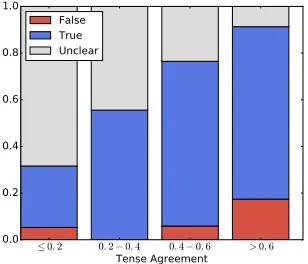
to mostly judgements of unclear.
Figure 1 shows that these expectations hold. When a verb with low tense agreement appeared as the main verb of a sentence, the truth of the comple-ment could only be inferred 30% of the time. When a verb with high tense agreement appeared as the main verb, the truth of the complement could be in-ferred 91% of the time. This difference is significant at p < 0.01. That is, tense agreement provides a
strong signal for identifying non-implicative verbs, and thus can help systems avoid false-positive en-tailment judgements, e.g. incorrectly inferring that
[image:4.612.109.263.381.513.2]wanting to merge⇒merging(Table 3).
Figure 1:Whether or not complement is entailed for main verbs with varying levels of tense agreement. Verbs with high tense agreement yield more definitive judgments (true/false). Each bar represents aggregated judgements over approx. 20 verbs.
Interestingly, tense agreement accurately mod-els verbs that are not implicative by definition, but which nonetheless tend to behave implicatively in practice. For example, our method finds high tense agreement for choose to andbe allowed to, which are often used to communicate, albeit indirectly, that their complements did in fact happen. To convince ourselves that treating such verbs as implicatives makes sense in practice, we manually look through
the RTE3 dataset (Giampiccolo et al., 2007) for ex-amples containing high-scoring verbs according to our method. Table 3 shows some example inferences that hinge precisely on recognizing these types ofde factoimplicatives.
5 Discussion and Related Work
Language understanding tasks such as RTE (Clark et al., 2007; MacCartney, 2009) and bias detection (Recasens et al., 2013) have been shown to require knowledge of implicative verbs, but such knowledge has previously come from manually-built word lists rather than from data. Nairn et al. (2006) and Mar-tin et al. (2009) describe automatic systems to han-dle implicatives, but require hand-crafted rules for each unique verb that is handled. The tense agree-ment method we present offers a starting point for acquiring such rules from data, and is well-suited for incorporating into statistical systems. The clear next step is to explore similar data-driven means for learning the specific behaviors of individual implica-tive verbs, which has been well-studied from a the-oretical perspective (Karttunen, 1971; Nairn et al., 2006; Amaral et al., 2012; Karttunen, 2012). An-other interesting extension concerns the role of tense in word representations. While currently, tense is rarely built directly into distributional representa-tions of words (Mikolov et al., 2013; Pennington et al., 2014), our results suggest it may offer important insights into the semantics of individual words. We leave this question as a direction for future work.
6 Conclusion
that captures the implicative tendencies of verbs by exploiting the tense relationship between the verb and its complement clauses. This method effectively separates known implicatives from known non-implicatives, and, more importantly, provides good predictive signal in an entailment recognition task.
Acknowledgments
We would like to thank Florian Schwartz for valu-able discussions. This research was supported by a Facebook Fellowship, and by gifts from the Al-fred P. Sloan Foundation, Google, and Facebook. This material is based in part on research sponsored by the NSF grant under IIS-1249516 and DARPA under number FA8750-13-2-0017 (the DEFT pro-gram). The U.S. Government is authorized to repro-duce and distribute reprints for Governmental pur-poses. The views and conclusions contained in this publication are those of the authors and should not be interpreted as representing official policies or en-dorsements of DARPA and the U.S. Government.
References
Patricia Amaral, Valeria de Paiva, Cleo Condoravdi, and Annie Zaenen. 2012. Where’s the meeting that was cancelled? existential implications of transitive verbs. InProceedings of the 3rd Workshop on Cognitive As-pects of the Lexicon, pages 183–194, Mumbai, India, December. The COLING 2012 Organizing Commit-tee.
Angel X Chang and Christopher D Manning. 2012. Su-time: A library for recognizing and normalizing time expressions. InLREC, pages 3735–3740.
Peter Clark, Phil Harrison, John Thompson, William Murray, Jerry Hobbs, and Christiane Fellbaum. 2007. On the role of lexical and world knowledge in rte3. In
Proceedings of the ACL-PASCAL Workshop on Textual Entailment and Paraphrasing, pages 54–59, Prague, June. Association for Computational Linguistics. Ido Dagan, Oren Glickman, and Bernardo Magnini.
2006. The PASCAL recognizing textual entailment challenge. In Machine Learning Challenges. Evalu-ating Predictive Uncertainty, Visual Object Classifica-tion, and Recognising Tectual Entailment, pages 177– 190. Springer.
Danilo Giampiccolo, Bernardo Magnini, Ido Dagan, and Bill Dolan. 2007. The third PASCAL recognising tex-tual entailment challenge. InProceedings of the
ACL-PASCAL workshop on textual entailment and para-phrasing, pages 1–9.
Lauri Karttunen. 1971. Implicative verbs. Language, pages 340–358.
Lauri Karttunen. 2012. Simple and phrasal implicatives. In *SEM 2012: The First Joint Conference on Lexi-cal and Computational Semantics – Volume 1: Pro-ceedings of the main conference and the shared task, and Volume 2: Proceedings of the Sixth International Workshop on Semantic Evaluation (SemEval 2012), pages 124–131, Montr´eal, Canada, 7-8 June. Associa-tion for ComputaAssocia-tional Linguistics.
Bill MacCartney. 2009. Natural language inference. Ph.D. thesis, Citeseer.
Fabienne Martin, Dennis Spohr, and Achim Stein. 2009. Disambiguation of polysemous verbs for rule-based inferencing. InProceedings of the Eight International Conference on Computational Semantics, pages 222– 234, Tilburg, The Netherlands, January. Association for Computational Linguistics.
Tomas Mikolov, Kai Chen, Greg Corrado, and Jeffrey Dean. 2013. Efficient estimation of word representa-tions in vector space.arXiv preprint arXiv:1301.3781. Rowan Nairn, Cleo Condoravdi, and Lauri Karttunen. 2006. Computing relative polarity for textual infer-ence. Inference in Computational Semantics (ICoS-5), pages 20–21.
Courtney Napoles, Matthew Gormley, and Benjamin Van Durme. 2012. Annotated gigaword. In Pro-ceedings of the Joint Workshop on Automatic Knowl-edge Base Construction and Web-scale KnowlKnowl-edge Ex-traction (AKBC-WEKEX), pages 95–100, Montr´eal, Canada, June. Association for Computational Linguis-tics.
Jeffrey Pennington, Richard Socher, and Christopher D. Manning. 2014. Glove: Global vectors for word rep-resentation. In Empirical Methods in Natural Lan-guage Processing (EMNLP), pages 1532–1543. Marta Recasens, Cristian Danescu-Niculescu-Mizil, and