LSTM Shift-Reduce CCG Parsing
Wenduan Xu Computer Laboratory University of Cambridge
Abstract
We describe a neural shift-reduce parsing model for CCG, factored into four unidirec-tional LSTMs and one bidirecunidirec-tional LSTM. This factorization allows the linearization of the complete parsing history, and results in a highly accurate greedy parser that outper-forms all previous beam-search shift-reduce parsers forCCG. By further deriving a glob-ally optimized model using a task-based loss, we improve over the state of the art by up to 2.67%labeled F1.
1 Introduction
Combinatory Categorial Grammar (CCG; Steedman, 2000) parsing is challenging due to its so-called “spurious” ambiguity that permits a large num-ber of non-standard derivations (Vijay-Shanker and Weir, 1993; Kuhlmann and Satta, 2014). To ad-dress this, thede factomodels resort to chart-based CKY(Hockenmaier, 2003; Clark and Curran, 2007), despite CCG being naturally compatible with shift-reduce parsing (Ades and Steedman, 1982). More recently, Zhang and Clark (2011) introduced the first shift-reduce model forCCG, which also showed substantial improvements over the long-established state of the art (Clark and Curran, 2007).
The success of the shift-reduce model (Zhang and Clark, 2011) can be tied to two main contributing factors. First, without any feature locality restric-tions, it is able to use a much richer feature set; while intensive feature engineering is inevitable, it has nevertheless delivered an effective and concep-tually simpler alternative for both parameter estima-tion and inference. Second, it couples beam search
with global optimization (Collins, 2002; Collins and Roark, 2004; Zhang and Clark, 2008), which makes it less prone to search errors than fully greedy mod-els (Huang et al., 2012).
In this paper, we present a neural architecture for shift-reduce CCG parsing based on long short-term memories (LSTMs; Hochreiter and Schmidhuber, 1997). Our model is inspired by Dyer et al. (2015), in which we explicitly linearize the complete history of parser states in an incremental fashion by requir-ing no feature engineerrequir-ing (Zhang and Clark, 2011; Xu et al., 2014), and no atomic feature sets (Chen and Manning, 2014). However, a key difference is that we achieve this linearization without relying on any additional control operations or compositional tree structures (Socher et al., 2010; Socher et al., 2011; Socher et al., 2013), both of which are vital in the architecture of Dyer et al. (2015). Crucially, unlike the sequence-to-sequence transduction model of Vinyals et al. (2015), which primarily conditions on the input words, our model is sensitive to all as-pects of the parsing history, including arbitrary po-sitions in the input.
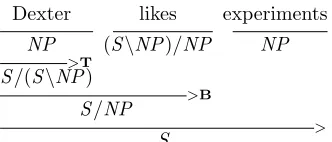
Dexter likes experiments
NP (S\NP)/NP NP >T
S/(S\NP)
>B
S/NP
[image:2.612.101.267.69.140.2]> S
Figure 1:ACCGderivation, in which each point corresponds to the result of a shift-reduce action. In this example, composition (B) and application (>) arereactions, and type-raising (T) is a
unaction.
as its beam-search counterpart.
On standard CCGBank tests, we clearly outper-form all previous shift-reduce CCGparsers; and by combining the parser with an attention-based LSTM supertagger (§4), we obtain further significant im-provements (§5).
2 Shift-Reduce CCG Parsing
CCG is strongly lexicalized by definition. A CCG grammar extracted from CCGBank (Hockenmaier and Steedman, 2007) contains over 400 lexical types and over 1,500 non-terminals (Clark and Curran, 2007), which is an order of magnitude more than those of a typical CFG parser. This lexicalized na-ture raises another unique challenge for parsing— any parsing model forCCGneeds to perform lexical disambiguation. This is true even in the approach of Fowler and Penn (2010), in which a context-free cover grammar extracted from CCGBank is used to parse CCG. Indeed, as noted by Auli and Lopez (2011a), the search problem for CCG pars-ing is equivalent to findpars-ing an optimal derivation in the weighted intersection of a regular language (generated by the supertagger) and a mildly context-sensitive language (generated by the parser), which can quickly become expensive.
The shift-reduce paradigm (Aho and Ullman, 1972; Yamada and Matsumoto, 2003; Nivre and Scholz, 2004) applied to CCG (Zhang and Clark, 2011) presents a more elegant solution to this prob-lem by allowing the parser to conduct lexical as-signment “incrementally” as a complete parse is be-ing built by the decoder. This is not possible with a chart-based parser, in which complete derivations must be built first. Therefore, a shift-reduce parser is able to consider a much larger set of categories per word for a given input, achieving higher
lexi-cal assignment accuracy than theC&Cparser (Clark and Curran, 2007), even with the same supertagging model (Zhang and Clark, 2011; Xu et al., 2014).
In our parser, we follow this strategy and adopt the Zhang and Clark (2011) style shift-reduce tran-sition system, which assumes a set of lexical cate-gories has been assigned to each word using a su-pertagger (Bangalore and Joshi, 1999; Clark and Curran, 2004). Parsing then proceeds by applying a sequence of actions to transform the input main-tained on aqueue, into partially constructed deriva-tions, kept on astack, until the queue and available actions on the stack are both exhausted. At each time step, the parser can choose to shift (sh) one of the lexical categories of the front word onto the stack, and remove that word from the queue; reduce(re) the top two subtrees on the stack using a CCGrule, replacing them with the resulting category; or take a unary(un) action to apply aCCG type-raising or type-changing rule to the stack-top element. For ex-ample, the deterministic sequence of shift-reduce ac-tions that builds the derivation in Fig.1 is:sh⇒NP,
un ⇒ S/(S\NP), sh ⇒ (S\NP)/NP, re ⇒
S/NP,sh⇒ NP andre⇒ S, where we use⇒to indicate theCCGcategory produced by an action.1
3 LSTM Shift-Reduce Parsing
3.1 LSTM
Recurrent neural networks (RNNs; e.g., see Elman, 1990) are factored into an input layerxtand a hid-den state (layer)htwith recurrent connections, and they can be represented by the following recurrence:
ht= Φθ(xt,ht−1), (1)
wherext is the current input, ht−1 is the previous
hidden state andΦis a set of affine transformations parametrized byθ. Here, we use a variant of RNN referred to as LSTMs, which augment Eq. 1 with a cell state,ct, s.t.
ht,ct= Φθ(xt,ht−1,ct−1). (2)
Compared with conventional RNNs, this extra fa-cility gives LSTMs more persistent memories over
1
longer time delays and makes them less suscepti-ble to the vanishing gradient prosuscepti-blem (Bengio et al., 1994). Hence, they are better at modeling temporal events that are arbitrarily far in a sequence.
Several extensions to the vanilla LSTM have been proposed over time, each with a modified instan-tiation of Φθ that exerts refined control over e.g., whether the cell state could be reset (Gers et al., 2000) or whether extra connections are added to the cell state (Gers and Schmidhuber, 2000). Our in-stantiation is as follows for all LSTMs:
it=σ(Wixxt+Wihht−1+Wicct−1+bi)
ft=σ(Wf xxt+Wf hht−1+Wf cct−1+bf)
ct=ftct−1+
ittanh(Wcxxt+Wchht−1+bc)
ot=σ(Woxxt+Wohht−1+Wocct+bo)
ht=ottanh(ct),
where σ is the sigmoid activation and is the element-wise product.
In addition to unidirectional LSTMs that model an input sequence x0,x1, . . . ,xn−1 in a strict
left-to-right order, we also use bidirectional LSTMs (BLSTMs; Graves and Schmidhuber, 2005), which read the input from both directions with two inde-pendent LSTMs. At each step, the forward hid-den state ht is computed using Eq. 2 for t =
(0,1, . . . , n−1); and the backward hidden statehˆt is computed similarly but from the reverse direction for t = (n−1, n−2, . . . ,0). Together, the two hidden states at each steptcapture both past and fu-ture contexts, and the representation for eachxt is obtained as the concatenation[ht; ˆht].
3.2 Embeddings
The neural network model employed by Chen and Manning (2014), and followed by a number of other parsers (Weiss et al., 2015; Zhou et al., 2015; Am-bati et al., 2016; Andor et al., 2016; Xu et al., 2016) allows higher-order feature conjunctions to be au-tomatically discovered from a set of dense feature embeddings. However, a set of atomic feature tem-plates, which are only sensitive to contexts from the top few elements on the stack and queue are still needed to dictate the choice of these embeddings. Instead, we dispense with such templates and seek
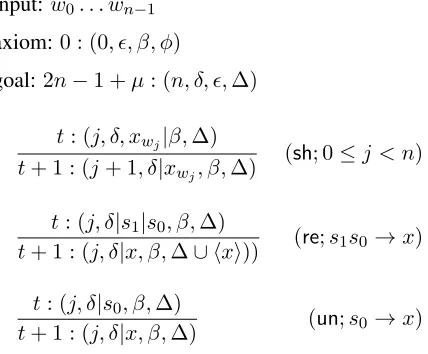
input:w0. . . wn−1
axiom:0 : (0, , β, φ)
goal:2n−1 +µ: (n, δ, ,∆)
t: (j, δ, xwj|β,∆)
t+ 1 : (j+ 1, δ|xwj, β,∆)
(sh; 0≤j < n)
t: (j, δ|s1|s0, β,∆)
t+ 1 : (j, δ|x, β,∆∪ hxi)) (re;s1s0→x)
t: (j, δ|s0, β,∆)
[image:3.612.317.531.74.251.2]t+ 1 : (j, δ|x, β,∆) (un;s0→x)
Figure 2: The shift-reduce deduction system. For thesh de-duction,xwj denotes an available lexical category forwj; for
re,hxidenotes the set of dependencies onx.
to design a model that is sensitive to both local and non-local contexts, on both the stack and queue.
Consequently, embeddings represent atomic input units that are added to our parser and are preserved throughout parsing. In total we use four types of embeddings, namely, word,CCGcategory, POSand action, where each has an associated look-up table that maps a string of that type to its embedding. The look-up table for words isLw ∈Rk×|w|, wherekis
the embedding dimension and|w|is the size of the vocabulary. Similarly, we have look-up tables for CCGcategories, Lc ∈ Rl×|c|, for the three types of actions,La∈Rm×3, and forPOStags,L
p ∈Rn×|p|.
3.3 Model
Parser. Fig. 2 shows the deduction system of our parser.2 We denote each parse item as(j, δ, β,∆), where j is the positional index of the word at the front of the queue, δ is the stack (with its top ele-ments0 to the right), and β is the queue (with its
top elementwj to the left) and∆is the set ofCCG dependencies realized for the input consumed so far. Each item is also associated with a step indicatort, signifying the number of actions applied to it and the goal is reached in2n−1 +µsteps, whereµis the total number ofunactions. We also define each action in our parser as a 4-tuple (τt, ct, wct, pwct),
whereτt ∈ {sh,re,un}fort≥1,ctis the resulting category ofτt, andwct is the head word attached to
2
Figure 3: An example representation for a parse item at time stept, with the 4 unidirectional LSTMs (left) and the bidirec-tional LSTM (right). The shaded cells on the left represent
δt= [hUt;hVt;hXt;hYt](Eq. 3), and the shaded cells on the right
representwj= [hWj; ˆh W
j].
ctwithpwct being itsPOStag.3
LSTM model. LSTMs are designed to handle
time-series data, in a purely sequential fashion, and we try to exploit this fact by completely linearizing all aspects of the parsing history. Concretely, we fac-tor the model as five LSTMs, comprising four uni-directional ones, denoted as U, V, X and Y, and an additional BLSTM, denoted as W (Fig. 3). Before parsing each sentence, we feed W with the complete input (padded with a special embedding⊥as the end of sentence token); and we use wj = [hWj ; ˆhWj ]to representwjin subsequent steps.4 We also add⊥to the other 4 unidirectional LSTMs as initialization.
Given this factorization, the stack representation for a parse item (j, δ, β,∆)at stept, for t ≥ 1, is obtained as
δt= [hUt;hVt;hXt;hYt], (3)
and together withwj,[δt;wj]gives a representation for the parse item. For the axiom item, we represent it as[δ0;w0], whereδ0 = [hU⊥;hV⊥;hX⊥;hY⊥].
Each time the parser applies an action
(τt, ct, wct, pwct), we update the model by adding
the embedding of τt, denoted as La(τt), onto U, and adding the other three embeddings of the action 4-tuple, that is,Lc(ct),Lw(wct)andLp(pwct), onto
V, X and Y respectively.
To predict the next action, we first derive an action hidden layerbt, by passing the parse item represen-tation[δt;wj]through an affine transformation, s.t.
bt=f(B[δt;wj] +r), (4)
3
In case of multiple heads, we always choose the first one.
4Word and
POSembeddings are concatenated at each input positionj, for0≤j < n; andwn= [hW⊥; ˆhW⊥].
where B is a parameter matrix of the model, r is a bias vector and f is a ReLU non-linearity (Nair and Hinton, 2010). Then we apply another affine transformation (withAas the weights and sas the bias) tobt:
at=f(Abt+s),
and obtain the probability of theithaction ina tas
p(τti|bt) =
exp{ait}
P τk
t∈T(δt,βt)exp{a
k t}
,
whereT(δt, βt)is the set of feasible actions for the current parse item, andτti∈ T(δt, βt).
3.4 Derivations and Dependency Structures
Our model naturally linearizesCCGderivations “in-crementally” following their post-order traversals. As such, the four unidirectional LSTMs always have the same number of steps; and at each step, the con-catenation of their hidden states (Eq. 3) represents a point in a CCG derivation (i.e., an action 4-tuple). Due to the large amount of flexibility in how de-pendencies are realized inCCG(Hockenmaier, 2003; Clark and Curran, 2007), and in line with most ex-isting CCG parsing models, including dependency models, we have chosen to modelCCGderivations, rather than dependency structures.5We also hypoth-esize that tree structures are not necessary for the current model, since they are already implicit in the linearized derivations; similarly, we have found the action embeddings to be nonessential (§5.2).
3.5 Training
As a baseline, we first train a greedy model, in which we maximize the log-likelihood of each tar-get action in the training data. More specifically, let
(τ1g, . . . , τTgn)be the gold-standard action sequence for a training sentencen, a cross-entropy criterion is used to obtain the error gradients, and for each sen-tence, training involves minimizing
L(θ) =−log
Tn
Y
t=1
p(τtg|bt) =− Tn
X
t=1
logp(τtg|bt),
whereθis the set of all parameters in the model.
5
As other greedy models (e.g., see Chen and Man-ning (2014) and Dyer et al. (2015)), our greedy model is locally optimized, and suffers from the label bias problem (Andor et al., 2016). A par-tial solution to this is to use beam search at test time, thereby recovering higher scoring action se-quences that would otherwise be unreachable with fully greedy inference. In practice, this has lim-ited effect (Table 2), and a number of more princi-pled solutions have been recently proposed to derive globallyoptimized models during training (Watan-abe and Sumita, 2015; Weiss et al., 2015; Zhou et al., 2015; Andor et al., 2016). Here, we extend our greedy model into a global one by adapting the ex-pected F-measure loss of Xu et al. (2016). To our best knowledge, this is the first attempt to train a globally optimized LSTM shift-reduce parser.
Letθ= {U,V,X,Y,W,B,A}be the weights of the baseline greedy model,6 we initialize the weights of the global model, which has the same ar-chitecture as the baseline, toθ, and we reoptimizeθ in multiple training epochs as follows:
1. Pick a sentencexnfrom the training set, decode it with beam search, and generate ak-best list of output parses with thecurrentθ, denoted as
Λ(xn).7
2. For each parse yi in Λ(xn), compute its sentence-level F1 using the set of dependencies in the∆field of its parse item. In addition, let
|yi|be the total number of actions that derived yiandsθ(yji)be the softmax action score of the jth action, given by the LSTM model. Com-pute the log-linear score of its action sequence asρ(yi) =P
|yi|
j=1logsθ(yij).
3. Compute the negative expected F1 objective (defined below) forxn and minimize it using stochastic gradient descent (maximizing ex-pected F1). Repeat these three steps for the re-maining sentences.
6
We use boldface letters to designate the weights of the cor-responding LSTMs, and omit bias terms for brevity.
7
As in Xu et al. (2016), we did not presetk, and foundk= 11.06on average with a beam size of 8 that we used for this training.
More formally, the lossJ(θ), is defined as
J(θ) =−XF1(θ)
=− X
yi∈Λ(xn)
p(yi|θ)F1(∆yi,∆
G xn),
where F1(∆yi,∆
G
xn)is the sentence level F1 of the
parse derived byyi, with respect to the gold-standard dependency structure∆Gxnofxn;p(yi|θ)is the nor-malized probability score of the action sequenceyi, computed as
p(yi|θ) =
exp{γρ(yi)} P
y∈Λ(xn)exp{γρ(y)}
,
whereγ is a parameter that sharpens or flattens the distribution (Tromble et al., 2008).8 Different from the maximum-likelihood objective, XF1 optimizes the model on a sequence level and towards the final evaluation metric, by taking into account all action sequences inΛ(xn).
4 Attention-Based LSTM Supertagging
In addition to the size of the label space, supertag-ging is difficult becauseCCGcategories can encode long-range dependencies and tagging decisions fre-quently depend on non-local contexts. For example, in He went to the zoo with a cat, a possible cate-gory forwith, (S\NP)\(S\NP)/NP, depends on the wordwentfurther back in the sentence.
Recently a number of RNN models have been proposed for CCG supertagging (Xu et al., 2015; Lewis et al., 2016; Vaswani et al., 2016; Xu et al., 2016), and such models show dramatic improve-ments over non-recurrent models (Lewis and Steed-man, 2014b). Although the underlying models differ in their exact architectures, all of them make each tagging decision using only the hidden states at the current input position, and this imposes a potential bottleneck in the model. To mitigate this, we gen-eralize the attention mechanisms of Bahdanau et al. (2015) and Luong et al. (2015), and adapt them to supertagging, by allowing the model to explicitly use hidden states from more than one input posi-tions for tagging each word. Similar to Bahdanau et al. (2015) and Luong et al. (2015), a key feature in
8
our model is a soft alignment vector that weights the relative importance of the considered hidden states.
For an input sentencew0, w1, . . . , wn−1, we
con-sider wt = [ht; ˆht] (§3.1) to be the representa-tion of the tth word (0 ≤ t < n, w
t ∈ R2d×1), given by a BLSTM with a hidden state size d for both its forward and backward layers.9 Let k be a context window size hyperparameter, we define
Ht∈R2d×(k−1) as
Ht= [wt−bk/2c, . . . ,wt−1,wt+1, . . . ,wt+bk/2c],
which contains representations for all words in the size k window except wt. At each position t, the attention model derives a context vectorct∈R2d×1 (defined below) fromHt, which is used in conjunc-tion withwtto produce an attentional hidden layer:
xt=f(M[ct;wt] +m), (5)
wheref is a ReLU non-linearity,M ∈ Rg×4d is a learned weight matrix,mis a bias term, andgis the size ofxt. Thenxtis used to produce another hidden layer (withNas the weights andnas the bias):
zt=Nxt+n,
and the predictive distribution over categories is ob-tained by feedingztthrough a softmax activation.
In order to derive the context vector ct, we first computebt∈R(k−1)×1fromHtandwtusingα∈ R1×4d, s.t. theithentry inbtis
bit=α[wT[i];wt],
fori∈[0, k−1),T = [t−bk/2c, . . . , t−1, t+1, . . . , t+ bk/2c]; andctis derived as follows:
at=softmax(bt),
ct=Htat,
where at is the alignment vector. We also exper-iment with two types of attention reminiscent of theglobalandlocalmodels in Luong et al. (2015), where the first attends over all input words (k =n) and the second over a local window.
It is worth noting that two other works have con-currently tackled supertagging with BLSTM mod-els. In Vaswani et al. (2016), a language model
9
Unlike in the parsing model,POStags are excluded.
layer is added on top of a BLSTM, which allows embeddings of previously predicted tags to propa-gate through and influence the pending tagging de-cision. However, the language model layer is only effective when both scheduled sampling for train-ing (Bengio et al., 2015) and beam search for infer-ence are used. We show our attention-based mod-els can match their performance, with only standard training and greedy decoding. Additionally, Lewis et al. (2016) presented a BLSTM model with two layers of stacking in each direction; and as an inter-nal baseline, we show a non-stacking BLSTM with-out attention can achieve the same accuracy.
5 Experiments
Dataset and baselines. We conducted all experi-ments on CCGBank (Hockenmaier and Steedman, 2007) with the standard splits.10 We assigned POS tags with the C&C POS tagger, and used 10-fold jackknifing for bothPOStagging and supertagging. All parsers were evaluated using F1 over labeled CCGdependencies.
For supertagging, the baseline models are the RNN model of Xu et al. (2015), the bidirectional RNN (BRNN) model of Xu et al. (2016), and the BLSTM supertagging models in Vaswani et al. (2016) and Lewis et al. (2016). For parsing exper-iments, we compared with the global beam-search shift-reduce parsers of Zhang and Clark (2011) and Xu et al. (2014). One neural shift-reduceCCG parser baseline is Ambati et al. (2016), which is a beam-search shift-reduce parser based on Chen and Manning (2014) and Weiss et al. (2015); and the oth-ers are the RNN shift-reduce models in Xu et al. (2016). Additionally, the chart-based C&C parser was included by default.
Model and training parameters.11 All our
LSTM models are non-stacking with a single layer.12 For the supertagging models, the LSTM
10
Training: Sections 02-21 (39,604 sentences). Develop-ment: Section 00 (1,913 sentences). Test: Section 23 (2,407 sentences).
11
We implemented all models using the CNN toolkit: https://github.com/clab/cnn.
12
Model Dev Test
C&C 91.50 92.02
Xu et al. (2015) 93.07 93.00
Xu et al. (2016) 93.49 93.52
Lewis et al. (2016) 94.1 94.3 Vaswani et al. (2016) 94.08 -Vaswani et al. (2016)+LM +beam 94.24 94.50
BLSTM 94.11 94.29
BLSTM-local 94.31 94.46
BLSTM-global 94.22 94.42
Table 1: 1-best supertagging results on both the dev and test sets. BLSTM is the baseline model without attention; BLSTM-local and -global are the two attention-based models.
hidden state size is 256, and the size of the atten-tional hidden layer (xt, Eq. 5) is 200. All parsing model LSTMs have a hidden state size of 128, and the size of the action hidden layer (bt, Eq. 4) is 80.
Pretrained word embeddings for all models are 100-dimensional (Turian et al., 2010), and all other embeddings are 50-dimensional. We also pretrained CCG lexical category and POS embeddings on the concatenation of the training data and a Wikipedia dump parsed withC&C.13All other parameters were uniformly initialized in±p
6/(r+c), wherer and c are the number of rows and columns of a ma-trix (Glorot and Bengio, 2010).
For training, we used plain non-minibatched stochastic gradient descent with an initial learning rateη0 = 0.1and we kept iterating in epochs until
accuracy no longer increases on the dev set. For all models, a learning rate scheduleηe = η0/(1 +λe)
withλ= 0.08was used fore≥11. Gradients were clipped whenever their norm exceeds 5. Dropout training as suggested by Zaremba et al. (2014), with a dropout rate of0.3, and an`2penalty of1×10−5,
were applied to all models.
5.1 Supertagging Results
Table 1 summarizes 1-best supertagging results. Our baseline BLSTM model without attention achieves the same level of accuracy as Lewis et al. (2016) and the baseline BLSTM model of Vaswani et al. (2016). Compared with the latter, our hidden state size is50%smaller (256 vs. 512).
For training and testing the local attention model (BLSTM-local), we used an attention window size
13We used the gensim word2vec toolkit: https://
radimrehurek.com/gensim/.
Supertaggerβ
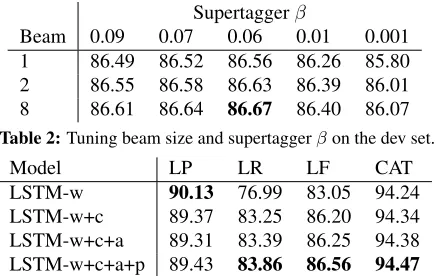
[image:7.612.318.536.71.209.2]Beam 0.09 0.07 0.06 0.01 0.001 1 86.49 86.52 86.56 86.26 85.80 2 86.55 86.58 86.63 86.39 86.01 8 86.61 86.64 86.67 86.40 86.07
Table 2:Tuning beam size and supertaggerβon the dev set.
Model LP LR LF CAT
LSTM-w 90.13 76.99 83.05 94.24
[image:7.612.84.285.71.191.2]LSTM-w+c 89.37 83.25 86.20 94.34 LSTM-w+c+a 89.31 83.39 86.25 94.38 LSTM-w+c+a+p 89.43 83.86 86.56 94.47
Table 3:F1 on dev for all the greedy models.
of5(tuned on the dev set), and it gives an improve-ment of 0.94% over the BRNN supertagger (Xu et al., 2016), achieving an accuracy on par with the beam-search (size 12) model of Vaswani et al. (2016) that is enhanced with a language model. De-spite being able to consider wider contexts than the local model, the global attention model (BLSTM-global) did not show further gains, hence we used BLSTM-local for all parsing experiments below.
5.2 Parsing Results
All parsers we consider use a supertagger probabil-ity cutoff β to prune categories less likely than β times the probability of the best category in a dis-tribution: for the C&C parser, it uses an adaptive strategy to backoff to smallerβ values if no span-ning analysis is found given an initialβ setting; for all the shift-reduce parsers, fixedβ values are used without backing off. Sinceβdetermines the deriva-tion space of a parser, it has a large impact on the final parsing accuracy.
78 79 80 81 82 83 84 85 86 87
0 5 10 15 20 25 30
F1 (labeled) on dev set
Training epochs LSTM-w LSTM-wc LSTM-wca LSTM-wcap
(a)Dev F1 of the greedy models
86.6 86.7 86.8 86.9 87 87.1 87.2 87.3 87.4 87.5
0 5 10 15 20
F1 (labeled) on dev set
Training epochs LSTM-XF1 (beam = 8)
[image:8.612.83.520.77.228.2](b)Dev F1 of the XF1 model
Figure 4:Learning curves with dev F-scores for all models.
Section 00 Section 23
Model Beam LP LR LF CAT LP LR LF CAT
C&C(normal-form) - 85.18 82.53 83.83 92.39 85.45 83.97 84.70 92.83 C&C(dependency hybrid) - 86.07 82.77 84.39 92.57 86.24 84.17 85.19 93.00 Zhang and Clark (2011) 16 87.15 82.95 85.00 92.77 87.43 83.61 85.48 93.12 Xu et al. (2014) 128 86.29 84.09 85.18 92.75 87.03 85.08 86.04 93.10
Ambati et al. (2016) 16 - - 85.69 93.02 - - 85.57 92.86
Xu et al. (2016)-greedy 1 88.12 81.38 84.61 93.42 88.53 81.65 84.95 93.57 Xu et al. (2016)-XF1 8 88.20 83.40 85.73 93.56 88.74 84.22 86.42 93.87
LSTM-greedy 1 89.43 83.86 86.56 94.47 89.75 84.10 86.83 94.63
LSTM-XF1 1 89.68 85.29 87.43 94.41 89.85 85.51 87.62 94.53
LSTM-XF1 8 89.54 85.46 87.45 94.39 89.81 85.81 87.76 94.57
Table 4:Parsing results on the dev (Section 00) and test (Section 23) sets with 100% coverage, with all LSTM models using the BLSTM-local supertagging model. All experiments using autoPOS. CAT (lexical category assignment accuracy). LSTM-greedy is the full greedy parser.
The greedy model. Table 3 shows the dev set re-sults for all greedy models, where the four types of embeddings, that is, word (w), CCG category (c), action (a) and POS (p), are gradually intro-duced. The full model LSTM-w+c+a+p surpasses all previous shift-reduce models (Table 4), achiev-ing a dev set accuracy of 86.56%. Category em-beddings (LSTM-w+c) yielded a large gain over us-ing word embeddus-ings alone (LSTM-w); action em-beddings (LSTM-w+c+a) provided little improve-ment, but further adding POS embeddings (LSTM-w+c+a+p) gave noticeable recall (+0.61%) and F1 improvements (+0.36%) over LSTM-w+c. Fig. 4a shows the learning curves, where all models con-verged in under 30 epochs.
The XF1 model. Table 4 also shows the results for the XF1 models (LSTM-XF1), which use all four types of embeddings. We used a beam size of8, and
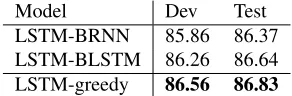
Model Dev Test
LSTM-BRNN 85.86 86.37 LSTM-BLSTM 86.26 86.64 LSTM-greedy 86.56 86.83
Table 5: Effect of different supertaggers on the full greedy parser. LSTM-greedy is the same parser as in Table 4, which uses the BLSTM-local supertagger.
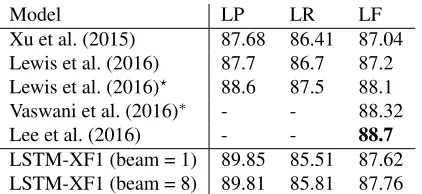
[image:8.612.352.498.466.514.2]Model LP LR LF Xu et al. (2015) 87.68 86.41 87.04 Lewis et al. (2016) 87.7 86.7 87.2 Lewis et al. (2016)? 88.6 87.5 88.1 Vaswani et al. (2016)∗ - - 88.32
Lee et al. (2016) - - 88.7
[image:9.612.81.292.70.167.2]LSTM-XF1 (beam = 1) 89.85 85.51 87.62 LSTM-XF1 (beam = 8) 89.81 85.81 87.76
Table 6: Comparison of our XF1 models with chart-based parsers on the test set.?denotes a tri-trained model and∗ indi-cates a differentPOStagger.
Effect of the supertagger. To isolate the parsing model from the supertagging model, we first ex-perimented with the BRNN supertagging model as in Xu et al. (2016) for both training and testing the full greedy LSTM parser. Using this supertag-ger, we still achieved the highest F1 (85.86%) on the dev set (LSTM-BRNN, Table 5) in compari-son with all previous shift-reduce models; and an improvement of 1.42% F1 over the greedy model of Xu et al. (2016) was obtained on the test set (Table 4). We then experimented with using the baseline BLSTM supertagging model for parsing (LSTM-BLSTM), and observed the attention-based setup (LSTM-greedy) outperformed it, despite the attention-based supertagger (BLSTM-local) did not give better multi-tagging accuracy. We owe this to the fact that large β cutoff values—resulting in almost deterministic supertagging decisions on average—are required by the parser during infer-ence; for instance, BLSTM-local has an average am-biguity of 1.09 on the dev set withβ = 0.06.14
Comparison with chart-based models. For
com-pleteness and to put our results in perspective, we compare our XF1 models with other CCG parsers in the literature (Table 6): Xu et al. (2015) is the log-linear C&C dependency hybrid model with an RNN supertagger front-end; Lewis et al. (2016) is an LSTM supertagger-factored parser using the A∗ CCG parsing algorithm of Lewis and Steed-man (2014a); Vaswani et al. (2016) combine a BLSTM supertagger with a new version of theC&C parser (Clark et al., 2015) that uses a max-violation perceptron, which significantly improves over the
14
All βcutoffs were tuned on the dev set; for BRNN, we found the sameβsettings as in Xu et al. (2016) to be optimal; for BLSTM,β = 4×10⁻⁵for training (with an ambiguity of
5.27) andβ= 0.02for testing (with an ambiguity of1.17).
originalC&Cmodels; and finally, a global recursive neural network model with A∗decoding (Lee et al., 2016). We note that all these alternative models— with the exception of Xu et al. (2015) and Lewis et al. (2016)—use structured training that accounts for violations of the gold-standard, and we conjecture further improvements for our model are possible by incorporating such mechanisms.15
6 Conclusion
We have presented an LSTM parsing model forCCG, with a factorization allowing the linearization of the complete parsing history. We have shown that this simple model is highly effective, with results out-performing all previous shift-reduce CCG parsers. We have also shown global optimization benefits an LSTM shift-reduce model; and contrary to previous findings with the averaged perceptron (Zhang and Clark, 2008), we empirically demonstrated beam-search inference is not necessary for our globally op-timized model. For future work, a natural direction is to explore integrated supertagging and parsing in a single neural model (Zhang and Weiss, 2016).
Acknowledgment
I acknowledge the support from the Carnegie Trust for the Universities of Scotland through a Carnegie Scholarship.
References
Anthony Ades and Mark Steedman. 1982. On the order of words. InLinguistics and philosophy. Springer. Alfred Aho and Jeffrey Ullman. 1972. The theory of
parsing, translation, and compiling. Prentice-Hall. Bharat Ram Ambati, Tejaswini Deoskar, and Mark
Steed-man. 2016. Shift-reduce CCG parsing using neural network models. InProc. of NAACL (Volume 2). Daniel Andor, Chris Alberti, David Weiss, Aliaksei
Severyn, Alessandro Presta, Kuzman Ganchev, Slav Petrov, and Michael Collins. 2016. Globally nor-malized transition-based neural networks. InProc. of ACL.
Michael Auli and Adam Lopez. 2011a. A comparison of loopy belief propagation and dual decomposition for
15
integrated CCG supertagging and parsing. InProc. of ACL.
Michael Auli and Adam Lopez. 2011b. Training a log-linear parser with loss functions via softmax-margin. InProc. of EMNLP.
Dzmitry Bahdanau, Kyunghyun Cho, and Yoshua Ben-gio. 2015. Neural machine translation by jointly learning to align and translate. InProc. of ICLR. Srinivas Bangalore and Aravind Joshi. 1999.
Supertag-ging: An approach to almost parsing. In Computa-tional linguistics. MIT Press.
Yoshua Bengio, Patrice Simard, and Paolo Frasconi. 1994. Learning long-term dependencies with gradient descent is difficult. InNeural Networks, IEEE Trans-actions on. IEEE.
Samy Bengio, Oriol Vinyals, Navdeep Jaitly, and Noam Shazeer. 2015. Scheduled sampling for sequence pre-diction with recurrent neural networks. In Proc. of NIPS.
Danqi Chen and Christopher Manning. 2014. A fast and accurate dependency parser using neural networks. In
Proc. of EMNLP.
Stephen Clark and James Curran. 2004. The importance of supertagging for wide-coverage CCG parsing. In
Proc. of COLING.
Stephen Clark and James Curran. 2007. Wide-coverage efficient statistical parsing with CCG and log-linear models. InComputational Linguistics. MIT Press. Stephen Clark, Darren Foong, Luana Bulat, and
Wend-uan Xu. 2015. The Java version of the C&C parser. Technical report, University of Cambridge Computer Laboratory.
Michael Collins and Brian Roark. 2004. Incremental parsing with the perceptron algorithm. In Proc. of ACL.
Michael Collins. 2002. Discriminative training methods for hidden Markov models: Theory and experiments with perceptron algorithms. InProc. of EMNLP. Chris Dyer, Miguel Ballesteros, Wang Ling, Austin
Matthews, and Noah A. Smith. 2015. Transition-based dependency parsing with stack long short-term memory. InProc. of ACL.
Jason Eisner. 1996. Efficient normal-form parsing for Combinatory Categorial Grammar. InProc. of ACL. Jeffrey Elman. 1990. Finding structure in time. In
Cog-nitive science. Elsevier.
Timothy Fowler and Gerald Penn. 2010. Accu-rate context-free parsing with Combinatory Categorial Grammar. InProc. of ACL.
Felix Gers and J¨urgen Schmidhuber. 2000. Recurrent nets that time and count. InNeural Networks. IEEE. Felix Gers, J¨urgen Schmidhuber, and Fred Cummins.
2000. Learning to forget: Continual prediction with LSTM. InNeural computation. MIT Press.
Xavier Glorot and Yoshua Bengio. 2010. Understand-ing the difficulty of trainUnderstand-ing deep feedforward neural networks. InProc. of AISTATS.
Joshua Goodman. 1996. Parsing algorithms and metrics. InProc. of ACL.
Alex Graves and J¨urgen Schmidhuber. 2005. Frame-wise phoneme classification with bidirectional LSTM and other neural network architectures. InNeural Net-works. Elsevier.
Sepp Hochreiter and J¨urgen Schmidhuber. 1997. Long short-term memory. In Neural computation. MIT Press.
Julia Hockenmaier and Mark Steedman. 2007. CCG-Bank: A corpus of CCG derivations and dependency structures extracted from the Penn Treebank. In Com-putational Linguistics. MIT Press.
Julia Hockenmaier. 2003. Data and Models for Statis-tical Parsing with Combinatory Categorial Grammar. Ph.D. thesis, University of Edinburgh.
Liang Huang, Suphan Fayong, and Yang Guo. 2012. Structured perceptron with inexact search. In Proc. of NAACL.
Marco Kuhlmann and Giorgio Satta. 2014. A new pars-ing algorithm for Combinatory Categorial Grammar. InTransactions of the Association for Computational Linguistics. ACL.
Kenton Lee, Mike Lewis, and Luke Zettlemoyer. 2016. Global neural CCG parsing with optimality guaran-tees. InProc. of EMNLP.
Mike Lewis and Mark Steedman. 2014a. A* CCG parsing with a supertag-factored model. In Proc. of EMNLP.
Mike Lewis and Mark Steedman. 2014b. Improved CCG parsing with semi-supervised supertagging. In Trans-actions of the Association for Computational Linguis-tics. ACL.
Mike Lewis, Kenton Lee, and Luke Zettlemoyer. 2016. LSTM CCG parsing. InProc. of NAACL.
Minh-Thang Luong, Hieu Pham, and Christopher Man-ning. 2015. Effective approaches to attention-based neural machine translation. InProc. of EMNLP. Vinod Nair and Geoffrey Hinton. 2010. Rectified linear
units improve restricted boltzmann machines. InProc. of ICML.
Joakim Nivre and Mario Scholz. 2004. Deterministic dependency parsing of English text. InProc. of COL-ING.
David Smith and Jason Eisner. 2006. Minimum-risk annealing for training log-linear models. InProc. of COLING-ACL.
Proc. of the NIPS Deep Learning and Unsupervised Feature Learning Workshop.
Richard Socher, Cliff Lin, Christopher Manning, and An-drew Ng. 2011. Parsing natural scenes and natural language with recursive neural networks. InProc. of ICML.
Richard Socher, John Bauer, Christopher Manning, and Andrew Ng. 2013. Parsing with compositional vector grammars. InProc. of ACL.
Mark Steedman. 2000. The Syntactic Process. MIT Press.
Roy Tromble, Shankar Kumar, Franz Och, and Wolfgang Macherey. 2008. Lattice minimum bayes-risk de-coding for statistical machine translation. InProc. of EMNLP.
Joseph Turian, Lev Ratinov, and Yoshua Bengio. 2010. Word representations: a simple and general method for semi-supervised learning. InProc. of ACL.
Ashish Vaswani, Yonatan Bisk, Kenji Sagae, and Ryan Musa. 2016. Supertagging with LSTMs. InProc. of NAACL (Volume 2).
Krishnamurti Vijay-Shanker and David Weir. 1993. Parsing some constrained grammar formalisms. In
Computational Linguistics. MIT Press.
Oriol Vinyals, Lukasz Kaiser, Terry Koo, Slav Petrov, Ilya Sutskever, and Geoffrey Hinton. 2015. Grammar as a foreign language. InProc. of NIPS.
Taro Watanabe and Eiichiro Sumita. 2015. Transition-based neural constituent parsing. InProc. of ACL. David Weiss, Chris Alberti, Michael Collins, and Slav
Petrov. 2015. Structured training for neural network transition-based parsing. InProc. of ACL.
Wenduan Xu, Stephen Clark, and Yue Zhang. 2014. Shift-reduce CCG parsing with a dependency model. InProc. of ACL.
Wenduan Xu, Michael Auli, and Stephen Clark. 2015. CCG supertagging with a recurrent neural network. In
Proc. of ACL (Volume 2).
Wenduan Xu, Michael Auli, and Stephen Clark. 2016. Expected F-measure training for shift-reduce parsing with recurrent neural networks. InProc. of NAACL. Hiroyasu Yamada and Yuji Matsumoto. 2003. Statistical
dependency analysis using support vector machines. InProc. of IWPT.
Wojciech Zaremba, Ilya Sutskever, and Oriol Vinyals. 2014. Recurrent neural network regularization. In
Proc. of ICLR.
Yue Zhang and Stephen Clark. 2008. A tale of two parsers: investigating and combining graph-based and transition-based dependency parsing using beam-search. InProc. of EMNLP.
Yue Zhang and Stephen Clark. 2011. Shift-reduce CCG parsing. InProc. of ACL.
Yuan Zhang and David Weiss. 2016. Stack-propagation: Improved representation learning for syntax. InProc. of ACL.
Hao Zhou, Yue Zhang, Shujian Huang, and Jiajun Chen. 2015. A neural probabilistic structured-prediction model for transition-based dependency parsing. In
![Figure 3: An example representation for a parse item at timerepresentstep t, with the 4 unidirectional LSTMs (left) and the bidirec-tional LSTM (right).The shaded cells on the left representδt = [hUt ; hVt ; hXt ; hYt ] (Eq](https://thumb-us.123doks.com/thumbv2/123dok_us/1359161.668500/4.612.90.284.77.150/figure-example-representation-timerepresentstep-unidirectional-bidirec-shaded-representdt.webp)