T o w a r d s a W o r k b e n c h for A c q u i s i t i o n of
D o m a i n K n o w l e d g e from N a t u r a l L a n g u a g e
A n d r e i M i k h e e v a n d S t e v e n F i n c h
H C R C L a n g u a g e T e c h n o l o g y G r o u p U n i v e r s i t y of E d i n b u r g h
2 B u c c l e u c h P l a c e , E d i n b u r g h E H 8 9 L W , S c o t l a n d , U K E - m a i h A n d r e i . M i k h e e v Q e d . a c . u k
Abstract
In this paper we describe an architecture and functionality of main components of a workbench for an acquisition of do- main knowledge from large text corpora. The workbench supports an incremental process of corpus analysis starting from a rough automatic extraction and or- ganization of lexico-semantic regularities and ending with a computer supported analysis of extracted data and a semi- automatic refinement of obtained hypo- theses. For doing this the workbench em- ploys methods from computational lin- guistics, information retrieval and kno- wledge engineering. Although the work- bench is currently under implementation some of its components are already im- plemented and their performance is il- lustrated with samples from engineering for a medical domain.
1 I n t r o d u c t i o n
One of the standard methods for the extraction of domain knowledge (or domain schema in ano- ther terminology) from texts is known as Distribu- tional Analysis (Hirshman 1986). It is based on the identification of the sublanguage specific co- occurrence properties of words in the syntactic re- lations in which they occur in the texts. These co- occurrence properties indicate important seman- tic characteristics of the domain: classes of ob- jects and their hierarchical inclusion, properties of these classes, relations among them, lexico- semantic patterns for referring to certain concep- tual propositions, etc. This knowledge about do- main in the form it is extracted is not quite sui- table to be included into the knowledge base and require a post-processing of the linguistically trai- ned knowledge engineer. This is known as a con-
often requires the help of a domain expert. Ho- wever, it seems to be possible to automate some tasks and facilitate human intervention in many parts using a combination of NLP and statistical techniques for data extraction, type oriented pat- terns for conceptual characterization of this data and an intuitive user interface.
All these resources are to be put together into a Knowledge Acquisition Workbench (KAWB) which is under development at LTG of the Uni- versity of Edinburgh. The workbench supports an incremental process of corpus analysis star- ting from a rough automatic extraction and orga- nization of lexico-semantic regularities and ending with a computer supported analysis of extracted data and a refinement of obtained hypotheses.
2 K A W A r c h i t e c t u r e
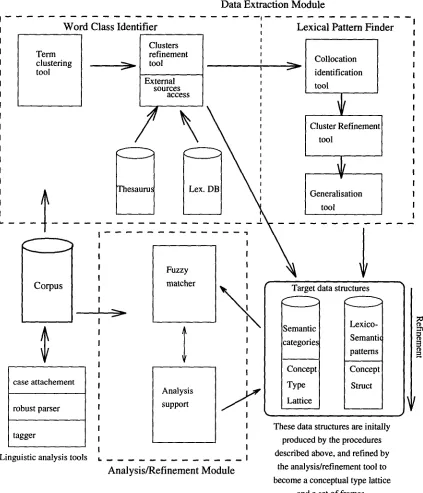
The workbench we are aiming at integrates com- putational tools and a user interface to support phases of data extraction, data analysis and hypo- theses refinement. The target domain description consists of words grouped into domain-specific se- mantic categories which can be further refined into a conceptual type lattice (CTL) and lexico- semantic patterns further refined into conceptual structures as shown elsewhere in the paper. KAW architecture is displayed in figure 1.
Data Extraction Module
T e r m clustering tool
---I
Corpus
I
case attachement
robust parser
tagger
Linguistic analysis tools
W o r d Class Identifier
f
/
Clusters refinement tool
External sources
access
Fuzzy I
f
Lexical Pattern Finder
Collocation
identification tool
Cluster Refinement tool
Generalisation
tool
f
matcher
Analysis support
I I I I I
I I I I I Analysis/Refinement Module
Target data structures
;emantic Lexico-
:ategodes Semantic
patterns
Concept Concept
Type Struct
Lattice
These data structures are initally produced by the procedures described above, and refined by
the analysis/refinement tool to become a conceptual type lattice
and a set of frames.
t~
[image:2.596.52.475.79.572.2]The w o r d class identification c o m p o n e n t en- compasses tools for the linguistic annotation of texts, word clustering tools and tools for access to external linguistic and semantic sources like thesauri, machine-readable dictionaries and lexi- cal data bases. Statistical clustering can be au- tomatically checked and subcategorized with the help of external linguistic and s e m a n t i c sources. The p a t t e r n f i n d e r c o m p o n e n t makes use of phrasal annotations of texts produced by a ge- neral robust partial parser. First, the corpus is checked for stable phrasal collocations for single words and entire semantic clusters by a special tool - a collocator. After collocations are collec- ted another tool - a generalizer tries automatically deduce regularities and contract multiple patterns into their general representations. Such patterns are then presented for a conceptual characteriza- tion to the knowledge engineer and some prede- fined generic conceptual structures are suggested for specialization.
The main aim of the analysis and r e f i n e m e n t m o d u l e is to uncover and refine structural gene- ralities found in the previous phases. It matches in the text patterns which represent hypotheses of the knowledge engineer, groups together and generalizes the found cases and presents them to the knowledge engineer for a final decision. The matcher evaluates how good a given piece of text matches the pattern and returns matches at va- rious levels of exactness.
If modules are to communicate flexibly then an inter-module information representation format needs to be specified. Standard Generalized Mar- kup Language (Goldfab 1990) is an international standard for marking up text. We use SGML as a way of exchanging information between modules in a knowledge acquisition system, and of storing that information in persistent store when it has been processed.
In the rest of the paper we will embark on a more detailed characterization of tools themselves. We, however, will not present any technical details and suggestions on an actual implementation because the workbench should be able to incorporate dif- ferent implementations . Some of the tools axe already implemented while others still need im- plementation or reimplementation in terms of the open architecture of the workbench. For an illu- stration we have used samples from engineering for the cardiac-failure domain using OHSUMED (Hersh 1994) corpus and a corpus of patient di- scharge summaries ( PDS ) described in Mikheev 1994.
3
Linguistic Annotation
The simplest form of linguistic description of the content of a machine-readable document is in the form of a sequence (or a set) of words. More so- phisticated linguistic information comes in several forms, all of which may need to be represented if performance in an automatic acquisition of lexical regularities is to be improved. The NLP module of the KAWB consists of a word tagger (e.g. Ku- piec 1993), a specialized partial robust parser and a case attachment module.
The tagger assigns categorial features to words. This is not a straightforward process due to the general lexical ambiguity of any natural langu- age but state-of-the-art taggers do this quite well (more than 97% correctness) using different stra- tegies usually based on an application of Hidden Markov Models (HMMs).
It is well-known that a general text parsing is very fragile and ambiguous by its nature. Syntactic ambiguity can lead to hundreds of parses even for fairly simple sentences. This is clearly inappro- priate. However, general and full scale parsing is not required for many tasks of knowledge ac- quisition but rather a robust identification of cer- tain text segments is needed. Among these seg- ments are compound noun phrases, verb phrases etc. To increase a precision of knowledge extrac- tion in some cases it is quite important to resolve references of pronominal anaphora. At the mo- ment in parsing sentences we are using a temporal expressions recognizer, a noun-phrase recognizer, a simple verb-phrase recognizer and a simple ana- phoric binder. This can be further extended to treat other phenomena of natural language, pro- viding that new components are robust and fast. The parser supplies information to a case atta- c h e m e n t module. This module using semantically driven role filler expectations for verbs provides a more precise attachment of noun phrases to verbs. To do this we are using ESK - an event and state knowledge base (Whittemore 94) which for more that 700 verbs contains information on thematic roles, semantic types for arguments, expected ad- juncts, syntactic information, propositional types, WordNet concept types and sense indices.
4
A u t o m a t i c Precategorization
the Zipf-Mandelbrot law, which states that the frequency of the n t h most frequent word in a na- tural language is (roughly) inversely proportional to n. Thus the majority of word tokens appear in a small fraction of the possible word types. Finch & Chater (1991) show how it is possible to infer a syntactic and semantic classification of a set of words by analyzing how they are used in a very large corpus. This is useful because very large corpora frequently exist for many domains. For example, in the medical domain, the freely available OHSUMED corpus (Hersh 1994) contains some 40 million words of medical texts. We now describe this m e t h o d for inferring a syntactic and semantic classification of words from scratch. Firstly, we measure the contexts in which words w E W occur, and define a statistically motiva- ted similarity measure between contexts of occur- rence of words to infer a similarity between words,
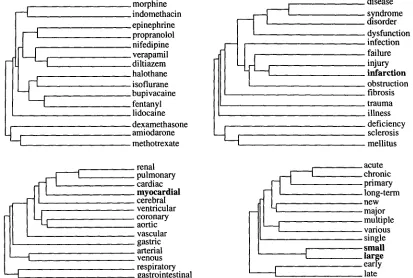
d(wl, w2), wl, w2 E W. In our case the context is defined to be a vector of word bigram statistics across the corpus for one and two words to the left and right, thus representing each word to be classified by a vector of bigram statistics. T h e n we apply a classification procedure to produce a hierarchical single link clustering (or dendrogram) (Sokal & S n e a t h , 1963) of words which we use as a basis for further classification. If this technique (as more fully described in Finch 1993) is applied to the OHSUMED corpus, some of the structure which is uncovered is displayed in figure 2. This figure displays part of a 3,000 word dendrogram which can then be "cut" at an appropriate level to form a set of disjoint classes which can then be or- dered according to their frequency of occurrence. This gives the knowledge engineer a means to quickly and relatively accurately classify the most frequent vocabulary used in a particular domain.
5
L e x i c o - S e m a n t i c P a t t r e n
A c q u i s i t i o n
Lexico-semantic patterns are structures where lin- guistic entries, semantic types and entire lexico- semantic patterns can be used in combinations to denote certain conceptual propositions of the underlying domain and cover certain sequences of words in the text. Linguistic entries can be words, phrases and linguistic types, for example: "of" - word, < N P head = " i n f a r c t i o n " > - a noun phrase with the head-word "infarction", < S Y N T type = N > - a noun etc. P a t t e r n s themselves are the ba- sis for induction of conceptual structures.
An example of a correspondence of many phra- ses to one lexico-semantic p a t t e r n is shown in fi- gure 3. This p a t t e r n covers all strings which have a reference to a person followed by one of the li-
sted verbs in any form followed by a compound noun with the head "infarction" and followed by a date expression. In this p a t t e r n $ P E R S O N and $DATE are patterns themselves and all other con- stituents are linguistic entries. If instead of "inf- arction" we use a type [DISEASE] we can achieve even broader coverage. Also note t h a t the $DATE constituent is optional which is expressed by "?". A conceptual structure which corresponds to the pattern adds more implicit information to the pat- tern. For instance, it states explicitly t h a t a b o d y component which is a location of a disease belongs to the person who is an experiencer of t h a t disease: [@infarction:V]
--~ (is-a)--~[@disease] -+(expr)-~[@person:y]
-+ (loc)--+[@body-COMP]+--(has) +-[@person:*y] --+ (cul)-+ [@time-point]
From the NL Processing point of view lexico- semantic patterns provide a way for going a b o u t without the definition of a general semantics for every word in the corpus. Many commonsense words take their particular meaning only in a con- text of domain categories and this can be expres- sed by means of lexico-semantic patterns.
5.1 C o l t o c a t o r
The collocator or multi-word term extraction mo- dule finds in the corpus significant co-occurrence of lexical items (words and phrases) which con- stitute terminology. Identified by the robust par- tial parser noun and verb groups which include domain semantic categories elicited at the preca- tegorization phase are collected together with fre- quencies of their appearance in the corpus. P h r a - ses are filtered through a list of general purpose words which is constructed separately for every new domain. Phrases which occur more often than a threshold computed using Zipf-Mandelbrot law are saved for post-analysis. Other phrases are decomposed into constituents for recalculation of saved phrase weights as described in Mikheev 91. Many terms include other terms as their compo- nents. This surface lexical structure corresponds to semantic relations between concepts represen- ted by these terms. To uncover term inclusion the system scans the term bank and replaces each entry of a term which currently in focus with its number. Figure 4 displays an excerpt from collo- cations extracted from PDS corpus in the original form and after term inclusion checking.
5.2 Inner C o n t e x t C a t e g o r i z a t i o n
morphine
~ indomethacin
epinephrine propranolol
. nifedipine
_ verapamil
_ diltiazem
_. halothane -. isoflurane bupivacaine fentanyl lidocaine dexamethasone
_ ~ amiodarone
methotrexate
t
-41
disease ~is ndrome
order dysfunction infection failure injury infarction obstruction fibrosis trauma illness deficiency sclerosis mellitus renal
pulmonary cardiac myocardial cerebral
I ventricular
coronary aortic vascular gastric arterial
I venous
respiratory
I gastrointestinal
I
S
----t
acute chronic primary long-term
new major
multiple
various
single small lar[ge early late
Figure 2: This figure shows four sub-clusters of our hierarchical cluster analysis of the 3,000 most frequent words in the OHSUMED corpus (Hersh 1994). It shows a subcluster of drugs (top left), disease- based nouns (top right), body-part adjectives (lower left), and condition modifying adjectives (lower right).
He had suffered He had
She had had
Mr.Mcdool sustained She developed
an acute myocardial infarction a true posterior myocardial infarction an interior infarction
a small anterior myocardial infarction an extensive myocardial infarction
in 1992.
on 5th of November 1992... in 1985.
in October 92.
$PERSON <V head = {suffer, have, sustain, develop} > <NC head = "infarction"> {"on", "in"} $DATE? Figure 3: This figure shows a correspondence of many phrases to one lexico-semantic pattern.
Num Freq $136 373 $234 475 $467 550 $1109 17 $1154 48 $2574 21 $2974 23 $2980 46 $3004 79
Annotated Phrase
myocardial//BODY-PART infarction//DISEASE
anterior myocardial//BODY-PART infarction//DISEASE inferior myoeardial//BODY-PART infarction//DISEASE
established inferior myocardial//BODY-PART infarction//DISEASE
history//INFORMATION of ischwemic heart//BODY-PART disease//DISEASE
history//INFOR.MATION of an anterior myocardial//BODY-PART infarction//DISEASE moderately severe stenosis//DISEASE
aortic//BODY-PART valve//BODY-PART stenosis//DISEASE
stenosis//DISEASE in the right coronary//BODY-PART artery//BODY-PART
[image:5.596.95.508.81.359.2] [image:5.596.127.521.439.494.2] [image:5.596.99.557.575.682.2]terms usually have a particular set of modifiers which represent different properties. The inner context categorization is started with extraction of compound nouns from collected by the colloca- tor noun phrases. Semantic categories for many adjectieval modifiers extracted at the word clu- stering phase are too general if any, but collected collocations and external lexical sources as, for ex- ample, WordNet can be used.
First, we can sort terms with the same head-word by length. For example, for the type INFARCTION the systems sorts terms as follows:
myocardial infarction, old infarction, acute infarction acute myocardial infarction, anterior myocardial inf- arction...
further anterior myocardial infarction...
Then we separate pure adjectival modifiers from adjectivized nouns:
infarction : inferior, old, acute, post, further, antero- lateral, lateral, infero-posterior, antero-septal, repea- ted, significant, large, limited / / myocardial, dia- phragmatic, subendocardial
m y o c a r d i a l i n f a r c t i o n : anterior, first, extensive, minor, small, previous, posterior, suspected.
Next we cluster pure adjectival modifiers into groups using synonym-antonym information avai- lable in WordNet. However, it is not necessarily the case t h a t related adjectives are stated together in one WordNet entry. Sometimes there is an in- direct link between adjectives. Also, since quite often WordNet gives semantically unrelated (in a given domain) adjectives together we use a heu- ristic rule which says t h a t if two adjectives are used together in one phrase they don't hold syno- nymy//antonymy relation.
The system assumes t h a t if there is at least one word in common in WordNet entries for two dif- ferent adjectives they can be clustered together. In our example for the type INFARCTION the fol- lowing clusters were automatically obtained: d u s t e r 1: chronic vs. acute;
d u s t e r 2: major, extensive, significant, large, old vs. minor, small, limited;
cluster 3: post vs. previous, ensuing; cluster 4: anterior vs. posterior; d u s t e r 5: inferior vs. superior;
rest: suspected; lateral; recent; further; repeated; As we see all clusters look fairly plausible except the single adjective "old" which was misclassified; it stands for a temporal p r o p e r t y of an infarction rather t h a n its spreading at a myocardium. This algorithm is gradually applied to al]~ entries
from the term bank and the knowledge engineer is presented with the results. This m e t h o d was fairly successfully used in our experiment, however, a large-scale evaluation of sense discrimination for constituent words is still needed to be done. 5.3 O u t e r C o n t e x t G e n e r a l i z e r
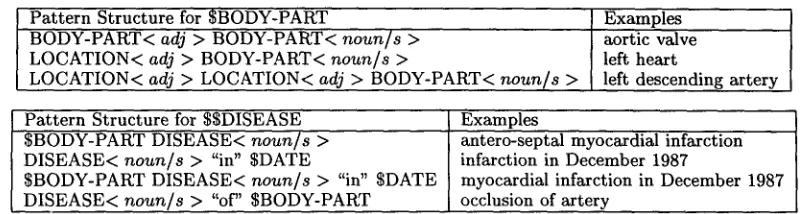
T h e lexico-semantic generalizer is a tool which extracts general lexico-semantic patterns in an empirical, corpus-sensitive manner analogous to that used to automatically extract word class dendrograms. From the multi-word t e r m bank collected by the collocation tool, we derive se- mantic frames by replacing each content word in each phrase by its semantic category, derived eit- her empirically from the word-level dendrogram in the case of frequent words, or derived from WordNet in the case of less frequent words (as described above). We also part of speech tag every word in the phrase. Therefore, the term "myocardial infarction" might become "BODY- PART<adj> DISEASE<noun/s>", as might "ga- strointestinal obstruction" or "respiratory fai- lure". Another example might be the assignment of "DISEASE<noun/s> of BODYPART<noun/pl>" to "obstruction of arteries" (function words such as "of" are usually not further subcategorized, since they convey structural information in them- selves). Thus we map the term bank to a set of paradigms, and we choose the set of paradigms which appear most frequently for clustering. Clustering proceeds by mapping words in the cor- pus to their semantic category (augmented with part-of-speech information), and clustering in the same way as we did for words, except t h a t the context vectors are recorded for the set of frequent semantic paradigms. For infrequent words where the empirical method for finding semantic class can't be applied, the WordNet technique descri- bed above is used. When this is done, we get a clustering of short lexico-semantic p a r a d i g m s . Once this is achieved, we can again apply the same methodology to find patterns of higher level which include patterns themselves. In our notation, we refer to singe word semantic categories as upper- case labels (which we choose as being descriptive of the class which has been discovered), simple se- quences of semantic categories by a preceding "$", and a sequence of sequences by a preceding "$$". These higher level patterns can be clustered in the same way to yield longer semantic sequence para- digms. Figure 5 illustrates generalizations for the types $BODY-PART and $$DISEASE.
5.4 A n a l y s i s S u p p o r t T o o l
Pattern Structure for $BODY-PART
BODY-PART< adj > BODY-PART< noun/s >
LOCATION< adj > BODY-PART< noun/s >
LOCATION< adj > LOCATION< adj > BODY-PART< noun/s >
Examples aortic valve left heart
left descending artery I Pattern Structure for $$DISEASE
$BODY-PART DISEASE< noun/s >
DISEASE< noun/s > "in" $DATE
$BODY-PART DISEASE< noun/s > "in" SDATE DISEASE< noun/s > "of" $BODY-PART
antero-septal myocardial infarction infarction in December 1987
myocardial infarction in December 1987 occlusion of artery
Figure 5: This figure shows results of generalization for the types SBODY-PART and $$DISEASE.
rent conceptual types (as more fully described in Mikheev & Moens 1994). For example, a type ori- ented structure for eventualities includes their the- matic roles (agent, theme ...), temporal links and properties while a type-oriented structure for ob- jects includes their components, parts, areas and properties. T h e system recognizes which structure should be used and presents it to the knowledge engineer with optional explanations or a question guided strategy for filling it up.
6 H y p o t h e s e s R e f i n e m e n t
A fuzzy matcher is a tool which uses a sophisti- cated p a t t e r n - m a t c h i n g language to extract text fragments at various levels of exactness. It mat- ches in the text patterns which represent hypo- theses of the knowledge engineer, groups together and generalizes cases which have been discovered and presents them to the knowledge engineer for a final decision.
P a t t e r n s themselves can be quite complex con- structions which can include strings, words, ty- pes, precedence relations and distance specifiers. In the simpliest case the knowledge engineer can examine a context for occurrences for a word or a type provided t h a t the type exists in the term bank as represented in figure 6.
More complex patterns can be used for the description of complex groups. For instance, there a request can be made to find all co- occurrences of the type DISEASE with the type BODY-COMPONENT when they are at the same structural group (noun phrase or verb phrase) and the disease is a head of the group:
{ [disease]. < > [body-component] }
curly brackets impose a context of a structural group, the "." means t h a t the words can be dis- tributed in the group, < > means t h a t the compo- nent can be b o t h to the left and to the right, and since the DISEASE is the first element of the pat- tern it is assumed to be the head. T h e program matches this p a t t e r n into the following entries:
myocardial infarction, infarction of myocardium, ste- nosis at the origin of left coronary artery...
To be powerful enough for our purposes this pat- tern language should be quite complex and it is important to provide an easy way for specification of such patterns with a question-guided process.
7 E x t e r n a l S o u r c e s A c c e s s
Already existing lexical databases are an im- portant source of information a b o u t constituent words of domain texts. KAWB provides generic facilities for access to such linguistic sources. For each source a converter which transforms source information into SGML marked data, which then can be used in the workbench, should be written. For some domains there already exist terminolo- gical banks available on-line. These banks vary in their linguistic c o v e r a g e - some list all possi- ble forms (singular, plural etc.) for terms while others just a canonical one, and in a conceptual coverage - some provide an extensive set of diffe- rent relations among terms (concepts) others just a subsumption hierarchical inclusion. In our implementation we used Unified Medical Langu- age System (UMLS) and WordNet (Beckwith et al
1990) - a publicly available lexical database, ho- wever we haven't provided the generic support for an abstract thesaurus yet.
8 C o n c l u s i o n
[image:7.596.111.513.73.180.2]developed an anterior myocardial an established inferior myocardial an acute inferior myocardial subsequent episodes of unstable he has experienced unstable
infarction from which infarction . The infarction with CHB angina including an angina and was
Figure 6: This figure shows an excerpt from a search for the type DISEASE with a distance four to the left and two to the right.
tion retrieval and computational linguistics.
R e f e r e n c e s
Beckwith, R., C. Fellbaum, D. Gross and G. A. Miller (1990) WordNet: A lexical data- base organized on psycholinguistic principles. CSL Report 42, Cognitive Science Labora- tory, Princeton University, Princeton.
Cutting, D., J. Kupiec, J. Pedersen and P. Sibun (1993) Beta test version of the Xerox tagger. Xerox Palo Alto Reseach Center, Palo Alto, Ca.
Finch, S. and N. Chater (1991) A hybrid approch to learning syntactic categories. AISB Quart- erly 8(4), 35-41.
Finch, S. P. (1993) Finding Structure in Langu- age. PhD thesis, Centre for Cognitive Science, University of Edinburgh, Edinburgh.
Goldfarb, C. F. (1990) The SGML Handbook. Ox- ford: Clarendon Press.
Health, U S. D.of (1993) UMLS Knowledge Sour- ces. Washington: National Library of Medi- cine.
Hersh, W. (1994) An interactive retrieval evalua- tion and a new large test collection for rese- arch. In W. B. Croft and C. J. van Rijsbergen, eds., Proceedings of the 17th Annual Interna- tional Conference onResearch and Develop- ment in Information Retrieval, pp. 192-202. Hirschman, L. (1986) Discovering sublanguage structures. In R. Grishman and R. Kittredge, eds., Analyzing Language in Restricted Do- mains: Sublanguage Description and Proces- sing, pp. 211-234. Hillsdale, N.J.: Lawrence Erlbaum Associates.
Mikheev, A. and M. Moens (1994) Acquiring and Representing Background Knowledge for a NLP System. In Proceedings of the A A A I Fall Symposium.
Mikheev, A. (1991) A cognitive system .for con- ceptual knowledge extraction from NL texts.
PhD thesis, Computer Science, Moscow Insti- tute for Radio-Engineering and Automation, Moscow.
Sokal, R. R. and P. H. A. Sneath (1963) Principles of Numerical Taxonomy. San Fransisco: W. H. Freeman.