Object-Extraction and Question-Parsing using CCG
Stephen Clark and Mark Steedman
School of Informatics University of Edinburgh 2 Buccleuch Place, Edinburgh, UK stevec,steedman @inf.ed.ac.uk
James R. Curran
School of Information Technologies University of Sydney
NSW 2006, Australia [email protected]
Abstract
Accurate dependency recovery has recently been reported for a number of wide-coverage statistical parsers using Combinatory Categorial Grammar (CCG). However, overall figures give no indication of a parser’s performance on spe-cific constructions, nor how suitable a parser is for specific applications. In this paper we give a detailed evaluation of a CCG parser on ob-ject extraction dependencies found inWSJtext. We also show how the parser can be used to parse questions for Question Answering. The accuracy of the original parser on questions is very poor, and we propose a novel technique for porting the parser to a new domain, by creating new labelled data at the lexical category level only. Using a supertagger to assign categories to words, trained on the new data, leads to a dra-matic increase in question parsing accuracy.
1 Introduction
Several wide-coverage statistical parsers have re-cently been developed for Combinatory Categorial Grammar (CCG; Steedman, 2000) and applied to the WSJ Penn Treebank (Clark et al., 2002; Hock-enmaier and Steedman, 2002; HockHock-enmaier, 2003b; Clark and Curran, 2004b). One motivation for using CCGis the recovery of the long-range dependencies inherent in phenomena such as coordination and ex-traction. Recovery of these dependencies is impor-tant forNLP tasks which require semantic interpre-tation and for processing text which contains a high frequency of such cases, e.g. Wh-questions fed to a Question Answering (QA) system.
One shortcoming of treebank parsers such as Collins (1999) and Charniak (2000) is that they typi-cally produce phrase-structure trees containing only local syntactic information. Johnson (2002) uses post-processing methods to insert “empty” nodes into the trees, and Dienes and Dubey (2003) use pre-processing methods to determine where discontinu-ities are likely to appear in the sentence. In contrast, theCCGparsers detect long-range dependencies as an integral part of the parsing process.
The CCG parser used here (Clark and Curran, 2004b) is highly accurate and efficient, recovering labelled dependencies with an overall F-score of over 84% on WSJ text, and parsing up to 50 sen-tences per second. Thus the parser should be useful for large-scaleNLP tasks. However, the overall ac-curacy figures give no indication of the parser’s per-formance on specific constructions, nor how suit-able the parser is for specific applications. In this paper we give a detailed evaluation for object ex-traction dependencies and show how the parser can be used to parse questions forQA.
We find that the parser performs well on the ob-ject extraction cases found in the Penn Treebank, given the difficulty of the task. In contrast, the parser performs poorly on questions from TREC, due to the small number of questions in the Penn Treebank. This motivates the remainder of the pa-per, in which we describe the creation of new train-ing data consisttrain-ing of labelled questions. Crucially, the questions are labelled at the lexical category level only, and not at the derivation level, making the creation of new labelled data relatively easy.
The parser uses a supertagger to assign lexical categories to words, and the supertagger can be adapted to the new question domain by training on the newly created data. We find that using the orig-inal parsing model with the new supertagger model dramatically increases parsing accuracy on TREC questions, producing a parser suitable for use in a QAsystem. For evaluation we focus on What ques-tions used in the TREC competitions. As well as giving an overall evaluation on this test set, we also consider a number of object extraction cases.
The creation of new training data at the lexical category level alone is a technique which could be used to rapidly port the parser to other domains. This technique may also be applicable to other lex-icalised grammar formalisms, such as Tree Adjoin-ing Grammar (Bangalore and Joshi, 1999).1
1Doran et al. (1997) propose using a supertagger for
2 The Parser
The parser used in this paper is described in Clark and Curran (2004b). It takes as input a POStagged sentence with a set of lexical categories assigned to each word. TheCCGcombinatory rules are used to combine the categories. A packed chart efficiently represents all of the possible analyses for a sentence, and the CKY chart parsing algorithm described in Steedman (2000) is used to build the chart.
A Maximum Entropy CCG supertagger (Clark and Curran, 2004a) is used to assign the categories. The lexical category set is obtained from CCGbank (Hockenmaier, 2003a), a treebank of normal-form CCG derivations derived from the Penn Treebank. CCGbank is also used for learning the parameters of the supertagger and parsing models.
2.1 The Supertagger
The supertagger uses a log-linear model to define a distribution for each word over the lexical cate-gory set. Model features are defined by the words andPOStags in the 5-word window surrounding the target word. The supertagger selects the most prob-able categories locally rather than maximising the sequence probability, assigning all categories whose probability is within some factor, β, of the highest probability category. For a word seen frequently in the training data, the supertagger can only assign categories from the word’s entry in the tag dictio-nary, which lists the categories each word has been seen with in the data.
In Clark et al.’s (2002) parser, a supertagger is used as follows: first around 4 lexical categories are assigned to each word, on average; if the chart gets too big or parsing takes too long, the number of cat-egories is reduced until the sentence can be parsed.
In this paper we use our more recent approach (Clark and Curran, 2004a): first a small number of categories is assigned to each word, e.g. 1.5, and the parser requests more categories if a spanning analy-sis cannot be found. This method relies on the gram-mar being constraining enough to decide whether the categories provided by the supertagger are likely to contain the correct sequence. Section 6 shows that this approach works well for parsing questions.
2.2 Parsing Model
In Clark and Curran (2004b) we investigate several log-linear parsing models forCCG. In this paper we use the following conditional model:
p(y|x)= 1 Z(x)e
P
iλifi(y) (1)
where y is a normal-form derivation and x is a sen-tence. (A normal-form derivation is one where
com-position and type-raising are used only when neces-sary.) There are various features, fi, used by the
model: rule instantiation features which count the number of times a local tree occurs in a derivation; features defined by the root category of a deriva-tion; and features defined by the lexical categories at the leaves. Each feature type has unlexicalised and head-lexicalised versions.
The remaining features capture word-word de-pendencies, which significantly improve accuracy. The best-performing model encodes word-word de-pendencies in terms of the local rule instantiations, as in Hockenmaier and Steedman (2002). We have also tried predicate-argument dependencies, includ-ing long-range dependencies, but these have not im-proved performance. Note we still recover long-range dependencies, even if modelling them does not improve performance.
The parser returns a derived structure correspond-ing to the most probable derivation. For evalua-tion the parser returns dependency structures, but we have also developed a module which builds first-order semantic representations from the derivations, which can be used for inference (Bos et al., 2004).
3 Object Extraction
Steedman (1996) presents a detailed study of vari-ous extraction phenomena. Here we focus on object extraction, since the dependencies in such cases are unbounded, and CCG has been designed to handle these cases. Correct dependency recovery for object extraction is also difficult for shallow methods such as Johnson (2002) and Dienes and Dubey (2003).
We consider three types of object extraction: ob-ject relative clauses, free obob-ject relatives, and tough-adjectives (Hockenmaier, 2003a). Examples of the first two from CCGbank are given in Figures 1 and 2, together with the normal-form derivation. The caption gives the number of sentences contain-ing such a case in Sections 2-21 of CCGbank (the training data) and Section 00 (development data).
The pattern of the two derivations is similar: the subject of the verb phrase missing an object is type-raised (T); the type-raised subject com-poses (B) with the verb-phrase; and the category for the relative pronoun ((NP\NP)/(S[dcl]/NP) or NP/(S[dcl]/NP)) applies to the sentence-missing-its-object (S[dcl]/NP). Clark et al. (2002) show how the dependency between the verb and object can be captured by co-indexing the heads of the NPs in the relative pronoun category.
an excellent publication that I enjoy reading
NP/N N/N N (NP\NP)/(S[dcl]/NP) NP (S[dcl]\NP)/(S[ng]\NP) (S[ng]\NP)/NP
> >T >B
N S/(S\NP) (S[dcl]\NP)/NP)
> >B
NP S[dcl]/NP
>
NP\NP
<
[image:3.595.108.493.70.138.2]NP
Figure 1: Extraction from object relative clause; 431 sentences in Sections 2-21, 20 in Section 00
he believes in what he plays
NP (S[dcl]\NP)/PP PP/NP NP/(S[dcl]/NP) NP (S[dcl]\NP)/NP)
>B >T
(S[dcl]\NP)/NP) S/(S\NP)
>B S[dcl]/NP
>
NP
>
S[dcl]\NP
<
[image:3.595.164.440.184.266.2]S[dcl]
Figure 2: Free object relative example; 269 sentences in Sections 2-21, 16 sentences in Section 00
That got hard to take
NP (S[dcl]\NP)/(S[adj]\NP) (S[adj]\NP)/((S[to]\NP)/NP) (S[to]\NP)/(S[b]\NP) (S[b]\NP)/NP)
>B
(S[to]\NP)/NP)
>
S[adj]\NP
>
S[dcl]\NP
<
[image:3.595.116.489.312.379.2]S[dcl]
Figure 3: tough-adjective example; 52 sentences in Sections 2-21, 2 sentences in Section 00
the categories for hard and got. These cases are rela-tively rare, with around 50 occurring in the whole of the treebank, and only two in the development set; the parser correctly recovers one of the two object dependencies for the tough-adjective cases in 00.
For the free object relative cases in Section 00, the parser recovers 14 of the 17 gold-standard de-pendencies2 between the relative pronoun and the head of the relative clause. The precision is 14/15. For the three gold standard cases that are misanal-ysed, the category NP/S[dcl] is assigned to the rel-ative pronoun, rather than NP/(S[dcl]/NP).
For the cases involving object relative clauses the parser provides a range of errors for which it is use-ful to give a detailed analysis.
3.1 Analysis of Object Extraction Cases
Figure 4 gives the 20 sentences in Section 00 which contain a relative pronoun with the category (NP\NP)/(S[dcl]/NP). There are 24 object depen-dencies in total, since some sentences contain more than one extraction (11), and some extractions in-volve more than one head (8, 18, 19). For evalua-tion, we determined whether the parser correctly
re-2
One of the 16 sentences contains two such dependencies.
covered the dependency between the head of the ex-tracted object and the verb. For example, to get the two dependencies in sentence 18 correct, the parser would have to assign the correct lexical category to had, and return respect and confidence as objects.
The parser correctly recovers 15 of the 24 object dependencies.3 Overall the parser hypothesises 20 extracted object dependencies, giving a precision of 15/20. Hockenmaier (2003a) reports similar results for a CCGparser using a generative model: 14/24 recall and 14/21 precision. The results here are a significant improvement over those in Clark et al. (2002), in which only 10 of the 24 dependencies were recovered correctly. Below is a detailed anal-ysis of the mistakes made by the parser.
For Sentence 1 the parser cannot provide any analysis. This is because the correct category for es-timated, ((S[pt]\NP)/PP)/NP, is not in the tag dic-tionary’s entry for estimated. Since estimated oc-curs around 200 times in the data, the supertagger only considers categories from the tag dictionary entry, and thus cannot provide the correct category as an option.
3Unless stated otherwise the parser uses automatically
1. Commonwealth Edison now faces an additional court-ordered refund on its summer/winter rate differential collections that the Illinois Appellate Court has estimated at $140 million.
2. Mrs. Hills said many of the 25 countries that she placed under varying degrees of scrutiny have made genuine progress on this touchy issue. √3. It’s the petulant complaint of an impudent American whom Sony hosted for a year while he was on a Luce Fellowship in Tokyo – to the regret of
both parties.
√4. It said the man, whom it did not name, had been found to have the disease after hospital tests.
5. Democratic Lt. Gov. Douglas Wilder opened his gubernatorial battle with Republican Marshall Coleman with an abortion commercial produced by Frank Greer that analysts of every political persuasion agree was a tour de force.
6. Against a shot of Monticello superimposed on an American flag, an announcer talks about the strong tradition of freedom and individual liberty
that Virginians have nurtured for generations.
√7. Interviews with analysts and business people in the U.S. suggest that Japanese capital may produce the economic cooperation that Southeast
Asian politicians have pursued in fits and starts for decades.
8. Another was Nancy Yeargin, who came to Greenville in 1985, full of the energy and ambitions that reformers wanted to reward. 9. Mostly, she says, she wanted to prevent the damage to self-esteem that her low-ability students would suffer from doing badly on the test. √10. Mrs. Ward says that when the cheating was discovered, she wanted to avoid the morale-damaging public disclosure that a trial would bring. √11. In CAT sections where students’ knowledge of two-letter consonant sounds is tested, the authors noted that Scoring High concentrated on the
same sounds that the test does – to the exclusion of other sounds that fifth graders should know.
√12. Interpublic Group said its television programming operations – which it expanded earlier this year – agreed to supply more than 4,000 hours of
original programming across Europe in 1990.
13. Interpublic is providing the programming in return for advertising time, which it said will be valued at more than $75 million in 1990 and $150 million in 1991.
√14. Mr. Sherwood speculated that the leeway that Sea Containers has means that Temple would have to substantially increase their bid if they’re
going to top us. √
15. The Japanese companies bankroll many small U.S. companies with promising products or ideas, frequently putting their money behind projects
that commercial banks won’t touch.
√16. In investing on the basis of future transactions, a role often performed by merchant banks, trading companies can cut through the logjam that
small-company owners often face with their local commercial banks.
17. A high-balance customer that banks pine for, she didn’t give much thought to the rates she was receiving, nor to the fees she was paying. √
18. The events of April through June damaged the respect and confidence which most Americans previously had for the leaders of China. √19. He described the situation as an escrow problem, a timing issue, which he said was rapidly rectified, with no losses to customers.
√ 20. But Rep. Marge Roukema (R., N.J.) instead praised the House’s acceptance of a new youth training wage, a subminimum that GOP
administrations have sought for many years.
Figure 4:Cases of object extraction from a relative clause in 00; the extracted object, relative pronoun and verb are in italics; for sentences marked with a√the parser correctly recovers all dependencies involved in the object extraction.
For Sentence 2 the correct category is assigned to the relative pronoun that, but a wrong attachment results in many as the object of placed rather than countries.
In Sentence 5 the incorrect lexical category ((S\NP)\(S\NP))/S[dcl] is assigned to the relative pronoun that. In fact, the correct category is pro-vided as an option by the supertagger, but the parser is unable to select it. This is because the category for agree is incorrect, since again the correct cat-egory, ((S[dcl]\NP)/NP)/(S[dcl]\NP), is not in the verb’s entry in the tag dictionary.
In Sentence 6 the correct category is assigned to the relative pronoun, but a number of mistakes else-where result in the wrong noun attachment.
In Sentences 8 and 9 the complementizer cate-gory S[em]/S[dcl] is incorrectly assigned to the rel-ative pronoun that. For Sentence 8 the correct anal-ysis is available but the parsing model chose in-correctly. For Sentence 9 the correct analysis is unavailable because the correct category for suffer, ((S[b]\NP)/PP)/NP, is not in the verb’s entry in the tag dictionary.
In Sentence 13 the correct category is again as-signed to the relative pronoun, but a wrong attach-ment results in return being the object of placed,
rather than time.
In Sentence 17 the wrong category S[em]/S[b] is assigned to the relative pronoun that. Again the problem is with the category for the verb, but for a different reason: thePOS tagger incorrectly tags pine as a base form (VB), rather than VBP, which completely misleads the supertagger.
This small study only provides anecdotal evi-dence for the reasons the parser is unable to recover some long-range object dependencies. However, the analysis suggests that the parser fails largely for the same reasons it fails on other WSJ sentences: wrong attachment decisions are being made; the lexical coverage of the supertagger is lacking for some verbs; the model is sometimes biased towards incorrect lexical categories; and the supertagger is occasionally led astray by incorrectPOStags.
In conclusion, the kinds of errors made by the parser suggest that general improvements in the coverage of the lexicon and parsing models based on CCGbank will lead to better recovery of long-range object dependencies.
4 Parsing Questions
Wide-coverage parsers are now being successfully used as part of open-domainQAsystems, e.g. Pasca and Harabagiu (2001). The speed and accuracy of our CCG parser suggests that it could be used to parse answer candidates, and we are currently in-tegrating the parser into a QA system. We would also like to apply the parser to the questions, for two reasons: the use of CCG allows the parser to deal with extraction cases, which occur relatively frequently in questions; and the comparison of po-tential answers with the question, performed by the answer extraction component, is simplified if the same parser is used for both.
Initially we tried some experiments applying the parser to questions from previous TREC competi-tions. The results were extremely poor, largely be-cause the questions contain constructions which ap-pear very infrequently, if at all, in CCGbank.4 For example, there are no What questions with the gen-eral form of What President became Chief Justice after his precidency? in CCGbank, but this is a very common form of Wh-question. (There is a very small number (3) of similar question types begin-ning How or Which in Sections 2–21.)
One solution is to create new annotated question data and retrain the parser, perhaps combining the data with CCGbank. However, the creation of gold-standard derivation trees is very expensive.
A novel alternative, which we pursue here, is to annotate questions at the lexical category level only. Annotating sentences with lexical categories is sim-pler than annotating with derivations, and can be done with the tools and resources we have avail-able. The key question is whether training only the supertagger on new question data is enough to give high parsing accuracy; in Section 6 we show that it is. The next Section describes the creation of the question corpus.
5 A What-Question Corpus
We have created a corpus consisting of 1,171 ques-tions beginning with the word What, taken from the TREC9–12competitions (2000–2003). We chose to focus on What-questions because these are a
com-4
An earlier version of ourQAsystem usedRASP(Briscoe and Carroll, 2002) to parse the questions, but this parser also performed extremely poorly on some question types.
1. What are Cushman and Wakefield known for? 2. What are pomegranates?
3. What is hybridization?
4. What is Martin Luther King Jr.’s real birthday?
5. What is one of the cities that the University of Minnesota is located in? 6. What do penguins eat?
7. What amount of folic acid should an expectant mother take daily? 8. What city did the Flintstones live in?
9. What instrument is Ray Charles best known for playing? 10. What state does Martha Stewart live in?
[image:5.595.333.519.283.351.2]11. What kind of a sports team is the Wisconsin Badgers? 12. What English word contains the most letters? 13. What king signed the Magna Carta? 14. What caused the Lynmouth floods?
Figure 5: Examples from the What-question corpus
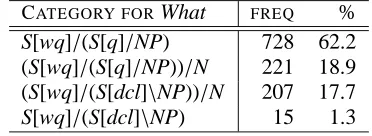
CATEGORY FORWhat FREQ %
S[wq]/(S[q]/NP) 728 62.2 (S[wq]/(S[q]/NP))/N 221 18.9 (S[wq]/(S[dcl]\NP))/N 207 17.7 S[wq]/(S[dcl]\NP) 15 1.3
Table 1:Distribution of What categories in questions
mon form of question, and many contain cases of extraction, including some unbounded object ex-traction. A sample of questions from the corpus is given in Figure 5.
The questions were tokenised according to the Penn Treebank convention and automatically POS tagged. Some of the obvious errors made by the tagger were manually corrected. The first author then manually labelled 500 questions with lexi-cal categories. The supertagger was trained on the annotated questions, and used to label the re-maining questions, which were then manually cor-rected. The performance of the supertagger was good enough at this stage to significantly reduce the effort required for annotation. The second author has verified a subset of the annotated sentences. The question corpus took less than a week to create.
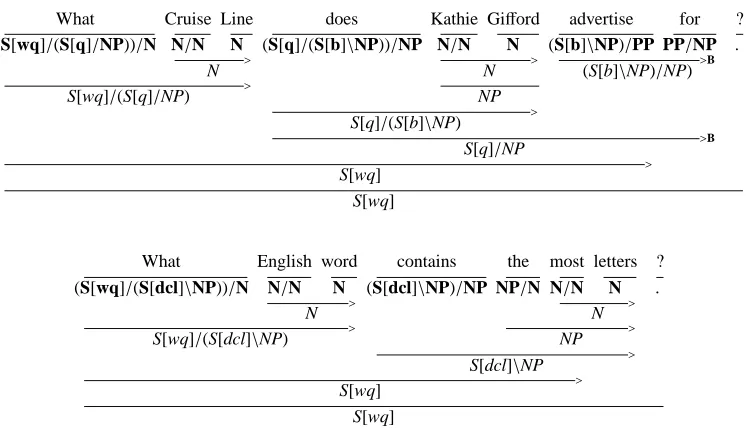
What Cruise Line does Kathie Gifford advertise for ? (S[wq]/(S[q]/NP))/N N/N N (S[q]/(S[b]\NP))/NP N/N N (S[b]\NP)/PP PP/NP .
> > >B
N N (S[b]\NP)/NP)
>
S[wq]/(S[q]/NP) NP
>
S[q]/(S[b]\NP)
>B S[q]/NP
>
S[wq] S[wq]
What English word contains the most letters ? (S[wq]/(S[dcl]\NP))/N N/N N (S[dcl]\NP)/NP NP/N N/N N .
> >
N N
> >
S[wq]/(S[dcl]\NP) NP
>
S[dcl]\NP
>
S[wq] S[wq]
Figure 6: Derivations for example What-questions; lexical categories are in bold
the final row is the root subject question What. For the examples in Figure 5, S[wq]/(S[q]/NP) appears in questions 1–6, (S[wq]/(S[q]/NP))/N in 7–11, (S[wq]/(S[dcl]\NP))/N in 12–13, and S[wq]/(S[dcl]\NP) in 14.
6 Evaluation
A development set was created by randomly select-ing 171 questions. For development purposes the remaining 1,000 questions were used for training; these were also used as a final cross-validation train-ing/test set. The average length of the tokenised questions in the whole corpus is 8.6 tokens.
The lexical category set used by the parser con-tains all categories which occur at least 10 times in CCGbank, giving a set of 409 categories. In creating the question corpus we used a small num-ber of new category types, of which 3 were needed to cover common question constructions. One of these, (S[wq]/(S[dcl]\NP))/N , applies to What, as in the second example in Figure 6. This category does appear in CCGbank, but so infrequently that it is not part of the parser’s lexical category set. Two more apply to question words like did and is; for example, (S[q]/(S[pss]\NP))/NP applies to is in What instrument is Ray Charles best known for playing?, and (S[q]/PP)/NP applies to is in What city in Florida is Sea World in?.
6.1 Supertagger Accuracy
As an initial evaluation we tested the accuracy of just the supertagger on the development data. The supertagger was run in two modes: one in which a single category was assigned to each word, and one in which 1.5 categories were assigned to each
1CAT 1.5CATS
ACCURACY: WORD SENT WORD SENT
MODEL
CCGbank 72.0 2 84.8 11
Qs 92.3 67 96.6 81
Qs+CCGbank 93.1 61 98.1 87
[image:6.595.118.491.66.280.2]10Qs+CCGbank 93.6 67 97.9 83
Table 2:Accuracy of supertagger on dev question data
word, on average. Table 2 gives the per-word accu-racy on the development question data for a num-ber of supertagging models; SENT accuracy gives the percentage of sentences for which every word is assigned the correct category. Four supertagging models were used: one trained on CCGbank only; one trained on the 1,000 questions; one trained on the 1,000 questions plus CCGbank; and one trained on 10 copies of the 1,000 questions plus CCGbank. The supertagger performs well when trained on the question data, and benefits from a combination of the questions and CCGbank. To increase the in-fluence of the questions, we tried adding 10 copies of the question data to CCGbank, but this had little impact on accuracy. However, the supertagger per-forms extremely poorly when trained only on CCG-bank. One reason for the very lowSENT accuracy figure is that many of the questions contain lexical categories which are not in the supertagger’s cate-gory set derived from CCGbank: 56 of the 171 de-velopment questions have this property.
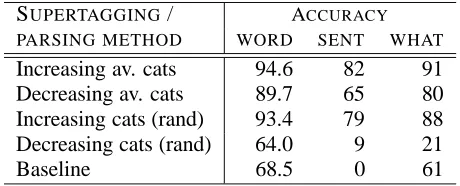
accu-SUPERTAGGING/ ACCURACY
PARSING METHOD WORD SENT WHAT Increasing av. cats 94.6 82 91 Decreasing av. cats 89.7 65 80 Increasing cats (rand) 93.4 79 88 Decreasing cats (rand) 64.0 9 21
Baseline 68.5 0 61
Table 3: Parser category accuracy on dev data
racy of 11% confirms that our parsing system based only on CCGbank is quite inadequate for accurate question parsing.
6.2 Parser Accuracy
Since the gold-standard question data is only la-belled at the lexical category level, we are only able to perform a full evaluation at that level. However, the scores in Clark and Curran (2004b) give an in-dication of how supertagging accuracy corresponds to overall dependency recovery. In addition, in Sec-tion 6.3 we present an evaluaSec-tion on object extrac-tion dependencies in the development data.
We applied the parser to the 171 questions in the development data, using the supertagger model from the third row in Table 2, together with a log-linear parsing model trained on CCGbank. We used the supertagging approach described in Sec-tion 2.1, in which a small number of categories is initially assigned to each word, and the parser re-quests more categories if a spanning analysis can-not be found. We used 4 different values for the parameterβ(which determines the average number of categories per word): 0.5, 0.25, 0.075 and 0.01. The average number of categories at each level for the development data is 1.1, 1.2, 1.6 and 3.8. The parser provided an analysis for all but one of the 171 questions.
The first row of Table 3 gives the per-word, and sentence, category accuracy for the parser output. Figures are also given for the accuracy of the cate-gories assigned to the first word What. The figures show that the parser is more accurate at supertag-ging than the single-category supertagger.
The second row gives the results if the original supertagging approach of Clark et al. (2002) is used, i.e. starting with a high number of categories per word, and reducing the number if the sentence cannot be parsed within reasonable space and time constraints. The third row corresponds to our new supertagging approach, but chooses a derivation at random, by randomly traversing the packed chart representation used by the parser. The fourth row corresponds to the supertagging approach of Clark et al. (2002), together with a random selection of
SUPERTAGGING / ACCURACY
[image:7.595.70.300.71.164.2]PARSING METHOD WORD SENT WHAT Increasing av. cats 94.4 79 92 Decreasing av. cats 89.5 64 81
Table 4: Cross-validation results
the derivation. The baseline method in the fifth row assigns to a word the category most frequently seen with it in the data; for unseen words N is assigned.
The results in Table 3 demonstrate that our new supertagging approach is very effective. The reason is that the parser typically uses the first supertag-ger level, where the average number of categories per word is only 1.1, and the per-word/sentence cat-egory accuracies are 95.5 and 70.8%, repsectively. 136 of the 171 questions (79.5%) are parsed at this level. Since the number of categories per word is very small, the parser has little work to do in com-bining the categories; the supertagger is effectively an almost-parser (Bangalore and Joshi, 1999). Thus the parsing model, which is not tuned for questions, is hardly used by the parser. This interpretation is supported by the high scores for the random method in row 3 of the table.
In contrast, the previous supertagging method of Clark et al. (2002) results in a large derivation space, which must be searched using the parsing model. Thus the accuracy of the parser is greatly reduced, as shown in rows 2 and 4.
As a final test of the robustness of our results, we performed a cross-validation experiment using the 1,000 training questions. The 1,000 questions were randomly split into 10 chunks. Each chunk was used as a test set in a separate run, with the remaining chunks as training data plus CCGbank. Table 4 gives the results averaged over the 10 runs for the two supertagging approaches.
6.3 Object Extraction in Questions
For the object extraction evaluation we considered the 36 questions in the development data which have the category (S[wq]/(S[q]/NP))/N assigned to What. Table 7 gives examples of the questions. We assume these are fairly representative of the kinds of object extraction found in other question types, and thus present a useful test set.
What amount of folic acid should an expectant mother take daily? What movie did Madilyn Kahn star in with Gene Wilder? What continent is Egypt on?
What year was Ebbets Field, home of Brooklyn Dodgers, built? What body of water does the Colorado River empty into?
Figure 7: Examples of object extraction questions
We inspected the output to see if the object de-pendencies had been recovered correctly. To get the object dependency correct in the first question in Ta-ble 7, for example, the parser would need to assign the correct category to take and return amount as the object of take. Of the 37 extracted object dependen-cies (one question had two such dependendependen-cies), 29 (78.4%) were recovered correctly. Given that the original parser trained on CCGbank performs ex-tremely poorly on such questions, we consider this to be a highly promising result.
7 Conclusion
We have presented a detailed evaluation of a CCG parser on object extraction dependencies in WSJ text. Given the difficulty of the task, the accuracy of the parser is encouraging. The errors made by the parser suggest that general improvements in the coverage of the lexicon and parsing models derived from CCGbank will lead to improved recovery of long-range object dependencies.
In contrast, we have suggested that general im-provements in CCGbank parsing models will not lead to satisfactory performance on question pars-ing. The reason is that the Wh-question domain is syntactically distinct from WSJ text. We have presented a novel method for porting the parser to the question domain, which has led to good perfor-mance on question parsing. This has also demon-strated the close integration of the supertagger and theCCGparser on which our method depends.
One of the major drawbacks of currentNLP tech-nology is that in general it performs very poorly outside of the training data domain. Our porting method only requires lexical category data, which is far easier to produce than full parse trees. This is an efficient method for porting the parser to other do-mains. The method may also be applicable to other lexicalised grammar formalisms.
We will extend the question corpus to other ques-tion types. We are also continuing to develop the supertagger, which we have demonstrated is central to efficient portable wide-coverage CCGparsing.
References
Srinivas Bangalore and Aravind Joshi. 1999. Supertag-ging: An approach to almost parsing. Computational Linguistics, 25(2):237–265.
Johan Bos, Stephen Clark, Mark Steedman, James R. Curran, and Julia Hockenmaier. 2004. Wide-coverage semantic representations from a CCG parser. In Proceedings of COLING-04, Geneva, Switzerland. Ted Briscoe and John Carroll. 2002. Robust accurate statistical annotation of general text. In Proceedings of the 3rd LREC Conference, pages 1499–1504, Las Palmas, Gran Canaria.
Eugene Charniak. 2000. A maximum-entropy-inspired parser. In Proceedings of the 1st Meeting of the NAACL, pages 132–139, Seattle, WA.
Stephen Clark and James R. Curran. 2004a. The impor-tance of supertagging for wide-coverage CCG pars-ing. In Proceedings of COLING-04, Geneva, Switzer-land.
Stephen Clark and James R. Curran. 2004b. Parsing the WSJ using CCG and log-linear models. In Pro-ceedings of the 42nd Meeting of the ACL, Barcelona, Spain.
Stephen Clark, Julia Hockenmaier, and Mark Steedman. 2002. Building deep dependency structures with a wide-coverage CCG parser. In Proceedings of the 40th Meeting of the ACL, pages 327–334, Philadel-phia, PA.
Michael Collins. 1999. Head-Driven Statistical Models for Natural Language Parsing. Ph.D. thesis, Univer-sity of Pennsylvania.
Peter Dienes and Amit Dubey. 2003. Deep syntactic processing by combining shallow methods. In Pro-ceedings of the EMNLP Conference, pages 431–438, Sapporo, Japan.
C. Doran, B. Hockey, P. Hopely, J. Rosenzweig, A. Sarkar, B. Srinivas, F. Xia, A. Nasr, and O. Ram-bow. 1997. Maintaining the forest and burning out the underbrush in XTAG. In Proceedings of the EN-VGRAM Workshop, Madrid, Spain.
Julia Hockenmaier and Mark Steedman. 2002. Gen-erative models for statistical parsing with Combina-tory Categorial Grammar. In Proceedings of the 40th Meeting of the ACL, pages 335–342, Philadelphia, PA. Julia Hockenmaier. 2003a. Data and Models for Statis-tical Parsing with Combinatory Categorial Grammar. Ph.D. thesis, University of Edinburgh.
Julia Hockenmaier. 2003b. Parsing with generative models of predicate-argument structure. In Proceed-ings of the 41st Meeting of the ACL, pages 359–366, Sapporo, Japan.
Mark Johnson. 2002. A simple pattern-matching al-gorithm for recovering empty nodes and their an-tecedents. In Proceedings of the 40th Meeting of the ACL, pages 136–143, Philadelphia, PA.
Marius Pasca and Sanda Harabagiu. 2001. High per-formance question/answering. In Proceedings of the ACL SIGIR Conference on Research and Development in Information Retrieval, pages 366–374, New Or-leans LA.
Mark Steedman. 1996. Surface Structure and Interpre-tation. The MIT Press, Cambridge, MA.