Semi-Supervised Semantic Role Labeling
Hagen F ¨urstenau
Dept. of Computational Linguistics Saarland University
Saarbr¨ucken, Germany
Mirella Lapata
School of Informatics University of Edinburgh
Edinburgh, UK [email protected]
Abstract
Large scale annotated corpora are pre-requisite to developing high-performance semantic role labeling systems. Unfor-tunately, such corpora are expensive to produce, limited in size, and may not be representative. Our work aims to reduce the annotation effort involved in creat-ing resources for semantic role labelcreat-ing via semi-supervised learning. Our algo-rithm augments a small number of man-ually labeled instances with unlabeled ex-amples whose roles are inferred automat-ically via annotation projection. We for-mulate the projection task as a generaliza-tion of the linear assignment problem. We seek to find a role assignment in the un-labeled data such that the argument sim-ilarity between the labeled and unlabeled instances is maximized. Experimental re-sults on semantic role labeling show that the automatic annotations produced by our method improve performance over using hand-labeled instances alone.
1 Introduction
Recent years have seen a growing interest in the task of automatically identifying and labeling the semantic roles conveyed by sentential constituents (Gildea and Jurafsky, 2002). This is partly due to its relevance for applications ranging from infor-mation extraction (Surdeanu et al., 2003; Mos-chitti et al., 2003) to question answering (Shen and Lapata, 2007), paraphrase identification (Pad´o and Erk, 2005), and the modeling of textual entailment relations (Tatu and Moldovan, 2005). Resources like FrameNet (Fillmore et al., 2003) and Prop-Bank (Palmer et al., 2005) have also facilitated the development of semantic role labeling methods by providing high-quality annotations for use in
train-ing. Semantic role labelers are commonly devel-oped using a supervised learning paradigm1where a classifier learns to predict role labels based on features extracted from annotated training data.
Examples of the annotations provided in FrameNet are given in (1). Here, the meaning of predicates (usually verbs, nouns, or adjectives) is conveyed byframes, schematic representations of situations. Semantic roles (orframe elements) are defined for each frame and correspond to salient entities present in the situation evoked by the pred-icate (orframe evoking element). Predicates with similar semantics instantiate the same frame and are attested with the same roles. In our exam-ple, the frameCause harmhas three core semantic roles,Agent,Victim, andBody partand can be in-stantiated with verbs such as punch, crush, slap, andinjure. The frame may also be attested with non-core (peripheral) roles that are more generic and often shared across frames (see the roles De-gree,Reason, andMeans, in (1c) and (1d)).
(1) a. [Lee]Agent punched [John]Victim [in the eye]Body part.
b. [A falling rock]Cause crushed [my ankle]Body part.
c. [She]Agent slapped [him]Victim [hard]Degree [for his change of mood]Reason.
d. [Rachel]Agent injured [her friend]Victim [by closing the car door on his left hand]Means.
The English FrameNet (version 1.3) contains 502 frames covering 5,866 lexical entries. It also comes with a set of manually annotated exam-ple sentences, taken mostly from the British Na-tional Corpus. These annotations are often used
1The approaches are too numerous to list; we refer the
as training data for semantic role labeling sys-tems. However, the applicability of these sys-tems is limited to those words for which labeled data exists, and their accuracy is strongly corre-lated with the amount of labeled data available. Despite the substantial annotation effort involved in the creation of FrameNet (spanning approxi-mately twelve years), the number of annotated stances varies greatly across lexical items. For in-stance, FrameNet contains annotations for 2,113 verbs; of these 12.3% have five or less annotated examples. The average number of annotations per verb is 29.2. Labeled data is thus scarce for indi-vidual predicates within FrameNet’s target domain and would presumably be even scarcer across do-mains. The problem is more severe for languages other than English, where training data on the scale of FrameNet is virtually non-existent. Al-though FrameNets are being constructed for Ger-man, Spanish, and Japanese, these resources are substantially smaller than their English counter-part and of limited value for modeling purposes.
One simple solution, albeit expensive and time-consuming, is to manually create more annota-tions. A better alternative may be to begin with an initial small set of labeled examples and aug-ment it with unlabeled data sufficiently similar to the original labeled set. Suppose we have man-ual annotations for sentence (1a). We shall try and find in an unlabeled corpus other sentences that are both structurally and semantically similar. For instance, we may think thatBill will punch me in the face andI punched her hard in the head re-semble our initial sentence and are thus good ex-amples to add to our database. Now, in order to use these new sentences as training data we must somehow infer their semantic roles. We can prob-ably guess that constituents in the same syntactic position must have the same semantic role, espe-cially if they refer to the same concept (e.g., “body parts”) and thus labelin the face andin the head with the role Body part. Analogously, Bill and I would be labeled as Agent and me and her as
Victim.
In this paper we formalize the method sketched above in order to expand a small number of FrameNet-style semantic role annotations with large amounts of unlabeled data. We adopt a learn-ing strategy where annotations are projected from labeled onto unlabeled instances via maximizing a similarity function measuring syntactic and
se-mantic compatibility. We formalize the annotation projection problem as a generalization of the linear assignment problem and solve it efficiently using the simplex algorithm. We evaluate our algorithm by comparing the performance of a semantic role labeler trained on the annotations produced by our method and on a smaller dataset consisting solely of hand-labeled instances. Results in several ex-perimental settings show that the automatic anno-tations, despite being noisy, bring significant per-formance improvements.
2 Related Work
The lack of annotated data presents an obstacle to developing many natural language applications, especially when these are not in English. It is therefore not surprising that previous efforts to re-duce the need for semantic role annotation have focused primarily on non-English languages.
Annotation projection is a popular framework for transferring frame semantic annotations from one language to another by exploiting the transla-tional and structural equivalences present in par-allel corpora. The idea here is to leverage the ex-isting English FrameNet and rely on word or con-stituent alignments to automatically create an an-notated corpus in a new language. Pad´o and Lap-ata (2006) transfer semantic role annotations from English onto German and Johansson and Nugues (2006) from English onto Swedish. A different strategy is presented in Fung and Chen (2004), where English FrameNet entries are mapped to concepts listed in HowNet, an on-line ontology for Chinese, without consulting a parallel corpus. Then, Chinese sentences with predicates instan-tiating these concepts are found in a monolin-gual corpus and their arguments are labeled with FrameNet roles.
probabil-ity model on which future assignments are based. Being unsupervised, their approach requires no manual effort other than creating the frame dic-tionary. Unfortunately, existing resources do not have exhaustive coverage and a large number of verbs may be assigned no semantic role informa-tion since they are not in the dicinforma-tionary in the first place. Pennacchiotti et al. (2008) address precisely this problem by augmenting FrameNet with new lexical units if they are similar to an ex-isting frame (their notion of similarity combines distributional and WordNet-based measures). In a similar vein, Gordon and Swanson (2007) at-tempt to increase the coverage of PropBank. Their approach leverages existing annotations to handle novel verbs. Rather than annotating new sentences that contain novel verbs, they find syntactically similar verbs and use their annotations as surro-gate training data.
Our own work aims to reduce but not entirely eliminate the annotation effort involved in creating training data for semantic role labeling. We thus assume that a small number of manual annotations is initially available. Our algorithm augments these with unlabeled examples whose roles are in-ferred automatically. We apply our method in a monolingual setting, and thus do not project an-notations between languages but within the same language. In contrast to Pennacchiotti et al. (2008) and Gordon and Swanson (2007), we do not aim to handle novel verbs, although this would be a natural extension of our method. Given a verb and a few labeled instances exemplifying its roles, we wish to find more instances of the same verb in an unlabeled corpus so as to improve the per-formance of a hypothetical semantic role labeler without having to annotate more data manually. Although the use of semi-supervised learning is widespread in many natural language tasks, rang-ing from parsrang-ing to word sense disambiguation, its application to FrameNet-style semantic role label-ing is, to our knowledge, novel.
3 Semi-Supervised Learning Method
Our method assumes that we have access to a small seed corpus that has been manually anno-tated. This represents a relatively typical situation where some annotation has taken place but not on a scale that is sufficient for high-performance su-pervised learning. For each sentence in the seed corpus we select a number of similar sentences
Fluidic motion F EE ~ ~ } }} } } }} } } } F luid h k n q t y } P ath | | ~ z feel SUBJ u u kkkkkkkk kkkkkkkk AUX { { vvvvvv vvv DOBJ XCOMP % % K K K K K K K K K K
we can course
SUBJ
y
y
ssssss sssIOBJs
[image:3.595.307.524.73.230.2]MOD ( ( P P P P P P P P P P P P blood DET through DOBJ again the vein DET our
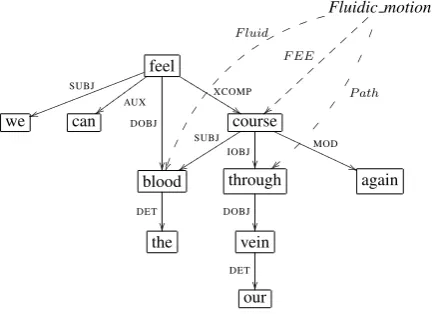
Figure 1: Labeled dependency graph with seman-tic role annotations for the frame evoking ele-ment (FEE)coursein the sentenceWe can feel the blood coursing through our veins again. The frame isFluidic motion, and its roles areFluidandPath. Directed edges (without dashes) represent depen-dency relations between words, edge labels denote types of grammatical relations (e.g.,SUBJ,AUX).
from an unlabeled expansion corpus. These are automatically annotated by projecting relevant se-mantic role information from the labeled sentence. The similarity between two sentences is opera-tionalized by measuring whether their arguments have a similar structure and whether they express related meanings. The seed corpus is then en-larged with thekmost similar unlabeled sentences to form the expanded corpus. In what follows we describe in more detail how we measure similarity and project annotations.
3.1 Extracting Predicate-Argument Structures
Lemma GramRole SemRole
blood SUBJ Fluid
vein IOBJ THROUGH Path
[image:4.595.91.273.61.119.2]again MOD —
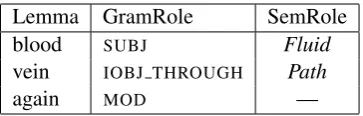
Table 1: Predicate-argument structure for the verb coursein Figure 1.
consider nodes coordinated with the predicate as arguments. Finally, for each argument node we record the semantic roles it carries, if any. All sur-face word forms are lemmatized. An example of the argument structure information we obtain for the predicatecourse(see Figure 1) is shown in Ta-ble 1.
We obtain information about grammatical roles from the output of RASP (Briscoe et al., 2006), a broad-coverage dependency parser. However, there is nothing inherent in our method that re-stricts us to this particular parser. Any other parser with broadly similar dependency output could serve our purposes.
3.2 Measuring Similarity
For each frame evoking verb in the seed corpus our method creates a labeled predicate-argument re-presentation. It also extracts all sentences from the unlabeled corpus containing the same verb. Not all of these sentences will be suitable instances for adding to our training data. For example, the same verb may evoke a different frame with dif-ferent roles and argument structure. We therefore must select sentences which resemble the seed an-notations. Our hypothesis is that verbs appearing in similar syntactic and semantic contexts will be-have similarly in the way they relate to their argu-ments.
Estimating the similarity between two predi-cate argument structures amounts to finding the highest-scoring alignment between them. More formally, given a labeled predicate-argument structure pl with m arguments and an unla-beled predicate-argument structure pu with n ar-guments, we consider (and score) all possible alignments between these arguments. A (partial) alignment can be viewed as an injective function
σ:Mσ → {1, . . . , n} where Mσ ⊂ {1, . . . , m}. In other words, an argumentiofpl is aligned to argumentσ(i) ofpu ifi∈Mσ. Note that this al-lows for unaligned arguments on both sides.
We score each alignment σ using a similarity
function sim(σ)defined as:
X
i∈Mσ
A·syn(gli, gσu(i)) +sem(wil, wuσ(i))−B
where syn(gil, guσ(i))denotes the syntactic
similar-ity between grammatical roles gl
i and guσ(i) and
sem(wil, wσu(i)) the semantic similarity between head wordswliandwσu(i).
Our goal is to find an alignment such that the similarity function is maximized:
σ∗:= arg max
σ
sim(σ). This optimization
problem is a generalized version of the linear assignment problem (Dantzig, 1963). It can be straightforwardly expressed as a linear program-ming problem by associating each alignment σ
with a set of binary indicator variablesxij:
xij :=
1 ifi∈Mσ∧σ(i) =j
0 otherwise
The similarity objective function then becomes:
m
X
i=1
n
X
j=1
A·syn(gil, guj) + sem(wil, wuj)−Bxij
subject to the following constraints ensuring thatσ
is an injective function on someMσ:
n
X
j=1
xij ≤1 for alli= 1, . . . , m
m
X
i=1
xij ≤1 for allj= 1, . . . , n
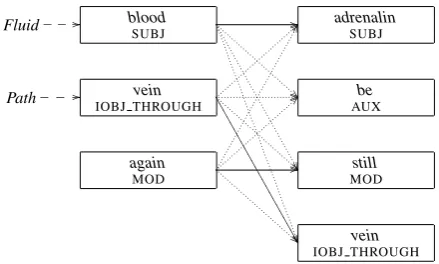
Figure 2 graphically illustrates the alignment projection problem. Here, we wish to project semantic role information from the seed blood coursing through our veins again onto the un-labeled sentence Adrenalin was still coursing through her veins. The predicatecoursehas three arguments in the labeled sentence and four in the unlabeled sentence (represented as rectangles in the figure). There are 73 possible alignments in this example. In general, for any m andn argu-ments, wherem ≤ n, the number of alignments isPm
k=0 (m−km)!(!nn!−k)!k!. Each alignment is scored
left unaligned (see the non-dotted edges in Fig-ure 2). Note that onlyveinandbloodcarry seman-tic roles (i.e.,FluidandPath) which are projected ontoadrenalinandvein, respectively.
Finding the best alignment crucially depends on estimating the syntactic and semantic similar-ity between arguments. We define the syntactic measure on the grammatical relations produced by RASP. Specifically, we set syn(gil, gσu(i)) to 1 if the relations are identical, toa≤1 if the rela-tions are of the same type but different subtype2 and to 0 otherwise. To avoid systematic errors, syntactic similarity is also set to0if the predicates differ in voice. We measure the semantic similar-ity sem(wli, wuσ(i)) with a semantic space model. The meaning of each word is represented by a vec-tor of its co-occurrences with neighboring words. The cosine of the angle of the vectors represent-ingwlandwuquantifies their similarity (Section 4 describes the specific model we used in our exper-iments in more detail).
The parameter A counterbalances the impor-tance of syntactic and semantic information, while the parameterB can be interpreted as the lowest similarity value for which an alignment between two arguments is possible. An optimal align-ment σ∗ cannot link arguments i0 of pl and j0
of pu, if A·syn(gi0l , guj0) +sem(wli0, wuj0)< B
(i.e., either i0 ∈/ Mσ∗ or σ∗(i0)6=j0). This
is because for an alignment σ with σ(i0) = j0
we can construct a better alignment σ0, which is
identical to σ on all i 6= i0, but leaves i0
un-aligned (i.e., i0 ∈/Mσ0). By eliminating a neg-ative term from the scoring function, it follows that sim(σ0)>sim(σ). Therefore, an alignmentσ
satisfyingσ(i0) =j0 cannot be optimal and
con-versely the optimal alignment σ∗ can never link two arguments with each other if the sum of their weighted syntactic and semantic similarity scores is belowB.
3.3 Projecting Annotations
Once we obtain the best alignmentσ∗betweenpl
and pu, we can simply transfer the role of each role-bearing argumentiofpl to the aligned argu-mentσ∗(i)ofpu, resulting in a labeling ofpu.
To increase the accuracy of our method we dis-card projections if they fail to transfer all roles of the labeled to the unlabeled dependency graph.
2This concerns fine-grained distinctions made by the
parser, e.g., the underlying grammatical roles in passive con-structions.
Fluid___// blood
SUBJ //
!
!
adrenalin SUBJ
Path_ _ _// IOBJ THROUGHvein
=
=
/
/
!
!
11 11 11 11 11 11 11 11 11 11 11
1 be
AUX
again MOD
F
F
=
=
/
/
!
!
still MOD
[image:5.595.308.528.64.196.2]vein IOBJ THROUGH
Figure 2: Alignments between the argument structures representing the clausesblood coursing through our veins again and Adrenalin was still coursing through her veins; non-dotted lines illus-trate the highest scoring alignment.
This can either be the case ifpldoes not cover all roles annotated on the graph (i.e., there are role-bearing nodes which we do not recognize as argu-ments of the frame evoking verb) or if there are unaligned role-bearing arguments (i.e., i /∈ Mσ∗
for a role-bearing argumentiofpl).
The remaining projections form our expan-sion corpus. For each seed instance we select thekmost similar neighbors to add to our training data. The parameterk controls the trade-off be-tween annotation confidence and expansion size.
4 Experimental Setup
In this section we discuss our experimental setup for assessing the usefulness of the method pre-sented above. We give details on our training pro-cedure and parameter estimation, describe the se-mantic labeler we used in our experiments and ex-plain how its output was evaluated.
Corpora Our seed corpus was taken from
The seed and unlabeled corpora were parsed with RASP (Briscoe et al., 2006). The FrameNet annotations in the seed corpus were converted into dependency graphs (see Figure 1) using the method described in F¨urstenau (2008). Briefly, the method works by matching nodes in the de-pendency graph with role bearing substrings in FrameNet. It first finds the node in the graph which most closely matches the frame evoking element in FrameNet. Next, individual graph nodes are compared against labeled substrings in FrameNet to transfer all roles onto their closest matching graph nodes.
Parameter Estimation The similarity function described in Section 3.2 has three free parameters. These are the weightAwhich determines the rel-ative importance of syntactic and semantic infor-mation, the parameterB which determines when two arguments cannot be aligned and the syntactic scoreafor almost identical grammatical roles. We optimized these parameters on the development set using Powell’s direction set method (Brent, 1973) withF1 as our loss function. The optimal
values forA, B andawere1.76, 0.41and0.67, respectively.
Our similarity function is further parametrized in using a semantic space model to compute the similarity between two words. Considerable lat-itude is allowed in specifying the parameters of vector-based models. These involve the defi-nition of the linguistic context over which co-occurrences are collected, the number of com-ponents used (e.g., the k most frequent words in a corpus), and their values (e.g., as raw co-occurrence frequencies or ratios of probabilities).
We created a vector-based model from a lem-matized version of the BNC. Following previ-ous work (Bullinaria and Levy, 2007), we opti-mized the parameters of our model on a word-based semantic similarity task. The task involves examining the degree of linear relationship be-tween the human judgments for two individual words and vector-based similarity values. We ex-perimented with a variety of dimensions (ranging from 50 to 500,000), vector component definitions (e.g., pointwise mutual information or log likeli-hood ratio) and similarity measures (e.g., cosine or confusion probability). We used WordSim353, a benchmark dataset (Finkelstein et al., 2002), con-sisting of relatedness judgments (on a scale of 0 to 10) for 353 word pairs.
We obtained best results with a model using a context window of five words on either side of the target word, the cosine measure, and 2,000 vec-tor dimensions. The latter were the most com-mon context words (excluding a stop list of func-tion words). Their values were set to the ratio of the probability of the context word given the tar-get word to the probability of the context word overall. This configuration gave high correlations with the WordSim353 similarity judgments using the cosine measure.
Solving the Linear Program A variety of algo-rithms have been developed for solving the linear assignment problem efficiently. In our study, we used the simplex algorithm (Dantzig, 1963). We generate and solve an LP of every unlabeled sen-tence we wish to annotate.
Semantic role labeler We evaluated our method on a semantic role labeling task. Specifically, we compared the performance of a generic seman-tic role labeler trained on the seed corpus and a larger corpus expanded with annotations pro-duced by our method. Our semantic role labeler followed closely the implementation of Johans-son and Nugues (2008). We extracted features from dependency parses corresponding to those routinely used in the semantic role labeling liter-ature (see Baker et al. (2007) for an overview). SVM classifiers were trained to identify the argu-ments and label them with appropriate roles. For the latter we performed multi-class classification following the one-versus-one method3(Friedman, 1996). For the experiments reported in this paper we used the LIBLINEARlibrary (Fan et al., 2008). The misclassification penaltyCwas set to0.1.
To evaluate against the test set, we linearized the resulting dependency graphs in order to obtain labeled role bracketings like those in example (1) and measured labeled precision, labeled recall and labeledF1. (Since our focus is on role labeling and
not frame prediction, we let our role labeler make use of gold standard frame annotations, i.e., label-ing of frame evoklabel-ing elements with frame names.)
5 Results
The evaluation of our method was motivated by three questions: (1) How do different training set sizes affect semantic role labeling performance?
3Given n classes the one-versus-one method builds
TrainSet Size Prec (%) Rec (%) F1(%)
0-NN 849 35.5 42.0 38.5
1-NN 1205 36.4 43.3 39.5
[image:7.595.70.294.63.176.2]2-NN 1549 38.1 44.1 40.9∗ 3-NN 1883 37.9 43.7 40.6∗ 4-NN 2204 38.0 43.9 40.7∗ 5-NN 2514 37.4 43.9 40.4∗ self train 1609 34.0 41.0 37.1
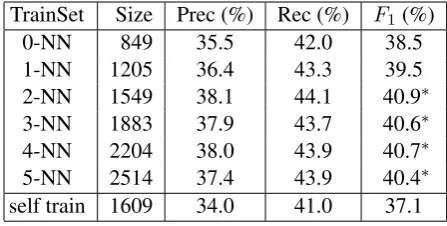
Table 2: Semantic role labeling performance using different amounts of training data; the seeds are expanded with theirknearest neighbors; ∗: F1is
significantly different from 0-NN (p <0.05).
Training size varies depending on the number of unlabeled sentences added to the seed corpus. The quality of these sentences also varies depending on their similarity to the seed sentences. So, we would like to assess whether there is a trade-off between annotation quality and training size. (2) How does the size of the seed corpus influence role labeling performance? Here, we are interested to find out what is the least amount of manual annotation possible for our method to have some positive impact. (3) And finally, what are the an-notation savings our method brings?
Table 2 shows the performance of our semantic role labeler when trained on corpora of different sizes. The seed corpus was reduced to at most 10 instances per verb. Each row in the table corre-sponds to adding theknearest neighbors of these instances to the training data. When trained solely on the seed corpus the semantic role labeler yields a (labeled)F1 of 38.5%, (labeled) recall is 42.0%
and (labeled) precision is 35.5% (see row 0-NN in the table). All subsequent expansions yield improved precision and recall. In all cases ex-ceptk= 1the improvement is statistically signif-icant (p <0.05). We performed significance test-ing onF1using stratified shuffling (Noreen, 1989),
an instance of assumption-free approximative ran-domization testing. As can be seen, the optimal trade-off between the size of the training corpus and annotation quality is reached with two nearest neighbors. This corresponds roughly to doubling the number of training instances. (Due to the re-strictions mentioned in Section 3.3 a 2-NN expan-sion does not triple the number of instances.)
We also compared our results against a self-training procedure (see last row in Table 2). Here, we randomly selected unlabeled sentences
corre-sponding in number to a 2-NN expansion, labeled them with our role labeler, added them to the train-ing set, and retrained. Self-traintrain-ing resulted in per-formance inferior to the baseline of adding no un-labeled data at all (see the first row in Table 2). Performance decreased even more with the addi-tion of more self-labeled instances. These results indicate that the similarity function is crucial to the success of our method.
An example of the annotations our method pro-duces is given below. Sentence (2a) is the seed. Sentences (2b)–(2e) are its most similar neighbors. The sentences are presented in decreasing order of similarity.
(2) a. [He]Theme stared and came [slowly]Manner[towards me]Goal.
b. [He]Theme had heard the shooting and come [rapidly]Manner [back to-wards the house]Goal.
c. Without answering, [she]Theme left the room and came [slowly]Manner [down the stairs]Goal.
d. [Then]Manner [he]Theme won’t come [to Salisbury]Goal.
e. Does [he]Theme always come round [in the morning]Goal[then]Manner?
As we can see, sentences (2b) and (2c) accu-rately identify the semantic roles of the verbcome evoking the frame Arriving. In (2b) He is la-beled as Theme, rapidly asManner, and towards the house as Goal. Analogously, in (2c) she is theTheme,slowly isManner anddown the stairs isGoal. The quality of the annotations decreases with less similar instances. In (2d)thenis marked erroneously as Manner, whereas in (2e) only the
Themerole is identified correctly.
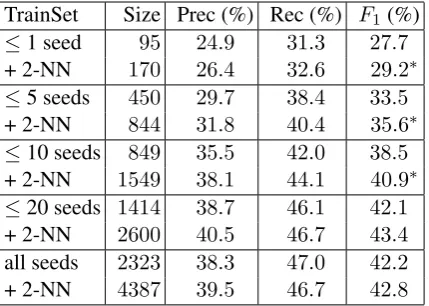
To answer our second question, we varied the size of the training corpus by varying the num-ber of seeds per verb. For these experiments we fixedk= 2. Table 3 shows the performance of the semantic role labeler when the seed corpus has one annotation per verb, five annotations per verb, and so on. (The results for 10 annotations are repeated from Table 2). With 1, 5 or 10 instances per verb our method significantly improves labeling perfor-mance. We observe improvements inF1 of 1.5%,
TrainSet Size Prec (%) Rec (%) F1 (%) ≤1 seed 95 24.9 31.3 27.7
+ 2-NN 170 26.4 32.6 29.2∗ ≤5 seeds 450 29.7 38.4 33.5
+ 2-NN 844 31.8 40.4 35.6∗ ≤10 seeds 849 35.5 42.0 38.5
+ 2-NN 1549 38.1 44.1 40.9∗ ≤20 seeds 1414 38.7 46.1 42.1
+ 2-NN 2600 40.5 46.7 43.4
all seeds 2323 38.3 47.0 42.2
[image:8.595.75.290.62.215.2]+ 2-NN 4387 39.5 46.7 42.8
Table 3: Semantic role labeling performance us-ing different numbers of seed instances per verb in the training corpus; the seeds are expanded with their k = 2 nearest neighbors; ∗: F1 is
signifi-cantly different from seed corpus (p <0.05).
corpus or all available seeds are used, however the difference is not statistically significant.
The results in Table 3 also allow us to draw some conclusions regarding the relative quality of manual and automatic annotation. Expand-ing a seed corpus with 10 instances per verb im-proves F1 from 38.5% to 40.9%. We can
com-pare this to the labeler’s performance when trained solely on the 20 seeds corpus (without any ex-pansion). The latter has approximately the same size as the expanded 10 seeds corpus. Interest-ingly,F1 on this exclusively hand-annotated
pus is only 1.2% better than on the expanded cor-pus. So, using our expansion method on a 10 seeds corpus performs almost as well as using twice as many manual annotations. Even in the case of the 5 seeds corpus, where there is limited informa-tion for our method to expand from, we achieve an improvement from 33.5% to 35.6%, compared to 38.5% for manual annotation of about the same number of instances. In sum, while additional manual annotation is naturally more effective for improving the quality of the training data, we can achieve substantial proportions of these improve-ments by automatic expansion alone. This is a promising result suggesting that it is possible to reduce annotation costs without drastically sacri-ficing quality.
6 Conclusions
This paper presents a novel method for reducing the annotation effort involved in creating resources for semantic role labeling. Our strategy is to
ex-pand a manually annotated corpus by projecting semantic role information from labeled onto un-labeled instances. We formulate the projection problem as an instance of the linear assignment problem. We seek to find role assignments that maximize the similarity between labeled and un-labeled instances. Similarity is measured in terms of structural and semantic compatibility between argument structures.
Our method improves semantic role labeling performance in several experimental conditions. It is especially effective when a small number of an-notations is available for each verb. This is typi-cally the case when creating frame semantic cor-pora for new languages or new domains. Our ex-periments show that expanding such corpora with our method can yield almost the same relative im-provement as using exclusively manual annota-tion.
In the future we plan to extend our method in order to handle novel verbs that are not at-tested in the seed corpus. Another direction con-cerns the systematic modeling of diathesis alter-nations (Levin, 1993). These are currently only captured implicitly by our method (when the se-mantic similarity overrides syntactic dissimilar-ity). Ideally, we would like to be able to system-atically identify changes in the realization of the argument structure of a given predicate. Although our study focused solely on FrameNet annotations, we believe it can be adapted to related annotation schemes, such as PropBank. An interesting ques-tion is whether the improvements obtained by our method carry over to other role labeling frame-works.
Acknowledgments The authors acknowledge
the support of DFG (IRTG 715) and EPSRC (grant GR/T04540/01). We are grateful to Richard Johansson for his help with the re-implementation of his semantic role labeler.
References
Collin F. Baker, Michael Ellsworth, and Katrin Erk. 2007. SemEval-2007 Task 19: Frame Semantic Structure Extraction. In Proceedings of the 4th International Workshop on Semantic Evaluations, pages 99–104, Prague, Czech Republic.
Ted Briscoe, John Carroll, and Rebecca Watson. 2006. The Second Release of the RASP System. In Pro-ceedings of the COLING/ACL 2006 Interactive Pre-sentation Sessions, pages 77–80, Sydney, Australia.
J. A. Bullinaria and J. P. Levy. 2007. Extracting semantic representations from word co-occurrence statistics: A computational study. Behavior Re-search Methods, 39:510–526.
George B. Dantzig. 1963. Linear Programming and Extensions. Princeton University Press, Princeton, NJ, USA.
R.-E. Fan, K.-W. Chang, C.-J. Hsieh, X.-R. Wang, and C.-J. Lin. 2008. LIBLINEAR: A library for large linear classification. Journal of Machine Learning Research, 9:1871–1874.
Charles J. Fillmore, Christopher R. Johnson, and Miriam R. L. Petruck. 2003. Background to FrameNet. International Journal of Lexicography, 16:235–250.
Lev Finkelstein, Evgeniy Gabrilovich, Yossi Matias, Ehud Rivlin, Zach Solan, Gadi Wolfman, and Ey-tan Ruppin. 2002. Placing search in context: The concept revisited. ACM Transactions on Informa-tion Systems, 20(1):116–131.
Jerome H. Friedman. 1996. Another approach to poly-chotomous classification. Technical report, Depart-ment of Statistics, Stanford University.
Pascale Fung and Benfeng Chen. 2004. BiFrameNet: Bilingual frame semantics resources construction by cross-lingual induction. In Proceedings of the 20th International Conference on Computational Linguistics, pages 931–935, Geneva, Switzerland.
Hagen F¨urstenau. 2008. Enriching frame semantic re-sources with dependency graphs. InProceedings of the 6th Language Resources and Evaluation Confer-ence, Marrakech, Morocco.
Daniel Gildea and Dan Jurafsky. 2002. Automatic la-beling of semantic roles. Computational Linguis-tics, 28:3:245–288.
Andrew Gordon and Reid Swanson. 2007. General-izing semantic role annotations across syntactically similar verbs. In Proceedings of the 45th Annual Meeting of the Association of Computational Lin-guistics, pages 192–199, Prague, Czech Republic.
Richard Johansson and Pierre Nugues. 2006. A FrameNet-based semantic role labeler for Swedish. In Proceedings of the COLING/ACL 2006 Main Conference Poster Sessions, pages 436–443, Syd-ney, Australia.
Richard Johansson and Pierre Nugues. 2008. The ef-fect of syntactic representation on semantic role la-beling. In Proceedings of the 22nd International Conference on Computational Linguistics, pages 393–400, Manchester, UK.
Beth Levin. 1993. English Verb Classes and Alter-nations: A Preliminary Investigation. University of Chicago Press.
Alessandro Moschitti, Paul Morarescu, and Sanda Harabagiu. 2003. Open-domain information extrac-tion via automatic semantic labeling. In Proceed-ings of FLAIRS 2003, pages 397–401, St. Augustine, FL.
E. Noreen. 1989. Computer-intensive Methods for Testing Hypotheses: An Introduction. John Wiley and Sons Inc.
Sebastian Pad´o and Katrin Erk. 2005. To cause or not to cause: Cross-lingual semantic matching for paraphrase modelling. In Proceedings of the EUROLAN Workshop on Cross-Linguistic Knowl-edge Induction, pages 23–30, Cluj-Napoca, Roma-nia.
Sebastian Pad´o and Mirella Lapata. 2006. Optimal constituent alignment with edge covers for seman-tic projection. In Proceedings of the 21st Interna-tional Conference on ComputaInterna-tional Linguistics and 44th Annual Meeting of the Association for Com-putational Linguistics, pages 1161–1168, Sydney, Australia.
Martha Palmer, Dan Gildea, and Paul Kingsbury. 2005. The Proposition Bank: An annotated corpus of se-mantic roles. Computational Linguistics, 31(1):71– 106.
Marco Pennacchiotti, Diego De Cao, Roberto Basili, Danilo Croce, and Michael Roth. 2008. Automatic induction of FrameNet lexical units. InProceedings of the Conference on Empirical Methods in Natu-ral Language Processing, pages 457–465, Honolulu, Hawaii.
Dan Shen and Mirella Lapata. 2007. Using semantic roles to improve question answering. In Proceed-ings of the joint Conference on Empirical Methods in Natural Language Processing and Conference on Computational Natural Language Learning, pages 12–21, Prague, Czech Republic.
Mihai Surdeanu, Sanda Harabagiu, John Williams, and Paul Aarseth. 2003. Using predicate-argument structures for information extraction. In Proceed-ings of the 41st Annual Meeting of the Association for Computational Linguistics, pages 8–15, Sap-poro, Japan.
Robert S. Swier and Suzanne Stevenson. 2004. Un-supervised semantic role labelling. InProceedings of the Conference on Empirical Methods in Natu-ral Language Processing, pages 95–102. Bacelona, Spain.