Abstract—In this paper, post-buckling behavior of cylindrical tubular struts is estimated by using fuzzy model identification. The developed fuzzy model has been applied to the numerical data obtained from the finite element analysis and fuzzy system parameters are trained by least-squares algorithm. It is known from these results that the fuzzy model is sufficiently accurate to be used in evaluation of post-buckling behavior of cylindrical tubular struts. The obtained load-shortening relation by fuzzy model showed a reasonably good agreement with finite element analysis. In this work the effect of local buckling is neglected.
Keywords—Fuzzy, Finite element, Post-buckling, Tubular member.
I. INTRODUCTION
Information on the inelastic behavior and buckling performance of tubular members is essential for a realistic assessment of strength and risk in offshore structures.
Braced steel frames are used in seismic active area. In this system, energy is also dissipated due to bracing inelastic behavior. In high seismic regions, it is a common practice to allow inelastic deformation in structures under high seismic hazard, in other word the resistance of braced steel frames to earthquake motions relies on the capacity of the bracing members to undergo several cycles of inelastic deformation including stretching in tension and buckling in compression.
A survey of past experimental studies on the inelastic response of diagonal steel braced members subjected to cyclic loading was carried out to collect data for the seismic design of brace members. The data collected have proved that the overall buckling as well as local buckling and rupture, together with connection failure, are the primary modes of brace member failures. Furthermore, the buckling and subsequent deterioration of the conventional buckling is one of the reasons of the complexity of the behavior of these
Manuscript received July 26, 2007.
S.N. Moghadam is MSC in Structural Engineering from K.N.Toosi University of technology, Tehran, Iran (e-mail: [email protected]).
B.Asgarian is Assistant Professor in Structural Engineering, Civil Engineering faculty , K.N.Toosi University of technology, Tehran, Iran (corresponding author to provide phone: +98-21-88779623; fax:+ 98-21-88779476; e-mail: asgarian@ kntu.ac.ir).
A. Raziei is MSC in Earthquake Engineering from K.N.Toosi University of technology, Tehran, Iran (email: [email protected]).
elements. As a whole, it can be concluded from the premiere studies that the cyclic behavior of brace members is complex due to some physical phenomena such as yielding in tension, buckling in compression, post buckling deterioration of compressive load capacity, deterioration of axial stiffness under cyclic loading and the Bauschinger effects. These factors significantly affect the process of formulating the inelastic behavior of steel braces.
In this paper a fuzzy model for simulation of buckling and post buckling responses of tubular struts with different sections is formulated. The new model is capable of simulating the inelastic behavior of the tubular struts. It has also the capability of accounting for overall buckling.
There are different approaches used in column analysis. The simpler approach, known as the eigenvalue approach, attempts to determine the maximum strength of a column in a direct manner without calculating the deflection. In this approach, an ideal or perfect column is assumed to be an ideal manner that the only deflection that occur at low loads are those in the direction of the applied loads, the load does not produce transverse deflection in the case of a concentrically loaded column until the buckling load, or more accurately the bifurcation load, is reached. For a real column it contains imperfections such as an initial out-of-straightness, deflection starts from the initial deflection at the beginning of application of the axial force and there is no bifurcation or sudden change of deflection as load increases. Thus, the buckling strength or the maximum load-carrying capacity of an initially crooked column must be determined by an alternative approach, like finite element analysis, to solve a column problem by tracing its load-shortening behavior throughout the entire range of loading up to ultimate load, including the descending branch of unloading [1].
The objective of this paper is to predict the post-buckling behavior of cylindrical tubular struts under a variety of slenderness ratio by a fuzzy inference system using the finite element analysis results as input-output data pairs. Many artificial intelligence techniques including neural networks and fuzzy inference methods have been successfully applied to a lot of problems, such as estimation of collapse moment for the wall-thinned pipe bends [2], Fuzzy logic-based expert system to predict the results of finite element analysis [3], Structural reliability analysis through fuzzy number approach [4],
Estimation of Post-buckling Behavior of
Cylindrical Tubular Struts Using Fuzzy Model
procedure for the static design of imprecise structures [5], and so forth.
The problem of determining a mathematical model for an unknown system by observing its input-output data pairs is generally referred to as system identification. The fuzzy identification methods have been largely and successfully applied to system identification problems that are used in this work. Fuzzy system parameters are trained by least-squares algorithm which is powerful and well-developed mathematical tools that have been proposed and used in a variety of areas for decades, including adaptive control, signal processing, and statistics. Nowadays they still prove to be essential and indispensable tools for constructing linear mathematical models. The same fundamental concepts can be extended to nonlinear models as well [6].
To train and test the fuzzy model, the post-buckling behavior of tubular struts is provided. These data are obtained by performing finite element analyses for various slenderness ratios.
In this paper the effect of local buckling is neglected. Also the fuzzy model can be used in push-over analysis of braced-frames.
II. POST-BUCKLING BEHAVIOR USING FINITE ELEMENT ANALYSIS
A. Analysis condition
In order to evaluate the post-buckling behavior of cylindrical tubular struts, the non-linear one-dimensional finite element analysis (FEA) is performed. In the analysis, 141 cylindrical tubular members that have slenderness ratio (KL/r) between 20.16 and 160.31 are selected. As an illustration, consider a fixed-ended column with initial imperfection
δ
iand subjected an increasing axial shortening (δx)as shown in Fig. 1. It is [image:2.595.323.510.295.531.2]assumed that the initial imperfection (out-of-straightness at mid-span) is equal to 0.001*L and the maximum of δxis equal to 0.02*L. Cross section area, gyration ratio, and effective length factor of the strut are shown as (A), (r), and (K) respectively.
Fig. 1. Shape and geometries of cylindrical tubular strut.
B. Finite element model
Plastic straight pipe elements allowing for large deformation behavior are used to model the cylindrical tubular members. This element is a uniaxial element with tension-compression, bending, and torsion capabilities. This element has six degree of freedom at each node, translations in the nodal, x, y, and z directions, and rotations about the nodal x, y, and z axes. Fig. 2
depicts the finite element meshes used in the analysis. The consideration of geometrical non-linearity in the finite element analysis is very important for precise determination of post-buckling behavior. Therefore, both geometric and material non-linearity is considered in this analysis.
The input of material behavior is described by a bilinear stress-strain curve. The initial slope of the curve is taken as the elastic modulus (E) of the material. At the yield stress (σy) of
the material, the curve is turned along the second slope defined by the tangent modulus (Et). Yield stress of selected material of
the cylindrical tubular struts is 360MPa, and the elastic modulus, the tangent modulus, and the Poisson ratio
( )
υ are 200GPa, 0.01*E and 0.3, respectively. Fig. 3 shows the stress-strain curve used in the analysis.Fig. 2. Finite element model of cylindrical tubular strut. (a) General shape of model (b) finite element meshes.
Fig. 3. Material behavior.
C. Load-shortening relationship
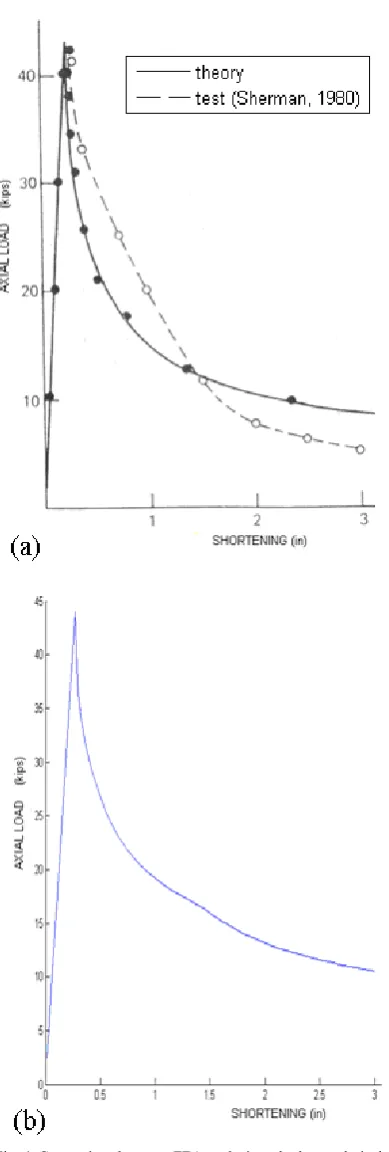
[image:2.595.89.250.580.638.2]Fig. 4. Comparison between FEA analysis and other analytical and experimental results.
(a) Theory and test result (b) FEA result. D = 4.504 (in), t = 0.092 (in), =41.9
y
σ (ksi), L = 225 (in), δi=0.001L, 72 = r KL , 50 = t D
III. FUZZY MODEL IDENTIFICATION
In this work, a fuzzy system that is designed by recursive least squares method is used to predict the post-buckling behavior of cylindrical tubular struts. To develop the fuzzy system, two parameters, namely
r KLand
L
x
δ are considered as
inputs and there is one output, namely
y x A
F
σ .
For the fuzzy system training, a C++ code was written and following steps was performed.
Step 1:
Suppose that 2
2 2
1
1 20.16, 160.31] [ 0.0001, 0.02]
[ R
U= α = β = ×α = β = ⊂ . For [α1,β1] , 141 fuzzy sets were definedA1l1
(
l1=1,2,...,141=N1)
,and for [α2,β2] , 200 fuzzy sets were defined 2
2l
A
(
l2= ,12,...,200=N2)
. Slenderness ratios ( ) r KL waschosen as 1
1
l
x
.r KL x1= ,
L
x =δx
2 , y x A F y σ = T T x x
X1=[ 11,..., 1141] =[20.16,21,22.11,...,159.31,160.31]
T T
x x
X2=[ 21,..., 2200] =[0.0001,0.0002,0.0003,0.0004,...,0.02]
2 ) (
)
(
i i l i i i i x x i lA
x
e
σ
μ
− −
=
,(
i=1,2)
,(
σ1= ,1σ2=0.001)
Step 2:Construct the fuzzy system from the 141×200fuzzy IF-THEN rules:
IF
x
1 is 1 1lA
andx
2 is 2 2lA
, THENy
is l1l2B
Where
l
1=
1
,
2
,...,
141
,l
2=
1
,
2
,...,
200
andB
l1l2 is anyfuzzy set with center at l1l2
y
that is free to change. Specifically,The fuzzy system was chosen with product inference engine, singleton fuzzifier, and center average defuzzifier and Gaussian membership function for fuzzy sets and the designed fuzzy system is:
∑ ∑
∏
∑ ∑
∏
= = = = = = ⎭ ⎬ ⎫ ⎩ ⎨ ⎧ − − ⎭ ⎬ ⎫ ⎩ ⎨ ⎧ − − = 141 1 200 1 2 1 2 141 1 200 1 2 1 2 1 2 1 2 2 1 ] ) ( exp[ ] ) ( exp[ ) (l l i
i l i i
l l i
i l i i l l i i x x x x y x f σ
σ (1)
Where l1l2
y
are free parameters to be designed, and lii
A
weredesigned in step1. Collect the free parameters l1l2
y
into the200
141× dimensional vector:
T y y y y y
y ,..., , ,..., ,..., ,..., ]
[ 1 1 141 1 1 2 141 2 1 200 141 200 =
θ (2)
And rewrite (1) as:
θ
)
(
)
(
x
b
x
f
=
T (3)T x b x b x b x b x b x b x
∑ ∑
= = − − − − − − − −⎪⎭
⎪
⎬
⎫
⎪⎩
⎪
⎨
⎧
×
×
=
141 1 200 1 ) ( ) ( ) ( ) ( 1 2 2 2 2 2 2 2 1 1 1 1 2 2 2 2 2 2 1 1 1 1 2 1 l l x x x x x x x x l l l l l le
e
e
e
b
σ σ σ σ (5) Step 3:Choose the initial parameters
θ
(0)=
0
. Step 4:For
p
=
,1
2
,...
, compute the parametersθ
using the following recursive least squares algorithm:] ) (
[ 0 0 ( 1)
) ( ) 1 ( )
( = − + − p−
p T p p p
p
θ
k y b xθ
θ
(6)1 0 ) 1 ( 0 0 ) 1 ( )
(
=
−(
)[
(
)
−(
)
+
1
]
−p p p T p p
p
P
b
x
b
x
P
b
x
k
(7)) 1 ( 0 1 0 ) 1 ( 0 0 ) 1 ( ) 1 ( )
( = − − − ( )[ ( ) − ( )+1]− ( ) p−
p T p p p T p p p
p P P b x b x P b x b x P
P (8)
Where
θ
(0)is chosen as in step 3, P(0)=σI whereσ
is a large constant, and (x0p,y0p)=(x01p,x02p;y0p) are the input-output pairs that are obtained by FEA [8].IV. APPLICATION TO THE POST-BUCKLING BEHAVIOR
In fuzzy model
x
1,
x
2are the input signals that present theL r
KL,δx respectively and
y
is the output signal that presentsthe
y x
A F
σ . The estimated post-buckling behavior of cylindrical
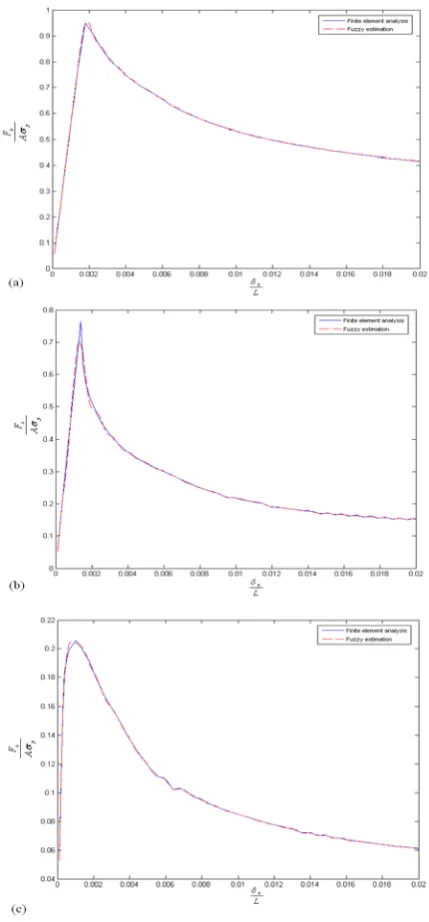
tubular struts by fuzzy model is compared with FEA analyses results in Fig. 5, 6 for different cases. According to the figures the trained model satisfactorily predicts the post-buckling behavior of the cylindrical tubular struts in the case of training data sets or other data sets. The fuzzy model is found to be faster than the FEA and it is interesting to note that CPU time of the fuzzy model does not depend on the element size but in the case of FEA that is very important.”
V. CONCLUSIONS
In this paper, fuzzy model has been used to estimate the post-buckling behavior of cylindrical tubular struts. The developed fuzzy model has been applied to the numerical data obtained using finite element analysis. The fuzzy model were trained using the data set prepared for training (training data) and verified by using another data set (test data) different from the training data. The maximum error of the fuzzy model for the test data is only a little greater than the maximum error for training data. Therefore, if the fuzzy model is trained first by using a number of data including a variety of slenderness ratio, they can accurately estimate the post-buckling behavior for any other slenderness ratio cases. The CPU time of a finite element analysis depends on the parameters, such as element size but the CPU time of the fuzzy model is independent of these parameters. Basically, this method was developed to easily estimate the post-buckling behavior, based on the results of
[image:4.595.323.538.167.629.2]finite element analyses that are assumed to be true but require long computation. More over, future studies are expected that apply genetic algorithms (GA) to optimize fuzzy model of post-buckling behavior and include local buckling effects in the fuzzy model. The results can be used in push-over analysis of braced-frames.
Fig. 5. Comparing FEA results with fuzzy model for training data. (a) =35.07
r
KL . (b)
03 . 72
=
r
KL . (c)
Fig. 6. Comparing FEA results with fuzzy model for test data. (a) =34.62
r
KL . (b)
63 . 85
=
r
KL . (c)
59 . 155
=
r
KL .
REFERENCES
[1] W. F. Chen, D. J. Han, Tubular members in offshore structures, Pitman Advanced Publishing Program.
[2] Man Gyun Na, Jin Weon Kim, In Joon Hwang, Estimation of collapse moment for the wall-thinned pipe bends using fuzzy model identification, Nuclear Engineering and Design, (2006)236:1335-1343.
[3] Amara Venkata Subba Rao, Dilip Kumar Pratihar, Fuzzy logic-based expert system to predict the results of finite element analysis, Knowledge-Based SYSTEMS, (2006).
[4] Marco Savoia, Structural reliability analysis through fuzzy number approach, with application to stability, Computers & Structures, (2002)80:1087-1102.
[5] F. Massa, T. Tison, B. Lallemand, A fuzzy procedure for the static design of imprecise structures, Computer methods in applied mechanics and engineering, (2006)195:925-941.
[6] J. S. R. Jang, C. T. Sun, E. Mizutani, Nero-fuzzy and Soft Computing, Prentice Hall.
[7] Sherman, Post local buckling behavior of tubular strut type beam-columns: an experimental study, report to shell oil company, Houston, Texas, university of Wisconsin-Milwaukee, (1980).